Religion and the INFJ

I’ve often seen INFJs described as an intensely spiritual type. Yet a little while ago, in an online INFJ group, someone posted that most INFJs are atheist or agnostic. Being a type that appreciates truth, someone else set up a poll trying to see if that was really the case.

It’s a small, volunteer sample group, but the results were interesting. 36% identified as atheist, agnostic or non-religious. That’s the same percentage that identified with a Christian religious sect. The remaining 28% identified as “spiritual” or with a non-Christian religion.

click to read article, "Religion and the INFJ" | marissabaker.wordpress.com
image credit: Amanda Jordan via StockSnap

INFJs approach religion much like we approach everything else: with an open, inquisitive mind looking for patterns, especially those relating to people. Our relationship with spirituality largely depends on how we were raised and the direction our lives took from there. But it also depends on our journeys of personal growth, how the religions we encounter line-up with our convictions, and whether or not faith “makes sense” to us.

The Hypocrisy Factor

Many INFJs I’ve seen talking about being non-religious started out in a church of some sort and then left. As with many people who leave churches, hypocrisy is often cited as the reason. INFJs are exceptionally good at detecting deception. We can read people well and pick up on inconsistencies in their patterns of behavior very quickly. At the same time, we want to believe the best of people and it can take a long time for us to admit someone who we value would betray us. Read more

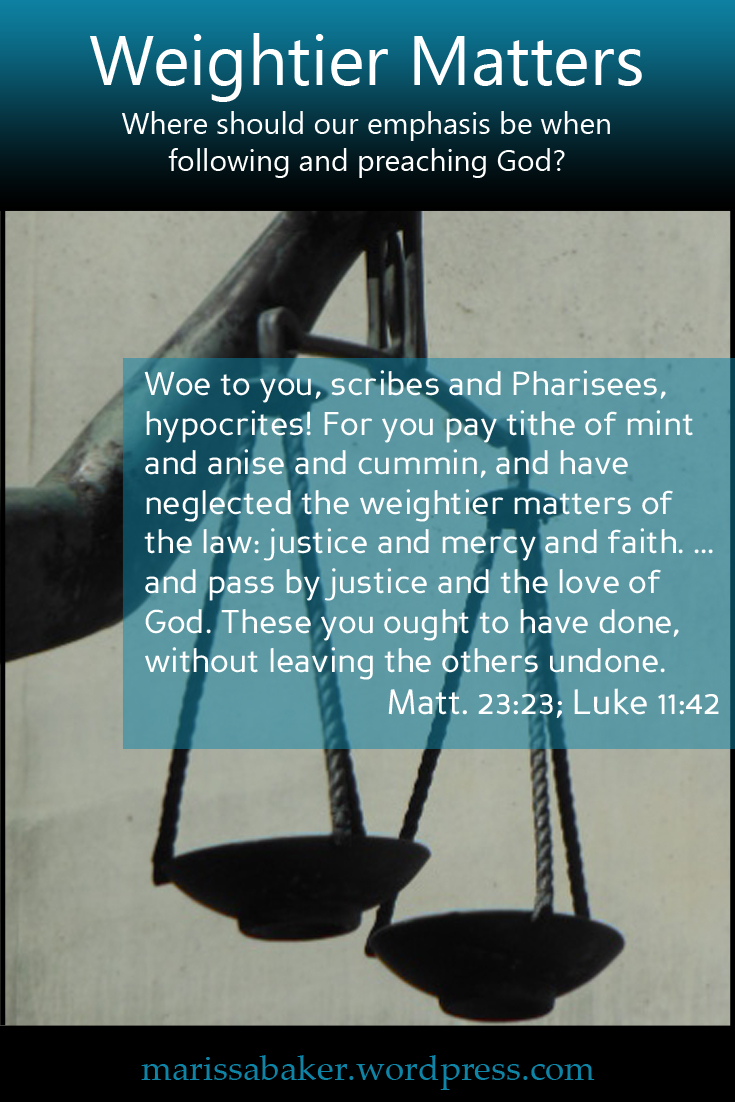
Weightier Matters

The scribes and Pharisees had a lot going for then. They were well-educated, well-respected, and held positions of authority in the community of believers. People thought they were important, and they were. Then this guy Jesus showed up and started condemning them for not following God correctly.

Can you imagine how this looked? Here are these men who’ve been the authority on worship tradition for years confronted by a young carpenter who just appeared out of nowhere. He didn’t even go to a good school! Worse, they know He’s right. But if they admit it, they lose their power.

weighty_matters
photo credit: Michael Coghlan “It Hangs in the Balance,” CC BY-SA

A similar thing can happen in our churches today. When leadership is focused on maintaining church tradition, there’s a danger of developing a Pharisaical attitude. A certain amount of resistance to change is needed to keep from forsaking sound doctrine, but often church tradition isn’t rooted in the Bible at all and if that’s the case it’s fair-game for reexamination. We can also, as the Pharisees did, error in emphasizing certain doctrines to the neglect of others. Read more

The Foundation: Faith Toward God

Here on my blog, we’re going through a study of foundational principles. The writer of Hebrews tells us our goal is to become mature Christians who can handle strong spiritual “meat,” but first, we need to have a foundation in place that’s firmly grounded on Jesus Christ.

Therefore, leaving the discussion of the elementary principles of Christ, let us go on to perfection, not laying again the foundation of repentance from dead works and of faith toward God, of the doctrine of baptisms, of laying on of hands, of resurrection of the dead, and of eternal judgment. And this we will do if God permits. (Heb. 6:1-3)

Without these foundational doctrines, we aren’t able to grow. We need to make sure our foundation is stable, and then we can go on to maturity in Christ. Read more

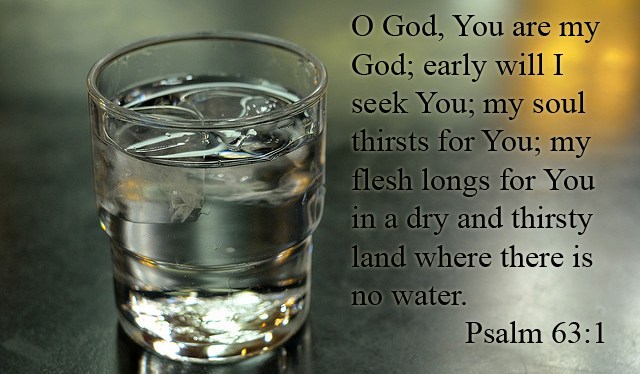
Thirst

I woke up this morning and reached for my water bottle. It wasn’t there, of course, since today is Yom Kippur (Day of Atonement) and we started fasting last night as the sun set. What struck me was how automatic the gesture was — I always have a bottle of water nearby, and grabbing it when I feel thirsty is almost unconscious.

So I asked myself, “Do I long for God the way I crave water when fasting?” Jesus called Himself the “living water.” Just as we need water to survive physically, so we need Him to survive spiritually. And yet somehow, I don’t think we are as attentive about drinking Him in as we are physical water. We should keep Him even closer than I usually keep my water bottle, and turn to Him at every reminder just like we take a drink whenever our throats feel a bit dry.

Thirst | marissabaker.wordpress.com
photo credit: [cipher], CC BY-SA, via Flickr
The Jews consider Yom Kippur the most solemn and holy day of the entire year, and I’m inclined to agree with them. This isn’t to belittle any of the other holy days or the weekly Sabbath, but God does seem to put a special importance on this day. For one thing, it’s the only day when He strictly specifies “you shall do no work at all.” The other holy days are also days of rest, but He uses a different phrase for that: “you shall do no customary work” or “No manner of work shall be done on them; but that which everyone must eat—that only may be prepared by you.”

And the Lord spoke to Moses, saying: “Also the tenth day of this seventh month shall be the Day of Atonement. It shall be a holy convocation for you; you shall afflict your souls, and offer an offering made by fire to the Lord. And you shall do no work on that same day, for it is the Day of Atonement, to make atonement for you before the Lord your God. For any person who is not afflicted in soul on that same day shall be cut off from his people. And any person who does any work on that same day, that person I will destroy from among his people. You shall do no manner of work; it shall be a statute forever throughout your generations in all your dwellings. It shall be to you a sabbath of solemn rest, and you shall afflict your souls; on the ninth day of the month at evening, from evening to evening, you shall celebrate your sabbath.” (Lev. 23:26-32)

On the Day of Atonement, everything stops. We stop eating, we stop drinking, and we stop doing any work. Usually, my morning routine goes like this: pray, feed fish, make breakfast, read a book, Bible study, yoga, then start working. On the Sabbaths, I usually only do the first three and then head off for per-services dance practice. But today, the only thing I have to think about is thirsting after God. I took a minute to feed the aquarium fish, but that’s it. I don’t have to worry about making breakfast or scheduling my day. I can listen to Hillsong music, pray, study, and turn my thoughts into this impromptu blog post.

I wonder if my younger self would have believed she’d learn to look forward to the Day of Atonement. Fasting doesn’t make me terribly ill, but it’s not really easy for me either, and I often thought of it as something we just had to get through before the Feast of Tabernacles. But, God be praised, I’m starting to learn more about how amazing this day is and why He considers it so important.

I pray each of you has a blessed, refreshing Yom Kippur that draws you closer to God.

G'mar Chatimah Tovah -- traditional greeting for this season. Literally," A good final sealing" or idiomatically, "May you be inscribed (in the Book of Life) for Good"
G’mar Chatimah Tovah — traditional Hebrew greeting for this season. Literally,” A good final sealing” or idiomatically, “May you be inscribed (in the Book of Life) for good”

Replacing Worry (Lessons from Zephaniah)

We live in the midst of a dangerous, confusing world, and it’s getting worse as we move ever closer to the time of Christ’s return.

And you will hear of wars and rumors of wars. See that you are not troubled; for all these things must come to pass, but the end is not yet. For nation will rise against nation, and kingdom against kingdom. And there will be famines, pestilences, and earthquakes in various places. All these are the beginning of sorrows. (Matt. 24:6-8)

Our first instinct when things get bad is to worry and panic. This is precisely what we’re told not to do. Easier said than done, though, isn’t it? Worry’s not something you can just turn off — you have to replace it with something else.

No Reason for Fear

Zephaniah prophesied during the reign of King Josiah, so things were going pretty well at the time for the nation of Judah. Even so, he warned about a time much like our own when things would start looking pretty bleak for God’s people. In the midst of these dark prophecies, though, Zephaniah’s book gives great reason for not giving in to fear.

In that day it shall be said to Jerusalem: “Do not fear; Zion, let not your hands be weak. The Lord your God in your midst, the Mighty One, will save; He will rejoice over you with gladness, He will quiet you with His love, He will rejoice over you with singing.”(Zeph. 3:16-17)

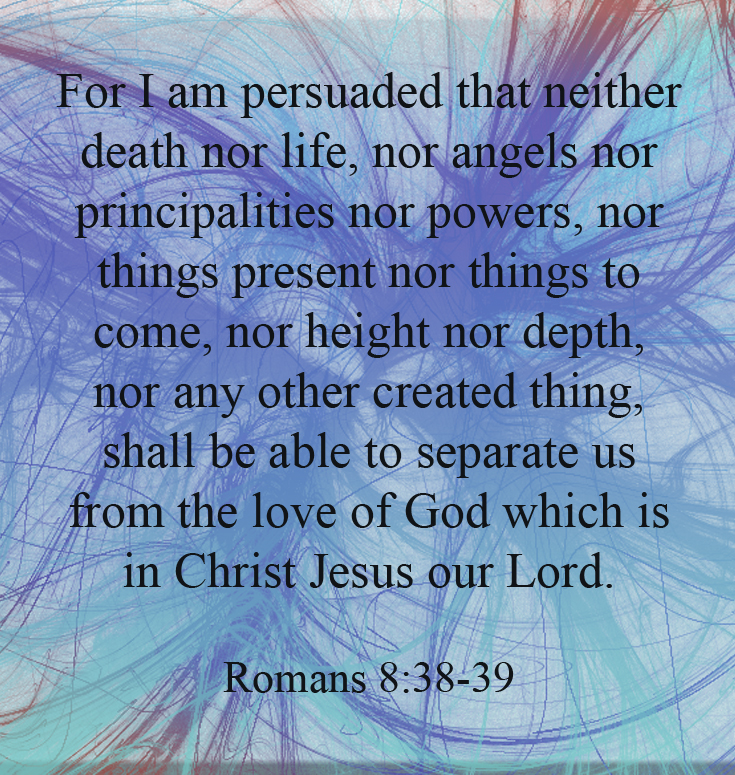
Replacing Worry | marissabaker.wordpress.comGod doesn’t just tell us not to have fear. He gives us assurances designed to make fear impossible. “Fear not” because God Himself is with you to save you. “Fear not” because of His steadfast love, which Paul says nothing can separate us from (Rom. 8:35-39). “Fear not” because the Lord delights in you (Deut. 10:15; Is. 62:4).

He Himself has said, “I will never leave you nor forsake you.” So we may boldly say: “The Lord is my helper; I will not fear. What can man do to me?” (Heb. 13:5-6)

I still struggle with removing fear on a practical level, but abstractly I know fear simply doesn’t make sense for a Christian. The God who created the universe personally guarantees that He won’t abandon you. I always find things I’m scared of less frightening if there’s a good friend beside me, and what better friend could we have to cling to for assurance and stability in times of fear than God Himself?

Live By Faith

We replace worry with faith by consistently turning to God.

Seek the Lord, all you meek of the earth, who have upheld His justice. Seek righteousness, seek humility. It may be that you will be hidden in the day of the Lord’s anger. (Zeph. 2:3)

Seeking after God and consistently following His commands is the best way to get close to Him, which is the best place to be in times of trouble. No matter what happens, our focus must stay on God as we live by faith.

Therefore you also be ready, for the Son of Man is coming at an hour you do not expect. (Matt. 24:44)

Living without fear doesn’t involve burying our heads in the sand and ignoring things that might make us afraid. Rather, it involves a watchful readiness while living in the faith and confidence of our Messiah.

Who then is a faithful and wise servant, whom his master made ruler over his household, to give them food in due season? Blessed is that servant whom his master, when he comes, will find so doing. (Matt. 24:45-46)

Replacing Worry | marissabaker.wordpress.comWhen we stand before Christ at the end of this earth or the end of our lives — whichever comes first — we want to be found “so doing.” Consistent growth and faithfulness will be rewarded.

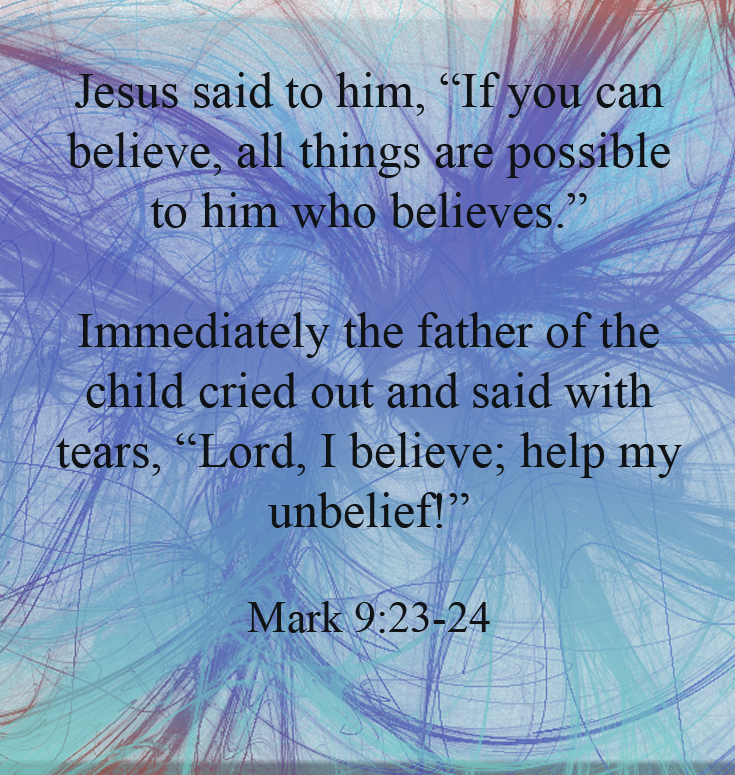
But what if you’re lacking in faith, and still suffering from worry? Ask God for help. He won’t turn down a sincere plea for help, even if it’s help with our unbelief.

 But let him ask in faith, with no doubting, for he who doubts is like a wave of the sea driven and tossed by the wind. For let not that man suppose that he will receive anything from the Lord; he is a double-minded man, unstable in all his ways. (James 1:6-8)

Brethren, let us pray for stability in our walk with God — to be grounded so firmly on the Rock of Jesus Christ that we won’t be tossed about with fear. Wavering and worry go hand-in-hand, and we need God’s help to overcome that and “continue in the faith, grounded and steadfast” (Col. 1:23).

Struggling With Questions For God (Lessons from Habakkuk)

As I study the minor prophets, I’m struck by how relevant their messages are today. Habakkuk wrestled with much the same questions that trouble believers in our own culture.

O Lord, how long shall I cry, and You will not hear? Even cry out to You, “Violence!” and You will not save. Why do You show me iniquity, and cause me to see trouble? For plundering and violence are before me; there is strife, and contention arises. Therefore the law is powerless, and justice never goes forth. For the wicked surround the righteous; therefore perverse judgment proceeds. (Hab. 1:2-4)

Why would God let a country founded on His law get so bad? How can He stomach the violence and corruption and rampant sin? Why isn’t He listening to us?

Struggling With God

The entire short book of Habakkuk is a back-and-forth between God and His prophet. After Habakkuk opened with his familiar questions, God responded. It wasn’t what Habakkuk was hoping for, though.

Look among the nations and watch — be utterly astounded! For I will work a work in your days which you would not believe, though it were told you. For indeed I am raising up the Chaldeans, a bitter and hasty nation which marches through the breadth of the earth, to possess dwelling places that are not theirs. (Hab. 1:5-6)
Habakkuk's Question | marissabaker.wordpress.comHabakkuk was understandably confused. He wanted action from God, but not this. The Chaldeans were a cruel people and God confirmed that their invasion would be “terrible and dreadful” as they “all come for violence” (Hab. 1:7, 9). Did the punishment really have to be so bad?

Are You not from everlasting, O Lord my God, my Holy One? We shall not die. O Lord, You have appointed them for judgment; O Rock, You have marked them for correction. You are of purer eyes than to behold evil, and cannot look on wickedness. Why do You look on those who deal treacherously, and hold Your tongue when the wicked devours a person more righteous than he? (Hab. 1:12-13)

I find it encouraging to read this and other stories where men of God struggled to understand His will. God is not obligated to explain Himself to man, and yet sometimes He does. He isn’t threatened or irritated by sincere, searching questions.

God’s Answer

What follows in chapter 2 answers Habakkuk’s question about why God would use a heathen nation to punish His own people. It is also a general statement about how God responds to wickedness.

Write the vision and make it plain on tablets, that he may run who reads it. For the vision is yet for an appointed time; but at the end it will speak, and it will not lie. Though it tarries, wait for it; because it will surely come, it will not tarry. (Hab. 2:2-3)

God basically starts out by telling Habakkuk to follow His instructions and be patient. Even when we don’t understand, God expects obedience. He doesn’t just leave Habakkuk with the answer, “Because I said so,” though.

Behold the proud, his soul is not upright in him; but the just shall live by his faith. (Hab. 2:4)

The Lord gives Habakkuk a guide we’re still using today, and which Paul quotes twice (Rom. 1:17; Gal. 3:11). “The just shall live by faith,” but that is not how Israel was living. Earlier, Habakkuk asked why God would punish Israel’s sin using a nation that was even more sinful than they. God points out here that no matter what Habakkuk thought about the Chaldeans, Israel’s sin still deserved judgement.

Chapter 2 proclaims “Woe” to people who are drunken, proud and never satisfied (2:5), to the violent (2:8, 17), to the covetous and those who plan to escape God’s wrath by their own strength (2:9-12), to those who scheme and take advantage of others (2:15-16), and to the idolaters (2:18-19). These problems were not limited to Israel or to a specific time, but God could not let His chosen people continue in such sin.

All For Us

Chapter 3 records a prayer that my study Bible notes was intended for singing as a Psalm and isn’t part of the exchange between Habakkuk and God. Given the subject matter, though, I suspect Habakkuk did write it after mulling over his talk with God and the answers he was given.

O Lord, I have heard Your speech and was afraid; O Lord, revive Your work in the midst of the years! In the midst of the years make it known; in wrath remember mercy. (Hab. 3:2)

Though he accepted God’s answer and knew his nation deserved punishment, there was nothing wrong with Habakkuk asking for mercy. We can do that today as well. His mercy is abundant (1 Pet. 1:3), and He has a long history of pardoning iniquity and holding back His wrath if we come to repentance, and of protecting His people in the midst of trouble.

If you have some extra time, click here to read all of Chapter 3. It’s an interesting picture Habakkuk paints of God — one full of power to execute vengeance, as well as one of a God full of glory and worthy of praise, who always acts for the good of His people even if it’s not how they expected.

You marched through the land in indignation; You trampled the nations in anger. You went forth for the salvation of Your people, for salvation with Your Anointed. You struck the head from the house of the wicked, by laying bare from foundation to neck. (Hab. 3:12-13)
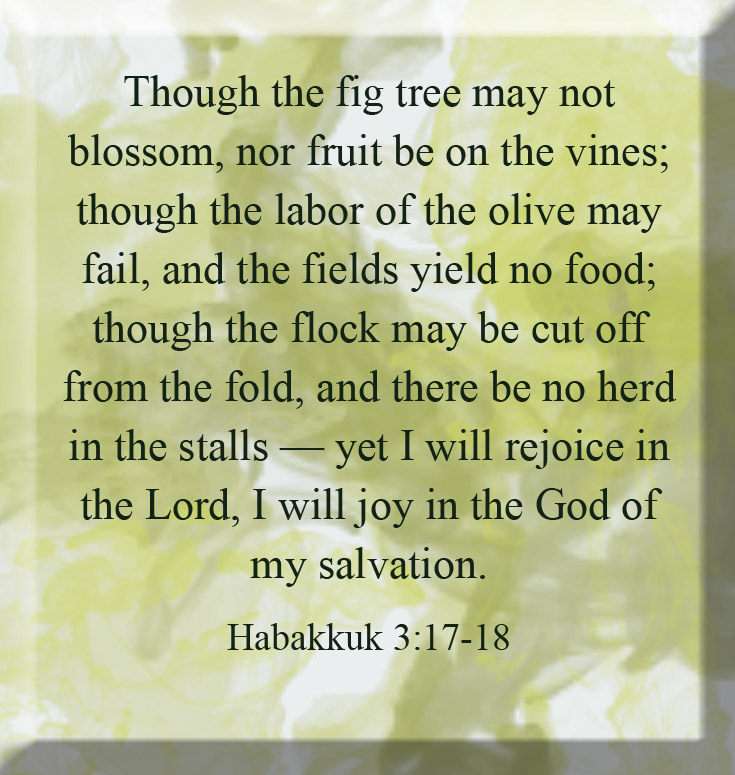
Habakkuk's Question | marissabaker.wordpress.comNo matter how bad it gets, Habakkuk says, “Yet I will rejoice in the Lord, I will joy in the God of my salvation” (Hab. 3:18). We can do the same thing, secure in the knowledge that God is committed to saving us who stay committed to following Him.

The Lord God is my strength; He will make my feet like deer’s feet, and He will make me walk on my high hills. (Hab. 3:19)