Spiritual PTSD

Why did the prophet Elijah flee from Queen Jezebel in the story recorded in 1 Kings18-19? It’s a question I’ve heard asked quite often in sermons, typically with some laughter. Elijah had just faced down all the prophets of Baal, saw God work a mighty miracle, and finally got the people of Israel’s attention. Then he runs for the hills when a woman threatens him. Really? What an appalling lack of faith!

A few weeks ago, my sister asked, “Do you think people can have spiritual PTSD?” For context, the Anxiety and Depression Association of America says that Post Traumatic Stress Disorder (PTSD) “is a serious potentially debilitating condition that can occur in people who have experienced or witnessed” a traumatic event such as “exposure to actual or threatened death, serious injury, or sexual violation.” That could very well be something Elijah was dealing with in this story. And I suspect that since you chose to click on a post with the title “Spiritual PTSD,” you or someone you know might have experienced some kind of trauma as well. Perhaps God’s response to Elijah’s trauma holds hope for us today as well.

Elijah’s Traumatic Day

The first time Elijah steps on the Biblical scene, he tells one of the scariest kings to ever rule Israel, “As Yahweh, the God of Israel, lives, before whom I stand, there shall not be dew nor rain these years, but according to my word” (1 Kings 17:1, WEB). We know nothing of Elijah’s background save that he was a Tishbite from Gilead. What we do know is that God promptly sent him into hiding first by himself and then with a widow’s family (1 Kings 17:2-24).

I don’t know why God hid Elijah. Perhaps God wanted him to learn patience and trust. Or maybe He wanted to keep Elijah safe. Whatever the reason, there’s no indication Elijah was hesitant to come out of hiding when the Lord said, “Go” several years later. First Elijah presents himself to King Ahab, then he calls hundreds of pagan priests to the now famous meeting at Mount Carmel (1 Kings 18:1-20).

We often read this story and focus on God’s awesome work in demonstrating that He alone is God. Today, let’s try to see it from Elijah’s perspective. He came out of hiding to talk with a king who wants him dead. He called 850 priests and prophets of a hostile religion to a meeting and spent a full day taunting them in public. The scripture records “they cried aloud, and cut themselves in their way with knives and lances, until the blood gushed out on them” (1 Kings 18:28, WEB). That couldn’t have been much fun be around. And with so many there, I doubt every evil priest stayed right by the alter. I imagine they also tried to stir up the people and spent time threatening and taunting Elijah as well.
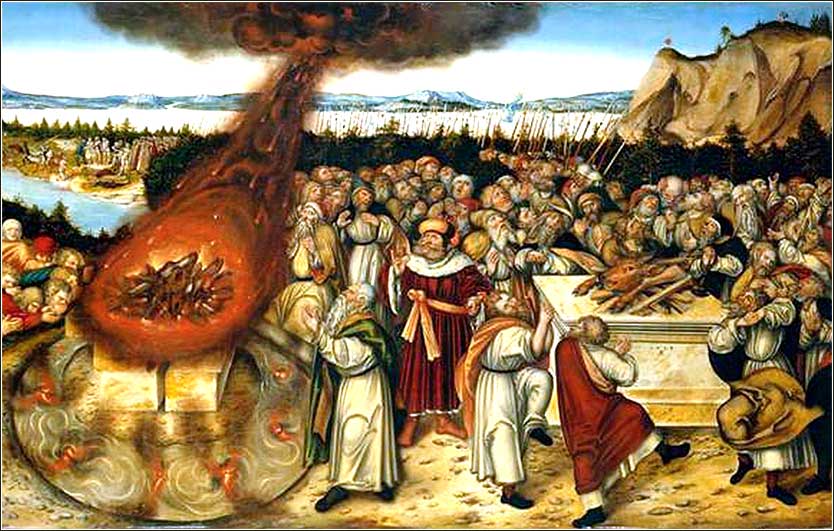
Elijah and the Priests of Baal by Lucas Cranach the Younger, ca. 1545
Image credit: “Elijah and the Priests of Baal” (cs. 1545) by Lucas Cranach the Younger

That went on all morning. In the afternoon, Elijah single handedly prepared a stone altar, butchered a bull, and set it up for an offering to God. I imagine he was physically exhausted by the time he stepped back and ordered the people to pour water over the altar three times (1 Kings 18:21-38). Then he prayed. God responded in spectacular fashion, burning up the water, stones, and dust as well as the sacrifice and wood. The people “fell on their faces” and said “Yahweh, he is God!” But Elijah’s job wasn’t done yet. He said, “Seize the prophets of Baal! Don’t let one of them escape!” They seized them; and Elijah brought them down to the brook Kishon, and killed them there” (1 Kings 18:39-40, WEB).

Elijah killed (probably with some help) at least 450 people that evening, perhaps 850 if “the prophets of the groves” from verse 19 were included with the prophets of Baal. And that still wasn’t the end of his day. He went up to the top of Carmel and prayed earnestly for rain. Once he saw a little cloud forming “he tucked his cloak into his belt and ran before Ahab to the entrance of Jezreel” (1 Kings 18:46, WEB). That’s at least 15 miles and he was running faster than a chariot.

There’s little indication what Elijah’s mental state was at this point. Was he exhausted but still patiently trusting God would work things out? Was he excitedly hopeful Ahab would turn back to God? We don’t know. We just know that when Jezebel promised to kill him within 24 hours “he ran for his life” (1 Kings 19:1-3, WEB). He ran about 100 miles from Jezreel to Bersheba, then goes another day’s journey in the wilderness and prays for death. In his series “Profiting From The Prophets,” Pastor Bob Deffinbaugh suspects Elijah could be “diagnosed as suicidal” and depressed at this point. I’m not a psychologist any more than Pastor Deffinbaugh is, but I’d say PTSD would be an equally valid diagnosis.

God’s Course of Treatment

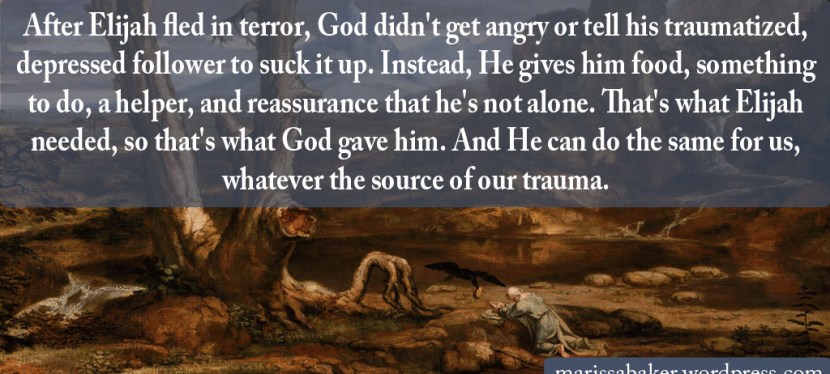
Perhaps the most remarkable thing about this story is how God responds to Elijah’s fear. He doesn’t get angry or tell his traumatized, depressed follower to suck it up. He sends an angel to offer encouragement, food, and strength so Elijah could get to Mount Horeb. There, God asks, “What are you doing here, Elijah?” (1 Kings 19:19:9, WEB). Elijah responds,

“I have been very jealous for Yahweh, the God of Armies; for the children of Israel have forsaken your covenant, thrown down your altars, and killed your prophets with the sword. I, even I only, am left; and they seek my life, to take it away.”

1 Kings 19:10, WEB

I’m not sure why God answered with “a great and strong wind [that] rent the mountains,” then an earthquake, then a fire. The scriptures say “the Lord was not in” these things. Perhaps Elijah refused to come out of his cave when God called the first time. Maybe he needed to see a display of God’s power as an encouragement or reminder. Whatever the case, he responds this time when the Lord calls in “a still small voice” (1 Kings 19:11-13, KJV). The LEB translates this as “the sound of a gentle whisper.”

The Lord asks again, “What are you doing here, Elijah?”  Elijah gives the same answer, probably the only one he could come up with after all that. The Lord responds in three parts: He gives Elijah a mission to anoint two kings, he tells him to anoint Elisha as his replacement, and He reveals there are 7,000 faithful people still in Israel (1 Kings 19:14-18). Food, something to do, a helper, and reassurance that he’s not alone. That’s what Elijah needed and that’s what God gave him.

What About Us?
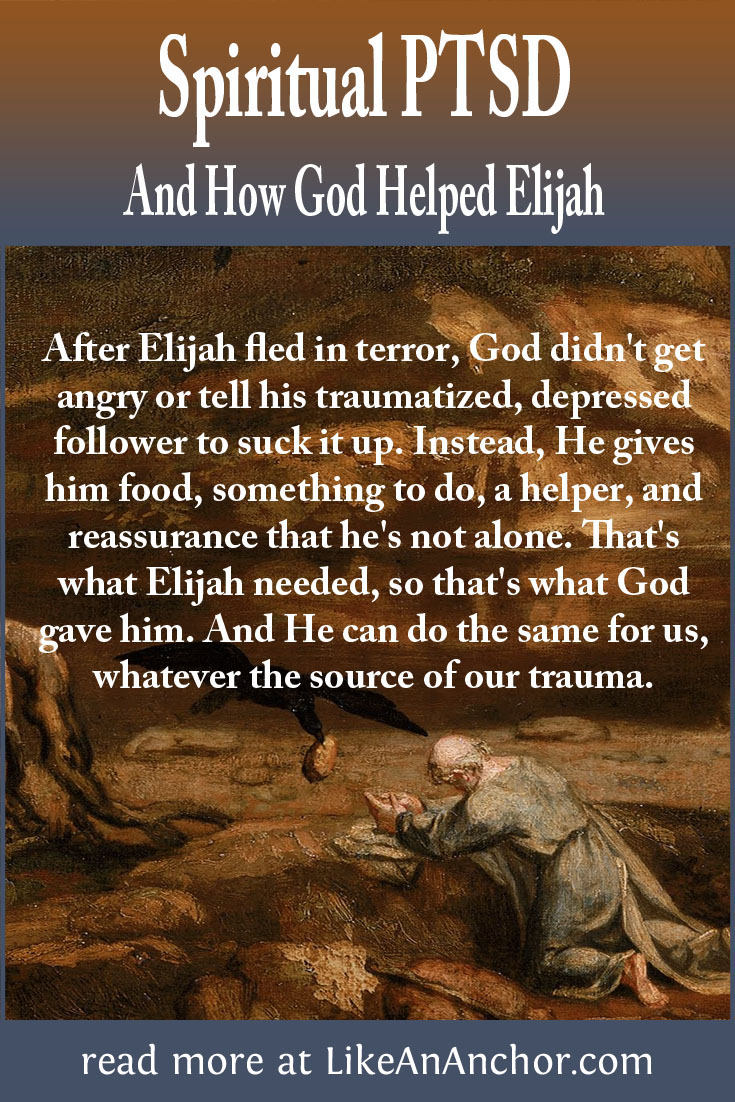
click to read article, "Spiritual PTSD" | LikeAnAnchor.com
Image credit: “Elijah In The Desert” (1818) by Washington Allston

When my sister brought up the idea of spiritual PTSD she wasn’t just talking about people in the Bible who God brought through traumatic situations. She was also asking about a kind of spiritual parallel. Can someone experience a traumatic event in their spiritual walk that gives them a sort of spiritual “PTSD” that affects how they interact with God, churches, and fellow Christians?

I think it can. One of the perks of writing a blog is that I get to hear from many of my fellow Christians who reach out to share their stories. But the heartbreaking thing is that many of those stories are ones that involve deep hurt, much of it caused by fellow church members. We probably all know stories (or have personal stories) of being abused, dismissed, slandered, and much more all by people who claim to be following God. Even worse, the party at fault is often in a leadership position. Far too often, a Christian’s deepest hurts come from the people who should be the first ones to reach out in love and compassion.

But that’s the great thing about God. Nothing limits Him. He can help us just as effectively as He helped Elijah, whatever the source of our trauma. Because we can look at examples like Elijah’s, we know God follows through on promises like, “‘I will in no way leave you, neither will I in any way forsake you.’ So that with good courage we say, ‘The Lord is my helper. I will not fear. What can man do to me?'” (Heb. 13:5-6, WEB).

Save

Walking by Faith (and next e-book announcement)

I just got back yesterday from an incredible  service-themed Young Adult weekend. It didn’t start out all that well for me, though. The day before I left I started feeling nervous (which is normal for me going into social events) but then by the time I left on Friday I had a shaking-crying-hyperventilating panic attack (which is becoming less and less normal/frequent for me).

I was really caught off-guard by this. I knew several people there — not just as acquaintances, but as friends — and I’d been eagerly looking forward to this event for weeks. I chalked it up to my too-active imagination combined with uncertainty about Friday evening’s schedule, breathed deep, prayed, turned Fallout Boy up, and started driving …

… and hit heavy traffic and rain (my two least favorite things to drive in). That left me running 20 late to met the people I was supposed to be car pooling with to the house I didn’t have an address for. Thankfully, one of the people I was meeting is also one of only 2 out of 100+ people at the weekend with my phone number, and he texted me the address. I proceeded to enter said address in my GPS and it took me to a house with no cars in the driveway.

It is either a testament to my stupidity or my faith that I walked up and rang the doorbell. Turns out, my friend accidentally sent me to another church member’s home (whose name I recognized, though I’d never met them) and they fed me cheese, gave me the correct address, and sent me on my way. Oddly, that’s when I felt a sense of peace for the first time all day. I was late, I was temporarily lost and yet God showed me that these worries coming true weren’t anything He couldn’t handle.

Walking by Faith | marissabaker.wordpress.com
photo credit: Dan4th Nicholas, CC BY via Flickr

Saturday brought a great round of seminars and an excellent sermon on foot washing and Passover. Nothing to worry about, until game night happened. I’m sure I’m in the minority judging by how many people said they had a wonderful time, but any sort of game that involves doing something in front of other people or in a group or on a team makes me intensely uncomfortable, especially if you add competition. The first two games were mixers where you asked someone a question and their name. I literally remember nothing from meeting people this way (does it even count as a “meeting” then?). Next was that game where you tie a balloon to your ankle and try to keep it from getting popped while popping everyone else’s balloon. I could have kissed whoever it was that popped my balloon the moment the game started.

That’s the last game I “played” (I stepped on my own balloon when they started round two) and I thoroughly enjoyed the rest of my evening talking with two other people who saw no appeal in participating. Give me a deep conversation with someone over competitive and/or rambunctious games any day. Now that’s how to meet new people. (Side-track back to the topic of social anxiety: game night continued throughout my conversations and there was a Bag of Doom from which they were drawing names to participate in a novelty challenge which you had to do while standing in the center of a room surrounded by 80-something people watching you. Can anyone say “introvert’s worst nightmare”?)

I think one of the biggest lessons I learned this weekend was that my fears were either 1) groundless or 2) didn’t have the power to hold me back. The fact that I had a panic attack before leaving turned into a blessing because it gave me the choice between either canceling my plans or praying through it and trusting God. I chose the later, and I kept encountering situations that could make me feel nervous and which reminded me to stay in prayer all weekend. Every single one of the things I was worried about worked out for the best, and the only part of that I can take credit for is that I took the step to go to the weekend and start a few conversations. The rest was all God.

This brings us in a very round-about way back to the topic of the weekend — service. Specifically, “Unlocking Your Desire To Serve.” As many of you know, I consider this blog a sort of ministry and it’s been growing in ways that amaze me and make me want to do more. One of the big things that holds me back is my own fears, including my fear of panicking when it’s important that I talk with people about my faith. So for me, blending this weekend’s focus on service with a need to rely on God for help working through my anxiety was a powerful experience.

  • If you gave up reading that long rambling post and started scrolling, here’s the e-book announcement:

Something I haven’t shared with many people is that in my local Messianic congregation I’ve been receiving words, prayers, and hints from brethren for the last several months along the lines of “God’s going to do something big in/with your life soon.” I even finally have a hint as to what that might involve after I came back from services a few weeks ago with a title for an e-book in my head which I promptly sat down and outlined. I’ve barely worked on it since, but this weekend was exactly what I needed to reconfirm that God wants me to be sharing my gifts through writing and that He’s more than capable of overcoming deficiencies on my part.

My first step is officially announcing the project here on this blog. The working title is “Rise Up, My Love” and the focus will be on reigniting the church’s passion for God (so, basically this blog in book form). I’m not committing to a release-date quite yet (it would be lovely to have it out by Sukkot/Feast of Tabernacles this fall, but I think a full year might be more realistic judging by how long it took to write The INFJ Handbook). I’ll keep you posted on details.


Replacing Worry (Lessons from Zephaniah)

We live in the midst of a dangerous, confusing world, and it’s getting worse as we move ever closer to the time of Christ’s return.

And you will hear of wars and rumors of wars. See that you are not troubled; for all these things must come to pass, but the end is not yet. For nation will rise against nation, and kingdom against kingdom. And there will be famines, pestilences, and earthquakes in various places. All these are the beginning of sorrows. (Matt. 24:6-8)

Our first instinct when things get bad is to worry and panic. This is precisely what we’re told not to do. Easier said than done, though, isn’t it? Worry’s not something you can just turn off — you have to replace it with something else.

No Reason for Fear

Zephaniah prophesied during the reign of King Josiah, so things were going pretty well at the time for the nation of Judah. Even so, he warned about a time much like our own when things would start looking pretty bleak for God’s people. In the midst of these dark prophecies, though, Zephaniah’s book gives great reason for not giving in to fear.

In that day it shall be said to Jerusalem: “Do not fear; Zion, let not your hands be weak. The Lord your God in your midst, the Mighty One, will save; He will rejoice over you with gladness, He will quiet you with His love, He will rejoice over you with singing.”(Zeph. 3:16-17)

Replacing Worry | marissabaker.wordpress.comGod doesn’t just tell us not to have fear. He gives us assurances designed to make fear impossible. “Fear not” because God Himself is with you to save you. “Fear not” because of His steadfast love, which Paul says nothing can separate us from (Rom. 8:35-39). “Fear not” because the Lord delights in you (Deut. 10:15; Is. 62:4).

He Himself has said, “I will never leave you nor forsake you.” So we may boldly say: “The Lord is my helper; I will not fear. What can man do to me?” (Heb. 13:5-6)

I still struggle with removing fear on a practical level, but abstractly I know fear simply doesn’t make sense for a Christian. The God who created the universe personally guarantees that He won’t abandon you. I always find things I’m scared of less frightening if there’s a good friend beside me, and what better friend could we have to cling to for assurance and stability in times of fear than God Himself?

Live By Faith

We replace worry with faith by consistently turning to God.

Seek the Lord, all you meek of the earth, who have upheld His justice. Seek righteousness, seek humility. It may be that you will be hidden in the day of the Lord’s anger. (Zeph. 2:3)

Seeking after God and consistently following His commands is the best way to get close to Him, which is the best place to be in times of trouble. No matter what happens, our focus must stay on God as we live by faith.

Therefore you also be ready, for the Son of Man is coming at an hour you do not expect. (Matt. 24:44)

Living without fear doesn’t involve burying our heads in the sand and ignoring things that might make us afraid. Rather, it involves a watchful readiness while living in the faith and confidence of our Messiah.

Who then is a faithful and wise servant, whom his master made ruler over his household, to give them food in due season? Blessed is that servant whom his master, when he comes, will find so doing. (Matt. 24:45-46)

Replacing Worry | marissabaker.wordpress.comWhen we stand before Christ at the end of this earth or the end of our lives — whichever comes first — we want to be found “so doing.” Consistent growth and faithfulness will be rewarded.

But what if you’re lacking in faith, and still suffering from worry? Ask God for help. He won’t turn down a sincere plea for help, even if it’s help with our unbelief.

 But let him ask in faith, with no doubting, for he who doubts is like a wave of the sea driven and tossed by the wind. For let not that man suppose that he will receive anything from the Lord; he is a double-minded man, unstable in all his ways. (James 1:6-8)

Brethren, let us pray for stability in our walk with God — to be grounded so firmly on the Rock of Jesus Christ that we won’t be tossed about with fear. Wavering and worry go hand-in-hand, and we need God’s help to overcome that and “continue in the faith, grounded and steadfast” (Col. 1:23).

Five Favorite Proverbs

Five Favorite Proverbs by marissabaker.wordpress.comFor our ladies’ book club next month at church, while people are getting caught-up on finding and reading the next book, we are studying Proverbs. This was inspired by the author of our last book, Liz Curtis Higgs, who is working through a 50 Favorite Proverbs Bible study on her blog. We’re each planning to bring a single Proverb to the group and talk about it. I’ve been preparing for this by reading Proverbs, and I’ve already found many more favorite proverbs than just one. Since I can’t take them all to our book club, I’ve decided to blog about them. I’ve selected five from the first ten chapters of Proverbs to share here.

In other news, my father has started a blog called Baptism For Life. If you like my Christian posts every Saturday, you’ll probably like his writings.

1: Repentance

Turn at my rebuke; surely I will pour out my spirit on you; I will make my words known to you. (Prov. 1:23)

This is wisdom personified and speaking, but I think from the way it is written (and the fact that, as scripture, it is inspired by Him) we can attribute these words to God. It is a promise, and a call to repentance. If we turn when we hear His reproof, instead of ignoring Him, He will pour out His spirit on us and teach us by revelation.

2: Security

But whoever listens to me will dwell safely, and will be secure, without fear of evil.” (Prov. 1:33)

This is a comforting reassurance of God’s protection for those who serve him — both to give them safety and to guard them from anxiety. Psalm 112:7 says, “He will not be afraid of evil tidings; his heart is steadfast, trusting in the Lord.” It is not necessarily that we will be protected from every bad thing, but a promise that God will be there for us through every thing. His peace “will guard your hearts and minds through Christ Jesus” (Phil. 4:7).

3: Fearless

Do not be afraid of sudden terror, nor of trouble from the wicked when it comes; for the Lord will be your confidence, and will keep your foot from being caught. (Prov. 3:25-26)

I’ve always been partial to, and comforted by, the “do not fear verses.” I struggle with fear and anxiety, but it comforts me beyond measure to know that I can turn that fear over to my Protector, who is the most powerful Being in existence. His is our confidence, and no one is able to take us out of His hands (John 10:28-29).

4: Relationship

My son, keep your father’s command, and do not forsake the law of your mother. Bind them continually upon your heart; tie them around your neck. When you roam, they will lead you; when you sleep, they will keep you; and when you awake, they will speak with you. (Prov. 6:20-22)

I love this scripture necklace, and I plan to get one as soon as I can decide what verse I want (anything up to 50 characters). The artist is an Etsy seller.

As Liz Curtix Higgs said when writing about Proverbs 3:3 (which I would list as a favorite, but she covered it thoroughly in her post), we need to keep God’s words close to us. We need to read and study the Bible, continually binding it to our hearts, fall asleep with God’s words in our minds, and wake to let Him talk to us again. We might, as she also suggested, quite literally wear them around our necks.

5: Love

Hatred stirs up strife, but love covers all sins. (Prov. 10:12)

When I read this verse, I wondered why it wasn’t the first thing that came to mind when I thought of favorite Proverbs. The conditions of our heart spill out into our lives, either to stir up strife or to promote peace. When Peter quotes this proverb, he says “above all things have fervent love for one another, for ‘love will cover a multitude of sins'” (1 Pet. 4:8). This, along with 1 Corinthians 13, express how very important love is — “above all things.” We must be on guard that our lives are expressions of love that covers sin and promotes peace, rather than expressions of hatred that leads to discord.

What are some of your favorite Proverbs? Why do those verses speak to you?