Fictional MBTI – Steve Rogers (ISFJ)

This was requested in the comments on Fictional MBTI – Loki, and since I went to see Captain America: The Winter Soldier on Friday it seemed a good time to write a post about Steve Rogers/Captain America. Incidentally, I will reference Winter Soldier in this post but will try to keep it spoiler-free. If you don’t want to know anything about the plot, though, go watch the film and then come back 🙂

In support of typing Steve as an ISFJ, I’ll be citing quotes from Captain America, The Winter Soldier, Gifts Differing* by Isabel Myers, and Was That Really Me?* by Naomi L. Quenk.

  • Disclaimer: links marked with an * are affiliate links. This means that, at no additional cost to you, I will receive a commission if you click on the link and make a purchase on that website.

Introverted Sensing

Isabel Myers describes the Introverted Sensing (Si) types – both ISFJ and ISTJ — as “remarkably dependable … they base their ideas on a deep, solid accumulation of stored impressions, which gives them some almost unshakable ideas” (102). For Steve Rogers, this resulted in the attitude that earned him consideration in Dr. Abraham Erskine’s experiment — “I don’t want to kill anyone. I don’t like bullies; I don’t care where they’re from” (Captain America). The same deeply rooted ideas that form his character also gave Steve the conviction to stand-up to Nick Fury when asked to compromise his values to create a “safe” world — “This isn’t freedom; it’s fear” (Winter Soldier).

In the right person, the traits of Si are perfect for military command. Si types are extremely stable, not entering “into things impulsively” and, “once in, they are very hard to distract, discourage, or stop” (Myers 102). When convinced he is in the right, Captain America is an unstoppable force, whether he is performing a one-man rescue mission in WWII or leading a team against Hydra.

Since Si is an introverted function, there are aspects of their private reactions that ISFJs usually keep to themselves. Only when they feel “off duty” and are around people they trust will they share insights into their unique way of viewing the world. These impressions “may be absurd, irreverent, touching, or hilarious, but never predictable, because their way of sensing life is intensely individual” (Myers 103). Steve tends to joke before going on missions, such as his dialog with Peggy Carter before he parachutes behind enemy lines in Captain America, and that scene from the beginning of Winter Soldier (which is also in the trailer) when he says he doesn’t anything to do on Saturday night because his barbershop quartet is dead.

Extroverted Feeling

Fictional MBTI - Steve Rogers. Captain America is an ISFJ. marissabaker.wordpress.com

Though an auxilary function, Extroverted Feeling (Fe) is the most easily visible aspect of an ISFJ. Heavily informed by dominant Si, this manifests in ISFJs as an emphasis on “loyalty, consideration, and the common welfare” (Myers 104). Myers also says that a well-balanced ISFJ will be very hard working and more practical than a typical introvert. They also “carry responsibility well,” though they do not necessarily enjoy leadership (102).

Fe is a social function, to the point that some introverts who use Fe may be mistaken for extroverts (this explains why you’ll sometimes see Steve typed as an ESFJ). It adapts to situations and strives to act in a way that is acceptable to as many people as possible. An ISTJ probably wouldn’t have agreed to become the “star-spangled man with a plan,” but ISFJ Steve was convinced that was how he could best serve his country. He stuck with that role up until it conflicted with his deeply held Si convictions. In this aspect, ISFJs resemble INFJS, in that both will try to please others for as long as possible without compromising their ideas.

Thinking

Psychologists disagree about whether or not the tertiary function should be described as “introverted” or “extroverted” (so it’s opposite of the auxiliary function), or simply listed by itself. Whichever the case, Jung says that this third function is under conscious control to some degree as it supports the auxiliary function (Quenk 33, 51). For an ISFJ, tertiary thinking helps with clarity in crisis situations, strategy and logic, and suspending feeling to evaluate other people’s actions. We can see this any time Captain America is planning something strategic, as he sorts through sensing data and comes up with a plan.

Extroverted Intuition

Fictional MBTI - Steve Rogers. Captain America is an ISFJ. marissabaker.wordpress.com

All dominant sensing type are uncomfortable with intuition, and highly skeptical of unverified facts. They can’t consciously access their inferior, or shadow, function of Extroverted Intuition (Ne) and are made uneasy by it. In every day life, this comes out as a general sense of worry and a skepticism about new ideas. This can be useful for detecting flaws in new proposals and warning about negative possibilities, which Steve does quite often in The Avengers. For ISFJs to become comfortable with something new and unexpected, they need time alone to process, such as Steve hiding from the world in The Avengers until he feel needed again and has had time to come to terms with his time displacement.

Anger is a typical response for ISFJs, particularly ISFJ men, when stressed. Stress can also cause ISFJs to become more outspoken, “irritable, and pessimistic” (Quenk 220). They are likely to feel a “loss of control over facts and data,” become more impulsive, and focus on worst-case scenarios (Quenk 221).

Stress triggers for inferior Ne include people whose types use intuition as a dominant function (such as Tony Stark/Iron Man), noisy and disorganized environments, unsubstantiated statements from authority figures, “not having sufficient information to do a good job,” and delays in goal achievement (Quenk 219). These last three triggers play a major role in the opening events of Winter Soldier, when Steve becomes angry that Nick Fury didn’t give him all the information about a rescue mission.


If you enjoyed this post, check out my other MCU typings:

Bucky Barns – ESTP

Loki – INFJ

Scott Lang -ISFP

T’Challa – ISFP

Thor – ESTP

Tony Stark – ENTP

Save

Save

Save

Save

Empathic Feeling

I realized Tuesday night when I was reading Fire by Kristin Cashore and crying into the bath water that I wasn’t crying because I felt sad a character had died. I was crying because someone in the book felt sad that this character had died. Once I thought about it, I realized that at least half of the times when fiction moves me to tears, it is in empathy with the characters rather than my own feelings being affected. In other words, I’m crying because the character is crying, not because of what moved the character to tears. Sometimes it is both (Ender’s Game, for example).
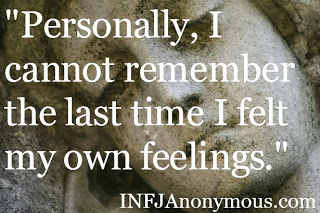
This feeling other people’s feelings (fictional and real) is something I didn’t have much of a grasp on until I discovered my Myers-Briggs type and started reading what other INFJs wrote about being overwhelmed with the emotions of others. Adding high sensitivity to the mix only heightens this (here is a wonderful article about Elaine Aaron’s research on the Highly Sensitive Person).

A Range of Empathy

The extent to which INFJs report feeling other people’s emotions range from an awareness of how others are reacting, to not being able to remember the last time you experienced a feeling that belonged only to you. “You feel it, I feel it,” an anonymous INFJ wrote. I may not be quite ready to claim my feeling of and for others reaches that extent, but I share her decision to try and avoid encountering strong negative emotions (e.g. a news story about child molestation, a film where a family is torn apart, real-life conflict) because of how overwhelming it is — emotionally as well as physically in terms of headaches and stomach pain.

Managing Feelings

In INFJ Coach’s series of blog posts on “10 Steps to an Amazing INFJ Life,” part two is “Manage Those Pesky Emotions.” Her article is mainly about dealing with our own emotions when they surface, but the comments point out that this is only part of the problem. One commenter named Jennie wrote that she asks herself,

“Is this my emotion that I’m feeling, or is it someone else’s emotion?’ Many of us INFJs are emotional sponges for the emotions that other people are feeling. Our NF gives us a very high degree of empathy, but sometimes taking on other people’s emotions can be too much to handle.

The other side to this is what INFJ writer Cheryl Florus points out in Personality Junkie’s INFJ Strategies for Dealing with Emotions: Part I. Because an INFJ’s feeling is extroverted, we often have an easier time understanding the emotions of other people than our own emotions (for more on function stacks, see this post). We feel emotions strongly, but need to make an effort to learn how to experience and express them in a way that doesn’t seem overwhelming or uncontrolled. Often, writing down or talking about our emotions is a way to get them outside us so we can look at them more objectively (I keep a journal and talk to my closest family members). Sometimes, until I’ve done this, I’m not exactly sure what it is I’m feeling, let alone how it should be expressed and dealt with.

What about you? Are you an INFJ with experience feeling other people’s feelings (or a non-INFJ who does the same thing, because I’d love to hear from you)? Or are you someone who has never had this happen and thinks we’re crazy?

Fictional MBTI — Neal Caffrey (ESTP)

Season 4 of White Collar is now on DVD, which means it’s on Netflix, which means I’m finally catching up on episodes. White Collar is probably my favorite crime drama (the only other candidates are NCIS: LA and Castle, and I haven’t liked them as well lately), and I’m fascinated by the characters.

When I first read David Keirsey’s Please Understand Me II chapter on Artisans, I was thinking of Neal Caffrey from White Collar even before Keirsey mentioned that most con-men were extroverted SP types (though of course most SP types [about 30-35% of the population] are not con-men). A hunch like that isn’t enough to type a fictional character, but it’s a good place to start.

Why SP?

Like Loki, typing Neal is complicated by his criminal behavior and possible psychopathy. I have not seen his Myers-Briggs type discussed often, and most of the ones I have seen type him an ENTJ or an ENFP. Since my decision to place him as a sensor instead of intuitive is apparently unpopular, I’d like to address why. While he does go with his “gut feeling” sometimes and rely on intuition, he does not display classic NF qualities like valuing personal authenticity, a focus on lasting emotional connections, and preoccupation with personal journeys. I could almost see him as an NT, but his problem solving abilities seem more focused on real-world results (a Sensing attribute) than on the abstract ideas behind the problems (an Intuitive trait).

The core characteristics Keirsey uses to describe Artisans are these (quoted from his website):

  • Artisans tend to be fun-loving, optimistic, realistic, and focused on the here and now.
  • Artisans pride themselves on being unconventional, bold, and spontaneous.
  • Artisans make playful mates, creative parents, and troubleshooting leaders.
  • Artisans are excitable, trust their impulses, want to make a splash, seek stimulation, prize freedom, and dream of mastering action skills.

Extroverted Sensing

Fictional MBTI: Neal Caffrey -- marissabaker.wordpress.comNow that I’ve narrowed Neal down to one of four types (ESFP, ISFP, ESTP, or ISTP), I want to switch from Keirsey’s approach to cognitive functions (which is too elaborate a subject to go into here. If you want background info, see this article).  I’ve settled on ESTP for Neal, which gives him this function stack:

  • Dominant: Extraverted Sensing (Se)
  • Auxiliary: Introverted Thinking (Ti)
  • Tertiary: Extraverted Feeling (Fe)
  • Inferior: Introverted Intuition (Ni)

Note: For the remainder of this post, I rely heavily on Keirsey’s Portrait of The Promoter, and Dr. A.J. Drenth’s ESTP Personality Profile.

Extroverted Sensing types (ESxPs) are life-of-the-party people. They enjoy presenting themselves well (for example, Neal’s expensive taste in clothing), and are generally seen as charming (that Neal fits this description goes without saying if you’ve watched the show). Se types are easily bored by routine, and actively seek out new sensory experiences (such as fine dining, romance, and [in Neal’s case] running a con). They like to take action, accomplish tasks, and experience the world. Keirsey describes them as a risk-taking type.

Introverted Thinking

Fictional MBTI: Neal Caffrey -- marissabaker.wordpress.comI’ve settled on Introverted Thinking instead of Feeling for Neal’s auxiliary function because of his gift for planning and how serious he becomes when he has to stop and think instead of just being free to act. It is one reason he is such a successful criminal, and why he is so valuable to the FBI. Dr. Drenth phrases it this way:

The fluid nature of their Ti, combined with the keen observational powers of their Se, contributes to ESTPs’ acumen as practical problem solvers. ESTPs can analyze a situation, diagnose the problem, and then determine how to fix it.

You can see examples of Neal’s thinking function in most episodes, as he responds to problems that arise by thinking and planning. Primarily, he approaches problem-solving from a perspective of getting things done efficiently (as opposed to worrying about how each option will affect people involved).

Relationships

Farther down the function stack, and less conciously available, is Extroverted Feeling. The typical ESTP does not like to share their judgments or true feelings. Keirsey says, “While they live in the moment and lend excitement – and unpredictability – to all their relationships, they rarely let anyone get really close to them.” Even when Neal does open up to people and form bonds with them (like his friendship with Peter), he is still able to run off to a tropical island and smoothly settle into a new life (though it only lasted for one episode in the fourth season).

So, what do you think? Does Neal fit the profile of an ESTP? Is there another type you think fits him better (maybe you have an argument for him as an iNtuitive)?

It’s NaNoWriMo Time!

National Novel Writing Month is well underway, and I am happy to report I have not yet fallen behind. The challenge is to write 50,000 words in a single month (which requires 1,667 words per day). I completed NaNoWriMo in 2011 while taking a full class load, working part time, and writing my undergraduate research thesis, so this year can’t be any harder, right?

This year, I very cleverly decided to begin NaNoWriMo by going to a church lock-in over the weekend. I frantically wrote 3,400 words on Friday, and wrote another 1,383 on the drive home before my laptop battery died (and another 1,100 before I went to bed). I was surprised how much I could write after only 3 hours of sleep (maybe 4 if you count the nap in the car).  I’m not going back to re-read for quality until after November is done, but the quantity part I was able to manage.

If you’re interested in the story I’m writing, you can look me up on the NaNo website under the name ‘linnon.am.meleth.vin’, or check out my writing blog under the pseudonym Maris McKay, where I’ve been writing about outlining my NaNo novel and drawing maps for the new fantasy world.

Fictional MBTI — Loki

Update: Click here for a newer post about Loki with a more complete type analysis.

Over the past couple weeks, without even looking for them, I’ve stumbled upon two blogs talking about Myers-Briggs types for fictional characters. One is a Tumbler called MBTI in Fiction. The other is a blog titled A Little Bit of Personality, with a series of posts analyzing heroic archetypes.

I’ve been intrigued by the characters each of these writers choose to type as INFJs. Neither of these writer’s are INFJs themselves (the writer from “MBTI in Fiction” is an ENTJ and the writer of “A Little Bit of Personality” is an ENTP), and it’s interesting to see who non-INFJs think are INFJs. I don’t always agree with them, but it’s interesting.

Loki

Fictional INFJs -- Loki. marissabaker.wordpress.comThis was the first post I saw from MBTI in Fiction. My initial reaction was, “There’s no way Loki and I have the same personality type.” But I agree that he’s an introvert, and I don’t think he’s logical or grounded enough to be either an S or a T type, so that leaves us with INFJ or INFP. (Some people type him as an INTJ Mastermind, but he seems to rely on Extroverted Feeling more than Extroverted Thinking as a function).

Both INFJs and INFPs feel everything very deeply and trust their intuition. However, INFPs tend to keep their emotions to themselves, though feelings will inform all their actions. Outwardly, they appear “receptive and non-judgmental.” INFJs prefer to approach the world through Introverted Intuition (Ni), followed by Extroverted Feeling (Fe). They are the rarest type, often question their sanity,  rely strongly on their intuitions about people, and tend to talk about their feelings. Dr. A.J. Drenth’s profile includes this descriptions, which I think sounds a lot like Loki (as played by Tom Hiddleston in The Avengers):

INFJs are far less serious inwardly than they may appear outwardly. Their inner world is well described as playful, imaginative, colorful, mischievous, and daring. Characterized by Perceiving rather than Judging, it is far less controlled and regulated than that of INFPs. INFJs love playing with ideas, perspectives, theories, images, symbols, and metaphors.

Another reason I’ve been won-over to typing Loki as an INFJ is because of the description of INFJ villains on A Little Bit of Personality’s page. It really does sound like Loki, and the last line hits a little too close to home for me to brush this analysis off as written by someone who just doesn’t understand INFJs.

When turned to villainy, the INFJ is *creepy*! There isn’t really any other word for it. Dark Paladins are the best of manipulators because they are incredibly intuitive about people and can apply their mild-manneredness to going under the radar as long as they need to, manipulating others who would never suspect them. Because they are so good at this and *know* it, pure-hearted INFJ’s often wonder if they are secretly evil and manipulative at heart, like one day they’ll wake up and realize they were bad all along.

Future Posts?

I was planning on covering several characters, but after I started writing Loki I decided one would be enough for a single post. Maybe I’ll write more at some other time, if anyone is interested. Are there any characters you’ve been thinking are INFJs? Would you be interested in me typing non-INFJ characters?

Save