Doing Deeds of Mercy

Mercy is an outward action. We can see this clearly when we think of how God shows mercy to us. He pours out mercy on us though we’ve done nothing to deserve His forgiveness and compassion. Jesus died for us. The Father provides for us. They alleviate the consequences of our sins. Their mercy is active and changes things in the lives of people who come to Them for help and relationship.

What about our mercy? I think sometimes we expect God’s mercy to be active yet think it’s okay for ours to be more passive. We mercifully forgive others on the inside (mostly) and don’t take action against them, so that’s good enough. We feel compassion for those in distress, and that’s a kind of mercy, right? We don’t really have to do any merciful acts to be considered merciful, do we? After all, God’s more concerned with what’s inside us than what we’re actually doing.

While God does look on our hearts, if our hearts are in the right place that should motivate us to take certain actions, including deeds of righteousness and mercy. Belief, repentance, and salvation are only the first steps in our walks with God. We’re to enter covenant with Him and start becoming like him. An integral part of this is learning to be merciful as God is merciful.

Mercy Starts With God

In Greek, the type of mercy we’re discussing is elos (G1656). There are other words for feelings of pity or compassion. Elos involves acting on those feelings. Spiros Zodhiates explains it in contrast to “charis (5485) which is God’s free grace and gift displayed in the forgiveness of sins as offered to men in their guilt. God’s mercy (elos) is extended for the alleviation of the consequences of sin.” Mercy is applied grace. It is passing over deserved punishment. It is reaching out to relieve suffering. It is active loving kindness, corresponding to the Hebrew word chesed which we talked about last week.

But God, being rich in mercy, for his great love with which he loved us, even when we were dead through our trespasses, made us alive together with Christ—by grace you have been saved — and raised us up with him, and made us to sit with him in the heavenly places in Christ Jesus (Eph. 2:4-6, WEB)

God’s mercy prompts Him to take life-changing, life-saving action. We can’t apply mercy at the same level God does, but we need to learn how to be merciful in the same way that He is.

Doing Deeds of Mercy | LikeAnAnchor.com
Photo credit: Jantanee via Lightstock

A Word for Mercy in Action

The word eleemosune (G1654) refers to actions of mercy. It’s the things we do when motivated by elos. The King James Version translated it “alms” and the concept has come to mean charitable giving in much the same way that the Hebrew word for righteousness, tzedakah, is equated with righteous giving. Originally, though, it was not just about giving money although that was definitely included.

This word is used to describe Tabitha’s “acts of mercy” and Cornelius’ “gifts to the needy” that have “gone up for a memorial before God” (Acts 9:36; 10:4, WEB). Also in Acts, Luke records the story of a lame man who sat in the door of the temple each day “to ask gifts for the needy,” or “alms” (Acts 3:2). When Peter saw this he said, “I have no silver or gold, but what I have, that I give you. In the name of Jesus Christ of Nazareth, get up and walk!” (v. 6). Peter didn’t have money but he still gave a gift of mercy.

Another example of mercy in action is found in the parable of the Good Samaritan. You can read it in Luke 10:25-37. A lawyer asked Jesus who qualified as his neighbor for the command “love your neighbor as yourself.” Jesus answered by telling the story of a Jewish man who was left for dead by robbers. A priest and a Levite passed him by, “but a certain Samaritan, as he traveled, came where he was. When he saw him, he was moved with compassion” and helped the man. When Jesus asked this lawyer which of the three who encountered the injured man “‘seemed to be a neighbor to him who fell among the robbers?’ He said, ‘He who showed mercy on him.’ Then Jesus said to him, ‘Go and do likewise.'”

Doing Deeds of Mercy | LikeAnAnchor.com
Photo credit: Shaun Menary via Lightstock

How to do Merciful Deeds

Being recipients of God’s mercy is supposed to motivate us to follow His merciful example. If we don’t, God can withdraw His mercy from us. It’s a scary thought, but that’s what Christ teaches (see Matthew 18:21-35, which I discuss in “Are You Participating in God’s Forgiveness?”).

So speak and so do, as men who are to be judged by a law of freedom. For judgment is without mercy to him who has shown no mercy. Mercy triumphs over judgment. (James 2:12-13, WEB)

Doing Deeds of Mercy | LikeAnAnchor.com
Photo credit: Jantanee via Lightstock

God wants to show mercy and we should too. We should delight in loving kindness, as He does (Jer. 9:24). Twice in Matthew’s gospel, Jesus speaks out against those who don’t understand what it means when God says, “I desire mercy, and not sacrifice” (Matt. 9:13; 12:7). His Jewish audience would have known He was quoting Hosea, where God laments Israel’s unfaithfulness to the covenant (Hos. 6:1-7).

God is not satisfied with obedience only when we feel like giving it or only in the areas we want to surrender to Him. He wants an ongoing, heart-transforming relationship with us as we seek to become more like Him and embrace our Godly identity. And that includes desiring and showing mercy.

The wisdom that is from above is first pure, then peaceful, gentle, reasonable, full of mercy and good fruits, without partiality, and without hypocrisy. Now the fruit of righteousness is sown in peace by those who make peace. (James 3:17-18, WEB)

This is a partial description of how God’s personality, character, and mind work, which means it’s also a list of character traits we should develop as people who follow him. And it includes being “full of mercy.” Let us be wise, godly people who learn to actively show mercy through our actions as well as by having feelings of compassion.


Featured image credit: Who Is Like The LORD via Lightstock

Understanding How the God Who Exercises Loving Kindness, Justice, and Righteousness Brings Us Salvation

“I am Yahweh who exercises loving kindness, justice, and righteousness in the earth, for I delight in these things,” says Yahweh.

I quoted this scripture from Jeremiah 9:24 in last week’s post and I’ve been thinking about it ever since. God defines Himself by using these three concepts and says He delights in them. If they’re that important to Him, then they should be important to us.

I feel like we talk fairly often about the fact that God balances justice/judgement and mercy/loving kindness. But sometime we’re puzzled about how exactly that works. Back in Medieval times, theologians wondered how a God of judgement and justice could also be one of mercy. Now we ask how a God of love and mercy could also be one of judgement. I think taking God’s characteristic righteousness into account — as well as studying the Hebrew word meanings — can help answer those questions.

Shapat, justice

We in the Christian churches today often start with the New Testament when trying to understand a concept. It can be useful, though, to start with the Old Testament because that’s the foundation the New Testament writers built on. In Hebrew, words for justice, judgement, government, and ordinances are all interconnected in the root word shapat (Theological Wordbook of the Old Testament, entry 2443).

We tend to think of judgement/justice as a judicial concept. In Hebrew thought, though, the functions of government were’t divided as we so often do today. The primary meaning “of shapat is to exercise the process of government” in any realm or any form.

When the Bible speaks of God’s judgement or justice it’s also referencing all aspects of His government, not simply judicial laws. To quote TWOT again, “although the ancients knew full well what law … was, they did not think of themselves as ruled by laws rather than by men … The centering of the law, rulership, government in a man was deeply ingrained.” Apply that concept to God, and the notion of justice has to do with Him as the center of true law, rulership, and government. He is the source of real authority and has the absolute right to rule as He chooses.

Read more

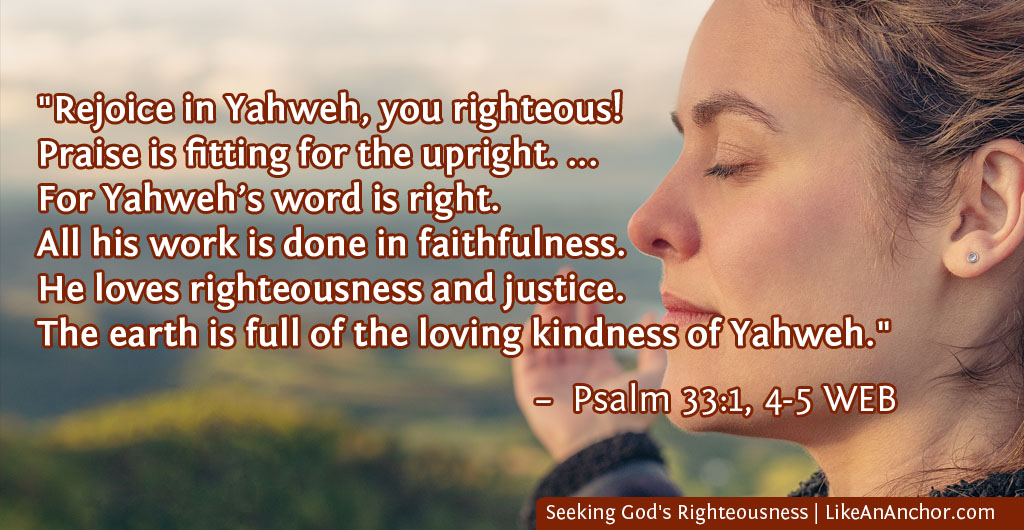
Seeking God’s Righteousness

I’ve been reading a book called Reclaiming Our Forgotten Heritage by Curty Landry and one of his comments about what we’re supposed to “seek first” caught my eye. This book is about how understanding the Jewish roots of Christianity can transform your faith. It’s amazing to me how much we can miss when we read the Bible in English with a Western cultural mindset. And it’s equally amazing how much it can deepen our understanding of God and His ways to dive-in to the roots of our faith.

One of the things Landry talks about is how our interpretation of words and stories in the Bible can change based on whether we approach them through a Western philosophical lens or a first-century Jewish one. An example is how we see the word “righteousness” in Matthew 6:33.

When we read “seek first the kingdom of God and His righteousness,” we in the Western world tend to think this means we have to be righteous in the sense of being a “law-abiding citizen” of heaven. But a Jewish person listening to Jesus would have thought of the Hebrew concept of tzedakah, which changes how you interpret this verse. Let’s take a look at that.

Righteousness in Hebrew

Tzedakah is about justice, righteousness, and truthfulness (Brown, Driver, Briggs lexicon, entry H6666). It’s associated with God’s fairness and is also tied to acts of charity and giving. At my Messianic congregation, this word is written on the box where we put tithes and offerings because tzedakah is so closely connected with righteous giving.

In her article “God’s Kind of Righteousness,” Lois Tverberg points out that “tzedakah means more than just legal correctness – it refers to covenantal faithfulness, often resulting in rescuing those in distress and showing mercy to sinners.” It’s quite a bit different than what most of us think of when we think “righteousness,” but it’s very much in line with God’s character.

From this Jewish perspective, then, one would better read Matthew 6:33 in this way: “Seek first the kingdom and the righteous acts of God – seek first kindness, seek first abundant benevolence, seek first gracious acts and deliverances – and all these other things will then be added to you.” Read in this way, Matthew 6:33 requires a daily walk of faith that still challenges me to this day. (Landry, p. 134).

Seeking God's Righteousness | LikeAnAnchor.com
Photo credit: Pearl via Lightstock

Doing and Believing

It might not sit well with many American Christians that we need to do what is right in addition to believing what is right. Or, depending on exactly what you believe, it might be challenging to know that our obedience has to go beyond legal correctness. But as a deeper look into tzedakah demonstrates, true faith involves ongoing growth and change as we become more and more like God. Nothing we can do will save us — “by grace you have been saved through faith, and that not of yourselves; it is the gift of God” (Eph. 2:8, all scriptures from the WEB translation). But after we’re saved, we do take certain actions in accordance with God’s ways — “faith, if it has no works, is dead in itself” (James 2:17).

He has shown you, O man, what is good. What does Yahweh require of you, but to act justly, to love mercy, and to walk humbly with your God? (Micah 6:8)

Jesus called justice, mercy, and faith “the weightier matters of the law” (Matt. 23:23). These are things which must not be left undone by God’s people. And though righteousness isn’t on this list, it is closely associated with mercy and justice (see Ps. 33;5; 889:14; Is. 16:5; Hos. 2:19). We’re supposed to become like God and since righteousness is part of His character it should be part of ours as well.

Yahweh, Our Righteousness

Our God loves righteousness (Ps. 11:7; 33:5). He even reveals it as one of His names which He puts on His people — Yahweh Tsidqenu, the Lord our Righteousness (Jer. 23:6; 33:16). In the Matthew 6:33 verse we opened with, Jesus doesn’t say “seek to be righteous” or that we should seek righteousness in general. He’s very specific. We are to seek God’s righteousness.

Yahweh says, “Don’t let the wise man glory in his wisdom. Don’t let the mighty man glory in his might. Don’t let the rich man glory in his riches. But let him who glories glory in this, that he has understanding, and knows me, that I am Yahweh who exercises loving kindness, justice, and righteousness in the earth, for I delight in these things,” says Yahweh. (Jer. 9:23-24)

Knowing God involves understanding that He exercises and loves righteousness. If we want to be righteous as He is, we need to come to Him. He will reveal His righteousness when we follow His ways and keep seeking Him, as Jesus told us to in Matthew 6:33 (Is. 54:17; 56:1; 61:10).

Pursue His Righteousness

Seeking God's Righteousness | LikeAnAnchor.com
Photo credit: Anggie via Lightstock

Returning to the idea that righteousness involves more than just law-based obedience, Jesus taught “that unless your righteousness exceeds that of the scribes and Pharisees, there is no way you will enter into the Kingdom of Heaven” (Matt. 5:20). He said this during the same sermon where He told us, “seek first God’s Kingdom and his righteousness.” Seeking righteousness is a foundational part of our faith, and yet the most scrupulously obedient religious elite of Jesus’ day didn’t practice God’s righteousness in a way that pleased Him. There is more to it than simply following rules.

We aren’t saved based on how well we measure up to God’s just laws. Jesus Christ died for us “so grace might reign through righteousness to eternal life” (Rom. 5:21). As we talked about earlier, God’s type of righteousness has to do with His kindness and benevolence — righteous acts that spring from His righteous character. His righteousness toward us isn’t about legal justification based on us already being perfect, but rather about bringing us into a right state with Him and empowering us to follow His example of righteous doing (Rom. 3:21-31).

Through Christ, we have “become the righteousness of God” (2 Cor. 5:21). We’re to be “filled with the fruits of righteousness, which are through Jesus Christ, to the glory and praise of God” (Phil. 1:11). Righteousness isn’t just passively applied, though. We must “follow after righteousness” (1 Tim. 6:11; 2 Tim. 2:22) and seek God’s “instruction in righteousness” from scripture (2 Tim. 3:16; Heb. 5:13). To quote Curt Landry again, seeking first God’s kingdom and His righteousness “requires a daily walk of faith” that challenges each of us today.

Featured image credit: Pearl via Lightstock

What Laodicea Doesn’t Know Can Hurt Us

In Revelation, the church in Laodicea received a warning and correction from Jesus that had to do with how they saw themselves.

To the angel of the assembly in Laodicea write: “The Amen, the Faithful and True Witness, the Beginning of God’s creation, says these things: ‘I know your works, that you are neither cold nor hot. I wish you were cold or hot. So, because you are lukewarm, and neither hot nor cold, I will vomit you out of my mouth. Because you say, ‘I am rich, and have gotten riches, and have need of nothing;’ and don’t know that you are the wretched one, miserable, poor, blind, and naked.'” (Rev. 3:14-17, all scripture references from WEB translation)

The things that the Laodiceans didn’t know about themselves were a threat to their spiritual position in Christ. He threatens to vomit them out of Him if they are not zealous to repent (Rev. 3:19). That’s pretty serious, and we can learn from His advice to them how to avoid similar mistakes.

Those who see the letters in Revelation as pictures of eras in the church tend to agree that we are currently living in the Laodicean era. And even if that’s not the case, those who “have an ear” are still instructed to “hear what the Spirit says to the churches” (Rev. 3:22). If we, like the Laodiceans, are ignorant of about our true spiritual condition then we need to heed this warning to wake up to the truth and change how we’re living.

Wretched and Miserable

Jesus starts out by telling the people who think they’re okay that they are in fact “wretched and miserable.” It reminds me of what Paul said in one of his letters: “let him who thinks he stands be careful that he doesn’t fall” (1 Cor. 10:12). Each of the words translated “wretched” and “miserable” are only used one other place in the Greek New Testament.

What a wretched man I am! Who will deliver me out of the body of this death? I thank God through Jesus Christ, our Lord! So then with the mind, I myself serve God’s law, but with the flesh, sin’s law. There is therefore now no condemnation to those who are in Christ Jesus, who don’t walk according to the flesh, but according to the Spirit. (Rom. 7:24-8:1)

Paul’s mindset was completely different than the Laodiceans. He knew he was in a wretched state and the only solution was to turn to Jesus for deliverance. This is reflected in his use of the word for miserable/pitiable as well. Read more

A Closer Look at God’s Promise to Give Us All Things

There are some big promises in the Bible for those who seek God. Jesus even says you’ll receive “all things” you pray for if you believe (Matt. 21:22; Mark 11:24). “All things” seems quite a big promise. And at times, it seems like one God doesn’t live-up to. If He really meant we’d get “all things” we pray for, then why don’t I have the miracle cure, the new yacht, or the publishing deal I asked for?

“All things” must not cover whatever physical blessings we want, else there wouldn’t be so few wealthy Christians. It must not cover perfect health and physical safety, else there wouldn’t be so many Christians fighting illness or being killed for their faith. The problem isn’t just that we lack faith — even people in the faith chapter were sold into slavery, sawed in two, and wandered around homeless (see Hebrews 11).

Maybe “all things” means something different than we assume at first glance. And maybe it’s even better than we realized or expected.

Seeking the One Who Made All Things

God is not a vending machine that spits out blessings when you put in prayers. He wants to give us good things of course, but even more than that He wants to connect with our hearts.

This is the boldness which we have toward him, that if we ask anything according to his will, he listens to us. And if we know that he listens to us, whatever we ask, we know that we have the petitions which we have asked of him. (1 John 5:14-15, WEB)

It’s okay to pray big prayers and expect results when we ask within God’s will. The part of these verses that really captures my attention, though, is that we know God listens to us when we pray. Have you ever thought about that? Listening is so important in relationships. You can’t get close to someone unless you’re both listening to each other. When we seek God, we can have confidence that He is a listener who wants to get to know us.

You shall call on me, and you shall go and pray to me, and I will listen to you. You shall seek me, and find me, when you search for me with all your heart. (Jer. 29:12-13, WEB)

When we seek God, our goal shouldn’t be to get things from Him. It should be to find Him. If you want “all things,” then seek a relationship with God the Father and with Jesus, “for whom are all things and through whom are all things” (Heb. 2:10, see also Col. 1:16-20).

Read more

How the Lord Meets with Us: Examining Jesus Christ’s Role as Intercessor

After writing last week’s post about coming to the Father through Jesus, I started studying the words “intercessor” and “mediator.” Interestingly, I found that in Hebrew the word used for “intercession” also means to encounter, come between, and meet with. It’s used in a variety of contexts, but I focused on the ones that related to how God interacts with us here on earth.

There are multiple ways that God can interact with humans. Two of those interactions involve rewarding good and punishing evil. We see the word for “intercession” used in both these contexts. This confused me at first, but as I studied it I found something that is very exciting and encouraging about how the two meanings connect.

Meeting With Punishment

The Hebrew word paga (Strong’s H6293) means “to encounter, meet, reach, entreat, make intercession” (BDB definition). Here’s one place it’s used in Exodus, when Moses and Aaron were talking with Pharaoh.

They said, “The God of the Hebrews has met with us. Please let us go three days’ journey into the wilderness, and sacrifice to Yahweh, our God, lest he fall on us with pestilence, or with the sword.” (Ex. 5:3, WEB)

“Fall on us” is translated from the word paga. We might paraphrase, “Let us worship God, or He’ll meet us with punishment.” It seems strange to have the same word as “intercession” used for meeting someone with pestilence or sword. Intercession tends to be seen as a more positive thing. If we head over to Isaiah’s writings, though, this starts to make more sense.

Read more