Thoughts on Sharing the Gospel

As I mentioned in my email newsletter that went out this past Wednesday, I’ve been reading quite a bit of New Testament historical fiction. One of the series–Angela Hunt’s “Jerusalem Road”— made me think about is how weird it would have been to live at the time of Jesus. We look back from our modern perspective and think it would have been amazing to be alive at that time and have the chance to actually meet and talk with Jesus. But I wonder if it’s more likely we’d have been confused and perplexed by this seemingly ordinary man who suddenly started performing miracles and who claimed to be the literal Son of God.

It’s hard for me to imagine not knowing Jesus is the Messiah (the Hebrew word for “Christ,” which means “anointed”). I grew up going to church. Not only that, I grew up in a culture that was shaped by Christianity and where most people I met had at least a basic understanding of who Jesus is and what Christians believe. It’s so natural for me to think of Him as the Son of God and accept that He lived, died, and rose from the dead. But that all would have been brand-new to early 1st century people.

As our modern culture moves farther and farther away from Christianity, more and more people don’t have much–if any–Christian cultural background or Bible knowledge. Those of us in the U.S. and similar countries can’t really assume anymore that if we talk with someone about our faith they’ll have any foundational Biblical knowledge to build on. It’ll be more like Paul preaching to Gentiles who’d never heard of Jesus and thought Yahweh was only a God for the Jews than it is like Peter preaching to Jewish people who already had a faith background but needed to hear how Jesus is relevant to them.
Image of four smiling people walking toward the camera overlaid with text from  2 Tim. 4:1-2, NET version: "I solemnly charge you before God and Christ Jesus, who is going to judge the living and the dead, and by his 
appearing and his kingdom: Preach the message, be ready whether it is convenient or not, reprove, rebuke, exhort with complete patience and instruction."
Image by Matt Vasquez from Lightstock

What Are the Gospels Doing?

I’ve also been pondering a related thought, this time about sharing Jesus with someone rejecting Him rather than someone who never knew about Him. I know of someone who was Christian but is now adopting Jewish beliefs, and I’ve heard that this person challenged someone to prove that Jesus is the Messiah and the Son of God using only the Old Testament. In many ways, that’s a ridiculous thing to ask. You can prove just from the Old Testament that there is a promised Messiah coming, but if you’re going to prove that it’s Jesus you need to cite evidence that His life lines up with those prophecies. As I thought about this topic more, I realized this is exactly the point of the gospels. They’re there to convince readers of who Jesus is.

Now Jesus performed many other miraculous signs in the presence of the disciples, which are not recorded in this book. But these are recorded so that you may believe that Jesus is the Christ, the Son of God, and that by believing you may have life in his name.

John 2o:30-31, NET

Have you ever noticed how many times the gospel writers (especially Matthew) say things like, “it is written” or “that it might be fulfilled”? They’re constantly referencing back to the Old Testament writings and linking them to Jesus, showing that He fulfilled prophecies. Just like Jesus came to fill the law and the prophets to the fullest and just like He had to open His disciples eyes to understand the scriptures about Himself (Matt. 5:17-20; Luke 24:25-48), so are the gospel accounts there to open up the scriptures for us and show that Jesus is the Messiah. Of course, God the Father is the one who opens minds to comprehend these truths (John 6:44), but He also responds to those who diligently seek Him (Matt. 7:7-11) and expects His people to help share His truths with the world (Matt. 28:18-20; 2 Tim. 4:1-2).

Preaching the Word of Christ

Image of two people studying a Bible together, overlaid with blog's title text and the words, "Pondering ways that talking about God today is similar to the first century."
Image by Anggie from Lightstock

I feel like a lot of times when we talk about our faith, we want to jump right into the details. We like to explain what makes our church’s Christianity different from other churches. We want to make sure people know God has expectations for them and their conduct if they commit to following Him. But that only matters to people if they already know about Christianity and they already care what God thinks about them. If they don’t have that already, they need to hear the gospel–the good news about who Jesus is and what He taught–before all the details about how to follow Him.

 For with the heart one believes and thus has righteousness and with the mouth one confesses and thus has salvation. For the scripture says, “Everyone who believes in him will not be put to shame.” For there is no distinction between the Jew and the Greek, for the same Lord is Lord of all, who richly blesses all who call on him. For everyone who calls on the name of the Lord will be saved.

How are they to call on one they have not believed in? And how are they to believe in one they have not heard of? And how are they to hear without someone preaching to them? And how are they to preach unless they are sent? As it is written, “How timely is the arrival of those who proclaim the good news.” But not all have obeyed the good news, for Isaiah says, “Lord, who has believed our report?” Consequently faith comes from what is heard, and what is heard comes through the preached word of Christ.

Romans 10:10-17, NET (bold italics mark quotations from Isa 28:16; Joel 2:32; Isa 52:7; Nah 1:15; Isa 53:1)

The details about how to follow Jesus are important–He included many of those “how-to” details in His message, and His followers filled in more information in their letters that make up the rest of the New Testament. But at it’s core, the gospel is very simple. People hear the preached word of Christ, they respond in faith and obey the good news, and their belief results in righteous living. Remember, God’s sincere desire is that everyone turn away from wickedness, turn to Him, and choose life (1 Tim. 2:1-4; 2 Peter 3:9; Eze. 18:21-32). That should be our desire as well, and the ways we talk about Him should reflect that.

I know this wasn’t really my typical blog post format this week. It was more musings and reflections than a topical Bible study. I just really struggled coming up with a topic this week, and so I wrote about the ideas my thoughts kept coming back to pondering.


Featured image by Ben White from Lightstock

Song Recommendation: “The Basics of Life” by 4HIM (a song I haven’t thought about in probably 10 years, but which popped into my head while writing this post)


Thoughts on Sharing the Gospel

I came down with a flu last week and just did not have the mental focus to do much of anything for the first few days. Which threw-off my typical Bible study routine and therefore my blog post plans. I did, however, feel good enough to read. As I perused my bookshelves, I realized I’d never actually read The Heliand: The Saxon Gospel translated by G. Ronald Murphy, which I’d been very excited about when I discovered it existed a few years ago.

The Heliand is an Old Saxon epic poem from the ninth-century A.D. The author is unknown, but based on clues in the text itself Murphey’s introduction suggests that we can assume the author thought a cultural translation of the gospel into a form Saxons could identify with would be a better conversion tool than Charlemagne’s forcible Christianization. This resulted in a gospel account that’s more of a retelling than a direct translation, with some interesting results.

For example, when Gabriel announces John the Baptist’s birth in The Heliand he says the All-Ruler sent him to say “your child will be a warrior-companion of the King of Heaven. He said that you and your wife should care for him well and bring him up on loyalty” (Song 2). Murphey’s footnote points out this is the “earliest known blending of Germanic warrior virtue with Christian religion,” and a likely origin for Medieval notions of knighthood.

In this version, all the disciples are called Christ’s warrior-companions. On the one hand, this is an inaccurate translation. It misses the Hebrew concept of a learner following a teacher and modeling his behavior. On the other hand, it’s not wrong to describe the original 12 disciples as “a picked group … for a special expedition or mission” (footnote on Song 14) or to say that we can also join Christ’s chosen warrior-companions. So maybe it’s not a mistranslation so much as a choice to emphasize a different Biblical aspect of following Jesus that will connect better with the audience. Then, after they’re interested in learning more, you could talk with them about what else it means to be a disciple.

What Makes A Good Translation?

As I think about The Heliand, I remember another book I read that talked about modern challenges with translating the Bible for some cultures today. There are still many languages in our modern world that don’t yet have a Bible translation. That’s something I don’t think we often think about as English-speaking Christians. The Bible has been available in English for over 400 years at this point and there are a dizzying array of translations available. At times, it can almost feel like the Bible has always been in English or has always been part of Western religious tradition.

I also get the sense from many American Christians that we expect what we read in our English Bibles to accurately reflect what’s in the Greek and Hebrew versions. I spend a lot of time looking at Greek and Hebrew words when I’m studying, so it always surprises me when I hear someone teaching from the Bible or writing an article about a Bible topic focus on one of the English words in a verse. For example, it might be helpful to know “disciple” comes from the Latin word for “learner” and it’s related to the word “discipline,” but the same link isn’t there between the Greek words manthanō and paideia so that tells us more about the translators than the New Testament writers.

Many of us opt for “literal” translations that are word-for-word, or as close to it as possible, like the New King James. “Dynamic” translations that aim to be thought-for-thought, like the New International Version, are also popular. The “free” or “paraphrase” translations like The Message are typically viewed with more suspicion (and rightly so, I think, since there’s more risk that the author’s opinion and modern culture will influence the text). (Click here for more on the different options with English translations.) However, despite the cautions with paraphrase translations, sometimes there might not be the option to translate word-for-word, or even thought-for-thought, depending on the language.

I think the other book I remember reading that talked about some of the challenges translating the Bible today was Reading the Bible with Rabbi Jesus by Lois Tverberg but I don’t remember for certain and I don’t have a copy here to check so I’ll need to reference it from memory.

In many cases, translators begin with the New Testament when translating since that seems like the most relevant for new Christians. That choice can, however, have some drawbacks. One of the stories I remember is that some well-meaning translators working on the gospel accounts left out all that boring genealogy information at the beginning. It wouldn’t mean anything to the people reading it anyway; they had never read a translation of the Old Testament in their language so they wouldn’t know who Abraham, David, and all those other people were. But then later, when the people they were working with found out about the genealogies, they said something like, “Oh! You mean Jesus was a real person? We thought he was made-up because he didn’t have a family.” In this case, the thing English-speaking readers thought was boring was essential for this non-Western audience. A literal translation was better.

The other story I remember involved the challenge of translating Paul’s letters into a language that didn’t have abstract nouns. How do you translate 1 Corinthians 13 into a language where love is always an action, not a concept to discuss? A direct translation is impossible; you’d have to paraphrase or introduce an entirely new concept to the target language. Obviously, it would be much easier to say, “when you’re loving, you’re also being patient and kind” than to try and explain abstract nouns. This is similar to what the author of The Heliand chose to do. He probably could have done a closer to literal translation from Greek into Old Saxon, but he evidently thought a paraphrase would make a whole lot more sense.

Cautions and Tips from the Word

When Jesus told His disciples to “go and make disciples of all nations,” He didn’t tell them precisely how they were to translate when “teaching them to obey everything I have commanded you” (Matt. 28:19-20, NET). But we do know that when He filled those same disciples and others with the Holy Spirit on Pentecost, “a crowd gathered and was in confusion, because each one heard them speaking in his own language” (Acts 2: 6, NET). God is perfectly fine with translations. And one of His most accomplished servants, Paul, modeled the importance of becoming relatable to people when preaching to them (1 Cor. 9:19-23).

Yet there are also cautions. James has this line, which ought to keep any of us teaching up at night: “Not many of you should become teachers, my brothers and sisters, because you know that we will be judged more strictly” (James 3:1, NET). In addition, we have very strict cautions not to add to or take away from the things which God delivers to us (Deut. 4:2; 12:32; Rev. 22:18-19). In other words, don’t take out the “boring” or uncomfortable bits, and don’t add things to make it more palatable either.

There’s a difference, though, between adding/taking away and making strategic decisions on what to emphasize first. If you’re writing an epic to be sung in Saxon mead halls, it makes sense to emphasize the fact that God is a warrior before talking about Him as a shepherd. If you’re translating into a culture that’s collective and family-oriented, you focus on God’s work building His family before talking about an individual relationship with God (actually, this is probably an easier translation than making it clear to individualistic Western readers that God sees His church as a whole collective).

There’s a lot to think about when considering how to translate God’s word, how to use the translations we have, and how to share the gospel across cultures. It’s even an increasingly relevant concern right here in the United States, where we can no longer assume people we talk with have any background in Christianity. Maybe there’s something we can learn from The Heliand about how to talk with people who may only have seen Christianity as something hostile to them. Maybe considering how the Bible is translated and taught cross-culturally can help us figure out how to speak with people who don’t have Christian backgrounds in our own cultures.

I am finally feeling better, so hopefully we’ll be back to a more typical sort of blog post next week. I hope you got something out of my musings on The Heliand this week, thought. If it made you think of any stories you’ve heard or experiences you’ve had sharing the gospel cross-culturally, I’d love to hear them.


Featured image by Peter H from Pixabay

“Song” Recommendation: It’s not sung in this version, but the reading by Dr. Shell gives us an idea of what The Heliand sounded like.

Footwear Of The Gospel

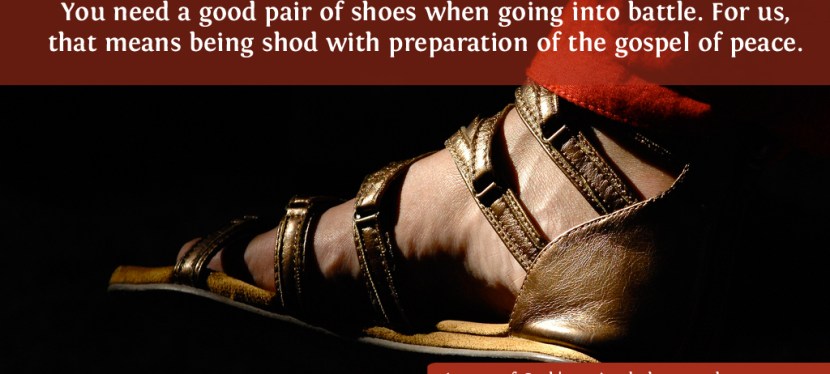
If you’re going into battle, you’re going to need a good pair of shoes. That’s probably not something most of us think about, but what soldiers wear on their feet helps determine how far they can travel in a day and what type of terrain they can fight on. In fact, a good argument can be made that one of the Roman army’s key strengths was improved footwear. Perhaps that’s part of what Paul was thinking about when he wrote this phrase to describe the third piece in the armor of God:

and binding shoes under your feet with the preparation of the good news of peace (Eph. 6:15, LEB)

This piece of armor is related to preparation, the gospel, and peace. It’s a curious combination, especially considering the girdle of truth and breastplate of righteousness have pretty straightforward descriptions. I wasn’t even quite sure what to title this post. Shoes of peace? Prepared footwear? Sandals for preparing good news of peace? I settled on the title you see up there since similar scriptures in Isaiah and Nahum place the focus on carrying good news. Let’s take a look at those.

Footwear Of The Gospel | marissabaker.wordpress.com
Photo credit: DVIDSHUB, CC BY via Flickr

Carrying God’s Words

How beautiful on the mountains are the feet of him who brings good news, who publishes peace, who brings good news, who proclaims salvation, who says to Zion, “Your God reigns!” (Is. 52:7, WEB)

Nahum borrows this phrase in 1:15 and Paul uses it to support his teaching that “faith comes by hearing and hearing by the word of God” (Rom. 10:17, WEB). People must call on the name of the Lord to be saved, but before that they must believe on him and to do that they need to hear about Him. For that to happen, there must be a preacher sent to carry the good news of peace (Rom. 10:13-15). Read more

Jesus Christ’s First Words

My parents tell me my first words were “Dada” and “duck.” I’m sure many of your parents also shared with your how excited they were when you first started talking, or perhaps you have kids of your own and eagerly waited for the first words to come from their mouths. We view first words as important, even on into adulthood when we meet someone for the first time. Based on the words people speak, we form ideas about their priorities, character, and motives.

Christ's First Words | marissabaker.wordpress.com

We don’t know what baby Jesus’s first words were, but we do have four gospels that contain many words He spoke while walking on this earth. Looking at the first words each writer records Christ speaking gives us key insight into His character and priorities.
Read more