Last week, I wrote quite a lengthy post about why it’s so important to tend our spiritual lives as we would a carefully cultivated garden. God desires growth from us, and we need to put effort into that if we want to stay in a close relationship with Him. It’s important to know how highly God values growth, for Jesus warns if we don’t use the gifts He has given us there’s a very real chance they’ll be taken away. Knowing God wants and expects us to grow isn’t much use, though, unless we also talk about how to make growth happen.
Abide in Jesus
When Paul talks about people in ministry “planting” and “watering” spiritual gardens, he also makes very clear that it is God who “gives the increase” (1 Cor. 3:6-9). Growth and fruitfulness happen because of God’s work in our lives. We’re involved, but we don’t make it happen.
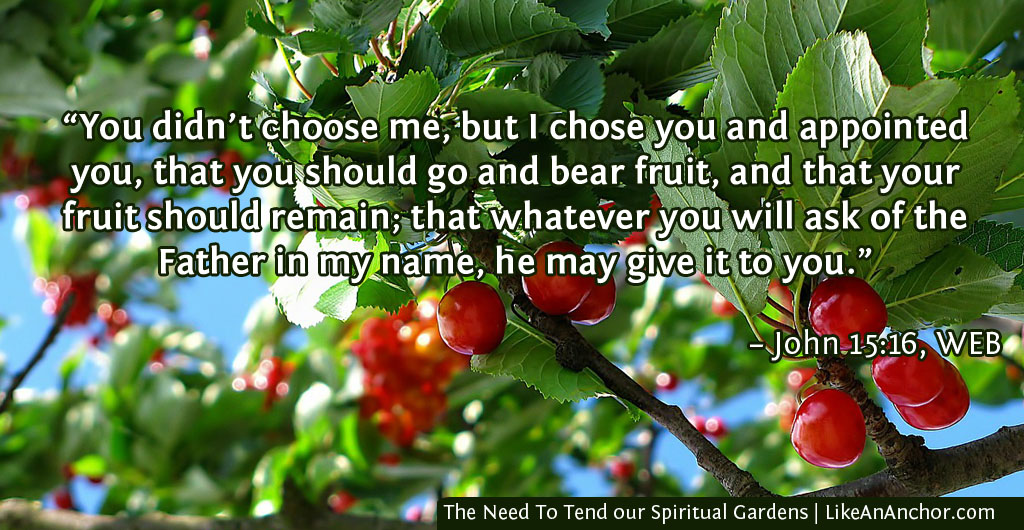
“Remain in me, and I in you. As the branch can’t bear fruit by itself unless it remains in the vine, so neither can you, unless you remain in me. I am the vine. You are the branches. He who remains in me and I in him bears much fruit, for apart from me you can do nothing.” (John 15:4-5, all quotes from WEB translation)
This is the first principle of spiritual growth. There are things we can and should be doing to grow God’s gifts and bear fruit for His glory. But the best efforts on our part will accomplish nothing if we are not firmly attached to Christ. Without Him, we’re like plants that have no root system. We can’t grow unless we’re abiding in Him. “Being filled with the fruits of righteousness” only comes “through Jesus Christ, to the glory and praise of God” (Phil. 1:11). Read more →
Suppose you and your neighbor were to plant a vegetable garden. One of you put the plants and seeds in, watered them once, then stepped back to let it all grow naturally. The other watered and weeded diligently, trimmed where needed, staked up the vines, and poured time and attention into the garden. The first will have a small harvest, if any, from plants choked by weeds and eaten by bugs. The second will enjoy a bountiful harvest of tasty, healthy vegetables. That’s the analogy Gary Thomas uses in his book Sacred Pathways to talk about growth in the Christian life.
“Some of us live with the mistaken impression that our faith needs only to be planted, not tended. Becoming a mature Christian, some think, is like becoming six feet tall — it either happens or it doesn’t. This is not the view of those who have written the classics of our faith or the view of the writers of scriptures (see, for example, Philippians 2:12-13; 1 Timothy 4:15-16; James 1:4; 2 Peter 1:5-11).” — Gary Thomas, Sacred Pathways, p. 232
The Bible is full of talk about spiritual growth and fruitfulness. We can’t do anything to earn salvation or accomplish reconciliation with God on our own — that only happens through the work of Jesus Christ. But once He gives us the precious gift of salvation He expects us to do something with it. That “something” can be summarized as “grow.”
Growing Your Gift
Examples of God’s expectation for growth are found in the parables of the talents and of the ten pounds. A lord goes to a far country, entrusting great wealth to his servants. When he returns, every servant who increased their gift (no matter by how much) is praised as “good and faithful,” and welcomed into the lord’s kingdom. There’s one servant, though, who did nothing with their gift except hide it. It sat in the ground, useless. This servant is the only one who is not praised. The lord actually takes their gift away and then casts them out (Matt. 25:14-30; Luke 19:11-27).
I honestly don’t see how people can read the Bible and still teach “once saved, always saved.” It is true that no one has the power to take you away from God (John 10:28-29), but you can reject God’s gift, or continue in sin without repenting, or neglect to use and grow what He’s given you (Heb. 10:26-31; Gal. 5:16-21; Matt. 18:21-35). Even the Apostle Paul didn’t think he could sit back and relax, assured that he’d get eternal life no matter what he did post-conversion (Phil. 3:11-14; 1 Cor. 9:27).
If we choose to do things that separate us from God and don’t then come back to Him and ask for forgiveness, we could miss out on the kingdom. God tells us how to get there and He even died to make it possible. He very much wants us to accept, use, and grow the gift He’s given us. But He won’t force us to.
Talking about how God can take back gifts which He gives (a Biblical idea that’s found right there in the Jesus’s parables) is not designed to make us live in a state of uncertainty and terror, wondering if we’re “really saved.” Paul clearly didn’t think he should live in despair and doubt because he hadn’t yet attained the end goal of a Christian life. On the contrary, it motivated him to keep growing and striving to follow God.
God doesn’t really ask much of us when you boil it all down. Just the things needed for a good relationship. Love Him. Respect Him. Abide by the boundaries He sets. Apologize if you do something to wrong Him. Use the gifts He’s given you instead of setting them aside like they don’t matter.
So then, my beloved, even as you have always obeyed, not only in my presence, but now much more in my absence, work out your own salvation with fear and trembling. For it is God who works in you both to will and to work, for his good pleasure. (Phil. 2:12-13, all quotes from WEB translation)
Salvation is something Jesus accomplished once for all humanity, and He is the only path to eternal life (Heb. 9:12; 10:11-12; Acts 4:12). Salvation is also a life-long process that we’re involved with as God works in and through us.
Be diligent in these things. Give yourself wholly to them, that your progress may be revealed to all. Pay attention to yourself and to your teaching. Continue in these things, for in doing this you will save both yourself and those who hear you. (1 Tim. 4:15-16)
Paul isn’t telling Timothy that he can save himself or his congregants in the same sense that Christ saved us. But he is pointing out that we are involved in the ongoing aspects of salvation. To return to the garden analogy, people can plant and water spiritual gardens but only God can make them grow (1 Cor. 3:6-9). We’re expected to work on growing, but God’s the one who makes all that growth possible.
Paul describes us in 1 Corinthians as “God’s farming.” In Romans, he uses another agricultural analogy by describing the people of God as trees with grafted branches. Israel is God’s olive tree, and when He opened salvation up to a wider group of people it was like He “grafted in” branches from wild olive trees. As the farmer, God is allowed to graft in or prune out as He pleases. He can even graft people back in after they’ve been cut out so long as they repent and turn back to Him in sincerer belief (Rom. 11:16-24). And we get to play a role in whether or not we stay grafted in.
“I am the true vine, and my Father is the farmer. Every branch in me that doesn’t bear fruit, he takes away. Every branch that bears fruit, he prunes, that it may bear more fruit. … I am the vine. You are the branches. He who remains in me and I in him bears much fruit, for apart from me you can do nothing. If a man doesn’t remain in me, he is thrown out as a branch and is withered; and they gather them, throw them into the fire, and they are burned. … In this my Father is glorified, that you bear much fruit; and so you will be my disciples. (John 15:1-2, 5-6, 8)
In another place, Jesus tells us that we will know false prophets by their fruits. We can discern whether or not someone is trustworthy by how they live and the fruits they produce. God applies the same logic to us; He knows us by our fruits (Matt. 7:17-23). And we are warned, like the people John the Baptist preached to, “every tree therefore that doesn’t produce good fruit” (e.g. “fruits worthy of repentance”) “is cut down, and thrown into the fire” (Luke 3:7-9).
Now, don’t go thinking all this talk of pruning and burning is happening because God doesn’t like us or wants to terrify us. He’s not up there waiting for any excuse to wack us out of the Vine. On the contrary, these things serve as a warning so that we’ll understand exactly how important it is that we stay close to Jesus Christ (the source of our life, as the roots that feed a plant) and commit to living in a Godly way (having a character that produces spiritual fruit). So long as we make even the tiniest effort, God is ready and eager to facilitate our growth.
Consider the lilies, how they grow. They don’t toil, neither do they spin; yet I tell you, even Solomon in all his glory was not arrayed like one of these. … Don’t seek what you will eat or what you will drink; neither be anxious. … But seek God’s Kingdom, and all these things will be added to you. Don’t be afraid, little flock, for it is your Father’s good pleasure to give you the Kingdom. (Luke 12:27, 29, 31-32)
One of the key characteristics of God’s kingdom is that it grows (Luke 13:18-21). And we’re invited to be a part of that. Seek Him. Grow with Him. Keep adding to your faith moral excellence, knowledge, self-control, perseverance godliness, brotherly affection, and love (2 Pet. 1:5-8). Produce fruit of love, joy, peace, patience, kindness, goodness, faith, gentleness, and self-control (Gal. 5:22-23).
One of the most encouraging studies I’ve ever done (for me at least) was on how God talks about human perfection. So long as we’re growing toward the goal of being perfect, as He is perfect, He treats us as if we’re already there. We don’t have to get everything right all the time or worry we’re not good enough. The only way to fail is to not even try. So long as we put effort into tending our spiritual gardens and do not neglect the gifts He has given us, God will make certain that we live abundant, fruitful lives that lead to the best eternal outcome.
A couple weeks ago, in an article titled “Psychology Isn’t Enough, but It Sure Helps: The Need for Personal, Spiritual Growth in Christianity” I talked about a book by Gary Thomas called Sacred Pathways: Discover Your Soul’s Path To God. I originally read it back in 2017 and I’d planned to write about it here on the blog but for some reason (which I don’t remember now) I never got around to it. So I reread it, and now I’d like to share some thoughts.
Book Overview
Thomas proposes nine “sacred pathways” — spiritual temperaments that describe how we’re most inclined to worship God. In the first chapter, he discusses that in the Christian churches we often expect everyone to worship God the same way. The example he uses is the “quiet time” that became a staple of church training and discipleship programs in the 1970s and ’80s. It involved spending 30 to 60 minutes each morning in prayer, personal worship, and Bible study, then having an accountability partner to check-in that you were keeping up with your routine. Prayer, worship, and study are all good things, but it’s not good if we reduce worship to “rote exercise” or assume everyone has to worship in the exact same way all the time (p. 14-15).
I’ve heard the idea that everyone else should worship “our way” voiced more or less directly by a variety of people in churches I’ve attended. Some think churches that don’t encourage dance are not worshiping Biblically; others worry about the people who aren’t committed enough to follow their example of reading the Bible through every year. I’ve voiced my own frustration with song services that have all the enthusiasm of a funeral dirge, saying we need more life in our worship to make it meaningful. Complaining about those who don’t worship the way we think they ought is a common thing. But perhaps it betrays a wrong attitude. Read more →
Someone once asked me if there are any aspects of Myers-Briggs® theory that I disagree with. I told them that my main issues have to do with ways it can be misused rather than with the actual theory. But as much as I like this type theory, I also acknowledge that it’s not a complete system for personal growth or even personality. Myers-Briggs® theory just describes how your mind works by talking about the psychological functions that you use most comfortably.
You can use type theory to help you develop those psychological functions, but they’re still not the whole story of your personality. There are other things we layer on top of that like personality traits, lived experiences, and personal beliefs. The functions are like a canvas we paint on; a foundation for building. They’re not the only things that make us who we are.
One of the dimensions that a system of psychological type does not cover is spirituality. That’s not to say that psychologists like Jung (whose work Myers-Briggs® theory is based on) would have denied there’s an essential spiritual component to humans. Far from it! It’s just that type psychology wasn’t designed to be a path in and of itself for spiritual growth. For that, we need something else.
A Connection Between Psychology and Spirituality
I had the idea to write this post last week, when I was listening to a podcast from Joel Mark Witt and Antonia Dodge of Personality Hacker. They’d recently attended an Enneagram workshop where one of the hosts, Uranio Pae, made the statement, “Spiritual work without psychological work is dangerous. Psychological work without spiritual work is incomplete.”
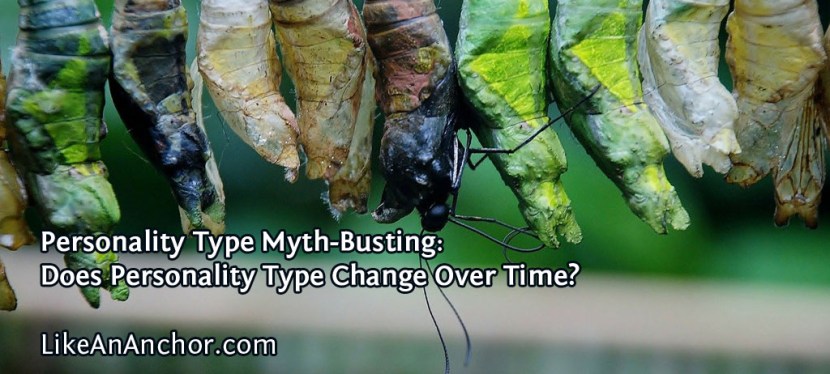
Whether or not your personality type can change is quite a point of debate in the Myers-Briggs® community. Officially, Myers-Briggs® theory holds that your personality type is inborn and does not change. In other words, you cannot start out as an ISFP and then transform into an ESFJ (or any other types) over the course of your life.
Practically, though, we know that people take personality tests all the time and get different results. It’s one of the big arguments leveled against Myers-Briggs® theory — that the tests don’t deliver consistent results and are therefore not valid, repeatable, or scientific. On top of all that, you might have seen articles about new research over the last few years that indicates your personality can change over your lifetime. How do we make sense of all that in relation to type theory?
Personality Traits vs. Personality Type
On the surface, it seems that Myers-Briggs® disagrees with psychology studies that say personality can and does change. But when you take a closer look, you’ll see there’s not really a disconnect. There’s a big difference between personality traits and personality type. The personality model that most psychologists favor today is called Big Five. It includes five key traits — extroversion, agreeableness, neuroticism, contentiousness, and openness.
Where you fall on these traits can change, though they’re considered relatively stable. When change happens it tends to do so gradually over many years (change is more likely and more rapid when something significantly life-changing occurs, such as a traumatic experience) . We also tend to be more stable in some traits and less stable in others. You can read more about this in the following articles: Read more →
Think about your favorite novel, movie, or TV show. It probably begins with the main characters going about their ordinary lives. Bilbo Baggins lives peacefully in his hobbit hole (The Hobbit). Elizabeth Bennet is socializing with her sisters and putting up with a mother eager to marry her off (Pride and Prejudice). Luke Skywalker is moisture farming on Tatooine (Star Wars). A pastor is sailing with his family to a colony in the South Pacific (The Swiss Family Robinson).
Then Gandalf arrives with a party of dwarves. Mr. Bingley moves to Netherfield. Droids arrive carrying secret plans that must be delivered to the Rebellion. The ship crashes on an uncharted island. Something changes, acting as an inciting incident to push the main character out of their normal life and into the events of the story.
We’re currently living in a time of great change. People are talking about what the “new normal” will look like and speculating about how much things will change now that there’s Covid-19 in the world. There have been many other times of great change throughout history — pandemics, the industrial revolution, natural disasters, colonization by European powers, terrorist attacks, the falls of empires, the birth of Jesus Christ. Some are terrible, some depend on your point of view, and a very few are spectacularly good.
We have very little control over how the world changes. But we do have some control over if and how we change in response to those changes. In many ways, we get to decide whether the effects of this pandemic will be an inciting incident for personal growth, a speed bump as we continue on much the same as before, or something that derails our path.
We would not have had a story if Bilbo stayed home, Elizabeth refused to speak with Darcy a second time, Luke didn’t follow R2-D2 into the desert, or the Swiss family had been rescued after only a week on the island. Now, I’m not saying you should ignore social distancing guidelines and go running off on a grand adventure. For us today I’m talking more about an internal adventure and a commitment to positive change.
Some of the greatest journeys we can go on are those of self-discovery, and they’re often prompted by change. The biggest moments that stand-out in my mind as times that sparked personal growth were starting college, beginning a dating relationship with a man I’d been friends with for years, and then the breakup which ended that relationship. Maybe this pandemic will be another one for me, and for many other people.
Whether you’re stuck at home and have some extra time on your hands or not, the changes in the world around us can serve as a reminder to look inwards and evaluate ourselves. We might ask questions like, “What impact am I having on the people around me for good or ill?” or “How can I become a healthier individual mentally, emotionally, and physically?” or “What do I want the next part of my story to look like?”
We can’t control when quarantine restrictions lift, who gets sick, or most other things associate with this pandemic. But we can control how we respond to the changes that are happening in our lives and the world around us. Let’s commit to making sure the great changes we’re going through now spark great next chapters in the stories of our own lives.
I haven’t quite finished it yet, but even just reading the introduction and chapter on my enneatype has given me some additional clarity on a couple issues I’ve been struggling with for a while. You might want to check this book out if you’ve been curious about the Enneagram or want some ideas for personal growth. I borrowed it from a digital library, so that might be an option for those who (like me) prefer to try out a book before buying it.






 (please note this is an affiliate link, which means if you click and make a purchase I’ll receive a small commission at no additional cost to you).
 Like An Anchor