Rethinking Heaven: Capturing A Vision Of The Resurrection

Christians and non-Christians alike typically assume that our religion teaches good Christians go to heaven when they die and bad people, or those who’ve never given their lives to Jesus, go to hell. As more and more Biblical scholars, Christian churches, and individual believers are realizing, though, this isn’t the most accurate picture of what the Bible teaches regarding life after death.

I grew up in churches that taught the resurrection. It’s straight out of the scriptures, but I hadn’t come across other churches teaching something similar until reading a book called Desiring the Kingdom by Catholic theologian James K.A. Smith. In this book, Smith made a comment about Christians not really going to heaven when they die and footnoted it with three book suggestions for further reading. I could only locate one book from that list in the library: Surprised by Hope by New Testament scholar and Anglican bishop N.T. Wright.

Wright’s powerful exegesis on the meaning of the resurrection is inspiring and some of the thoughtful, well-researched ways he diverged from my church’s traditional teachings made me realize there are alternative explanations for a few difficult scriptures that deserve a second look. I also admire his style. Instead of telling people “You’re wrong,” he says, “We’ve been misinformed, and here’s the more wonderful plan God has for us.” That’s what I want to focus on today. The deeper our understanding of what God is actually planning for us, the firmer our hope and faith becomes.

What Happens When We Die?

The idea that human beings have immortal souls does not come from the Bible, It traveled into Christian theology from Greek philosophy, specifically Plato (see “Plato’s Shadow” by Gary Petty for more details). The Bible teaches that God “alone possesses immortality” (1 Tim. 6:16, NET). Immortality is not something inherent to humans. We didn’t even have a chance at eternal life until Jesus Christ broke “the power of death and brought life and immortality to light through the gospel!” (2 Tim. 1:10, NET).

In Hebrew thought and New Testament theology, the soul refers “not to a disembodied entity hidden within the outer shell of a disposable body, but rather to what we would call the whole person or personality” (Wright, p. 28). In Hebrew, the word translated “soul” is nephesh (H5315). It refers to a living thing with breath (Thayer’s Dictionary).

 Yahweh God formed man from the dust of the ground, and breathed (naphach) into his nostrils the breath (neshamah) of life; and man became a living soul (nephesh).

Genesis 2:7, WEB

The New Testament does talk about different parts of a human. We have a body  — the soma , which is fleshy, physical, and “that which casts a shadow” (Thayer G4983). We have a soul — psuche , the vital force of life and personality (G5590). And we have a spirit — pneuma , the “rational spirit, the power by which the human being feels, thinks, decides” (Thayer G4151). The three can’t really be separated in any useful way, though; they all go together to make us human beings in the image of God.

Now may the God of peace himself make you completely holy and may your spirit (pneuma) and soul (psuche) and body (soma) be kept entirely blameless at the coming of our Lord Jesus Christ.

1 Thessalonians 5:23, NET

So, we are human bodies that God created from dust and breathed into, making us living beings with spirits that can communicate with His Spirit. Ecclesiastes says that, at death, “the dust returns to the earth as it was, and the spirit returns to God who gave it” (Ecc. 12:7, WEB). Wright believes that this spirit is conscious while awaiting the bodily resurrection, but I lean more toward my church’s traditional teaching that this isn’t the case.

While there are a couple verses hinting at the possibility of consciousness after death (Luke 16:19-31; Rev. 6:9-10), the bulk of scripture compares death to sleep (John 11:11-13; 1 Cor. 15:6, 18, 31; 1 Thes. 4:13-15; 5:10; 2 Pet. 3:4; Dan. 12:2; and many others). Furthermore, “in death there is no memory of you” (Ps. 6:5, WEB), “the dead don’t praise Yah” (Ps. 115:17, WEB), and ” the dead don’t know anything” (Ecc. 9:5, WEB). Two scriptures–one in a parable and one in Revelation– that aren’t necessarily clear/straightforward do not seem to be enough evidence to counter the many, many other scriptures describing the dead as unconscious and sleeping.
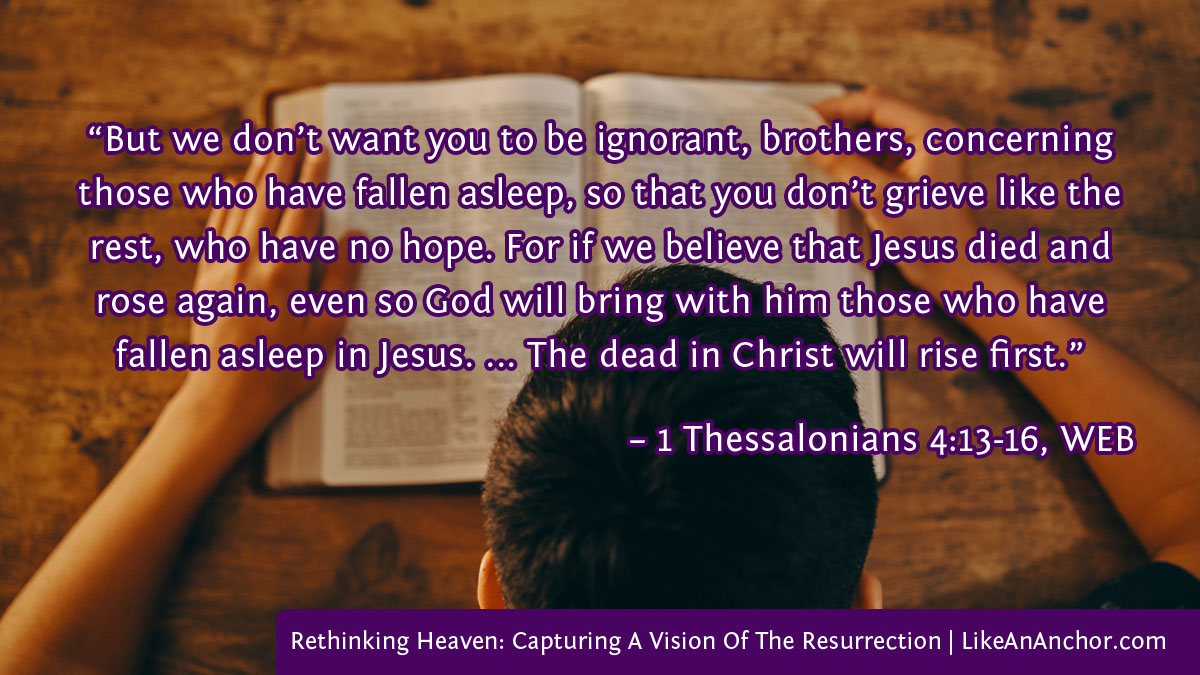
Image of a man reading the Bible overlaid with text from 1 Thes. 4:13-16, WEB version:  “But we don’t want you to be ignorant, brothers, concerning those who have fallen asleep, so that you don’t grieve like the rest, who have no hope. For if we believe that Jesus died and rose again, even so God will bring with him those who have fallen asleep in Jesus. ... The dead in Christ will rise first.”
Image by Matt Vasquez from Lightstock

For The Firstfruits

Eternal life is a gift God promises to those who follow Him now, in this life (we’ll save those who don’t for a follow-up post next week). The promises to believers are spelled out clearly in scripture, and nowhere more clearly than in 1 Corinthians 15. Here in the resurrection chapter, Paul reminded the Corinthians that he declared to them the gospel: “that Christ died for our sins according to the scriptures, and that he was buried, and that he was raised on the third day according to the scriptures, and that he appeared to” the apostles and hundreds of other believers (1 Cor. 15:3-5, NET). Jesus’s resurrection is central to the gospel message.

Paul then addressed a group of people who didn’t believe in the resurrection of the dead. He stated in no uncertain terms that if there is no resurrection the gospel is empty, and “if Christ has not been raised, your faith is useless; you are still in your sins. Furthermore, those who have fallen asleep in Christ have also perished” (1 Cor. 15:17-19, NET). There is no alternative. Either there’s a resurrection of the dead or we have no hope at all; physical death would be permanent.

Paul spent the next few verses talking about how and when we’ll be raised. N.T. Wright summed up the “how” by saying, “the risen Jesus is both the model for the Christian’ future body and the means by which it comes about” (p. 149). The “when” for the resurrection of faithful believers is Jesus Christ’s second coming (1 Thes. 4:13-18; 1 Cor. 15:23). This resurrection is for “the firstfruits”–a select group of people who actively, faithfully followed God during their physical lives. It’s not enough to verbally accept Jesus as your savior; we also have to live like Christians. And so the resurrection chapter also includes the injunction not to be deceived or corrupted, but rather “Sober up as you should, and stop sinning!” (1 Cor. 15:34. NET).
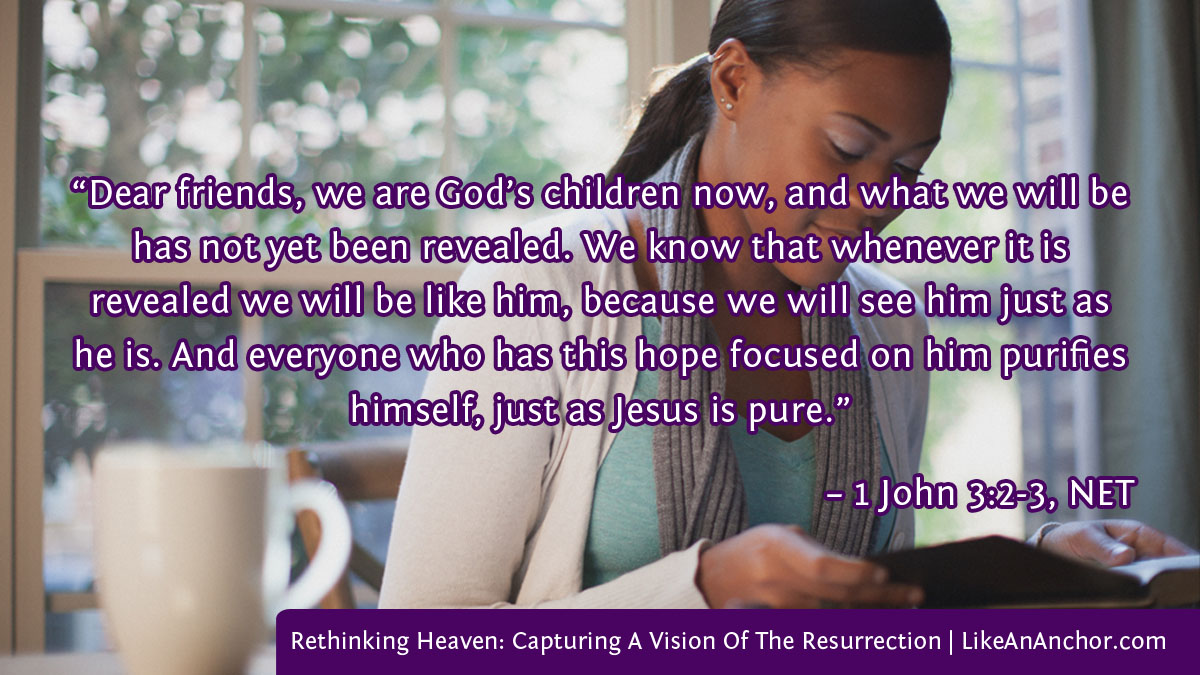
Image of a woman reading the Bible overlaid with text from 1 John 3:2-3, NET version:  “Dear friends, we are God’s children now, and what we will be has not yet been revealed. We know that whenever it is 
revealed we will be like him, because we will see him just as he is. And everyone who has this hope focused on him purifies himself, just as Jesus is pure.”
Image by Pearl from Lightstock

A Bodily Resurrection

Paul anticipated one question that many will have about the resurrection when he said, “But someone will say, ‘How are the dead raised? With what kind of body will they come?'” (1 Cor. 15:35, NET). It’s an understandable question, especially today given the confusion about what “soul” actually means. The short answer is given by John: “we will be like him, because we will see him just as he is.” (1 John 3:2, NET). When we’re resurrected, it will be to an existence like God’s.

Paul addresses this question in more depth. He likens our bodies now to “a bare seed” sown in a field with the expectation that it will grow into a mature, flourishing plant (1 Cor. 15:37, NET).We currently have a “natural body” that bears the image of the first human being that God breathed into and made a living being. Those who rise from the dead in the first resurrection will have a “spiritual body” that bears the image of Jesus Christ (1 Cor. 15:42-49).

 It is the same with the resurrection of the dead. What is sown is perishable, what is raised is imperishable. It is sown in dishonor, it is raised in glory; it is sown in weakness, it is raised in power; it is sown a natural body, it is raised a spiritual body. If there is a natural body, there is also a spiritual body.

1 Corinthians 15:42-44, NET

In Greek, the words “natural” and “spiritual” are psychikos and pneumatikos. Wright points out that “Greek adjectives ending in -ikos describe not the material out of which things are made but the power or energy that animates them” (p. 155, emphasis in original). We currently have a body animated by the human soul. We will have a body “animated by God’s pneuma, God’s breath of new life, the energizing power of God’s new creation” (p. 156).

When Jesus rose from the dead, people could touch Him (John 20:27) and eat with Him (John 21:9-13). He told them, “Look at my hands and my feet; it’s me! Touch me and see; a ghost does not have flesh and bones like you see I have” (Luke 24:39, NET). Though He could appear in the middle of a locked room or vanish from sight (Luke 24:30-31, 36), Jesus wasn’t a ghost or a disembodied spirit. His spiritual body was something more than His physical one.

We’re not waiting for an escape from the body, but rather “the redemption of our bodies” (Rom. 8:23, NET). We long “to put on our heavenly dwelling … because we do not want to be unclothed, but clothed, so that what is mortal may be swallowed up by life” (2 Cor. 5:1-5, NET). We’re not waiting to go to heaven when we die — we’re waiting for Christ to come down from heaven to raise His people from their sleep of death and transform us all to have a spiritual life and body like His (1 Cor. 15:51-58). And it doesn’t end there!

Blessed and holy is the one who takes part in the first resurrection. The second death has no power over them, but they will be priests of God and of Christ, and they will reign with him for a thousand years.

Revelation 20:6, NET

We don’t have a ton of information about what happens after the first resurrection, but God does sketch out the final stages of His plan for us. We know that for 1,000 years, those firstfruits who were resurrected from the dead or who were alive and transformed at Jesus’s second coming reign alongside Him in what we call the Millennium (most details about this come from the prophets and Revelation). After that, there will be a resurrection of the remaining dead, a final judgment, Satan’s total defeat, a new heaven and new earth, and God will come to dwell with humanity on earth (Rev. 20-22). It’s an incredible future that God has planned for His creation! Let’s not settle for any teaching that offers less than His glorious plan that He has revealed to us in scripture.


Featured image by Ruby-Rose from Lightstock

Song Recommendation: “With The Sound of Trumpets

What (if anything) must you do to be a Christian?

Is there anything we have to do in order to be a Christian? Some will tell you the answer is “no” — that salvation is a free gift and once you accept it you’re a Christian and there’s nothing else you need to do. Others will say “yes” — that you’re not a Christian unless you keep God’s commandments and follow Jesus Christ.

The truth is that God offers salvation freely, but you have to accept the gift on God’s terms. Those terms are called covenants — agreements that involve two parties binding themselves together with oaths. On the spiritual level, God initiates covenants, establishes the terms and promises, and binds Himself to the covenant oaths. These covenants are unfailing and sure, regardless of human action. We can choose whether or not to walk in covenant with God, but the covenant, and associated consequences for sin, stand whichever you decide.

What (if anything) must you do to be a Christian? | marissabaker.wordpress.com

Choose Covenant

“I make this covenant and this oath, not with you alone, but with him who stands here with us today before the Lord our God, as well as with him who is not here with us today,” Moses recorded in Deuteronomy 29:14-15. Not entering into covenant with God does not mean you’re getting out of consequences for sin — it means you’re choosing a path of death (Deut. 29:18-28).
Read more

Inheriting Covenants

My renewed interest in studying covenants started with a Greek dictionary. Typically, I would define covenant as  “a binding agreement between two parties,” which is a very basic description of the Hebrew word berith (H1285). For the New Testament, though, Spiros Zodhiates says diatheke (G1242) refers to “the disposition which a person makes of his property in prospect of death, i.e. his testament” and shows “a unilateral demonstration of the will of the testator.”

I’ve always been confused by the discussion about testaments in the book of Hebrews because it didn’t all line-up with my idea of covenants. Do we enter covenant with God as a mutual agreement, or are we benefactors of God’s unilateral will (whether we want it or not)? And how, exactly, do we become partakers of this covenant? After 3 weeks of study, I realized the answer is a little bit of both and that clarity for this question is found in Jesus Christ (that should have been obvious, right?) Read more

God’s Message Through the Aaronic Blessing

At a conference this past December, I attended an excellent seminar by a gentleman named Hal exploring the depth of the Hebrew words used in the Aaronic blessing (I want to credit him, but not sure if he’d want his full name used here, so we’ll just stick with first names). This blessing goes like this in the New King James Version: “The Lord bless you and keep you; the Lord make His face shine upon you, and be gracious to you; the Lord lift up His countenance upon you, and give you peace” (Num. 6:24-26).

God's Message Through the Aaronic Blessing | marissabaker.wordpress.com

These words are lovely in English, but I was awed by how much more incredible they are when you start digging deep into the Hebrew meanings. In this article, we’re going to take a deep-dive into the words originally used to record this blessing. These words illuminate an encouraging, hopeful message that God continues to share with us today.

Read more

Growing To Perfection

Have you ever wondered why God commands us to be perfect when it seems so impossible? In English, the word means things like, “being entirely without fault or defect” and “corresponding to an ideal standard or abstract concept” (Merriam-Webster Dictionary). When we read that and think of verses like “all have sinned and fall short of the glory of God” (Rom. 3:23, NET), we might get discouraged. It’s disheartening to look at ourselves and realize how far we are from perfection.

The task of becoming perfect seems even more daunting when we read, “So then, be perfect, as your heavenly Father is perfect” (Matt. 5:48, NET). How could we ever become as perfect as God is? If we don’t give up altogether thinking of that monumental task, it’s easy to get caught in a cycle of trying to be perfect, failing, and then falling into depression and/or guilt. We might think we’re not good enough for God. We might know that achieving perfection is only possible with God’s help, but still feel like if only we worked at it a little harder we’d be able to use His help more effectively and stop being so imperfect.

God doesn’t set us up for failure, though. Rather, His way of looking at perfection is very encouraging. First, we need to remember that Jesus told us things which are impossible for men are possible for God (Matt. 19:26). Next, let’s look at what “perfect” means in the Bible and how it’s used, because it’s different than we might expect.

What is “Perfect”?

Let’s start with an example. In the Old Testament, God described Job as a “perfect” or “blameless” man twice at the beginning of Job’s story (Job 1:8; 2:3). We know that Job learned and grew as a result of the trials he went through. God even showed up personally to set Job straight. And yet God could describe Job as “perfect” with complete honesty before all that growth happened.

The word in Hebrew that’s translated “perfect” in the KJV is tam (H8535), which refers to completeness and entirety. It doesn’t necessarily mean finished, though — rather, it describes someone moving “naturally toward that which is ethically sound” (Theological Wordbook of the Old Testament entry 2522). Thus in the Bible, we can be described as “perfect” while being on the path toward perfection–toward being like God.

As for God, his way is perfect.
    Yahweh’s word is tested.
    He is a shield to all those who take refuge in him.
For who is God, besides Yahweh?
    Who is a rock, besides our God?
God is my strong fortress.
    He makes my way perfect.

2 Samuel 22:31-33, WEB

God is perfect in an absolute sense, and He takes on Himself the task of moving us toward similar perfection. As long as we are growing toward being like Him, He can describe us as “perfect” just like He called Job perfect.

This idea of growth also fits in with the New Testament writings. There are two main words translated “perfect” from Greek, and one is teleios (G5046). It means something that is finished or complete, as in completely blameless, or a person who is full-grown in mind and understanding (Zodhiates). This “full growth” is what Jesus Christ prayed His followers would experience.

The glory which you have given me, I have given to them; that they may be one, even as we are one; I in them, and you in me, that they may be perfected into one; that the world may know that you sent me and loved them, even as you loved me.

John 17:22-23, WEB

Perfection as a Christian has everything to do with growth. If we think we’re already perfect, then we’re not (1 Cor. 10:12). But if we’re pursuing perfection by trying to be like God and deepening our relationship with Him, then He talks about us as if we’re already perfect.

Image of a man pushing open a door overlaid with text from Ephesians 4:13, NKJV version:  “till we all come to the unity of the faith and of the knowledge of the Son of God, to a perfect man, to the measure of the stature of the fullness of Christ”
Image by Pearl from Lightstock

On To Perfection

God the Father and Jesus Christ don’t leave us in the dark about how to grow toward perfection. The key is to focus on them rather than ourselves. We’re not trying to make ourselves perfect; we’re trying to mimic them. We’ll never eclipse their perfection, but we can become like them. That won’t be fully realized in this life, but we start the process now and in the future we’ll be so much “like him” that “we will see him just as he is” (1 John 3:1-3).

A disciple is not above his teacher, but everyone who is perfectly trained will be like his teacher.

Luke 6:40, NKJV

This verse brings us to the other Greek word frequently translated “perfect.” Katartizo (G2675) means “to put a thing in its appropriate condition.” It can mean repairing something that was broken, setting a person right with God, and preparing or equipping someone for a purpose (Zodhiates). Here in Luke, Jesus is telling us that in order to become whole, complete and right with God, we have to become like Him. Growing the whole church body toward being like Christ is one of the most important responsibilities of the church (Eph. 4:10-14). The closer we get to “attaining to the measure of Christ’s full stature” (Eph. 4:13, NET), the more mature we become as Christians.

Keep Growing!

Image of a woman looking up at the sky with the blog's title text and the words "We know we're not sinless or flawless and perfection might seem an unattainable goal. But God still calls people "perfect" when they're growing toward being like Him."
Image by Brightside Creative from Lightstock

We all have a responsibility to grow. Not to make ourselves perfect as if we could fix all our flaws ourselves, but to keep moving toward being like God. God doesn’t get angry and pounce on us when we stumble and fall or miss the mark; He helps us get back up. When we repent and keep growing, He still calls us perfect. It’s only when we stagnate (or sin and refuse to repent and change) that we get into real trouble.

For although by this time you should be teachers, you again need to have someone teach you the rudiments of the first principles of the revelations of God. You have come to need milk, and not solid food. For everyone who lives on milk is not experienced in the word of righteousness, for he is a baby. But solid food is for those who are full grown, who by reason of use have their senses exercised to discern good and evil.

Therefore leaving the teaching of the first principles of Christ, let’s press on to perfection—not laying again a foundation of repentance from dead works, of faith toward God, of the teaching of baptisms, of laying on of hands, of resurrection of the dead, and of eternal judgment. This will we do, if God permits.

Hebrews 5:12-6:3, WEB

“Why aren’t you growing?” the writer of Hebrews asks. “You know what the elementary principles are, so build on them.” If you’re a brand-new Christian then you will be learning those principles, but as the years pass you’re supposed to keep building. We have a foundation — Jesus Christ whose sacrifice perfects us (1 Cor. 3:11; Heb. 10:14) — and now is the time to start building on that foundation. Even though God refers to us as  perfect before we actually reach that goal, we can’t become complacent.

Not that I have already attained this—that is, I have not already been perfected—but I strive to lay hold of that for which Christ Jesus also laid hold of me. Brothers and sisters, I do not consider myself to have attained this. Instead I am single-minded: Forgetting the things that are behind and reaching out for the things that are ahead, with this goal in mind, I strive toward the prize of the upward call of God in Christ Jesus. Therefore let those of us who are “perfect” embrace this point of view. If you think otherwise, God will reveal to you the error of your ways.

Philippians 3:12-15, NET

Even the Apostle Paul didn’t think he could stop pursuing perfection, and he wrote over 30% of the New Testament text! But he didn’t let the fact that he wasn’t perfect yet discourage him. He also encouraged his fellow Christians to keep growing toward perfection and maturity in Christ. Like Paul, I hope we can accept the fact that we’re not yet perfect while continuing to move towards being like Jesus and our Father. We don’t have to beat ourselves up over not being “good enough.” God calls us perfect as long as we keep growing toward being like Him.


Featured image by Pearl from Lightstock

Feeling After The Lord

Feeling After The Lord | marissabaker.wordpress.comIt seems that Christians are often suspicious of feelings. And why shouldn’t we be? After all, “The heart is deceitful above all things, and desperately wicked; who can know it?” (Jer. 17:9). We can’t understand our own hearts, so how can we trust anything they tell us?

I’ve suspected for some time that our feelings may be more important to our relationship with God than some people like to admit, but I wondered if my own tendency to favor intuition and feelings in decision-making was coloring my thinking. Then I noticed a verse in my King James study Bible that talked about people seeking the Lord “if haply they might feel after Him” (Acts. 17:27). When you look at the Greek this doesn’t really havemuch to do with emotions, but it did prompt a more in-depth study about how much we can trust our hearts and feelings.

New Hearts

When we talk about our “hearts” in the Bible, the Hebrew word is lebab (H3824). The Theological Wordbook of the Old Testament by Harris, Gleason, and Waltke describes this word as “the richest Biblical term for the totality of man’s inner or immaterial nature.” It refers to someone’s personality, and primarily includes their emotions, thoughts, and will. Any sort of feeling — positive and negative — can be attributed to the heart.

The passage in Jeremiah 17 which tells us our hearts are deceitful and wicked also tells us that the Lord is able to know, search, and try our hearts (Jer. 17:9-10). As the only one Who can really understand what’s going on in our innermost self, God is also able to effect changes inside us at a heart-level.

I will give you a new heart and put a new spirit within you; I will take the heart of stone out of your flesh and give you a heart of flesh. I will put My Spirit within you and cause you to walk in My statutes, and you will keep My judgments and do them. (Ezk. 36:26-27)

Our hearts can be changed. They don’t have to stay wicked and untrustworthy. That doesn’t, however, mean we can follow our hearts all the time once we’re in a relationship with God. David walked “in integrity of heart” and God called him “a man after My own heart, who will do all My will” (1 Kings 9:4; Acts 13:22), yet he still sinned by acting on his feelings for Bathsheba.

Keep your heart with all diligence, for out of it spring the issues of life. (Prov. 4:23)

Even when God is working with our hearts, we still have an obligation to keep and guard our inner selves. We have the Holy Spirit in us, but we’re also still human. While our gut instincts and feelings are more likely to be right when we’re in covenant with God, we could still be deceived by our hearts.

Reach Out

Let’s go back to that verse I mentioned in Acts. It’s part of Paul’s sermon in Athens.

And He has made from one blood every nation of men to dwell on all the face of the earth, and has determined their preappointed times and the boundaries of their dwellings, so that they should seek the Lord, in the hope that they might grope for Him and find Him, though He is not far from each one of us; for in Him we live and move and have our being, as also some of your own poets have said, ‘For we are also His offspring.’ (Acts 17:26-28)

In the Greek, the phrase “grope for” (NKJV) or “feel after” (KJV) is translated from the word pselaphao (G5584). This word is derived from a root that means “to touch lightly,” and here in Acts if means to feel or touch and object. The picture it paints is of us reaching out, searching for God like someone feeling around in the dark to find another person.

By night on my bed I sought the one I love; I sought him, but I did not find him. “I will rise now,” I said, “And go about the city; in the streets and in the squares I will seek the one I love.” I sought him, but I did not find him.” (Song 3:1-2)

Since we’re not going to find God by waving our hands around and reaching for something physically tangible, I imagine this “feeling after” God takes place in our hearts. This brings us right back to the idea of emotions, thoughts, and the immaterial parts of us.

I’m reminded of a conversation I had with a friend some years ago about what role emotions have in our faith. One of the questions that came up was, “What does the Holy Spirit in us feel like, if it’s not a feeling?” It’s an appeal to probability fallacy to , but it illustrates a point — we instinctively sense that the immaterial part of us will be involved in noticing the immaterial Spirit of God.

Jesus answered and said to him, “If anyone loves Me, he will keep My word; and My Father will love him, and We will come to him and make Our home with him.” (John 14:23)

In Acts 17, Paul told those who were “feeling after” God that “He is not far from each one of us.” Here in John, Christ tells us that both He and His Father will dwell with an inside of Their people via the Holy Spirit (John 14:15-18). Talk about being close to someone! We “live and move and have our being” in Them, and They live inside us. That’s the most intimate relationship you’ll ever have with anyone.

For in Him [Jesus] dwells all the fullness of the Godhead bodily; and you are complete in Him, who is the head of all principality and power. (Col. 2:9-10)

Being in relationship with God makes us complete. He strengthens our weaknesses, makes wise our foolishness, and quiets our anxieties. When we go looking for God and cling tightly to Him, the change He can and will work inside us on a spiritual, emotional, and mental level is astonishing. It transforms us to the core of our being, including our feelings.