Reasons for Atonement

Today, the 14th of September/10th of Tishrei is the Day of Atonement, or Yom Kippur. It is, as far as my research can find, considered the holiest day of the Jewish year. That does not, however, mean this important day holds no significance for Christians. Like the rest of the Old Testament, God’s Holy Days were given to man for a purpose that did not expire when Jesus Christ instituted the New Covenant. Some things were replaced/filled to the fullest, such as animal sacrifices being fulfilled by Jesus Christ’s sacrifice (Heb. 7:26-28). Others were updated to be understood in a spiritual light, which is what I touched on in “Righteousness by Faith” and “Purpose of the Law.” In the case of God’s Sabbaths and Holy Days, we have ample evidence that Jesus Christ kept these days as Holy and that the New Testament church followed His example.

Loose The Bonds of Wickedness
The Day of Atonement (Yom Kippur) for Christians marissabaker.wordpress.comThe Day of Atonement is specifically referred to as “the Fast” in Acts 27:9. But knowing that Paul and his fellow believers observed the Day of Atonement only gives modern Christians an example to follow. That in and of itself is not an explanation for why this day should be observed. For that, we have to take a look at the Old Testament observance.

And the Lord spoke to Moses, saying: “Also the tenth day of this seventh month shall be the Day of Atonement. It shall be a holy convocation for you; you shall afflict your souls, and offer an offering made by fire to the Lord. And you shall do no work on that same day, for it is the Day of Atonement, to make atonement for you before the Lord your God.For any person who is not afflicted in soul on that same day shall be cut off from his people.And any person who does any work on that same day, that person I will destroy from among his people.You shall do no manner of work; it shall be a statute forever throughout your generations in all your dwellings. It shall be to you a sabbath of solemn rest, and you shall afflict your souls; on the ninth day of the month at evening, from evening to evening, you shall celebrate your sabbath.” (Lev. 23:26-32)

Leviticus 23 lists the most important days of the year in God’s calendar, yet Atonement is the only one where the people are told they will be “cut off” and/or “destroyed” if it is not properly observed. A possible reason for the significance placed on this particular day lies in the symbolism of fasting. In my Google searches looking for descriptions of the Jewish observance of Yom Kippur, I stumbled across a Christian website that had the following to say about Atonement. (To provide proper attribution, here’s the link [but I didn’t finish reading this article and I don’t know anything about the site].)

An Israelite’s refusal to fast, which resulted in the offender being cut off from the community (Leviticus 23:29) is the Old Testament’s equivalent of a person today refusing to repent, which will result in the offender being cut off from eternal life (Luke 13:3). Fasting is outward proof that the person doing the fasting is serious about repentance, which is vital for forgiveness.

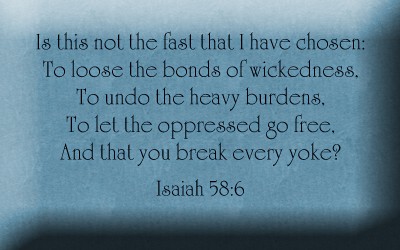
This idea fits in nicely with the purpose of fasting. In Isaiah 58, God answers Israel’s question about why He has no respect for their fasts by describing an acceptable fast. “Is this not the fast that I have chosen,” He asks in verse 6, “To loose the bonds of wickedness, to undo the heavy burdens, to let the oppressed go free, and that you break every yoke?”

Undo The Heavy Burdens

When we fast, it serves as a reminder of how much we need God and of the severity of our struggle against sin.  Going without food or water for 24 hours (or 25, in the Jewish tradition) reminds us how weak we are as human beings. The reminder of how much we need physical food and water — which is provided by God (James 1:17) — also helps us realize how much we are dependent on God for spiritual things. We are to hunger and thirst after righteousness (Matt. 5:6), but does my soul always long for God as much as my throat longs for water today?

As the deer pants for the water brooks, so pants my soul for You, O God. (Ps. 42:1)

O God, You are my God; early will I seek You; my soul thirsts for You; my flesh longs for You in a dry and thirsty land where there is no water. (Ps. 63:1)

Fasting should also remind us of our daily struggle against sin. I’m so used to drinking and eating that I have to consciously remind myself not to  grab a drink of water or open my dark chocolate and cashew stash today. While we were without God in the world, we were in a similar state of sinning without really thinking about it. But now that we have been redeemed by Christ’s sacrifice, we are to walk in newness of life and must make an effort to run away from sin and toward Christ (Rom. 6:4). Without His divine aid, we would slide back into sin.

Let The Oppressed Go Free

As we know, Jesus Christ’s sacrifice is what frees us from the heavy burden of sin (John 8:31-36). If freeing people from wickedness is also the purpose of fasting, it makes sense that fasting under the New Covenant would be related to the subject of repenting and accepting Christ’s sacrifice on our behalf.

In the Old Testament, the Day of Atonement was the only day of the year on which the High Priest could enter the Holy of Holies in the tabernacle or temple (Lev. 16:2-10; 16:29-34). It is, therefore, this day that is referred to in Hebrews when the writer says,

the priests always went into the first part of the tabernacle, performing the services.  But into the second part the high priest went alone once a year, not without blood, which he offered for himself and for the people’s sins committed in ignorance; the Holy Spirit indicating this, that the way into the Holiest of All was not yet made manifest while the first tabernacle was still standing. …

But Christ came as High Priest of the good things to come, with the greater and more perfect tabernacle not made with hands, that is, not of this creation. Not with the blood of goats and calves, but with His own blood The Day of Atonement for Christians marissabaker.wordpress.comHe entered the Most Holy Place once for all, having obtained eternal redemption. For if the blood of bulls and goats and the ashes of a heifer, sprinkling the unclean, sanctifies for the purifying of the flesh,  how much more shall the blood of Christ, who through the eternal Spirit offered Himself without spot to God, cleanse your conscience from dead works to serve the living God? (Heb. 9:6-8, 11-14)

Christ’s sacrifice supersedes the physical animal sacrifices by a human priest, just as His priesthood supersedes the Levitical system. But doing away with the animal sacrifice does not do away with our need for repentance. Christ said His servants would fast (Mat. 6:16-18; Matt. 9:14-16), and our obedience to this (particularly in the commanded fast on the Day of Atonement) reminds us of our need for redemption. Fasting helps us draw near to God, shows us how much we need Him, and is a physical sign of our willingness to obey His commands.

Break Every Yoke

The third main element of the Day of Atonement in the Old Testament involved the “scapegoat” or the “Azazel goat.”

“And when he has made an end of atoning for the Holy Place, the tabernacle of meeting, and the altar, he shall bring the live goat. Aaron shall lay both his hands on the head of the live goat, confess over it all the iniquities of the children of Israel, and all their transgressions, concerning all their sins, putting them on the head of the goat, and shall send it away into the wilderness by the hand of a suitable man. The goat shall bear on itself all their iniquities to an uninhabited land; and he shall release the goat in the wilderness. (Lev. 16:20-22)

In the churches I’ve been a part of, this has traditionally been read as symbolic of Satan being bound so that he “so that he should deceive the nations no more till the thousand years were finished” (Rev. 20:1-3. Permanently removed in verse 10). I see no reason to contest this interpretation. Though God’s people have been freed by Christ’s sacrifice, we still have to deal with  living in a fallen world subject to Satan’s influence. The “whole creation groans” and is subject to “the bondage of corruption” until the time of Christ’s return and Satan’s removal (Rom. 8:21-22), which will finally fulfill the Day of Atonement. Today reminds us of the incredible hope God gives us that someday, the entire world will be released from Satan’s yoke and enjoy the true freedom found in being a part of God’s family.

Jesus The Christ

I’d like to share a quote from a book I picked up a couple weeks ago. I still haven’t decided whether or not I like Mysteries of the Middle Ages by Thomas Cahill, but it has given me several things to think about. For example, there is an interesting footnote to page 50, in which the author discusses the shift from approaching Christianity through a “Jewish conceptual framework” to a Greco-Roman view that disconnected Christianity from its Jewish roots.

By the time of Constantine, Jesus was already shedding his Jewishness; and the Greek word Christos (Christ), meaning ‘Anointed One,” a translation of the Hebrew mashiach (messiah), had become in effect Jesus’s surname.

The problem with this is that treating “Christ” simply as a surname can make us lose sight of an important aspect of Who He is and what He was sent to do. His names have meaning, but too often we pay no more attention to those meanings than we would to the fact that the names John Doe mean “God is gracious” and “a female deer.”

Christ, the Anointed, is a title that God gave Jesus. It is so important that it quickly became part of His name — the name “Jesus Christ” is used 198 times in the New Testament and “Christ Jesus” 58 times. “Lord and Christ” is how Peter referred to Jesus in his Acts 2 sermon.

This Jesus hath God raised up, whereof we all are witnesses. Therefore being by the right hand of God exalted, and having received of the Father the promise of the Holy Ghost, He hath shed forth this, which ye now see and hear. For David is not ascended into the heavens: but he saith himself, The LORD said unto my Lord, Sit thou on My right hand, until I make Thy foes Thy footstool. Therefore let all the house of Israel know assuredly, that God hath made that same Jesus, whom ye have crucified, both Lord and Christ” (Acts 2:32-36).

Looking For a Messiah

Having read from the scriptures we know as the Old Testament (some were discussed in this post last week), the Jews of Christ’s day were expecting an Anointed Savior to appear from the Lord. When Andrew (who became one of the 12 disciples) first met Jesus, he said, ““We have found the Messiah” (which is translated, the Christ)” (Jn. 1:41, NKJV). Even the Samaritan woman who Jesus spoke with at the well said, ““I know that Messiah is coming” (who is called Christ). “When He comes, He will tell us all things” (Jn 4:25, NKJV). In reply, Jesus said, “I who speak to you am He.”

The fact that the Jews were expecting the Messiah — the Lord’s Anointed, or masiyach (H4899) — is why He is referred to as “the Christ” seventeen times in the gospels. It is why John’s Gospel was written, so “that ye might believe that Jesus is the Christ, the Son of God; and that believing ye might have life through His name” (Jn. 20:31).

What Was He Anointed to Do?

 The Spirit of the Lord is upon Me, because He hath anointed Me to preach the gospel to the poor; He hath sent Me to heal the brokenhearted, to preach deliverance to the captives, and recovering of sight to the blind, to set at liberty them that are bruised, to preach the acceptable year of the Lord. (Luke 4:18-19)

This scripture is one Jesus chose to read as He taught in the synagog at Nazareth on the Sabbath. After reading it, He said, “This day is this scripture fulfilled in your ears” (Luke 4:21). Quoted from Isaiah 61, this mission is what His anointing included. Here in Luke and Acts 10:38 are the only places I’ve been able to find where the word “anoint” is  used this way in the NT, but I think it is safe to say that the anointing Jesus received from God included other roles, such as High Priest (Heb. 5:1-10).

If we forget the meanings contained in Jesus’s names, we lose sight of much more than just the Jewish roots of our faith. The fact that Jesus is the Christ, the One chosen and Anointed by God, is one of the founding principles of our faith, and should not be ignored if we seek to follow and honor Him.

The Lord’s Anointed

It happened again — I intended to write a post about one thing and got sidetracked by a different verse. This time, it was Psalm 2 out of The Holy Bible in its Original Order.

Why do the nations rage, and the people plot in vain? The kings of the earth set themselves, and the rulers take counsel together, against the Lord and against His Christ, saying, “Let us break Their bands asunder and cast away Their cords from us.” (Psalm 2:1-3)

The word translated “Christ” in this version is typically translated “anointed” (compare texts from the NKJV, NIV, and ESV). This is from the Hebrew word masiyach (H4899), which we typically Anglicize as Messiah. As pointed out in John 1:41, Messiah is, “being interpreted, the Christ.”

Messiah

Looking at the use of this word in the Old Testament, it is translated several ways. The first time it appears, it is referring to “the priest that is anointed” (Lev. 4:3, 5, 16; 6:22). Since it usually refers to a consecrated person, it can also be used of kings (1 Sam. 24:6; 2 Sam. 23:1) or God’s people (1 Chron. 16:22; Psa. 28:8).* Warren Baker and Eugene Carpenter say in their dictionary that the concept of “Messiah, as a Savior is not fully developed in the Old Testament. .. this concept is developed later, during the New Testament period and fits better with the parallel Greek word christos.

Daniel’s prophecy is the only place where masiyach is translated Messiah in the KJV.

Know therefore and understand, that from the going forth of the commandment to restore and to build Jerusalem unto the Messiah the Prince shall be seven weeks, and threescore and two weeks: the street shall be built again, and the wall, even in troublous times. And after threescore and two weeks shall Messiah be cut off, but not for Himself: and the people of the prince that shall come shall destroy the city and the sanctuary; and the end thereof shall be with a flood, and unto the end of the war desolations are determined. (Daniel 9:25-26)

Christ’s Kingdom

Though masiyach is only translated as Messiah once, its usage in the OT may not be as disconnected from the NT as Baker and Carpenter seem to think. Take 1 Samuel 2 for instance. Hannah’s prayer of thanks after Samuel’s birth ends with a prophecy:

The adversaries of the LORD shall be broken to pieces; out of heaven shall He thunder upon them: the LORD shall judge the ends of the earth; and He shall give strength unto his king, and exalt the horn of His anointed.(1 Samuel 1:10)

This seems to me like it could be a prophecy of Jesus Christ coming, and I’m not the first to think along these lines. Writing in the early 18th century, Matthew Henry said,

We have reason to think that this prophecy looks further, to the kingdom of Christ, and the administration of that kingdom of grace, of which she now comes to speak, having spoken so largely of the kingdom of providence. And here is the first time that we meet with the name Messiah, or his Anointed. The ancient expositors, both Jewish and Christian, make it to look beyond David, to the Son of David. Glorious things are here spoken of the kingdom of the Mediator, both before and since his incarnation; for the method of the administration of it, both by the eternal Word and by that Word made flesh, is much the same.

His Anointed

Though Henry does not not draw the same conclusions about the following verses, I would like to bring them up as well. When the Lord rejects Eli’s sons from being priests because of their sins (1 Sam. 2:22-36), He says,

I will raise Me up a faithful priest, that shall do according to that which is in Mine heart and in My mind: and I will build him a sure house; and he shall walk before Mine anointed for ever. (1 Samuel 2:35)

Neither The Holy Bible in its Original Order nor the NKJV capitalize “anointed” in this verse, but I could easily see this as referencing two God-beings. It is a similar situation in chapter 12, when Eli addresses the people after anointing a king over them.

Behold, here I am: witness against me before the LORD, and before His anointed: whose ox have I taken? or whose ass have I taken? or whom have I defrauded? whom have I oppressed? or of whose hand have I received any bribe to blind mine eyes therewith? and I will restore it you.

And they said, Thou hast not defrauded us, nor oppressed us, neither hast thou taken ought of any man’s hand.  And he said unto them, The LORD is witness against you, and his anointed is witness this day, that ye have not found ought in my hand. And they answered, He is witness. (1 Samuel 12:3-5).

I would love to hear my readers’ thoughts on these verses. Could they be references to the Lord’s Anointed? or am I reading too much into this?

*according to Strong’s Dictionary and The Complete WordStudy Dictionary: Old Testament. See “About” for complete citations.

God’s Love Story — PDF online

For this cause shall a man leave his father and mother, and shall be joined unto his wife, and they two shall be one flesh. This is a great mystery: but I speak concerning Christ and the church. - Ephesians 5:31-32The final version of what I’m going to call an “e-booklet” is now online. You can download “God’s Love Story” and read a chapter outline at this link.

Here are a couple excerpts. This first is from the introduction.

One reason we gravitate towards tales of heroism, rescue, and love is that there is a basic need in our souls for a relationship with God and His Son. Stories where the handsome prince rides up and rescues the fair princess speak to our longing to know the Prince of Peace, Who laid His life down to rescue His bride from captivity to sin. Jesus Christ is the most powerful, most loving, and most perfect hero-lover to ever exist, far surpassing even the most ambitious human attempts to fashion a story’s hero. The Bible is a living, dynamic book that includes instruction, history, prophecy, and a revelation of the plan of God which reads like a story. My personal theory as to why the Bible reads like a story is because our idea of what makes a good story comes from the sequential narrative God uses to reveal His plan.

This paragraph is from a discussion in Chapter 5 about the Greek words translated “love.”

While agape is a higher kind of love, I think there is something amazing in recognizing that it is not the only love God has towards us. Before His crucifixion, Jesus told His disciples that after His resurrection, “ye shall ask in My name: and I say not unto you, that I will pray the Father for you: for the Father Himself loveth you, because ye have loved Me, and have believed that I came out from God.” (Joh. 16:26-27). The Father has phileo for those who have phileo for His son. This means the Father Himself has common interests and friendship with those who love and believe in His Son. In this context, it is certainly not a lesser love than agape. Philos is an incredible kind of love to share with the creator of the universe.

I hope those of you who choose to download and read the full e-booklet find it edifying and encouraging. I would love to hear your feedback.

The Altar of Our Hearts

A verse that my father pointed out yesterday when I was Bible studying has been on my mind and I’d like to share some thoughts about it before I take off for Michigan for the weekend. It is the first part of 2 Chronicles 16:9

For the eyes of the LORD run to and fro throughout the whole earth, to shew Himself strong in the behalf of them whose heart is perfect toward Him.

The word ‘perfect’ is from the Hebrew shâlêm (H8003 שׁלם). I know very little about Hebrew, but the definintion for this word that is given in my Hebrew-Greek Key Word Study Bible is intriguing: “It means complete, whole, perfect …  uninjured, unhewn, untouched stones … peaceful, friendly, cherishing peace and friendship … It is interesting that the stones for the original altar and Solomon’s Temple were uncut (shâlêm).”

It is indeed interesting that the word for a heart that is perfect with God is the same word used to describe an altar upon which sacrifices could be offered to God. It is even more compelling when we consider the New Testament verses that speak of us as “the temple of God” (1 Cor. 3:16, 6:19; 2 Cor. 6:16). The Greek word in these verses is naos (G3485 ναός), which is used to refer to the Holy of Holies.

As we continue to keep the Feast of Unleavened Bread, it is a good time to examine our hearts before God. Are we offering ourselves as acceptable sacrifices? Do we say with the Psalmist, “Let the words of my mouth, and the meditation of my heart, be acceptable in thy sight, O LORD, my strength, and my redeemer” (Psalms 19:14).

Ye also, as lively stones, are built up a spiritual house, an holy priesthood, to offer up spiritual sacrifices, acceptable to God by Jesus Christ. (1 Peter 2:5)

I beseech you therefore, brethren, by the mercies of God, that ye present your bodies a living sacrifice, holy, acceptable unto God, which is your reasonable service. (Romans 12:1)

By Him therefore let us offer the sacrifice of praise to God continually, that is, the fruit of our lips giving thanks to his name. (Hebrews 13:15)