Praising God With All That You Are

Several years ago, I did a study on Hebrew words for praise and discussed six different words translated “praise” in the KJV (yadah, zamar, todah, halel, tehillah, and barak). Last year, when I was studying song in connection to prophecy, I also started collecting scriptures related to singing praise. Finally, this spring, I collected those scriptures into a list of 30 to share with my ladies’ scripture-writing group at church.

One of the things I worried about when I shared this list was that 22 out of 30 were from Psalms. Typically, I like to draw from all over the Bible but for this one, most of the on-topic verses were in Psalms (not surprising, considering what we’re studying). I worried it might start to seem monotonous to write out verses from psalms over and over each day that basically all read as “sing praise to God.” But there’s a lot more variation in those verses than it seems when writing them in English. As I wrote these scriptures throughout February, I also wrote down the Hebrew words translated “sing,” “praise,” and occasionally “thanks.” It’s just two or three words in English, but in Hebrew there’s zamar, zamiyr, zimral, shur, shiyr, yadah, halel, tehillah, tephillah, ranan, renanah, todah, anah, and shaback.

I find the wide variety of Hebrew words that surround the concept of praise and song fascinating, particularly since Hebrew has a far smaller pool of words than English. There are “about eight thousand words” in the Hebrew language, in contrast to “one hundred thousand or more in our language” (Reading the Bible with Rabbi Jesus: How a Jewish Perspective Can Transform Your Understanding, Lois Tverberg, p. 61). Given that vast difference between the two languages, you’d expect that English would be the one with tons of words that are synonymous with praise (it does to a certain extent, but you don’t often see words like commend, compliment, extol, applaud, etc. used in English scripture). Praise must be extremely important to the Hebrew people for them to devote so many of their words to this concept.

To help illustrate this point, let’s look at a concept that the English language places a high value on: the legal system and government. There are a ton of different words for government, branches of government, and the systems of government. But Hebrew doesn’t have words for separating the legislative, executive, and judicial functions of government. They combine everything into one word shapat/mishpat, which Bible translators often render as “justice.” It’s a reflection of a culture where all that authority is centered in God and the king as His representative on earth. In contrast, English reflects a culture where government functions are divided up among different people and conceptualized differently.

It’s similar with praise. In English, we think of praise and worship together and mostly associate it with singing Christian music. We might also include praise in the sense of thanking or acknowledging God for good things that He has done. But praise in Old Testament Hebrew culture is much more varied and vital a concept, and that’s reflected in the number of words the language uses to denote specific types of praise.

Halal–glorifying God with praise

Even if you know nothing about Hebrew, you probably know this word because of our English “hallelujah” (literally, praise Yah[weh]). The root word halal (H1984) appears 165 times in the Old Testament. It can mean to shine, boast, or even “act like a madman” (Brown, Driver, Briggs [BDB]) but most often it means praise. Basically, it “connotes being sincerely and deeply thankful for and/or satisfied in lauding” something or someone (Theological Wordbook of the Old Testament [TWOT], entry 500). One noun form, tehilla (H8416), also appears fairly often in the Old Testament (57 times). It “represents the results of halal as well as divine acts which merit that activity” (TWOT 500c). Tehilla can also be linked specifically to a “song or hymn of praise” (BDB, H8416).

Praise (halal) Yah!
    Praise Yahweh from the heavens!
    Praise him in the heights! …

let them praise (halal) Yahweh’s name,
    for his name alone is exalted.
    His glory is above the earth and the heavens.
He has lifted up the horn of his people,
    the praise (tehilla) of all his saints,
    even of the children of Israel, a people near to him.
Praise (halal) Yah!

Psalm 148:1, 13-14, WEB

Typically in the Bible, halal is used to praise and glorify God. It’s linked with joy, speaking, singing, dancing, and intelligent expression. Interestingly, “most of these occurrences are plural … [showing] that the praise of Jehovah was especially, though by no means uniquely … congregational” (TWOT 500). We can and should praise when we’re alone, but praise is something that’s expected when God’s people gather together. That’s why so many churches sing songs that glorify God as part of their formal services.

Praise (halal) Yah!
    Praise God in his sanctuary!
    Praise him in his heavens for his acts of power!
Praise him for his mighty acts!
    Praise him according to his excellent greatness!
Praise him with the sounding of the trumpet!
    Praise him with harp and lyre!
Praise him with tambourine and dancing!
    Praise him with stringed instruments and flute!
Praise him with loud cymbals!
    Praise him with resounding cymbals!
Let everything that has breath praise Yah!
    Praise Yah!

Psalm 150, WEB

Yadah–confessing God is worthy of praise

Another very common Hebrew word for praise is yadah (H3034). It appears 114 times in the Old Testament. This one is often translated “give thanks,” though it’s also translated “praise” or “confess.” The “thanks” translation can be misleading, though, because there really isn’t an Old Testament equivalent to our concept of “to thank” (TWOT 847). In the Bible, thanks “is a way of praising” God rather than something we do, such as say “thank you” to other people. “Confession” is probably the best English equivalent to yadah (TWOT).

Oh, send out your light and your truth.
    Let them lead me.
    Let them bring me to your holy hill,
    to your tents.
Then I will go to the altar of God,
    to God, my exceeding joy.
I will praise (yadah) you on the harp, God, my God.
Why are you in despair, my soul?
    Why are you disturbed within me?
Hope in God!
    For I shall still praise (yadah) him:
    my Savior, my helper, and my God.

Psalm 43:3-5, WEB

In the sense of praise or thanks, yadah has to do with acknowledgement, “‘recognition’ and ‘declaration’ of a fact” (TWOT 847). The word can be used in a good or bad sense: for example, confessing sin or acknowledging God’s goodness. The noun todah (H8426) has basically the same meaning, and is often associated with offerings (e.g. “thank offering” or “praise offering”) (TWOT 847b).

Barak–blessing or praising

Barak (H1288) is used 285 times in the Old Testament (or 415 if you include all the root’s derivatives), and it’s usually translated “bless.” The basic meaning may be “to kneel” (TWOT 285). It’s often used of God blessing people, but when it’s used of people blessing God it can be seen as a type of praise.

Praise (barak) our God, you peoples!
    Make the sound of his praise (tehilla) heard,

Psalm 66:8, WEB

When we looked at yadah earlier, one of the things I didn’t mention is that the root word is likely related to throwing or casting something with the hands (BDB). It makes me think of Paul’s desire that “the men in every place pray, lifting up holy hands” (1 Tim. 2:8, WEB). Lifting hands when praising God can be controversial (some churches discourage or even forbid it, while in others it’s normal), but it’s definitely Biblical. In psalms, lifting hands is linked with praise.

So I will bless (barak) you while I live.
    I will lift up my hands in your name.

Psalm 63:4, WEB

Lift up your hands in the sanctuary.
    Praise (barak) Yahweh!

Psalm 134:2, WEB

With the link between barak and kneeling as well as its use with lifting hands in praise, I think it’s safe to say we could classify this as one of the physical types of praise. In many cases, we’ll see that praise involves our voices and bodies as well as our thoughts. You can praise God in your mind, but you’re also supposed to praise Him with your voice and with your body (e.g. kneeling, lifting hands, dancing).

Zamar–singing or playing praise music

The word zamar (H2167) basically means to sing or to play an instrument. But it’s used so much in the Old Testament in relation to praise that it’s typically translated “sing praise.” It might not always mean singing, though, as it’s also linked with playing lyre, harp, and tambourine (TWOT 558). This may imply that praise music typically has lyrics, but can also be instrumental. This word appears 45 times in the Old Testament.

I will give thanks (yadah) to Yahweh according to his righteousness,
    and will sing praise (zamar) to the name of Yahweh Most High.

Psalm 7:17, WEB

Make a joyful shout to God, all the earth!
Sing (zamar) to the glory of his name!
    Offer glory and praise (tehilla)!

Psalm 66:1-2, WEB

Words translated “psalm” or melody, like zimrah and mizmor, are derivatives of zamar. Over and over in scripture, you’ll see praise linked with music and specifically song. Whether we have perfect pitch or we’re just making a joyful noise, we shouldn’t be shy to express our adoration for God through music or even shouts of joy.

Make a joyful noise to Yahweh, all the earth!
    Burst out and sing for joy, yes, sing praises (zamar)!
Sing praises (zamar) to Yahweh with the harp,
    with the harp and the voice of melody (zimrah).
With trumpets and sound of the ram’s horn,
    make a joyful noise before the King, Yahweh.

Psalm 98:4, WEB

Ranan–crying out praises

The basic meaning of ranan (H7442) is “to cry out, shout for joy, give a ringing cry” (BDB). Typically, it’s used of crying out to God for some reason, and in psalms it’s often paired with joy and singing. The word might even mean to sing out joyful praises, depending on the context: “The jubilation which is the main thrust of the root … could equally well be expressed in shouting or song” (TWOT 2179). One of the noun forms, renanah (H733) is “a ringing cry, shout (for joy)” and can be translated “singing” (BDB).

Shout for joy to Yahweh, all you lands!
Serve Yahweh with gladness.
    Come before his presence with singing (renanah).
Know that Yahweh, he is God.
    It is he who has made us, and we are his.
    We are his people, and the sheep of his pasture.
Enter into his gates with thanksgiving (todah),
    and into his courts with praise (tehilla).
    Give thanks (yadah) to him, and bless (barak) his name.
For Yahweh is good.
    His loving kindness endures forever,
    his faithfulness to all generations.

Psalm 100, WEB

Shir–songs, often of praise

The words for “sing” and “song” are not confined to religious music, but they are so often linked with praise that it’s worth mentioning them in this study. The Hebrew word shir or shiyrah (H7892) is often used in the psalms, both to describe what is being written (e.g. “a song of ascents” for Ps. 120-134) and as part of the text of the psalm (e.g. “with my song I will thank him” [Ps. 28:7, WEB]).

Praise (halal) Yahweh! Sing (shir) to Yahweh a new song, his praise (tehilla) in the assembly of the saints. 

Psalm 149:1, WEB

Shir is typically used for hymns and psalms of lament. Both can be linked to praise. Many songs of lament “evolve into songs of praise in anticipation of God’s deliverance.” Hymns involve singing to God “in response to something already experienced” (TWOT 23781). Often, this type of song involves praising who or what God is or confessing/thanking Him for things that He has done. As I mentioned earlier, the topic “sing praise” is what prompted this blog post. You can download my free 30-day scripture writing plan and keep studying this topic on your own by clicking here.

Gadal–praising God’s greatness

The TWOT lists gadal (H1431) or gadol (H1419) in the sense of “to magnify” as one of the synonyms for halel (TWOT 500). You’re not likely to find it if you search for Hebrew words translated “praise” in English Bibles (it’s most often translated “great”), but the usage is linked to praise.

Great (gadol) is Yahweh, and greatly to be praised (halal),
    in the city of our God, in his holy mountain.

Psalm 48:1, WEB

I will praise (halal) the name of God with a song (shir),
    and will magnify (gadal) him with thanksgiving (todah).

Psalm 69:30, WEB

The root verb gadal means to “grow up, become great or important … praise, (magnify), do great things” (TWOT 315). In certain verb stems, it can mean “to magnify” or “consider great.” It’s often used to speak of God’s greatness or to talk about how God magnifies Himself. The adjective gadol has a similar range of meanings (TWOT 315d). Together, the two words appear a total of 643 times in the Old Testament.

Rum–lifting God high for praise

The TWOT lists rum (H7311) in the sense of “to exalt” as one of the synonyms for halel (TWOT 500). The root has three basic meanings: “literal height,” “height as symbolic of positive notions such as glory and exaltation,” and “height as symbolic of negative notions such as arrogance and pride” (TWOT 2133). We can “exalt God in praising” Him, or lift His name high. One specific derivative, romam (H7319), means “high praises” (TWOT 2133f).

May the high praises (romam) of God be in their mouths,
    and a two-edged sword in their hand

Psalm 149:6, WEB

Shabach–praise His mighty deeds

The verb shabach (H7623) only appears 11 times in the Old Testament. It means to praise, laud, or commend (BDB). Typically, it’s “used to praise God for his mighty acts and deeds” (TWOT 2313).

Because your loving kindness is better than life,
    my lips shall praise (shabach) you.
So I will bless (barak) you while I live.
    I will lift up my hands in your name.
My soul shall be satisfied as with the richest food.
    My mouth shall praise (halal) you with joyful lips,

Psalm 63:3-5, WEB


Praise (halal) Yahweh, all you nations!
    Extol (shabach) him, all you peoples!
For his loving kindness is great toward us.
    Yahweh’s faithfulness endures forever.
Praise (halal) Yah!

Psalm 117, WEB

Why Study Praise Words?

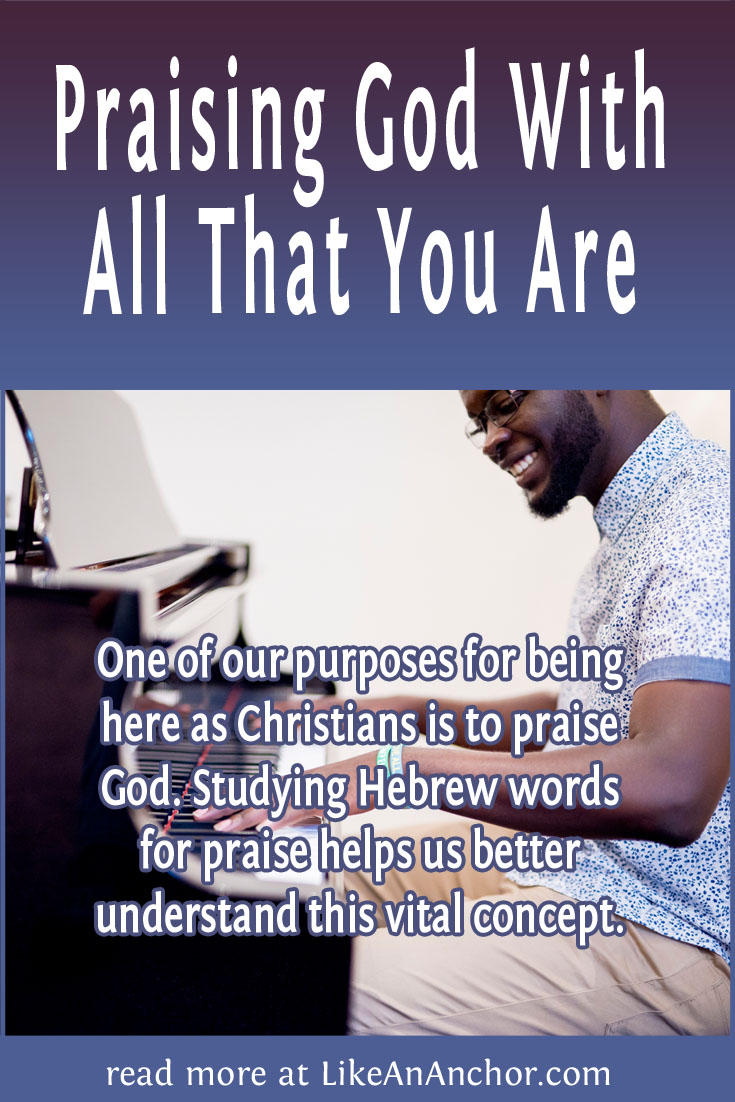
Image of a smiling man playing the piano, overlaid with blog's title text and the words, "One of our purposes for being here as Christians is to praise God. Studying Hebrew words for praise helps us better understand this vital concept."
Image by Ben White from Lightstock

So why did we spend all this time looking at nine Hebrew words (more if you include derivatives from the root words) that all translate into English so similarly?

In an English Bible, “praise” appears hundreds of times, depending no the translation (254 in WEB, 259 in KJV, 328 in NET, 363 in NIV). It’s a vital concept in scripture, and something that we need to understand how to do if we’re to relate properly to God. One of our purposes for being here as Christians is to praise Him. Our lives should praise God, as well as our lips (Phil. 1:9-11; Heb. 13:14-15).

In Christ we too have been claimed as God’s own possession, since we were predestined according to the purpose of him who accomplishes all things according to the counsel of his will so that we, who were the first to set our hope on Christ, would be to the praise of his glory. 

Ephesians 1:11-12, NET

If we just looked at the English word for praise, we’d think the definition was limited to “express warm approval or admiration of” and “express one’s respect and gratitude toward (a deity), especially in song” (definitions from Google and Oxford Languages). Studying the variety of Hebrew words related to praise gives us a much broader appreciation of praise. It’s more than just approval, admiration, respect, and gratitude. It’s a whole-life, whole-body, whole-heart expression of God’s glory, our thankfulness, and much more.


Featured image by Pearl from Lightstock

Finding Jesus in the Old Testament

Several times during Jesus’s ministry, He told people that the scriptures they read told them about Him. For example, He told some, “You study the scriptures thoroughly because you think in them you possess eternal life, and it is these same scriptures that testify about me” (John 5:39, NET). Remember, they would have just had the Old Testament at this time. The gospel events were happening in front of them, but they didn’t have written records yet pointing out which prophecies Jesus fulfilled and cross-referencing Old and New Testament writings the way we do today. And yet, Jesus told people that “everything written about me in the law of Moses and the prophets and the psalms must be fulfilled” (Luke 24:44, NET). He expected at least some of the people He spoke with to recognize that the law, prophets, and psalms all pointed to a Messiah and that He was that promised Messiah.

When I think about these scriptures, I wonder if I could have recognized that there was a coming Messiah from reading the Old Testament (OT). Even with the benefit of New Testament (NT) perspective, I struggle to see Him in the law of Moses. Not even all of the psalms and prophecies that NT writers identify as Messianic seem like something I’d have recognized when just reading the OT. Like the disciples on the road to Emmaus, we need Jesus to intervene in our minds to open our understanding (Luke 24:13-35). In fact, there are scriptures indicating it’s impossible to understand God’s word or have a relationship with Him unless the Father and Jesus take an active role in your life (John 6:44; 14:6).

At this point, we might ask ourselves several different questions, such as, “How much did believers in the Old Testament know?” and “How did salvation through Jesus (since you can’t be saved through anyone else [Acts 4:12]) work for people who lived and died before His sacrifice?” For today, though, I want to focus on the question, “Which verses in the Old Testament clearly point to Jesus Christ?” Or, since we’ll be looking at the OT that was written in Hebrew, to Yeshua the Messiah?

Image of a man studying the Bible overlaid with text from Matt. 16:16-17, NET version:  Simon Peter answered, “You are the Christ, the Son of the living God." Jesus answered, “Simon, Jonah's son, God has blessed you. No person on earth has showed you this. But my Father in heaven has showed you.”
Image by Matt Vasquez from Lightstock

Clarifying Names

The name “Jesus” is the English transliteration (representing a word from one language with the sounds and alphabet of another) of the Greek name Iēsous, which comes from the Hebrew name Yehoshua or Yeshua (H3091). The name means “Yahweh is salvation,” from the words Yahweh or Yehovah (H3068, God’s proper name [Ex. 4:15-16]) and yasha (H3467, “to save, be saved, be delivered” [BDB]). Yasha is the main root of a group of Hebrew words. Frequently used derivatives include yeshuah (H3444, salvation), teshuah (H8668, help, rescue, salvation) , and names such as Joshua, Hosea, Isaiah (Theological Wordbook of the Old Testament [TWOT] entry 929).

You won’t ever see the name “Jesus” in the Old Testament, but you frequently see the name Yeshua: it is translated into English as Joshua. There’s no prophecy in the Old Testament that says the Messiah will be named Yeshua. When Jesus was born, His name likely wouldn’t have stood out too much. Joshua is a popular name even today, and I doubt it was unusual in Jesus’s day considering the historic Yeshuas that people would have been familiar with (e.g. Moses’s successor Joshua son of Nun and Joshua the son of Josedech who appears in Haggai’s prophecies).

“Christ” is more of a title than a name. It is a transliteration into English of the Greek word christos (G5547), which is a translation (rendering the meaning of a word into the corresponding word in another language) of the Hebrew word mashiyah or Messiah (H4899). Both the Greek and Hebrew words mean “anointed” (Thayer; BDB). The root word mashach (H4886, anoint or rub with oil) is used most frequently of kings and priests sanctified for the Lord, and it’s also used twice of prophets (TWOT 1255). For example, it’s used when Yahweh chose Saul as the first king of Israel.

“Tomorrow about this time I will send you a man out of the land of Benjamin, and you shall anoint (mashach) him to be prince over my people Israel. He will save (yasha) my people out of the hand of the Philistines; for I have looked upon my people, because their cry has come to me.”

1 Samuel 9:16, WEB

Mashiyah (H4899, anointed one) is most frequently used in the Old Testament to refer to kings (TWOT 1255c). It also became closely associated with the God-being we now know as Jesus. By the time Jesus arrived, the Jews of His day were looking for the promised Messiah or Christ (Luke 3:15; 22:67; John 1:41-42; 4:25-29; 7:26). We still call prophecies from the OT that point to Jesus Messianic passages. It might surprise us, then, that if we compare all the verses using yasha and its related words to all the verses using masach and its related words, there are only 5 scriptures that use both and none of them are Messianic prophecies (1 Sam. 9:16; 2 Sam. 22:51; Psalm 8:50; 20:6; 28:8).

Image of a woman studying the Bible overlaid with text from John 4:25-26, NET version:  The woman said to him, “I know that Messiah is coming” (the one called Christ); “whenever he comes, he will tell us everything.”
Jesus said to her, “I, the one speaking to you, am he.”
Image by MarrCreative from Lightstock

Prophecies of the Messiah

There actually aren’t as many OT prophecies identifying the coming Messiah/Christ by the title “anointed” as you might think. It honestly surprised me, but when you realize that the Hebrew word mashiyah was “almost exclusively reserved as a synonym for ‘king'” (TWOT 1255c), then it becomes more understandable how OT readers realized that the spirit-filled, victorious, salvation-bringing God-being who would come in the name of the Lord should be called Messiah. We can see this in some of the disciples’ reactions to first meeting Jesus.

One of the two who heard John and followed him was Andrew, Simon Peter’s brother. He first found his own brother, Simon, and said to him, “We have found the Messiah!” (which is, being interpreted, Christ). He brought him to Jesus. … Philip found Nathanael, and said to him, “We have found him, of whom Moses in the law, and the prophets, wrote: Jesus of Nazareth, the son of Joseph.” …

Jesus saw Nathanael coming to him, and said about him, “Behold, an Israelite indeed, in whom is no deceit!”

Nathanael said to him, “How do you know me?”

Jesus answered him, “Before Philip called you, when you were under the fig tree, I saw you.”

Nathanael answered him, “Rabbi, you are the Son of God! You are King of Israel!”

John 1:40-42, 45, 47-49, WEB

Andrew called Jesus “the Messiah.” Phillip called Him the one “of whom Moses in the law, and the prophets, wrote.” Nathaniel called Him, “the Son of God” and “King of Israel.” They knew they were waiting for the Messiah, God’s son and the King of Israel, from reading the law and the prophets. Thanks to the Father’s revelation working in their lives, they could correctly identify that Jesus was the Christ (Matt. 16:13-20). Perhaps they were all thinking of Psalm 2, where the author talks about “Yahweh and … his Anointed,” who is also “King on my holy hill of Zion” and the Son of God.

Daniel also prophesied about “the Anointed One, the prince” (Dan. 9:25-26, WEB). Isaiah spoke of a descendent of David who would be full of God’s spirit and rule on David’s throne (implying an anointing even when it’s not explicitly mentioned) (Isaiah 9:1-7; 11:1-5; 61:1). Psalms talk about a strong, ruling, righteous, and anointed king (Ps. 45:1-7; 110:1-5). With those scriptures, as well as whatever oral traditions might have been passed down (depending on how much the people of God knew about His plan that didn’t make it into official scriptural writings), the people of Jesus’s day had the background needed to know they were looking for a Messiah. Even then, not everyone who met Jesus (Yeshua) was able to recognize that He was the Christ (Messiah). They needed God to give them eyes to see, ears to hear, and hearts to understand (Mat. 13:10-17).

Asking to Understand

Image of two hands holding a small Bible, overlaid with blog's title text and the words, "When you know where and how to look, you can see Jesus all throughout the Old Testament writings."
Image by Maura Griesse from Lightstock

When you know where to look, it’s not that hard to find Jesus in the Old Testament or to read the OT and see that there’s a coming Messiah. But without God working in your mind and heart, you won’t know to look. People can read the Bible over and over, even memorize huge sections, but still miss key truths because they’re just reading on their own with a human perspective. God is the one who makes His Bible come alive.

I think sometimes Christians forget how thankful we ought to be to God for letting us understand His word. And when we do that, we might also forget that we don’t yet know everything fully (1 Cor. 8:1-2; 13:12). For me at least, studying the prophecies of Jesus in the OT helps me realize that. Without God’s help and the records of fulfilled prophecies in the NT, I’d understand much less than I do now. And maybe there’s still more to learn, if I’m willing to ask.

“Ask and it will be given to you; seek and you will find; knock and the door will be opened for you. For everyone who asks receives, and the one who seeks finds, and to the one who knocks, the door will be opened. Is there anyone among you who, if his son asks for bread, will give him a stone? Or if he asks for a fish, will give him a snake? If you then, although you are evil, know how to give good gifts to your children, how much more will your Father in heaven give good gifts to those who ask him!”

Matthew 7:7-11, NET

We need to remember to thank God for the understanding He has granted us, and keep asking to know Him more deeply. One way we can participate in knowing Him at a deeper level is to prayerfully study His entire Bible. The questions I opened with today–“How much did believers in the Old Testament know?” and “How did salvation through Jesus work for people who lived and died before His sacrifice?”–are the types of questions a speaker at my church invited listeners to study in a message I heard last week.

That message focused on Abraham, and it’s fascinating to look at the conversations God had with him and at what the NT writers say about Abraham and God’s relationship. One verse even talks about the gospel being preached to Abraham, and in another Jesus said that Abraham “was overjoyed to see my day” (John 8:56; Gal. 3:7-16). Abraham probably knew a lot more about the Messiah than I’d realized just from reading his story, and he didn’t even have scrolls to study of the law, psalms, and prophets. Perhaps we can also understand more deeply by studying the relationships and revelation that God granted to those Old Testament heroes of faith (the people in Heb. 11, for example) and by asking God to speak into our lives similar to the way that He spoke to them.


Featured image by Inbetween from Lightstock

Song Recommendation: “Psalm 45 (A Noble theme)”

Inheriting Covenants: Revisited

I’ve been thinking about covenants a lot lately, especially the topic of which covenants transfer to us today and how that happens. I think of this as the topic of “inheriting covenants,” the title of a blog post I wrote way back in 2016. When I realized how long ago I wrote that post, I wanted to revisit the topic. As we grow in our walk with God, we should gain a deeper appreciation and understanding of His word. It’s good to go back sometimes and revisit topics we thought we understood well. As Paul said, “If someone thinks he knows something, he does not yet know to the degree that he needs to know” (1 Cor. 8:2, NET). There’s so much depth to God’s word; so much to learn as we grow.

Defining Covenants

Let’s start with the basics. In Hebrew, the word for “covenant” is berith (H1285). In Greek, for the New Testament, the word is diatheke (G1242). These words don’t mean exactly the same thing, and so it can be challenging for us today to figure out what the Biblical writers meant by covenants and how they worked. Also, most of our lives aren’t based on covenants today; in the U.S., I’ve rarely heard that word used outside of a religious context. We need to do some linguistic and historical research to understand covenants, which are so important to the Biblical world and God’s ongoing relationships with humanity.

The Theological Wordbook of the Old Testament (TWOT) notes that “Apart from blood ties the covenant was the way people of the ancient world formed wider relationships with each other” (entry 282a). Covenants have to do with establishing relationship. They were binding agreements between two parties that people in the ancient world took very seriously; “There is no firmer guarantee of legal security peace or personal loyalty than the covenant” (Behm, qtd. in TWOT). When God made a covenant with His people, we was binding Himself in relationship to them in the most reliable way possible. Like other covenants, the ones between God and humanity include both expectations and promises. Covenant documents between people survive to the present day, and the format of them has many similarities with God’s Ten Commandments and the book of Deuteronomy (Klein, ref. in TWOT).

In Greek, diatheke means testament, as in “the last disposition which one makes of his earthly possessions after his death,” or a covenant agreement (Thayer). According to Spiros Zodhiates, dispensation/testament is always the usage in classical Greek (The Complete WordStudy Dictionary of the New Testament, entry 1242). New Testament writers picked this word to use for covenants. That might seem odd at first, but Zodhiates proposes a definition of covenant that covers both the unilateral enactment of diatheke and the established relationship of berith. He writes that what we describe as a covenant “is a divine order or agreement which is established without any human cooperation and springing from the choice of God Himself whose will and determination account for both its origin and its character” (entry G1242, section IV).

Indeed, we always see God as the initiator of covenants and, by necessity, the relationship established by a covenant with God is always one where He is the superior party. God calls us His friends, but that is a gracious choice on His part; we are by no means His equals nor can we make demands of Him. We either choose to accept the covenants He offers, or we reject relationship with Him. We don’t get the chance to insert our own demands into the covenant; we trust that we’re more than adequately protected and provided for by His promises.

Image of a woman reading the Bible overlaid with text from Jeremiah 31:31, 33, NET version: "Indeed, a time is coming," says the Lord, "when I will make a new covenant with the people of Israel and Judah. ... I will put my law within them and write it on their hearts and minds. I will be their God and they will be my people."
Image by Matt Vasquez from Lightstock

Key Covenants

There are four main covenants that God made with human beings that are recorded in the Old Testament writings: the Noahic Covenant, the Abrahamic Covenant, the Sinai Covenant, and the Davidic Covenant. There are other covenants mentioned, but those are the big ones. The BibleProject has a great summary of these on YouTube:

With the exception of the Noahic Covenant, the covenants God made with people included expectations for God’s human covenant partners. God kept up His covenant promises, but people broke the covenants with God. That put us under a death-penalty; a curse (Rom. 3:23; 5:12; Gal. 3:10). Then Jesus came along. As a human being, He was a physical descendant of Abraham, an Israelite heir of the covenants with God, and a man in the lineage of David (Acts 2:29-31). He was born into the physical position of an heir to all these key covenants. He also came as God in the flesh, so He can see covenants from both sides and keep covenant perfectly both as God and human.

Prior to Jesus Christ coming to this earth, all except the Noahic Covenant were linked to Abraham’s descendants. The Sinai Covenant was with all of physical Israel and included a fuller revelation of God’s law and expectations. The Davidic covenant was more specific, applying to one line of the tribe of Judah. It was possible for a stranger to join themselves to Israel and become part of the Abrahamic and Sinai Covenants with God, as Rahab and Ruth did, but it was apparently quite rare and more often than not was discussed in a prophetic context (Is. 56:6-7).

That also changed with Jesus’s coming. In the New Testament, Paul writes to Gentile believers that they were “alienated from the citizenship of Israel and strangers to the covenants of promise, having no hope and without God in the world” until the time of their conversion. They were not previously heirs to the covenants, “But now in Christ Jesus you who used to be far away have been brought near by the blood of Christ” (Eph. 2:12-13, NET). This is a fulfillment of a promise that God delivered through His prophets; a promise to make a better New Covenant with the people of Israel and the spiritual descendants of Abraham.

A Question of Inheritance

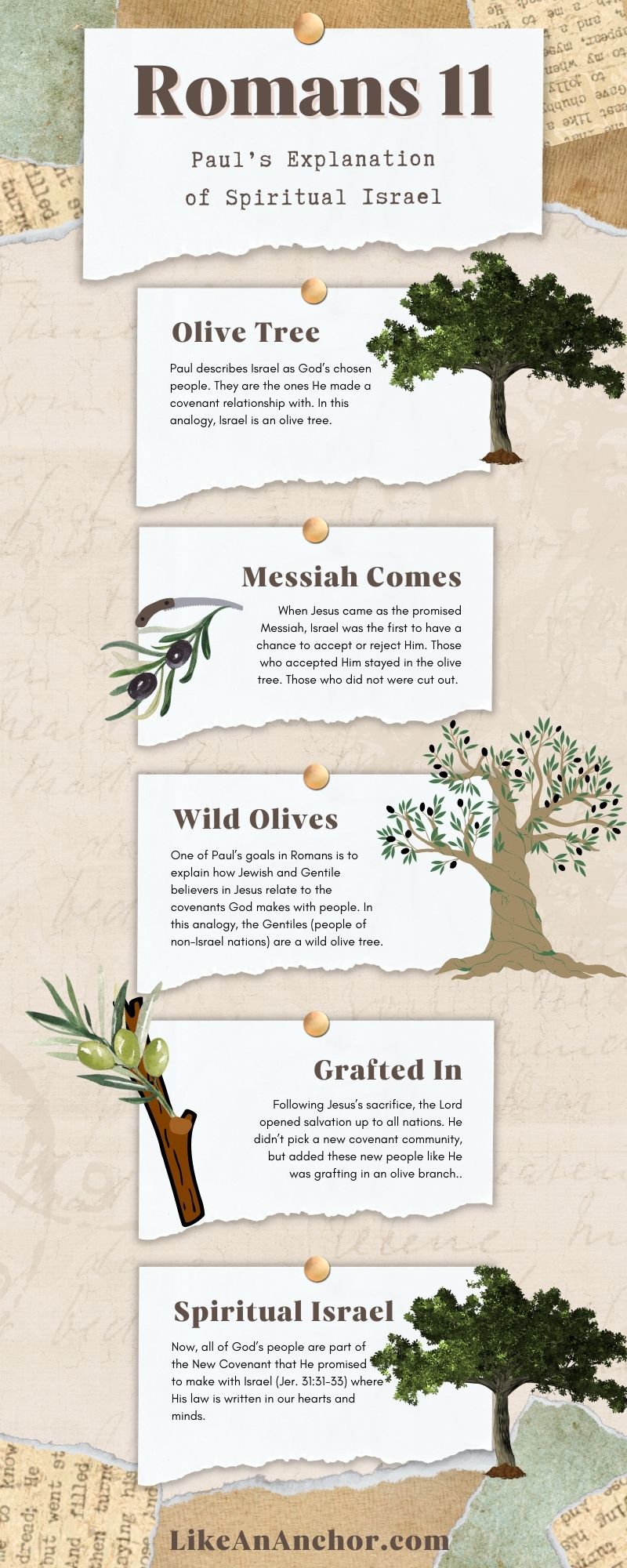
Infographic illustrating the "grafted in" analogy Paul uses for how Jewish and Gentile Christians enter the New Covenant community with God.

I usually go to Romans when I want to discuss covenants, which is where we were a couple weeks ago when I shared an infographic illustrating how all God’s people become spiritual Israel. Today, though, we’re going to spend some time in Galatians.

In this letter, Paul writes to a group of churches with the expressed purpose of countering distorted gospels (Gal. 1:6-8). He wants to ensure that they follow the pure gospel that he receive, not some distortion arising from human reasoning (Gal. 1:1, 11-12, 15-24). That’s the perspective Paul’s coming from when he discusses covenants in this letter.

It appears that the Galatian believers had been deceived by a person or group who told them they needed to keep the whole Jewish law in order to be saved. The Galatians were worried that the male believers needed to be circumcised, that they had to keep the whole Old Covenant law, and that they additionally had to keep Jewish additions to God’s law. Paul reminds them that it is Jesus’s faithfulness that brings us righteousness and justification, not our own efforts. That doesn’t mean we break God’s law; Christ in us most certainly does not encourage sin. But He also didn’t save us and give us the Spirit so that we could then save ourselves by our own efforts. Rather, we’re following the example of Abraham.

Just as Abraham believed God, and it was credited to him as righteousness, so then, understand that those who believe are the sons of Abraham. And the scripture, foreseeing that God would justify the Gentiles by faith, proclaimed the gospel to Abraham ahead of time, saying, “All the nations will be blessed in you.” So then those who believe are blessed along with Abraham the believer. 

Galatians 3:6-9, NET (bolt italics mark quotes from the Old Testament)

Here, Paul quotes from the record in Genesis of God cutting a covenant with Abraham (Gen. 15). This covenant is one of inheritance and blessing. We learn more about it in Genesis 17 and 18, which Paul also quotes. If you read that section, you’ll notice that God’s covenant with Abraham included people following the Lord’s way and doing what is right. But, as Paul emphasizes, the promises come to Abraham and his descendants because God is faithful, not because they kept the Law that God later shared as part of the Sinai Covenant or because they observed Jewish traditions added later.

God does want people to follow His law (it defines sin and, since sin is not consistent with God’s character, it damages relationships between us and Him). But God also knows that all people sin. It is very, very good for us that He upholds His part of covenants even when people aren’t faithful, because one of those covenant promises was that God would send Jesus as the Messiah. That’s how we inherit the Abrahamic Covenant promises: through Jesus Christ.

 Brothers and sisters, I offer an example from everyday life: When a covenant has been ratified, even though it is only a human contract, no one can set it aside or add anything to it. Now the promises were spoken to Abraham and to his descendant. Scripture does not say, “and to the descendants,” referring to many, but “and to your descendant,” referring to one, who is Christ. What I am saying is this: The law that came 430 years later does not cancel a covenant previously ratified by God, so as to invalidate the promise. For if the inheritance is based on the law, it is no longer based on the promise, but God graciously gave it to Abraham through the promise.

Galatians 3:15-18, NET (bolt italics mark quotes from the Old Testament)

A few verses later, Paul says that the Law was “added because of transgressions, until the arrival of the descendant to whom the promise had been made” (Gal. 3:19, NET). He also says the law was a guard to keep us safe and a “tutor to bring us to Christ, that we might be justified by faith” (Gal. 3:24, WEB). The law defines sin for us and reveals the penalties for breaking God’s covenant law. As transgressors of the covenant, we deserved to inherit the curses contained in the covenanting words (Deut. 11:26-32; 27:1-28:68). The only one who perfectly kept God’s covenant was Jesus Christ, and so He’s the only one who truly deserved to inherit all the promises. When He died, He “willed” those promises to us. We inherit the Abrahamic Covenant alongside Him, and through Him we’re brought into the New Covenant that God long ago promised would replace the Old (Sinai) Covenant (Jer. 31:31-34; Heb. 8).

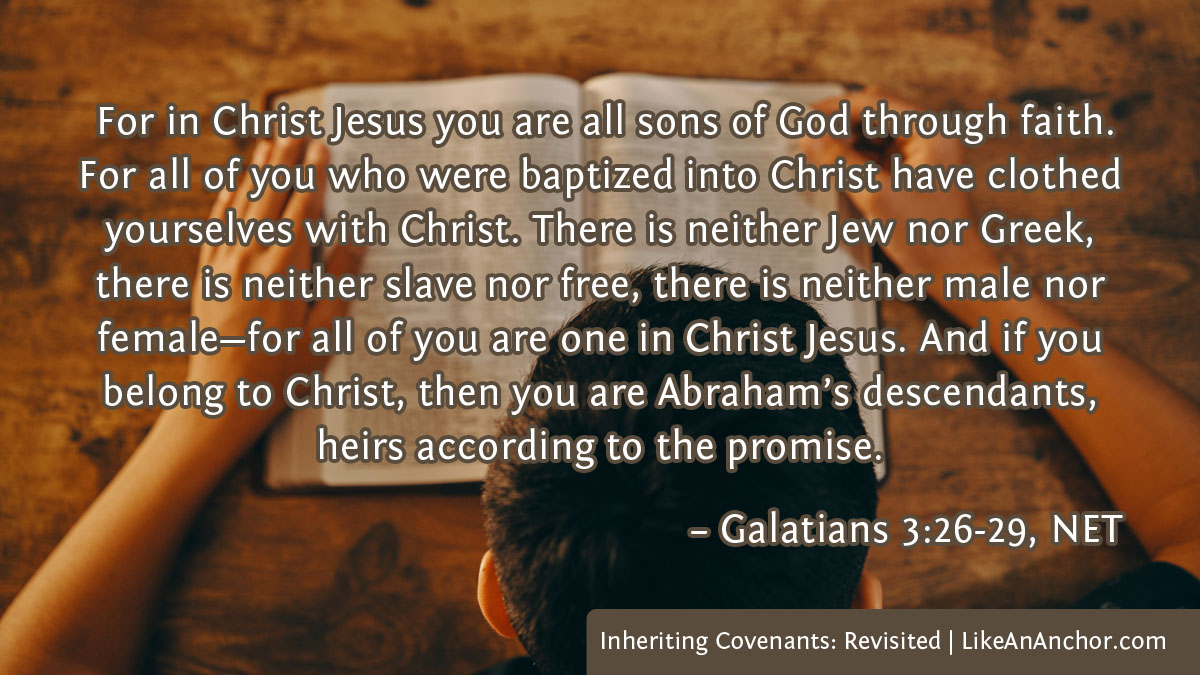
Image of a man reading the Bible overlaid with text from Galatians 3:26-29, NET version:  " For in Christ Jesus you are all sons of God through faith. For all of you who were baptized into Christ have clothed yourselves with Christ. There is neither Jew nor Greek, there is neither slave nor free, there is neither male nor female—for all of you are one in Christ Jesus. And if you belong to Christ, then you are Abraham’s descendants, heirs according to the promise."
Image by Matt Vasquez from Lightstock

Promises Through Jesus

I find it so fascinating that the New Testament writers use the fact that the Greek word for covenant also means last will and testament to connect the idea of covenant inheritance to our adoption as God’s children (Gal. 3:26-4:7; Rom. 8:14-17). The author of Hebrews spends quite a bit of time explaining this concept, particularly the transition from Old to New Covenant.

 And so he [Jesus] is the mediator of a new covenant, so that those who are called may receive the eternal inheritance he has promised, since he died to set them free from the violations committed under the first covenant. For where there is a will, the death of the one who made it must be proven. For a will takes effect only at death, since it carries no force while the one who made it is alive. 

Hebrews 9:15-17
Image of a man and woman reading the Bible together, overlaid with blog's title text and the words, "Jesus makes all who believe in and fellow Him heirs of God's covenant promises."
Image by Anggie from Lightstock

As the Word of God, Jesus is (almost certainly) the God-being who delivered the first covenants in the Old Testament. Then, as the original testator, He died so we can be freed from the Old Covenant and join Him in a New Covenant (Jer. 31:32-34; Rom 7:1-4). At the same time, as a human heir to all the covenants (and the only person who kept humanity’s side of the covenant bargain, since He never sinned), Jesus died to take on Himself the penalty we earned for breaking the covenant, purify us with His blood, and bring us into a new covenant (Heb. 9:18-28). Yet another layer is that He inherits all the promises, wills them to us at His death, then rises again to inherit as well (Eph. 1:3-21).

We were also assigned an inheritance in him, having been foreordained according to the purpose of him who does all things after the counsel of his will, to the end that we should be to the praise of his glory, we who had before hoped in Christ. …

For this cause I also …  don’t cease to give thanks for you, making mention of you in my prayers, that the God of our Lord Jesus Christ, the Father of glory, may give to you a spirit of wisdom and revelation in the knowledge of him, having the eyes of your hearts enlightened, that you may know what is the hope of his calling, and what are the riches of the glory of his inheritance in the saints, and what is the exceeding greatness of his power toward us who believe, according to that working of the strength of his might which he worked in Christ, when he raised him from the dead

Ephesians 1:11-12, 15-20, WEB

It’s amazing to me that God invites us to be covenant partners with Him and participate in the relationships that He’s been building with humanity since the world began (the word “covenant” isn’t used in the creation story, but the words of His promises to Adam and Eve are covenant-like, and some call it the Adamic Covenant). People often say that God wants a personal relationship with you, and covenants are the way that the Bible describes that relationship. They’re so important to understanding our role in God’s plan and His family, and I don’t think we talk about them enough. The more deeply and completely we understand covenants, the better we’ll understand God and the relationship He wants to have with us.


Featured image by falco from Pixabay

A Time To Return

If I asked you to define “repent” or “repentance,” what would you say?

We know it’s the thing you’re supposed to do when you’ve sinned and you’re coming to God asking for forgiveness. But is it just saying you’re sorry?

In English, “repent” means to express regret and remorse. While the Hebrew and Greek words translated “repent” in the Bible include that aspect of regret, the Biblical concept goes a step farther. Biblical repentance involves change. This change is a movement; an alteration in the direction of your heart and your life. The word image contained in both Hebrew and Greek is to turn away from sin and to turn toward God.

Unpopular Repentance

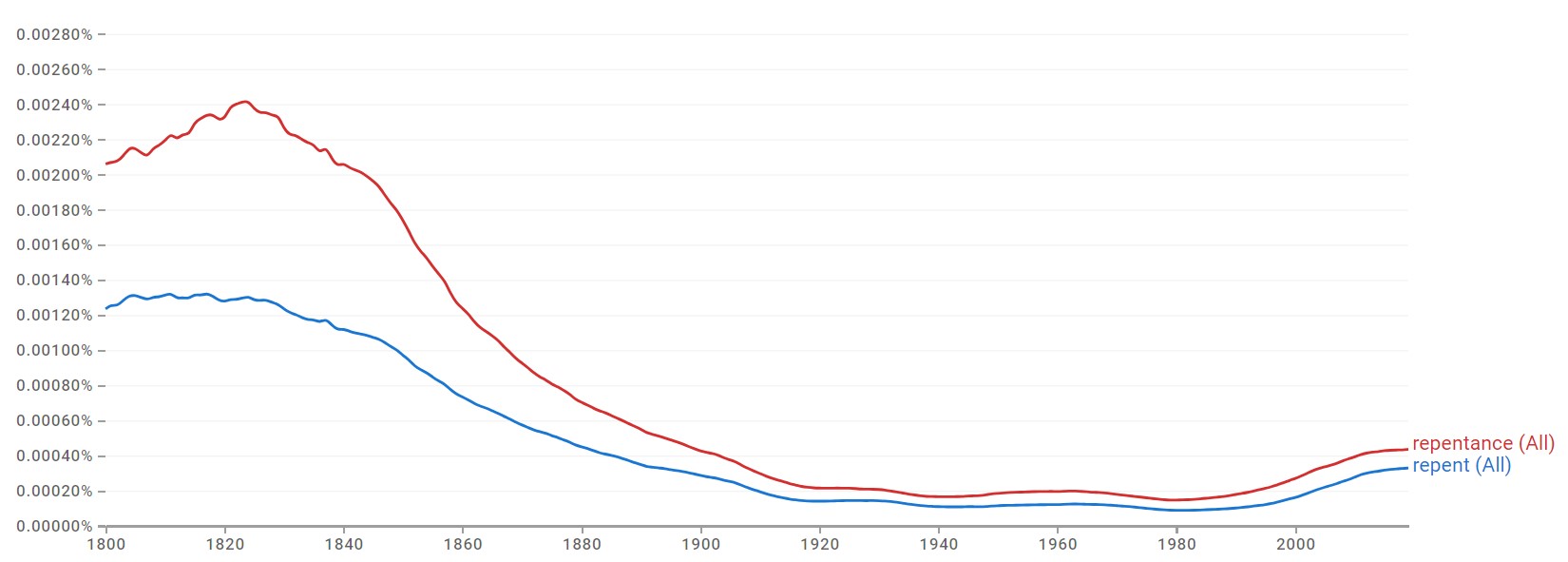
According to Oxford Languages (via Google), “repent” means “feel or express sincere regret or remorse about one’s wrongdoing or sin.” It came into Middle English “from Old French repentir, from re- (expressing intensive force) + pentir (based on Latin paenitere ‘cause to repent’).” There’s also something interesting going on with Google’s tracking for how often this word was used in English-language books between 1800 and 2019.

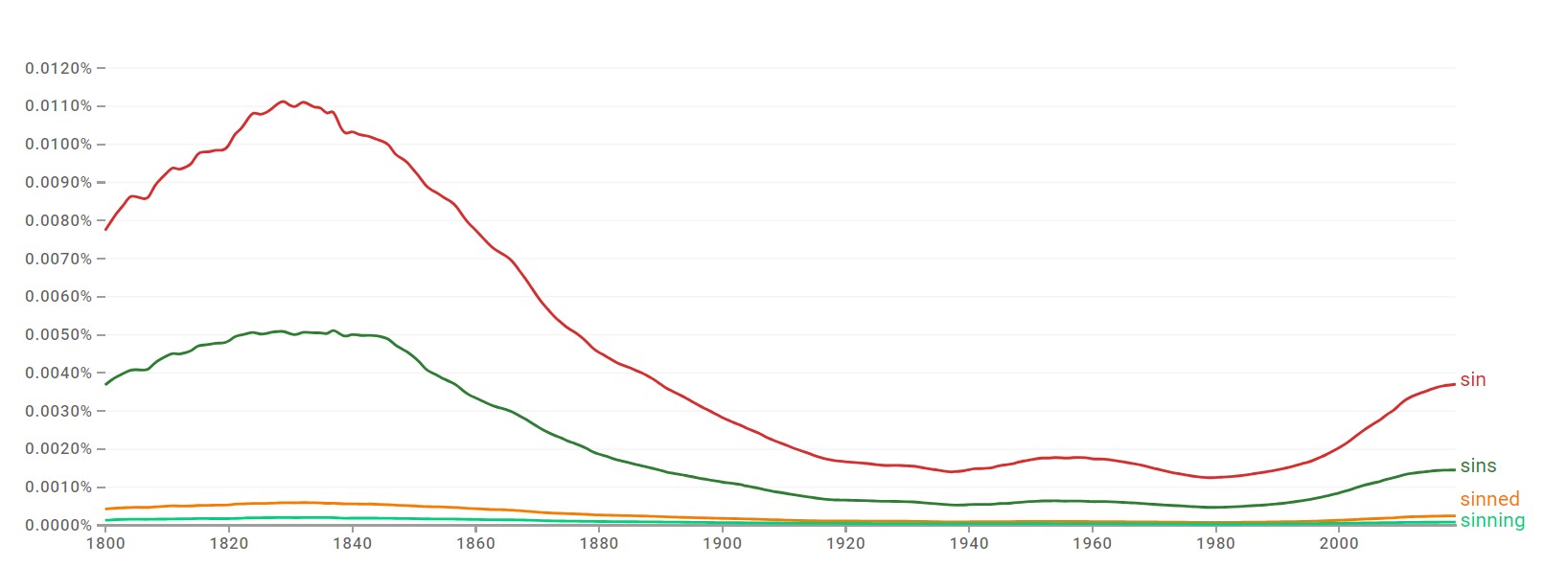
Evidently, repentance is not a popular idea (though I am intrigued by the recent uptick in usage after that slump in the 1900s). I don’t really think it will surprise any of us that “repent” and “repentance” are used less now than they were in the early 1800s. Repentance is something you need to do after you sin, and sin isn’t something we like to think about either. The more moral relativism takes hold in our society, the less people are willing to acknowledge sin is even a real thing since sin is the transgression of (God’s) absolute laws. The chart for “sin” in English language books looks very similar to the one for repentance.

But what about us today? If we’re sincerely following Jesus and love Him, He says we’ll obey His commandments. Commandments are contained in the law of God (Matt. 22:36, 40). The law and commandments are “holy, righteous, and good” (Rom. 7:12), and it is how God lets people know what sin is (Rom. 7:7-8). John says, “Sin is lawlessness” (1 John 3:4, WEB) or “the transgression of the law” (KJV). Paul further adds that “all have sinned” (Rom. 3:23). When Jesus came to this earth, one of His stated purposes was to call “sinners to repentance” (Luke 5:32), and it’s a message His disciples continued to preach (Acts 2:38; 3:19).

Putting all that together, we see that every human being is guilty of sin. Jesus can fix that problem, though. When sinners repent and follow Him, He takes away their sins (John 1:29; 1 John 3:5). Even after that, though, we still have a responsibility to keep His commandments because we love Him. And if we sin, then we need to repent again.

Returning and Changing

In Greek, one word translated “repent” is metanoeo (G3340). It includes the “regret or sorrow” aspect that is captured by the English word “repent,” but it also involves another step. The root words are meta (G3326: to be among or amidst, or to move toward that position) and noeo (G3539: “to exercise the mind, think, comprehend”) (Zodhiates entry G3340). Metanoeo is distinct from regret (metamelomai [G3338]) and includes “a true change of heart toward God” (Zodhiates). Thayer defines metanoeo as “to change one’s mind for better, heartily to amend with abhorrence of one’s past sins” (Thayer entry G3340). There’s a sense of turning around involved, as if when we sin we are walking away from God and when we repent we turn around and go toward Him again.

There’s another word for repentance in the New Testament as well. Zodhiates writes, “Metanoeo presents repentance in its negative aspect as a change of mind or turning from sin while epistrepho presents it in its positive aspect as turning to God” (Zodhiates entry G3340). He also notes that both of these words “derive their moral content … from Jewish and Christian thought, since nothing analogous to the biblical concept of repentance and conversion was known to the Greeks.” To understand what metanoeo and epistrepho (G1994) meant to early Christians, we need to look back at the Hebrew words expressing the same concepts.

Once again, we have two words that can be translated into English as “repent.” One of those, nacham (H5162) is typically only used of God “repenting” in the sense of “relenting or changing,” like He did when he delayed Nineveh’s destruction in response to their repentance (Theological Wordbook of the Old Testament [TWOT] entry 1344). In that story of Nineveh, we also see the Hebrew word more commonly used for human repentance, shub (H7725).

Jonah began to enter into the city a day’s journey, and he cried out, and said, “In forty days, Nineveh will be overthrown!”

The people of Nineveh believed God; and they proclaimed a fast, and put on sackcloth, from their greatest even to their least. The news reached the king of Nineveh, and he arose from his throne, and took off his royal robe, covered himself with sackcloth, and sat in ashes. He made a proclamation and published through Nineveh by the decree of the king and his nobles, saying, “Let neither man nor animal, herd nor flock, taste anything; let them not feed, nor drink water; but let them be covered with sackcloth, both man and animal, and let them cry mightily to God. Yes, let them turn (shub) everyone from his evil way, and from the violence that is in his hands. Who knows whether God will not turn (shub) and relent (nacham), and turn (shub) away from his fierce anger, so that we might not perish?”

God saw their works, that they turned (shub) from their evil way. God relented (nacham) of the disaster which he said he would do to them, and he didn’t do it.

Jonah 3:4-10, WEB

The basic meaning of shub is to turn or return. It is a Hebrew verb used frequently; “over 1050 times” in the Old Testament. While the Hebrew writers use many word pictures to describe repentance, all “are subsumed and summarized by this one verb shub. For better than any other verb is combines in itself the two requisites of repentance: to turn from evil and to turn to the good” (TWOT 2340). Like the Greek words that would later represent the same concept, Hebrew notions of repentance include both regret and turning away from sin and turning toward God. There’s always a sense of change; the verb shub is so connected with turning and change that it is even used of physical movement and coming back to a people or location (TWOT 2340).

The word shub is particularly important in it’s relation to “the covenant community’s return to God,” and one scholar concludes “there are a total of 164 uses of shub in a covenantal context” (TWOT 2340). Covenants are the way that God makes formal relationships with people; if we’re truly following God then we have made a covenant commitment to Him. Under the terms of a covenant, both parties involved have rights and responsibilities. In relation to repentance, both God and humanity have a role to play. The person repenting goes “beyond contrition and sorrow to a conscious decision of turning to God,” God freely extends His sovereign mercy, and then we continue in a commitment that involves “repudiation of all sin and affirmation of God’s total will or one’s life” (TWOT 2340). That concept is found in the Old Covenant, and is reinforced in the New Covenant (Acts 3:19; 26:17-20; 1 Thes. 1:9).

Trumpet Blasts As A Call to Return

In last week’s post, I talked about observing the Day of Trumpets (Yom Teruah). It is one of God’s special holy days, which He commands His covenant people to keep. It is a Sabbath day of complete rest, a day God calls His people to gather together, and “a memorial announced by loud horn blasts” (Lev. 23:24, WEB); “it is a day of blowing trumpets for you” (Num. 29:1, WEB). We traditionally say that in the New Covenant, the Day of Trumpets pictures the second coming of Jesus Christ, which will be heralded by trumpet blasts (1 Thes. 4:15-18).

We can also see the trumpet blasts as a call to alert us today of the need to return to God. In Jewish tradition, the Sabbath day that falls between Day of Trumpets and Day of Atonement (Yom Kippur) is called Shabbat Shuvah, the Sabbath of Return. As we just learned, shuvah/shub is the Hebrew word for repentance. As we move from Day of Trumpets to Day of Atonement, repentance should be on our minds.

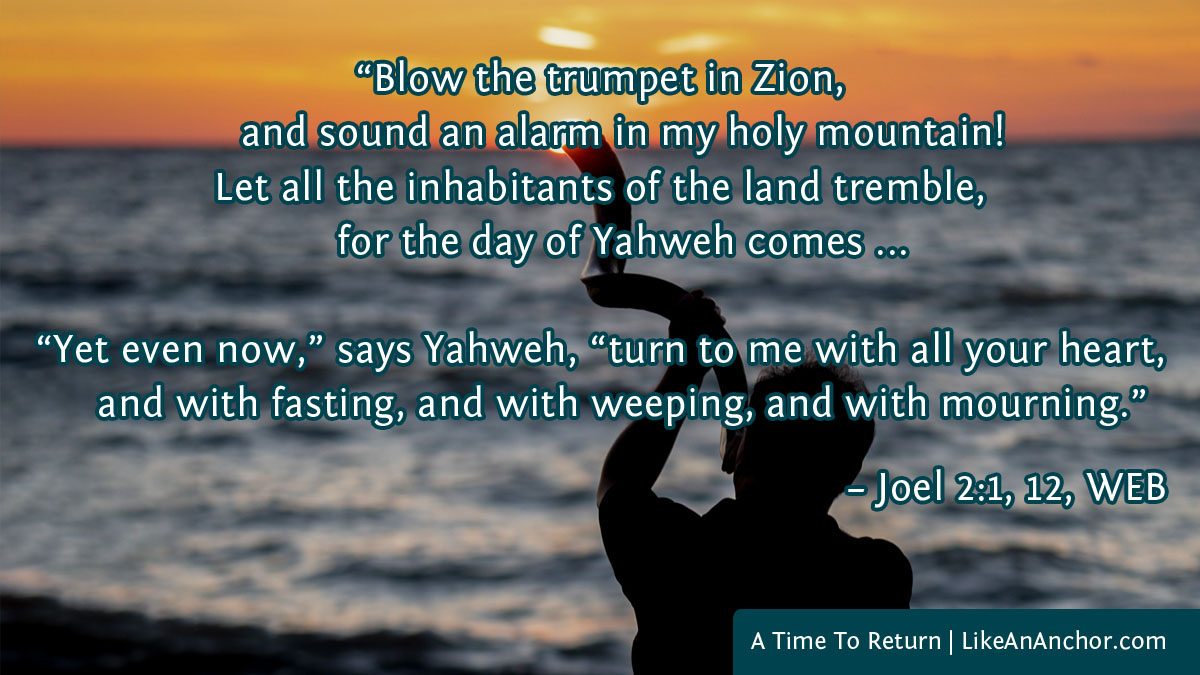
Blow the trumpet in Zion,
    and sound an alarm in my holy mountain!
Let all the inhabitants of the land tremble,
    for the day of Yahweh comes,
    for it is close at hand:
A day of darkness and gloominess,
    a day of clouds and thick darkness.
As the dawn spreading on the mountains,
    a great and strong people;
    there has never been the like,
    neither will there be any more after them,
    even to the years of many generations.

Joel 2:1-2, WEB

As Joel warns, the time before Jesu’s return (the day of Yahweh, or day of the Lord) will be a dark time for the world as a whole. The world is getting worse and worse as His return draws nearer, and Revelation reveals it’s only going to get even worse (like during the soundings of the seven trumpets given to angels; Rev. 8-11). When contemplating the coming of this day, Peter asks a pertinent question: “since all these things will be destroyed like this, what kind of people ought you to be in holy living and godliness?” (2 Pet. 3:11, WEB). He answers by saying that since we look for Jesus’s return, we should “be diligent to be found in peace, without defect and blameless in his sight” and “grow in the grace and knowledge of our Lord and Savior Jesus Christ” (2 Pet. 3:14, 18 WEB). Joel records a similar warning to turn back to following God faithfully.

Yahweh thunders his voice before his army;
    for his forces are very great;
    for he is strong who obeys his command;
    for the day of Yahweh is great and very awesome,
    and who can endure it?
“Yet even now,” says Yahweh, “turn to me with all your heart,
    and with fasting, and with weeping, and with mourning.”
Tear your heart, and not your garments,
    and turn to Yahweh, your God;
    for he is gracious and merciful,
    slow to anger, and abundant in loving kindness,
    and relents from sending calamity.
Who knows? He may turn and relent,
    and leave a blessing behind him,
    even a meal offering and a drink offering to Yahweh, your God.
Blow the trumpet in Zion!
    Sanctify a fast.
    Call a solemn assembly.
Gather the people.
    Sanctify the assembly.

Joel 2:11-16, WEB
Image of four people walking into a church building with the blog's title text and the words "As we're reminded of Jesus's approaching return, God calls us to repentance; to turn away from our own way of doing things and turn toward Him."
Image by Pearl from Lightstock

This year, we will observe the Day of Atonement on September 25, 2023. This is a solemn holy day when God commands us to rest completely and “afflict your souls” (traditionally understood to mean fasting). Reading Joel, I can’t help but notice that the trumpet blasts warning that the Messiah’s return is coming closer and closer also call us to fast and repent. God and the prophet Joel call out to readers, saying, “turn (shub) to Yahweh, your God!”

All of us are getting closer every day either to the end of our lives or to Jesus Christ’s return. One way or another, we have a limited time here on this earth. Keeping the Day of Trumpets and Day of Atonement remind us of that. They also remind us of the wonderful things the Messiah has done and is doing for His people. Because of Jesus’s atoning sacrifice, God graciously removes our sins when we repent, turning our lives around and (re)committing to following Him faithfully. We need that reminder of His awesome mercy, of our total dependence on Him, and of His promise to return and set things on this earth right.


Featured image by Pearl from Lightstock

How Do We Learn From God’s Judgements?

As I wrote last week’s post about “Seeking and Learning Righteousness,” I kept mentioning the connection between learning righteousness and paying attention to God’s judgements. The key scripture we looked at in that post reads, “Yes, with my spirit within me I will seek you earnestly; for when your judgments are in the earth, the inhabitants of the world learn righteousness” (Is. 26:9, WEB). 

It’s clear from this and other verses we looked at last week that we can learn righteousness from God’s judgements. But how? That was a question I thought of while writing, but didn’t really have the time to address. To answer this, we first need to understand what Isaiah means by God’s judgements.

More than Simply “Judgements”

The word translated “judgement” in Isaiah 26:9 is the Hebrew mishpat (H4941). Common translations include “judgement, justice, ordinance” (Brown-Driver-Briggs). This word is not confined to what we think of as the judicial function of government. The root word shapat means “to exercise [all] the processes of government” (Theological Wordbook of the Old Testament [TWOT], entry 2443). Furthermore, ancient understanding didn’t really separate the law from the lawgiver–“the centering of law, rulership, government in a man was deeply ingrained” (TWOT 2443). This makes perfect sense when we think of God as the Lawgiver and Ruler. The Bible treats His Law as an extension of His character.

For mishpat specifically, there are “at least thirteen related, but distinct, aspects of the central idea, which if to be rendered by a single English word with similar range of meaning ought by all means to be the word ‘justice'” (TWOT 2443c). These 13 meanings include “the act of deciding a case of litigation,” “a sentence or decision issuing from a magistrate’s court,” “an ordinance of law,” and “one’s right under law,” among others.” One other key meaning is “sovereignty, the legal foundation of government in the sense of ultimate authority or right.” People today expect this to be centered in laws and governing documents, but in scripture “The mishpat is God’s” (TWOT 2443c; Deut. 1:17). He has all authority, and when He exercises judgement/justice He does so as head of everything (not just a single branch of government).

When we speak of learning from God’s mishpat, that includes learning from His sovereign authority, His ordinances of law, and His just legislative rulings. Mishpat appears 421 times in the Old Testament so obviously we can’t look at every verse right now, but we can look at some examples of how God expected people to interact with His mishpat.

  • God chose to share His plans about Sodom and Gomorrah with Abraham before it happened because “I have known him, to the end that he may command his children and his household after him, that they may keep the way of Yahweh, to do righteousness and justice (mishpat)” (Gen. 18:19, WEB). One of the reasons the Lord trusted Abraham is because he kept Yahweh’s mishpat and would teach the people under his care to do so as well.
  • The laws/rules/ordinances/commands revealed to Moses at Mount Sinai are called mishpat: “Moses came and told the people all Yahweh’s words, and all the ordinances(mishpat); and all the people answered with one voice, and said, ‘All the words which Yahweh has spoken will we do'” (Ex. 24:3, WEB). (See also Lev. 18:4-5; 20:22; 25:18; 26:46).
  • The people of Israel had to keep all the Lord’s mishpat if they wanted to inherit the promises He made. They were warned not to add to or take away from God’s commands, nor to forget them. They also had a responsibility to pass on the mishpat to their children, as Abraham did to his. If they kept the mishpat, God would give them great blessings (Deut. 4:1-14; 5:1-22, 31-33; 7:12-13; 11:1; 26:16-19).
  • David, whom God described as “a man after my heart, who will do all my will” (Acts 13:22, WEB), said, “I have kept Yahweh’s ways, and have not wickedly departed from my God. For all his ordinances (mishpat) were before me. As for his statutes, I didn’t depart from them” (2 Sam 22:22-23, WEB).
  • We often say Solomon asked God for wisdom, but the specific wording when God responds is, “Because you … have asked for yourself understanding to discern justice (mishpat); behold, I have done according to your word. Behold, I have given you a wise and understanding heart” (1 Kings 3:11-12, WEB).
  • Judgement came on ancient Israel because they forsook God and stopped keeping His judgements/ordinances (1 Kings 11:31-33; Neh. 1:4-7; 9:28-29; Ezk. 5:5-8; 11:10-12; 20:11-24; Dan. 9:4-5). Notice that not keeping God’s mishpat is a sin and is linked with forsaking God Himself.
Image of a man watching a sunset overlaid with text from Deut. 11:1, WEB version:  “you shall love Yahweh your God, and keep his instructions, his statutes, his ordinances, and his commandments, always.”
Image by Aaron Kitzo from Lightstock

Lessons from Ancient Israel’s Relationship With God

I want to spend a little more time looking at ancient Israel’s relationship with God’s mishpat. When God instituted the Sinai Covenant with Israel, it was like a marriage ceremony. The laws and ordinances that He delivered are like the marriage vows that couples make. Both God and the people bound themselves together in a formal relationship–a covenant–and agreed to live by His mishpat (Ex. 24:3). As co-inheritors with Jesus Christ of the covenants God made with His people in the past, His mishpat are still relevant for us today and we can learn from the ways that God’s people in the past related to Him and His justice/ordinances.

There’s a passage in Ezekiel where God summarizes His relationship with the people of Israel thus far, and He pays particular attention to how they related to His mishpat. Ezekiel records that “some of the elders of Israel came to inquire of Yahweh,” and Yahweh responded by telling Ezekiel, “Cause them to know the abominations of their fathers” (Ezk. 20:1, 4, WEB). As we read the history of Israel from the Lord’s perspective, keep in mind that He uses the word “abominations” to describe what the people did. The actions they took against Him and His mishpat were very serious.

“So I caused them to go out of the land of Egypt, and brought them into the wilderness. I gave them my statutes, and showed them my ordinances (mishpat), which if a man does, he will live in them. Moreover also I gave them my Sabbaths, to be a sign between me and them, that they might know that I am Yahweh who sanctifies them.

“But the house of Israel rebelled against me in the wilderness. They didn’t walk in my statutes, and they rejected my ordinances (mishpat), which if a man keeps, he shall live in them. They greatly profaned my Sabbaths. Then I said I would pour out my wrath on them in the wilderness, to consume them. But I worked for my name’s sake, that it should not be profaned in the sight of the nations, in whose sight I brought them out.  Moreover also I swore to them in the wilderness, that I would not bring them into the land which I had given them, flowing with milk and honey, which is the glory of all lands;  because they rejected my ordinances (mishpat), and didn’t walk in my statutes, and profaned my Sabbaths; for their heart went after their idols. Nevertheless my eye spared them, and I didn’t destroy them. I didn’t make a full end of them in the wilderness. I said to their children in the wilderness, ‘Don’t walk in the statutes of your fathers. Don’t observe their ordinances (mishpat) or defile yourselves with their idols.  I am Yahweh your God. Walk in my statutes, keep my ordinances (mishpat), and do them.  Make my Sabbaths holy. They shall be a sign between me and you, that you may know that I am Yahweh your God.'”

“But the children rebelled against me. They didn’t walk in my statutes, and didn’t keep my ordinances (mishpat) to do them, which if a man does, he shall live in them. They profaned my Sabbaths. Then I said I would pour out my wrath on them, to accomplish my anger against them in the wilderness. Nevertheless I withdrew my hand, and worked for my name’s sake, that it should not be profaned in the sight of the nations, in whose sight I brought them out. Moreover I swore to them in the wilderness, that I would scatter them among the nations, and disperse them through the countries; because they had not executed my ordinances (mishpat), but had rejected my statutes, and had profaned my Sabbaths, and their eyes were after their fathers’ idols.”

Ezekiel 20:10-24, WEB

This tragic story is not just ancient history. Paul told New Covenant Christians in Corinth, “These things happened to them as examples and were written for our instruction, on whom the ends of the ages have come. So let the one who thinks he is standing be careful that he does not fall” (1 Cor. 10:11-12, NET). We need to learn from the lessons of Israel’s history in the Old Testament so that we don’t make the same mistakes, such as rejecting the mishpat of our God. Then and today, God wants people who have a relationship with Him to live in and walk in His justice/ordinances/judgements. We’re supposed to become holy as He is holy, and doing what He tells us to is part of that process.

Image of two women reading Bibles overlaid with text from 1 Peter 1:13-15, WEB version:  "“Be sober, and set your hope fully on the grace that will be brought to you at the revelation of Jesus Christ—as children of obedience, not conforming yourselves according to your former lusts as in your ignorance, but just as he who called you is holy, you yourselves also be holy in all of your behavior”
Image by Shaun Menary from Lightstock

Trained in Righteousness Today

Talking about the ordinances of God from the Old Testament makes some modern Christians uncomfortable. This is due to misinformation about how New Covenant believers relate to God’s laws. For example, Paul is often misread as doing away with God’s law. He preempted that reading by asking and answering a question: “Do we then nullify the law through faith? May it never be! No, we establish the law” (Rom. 3:31, WEB). This sentiment echoes something Jesus Himself said.

“Do not think that I have come to abolish the law or the prophets. I have not come to abolish these things but to fulfill them. I tell you the truth, until heaven and earth pass away not the smallest letter or stroke of a letter will pass from the law until everything takes place. So anyone who breaks one of the least of these commands and teaches others to do so will be called least in the kingdom of heaven, but whoever obeys them and teaches others to do so will be called great in the kingdom of heaven. For I tell you, unless your righteousness goes beyond that of the experts in the law and the Pharisees, you will never enter the kingdom of heaven!”

Matthew 5:17-20, NET

The scribes, or “experts in the law,” and Pharisees were a group of people that Jesus called out for putting on a righteous show while neglecting the true spiritual meaning of God’s laws and leaving “justice, mercy, and faith” undone (Matt. 23). Jesus wants His people to follow His words faithfully from the heart, not to put on a righteous show. Aligning ourselves with Jesus is how we become truly righteous.

That’s how the mishpat of God help us learn righteousness. The Law is an expression of God’s character, and keeping it aligns people with Him. Paul compared the Law to a “tutor to bring us to Christ, that we might be justified by faith” (Gal. 3:24, WEB). Even today, the mishpat of God (which we’re to keep on a spiritual and literal level as New Covenant believers with the law written in our hearts) point us to our Savior and help us learn righteousness.

You, however, must continue in the things you have learned and are confident about. You know who taught you and how from infancy you have known the holy writings, which are able to give you wisdom for salvation through faith in Christ Jesus. Every scripture is inspired by God and useful for teaching, for reproof, for correction, and for training in righteousness, that the person dedicated to God may be capable and equipped for every good work.

2 Timothy 3:14-17, NET

When Paul wrote these words to Timothy, the “holy writings” and “scripture” he refered to are what we now call the Old Testament. Over and over in those scriptures, we learn that righteousness and justice are something that God loves and that those who love Him will keep His mishpat (Deut. 11:1; 30:16; Ps. 33:5; 37:28). God pleads with His people to walk in and follow His mishpat and practice righteousness because that’s the way to life (Lev. 18:5; Neh. 9:29; Ezk. 18:9). Then, just as today, God “wants all people to be saved and to come to a knowledge of the truth” (1 Tim. 2:4, NET; see also 2 Pet. 3:9 and Ezk. 18; 33).

There are no human beings who can claim to be perfectly righteous on their own, “for all have sinned” (Rom. 3:10, 23, WEB). It is Jesus Christ’s act of righteousness that makes it possible for us to really become righteous (Rom. 5:17-18). Now that He has called us, we are obligated to obey God our Savior as servants of righteousness (Rom. 6:12-23). We’re not justified by our own righteousness, but having been justified by Jesus we must choose to live according to His righteousness. God’s mishpat train us in how to do that.

Called To Holiness

Image of a man praying with the blog's title text and the words "Scriptures say we can learn righteousness from God's 
judgements.  How?"
Image by WhoisliketheLord Studio from Lightstock

Like Timothy, we need God’s word “for teaching, for reproof, for correction, and for training in righteousness” so that we who are “dedicated to God may be capable and equipped for every good work” (2 Tim. 3:16-17, NET). God has called us for a purpose, which involves becoming part of His family. We’re literally supposed to become like Him. This is a process that won’t be completed until Jesus Christ’s return.

When Paul tells his readers they are “called to be saints,” the word translated “saints” literally means a holy thing/people (Rom. 1:7; G40 hagios). Peter expands on this idea when he says we must be “obedient children” who, “like the Holy One who called you, become holy yourselves in all of your conduct, for it is written, ‘You shall be holy, because I am holy‘” (1 Peter 1:15-16, NET [bold italics a quote from  Lev 19:2]). God expects holiness and righteous conduct from those He calls into a relationship with Him.

The simplest way to put this is that we’re to follow Jesus’s holy and righteous example (Acts 3:14; 1 Cor. 11:1; Eph. 5:1-2). Expand on it a little more, and you get the two greatest commandments–love God and love your neighbor (Mark 12:28-34; Rom. 13:8-10). For more detailed instructions on how to be holy and righteous, we go to the Lord’s words, laws, ordinances, and teachings (those mishpat we’ve been talking about). God’s word shows us what people who are becoming holy do and do not do. As we obey His commands out of love for Jesus and the Father, we are training in righteousness and becoming holy like He is holy.


Featured image by Matt Vasquez from Lightstock

How I Bible Study: Tips, Recommendations, and Resources

I’ve been going back and forth on making a post like this for quite some time now. There isn’t one right formula for studying your Bible, and I’m not saying there is. As long as you’re reading God’s word, praying for His guidance, and working to know Him better then you can have a productive study. I don’t want to imply the way I study is the “right” or “best” way. But a few people have asked me to recommend Bible study resources, and I also realized that some of the study tools I use to help me understand the Greek and Hebrew behind our English translations aren’t familiar to everyone.

In this post, I’ll go through resources I use frequently and highly recommend. If you have other resources that you like to use, I’d love to learn about them. Please leave a comment so everyone reading can benefit from the recommendations 🙂

Disclaimer: Some of the links on this page are affiliate links (marked with an *). This means that if the resource I mention is available for purchase on Amazon, I provide a link and if you use that link to make a purchase I will receive a commission (at no additional cost to you).

Background Reading

Whenever I’m reading a text, I like to ask myself contextual questions. When was this written? Who was it written for? What culture(s) influenced the writer? When reading the Bible, the ultimate author behind the text is God, but He used human beings who were influenced by the world they lived in. Modern, Western Christians often think of Christianity as a Western/European religion and either don’t think about or misunderstand the ancient Eastern cultural context. This can lead to misinterpretations of the Bible and misunderstandings about underlying concepts such as how language works.

Misreading Scriptures with Western Eyes (coupled with attending a Messianic congregation for several years) fundamentally changed how I read the Bible, I think very much for the better. The modern world, particularly modern Western culture, is not very similar to the Biblical world. While God’s message is simple enough for a child to understand and His word can speak to everyone where they are, it’s also full of riches so deep we’ll never reach the bottom. Familiarizing yourself with the cultural context is key to understanding the Bible on a deeper level. These are my two favorite books I’ve found so far on that topic:

Digital Tools

There are three free digital resources that I use to support a deeper study of God’s word. These tools provide a variety of Bible translations, the ability to compare those translations, resources for studying the Greek and Hebrew behind our English translations, and a variety of commentaries. I use all of these tools to varying degrees, depending on exactly what I’m trying to study.

  • MySword app–this is a free-to-download Android app. I use this app on my phone as my Bible when at church, traveling, and often when studying at home. It makes it easy to compare translations, look up words in a dictionary, and do pretty robust word studies all in the palm of your hand. It’s also a great supplement to the language tools I’ll talk about in the next section.
    • The search tool for MySword is pretty good, and you can search for Greek and Hebrew words by searching for the Strong’s number in translations that include those. However, the free version of MySword doesn’t include all the search tools that eSword has and it limits you to 100 results.
  • eSword for PC–a free-to-download Bible study program. I mostly use this one if I want to search for specific words or topics in the Bible. The search tools are robust (even more so than MySword) and make it easy to search for parts of words, whole words, and Greek and Hebrew words (by searching for the Strong’s number). You can also have a Bible, dictionary, commentary, and your own notes all open on the same screen.
  • BibleGateway–an online resource that makes comparing Bible translations very simple. It’s the easiest tool I’ve found for looking at multiple translations side-by-side and doing full text searches of more than one translation at the same time. I use it all the time when writing my blog posts for this site. One thing I like about this website compared to MySword or eSword is that it includes full footnotes (very handy with translations like NET).
screenshot of eSword Bible program showing search tools using the example  of searching for partial matches to the words "love law"
Screenshot showing eSword search tool

Language Tools

I’ve done some formal study of Greek–enough to recognize words, understand basic grammar, and read it a little–but not much for Hebrew. The tools I use to study the Bible’s original languages aren’t a perfect substitute for really learning the languages, but I think they do make it easier for someone with a basic understanding of how language works (something any of us can learn relatively easily) to get a deeper look into the nuances of the Bible without devoting their lives to a study of ancient languages.

In both eSword and MySword, I recommend Thayer’s Dictionary for Greek and Brown-Driver-Briggs (BDB) for Hebrew. Both of these digital tools offer downloadable modules that link those dictionaries to Strong’s numbers. For any Bible translation that includes Strong’s numbers, you can click on that number and go right to the dictionary. Some of the translations also offer codes that give you more insight into how the word is used. For example, here’s what John 1:1 looks like in the MySword module for A Faithful Version with Strong’s numbers and Morphology (AFV+) if you click on more detail for the word translated “Word.”

I don’t read AFV+ much just because all those codes can get confusing to look at, but it is great for looking up the nuances behind a translation. If you click on the Strong’s number (G3056), it takes you to Thayer’s dictionary. I don’t have this in the screenshot, but if you scrolled down it would also provide Strong’s definition and a list of all the places this word is used in the New Testament (you could also search for G3056 in the AFV+ or other Strong’s coded translation to see all the places its used).

If you click on the morphology link (N-NSM) this translation shows you linguistic information for the word. Logos is a noun, and here it’s in the nominative case (identifying logos as the subject of the sentence), singular in number, and masculine gender (Greek has gendered nouns much like French or German). I use this tool most often to look up whether a word is singular or plural since you can’t always tell in English (e.g. when Paul says “you are the temple of God,” “you” is plural in the Greek but ambiguous in English).

Hebrew and Greek Dictionaries

In addition to these digital language tools, I also have two print dictionaries that I really like. These provide more complete definitions than the tools in eSword or MySword and also help you understand how different words relate to each other.

  • The Complete WordStudy Dictionary: New Testament* by Spiros Zodhiates—my favorite Greek dictionary. It uses Strong’s numbering system and is simple to use.
  • Theological Wordbook of the Old Testament* (TWOT) by Laird R. Hariss, Gleason L. Archer, Jr., and Bruce K. Waltke — my favorite Hebrew dictionary. Rather than being tied to Strong’s numbers, this dictionary groups Hebrew words by their root, which provides a much deeper look at the nuances of the Hebrew language. The different numbering system can make this one a bit more challenging to use, but in MySword the BDB dictionary module makes things easy by telling you where to look up the word in TWOT.

Google Is Your Friend

Another general tool that I use a lot is a simple Google search. Don’t know what the Genitive Case is in Greek? There are language-learning tools to help you understand Greek grammar. Partly remember a verse but can’t find it in eSword, MySword, or BibleGateway? Try Googling the words you remember with the word “Bible” and it’ll help you figure out if it’s in a translation you hadn’t thought of or if it’s a quote from something else. Suddenly need an interlinear version of the Septuagint? I recently found one on StudyLight.org. We’re fortunate to live in a time when we have access to Bible Study tools people even just a few decades before could only dream about or could only access in specialized print books.

Finding Study Topics

Most of my Bible studies end up on this blog. That means I’m usually looking at specific topics when I study, so being able to search the Bible effectively, look up Hebrew and Greek words, and compare translations is super helpful. It’s also helpful to be listening to and reading things that prompt Bible-related ideas that can turn into studies which then show up here on my blog. Here are some of my favorite Christian resources for inspiring new studies:

Final Thoughts

As I mentioned before, not everyone Bible studies the same way, and that’s okay. We have different spiritual temperaments and different ways we most easily connect with God and His word. Some might spend more time reading whole books rather than focusing on topics. Some might find the most value in picking one verse and meditating on it for their whole study time. Others could read, then search for ways to put those lessons into real-world action. And I’m sure there are way more study styles than I could list here.

I like Gary Thomas’s book Sacred Pathways* as a tool to describe those temperaments (you can read my full review by clicking here). I most closely align with what he calls the “Contemplative” and “Intellectual” temperaments, and I suspect others with similar ways of relating to God will be the ones that find this post most useful (if they haven’t already tracked down similar resources of their own). Still, I hope some of these tools and resources will be helpful for you whatever your spiritual temperament. And I hope you’ll share some of your own favorite resources in the comments.

Featured image by StartupStockPhotos from Pixabay