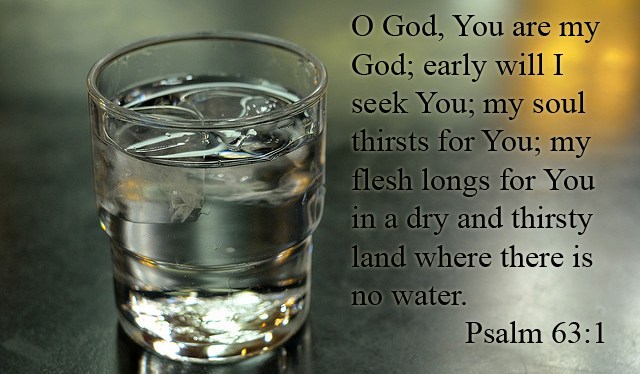
I woke up this morning and reached for my water bottle. It wasn’t there, of course, since today is Yom Kippur (Day of Atonement) and we started fasting last night as the sun set. What struck me was how automatic the gesture was — I always have a bottle of water nearby, and grabbing it when I feel thirsty is almost unconscious.
So I asked myself, “Do I long for God the way I crave water when fasting?” Jesus called Himself the “living water.” Just as we need water to survive physically, so we need Him to survive spiritually. And yet somehow, I don’t think we are as attentive about drinking Him in as we are physical water. We should keep Him even closer than I usually keep my water bottle, and turn to Him at every reminder just like we take a drink whenever our throats feel a bit dry.
photo credit: [cipher], CC BY-SA, via FlickrThe Jews consider Yom Kippur the most solemn and holy day of the entire year, and I’m inclined to agree with them. This isn’t to belittle any of the other holy days or the weekly Sabbath, but God does seem to put a special importance on this day. For one thing, it’s the only day when He strictly specifies “you shall do no work at all.” The other holy days are also days of rest, but He uses a different phrase for that: “you shall do no customary work” or “No manner of work shall be done on them; but that which everyone must eat—that only may be prepared by you.”
And the Lord spoke to Moses, saying: “Also the tenth day of this seventh month shall be the Day of Atonement. It shall be a holy convocation for you; you shall afflict your souls, and offer an offering made by fire to the Lord. And you shall do no work on that same day, for it is the Day of Atonement, to make atonement for you before the Lord your God. For any person who is not afflicted in soul on that same day shall be cut off from his people. And any person who does any work on that same day, that person I will destroy from among his people. You shall do no manner of work; it shall be a statute forever throughout your generations in all your dwellings. It shall be to you a sabbath of solemn rest, and you shall afflict your souls; on the ninth day of the month at evening, from evening to evening, you shall celebrate your sabbath.” (Lev. 23:26-32)
On the Day of Atonement, everything stops. We stop eating, we stop drinking, and we stop doing any work. Usually, my morning routine goes like this: pray, feed fish, make breakfast, read a book, Bible study, yoga, then start working. On the Sabbaths, I usually only do the first three and then head off for per-services dance practice. But today, the only thing I have to think about is thirsting after God. I took a minute to feed the aquarium fish, but that’s it. I don’t have to worry about making breakfast or scheduling my day. I can listen to Hillsong music, pray, study, and turn my thoughts into this impromptu blog post.
I wonder if my younger self would have believed she’d learn to look forward to the Day of Atonement. Fasting doesn’t make me terribly ill, but it’s not really easy for me either, and I often thought of it as something we just had to get through before the Feast of Tabernacles. But, God be praised, I’m starting to learn more about how amazing this day is and why He considers it so important.
I pray each of you has a blessed, refreshing Yom Kippur that draws you closer to God.
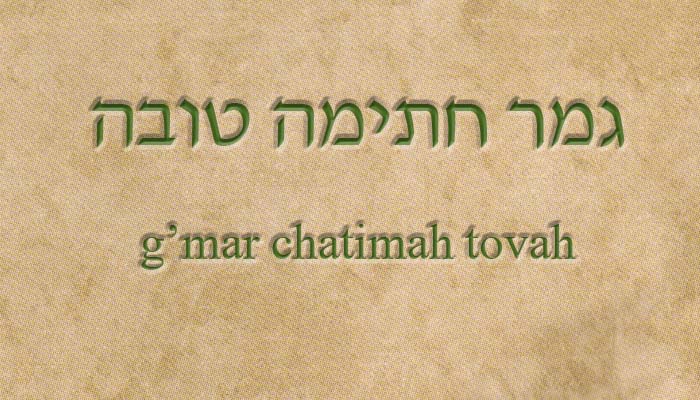
G’mar Chatimah Tovah — traditional Hebrew greeting for this season. Literally,” A good final sealing” or idiomatically, “May you be inscribed (in the Book of Life) for good”
I love weddings. Smiling faces, happy tears, white dress, flowers, everywhere, dancing, true love … *sigh*. But even the best wedding I can imagine won’t be as wonderful as the heavenly wedding after Jesus Christ returns to claim His bride.
We’re fast approaching the fall holy day season. Yom Teruah/Feast of Trumpets is on Monday, September 14. It’s the day that pictures Christ’s triumphal return, which closely connects it with His marriage.
Building A House
In the marriage customs of Christ’s day, at least among the Jews, there were strong parallels with God’s plan. After a betrothal ceremony, the bridegroom went away to build a house. In the mean time, the bride got ready and watched carefully because she wasn’t sure when he’d show up again. The timing depended on the bridegroom’s father saying the house was complete and the bride’s father agreeing that the bride-price had been properly paid.
Jesus told His disciples He didn’t know when He was coming back — that was something only the Father could decide (Matt. 24:36; Mark 13:32). He did, however, tell us what He’d be doing in the mean time.
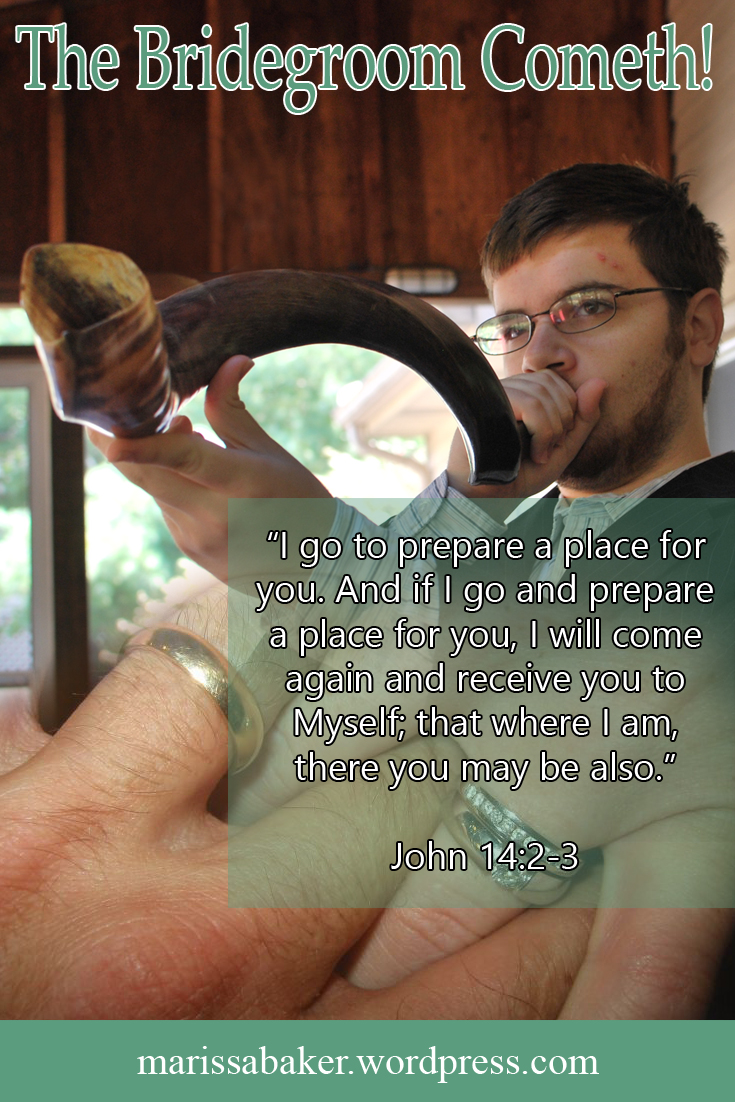
Let not your heart be troubled; you believe in God, believe also in Me. In My Father’s house are many mansions; if it were not so, I would have told you. I go to prepare a place for you. And if I go and prepare a place for you, I will come again and receive you to Myself; that where I am, there you may be also. (Jn. 14:1-3)
Christ’s house-building functions on two levels. One is mentioned here – His preparation of a dwelling place for us in His Father’s heavenly realm. Another involves us more directly.
For every house is built by someone, but He who built all things is God. And Moses indeed was faithful in all His house as a servant, for a testimony of those things which would be spoken afterward, but Christ as a Son over His own house, whose house we are if we hold fast the confidence and the rejoicing of the hope firm to the end. (Heb. 3:4-6)
having been built on the foundation of the apostles and prophets, Jesus Christ Himself being the chief cornerstone, in whom the whole building, being fitted together, grows into a holy temple in the Lord, in whom you also are being built together for a dwelling place of God in the Spirit. (Eph. 2:20-22)
Bridal Preparations
We are built on and in Jesus, by Jesus, so we can be fit dwellings for God. While He is preparing a place for us, He is also preparing us to dwell with and be indwelt by Him and His Father. Still, He isn’t the only one working on getting the Bride ready.
Let us be glad and rejoice and give Him glory, for the marriage of the Lamb has come, and His wife has made herself ready. (Rev. 19:7)
This verse describing the bride as “ready” is in the future. Since that’s the case, the Bride today should have started preparations if she wants to be ready by the time this marriage takes place. Yet how can we possibly prepare to marry Jesus? How can we hope to be a suitable helper for Him? Well, we couldn’t if all this preparation was done on our own.
Therefore, my beloved, as you have always obeyed, not as in my presence only, but now much more in my absence, work out your own salvation with fear and trembling; for it is God who works in you both to will and to do for His good pleasure. (Phil. 2:12-13)
We have to work on ourselves, but that’s all made possible because God is working in us. Since He’s already adopted us into His family, He fills the Father-of-the-Bride role as well as being the Bridegroom’s Father.
Paul wrote to Timothy that if we purge ourselves form ungodliness and iniquity, then we’ll be “a vessel for honor, sanctified and useful for the Master, prepared for every good work” (2 Tim. 2:21). That’s what we want to become — purified for use in the temple and prepared to do good works.
Claiming The Bride
The time between formal betrothal and when both fathers gave the go-ahead for the groom’s return could stretch into years. Like some of those ancient brides, the church has waited a long time for her groom to come back. We know He’s coming, and we’re working on getting ready, but are we waiting eagerly for Him? Do we anticipate His arrival?
But while the bridegroom was delayed, they all slumbered and slept. And at midnight a cry was heard: ‘Behold, the bridegroom is coming; go out to meet him!’ (Matt. 25:5-6)
Now we get to the part involving trumpet blasts — they signaled the bridegroom’s return in an unmistakable sign that he was close at hand. It’s enough to wake you up, but doesn’t give you enough time for panicked last-minute preparation. If you aren’t ready when the trumpet sounds, you miss His arrival.
Behold, I tell you a mystery: We shall not all sleep, but we shall all be changed — in a moment, in the twinkling of an eye, at the last trumpet. For the trumpet will sound, and the dead will be raised incorruptible, and we shall be changed. (1 Cor. 15:51-52)
Once He’s here, we’re out of time. Either we’re ready to go with Jesus into the wedding feast, or we’re left outside like the five foolish virgins (Matt. 25:11-13).
For the Lord Himself will descend from heaven with a shout, with the voice of an archangel, and with the trumpet of God. And the dead in Christ will rise first. Then we who are alive and remain shall be caught up together with them in the clouds to meet the Lord in the air. And thus we shall always be with the Lord. (1Thes. 4:16-17)
This is what Yom Teruah — the Feast of shouting and trumpet-sounding — pictures. It’s a yearly reminder for the Bride of Messiah to get ready. Your Bridegroom is coming! Do you hear the trumpet?
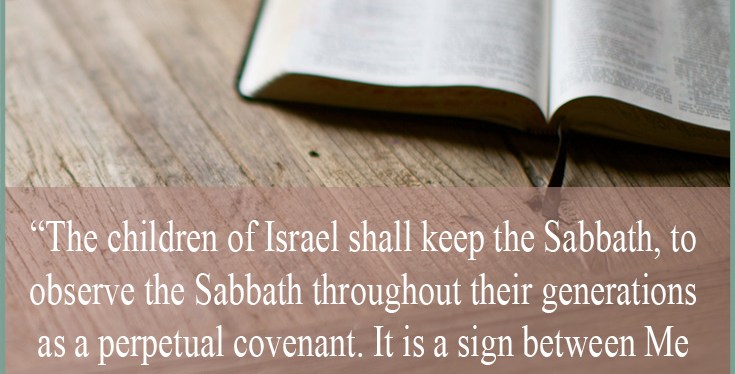
I’ve mentioned before that I keep Saturday as a Sabbath rest, but I don’t think I’ve talked about why. Not every Christian is convicted of this, but I’m seeing more and more acknowledging the value of “sabbathing.” It’s just a small step from realizing that God’s command to rest is good, to resting on the day He set aside from the beginning of creation.
Thus the heavens and the earth, and all the host of them, were finished. And on the seventh day God ended His work which He had done, and He rested on the seventh day from all His work which He had done. Then God blessed the seventh day and sanctified it, because in it He rested from all His work which God had created and made. (Gen. 2:1-3)
This verse tells us God chose a certain day, the seventh, as a day of rest. He gave this day a special blessing, and set it apart for sacred use. “Sanctified” in the Hebrew carries the sense of separating something from “the common or profane” and placing it in “the sphere of the sacred” (Theological Wordbook of the Old Testament, p.1989). That’s what God did with the Sabbath day from the beginning of the world. Read more →
These are the Days of Awe. That’s what Jewish believers call the 10 days between Yom Teruah/The Feast of Trumpets (which fell on Thursday, September 25th this year) and Yom Kippur/The Day of Atonement (Saturday October 4th).
Having recently started attending with a Messianic Jewish group, I wanted to focus my pre-Trumpets study this year on the Hebraic roots of this Holy Day. With the Feast of Trumpets just a few days past, I’d like to share some of that study with you today as we look forward to the Day of Atonement.
A Question of Trumpets
I found five different Hebrew words translated “trumpets” in the Old Testament. Let’s just take a quick look at each one:
chatsotserah (H2689). A metal trumpet (Num. 10:2, 8).
yobel (H3104). The signal of a trumpet or blast of a horn. A common noun referring to trumpets, horns , and the year of Jubilee (Lev. 25:10).
shophar/shofar (H7782). A ram’s horn. The word most often used in the Bible.
taqoa (H8619). A trumpet with a looped tube and flared bell that makes a shrill sound (Ezk. 7:14).
teruah (H8643). A shout of joy or alarm. The noise from a trumpet.
This last word is the one used in Leviticus 23 and in Numbers 29 in reference to the Feast of Trumpets. My Hebrew dictionary says it means “a shout of joy; a shout of alarm, a battle cry. It refers to a loud, sharp shout or cry in general, but it often indicates a shout of joy or victory. … It can refer to the noise or signal put out by an instrument” (Baker and Carpenter, 2003). A more literal translation of Yom Teruah, the phrase we translate as “Feast of Trumpets,” would be “Day of Shouting.”
Then the Lord spoke to Moses, saying, “Speak to the children of Israel, saying: ‘In the seventh month, on the first day of the month, you shall have a sabbath-rest, a memorial of blowing of trumpets, a holy convocation. You shall do no customary work on it; and you shall offer an offering made by fire to the Lord.’” (Lev. 23:23-25)
Now, I’m certainly not saying this day doesn’t involve blowing trumpets. Silver trumpets would have been blown for the new moon and because this was a high Holy Day (Num. 10:1-2, 10). Shofars (the ram’s horn trumpets) were blown as well. In fact, they were blown on every Sabbath and Festival.
Blow the trumpet at the time of the New Moon, at the full moon, on our solemn feast day. For this is a statute for Israel, a law of the God of Jacob. (Ps. 81:3-4)
Based on this scripture alone, I’d say shofars belong as part of every Christian service. And there are other passages too, like Joel 2:15, which indicates shofars are a key part of calling solemn assemblies and sanctifying fasts, and Psalm 150:3, which instructs us to praise God “with the sound of the trumpet.” But I digress …
So, lots of trumpets blasts on Yom Teruah. There’s even a traditional pattern for how to blow them, and shofars are sounded at least 100 times in a typical Yom Teruah service. (Here’s a link for more about Jewish tradition associated with Yom Teruah, and a recording of the shofar sounds). But even though trumpets are a huge part of this day, looking into the Hebrew had me wondering if I’d been keeping the “Feast of Trumpets” my whole life when I should have been keeping “the Day of Shouting for joy and battle cries.” I also wondered if it really made any difference. Does a better understanding of the Hebrew add layers of spiritual meaning?
The Day of Shouting
The word “Teruah” is used 36 times in the Old Testament. It is translated “blow an alarm” as for war (Num. 10:6, 31:6) and to shout like when the walls of Jericho fell (Josh. 6:5, 20). The people shouted for joy when seeing the ark of the covenant and when the temple was rebuilt (2 Sam. 6:15; 1 Chron. 15:28; Ezr. 3:11-13). Teruah is also translated “joy,” “rejoicing,” and “joyful sound” (Job 8:21, 33:26; Ps. 27:6, 89:15). It is used of praising God (Ps. 47:5), and of fighting with Him on our side (2 Chron. 13:12).
The meaning of Yom Teruah/the Day of Shouting can be interpreted several ways. A website for Karaite Judaism says it may be “intended as a day of public prayer. The verb form of Teruah often refers to the noise made by a gathering of the faithful calling out to the Almighty in unison.” The examples they give are Psalms 47:2, 66:1, 81:2, and 100:1. A Messianic website says the shofar and trumpet blasts are “a wake-up blast — a reminder that the time is near for the Day of Atonement.” There are strong themes of repentance, rebirth, and resurrection associated with this day.
Another element of Yom Teruah was brought out in the teaching given by the Rabbi at my local Messianic congregation. He said that the shofar is blow every day in the month leading up to Yom Teruah as a proclamation that the King is returning. We are to prepare ourselves to hear the voice of the Lord (traditionally, the shofar is seen as symbolizing God’s voice). In Hebrew, the word “prepare” is connected with the human face — we’re making ourselves ready to be face-to-face with God. In that sense, Yom Teruah is a yearly reminder of something we should be doing all the time. It’s also just the beginning of such reminders to repent and be at one with God, since it’s starts out the 10-day count to Atonement (which will definitely be the subject of next week’s blog post).
This preparation to meet God reminds me of the giving of the Ten Commandments. Before delivering His laws, God commanded boundaries to be set up so the people couldn’t get dangerously close to His presence on the mountain, but He did want them to be present as He delivered the words of the covenant. The people were commanded to consecrate themselves and wash in preparation for meeting with God, and then God commanded, “When the trumpet sounds long, they shall come near the mountain” (Ex. 19:10-13). Here, the trumpet acted as a call to assemble in God’s presence.
The King is Coming!
In the New Testament, trumpet blasts and shouts are strongly associated with Jesus Christ’s return. Traditionally, Christians who keep Yom Teruah have said that the Feast of Trumpets pictures Christ’s second coming and the first resurrection from the dead.
For the Lord Himself will descend from heaven with a shout, with the voice of an archangel, and with the trumpet of God. And the dead in Christ will rise first. Then we who are alive and remain shall be caught up together with them in the clouds to meet the Lord in the air. And thus we shall always be with the Lord. (1 Thes 4:16-17)
For my readers who aren’t familiar with this particular interpretation of future prophecy and “what happens after death” belief, here’s a quick summary of what I believe: Those who have died are “asleep,” waiting for a resurrection. The believers who have died “in Christ” will be raised to eternal life at His second coming, and the non-believers will be raised 1,000 years later to be given as second (or in many cases a first) chance to understand God’s truth (Rev. 20:4-5, 11-15)
Behold, I tell you a mystery: We shall not all sleep, but we shall all be changed — in a moment, in the twinkling of an eye, at the last trumpet. For the trumpet will sound, and the dead will be raised incorruptible, and we shall be changed. (1 Cor. 15:51-52)
Right now, we’re in waiting for our Bridegroom, Jesus the Christ, to return for us (John 14:1-3). If we’re dead when that happens, we’ll be brought back to life. If we’re still alive, we’ll be changed into spirit beings.
At first, shouting for joy and shouting a battle cry seem only distantly related. But if we turn to Revelation and read more about Christ’s return, the connection in Yom Teruah becomes more clear.
And I heard, as it were, the voice of a great multitude, as the sound of many waters and as the sound of mighty thunderings, saying, “Alleluia! For the Lord God Omnipotent reigns! Let us be glad and rejoice and give Him glory, for the marriage of the Lamb has come, and His wife has made herself ready.” And to her it was granted to be arrayed in fine linen, clean and bright, for the fine linen is the righteous acts of the saints. (Rev. 19:6-7)
Here is where the shouts of joy, praise, and exhalation come in. We’ve been preparing to meet our Bridegroom, and here He is! Then, just a few verses down, we see how the shouts of joy turn into a battle cry.
Now I saw heaven opened, and behold, a white horse. And He who sat on him was called Faithful and True, and in righteousness He judges and makes war. His eyes were like a flame of fire, and on His head were many crowns. He had a name written that no one knew except Himself. He was clothed with a robe dipped in blood, and His name is called The Word of God. And the armies in heaven, clothed in fine linen, white and clean, followed Him on white horses. (Rev. 19:11-14)
The armies which follow Christ at His return are clothed in “white linen” garments just like His bride, so this is often read as a sign that we’ll be riding into battle alongside Him to set up the promised kingdom of peace.
Yom Teruah is already passed for this year, but our preparations to meet the King and become a suitable bride for Him are ongoing. In Matt. 22:2, Jesus said, “The kingdom of heaven is like a certain king who arranged a marriage for his son.” This marriage is an integral part of Their great plan, and we as the church are the focus of it. I pray we all hear and head the trumpet blast that calls out to us and says, “The King is coming! make ready to meet Him.”
Happy Feast of Tabernacles! This holy day season is the most anticipated time of the year for my family, and for many of my friends. A whole eight days of getting away from “the world” (well, unless you’re in school and then there’s all that homework …), fellowshipping with other believers, and obeying the command to “rejoice before the Lord your God for seven days” (Lev. 23:33-43).
I’ve decided that one of the things I’m going to do this Feast to make it a little “extra special” is post something on this blog every day. I finished all of the writing that I needs done (copywriting articles, posts on my author blog), so I can focus my writing for the next week on fiction and fun things like this blog. Since I like writing so much, I’m really looking forward to that.




 Like An Anchor