The Problem of Being Too Agreeable

INFJs place a high value on interpersonal harmony. Often, that manifests (especially in less mature/confident INFJs) as an unwillingness to just flat-out turn someone down. We’d much rather use “maybe,” “someday,” and “that might be nice” rather than “no,” “never,” and “I don’t think so.”

But that can back-fire on us and create discord in friendships. Other types can interpret our “maybes” as commitments, then get upset at us for breaking our word. Or they might recognize that we’re brushing them off and become frustrated by our refusal to give them a direct answer. Our attempts to avoid conflict can actually make things worse.
click to read article, "The Problem of Being Too Agreeable" | marissabaker.wordpress.com
Photo credit: “Smile Harder” by Kevin Galens, CC BY-SA via Flickr

Last week, we talked about one problem that can plague INFJ friendships — the fact that we have a tendency drop out of contact with our friends. It’s fairly easily explained from the INFJ’s perspective, but it can have an unintentional affect of hurting the people around us. Another similar (and in some ways related) problem is our temptation to noncommittally agree with what we think people want to hear, then ignore them and hope they forget about it. Read more

The Vanishing INFJ

I’ve written before about how other types can be friends with an INFJ. But there’s another side to that dynamic: what INFJs are like as friends. We can be fantastic friends — fun, engaging, good listeners, intensely loyal. But sometimes we’re not the best sort of friends and often, that’s the INFJ’s fault.

There are some things I love about being an INFJ personality type. And then there are other aspects which aren’t so nice, and some of those can negatively impact our friendships if we’re not careful. Today, I’m speaking of our tendency to drop out of contact with people.

click to read article, "The Vanishing INFJ?" | marissabaker.wordpress.com
photo credit: Tony Lam Hoang via StockSnap

Unique Mental Wiring

INFJs are a curious mix of mental processes. We’re most comfortable using Introverted Intuition (also called “Perspectives”). This is focused on collecting information about how the world works, processing it internally, and making speculative leaps about what it means. Basically, it’s advanced pattern recognition.

That’s paired with Extroverted Feeling (aka “Harmony”). This mental process is in-tune with other people’s feelings and wants to make sure their needs get met. It’s generally the first mental place INFJs go when trying to make a decision, asking, “How will this affect other people and my relationship with them?” When well-developed in an INFJ, they can be so outgoing and social that they seem like extroverts.

But we might also skip this process and spend more time in our tertiary Introverted Thinking (aka “Accuracy”). That one’s more about analyzing of facts, trying to make things “make sense to me.” It’s also impersonal. When INFJs spend more time inside their heads than on developing our extroverted side, we can stay in an introverted Intuition-Thinking loop.

Distracted By The Inner World

Using our Intuitive and Thinking process together isn’t always a bad thing for the INFJ. Our Extroverted Feeling side is important to develop so we can make decisions more easily, maintain friendships, and experience personal growth. But we to also need alone time to re-charge and it can be a good way to process data. It only becomes a problem sometimes when we get “stuck” in our introverted side. Read more

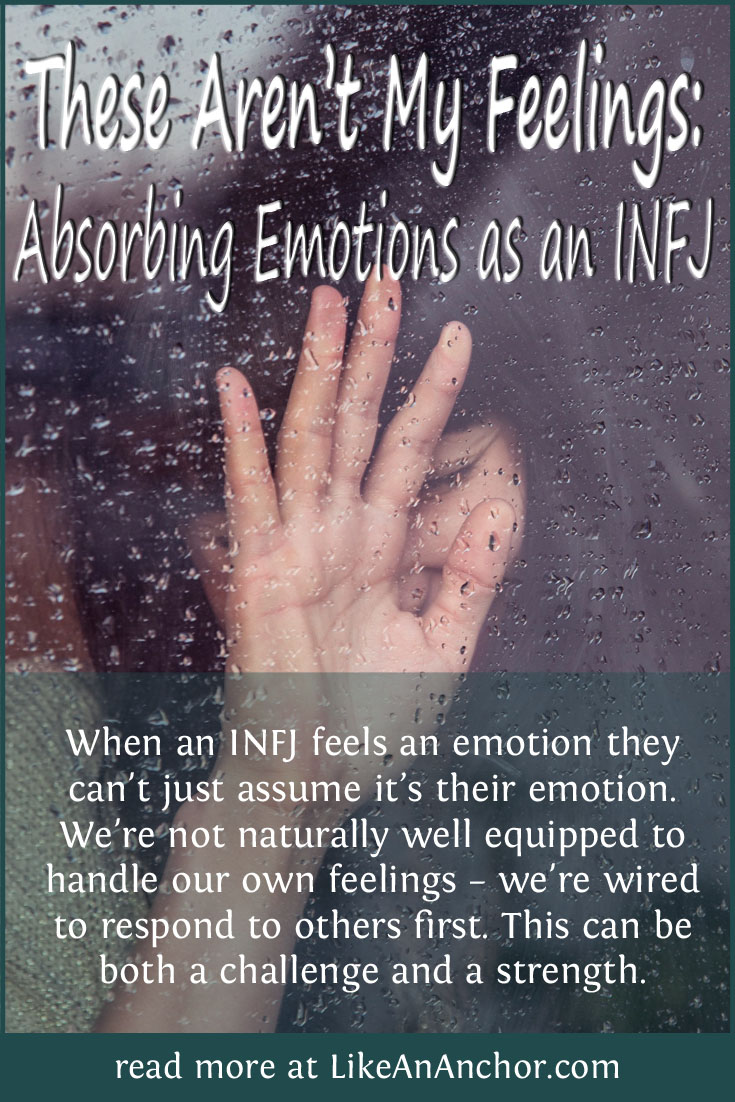
These Aren’t My Feelings: Absorbing Emotions as an INFJ

This past Friday I did something I’ve never done before and which provided my father with much amusement. I danced at someone’s funeral. More precisely, it was at a memorial service for a man I didn’t really know. I’d seen him at church services, but we never spoke. His wife was on our dance team, though, and she asked us to open the service by dancing to Bo Ruach Elohim.

At first, I didn’t really feel much about this man’s death beyond a rather abstract sense of sympathy for those who loved him. But as soon as I was surrounded by those who were grieving, I started to feel it as well. Layering on top of that were the emotions I imagined other people I cared about feeling. I won’t go into any details, but some of the things this man’s wife and daughter mentioned when they spoke about him directly touched on struggles I know two other friends are going through. And my heart ached with/for them all.

INFJ Empaths

These Aren’t My Feelings: Absorbing Emotions as an INFJ | LIkeAnAnchor.com
Photo credit: Milada Vigerova via StockSnap

INFJs are inherently sensitive to other people’s emotions. On top of that, many describe themselves as an HSP (Highly Sensitive Person) and/or empath. This trait, “empath,” isn’t simply a person who feels empathy. Here’s a description written by Jennifer Soldner, an empathic INFJ:

An empath is a person who feels exactly what others feel. This is not to be mistaken with sympathy, which is trying to understand what someone is going through, or even the very similar word empathy, which is actually just being familiar with what someone else is experiencing. An empath literally feels exactly what someone else feels, even if they have never experienced, nor can they relate in any way to what the other person is going through. (from The INFJ Empath Explained)

Talking about being an empath is kind of tricky. Going back to my opening story, suppose I told you that I didn’t start out having feelings of my own about this man’s death, but when I walked into a room of people grieving for him I felt grief. Someone who reads that and assumes I’m an empath would say it’s because I was picking up the other people’s energy waves and feeling their grief as if the emotion were my own. Someone who doesn’t think I’m an empath would say I’m mirroring the other people’s grief because I observe it and care about them, or that I’m projecting my ideas of what they are feeling and then responding to that. Read more

Maybe The Telephone Isn’t An Enemy

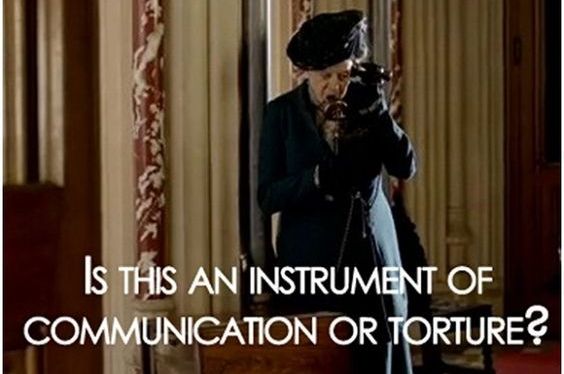
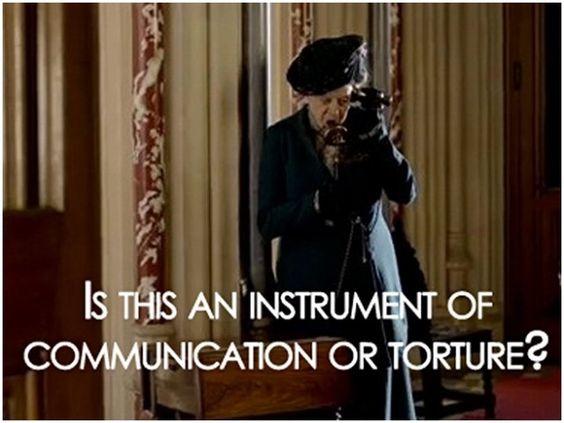
Some of you might think that title is strange, but my fellow introverts will understand. The hours of mental preparation that go into making a two minute phone call. The sense of dread when the phone rings and you aren’t ready to talk with someone. The pressure of sounding engaged and alert while thinking fast enough to avoid awkward silences. Most of us view the telephone in much the same way the Dowager Countess of Grantham does.

some thoughts for introverts. Click to read article, "Maybe The Telephone Isn't An Enemy" | marissabaker.wordpress.comBut I had a truly enjoyable phone conversation with a friend this weekend, and I realized this wasn’t an isolated incident. When he asked for my number my first instinct was panic, then I realized there wasn’t any reason to. I talk with my sister on the phone for hours almost every day. I chat with my dance team when we’re coordinating practice times. I enjoy the unexpected call from my cousin or a select group of friends. Chatting on the phone really isn’t all that scary.

Now, in the interest of full disclosure, I am in many ways a stereotypical introvert in regards to the telephone. We don’t have caller ID on the landline and the calls are rarely for me, so I refuse to answer when it rings unless I recognize the voice and want to talk with them now. My cell phone is set so it doesn’t even ring unless the number is in my contacts list and, in general, I much prefer written communication. There are times, however, when telephones are a preferable method of communication. Read more

INFJ User Guide

Congratulations on the procurement your new INFJ!* INFJs are highly sought after in the personality type collecting world given their extremely rare nature. INFJ spotting is a very difficult hobby, requiring forays into the deepest recesses of bookstores, yoga studios, and the internet. Keeping an INFJ in your life once you’ve found one can be even more of a challenge.

INFJs are widely considered one of the most amiable and empathetic personalities. Their minds offer a good balance of emotion and logic that helps them relate to most types of people, and they highly value commitment and relationships. As introverts, though, they have limited social energy and they don’t maintain relationships with most of the people they meet. Once you’ve found an INFJ, taking your acquaintance to the level or friendship, or relationship, isn’t simple. That is, unless you have this user guide.

INFJ User Guide | marissabaker.wordpress.com

Overview of the INFJ

The INFJ is a strange sort of creature, often compared to unicorns. Their uniqueness is a result of two things: the way their brains/personalities are hardwired and the rarity of their personality type. What’s perfectly normal for an INFJ seems unusual among humanity as a whole because so few people function this way. Understanding your INFJ’s basic functions is the first step towards successful interaction with the INFJ.

Read more

The Single INFJ

It’s strange that a personality type for which “homemaker” is one of the top recommended career options has such a difficult time finding love. While not true of all INFJs, many of us are romantics in every sense of the word. We’re idealists who still believe in soul-mates. We’re eager to dive deep into relationships and prioritize the people closest to us. We’re among the MBTI types least likely to cheat in a romantic relationship.

But we also shy away from any type of deep relationship if we don’t feel completely safe. Our idealism means we often have unrealistic expectations for our (potential) romantic partners. The soul-mate type of understanding we crave is hard to find. And so here I am, turning 27 this year having been on 4 dates since I was 19 (all with guys I chose not to go out with a second time) and yet still wanting to be in a relationships (almost) just as much as ever.

So what’s a single INFJ to do? It sounds cliche, but I agree with Amelia Brown on Introvert, Dear that it’s important  to focus  on “the relationship you have with yourself.” If you’re not comfortable with yourself, you’re never going to be happy, regardless of whether or not you’re in a relationship with someone else. Also, if you haven’t taken ownership of your life, your choices, and your struggles then you’re going to have a harder time cultivating the sort of strong, lasting relationship INFJs crave. Read more