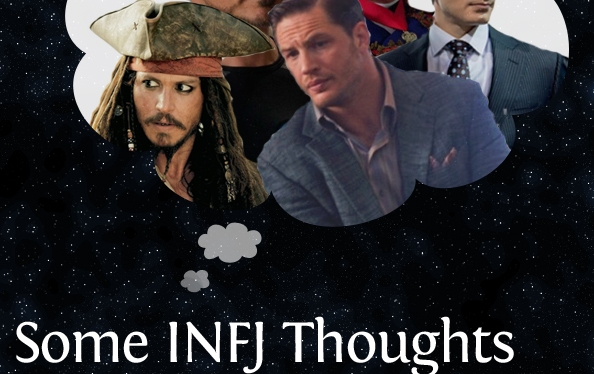
Some INFJ Thoughts on ENTPs

Some INFJ Thoughts on ENTPs | marissabaker.wordpress.comI suspect that, much like you’re not supposed to have favorite relatives, you’re not supposed to have favorite personality types. One of the core tenets of type-theory is that no type is better than another. And yet … I do have some favorites. ENFJ, ENTJ, INFJ, INTJ, INTP, ISTP, ESTP, ENTP …

Strangely enough, it’s not necessarily related to my interactions with a type in real life. In person, I can find common ground with most personality types depending on the individual person and the circumstances of our meeting. So when I talk about my favorite personality types, it requires an addendum that I am friends with and like people of all types (for example, my best-friend-who’s-not-a-relative doesn’t fit any of the types I listed above).

Still, there’s something about certain personality types that is irresistibly intriguing. I know several ENFJs, and the friendship and genuine communication that can exist between them and INFJs is truly amazing. I love talking with INTPs and INTJs because their minds are so incredibly keen and they challenge me to really think deeply about things. And then there’s the ENTPs ❤

ENTP Type

David Keirsey, and many other type psychologists, describe the ENTP personality type as the “soulmate” for INFJs. Of course, type compatibility in relationships is much more complicated than that, but I can definitely see why. At least, I think I can. I haven’t actually met a self-confirmed ENTP in real life. I know a guy who is either ENTP or ENFP, and knew someone I think was ENTP. Other than that, my interactions with them have all been online. Although, if fictional character’s count, we all know some that are (probably) ENTP:

(note: there are female ENTPs, just as there are male INFJs. They’re just more rare, and hence harder to find.)

ENTPs are characterized by high energy, “compelling enthusiasm,” independence, their pursuit of possibility, a constant string of projects that command their attention, and being “startlingly clever” (Isabel Myers, Gifts Differing p.106-108). There’s individual variation within all types, and Isabel Myer specifically says that

“Extroverted intuitives are hard to describe because of their infinite variety. Their interest, enthusiasm, and energy pour suddenly into unforeseeable channels like a flash flood, sweeping everything along, overwhelming all obstacles, carving out a path which others will follow long after the force that made it has flowed on into other things ” (Gifts Differing, p.106).

INFJs and ENTPs

Maybe what Myers talks about in the above quote is one reason INFJ’s like ENTPs so much. We have plenty of ideas, but struggle with moving them into the real world. We want to make big contributions, but we have trouble putting ourselves out there. We want to pour ourselves into people, but have limited energy for social interactions. So the idea of partnering with someone who specializes in active idea exploration in a big way is very attractive. Please tell me I’m not the only INFJ who has thought it would be wonderful to be the Pepper Pots to someone’s Tony Stark? (note: I’m not typing Pepper as an INFJ, just using it as an example.)

Some INFJ Thoughts on ENTPs | marissabaker.wordpress.comLooking closer at the two types, we see similarities in their function stacks that also helps explain the compatibility:

  • INFJ: Introverted Intuition, Extroverted Feeling, Introverted Thinking, Extroverted Sensing
  • ENTP: Extroverted Intuition, Introverted Thinking, Extroverted Feeling, Introverted Sensing

Both types lead with Intuition, but use that function in different ways. Intuition is a perceiving process, which has to do with how we take in and process new information. It’s close enough for the two types to understand each other, but different enough to compliment instead of overlap.

The two middle functions for both types are the same, just in a different order. Thinking and Feeling are both judging processes, which means they affect how we make decisions and what we believe the world “should” look like. INFJs and ENTPs approach this in a way that is easy for the other type to understand, but they are strong in different areas.

Their inferior functions are both sensing, but one is extroverted and one introverted. Our inferior functions typically show up when we’re stressed, so having different inferior functions means that different things stress these two types out. That can be really useful if you want someone who can help you out of stress instead of getting pulled in with you. It’s also important that they’re not exact opposites, since types who use intuition as their inferior function can get stressed-out by dominant intuitives (e.g. an ISFJ who is stressed by change might find it uncomfortable to spend much time with an ENTP).

What about you? anyone else want to confess they have favorite personality types? 🙂

Click here to check out my e-book, The INFJ Handbook, for more information and insight into the INFJ personality type
Available in the Amazon Kindle Store

Save

The INFJ Handbook is here!

Two years ago this weekend, I published my first INFJ blog post on this site. It seems fitting, then, that I’m releasing my first e-book this weekend and that it is all about INFJs. Inside, you’ll find:

  • Quick introduction to Myers-Briggs type theory
  • Thorough description of the INFJ personality type
  • Discussions of INFJ strengths and weakness
  • Tips for personal growth
  • List of things that INFJs want other people to know
  • Special section on how other types view INFJs
  • True-life stories from five INFJ contributors
The INFJ Handbook by Marissa Baker
click to purchase

A very special thanks to Kerry, Rachel, Johanna, Denise, and Yeni — the INFJs who contributed the stories appearing in this book. You should have already received a free PDF copy of this book at the e-mail address I have on record for you. If not, let me know.

You can purchase this book in the Amazon Kindle store. For this first week only, the book is on-sale for $0.99. It will go back to the regular price of $2.99 next Monday morning.

Understanding The INFJ “Door Slam”

Shutting people out of your life after they’ve hurt you or someone you love isn’t specific to INFJs, but it happens often enough that we’ve given it a name: The INFJ Door Slam. I like the definition given in an article by Jenn Granneman titled “How INFJs Deal with Conflict: 10 Confessions” (which is no longer available online).

“It means you’ve hurt me so much, I’m no longer investing any of my (limited) supply of energy in you. It means I’ve come to resent you. If you value me, don’t let it get to this point. It’s really hard to go back.”

An INFJ door slam may or may not involve actually cutting a person out of your life. Depending on the circumstances, a door slam can range from ignoring someone completely, to limiting contact to the bare minimum, to acting almost normal. In some cases the person who’s been door slammed can’t help but notice, while in others they don’t realize anything has changed (though something definitely has, at least in the INFJ’s mind). Read more

Fictional MBTI – Cinderella (ISFJ)

I had two Myers-Briggs-related thoughts while watching Disney’s new live-action Cinderella last Sunday. 1) she’s a perfect example of an ISFJ, and 2) she’s a perfect example of why people mistake ISFJs for INFJs and vice versa.

Usually when we talk about fictional ISFJs we talk about men — Samwise Gamgee, John Watson, Steve Rodgers … and they are all very good examples of ISFJs in fiction. But in real life, ISFJ women outnumber ISFJ men, so it seems odd not to have a woman on the list of famous fictional ISFJs. I think Cinderella is a great example of an ISFJ, and here’s why.

Why ISFJ?

Fictional MBTI - Cinderella (ISFJ) marissabaker.wordpress.comCinderella, like other ISFJs, leads with a process called Introverted Sensing (Si). Dr. A.J. Drenth considers it one of the “least understood of the eight Myers-Briggs functions,” and David Keirsey chategorized them with the Guardian types (SJs). All Guardians use Si as their their first or second function.

They are more concerned with ensuring their beliefs and behaviors are consistent with an existing standard than they are in formulating their own set of standards. In many ways, they are dependent on what has already been already been tried and established, systems of thought that grant them a sense of consistency and security. –Dr. Drenth

Read more

Looking For Love With The MBTI

Looking For Love With The MBTI | marissabaker.wordpress.com
Dennis Skley, CC BY-ND via Flickr

People have been trying to use personality types to find their perfect romantic match since typology first became popular. In a previous posts about Myers-Briggs types and love languages, I talked about how falling in love — and staying in love — with someone is so much more complex than simply matching personality types. Sometimes when browsing personality type forums, I’ll come across posts from people asking how to find and attract a someone of a specific personality type (often it’s an ENTP asking for step-by-step instructions to win an INFJ, which I find hilarious). It’s like some of us think that if we can just find someone who is our ideal type-match, then we’ll be happy because we caught the mythical “compatibility” creature.

Disclaimer: some of the links in this post are affiliate links. This means that, at no additional cost to you, I will receive a commission if you click on the link and make a purchase on that website.

Now, I do have some personality types I find more attractive romantically than others, but it’s not always the types I’m “supposed” to like according to Myers-Briggs or Keirsey theories. Even Isabel Myers was happily married to a man who her theory said should have been incompatible. An understanding of love languages and a mutual willingness to understand and work with each other is one piece of the puzzle. Another is something I just learned this week from Personality Hacker.*

The “Genius System”

Personality Hacker was founded by Antonia Dodge and Joel Mark Witt, who use what they call the “Genius system” to divide Myers-Briggs types into four groups based on the last two letters in a person’s type. In terms of function stacks, this means they group types based on whether the type introverts or extroverts their Judging function. The groupings end up looking like this:

  • “Harmony” — Extroverted Feelers (ESFJ, ISFJ, ENFJ, INFJ)
  • “Authenticity” — Introverted Feelers (ESFP, ISFP, ENFP, INFP)
  • “Effectiveness” — Extroverted Thinkers (ESTJ, ISTJ, ENTJ, INTJ)
  • “Accuracy” — Introverted Thinkers  (ESTP, ISTP, ENTP, INTP)

According to a new article on Personality Hacker, each of these groups look for and expressed love in a unique way. Most people would tell an INFJ to look for a relationship with an ENFP or an ENTP and avoid their opposite type, ESTP. This system stays that an ENFP and and ENTP express love in completely different ways, but ENTPs and ESTPs are actually very similar in how they love. That would explain why some INFJs find ENFPs really attractive, while others prefer ESTPs or ENTPs. It’s not so much about matching two specific types, as it is about finding types who express love in a way you relate to and understand. This Genius style take on the MBTI adds an intriguing aspect to the subject of personality types in relationships. You can check out the Personality Hacker podcast on how each type says “I Love You”* for a full explanation, but here’s my brief take on what this means:

Types of Love

Harmony” types, who use Extroverted Feeling as their first or second function, feel loved when they are connected, safe, cared for, and accepted as their authentic selves. They express love in a similar way, by encouraging the people they love and keeping in touch with them. They are primarily concerned with harmonious relationships and emotional connection.

The types who use Introverted Feeling, “Authenticity” in the Genius System, highly value honesty in relationships. They feel loved when they know someone is being real with them and is supportive of their own authentic expressions. Authenticity types express love by giving people space to be themselves and being willing to work through problems in the relationship.

Effectiveness” types, those who use Extroverted Thinking, value independence in relationship. They want to know that the person who loves them is supportive of their goals and can be trusted to function on their own. They are loyal and protective towards those they love, and give them room to be themselves.

Those who use Introverted Thinking, “Accuracy” types, feel loved when they are respected. They want to know that the person who is in love with them thinks they are impressive and that the relationship makes sense. In return, they are protective, non-judgmental, and strive to bring the best version of themselves to the relationship.

Matching Types

Ultimately, typology is simply a tool we can use to understand each other. When we understand ourselves and the people around us, we have a better idea of what we’re looking for in a romantic relationship. I think that’s really the best way to apply Myers-Briggs theory to romance. We can’t just say that all INFJs’ ideal match is an ENTP — people are far more nuanced than that, even within a type. But the better we understand how we’re wired and what makes us feel loved, the more likely we’ll be able to recognize whether a potential romantic partner would be a good or a bad match for us.

This is one of the things Debra Fileta talks about in her book and blog True Love Dates. You have to know yourself before you try to get to know other people in a romantic context, otherwise you have no idea what you’re looking for in a relationship. So maybe the first thing we should do when looking at the Genius System types is find which group we fit into. If we know who we are, we’re one step closer to knowing what we want.

*indicates affiliate links


Why I Sponsor Children

“I’d like to help, but …”

photo from Unbound.org

We fill-in-the-blank with a wide variety of things for a whole host of reasons, but today I want to talk about giving to charities. I saw a discussion on an INFJ Facebook group several months ago asking which charities other INFJs support. INFJs are considered one of the “save the world” personality types, as evidenced by the fact that two of the most famous INFJs were Mother Theresa and Gandhi. Many of the INFJ profiles you’ll read online talk about how INFJs often find work in non-profits and support charities. But even among a group of INFJs, there were plenty of people talking about the fact that they never donate to anything.

Now, there are perfectly understandable reasons for not giving money and I would never suggest you donate money that you don’t have. But if you have the means and desire to help, excuses like “I don’t trust charities” or “I don’t have the time” don’t hold up well in my mind. You can donate your time and money within your own community so you can see exactly what effects your efforts are having. There are also charities with good reputations who use their money wisely — you just have to look for them. And after that initial time-outlay of finding a charity you like, getting online to send money takes about a minute.

Personally, I like to sponsor children. I use Unbound, but as far as I know Compassion International is a great option as well. This is the perfect fit for me for several reasons:

  • I’m making a difference now, on an individual level for this child and their family
  • I’m affecting the future, because children become the adults that shape their countries
  • I get to build a relationship with the people I’m helping, through letter-writing

I guess the main thing I want to do today is encourage you to think about the impact you’re having on this world for good. It can be in any number of ways — serving in our church groups, going out of your way to make someone smile, donating money or food stuffs, volunteering your time, sponsoring a child … the list just goes on and on. I want to leave you with a quote from C.S. Lewis that convicted me to start finding more ways to give, though I still think I fall short by these standards.

I do not believe one can settle how much we ought to give. I am afraid the only safe rule is to give more than we can spare. In other words, if our expenditure on comforts, luxuries, amusements, etc, is up to the standard common among those with the same income as our own, we are probably giving away too little. If our charities do not at all pinch or hamper us, I should say they are too small. There ought to be things we should like to do and cannot do because our charitable expenditure excludes them.”– C.S. Lewis, Mere Christianity