So Much Cooler Inside

Like many introverts (and a goodly number of extroverts, if some of my friends are any indication), I have an active imagination and “a rich inner life.” I’m daydreaming most of the time, even when it’s not readily apparent. I do let my musings out sometimes, here on this blog and over on my Pinterest boards, for example. The fact that I’m more comfortable expressing myself this way than in person reminds me of Brad Paisley’s song “Online,” except I’m telling the truth online and often masking my real self when I meet people in person. (Watch the music video if you haven’t yet — William Shatner is in it.)

This image by Gene Mollica makes me wonder how many fantastic things people hide behind their masks.

But even my online persona isn’t as “cool” as the me that stays inside my head. She joins the fellowship of the ring, travels with The Doctor, serves as an exopsychologist on the starship Enterprise, rules the world with Peter the Hegemon (if you don’t get this reference, you’re not reading enough Orson Scott Card), moves to a lake-side yurt to write books, marries Prince Charming, and adopts a couple of kids (just not all at the same time).

I spend a large (unreasonable?) amount of time thinking, daydreaming, and imagining. Sometimes I wonder if there’s something wrong with me — why don’t I spend more time making my real life interesting instead of constructing fantasies? As a fiction writer, I can call some of it research and story plotting, but I wouldn’t have to be in the stories myself if that were entirely the case. And I can only think of two such daydreams which have become full-fledged stories that can stand on their own.
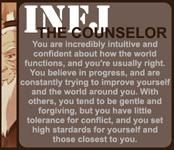
INFJs hate conflict
Things You Should Know About INFJs

Partly because I spend so much time in my head, I often wonder what people think of me in real life. For someone who picks up on other people’s emotions intuitively, you’d think this would be easy. But I get so nervous when I think I’m under scrutiny that it’s hard to get past my own emotions enough to pick up on what other people think (unless their emotions are negative, in which case it’s time to flee the room). And then it’s easier to hide out in my head than spend time with “real” people, and the whole cycle begins all over again.

Well, I’m off to write a post for a different blog while talking over the direction of a novel with a couple of my characters (in my head of course — I’m sure my family would start worrying if such conversations were carried on out-loud).

Things You Should Know About INFJs

It might be terribly self-centered to devote an entire post to my Myers-Briggs personality type, but I’m going to do it anyway (think of it as a birthday present to myself). As the rarest personality type, we INFJs often feel misunderstood and alone. Most estimates say that less than 1-2% of the population have this type. That’s one reason discovering our label is so important to us (as I’ve written about before). It lets us know that we are not abnormal, flawed humans. We’re perfectly normal INFJs. This isn’t going to be the first list of it’s type. There’s a Top 10 Things Every INFJ Wants You To Know list and one titled How to love your INFJ? This last one is written mostly for romantic relationships, but it’s funny and true so I linked to it anyway. Though these two lists, and others like them, are excellent, I still wanted to add my voice to the mix. Which brings us to the first point:

Always daydreaming
image found on Pinterest
  • INFJ spend a lot of time thinking, and we like to share our thoughts. The problem is, we have a hard time putting them into words when we’re speaking, which can make us appear inarticulate or even unintelligent. That’s why so many of us become writers — it gives us the time we need to put our thoughts in order before we present them to other people. When we do talk with and listen to others, we crave depth and sincerity rather than small talk.
  • In keeping with all the time we spend inside our own minds, you’ll sometimes notice us staring off into space. There’s nothing wrong with me when I do this and there is certainly no need to wave your hand in front of my face, shout at, or poke me (you know who you are).
  • We really do need people. While some introverts can thrive in solitude for quite some time, INFJs love being around people. They might terrify us sometimes, and we do need alone time to recharge, but life without people makes us depressed. This doesn’t mean you’re likely to find us at parties, however. We prefer a few close friendships. And when we find those friendships, we want them to last forever and tend to work hard at being a good friend.
  • The flip side of this relationship thing is that it’s hard for us to make these deep friendships because we’re reluctant to share our true selves with others. It’s taken years for me to share bits of my inner world with my closest friends. In addition, INFJs have a horror of conflict, and will avoid it as long as possible even when something needs to be addressed in a relationship.
  • C.S. Lewis made for another world
    image found on Pinterest

    We’re often feel like we belong in other worlds. For me, this fits quite well into my Christian faith and my fantasy writing. For other INFJs, it can mean feeling disconnected from the physical to such an extent that they’ll forget to eat (something I’ve never struggled with).

  • INFJs tend to be romantic idealists. We do dream of finding true love, but I mean this in the sense given in the fourth Oxford English Dictionary definition. We are fascinated by what might be, what could be, and what should be. We want to bring order and peace to the world.

    4. Characterized or marked by, or invested with, a sense of romance (romance n. 5a); arising from, suggestive of, or appealing to, an idealized, fantastic, or sentimental view of life or reality …

  • INFJs are known in personality circles for being deeply intuitive. We just seem to know things without being able to explain them. This frustrates our more logical friends, but we find it very useful. It helps us see situations and arguments from both sides and appreciate different people’s perspectives even when we don’t agree with them. In spite of a strong sense of right and wrong and strict adherence to an inner value system, INFJs are very open minded and want to see the best in people.


If you’d like to know more about the INFJ personality type, check out my book The INFJ Handbook. I just updated it with a ton of new information and resources. You can purchase it in ebook or paperback by clicking this link.

Vive Les Introverts

I’ve been fascinated by type psychology since high school. In lieu of a guidance counselor (since I was homeschooled), my mother suggested I see if the library had any books about career testing or if I could find websites that offered free tests. That was when I first stumbled upon the MBTI and discovered my personality type. I know there are many people who don’t find value in personality types, either because the type method doesn’t fit them well or they just don’t care, but when I found out what my type was, I suddenly felt like I wasn’t alone in the universe. Apparently this is a typical reaction for INFJs, since it is the least common type.

Before this turns into a post about my personality type, I want to get on to my real topic. Last week, I came across this video via the blog Personality Junkie. If you have 19 minutes, I highly recommend watching it. Even if you’re not an introvert, she has an interesting perspective on culture and the contributions of both introverts and extroverts to society.

I read Susan Cain’s book, Quiet: The Power of Introverts in a World That Can’t Stop Talking, a few months ago. If you like this talk, you should check it out. Her research is extensive, and it’s presented in a reader-friendly, almost conversational format.

“Introverts … may have strong social skills and enjoy parties and business meetings, but after a while wish they were home in their pajamas. They prefer to devote their social energies to close friends, colleagues, and family. They listen more than they talk, think before they speak, and often feel as if they express themselves better in writing than in conversation. They tend to dislike conflict. Many have a horror of small talk, but enjoy deep discussions.” – Susan Cain

Even though I grew up in one of the most introvert-friendly environments you can find (homeschooled by supportive, introverted parents), I’ve long felt like there was “something wrong with me.” This is apparently common for introverts, especially in western culture where we are constantly presented with extroversion as a cultural ideal. Fun, outgoing, talkative people are surrounded by friends and happy — melancholy, lonely bookworms who stay home on Saturday night can only wish they were that “cool.”

good grade, social life, adequate sleep. Pick Two [welcome to college]
I’ll take #1 and #3, please
By the time I was a couple years into my college studies, I’d become convinced that working alone was the best way for me to succeed. Writing my ideas was more productive than talking about them, working in groups just slowed me down. But even carrying a 3.98 GPA didn’t help much when favorite professors said, “You’d be the perfect student if only we could get you to talk more.” I was already talking more than I wanted — sometimes as much as once or twice per class to get those participation points I didn’t usually need, but was too contentious to just ignore.

Since reading Susan Cain’s book and another called Introvert Power: Why Your Inner Life if Your Hidden Strength by Laurie Helgoe, I’ve started to feel more comfortable embracing my introvertedness. Ironically, this has helped me when I need (or want) to extrovert — it’s easier to talk to people when I’m more comfortable being myself.

“Let’s clear one thing up: Introverts do not hate small talk because we dislike people. We hate small talk because we hate the barrier it creates between people.” – Laurie Helgoe

About 50% of the world’s population is introverted, and research indicates we are born with a base personality type. Though socialization plays a role, we can’t help being introverted or extroverted. And there’s really no reason we should want to “help it.” Introverts have just as much to offer the world as extroverts. We just approach life a little differently.