Isaiah Study: Doing A New Thing

Today’s article is the fifth blog post since I started studying Isaiah 40-66. In the first post, I made a list of key themes that I want to study more extensively in this section of scripture. The list included (among other things) the message that God is doing and making something new. This theme is very closely connected to the one we discussed in last week’s post about looking toward the Messiah. It’s also connected with another point we touched on a few weeks ago; that one way God proves He is God is by revealing His new plans to the prophets before they happen.

I can only imagine how awed Isaiah must have been to receive this revelation. How encouraging it must have been to learn that God has such an amazing plan to set things right; to realize that a Messiah would soon come to usher in the salvation of the world! I wonder how much of the timing he understood. Did Isaiah know we’d still be reading these words thousands of years later, joining him in marveling at all that God has done in the past and will do in the future? Peter seems to think he did.

Concerning this salvation, the prophets sought and searched diligently. They prophesied of the grace that would come to you, searching for who or what kind of time the Spirit of Christ, which was in them, pointed to, when he predicted the sufferings of Christ, and the glories that would follow them. To them it was revealed, that they served not themselves, but you, in these things, which now have been announced to you through those who preached the Good News to you by the Holy Spirit sent out from heaven; which things angels desire to look into.

1 Peter 1:10-12, WEB

Here, Peter tells us that people like Isaiah did know they were speaking to us–we who know the Messiah and have received His salvation. Peter was also among those to whom Jesus said “many prophets and kings desired to see the things which you see, and didn’t see them, and to hear the things which you hear, and didn’t hear them” (Luke 10:24, WEB; see also Matthew 13:14-17). The prophets didn’t see everything as clearly as we do know. God has revealed to us things so glorious that the angels desire to look into them. We see His future plan for “glories that would follow” more clearly, particularly as we look back on the prophets’ words about the new things God still has in store for us.

Declaring a New Way to Save

At the end of the first Servant Song prophecy, God says, “Behold, the former things have happened and I declare new things. I tell you about them before they come up” (Is. 42:9, WEB). That’s one of the main things that God is doing in this section of Isaiah. There’s so much emphasis on the Messiah and on the new things God will do through Him. Jesus’s coming changed things dramatically for God’s people. Once we were sinners condemned to death, now we’re redeemed from that penalty. Once we were under the Law as a “guardian” of our conduct; now we keep the Law from the heart on a spiritual level (Gal. 3:23-25; Rom. 8:1-14). Once we saw God’s plan only dimly, now He’s revealed it to His people more clearly (Matt. 13:10-11; 1 Cor. 2:9-10; Eph. 3:4-6; 1 Pet 1:10-12).

When Isaiah’s original readers heard God “declare new things” about the Messiah, Jesus’s first coming was still in the future. At this time, God told Israel “from this point on I am announcing to you new events” (Isa. 48:6, NET). Knowing there’s a Messiah bringing a new way to save isn’t news for us anymore–from our perspective, He arrived here on earth nearly 2,000 years ago. However, we can still get excited for what His coming meant for us and for other new things that God is planning.

Look, I am about to do something new.
Now it begins to happen! Do you not recognize it?
Yes, I will make a road in the wilderness
and paths in the wastelands.
The wild animals honor me,
the jackals and ostriches,
because I put water in the wilderness
and streams in the wastelands,
to quench the thirst of my chosen people,
the people whom I formed for myself,
so they might praise me.

Isaiah 43:19-21, NET

The context for this passage is redemption. God is revealing that He will rescue Israel from the Babylonians, but then the language shifts to declaring a future redemption as well. The “road in the wilderness” and God’s work with the wild animals foreshadows Millennial imagery in Isaiah 65 (which we’ll get to later in this post). God began His new work of bringing peace to earth with Jesus’s first coming, and He’s still working on that exciting project today as we–and all of creation–await Jesus’s second coming.

For I consider that our present sufferings cannot even be compared to the coming glory that will be revealed to us. For the creation eagerly waits for the revelation of the sons of God. For the creation was subjected to futility—not willingly but because of God who subjected it—in hope that the creation itself will also be set free from the bondage of decay into the glorious freedom of God’s children.

Romans 8:19-21, NET

Something New For Us

In addition to God’s new revelations about how He plans to save and transform the world, He also revealed something new that’s happening in each of us. He promises He’ll give His people new names as He does the part of His new work that takes place inside each of them.

For the sake of Zion I will not be silent;
for the sake of Jerusalem I will not be quiet,
until her vindication shines brightly
and her deliverance burns like a torch.
Nations will see your vindication,
and all kings your splendor.
You will be called by a new name
that the Lord himself will give you.
You will be a majestic crown in the hand of the Lord,
a royal turban in the hand of your God.
You will no longer be called, “Abandoned,”
and your land will no longer be called “Desolate.”
Indeed, you will be called “My Delight is in Her,”
and your land “Married.”
For the Lord will take delight in you,
and your land will be married to him.

Isaiah 62:1-4, NET

Here, we’re told two of the new names God gives to the people He’s working with. We’re also told “you will be called by a new name that the Lord himself will give you.” If we were just looking at this verse on its own, we might think that refers to the new names Hephzibah (“My Delight is in Her”) and Beulah (“Married”). However, we also learn more about other new names in the book of Revelation. Jesus mentions two of His letters to the seven churches.

To the angel of the church in Pergamum write the following: … The one who has an ear had better hear what the Spirit says to the churches. To the one who conquers, I will give him some of the hidden manna, and I will give him a white stone, and on that stone will be written a new name that no one can understand except the one who receives it.’

Revelation 2:12, 17, NET

To the angel of the church in Philadelphia write the following: … The one who conquers I will make a pillar in the temple of my God, and he will never depart from it. I will write on him the name of my God and the name of the city of my God (the new Jerusalem that comes down out of heaven from my God), and my new name as well.

Revelation 3:7, 12, NET

The first new name mentioned is highly individual; only the person who receives the name even knows what it is. The second new name is one that we’ll share with Jesus Christ. I don’t want to get too off-track from today’s topic, so we’ll keep this discussion about names brief. For now, let’s remember that names in Hebrew thought are closely tied to a person’s reputation and character. When God puts His name on us, He’s trusting us with His family’s reputation and claiming us as people who are like Him.

God also has a long history of giving new names to people He works closely with, including Abraham, Sarah, Israel, Peter, James, John, and Paul (Genesis 17:4-5, 15-16; 32:28; Mark 3:16-17; Acts 13:9). There’s something very special about getting a new name from God, and it seems that it has to do with receiving a new position in life. New names come with a new way of living or a new attainment of something that God is working on in us. It’s fitting, then, that we’re told we’ll get new names when God is handing out rewards to faithful people after Jesus returns to this earth. That’s also when we’ll be revealed as the glorious children of God (Rom. 8:18-24).

New Heavens and New Earth

Isaiah has a lot to say about the Millennial reign of Jesus Christ and the new earth which will follow. In Revelation 20, we’re told that after Jesus’s second coming Satan will be locked away for a thousand years, the faithful will rise from the dead, and they’ll “be priests of God and of Christ, and will reign with him one thousand years” (Rev. 20:6, WEB). Then in Revelation 21-22, we learn of “a new heaven and a new earth” that will come after that. We don’t get many details about what the Millennium or the world after that will look like here in Revelation, but we learn more through God’s descriptions through Isaiah of His future holy mountain (Isaiah 2:1-4; 11:1-10).

“For, behold, I create new heavens and a new earth;
    and the former things will not be remembered,
    nor come into mind.
But be glad and rejoice forever in that which I create;
    for, behold, I create Jerusalem to be a delight,
    and her people a joy.
I will rejoice in Jerusalem,
    and delight in my people;
and the voice of weeping and the voice of crying
    will be heard in her no more.
    “No more will there be an infant who only lives a few days,
    nor an old man who has not filled his days;
for the child will die one hundred years old,
    and the sinner being one hundred years old will be accursed.
They will build houses and inhabit them.
    They will plant vineyards and eat their fruit.
They will not build and another inhabit.
    They will not plant and another eat:
for the days of my people will be like the days of a tree,
    and my chosen will long enjoy the work of their hands.
They will not labor in vain
    nor give birth for calamity;
for they are the offspring of Yahweh’s blessed
    and their descendants with them.
It will happen that before they call, I will answer;
    and while they are yet speaking, I will hear.
The wolf and the lamb will feed together.
    The lion will eat straw like the ox.
    Dust will be the serpent’s food.
They will not hurt nor destroy in all my holy mountain,”
    says Yahweh.

Isaiah 65:17-25, WEB

Isn’t this an incredible picture of the future? This is what we have to look forward to after Jesus returns to earth. It’s this future that we’ll be picturing when we observe Sukkot (the Feast of Tabernacles) in just a few months. Given the connection between Sukkot and the Millennial reign of Jesus Christ, it’s fitting that the last thing the Lord says in Isaiah about His new heavens and new earth relates to God’s holy calendar and His Sabbath days. This verse also connects to our post about Sabbath-keeping in Isaiah 40-66.

“For just as the new heavens and the new earth I am about to make will remain standing before me,” says the Lord, “so your descendants and your name will remain. From one month to the next and from one Sabbath to the next, all people will come to worship me,” says the Lord.

Isaiah 66:22-23, NET

These verses promise that in the midst of all this newness, there will also be a reliable stability. God is still on His throne. His character and the way He wants to do things are not going to change. We’ll still have patterns of worship to follow. We’ll still have relationships with Him, though they will then be closer than ever before.

We know Jesus is coming back, but it’s easy to let that slip our minds as we go through our day-to-day lives. But if we hold onto the vision in Isaiah and other future-pointing passages of scripture, we can also hold onto the excitement of being part of the “new thing” God is doing. And that can help us stay encouraged and joyful as we move forward into the future.

Featured image by Inbetween from Lightstock

Song Recommendation: “The Holy City” by Stanford Olsen and The Tabernacle Choir

Bonus song I found while searching for a different “New Heaven, New Earth” song: “Новое небо” by Simon Khorolskiy

Isaiah Study: Looking Toward the Messiah

In Jewish communities, and many Messianic Jewish groups as well, there’s a tradition of reading through the Torah once a year. The first five books of the Bible (the Law or Torah) are divided into sections called parashot. Those are paired with selections from the Prophets, called haftarot, that link the Torah to events in Israel’s history. All around the world, synagogues read the same sections each week. They’ve been doing this on the same schedule every year since around 400-500 AD.

I already knew about the Torah portions from my time attending with a Messianic congregation, so that didn’t surprise me when I read about it in Reading the Bible with Rabbi Jesus: How a Jewish Perspective Can Transform Your Understanding by Lois Tverberg. But I was surprised to learn this tradition is based on one that’s much older. In 1806, thousands of early Jewish texts were discovered that included “multiple synagogue lectionary lists” splitting the Torah into “150-170 readings, likely taking about three and a half years to complete” (Tverberg p. 195-96). This older tradition read through the Torah just like people do today, but the selected readings from the prophets were different. In the older tradition, the readings are more focused on “a glorious future kingdom and a coming Messianic age” (p. 197).

So what does all this have to do with our ongoing study of Isaiah 40-66? While we can’t know exactly which passages from the Prophets Jesus and His followers heard alongside the Torah in their synagogues (the liturgy readings weren’t standardized until later) we can make a reasonable guess based on the early scripture lists we do have. In those lists, “over half of the prophetic readings came from Isaiah, especially chapters 40-66, which focus on promises of redemption and renewal” (Tverberg p. 199). Those are the same passages we’ve been studying. They’re also passages that Jesus quoted and Paul references in many of his letters (click here for a list of Isaiah quotes in the New Testament).

If you’re familiar with the Servant Song prophecies in Isaiah, the choice of these scriptures to point toward the Messiah shouldn’t come as a surprise. All four of these famous Messianic prophecies come from the last part of Isaiah. Those aren’t the only Messianic messages in the final 27 chapters, though. If you read the first post in this series, you’ll see I made a list of key themes that I want to study more extensively. The list included (among other things) a focus on redemption, deliverance, salvation, and restoration that are connected to the promise that God will call a Servant to redeem His servants. This is also related to God’s covenant faithfulness; the Messiah is coming because God is faithful to His promises.

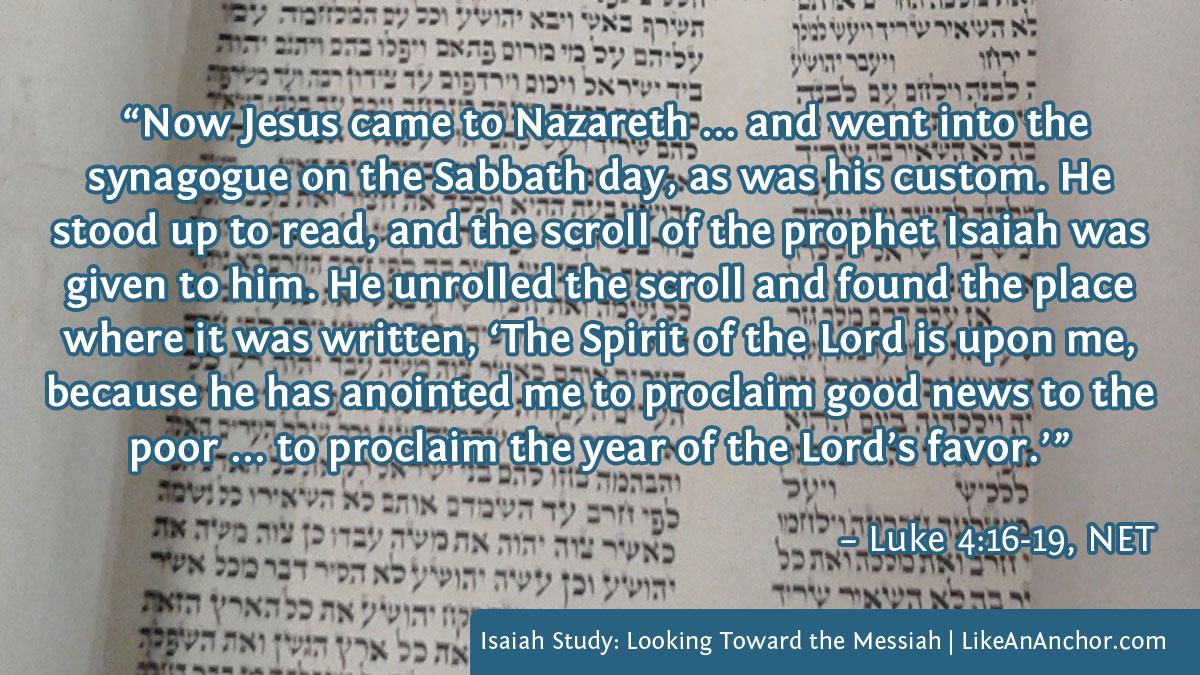
Image shows an open scroll with Hebrew writing with a quote from Luke 4:16-19, NET version:  “Now Jesus came to Nazareth ... and went into the synagogue on the Sabbath day, as was his custom. He stood up to read, and the scroll of the prophet Isaiah was given to him. He unrolled the scroll and found the place where it was written, ‘The Spirit of the Lord is upon me, because he has anointed me to proclaim good news to the poor ... to proclaim the year of the Lord’s favor.’”
Image by Marissa Baker

The Servant Songs

We’ve been talking about the Servant Songs for weeks now, but haven’t taken a close look at them yet. In my first post,  I mentioned you can find these prophecies in Isaiah 42:1–9; 49:1–13; 50:4-11; 52:13– 53:12. I also said these aren’t the only the only prophecies in Isaiah 40-66 and that God’s words in this section aren’t just for people who were anticipating the Messiah’s first coming. They’re also for us today, who are awaiting Jesus’s second coming. We can see that as we look through the four servant songs all together.

First Song

The first Servant Song speaks of the Messiah as a servant chosen by God (Is. 42:1–9). The Servant “will bring justice to the nations” without shouting or raising his voice. This prophecy also speaks of Yahweh (the name God applies to Himself in Ex. 3:15) holding the Servant’s hand and making Him “a covenant for the people, as a light for the nations.” Yahweh affirms this will happen; it’s one of the “new things” He’s declaring in this section of Isaiah. You’ll find this first Servant Song quoted in Matthew 12:15-21, Luke 2:26-32, and Romans 15:12.

Second Song

The second Song is written in first-person; the Servant is speaking (Is. 49:1-13). He says, “Yahweh has called me from the womb” to accomplish reconciliation by bringing God’s covenant people back to Him. Again, Yahweh calls the Servant “a light to the nations, that you may be my salvation to the end of the earth.” This passage speaks of the Servant accomplishing powerful deliverance, backed-up with Yahweh’s power and might. It’s quoted in Luke 2:28-32, Acts 13:47, and 2 Corinthians 6:2. In Acts 13:47, Paul and Barnabas apply part of this prophecy to their work as they follow in the Messiah’s footsteps. This indicates that while the Servant Songs are Messianic (they point to Jesus), at least part of this one can also apply to those following in Jesus’s footsteps.

Third Song

The third song presents the Servant more as suffering than triumphant (Is. 50:4-11). It speaks of Yahweh teaching the servant and giving Him wisdom for working with people. It also speaks of the Servant voluntarily submitting to suffering inflicted by other people, and affirms that “the Lord Yahweh will help me.” Like the second Song, this one is written from the Servant’s perspective and affirms His trust in Yahweh. According to SimplyBible.com’s list of Isaiah quotes, this song is not quoted directly in the New Testament. I suspect, though, that the gospel writers might have had this Song in mind when they wrote about people being astonished at the wisdom and authority of Jesus’s teachings (Matt. 13:54; Mark 1:22; Luke 4:32).

Fourth Song

The final servant song might be the most famous (Is. 52:13– 53:12). It’s certainly the one I’m most familiar with; in my church we read it every Passover. It’s also the Servant song that’s most often quoted in the New Testament (Matt. 8:16-17; Mark 15:27-28; Luke 22:37; John 12:37-38; Acts 8:32; Rom. 10:16; 15:21; 1 Pet. 2:22-25). And that list only includes direct quotes; there are other scriptures, like Christ’s discussion of servants ruling kingdoms, that likely allude to this passage (Luke 22:25-30).

In this Passage, God says that His Servant “will cleanse many nations,” but in the process He will suffer so much His face will become unrecognizable. This is one of the Messianic prophecies that speaks most clearly and graphically of the terrible things Jesus suffered to pay the price for our transgressions. Again, there are themes of justice and light, as well as inheriting a kingdom, but the focus is on the suffering of Messiah and what He means to accomplish with with His suffering.

Image shows two people's hands clasped together with a quote from Matthew 8:16-17, WEB version: “When evening came, they brought to him many possessed with demons. He cast out the spirits with a word, and healed all who were sick, that it might be fulfilled which was spoken through Isaiah the prophet, saying, ‘He took our infirmities and bore our diseases.’”
Image by Jantanee from Lightstock

A Mission of Redemption, Salvation, and Release

In the WEB translation for Isaiah 40-66, the word “redeem” shows up 24 times. “Salvation” is here 19 times and “save” 12 times. “Deliver” is used 12 times. “Help” 10 times. “Restore” is here 4 times, “release” 3 times, and “preserve” 2 times. (These numbers also include related words like “deliverer” and “redeemed”). These words related to God’s work in saving His people show up all through Isaiah 40-66; not just in the Servant Songs. Throughout these chapters, God is focused on the redemption, salvation, deliverance, and restoration of His people. He’s sharing His plans to help, release, and preserve us.

But now Yahweh who created you, Jacob,
and he who formed you, Israel, says:
“Don’t be afraid, for I have redeemed you.
I have called you by your name.
You are mine.
When you pass through the waters, I will be with you,
and through the rivers, they will not overflow you.
When you walk through the fire, you will not be burned,
and flame will not scorch you.
For I am Yahweh your God,
the Holy One of Israel,
your Savior.”

Isaiah 43:1-3, WEB

Break out into joy!
Sing together, you waste places of Jerusalem;
for Yahweh has comforted his people.
He has redeemed Jerusalem.
Yahweh has made his holy arm bare in the eyes of all the nations.
All the ends of the earth have seen the salvation of our God.

Isaiah 52:9-10, WEB

The Lord Yahweh’s Spirit is on me,
because Yahweh has anointed me to preach good news to the humble.
He has sent me to bind up the broken hearted,
to proclaim liberty to the captives
and release to those who are bound,

Isaiah 61:1, WEB

Passages like these are found all around the Servant Songs, sprinkled throughout Isaiah 40-66. They reveal God’s redeeming purpose and join the Servant Songs in pointing toward the Messiah. Jesus even quoted the passage from Isaiah 61 (with one line added from Isaiah 58:6) when He went into the synagogue to His hometown on the Sabbath day. It appears that He was reading the Torah portion and associated passage from the Prophets that day, and used Isaiah 61 to teach about His role as God’s servant (Luke 4:15-21). The way He read this passage might not seem too startling to us, but by saying that He’s fulfilling this prophecy Jesus boldly proclaimed Himself as the Messiah. It was such a startling claim that His hearers were “filled with rage” and threw him out of town (Luke 4:22-30).

If you read through Isaiah 40-66, you’ll see God is talking about deliverance on multiple levels. He’s speaking to Ancient Israel at the time, promising deliverance from captivity. He’s also pointing to a time when the Messiah would come with spiritual deliverance from sin–that’s what happened when Jesus came to this earth and died for us. On top of that, God’s revelations at the end of Isaiah look farther forward to a time when the entire world will be renewed and restored.

A New Thing

Image of a woman looking down a railway track holding a Bible. It is overlaid with the blog's title text and the words "Just as the Jewish people of Jesus's day looked for a Messiah and focused on prophecies of His first coming, we today can eagerly look forward to 
His second coming.
Image by Kristen McDow from Lightstock

It’s fascinating to see links between the New and Old Testament. Studying these patterns gives us a deeper appreciation for the Bible and a deeper understanding of Jesus. Sometimes, though, it might not seem all that relevant today since the prophecies are already fulfilled. But we can still learn from them, and not all of them are entirely done yet. Just as the Jewish people of Jesus’s day looked for a Messiah and focused on prophecies of His first coming, we today can look forward eagerly to His second coming. Let’s take another look at the end of the first Servant Song prophecy.

“I am Yahweh.
    That is my name.
    I will not give my glory to another,
    nor my praise to engraved images.
Behold, the former things have happened
    and I declare new things.
    I tell you about them before they come up.”

Sing to Yahweh a new song,
    and his praise from the end of the earth,
    you who go down to the sea,
    and all that is therein,
    the islands and their inhabitants.

Isaiah 42:9, 10, WEB

While the Servant Song seems to wrap up in verse 9 (though Yahweh also discusses “my servant” in verses 18-19 while rebuking those who trust in false gods), a new song continues in verse 10. It’s the first time in this part of Isaiah that God directly states He’s doing something new and exciting. As we’ll see more thoroughly in next week’s post, this “new thing” that He’s doing with the Messiah is the beginning of a larger project to make all things new.

We’re still waiting for the complete fulfillment of the Messianic prophecies in Isaiah. Reading God’s promises to send the Messiah back to redeem us mightily, establish His kingdom, and complete His “new” work can still encourage us as we await Jesus’s return.

Featured image by Inbetween from Lightstock

Isaiah Study: Joy in the Sabbath Covenant With God

We’re now in week three of an ongoing study of Isaiah 40-66. In these final 27 chapters of the book, Isaiah records God’s words about His feelings and plans. God shares His perspective on His relationship with His people and reveals His plans for the future. Part of those plans have already been fulfilled with Jesus’s first coming as Messiah, but others are still in the future for us as we read Isaiah today. In addition to studying those prophecies, God’s perspective on His relationship with His people is also relevant today.

Throughout the Old Testament, God worked with a specific family of called-out people. The descendants of Abraham, Isaac, and Jacob (Israel) were the only chosen people of God. Though others could join the covenant God made with Israel, it didn’t happen all that often. By the time Jesus came to this earth, many Jews of the day thought you couldn’t really have a relationship with God without being a physical descendant of Abraham. Jesus proved that assumption wrong, but it wasn’t by saying your family identity doesn’t matter anymore. Rather, He and His followers made it clear we’re being adopted into God’s covenant. God didn’t get rid of “Israel”–He elevated that covenant people to a spiritual level and made everyone whom He calls into relationship with Him part of the family. This is what Paul’s talking about in passages like Romans 11 and Galatians 4.

Sabbath-keeping is one sign of God’s original covenant with ancient Israel. Jesus and His followers also kept the Sabbath, and scripture reinforces that the Sabbath rest is still important for believers who followed their examples. The importance of the Sabbath in the New Testament is also deeply rooted in earlier scripture writings, which still help us understand the importance of the Sabbath today. If you go back and read my first Isaiah Study post, you’ll see I made a list of key themes that I want to study more extensively in this section of scripture. Among other things, that list included the role of covenant faithfulness and the importance of Sabbath keeping. God spends quite a bit of time in this section of scripture talking about the Sabbath, and that’s what we’re going to look at more closely today.

Image shows a Bible lying open. It is overlaid with a quote from Mark 2:27-28, WEB version: He said to them, “The Sabbath was made for man, not man for the Sabbath. Therefore the Son of Man is lord even of the Sabbath.”
Image by Anggie from Lightstock

Sabbath-Covenant Connection

For many Christian today, the Sabbath seems like a distant concept. We might just think of it as the name Jewish people give Saturday or an old name used way back when people in Western nations closed their businesses on Sundays. We might even think of it as a verb describing something we can do whenever we need a “sabbathing” break. None of those really reflect how the Bible talks about the Sabbath. God calls it a holy day of rest. It’s a day that belongs to Him and which He shares with His people. It’s really, really important to Him.

“Six days shall work be done, but on the seventh day is a Sabbath of solemn rest, holy to Yahweh. Whoever does any work on the Sabbath day shall surely be put to death. Therefore the children of Israel shall keep the Sabbath, to observe the Sabbath throughout their generations, for a perpetual covenant. It is a sign between me and the children of Israel forever; for in six days Yahweh made heaven and earth, and on the seventh day he rested, and was refreshed.”

Exodus 31:15-17, WEB

This command is found in Exodus, but the Sabbath dates all the way back to the first pages of Genesis. God made the Sabbath holy time from the very foundation of the world. Jesus upheld the Sabbath’s importance, teaching on the Sabbath day and describing it as something “made for man” which He is Lord of. The times when you see people like the Pharisees complaining about Jesus breaking the Sabbath, what He’s actually doing is getting rid of the additional restrictions Jewish leaders had piled up on top of God’s original intent (Mark 2:23-28; John 5:14-18). In John 5:18, for example, the Greek word for “broke” is lou (G3089), which means to set loose something that has been bound or tied up.

This is a long digression from Isaiah, but it’s necessary background before we look at the three passages in Isaiah 40-66 where God talks about Sabbath keeping. The Sabbath is a sign of God’s covenant with His people. It didn’t go away after He established a new and better covenant. It became even more special because the closer our relationships with God grows and the more like Him we become, the more we should value the things that He values. That’s why I (and an ever-growing number of other Christians and Messianic Jews) still keep the Sabbath from Friday night at sunset to Saturday night at sunset, just like Jesus and His followers did.

Image shows a Bible lying open. It is overlaid with a quote from Isaiah 56:1-2, NET version: He said to them, “The Sabbath was made for man, not man for the Sabbath. Therefore the Son of Man is lord even of the Sabbath.”
Image by Lamppost Collective from Lightstock

All People Welcomed

One of the reasons that we know God has always been interested in expanding His family beyond one physical nation is because of what He says in Isiah 56. In this passage, God promises that His house will be a place for all people and nations. Those without families of their own and who’ve come in from nations outside Israel are just as important to Him as anyone who grew up in the faith. It’s a longer section than I usually block quote, but I encourage you to read the whole thing slowly (if you’re like me, you’re always tempted to skimp when you see large quotes).

Yahweh says,

“Maintain justice
    and do what is right,
for my salvation is near
    and my righteousness will soon be revealed.
Blessed is the man who does this,
    and the son of man who holds it fast;
who keeps the Sabbath without profaning it
    and keeps his hand from doing any evil.”

Let no foreigner who has joined himself to Yahweh speak, saying,
    “Yahweh will surely separate me from his people.”
    Do not let the eunuch say, “Behold, I am a dry tree.”

For Yahweh says, “To the eunuchs who keep my Sabbaths,
    choose the things that please me,
    and hold fast to my covenant,
I will give them in my house and within my walls a memorial and a name better than of sons and of daughters.
    I will give them an everlasting name that will not be cut off.

Also the foreigners who join themselves to Yahweh
    to serve him,
and to love Yahweh’s name,
    to be his servants,
everyone who keeps the Sabbath from profaning it,
    and holds fast my covenant,
I will bring these to my holy mountain,
    and make them joyful in my house of prayer.
Their burnt offerings and their sacrifices will be accepted on my altar;
    for my house will be called a house of prayer for all peoples.”
The Lord Yahweh, who gathers the outcasts of Israel, says,
    “I will yet gather others to him,
    in addition to his own who are gathered.”

Isaiah 56:1-8, WEB

Isn’t this a beautiful passage? Think of what it meant to be a eunuch, unable to have children, in a society where family and community was so vitally important. Think of how alone you might feel as a foreigner who likely had to cut ties with your own people to join one that followed a different God. Then, into all those feelings of isolation and worry, here comes the almighty, powerful God saying that if you keep His Sabbath and respect His covenant He’ll make you fully part of the best family ever.

With that in mind, it’s no wonder that God speaks of the people who are keeping the Sabbath and holding onto His covenant as “joyful in my house of prayer.” How could you feel anything other than joy hearing this?

Also notice that this passage speaks of our present and future; it’s not just for people of the distant past. There are a lot of future-tense words in there, and it wasn’t until Jesus’ first coming that we started to see God’s temple–which is currently made up of all believers–become “a house of prayer for all people” (Mark 11:15-17; Eph. 2:11-13). These promises to those who join God’s covenant are still for us today.

Image shows a Bible lying open. It is overlaid with a quote from Isaiah 58:13-14, NET version: "“You must observe the Sabbath
rather than doing anything you please on my holy day.
You must look forward to the Sabbath
and treat the Lord’s holy day with respect. ...
Then you will find joy in your relationship to the Lord,
and I will give you great prosperity.”
Image by Lamppost Collective from Lightstock

Finding Joy in Your Relationship With God

I’m always surprised by people who think that Sabbath keeping is some kind of burden when I tell them why I don’t work on Saturdays. Even just from a human perspective, who wouldn’t want a whole day of rest each week? From a spiritual perspective, spending holy time with God for a day ought to sound like one of the best ideas ever, and God thinks so too. In fact, He says Sabbath keeping directly leads to a joyful relationship with Him.

“You must observe the Sabbath
rather than doing anything you please on my holy day.
You must look forward to the Sabbath
and treat the Lord’s holy day with respect.
You must treat it with respect by refraining from your normal activities,
and by refraining from your selfish pursuits and from making business deals.
Then you will find joy in your relationship to the Lord,
and I will give you great prosperity,
and cause crops to grow on the land I gave to your ancestor Jacob.”
Know for certain that the Lord has spoken.

Isaiah 58:13-14, NET

I like the way the NET Bible translates these verses. There are Hebrew idioms in this passage that can seem a bit confusing if you try to read them too literally, but this translation leaves no doubt about the intended meaning. “You must observe the Sabbath … You must look forward to the Sabbath and treat the Lord’s holy day with respect.” No ifs, ands, or buts.

God’s character and priorities don’t change (Mal. 3:6; Heb. 13:8). Jesus didn’t come to destroy the law (including the Sabbath command), but to fill it to the fullest spiritual extent and reveal that God always wanted obedience from the heart rather than just going through the motions (Ex. 20:8-11; Matt. 5:17-20). When we read God’s word here in Isaiah, we can know He means them for us today as well as for the original audience. The commands here are for us, and so is the promise: “Then you will find joy in your relationship to the Lord, and I will give you great prosperity.”

A Future of Sabbaths With God

Image with the blog post's title and a picture of people sitting in church services. It is overlaid with the words, "In Isaiah, God promises blessings of joy and belonging to those who faithfully keep His covenant and His Sabbath. Those promises are still available for us today."
Image by Brown Bag Photography from Lightstock

Many parts of the last 27 chapters of Isaiah refer to things which are still in our futures. One of those prophetic passages reveals that people will still be keeping God’s holy Sabbath day in the future after Jesus’s second coming when God makes a new heaven and a new earth (Is. 65:17; 2 Pet. 3:13; Rev. 21:1).

“For as the new heavens and the new earth, which I will make, shall remain before me,” says Yahweh, “so your offspring and your name shall remain. It shall happen that from one new moon to another, and from one Sabbath to another, all flesh will come to worship before me,” says Yahweh.

Isaiah 66:22-23, WEB

This passage at the end of Isaiah begins with God saying He wants a relationship with a person “who is poor and of a contrite spirit, and who trembles at my word” (Is. 66:2, WEB). When we’re humble in our spirits and honor God’s word, one of the ways we can show our respect is by following His commandments. It’s not that hard; Jesus’s “yoke is easy to bear” “and his commandments do not weigh us down” (Matt. 11:29-30; 1 John 5:2-4). Keeping God’s commandments–including the ones about the Sabbath–is a privilege and a joy. And if we’re going to spend eternity with God, it’s something we’ll be doing forever.

If you’ve been keeping God’s Sabbath for years, I invite you to let this study of Isaiah reinvigorate your Sabbath-keeping and remind you of the joy this day brings. If Sabbath-keeping is a new concept to you or it’s something you haven’t thought is important for New Testament Christians, I hope this study gives you something to think about. The world can make it challenging to take one day off each week and spend it with God, but the rewards are well worth any inconvenience. As God promises in Isaiah, “You must observe the Sabbath … then you will find joy in your relationship to the Lord” (Is. 58:13-14, NET).

Featured image by Inbetween from Lightstock

Isaiah Study: God is Incomparable and Irreplaceable

Last week, I started studying Isaiah 40-66. These are the last 27 chapters of the book, and they record an extended dialog where God speaks candidly about His feelings, desires, and plans. In this passage, He revealed His plans for ancient Israel’s immediate future at the time, for the Messiah’s coming (included the four famous Servant Song passages), and for events that are still in the future for those of us reading Isaiah today.

If you go back and read last week’s post, you’ll see I made a list of key themes that I want to study more extensively in this section of scripture. The list included (among other things) God’s defense of His reputation and His power to achieve all He’s promised. Another related point is that God is incomparable and sovereign, so trying to replacing Him with idol worship is foolish.

God shows so much emotion in this section of scripture, and much of it is related to the topic of who He is and how people ought to relate to Him. He’s angry and heartbroken when His people turn away, cutting off contact with Him. He’s confused by Israel’s forgetfulness about all He’s done in the past. He wants them to see Him for who He is and give up their foolish attachment to gods made from wood and stone. Though some of the specific wording is closely connected to Israel of Isaiah’s day, the passages also hold meaning for us today. The specifics of our struggles might be different but we’re not immune from developing an inaccurate view of the Lord.

Mi Chamocha

After God parted the Red Sea in Exodus, Moses and Miriam led the people in a song of joy that includes these words: “Who is like you, Yahweh, among the gods? Who is like you, glorious in holiness, fearful in praises, doing wonders?” (Ex. 15:11, WEB). In Hebrew, “who is like you?” is mi chamocha (which is where we get the names Michael and Michelle). You can hear parts of this Hebrew prayer in The Prince of Egypt’s soundtrack (click here for lyrics with a translation; click here for the song).

As I read through Isaiah 40-66, the phrase mi chamocha kept coming to mind. In the Exodus song, the question, “Who is like you, Lord?” is a rhetorical one. The answer should be obvious when we look at His creation and marvelous miracles, such as rescuing Israel from Egypt–there’s no one who can compare to the Lord. Many years later, though, the descendants of those people who once sang mi chamocha aren’t so sure of the answer. And so God asks a series of questions near the beginning of the passage we’re studying in Isaiah.

Who has measured the waters in the hollow of his hand,
and marked off the sky with his span,
and calculated the dust of the earth in a measuring basket,
and weighed the mountains in scales,
and the hills in a balance?
Who has directed Yahweh’s Spirit,
or has taught him as his counselor? …

To whom then will you liken God?
Or what likeness will you compare to him? …

“To whom then will you liken me?
Who is my equal?” says the Holy One.

Isaiah 40:12-13, 18, 25, WEB

Isaiah’s readers–past and present–need this reminder. In our modern world, it’s easy to forget how awe-inspiring God is. We’re jaded, tired, and distracted; often out-of-touch with the marvels of God’s creation and forgetful of His wonderful works. We need reminders of our insignificance and God’s mighty power (Is. 41:14-20). Yet like Isiah’s first audience, we’ve already witnessed God’s goodness. Now we need to remember it and worship Him accordingly, recognizing that there is no other god (Is. 43:10-13; 44:6-8; 46:5-11; 63:7-14; 64:4).

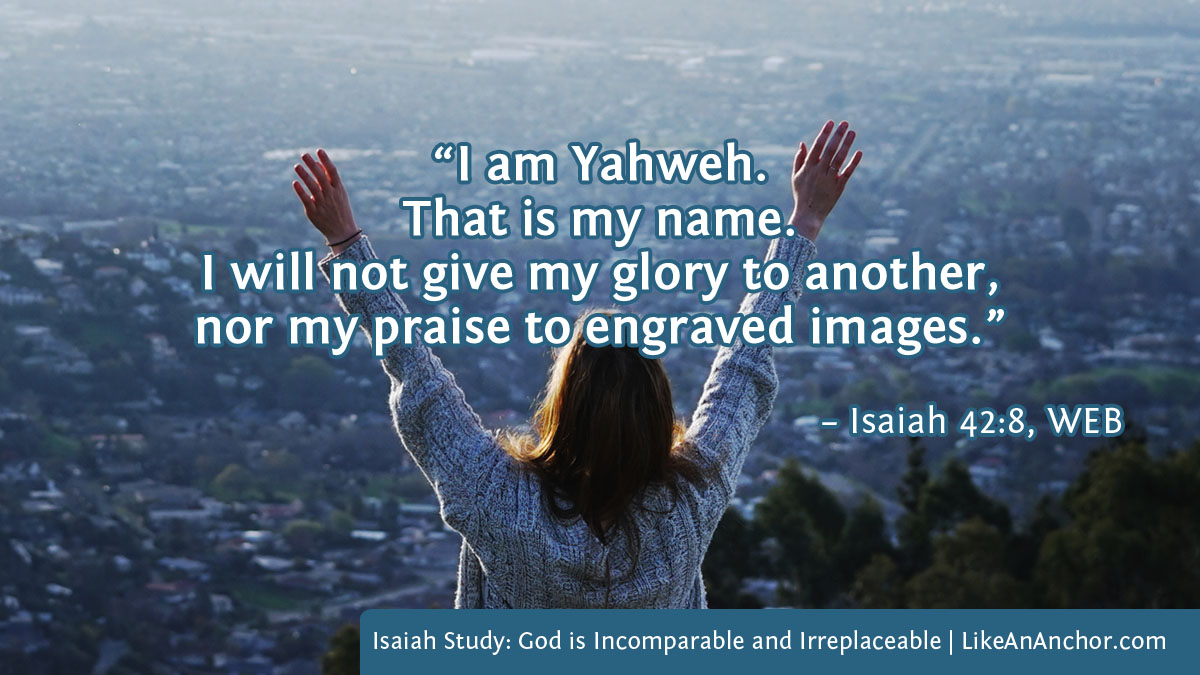
Image of a woman worshiping with her arms raised and a quote from Isaiah 42:8, WEB version: “I am Yahweh. That is my name. I will not give my glory to another, nor my praise to engraved images.”
Image by Ruby-Rose from Lightstock

Foolish Idolatry

When we turn away from God and put something else in His place, we’re guilty of idolatry. In ancient Israel’s case, this often took the form of literally worshiping other gods. My guess is that most of you reading this today aren’t tempted to carve a block of wood into a shape and bow down to it. Our idolatry temptations are more subtle. They’re still there, though, and it’s still important to be careful of them. The Apostle John makes this clear with the final admonition of his first letter: “Little children, keep yourselves from idols” (1 John 5: 21).

God’s feelings about idolatry take up huge parts of Isaiah 40-66. He keeps coming back to this topic. He seems genuinely puzzled by how a people to whom He’s revealed Himself and who’ve seen Him work wonders could turn from Him and bow down to images they made themselves. It’s simply absurd.

Everyone who makes a carved image is vain.
The things that they delight in will not profit.
Their own witnesses don’t see, nor know, that they may be disappointed. …

No one thinks,
neither is there knowledge nor understanding to say,
“I have burned part of it in the fire.
Yes, I have also baked bread on its coals.
I have roasted meat and eaten it.
Shall I make the rest of it into an abomination?
Shall I bow down to a tree trunk?”

Isaiah 44:9, 19, WEB

God is a logical, rational being and He gave humans the ability to think that way, too. Sometimes, though, understanding is clouded to the point that people can’t even figure out that the same wood they cook their food over doesn’t turn into a god just because someone carved it into a shape.

Over and over God and Isaiah come back to the topic of idolatry, challenging their readers to think about what they’re doing (Is. 44:9-20; 46:5-7; 57:3-11). If people really realized who and what God is, they’d know they could never replace Him. As such, proving who He is and that He’s the one responsible for what happens to His people is a key part of God’s purpose in this section of scripture. He even says one of the main reasons for prophecy is to disprove idols.

I have declared the former things from of old.
    Yes, they went out of my mouth, and I revealed them.
    I did them suddenly, and they happened.
Because I knew that you are obstinate,
    and your neck is an iron sinew,
    and your brow bronze;
therefore I have declared it to you from of old;
    before it came to pass I showed it to you;
    lest you should say, ‘My idol has done them.
    My engraved image and my molten image has commanded them.’

Isaiah 48:3-5, WEB

God is all-powerful. He created everything that exists and He determines the shape of the future. We can rest assured that, just as He accomplished His purposes in the past, so He will bring His future plans to pass as well. And if we ever start losing sight of Who God is and wondering if He has the power to follow-through on all the things He’s promised, we can come back to passages like Isaiah 40-66 for reassurance and reminders (Is. 41:20; 45:7; 46:9-10; 55:8-17; 59:1).

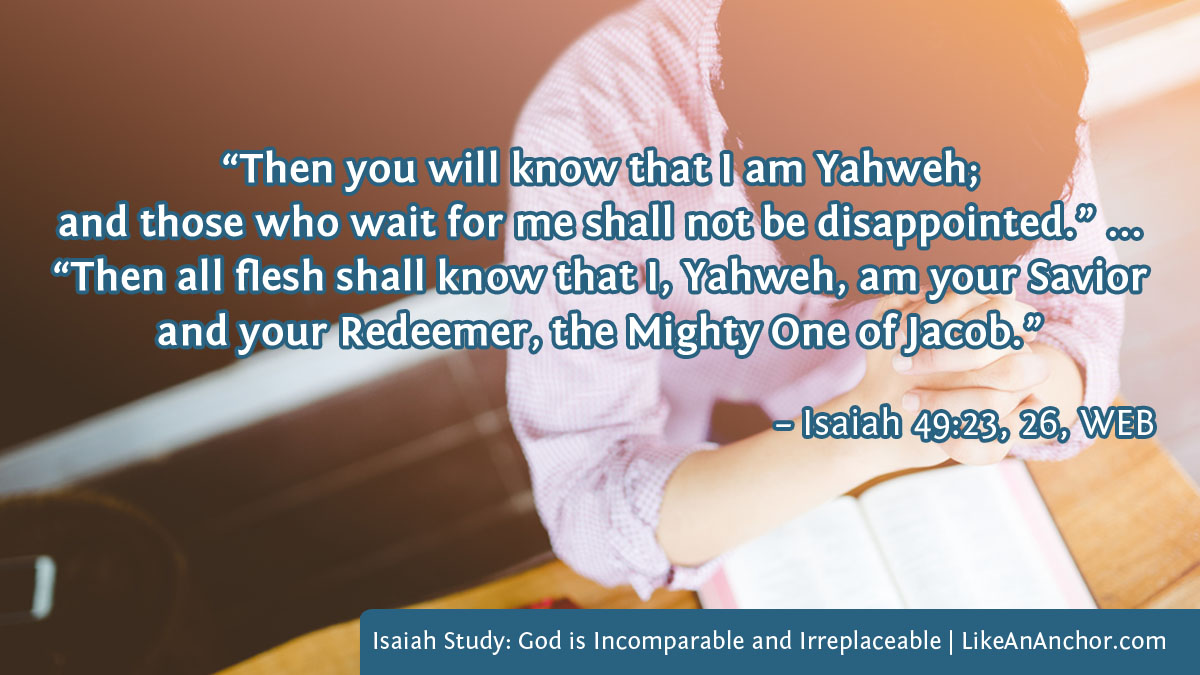
Image of a man praying while studying and a quote from Isaiah 49:23, 26, WEB version: “Then you will know that I am Yahweh; and those who wait for me shall not be disappointed.” ... “Then all flesh shall know that I, Yahweh, am your Savior and your Redeemer, the Mighty One of Jacob.”
Image by WhoisliketheLord Studio from Lightstock

God is Incomparable and Sovereign

Have you ever noticed how much the Bible talks about names? That’s because names in Hebrew culture are connected to a person’s reputation. In an Eastern society, like the one where the people in the Bible lived, family connections, honor, and reputation are extremely important (for more on this topic, see Misreading Scripture with Western Eyes by E. Randolph Richards and Brandon J. O’Brien and Reading the Bible with Rabbi Jesus by Lois Tverberg).

God uses this cultural trait to emphasize how much He cares about the way people perceive Him. It is vitally important to Him that we remember who He is and realize that nothing and no one can compare to Him. Notice these words in part of God’s commission to Cyrus that’s recorded in these final chapters of Isaiah:

I am Yahweh, and there is no one else.
Besides me, there is no God.
I will strengthen you,
though you have not known me,
that they may know from the rising of the sun,
and from the west,
that there is no one besides me.
I am Yahweh, and there is no one else.
I form the light
and create darkness.
I make peace
and create calamity.
I am Yahweh,
who does all these things.

Isaiah 45:5-7, WEB
Image of a smiling woman worshipping with the blog's title text and the words "God’s reputation in our eyes affects our relationship with Him. The more we accurately we see Him, the more properly we relate to and respect Him. "
Image by Pearl from Lightstock

What people think of God doesn’t change who He is; He is the sovereign Lord and creator of all things whether humans believe it or not. Still, He cares about how people–especially His people–view Him. He puts His name on us and tells us not to misuse that Name (Ex. 20:7; Num. 6:27). His reputation in our eyes affects our relationship with Him; the more accurately we see Him, the more properly we relate to Him.

“Listen to me, O Jacob,
and Israel my called:
I am he.
I am the first.
I am also the last.
Yes, my hand has laid the foundation of the earth,
and my right hand has spread out the heavens.
when I call to them, they stand up together.

Isaiah 48:12-13, WEB

The world is full of distracting and worrisome things. That’s true for us today just as it was true in Isaiah’s day. We battle things that vie for our attention and hearts, offering to fill our time with comforting distractions rather than what really matters. We also hear and see constant reminders that the world is violent, unstable, and full of threats to our security and way of life.

God’s word cuts through that whole thick pile of distractions and worries like a sharp blade. How could we spend time in useless distractions when the Creator of the universe wants to speak to our hearts? How could we waste our time worrying about “what ifs” when the all-powerful Lord says He will deliver and preserve us?

God is incomparable and irreplaceable. Who is like the Lord? Only He Himself. There’s no one who can compare and nothing which can replace Him. We need to remember that. It will help keep our hearts in the right place and our eyes on the goal of eternal life with the Lord.

Featured image by Inbetween from Lightstock

The Start of an Isaiah Study

I had kind of an odd work schedule last week which left me with very little time for Bible study on Monday, Tuesday, and Thursday, but a Wednesday and Friday to arrange as I pleased. I spent most of Wednesday morning reading through Isaiah 40 to 66 (the end of the book) and taking note of themes that keep popping up. This last section of the book is an extended dialog where God reveals His plans for ancient Israel’s immediate future, for the Messiah’s coming, and for events that are still in our futures today.

I love passages from this section of Isaiah, but this is the first time I’ve sat down and read all the way through in one setting to get the full context. Usually, I spread reading this many chapters out over several days, or jump around within them when studying a topic. Though that’s my usual study plan, I feel like I’ve been building up to this more in-depth study for a while now. Back in January, I read Isaiah 40-45 when talking about how God uses the word “name” in Isaiah 43. Just last month, we were in Isaiah 63 to talk about the Lord as a warrior. I also quoted verses from the last half of Isaiah in “What Does ‘I Lift Up My Soul’ Mean?” and “Cultivating Lives of Peace and Joy.”

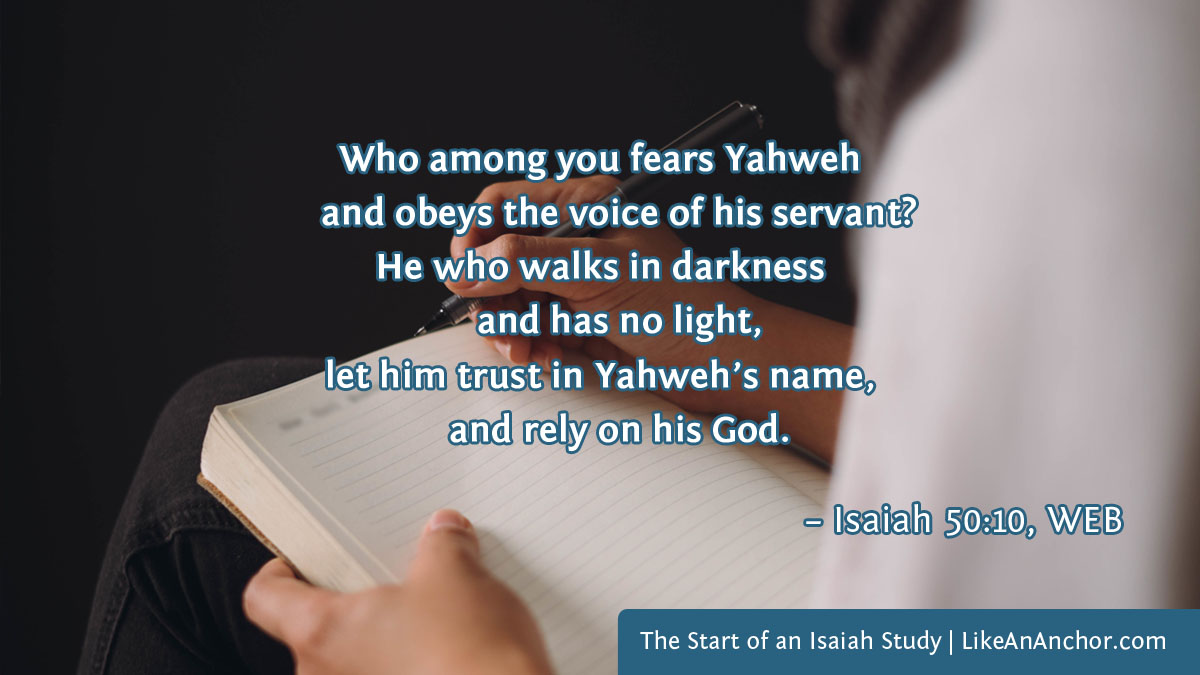
My most recent study of Isaiah began earlier this month when I started a daily scripture writing program about trust (similar to the ones I have posted at this link). One of the verses on that list was Isaiah 50:10, and for some reason it didn’t seem familiar even though I’m pretty sure I’d read this very passage recently. As I flipped back looking for a good starting point to read for context, I realized I had to go back all the way to Chapter 40 to find the beginning and I’d need to go all the way to 66 to find the end. Now seemed a good time to take a closer look at that whole section.

Image of a woman writing in a notebook, with text from Isaiah 50:10, WEB version: "Who among you fears Yahweh and obeys the voice of his servant? He who walks in darkness and has no light, let him trust in Yahweh’s name, and rely on his God."
Image by Corey David Robinson from Lightstock

Key Themes For Study

In addition to providing context for the verse in Isiah 50 that caught my eye last week, reading this whole section of Isaiah also gives us context for the famous Servant Song prophecies about the Messiah. These prophecies pointing to Jesus Christ are found in Isaiah 42:1–9; 49:1–13; 50:4-11; 52:13– 53:12. As I read the final 27 chapters of the book, though, I realized the Servant Songs aren’t the only Messianic prophecies here. Also, God’s words in this section of scripture aren’t just for people who were looking forward to Jesus’s first coming. They’re also for us awaiting His second coming.

Following a conversation Isaiah has with King Hezekiah in chapter 39, the Book of Isaiah shifts from a blend of history and prophecy to a poetic, passionate message from God. Chapter 40 begins with God’s call, “Comfort, comfort my people.” Here, we learn about the voice of one who will cry out, “Prepare the way of Yahweh in the wilderness! Make a level highway in the desert for our God” (Is. 40:1-3, WEB). If you’ve got a good memory, you might recognize this phrase from the New Testament as well; every gospel identifies John the Baptist as the voice making the way ready for Jesus’s coming as Messiah (Matt. 3:1-3; Mark 1:1-4; Luke 3:1-4; John 1:19-23). The Messianic themes in these chapters start well before the more famous Servant Songs.

There’s a lot going on in these chapters, as you might suppose when we’re looking at such a large chunk of scripture. Even just a short summary of key themes is quite a long list. This isn’t even every topic covered in this section of scripture; just the ones that stood out to me most:

  • God is motivated by justice
  • God as a husband
  • God as a warrior
  • God as a potter, with us as His clay
  • God’s defense of His reputation and His power to achieve all He’s promised
  • God is incomparable and sovereign; idol worship is foolish
  • Redemption, deliverance, salvation, restoration
  • Calling a Servant to redeem God’s servants
  • Covenant faithfulness; God never abandons His people
  • Sins push God away from us and we need to own-up to that
  • Prosperity for the righteous; no prosperity for the wicked
  • The importance of obedience and Sabbath keeping
  • Joy in relationship with God
  • Reminders to “fear not!”
  • God is doing/making something new

Reflections

Image of a woman studying the Bible, with the blog's title text and the words "Isaiah 40 to 66 is an extended dialog where God reveals plans and desires that are just as relevant for us today as they 
were for the original audience."
Image by MarrCreative from Lightstock

We don’t have time to cover all these themes in today’s post, and I haven’t had time to dig-deep into any of them yet. I plan to keep coming back to this list quite a bit over the next few weeks; I won’t need to worry about finding new blog post ideas for a while! For the rest of today’s post, I’m just going to share some of my reflections and take-aways from reading this whole section of scripture. In future posts, we’ll dive deeper into some of the specific topics.

As I read these chapters, I was struck by how much emotion God shows. He’s passionately engaged with His people. He talks about His anger with them when they turned away from Him; abandoning their relationship with the Sovereign Lord to bow down to a block of carved wood. He fights to rescue them as a fervent warrior and calls for them to return to Him as a husband who desires His wife. He even says at the end that He finds joy and happiness in His people.

God’s feelings about idolatry take up huge parts of this section of Isaiah. Reading it all together, I was surprised how often God came back to this topic. It seems to boggle His mind. Look at who He has shown Himself to be and all that He’s done for this nation in the past. Yet they turn from Him and bow down to images they made themselves? Even just with a little common sense they should be able to figure out that the wood they cook their food over doesn’t turn into a god just because they carved it into a shape. Over and over God and Isaiah come back to this point, challenging their readers to think about what they’re doing. If only they would realize who and what God is, they’d know they could never replace Him.

I’m looking forward to continuing this study over the next few weeks. If this post inspires you to take another look at this part of Isaiah, then you’re welcome to join me. If you do, I’d love to hear what you find in your study. You can leave comments on the posts or send me an email. I always think it’s fascinating how God can reveal different insights to people about the same passage of scripture since we each approach study with different perspectives and interests.

Posts in This Series:

Isaiah Study 1: God is Incomparable and Irreplaceable

Isaiah Study 2: Joy in the Sabbath Covenant With God

Isaiah Study 3: Looking Toward the Messiah

Isaiah Study 4: Doing A New Thing

Isaiah Study 5: The Contrast Between Righteousness and Wickedness

Isaiah Study 6: The Lord’s Desire for Justice

Isaiah Study 7: Are We Ever Abandoned By God?

Isaiah Study 8: The Potter and the Clay

Isaiah Study 9: Replacing Fear With Joy

Isaiah Study 10: Let Us Go Up to the Lord’s Mountain

Featured image by Inbetween from Lightstock

A Song of God’s Vineyard

I want to start today with a scripture passage. It’s a bit long, but it sets the stage perfectly for what we’ll be talking about in this post.

Let me sing for my well beloved a song of my beloved about his vineyard.
My beloved had a vineyard on a very fruitful hill.
He dug it up,
gathered out its stones,
planted it with the choicest vine,
built a tower in the middle of it,
and also cut out a wine press in it.
He looked for it to yield grapes,
but it yielded wild grapes.

“Now, inhabitants of Jerusalem and men of Judah,
please judge between me and my vineyard.
What could have been done more to my vineyard, that I have not done in it?
Why, when I looked for it to yield grapes, did it yield wild grapes?
Now I will tell you what I will do to my vineyard.
I will take away its hedge, and it will be eaten up.
I will break down its wall, and it will be trampled down.
I will lay it a wasteland.
It won’t be pruned or hoed,
but it will grow briers and thorns.
I will also command the clouds that they rain no rain on it.”

For the vineyard of Yahweh of Armies is the house of Israel,
and the men of Judah his pleasant plant:
and he looked for justice, but, behold, oppression;
for righteousness, but, behold, a cry of distress.

Isaiah 5:1-7, WEB

Love songs like this are one reason I love the book of Isaiah so much. It starts out sounding like something from Song of Solomon, with someone singing to Yahweh, their beloved. Then the song turns sour (like the grapes in this vineyard) as Israel turned their hearts away from their lover. God Himself interjects to finish the story. They turned their back on Him even though He did everything right, and for Him this isn’t an empty claim. No one can do more than God to show love and to provide fertile ground to grow in. It wasn’t unreasonable of Him to look at a people He “planted” and expect they’d yield fruits of justice and righteousness instead of oppression and distress.

I recently started reading a new one-year devotional called Worship The King by Chris Tiegreen. January 15-19 are all based on Isaiah 5:1-7, and one of the things Tiegreen points out is that, God’s question, “What more could I do?” is in some ways rhetorical. There was one more thing He could do, and He did it when He sent Jesus to die for our sins (p. 18). If you’ve ever wondered why Jesus spent so much time talking about agriculture and vineyards in His parables, this is it. He’s continuing a metaphor God started using in the prophets to show how He fits into God’s love story.

Vineyard Parables

There are three primary vineyard parables that Jesus shared during His ministry. One is focused on reward for workers in a vineyard (Matt. 20:1-16), and another on two sons whose father told them to work in his vineyard (Matt. 21:27-32). Then, right after that parable where only one son did his father’s will by working in the vineyard, Jesus says this:

“Hear another parable. There was a man who was a master of a household who planted a vineyard, set a hedge about it, dug a wine press in it, built a tower, leased it out to farmers, and went into another country. When the season for the fruit came near, he sent his servants to the farmers to receive his fruit. The farmers took his servants, beat one, killed another, and stoned another. Again, he sent other servants more than the first; and they treated them the same way. But afterward he sent to them his son, saying, ‘They will respect my son.’ But the farmers, when they saw the son, said among themselves, ‘This is the heir. Come, let’s kill him and seize his inheritance.’ So they took him and threw him out of the vineyard, then killed him. When therefore the lord of the vineyard comes, what will he do to those farmers?”

Matthew 21:33-40, WEB

The people Jesus is talking with are pretty sure they know the answer to that last question. The master will kill the servants and “lease out the vineyard to other farmers who will give him the fruit in its season.” In response, Jesus points them back to a scripture predicting the Messiah would be rejected by the people who should have been looking for His arrival (Psalm 118:22-23). The other servants who came before Him were prophets like Isaiah and many others whom Israel ignored. Now, the Master’s Son is here.

Jesus doesn’t point His listeners back to Isiah’s song about the vineyard, but we can easily see the parallels. Here in Jesus’s parable, though, the link between Him and the vineyard is made more explicit. God has a vineyard like the one Isaiah sang about. Jesus coming as the Master’s Son is the one thing more that God can do to receive the fruit His vineyard owes Him. And then the leaders of His people killed Him just like the wicked workers in this parable. Jesus points beyond that death when He says, “God’s Kingdom will be taken away from you and will be given to a nation producing its fruit” (Matt. 21:41-46). That doesn’t mean Jewish or Israelite people won’t be in God’s kingdom (as Paul points out using another agricultural example in Romans 11). It does mean that staying in a fruit-producing relationship with God is far more important to your long-term spiritual wellbeing than whether or not your ancestors had a covenant with Him.

Our Role as Vines

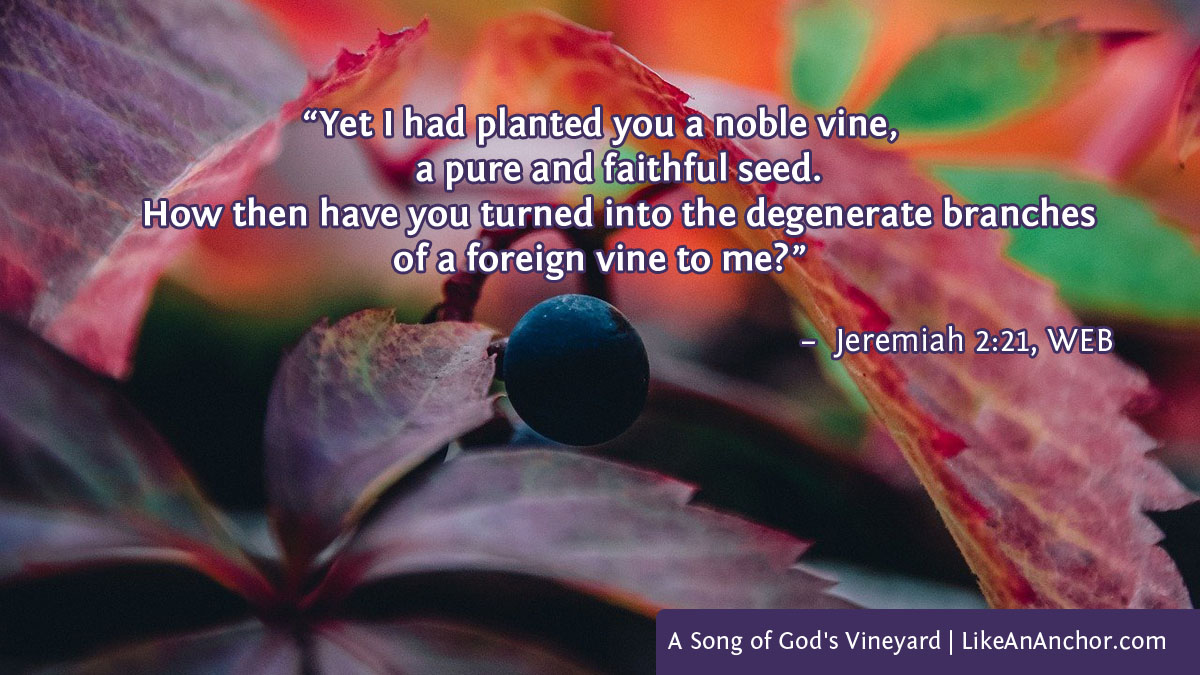
Fruitfulness is something God comes back to again and again. In another vineyard song from Isaiah, God speaks of a time when “Jacob will take root. Israel will blossom and bud. They will fill the surface of the world with fruit” (Is. 27:2-12, WEB). Even in this song, though, it speaks of issues with the vineyard that must be forgiven before the vines can thrive. As other prophets point out, the vines that God cultivated for thousands of years weren’t always as fruitful as they should have been (Jer. 2:19-22; 12:10-11; Ezk. 19:10-14). It’s an issue that could really only be solved by Jesus’s sacrifice. Even after that sacrifice, though, fruitfulness requires our participation. Jesus addressed this idea in another parable, this time about a fig tree.

He spoke this parable. “A certain man had a fig tree planted in his vineyard, and he came seeking fruit on it, and found none. He said to the vine dresser, ‘Behold, these three years I have come looking for fruit on this fig tree, and found none. Cut it down. Why does it waste the soil?’ He answered, ‘Lord, leave it alone this year also, until I dig around it and fertilize it. If it bears fruit, fine; but if not, after that, you can cut it down.’”

Luke 13:6-9, WEB

As vines and trees in God’s vineyard, we have a say in whether or not we produce fruit. He provides fertile ground where we can thrive. He prunes and forgives us, keeping us spiritually healthy. He feeds everyone connected to Jesus–the Root that we all rely on as branches who are part of Him as the Vine (John 15:1-16). But we’re human beings, not vines that always stay exactly where we’re planted. Whether or not we stay in that good soil is our choice. We need to keep seeking God’s correction and forgiveness as we grow to be more and more like Him. And we need to stay rooted in the vine. Only then will the Father be glorified by the fruit that we produce and the love song that we sing to Him.

Featured image by alohamalakhov from Pixabay

Song Recommendation: “Dance With Me” by Paul Wilbur