Why Is It So Hard For Certain Personality Types To “Just Get Over It”?

You know when you’re struggling with something bad that happened to you and someone says, “Just get over it,” but you know it’s not that simple? For some reason, this particular hurt lodged deep inside and letting go seems well-nigh impossible.

For this post, I’m not talking about a hurt like grief over losing someone you love. We know why things like that are hard to “get over,” and in many cases it wouldn’t be appropriate to move on quickly. Most people recognize that hurts of that sort require time to heal and grieve. I’m talking about interpersonal hurts that might seem “little,” but have a big impact anyway. For example…

  • You express an authentic part of yourself (like your happy, fun-loving side), then people assume that’s all there is to your personality.
  • You receive 99% positive feedback about a project, but that 1% haunts you anyway.
  • You help someone out of the goodness of your heart, but others misinterpret your motives.
  • You decide to open up to someone, then lie awake at night worrying about their reaction.

Hurts like this touch on the core of who we are and/or our relationships with other people. These hurts are often deeply individual, and others might not understand them. If you don’t care what other people think of you, then you’re not going to understand why someone else is so upset about the one person in their life who’s a critic. If you find it easy to adapt to different social situations, you might not understand why someone’s so upset about not being able to express their true self all the time.

The reason why things like this can hurt us so deeply is often nuanced and complicated, but it has a lot to do with how we use the Feeling sides of our personalities. Everyone has a Feeling side (whether or not there’s an F in your four-letter Myers-Briggs® type), and we each use this part of our personality a little differently. Read more

Ficitonal MBTI – The Librarians

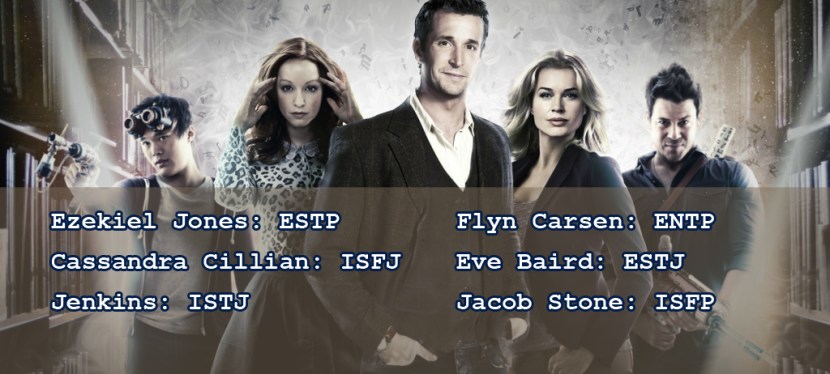
The Librarians is one of my favorite TV shows. What could be better than a team of bookworms saving the world from runaway magic? Sure it’s campy and can’t be taken too seriously, but isn’t that part of the appeal?

Typing fictional characters is one of my favorite things to do in blog posts. I’d started writing this one for last week, but when I realized how many of the Librarians characters are Sensing types I thought it’d be a great follow-up to my “Myths About Sensing Types” post. One of the more pervasive myths about Sensors is that they’re neither intelligent nor imaginative. Since all the main characters in this show except Flynn are Sensors, The Librarians provides a perfect example to the contrary.

Please note: I type using cognitive functions, which are the basis of Myers-Briggs theory. If you’re not familiar with this concept or want a refresher, check out this articles: The Simplest Guide To Myers-Briggs Functions Ever

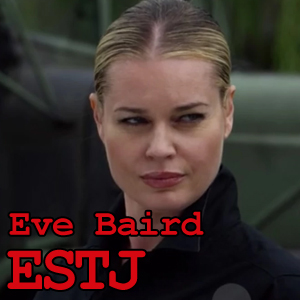
Eve Baird: ESTJ

Ficitonal MBTI – The Librarians | marissabaker.wordpress.com

Eve is the easiest character to type, partly because she’s such a stereotypical example of the type nicknamed “Supervisor” or “Guardian.” ESTJs are known for their blunt demeanor, no-nonsense attitudes, and ability to keep things moving forward. They also care about keeping the world running as it should be, a trait Eve devotes to keeping the Library safe and magical artifacts out of the wrong hands.

ESTJs lead with a judging function called Extroverted Thinking/Effectiveness. That means Eve’s preferred mental process involves measuring and managing impersonal criteria when making decisions. There are examples of this in literally every episode. Read more

Part Two: “Unofficial” Disney Princesses MBTI Chart

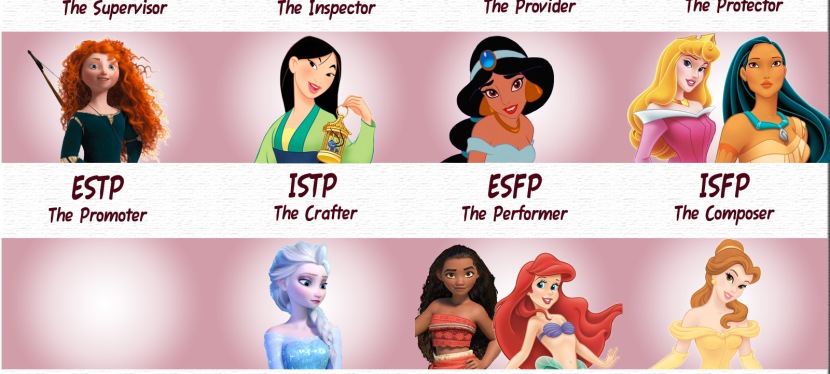
Last week, I updated an old post called The Missing Disney Princesses with a brand new MBTI Chart featuring the 14 official princesses (well, technically there are 11 official princesses, plus Anna and Elsa who have their own line, and Moana who hasn’t been crowned yet. So it was more like the “Official + New/Popular Princesses Chart”).

There are other Disney women, though, who’ve been completely snubbed by the Disney princess line-up and I wanted to include those as well. I had them on a separate chart in my previous post and I wanted to follow that pattern this time as well. Eilonwy and Alice were the most requested characters I left out last time, so I’m adding them. And I’ve also added a character no one asked about from my favorite underappreciated Disney films — Maid Marion from Robin Hood.Updated Disney Princesses MBTI Chart, Part Two | marissabaker.wordpress.com

Note: I’m not using anything from sequel films (just to help narrow-down the typing choices), so that’s why you won’t see Ariel’s daughter Melody (for example). I also type using cogitative functions. If you’re not familiar with that aspect of Myers-Briggs theory, click here and here for a two-part introduction. Read on for detailed explanations for why I chose these types for the unofficial princesses, and click here for the post about the other princesses.

Read more

Updated Disney Princesses MBTI Chart

A couple years ago, I made a Myers-Briggs chart called The Missing Disney Princesses that quickly became one of the more popular posts on my blog. Now (finally!!!) I get to update it to include our new princess, Moana.

But I’m not just adding Moana to my chart. I’m also moving around a few of the other princesses. Last time, my focus was on showing that we don’t see all the personality types represented by the Disney princesses. Both Intuitive and Thinking types are under represented among Disney’s ladies. That’s still the case, but this time my focus is on explaining why I typed each princess the way I did.

In the two years since publishing the last chart, I’ve learned more about Myers-Briggs typing. I’ve also re-watched several of these movies, considered comments from readers on the previous post, and asked advice from fellow personality type and Disney enthusiasts. In response, I’ve re-typed several characters (which is noted and explained in the individual character discussions).Updated Disney Princesses MBTI Chart | marissabaker.wordpress.com

Note: I type using cogitative functions. If you’re not familiar with that aspect of Myers-Briggs theory, click here and here for a two-part introduction. Read on for detailed explanations for why I chose these types for each character. Read more

Myers-Briggs: Fad or Science?

Friends who know I blog about Myers Briggs types sometimes send me links to people critiquing the MBTI and ask what I think. The arguments in videos like “Why the Myers-Briggs test is totally meaningless” and articles such as “Goodbye to MBTI, the Fad That Won’t Die” tend to follow a similar pattern and hit the same points:

  • Kathryn Brigs and Isabel Briggs Myers had no formal training.
  • The test doesn’t allow for complex personalities or that someone can be a little bit of an extrovert and a little bit of an introvert at the same time.
  • Similarly, the judging-perceiving, thinking-feeling, and sensing-intuition “scales” don’t allow for people who use both.
  • About 50% of people who take the test twice within 5 weeks get different results.
  • Test fails to predict success in various jobs and doesn’t provide meaningful data.
  • The test remains popular because it only gives positive results. These results are vague and hard to argue with, much like astrology and pseudoscience.

Disclaimer: some of the links in this post are affiliate links. This means that, at no additional cost to you, I will receive a commission if you click on the link and make a purchase on that website.

Setting aside the first arguments for now, I think these points are a good criticism of some of the free tests going around which make people pick just between the four letter groups. None of this, however, takes into account the science behind Myers-Briggs. In fact, if the critics would bother reading Isabel Myers’ book Gifts Differing,* they would find most of their points have nothing to do with actual Myers-Briggs theory.Myers-Briggs: Fad or Science? | marissabaker.wordpress.com

The Truth About Extroverts and Introverts

The video I linked above correctly states that Jung’s theory allowed for people who didn’t fit neatly into a single category. But then they say Kathryn Briggs and Isabel Myers “took Jung’s types but slightly altered the terminology and changed it so every single person was assigned only one possibility or another. You couldn’t be a little bit of an extrovert or a little bit of an introvert.”

In fact, this a complete misrepresentation of Myers-Briggs theory. Read more