If you’ve done much reading about Myers-Briggs® types, you’ve probably come across the claim that Intuitives are smarter than Sensors. Or perhaps you’ve seen people talk about Thinking types being more intelligent than Feeling types.
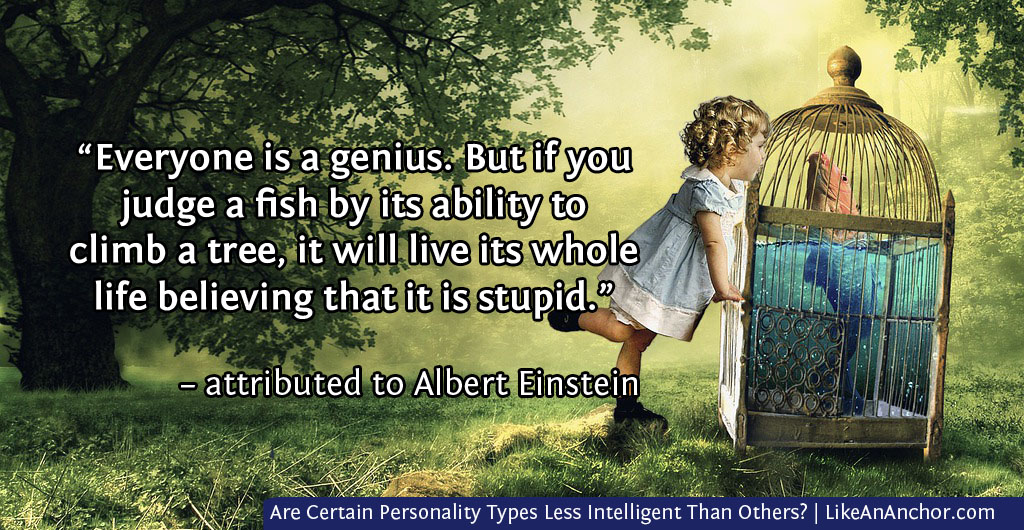
Both of these ideas are untrue. They’re based on inaccurate stereotypes about the types and/or misunderstandings about the unique sort of intelligence that each type uses. In reality, every personality type is intelligent and no one type is smarter than any other. They do have different kinds of intelligence, though, and there are situations where one type might appear smarter than others just based on what skills the situation calls for.
The idea that Sensing types aren’t smart is actuality based on something Isabel Meyers mentions in her book Gifts Differing. She said that Intuitive types tend to score higher on IQ tests. What people who spread this rumor miss is that she also pointed out that the structure of IQ tests puts Sensors at a disadvantage which has nothing to do with whether or not they’re smart. Read more →
Have you ever witnessed, or been part of, a conversation that starts to turn into a conflict because both parties feel the other just doesn’t “get it”? They’re approaching whatever topic they’re discussing from different perspectives, seeking different outcomes, and/or phrasing things in a way that makes sense to them but for some reason sets the other on edge.
If you talk with one of them after this conversation, you might hear things like, “I just can’t understand why they’re so irrational!” or “Why can’t they just tell me what they actually think?” Then if you talk with the other person you could hear, “I don’t see why they insist on stirring-up conflict” or “How dare they put me on the spot like that!”
This sort of situation often develops when Thinking and Feeling personality types clash. It’s especially noticeable among the INFJ, ISFJ, ENFJ, and ESFJ types and INTJ, ISTJ, ENTJ, and ESTJ types, since these types direct their decision-making processes outward. In other words, they interact with the outer world using their judging functions of Extroverted Feeling and Extroverted Thinking. If you’re not familiar with function theory, click here to read “The Simplest Guide to Myers-Briggs® Functions Ever.”
One of my favorite applications for personality type theory is using it to better understand people who don’t see the world the same way as us. As I explained in a post a couple weeks ago, both Thinking and Feeling are considered rational functions. These two ways of decision-making use very different foundations for their rationalizations, however. And if you’re not aware of how that all works, then it can lead to quite a bit of frustration when you’re trying to have a conversation with someone who doesn’t share your type’s preferences. Read more →
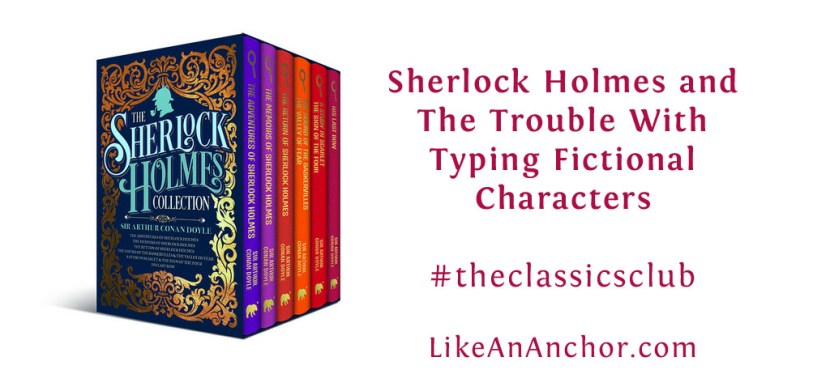
Discussions about Sherlock Holmes’ Myers-Briggs® type can get pretty heated in the online community. He’s either an INTJ or INTP and whichever side you come down on (if you care about this sort of thing) is worth passionately defending. I’ve weighed-in on this myself in a blog post arguing that Sherlock as portrayed by Benedict Cumberbatch in the Sherlock BBC series, Robert Downy Jr. in the Sherlock Holmes movies, and even the Basil of Bakerstreet version from Disney’s The Great Mouse Detective are all INTPs.
I do think that’s the best-fit type for all three of those versions, but they aren’t the only portrayals of Sherlock Holmes. We ought not forget, for example, the original character in the stories penned by Sir Arthur Conan Doyle. I’ve been reading and re-reading several of those for my Classics Club book list and Sherlock doesn’t seem very much like an INTP in those stories. In fact, the only thing I can say with absolute certainty is that he’s a Thinking personality type.
That brings us to the second part of this post’s title: the trouble with typing fictional characters. Though I love looking at fictional characters’ personality types, there are limits to how accurately you can type them. It gets especially tricky in the case of someone like Sherlock Holmes or Batman because so many writers and actors have been involved in portraying this character over quite a long period of time. There’s bound to be some inconsistencies in how each creative sees the character they’re working with. Plus, I doubt very many of them think about the character’s Myers-Briggs® type and how they can keep it consistent in every portrayal.
Going back to Sherlock Holmes as our example, Sir Arthur Conan Doyle sometimes writes him in a way that looks like ISTJ, sometimes more like one of the NTJ types, and sometimes with traits of a TP type. He also calls Dr. Watson by two different first names (John is used three times, James once), so I think it’s safe to say Doyle wasn’t all that concerned with consistency. In any case, Doyle’s Sherlock Holmes stories were written about 30 years before Jung published Psychological Types, so we know he wasn’t relying on those theories when writing the character.
So Why Type Fiction?
Since it’s difficult to type fictional characters with a high degree of accuracy, why do it? For one thing, it’s fun. It’s one of the ways to turn an interest in Myers-Briggs® into an entertaining pastime as well as a useful hobby.
Typing fictional characters can also sharpen our skills typing real people. It gives us a chance to study how characters react and puzzle out which psychological functions they’re using based on what they say and how they act. In addition, well-written characters provide familiar examples of the different types to use in every-day conversation. If someone asks me what an ENTP or ISFJ, for example, looks like in real-life then Tony Stark and Samwise Gamgee are there to help clarify things.
Do you enjoy trying to figure out fictional characters’ personality types? Tell us about your favorite characters and what you think their types are in the comments!
What fictional characters do you relate to as an ISTJ?
Just as we can describe real people using the Myers-Briggs® typology system, we can also use the system to type well-written fictional characters. Some of fiction’s most iconic and intriguing characters are ISTJs, and today we’re going to talk about seven of them that I think real-life ISTJs will find relatable.
Another great thing about looking at character personality types is that it helps us to better understand people who have different types than we do. Fictional ISTJs can serve as examples for what real-life ISTJs might be like, and also show how much variation can exist between individuals with the same type.
Bathsheba Everdene
Thinking-type heroines are a pretty rare thing in fiction, especially in older stories. But the heroine of Thomas Hardy’s Far From the Madding Crowd (1874) is one of the rare examples. Bathsheba Everdene didn’t really capture my attention when I first read the book, but in hindsight she’s one of the more unique female characters in classic British fiction. I also liked her in the 2015 film version.
When someone interested in Myers-Briggs®talks about loops, they’re referring to what happens when a person bypasses their co-pilot function and starts relying on their dominant and tertiary process instead. This can be a temporary situation, or it can last for quite a long time depending on the individual and their circumstances.
Some people teach that the Dominant-Tertiary Loop leads to personality disorders, but I have not found any good research to back up this claim. We can slip into a loop pattern without developing a disorder, and specific mental illnesses aren’t tied to any one personality type. It seems more likely to me that, as a general rule, loops are part of a reaction to stress or an attempt to avoid discomfort.
We all need a balance between inner and outer world feedback, a way to learn new information, and a way to process information and make decisions. We’re got all that covered in our dominant and co-pilot functions because one is introverted and one is extroverted, and one’s a perceiving/learning function (Sending or Intuition) and one’s a judging/decision-making function (Feeling or Thinking).
When we skip our co-pilot function and go for the tertiary instead, we’re replacing the co-pilot with a function that fills a similar role because the tertiary and co-pilot are both either Perceiving or Judging functions. However, the tertiary has the same orientation (Introverted or Extroverted) as the dominant function. Going into a “loop” means we’re ignoring the world that is most uncomfortable for us and we’re opting to use a function that’s less mature than our co-pilot. This “loop” is going to look different for each type, but in all cases it means we’re not balanced. It also usually means that we’re avoiding personal growth. Read more →
When we talk about psychological functions in Myers-Briggs® types, the tertiary function often gets over looked. Usually, we talk about the two that we use most often or about the inferior function that usually shows up under stress. These three functions are hugely important. Our dominant and co-pilot processes need to work together for us to have healthy, balanced personalities. And we need to understand the inferior function so we’re better equipped to recognize and deal with how we react to stressful situations. But the tertiary function is also important.
The tertiary function is also called the “relief function.” In Personality Hacker’s car model (affiliate link), they call it the 10-year-old because that’s the level of maturity this function typically has. Psychologist John Beebe named it the “Eternal Child” after one of Carl Jung’s archetypes. Though we don’t talk about this function nearly as much as some of the others, it’s also a key part of our personality. Understanding the tertiary function, and how it relates to the other functions, can really help us understand ourselves.
Growth And The Functions
In terms of typology, personal growth happens when we’re using both our introverted and our extroverted sides, as well as our judging and perceiving sides. Working to find a balance between our dominant and co-pilot processes leads to growth and change because we’re exercising all these aspects of our personality. Read more →


 Like An Anchor