One of the phrases that I’ve been praying a lot over the past year since my baby was born is, “We’re in your hands, Lord, and that’s a good place to be.” It’s not a phrase that’s found in scripture, but the idea is Biblical. I’ve found that it serves as a good reminder to help me find calm amid anxieties and refocus on God’s goodness, faithfulness, and promises.
Today’s post is going to be quite a bit different than usual. As I was praying about this topic earlier in the week and planning how to write about it, I started writing song lyrics instead of an article. I haven’t tried songwriting since high school, and I rarely write poetry, so it caught me off-guard. A while ago, I’d prayed that God would help me write songs (the reason why is a long story we don’t need to get into now), but I’d assumed the answer was “no.” Apparently, though, it was, “not yet” and suddenly I have one completed hymn and two others drafted.
I’m not a musician (though I do have some musical training, I focused mainly on voice), and I didn’t write the tunes for these pieces. The one I’m sharing today is set to the traditional Irish tune “Slane,” which you might know as “Be Thou My Vision.” I love these old traditional melodies, and since they’re in the public domain I can freely use them and add my own lyrics.
Hold Me In Your Hands
Hold me in your hands as long as I live; Nothing else matches the comfort you give. With you, Lord, beside me my eyes finally see Dwelling with you is the best place to be.
When I am sinking in life’s stormy waves, You stretch your hand out and surely do save. You say “Have no fear” and slowly I learn We can rest easy where you are concerned.
God of all comfort you still hold us all. When we’re in your hands then we’ll never fall. Uphold your people with your righteous hand, In your great power we surely will stand.
Lyrics by Marissa Martin. Set to the traditional Irish tune “Slane” (“Be Thou My Vision”)
Here’s a really good piano version of “Be Thou My Vision.” The pianist plays four verses and I only have three, but you can see what the music sounds like and maybe sing along with my lyrics. I’m releasing my lyrics under a Creative Commons license (CC BY-SA) and the music is already public domain, so if you want to use them for something you don’t have to worry about copyright restrictions. The sheet music is at the end of this post.
Scripture References
I reference quite a few scriptural phrases in my song, but there were three verses in particular that I was thinking about as I wrote these lyrics:
So do not fear, for I am with you; do not be dismayed, for I am your God. I will strengthen you and help you; I will uphold you with my righteous right hand.
Isaiah 41:10, NET
But when he saw the wind, he was afraid and, beginning to sink, cried out, “Lord, save me!”
Immediately Jesus reached out his hand and caught him. “You of little faith,” he said, “why did you doubt?”
Matthew 14:30-31, NET
Blessed is the God and Father of our Lord Jesus Christ, the Father of mercies and God of all comfort, who comforts us in all our troubles so that we may be able to comfort those experiencing any trouble with the comfort with which we ourselves are comforted by God.
2 Corinthians 1:3-4, NET
One of the many reasons that I love music is because it makes things easier to remember. I want my daughter to learn phonics, so we listen to “Sing the Alphabet.” I want to strengthen my French speaking and listening skills, so I listen to French music. And when I want to memorize scripture and/or scriptural truths, it’s a whole lot easier for me to do that when it’s set to music.
It’s a question associated with overly enthusiastic or exceptionally earnest evangelists, knocking on doors and chatting you up in coffee shops. But it’s also a question that haunts many Christians. Like many things, we often fall into two extremes related to this question. On the one hand, we have people who say, “Once saved, always saved, so it doesn’t matter what I do now.” On the other hand, we have people who are terrified that they’re not actually saved and spend their lives struggling to measure up to God’s perfect standard with no assurance that they’ll make it in the end.
A few weeks ago, our pastor gave a message about the three ways that the Bible talks about salvation: we are saved, we are being saved, and we will be saved. He also mentioned an analogy that I’ve been mulling over for a couple weeks now. Like all analogies, it breaks down if you carry it too far, but I think it gives us a good starting point.
People who say they are already saved by Jesus are correct. But so are people who say that you can “lose” that salvation (though “reject” would be a much more accurate term). It’s like if a firefighter pulls you out of a burning building. Once you’re out of the fire, you’ve been saved. The salvation has already happened and it’s not going to be undone by the person who rescued you. But you can still run back into the burning building. It would be phenomenally stupid, but you have the free will to reject salvation. Knowing that can lead to anxiety for many people, but how worried should you actually be about this knowledge?
Image by HarveyMade from Lightstock
Be Confident
In my church, we spend quite a bit of time refuting the “once saved, always saved” heresy. No, you didn’t do anything to earn salvation–it’s a gift of God–but once you’re saved by grace, you owe God loyalty, faithfulness, and obedience. You can even choose to reject salvation, either verbally or by actions that deny your relationship with God (see, for example, 1 Cor. 6:9-10; Gal. 5:19-21; Heb. 10:26-31). We are currently saved, but it is also an ongoing process of walking with God that He will finally accomplish at Jesus’s return.
It’s an important point to understand, but I think perhaps we should spend just as much time countering the mistake that is more pervasive in our church, namely, the fear that we’re not good enough for God and might not really be saved. I’ve known people paralyzed by anxiety and fear that they don’t measure up to God, that He won’t give them salvation, and that they won’t be good enough to be in the kingdom. While we should have a great deal of respect for God, He does not want the people He welcomed into a relationship with Him to cower in fear!
You’re not supposed to feel guilty that you needed God’s grace. You should realize that you’re guilty of sin and can only be saved by His grace, but you shouldn’t beat yourself up because you couldn’t earn salvation. You were never meant to earn it! Reading through all of Paul’s letter to the Romans (preferably in one setting) is a beautiful exploration of these facts. None of us can earn salvation, but God knows that and in His great mercy, He worked things out so we don’t need to; we just need to believe in Jesus and commit to following Him. None of our works earn God’s favor or pay Him back for His grace, but good works (and refusing to go back to living in sin) are the correct response to His work in us. Confidence that we’ve received salvation is a topic Paul kept coming back to again and again in his letters.
And so, since we have been justified by his grace, we become heirs with the confident expectation of eternal life.
Titus 3:7-8, NET
This was according to the eternal purpose that he accomplished in Christ Jesus our Lord, in whom we have boldness and confident access to God by way of Christ’s faithfulness.
Ephesians 3:11-12, NET
God wants us to be bold and confident in relation to our salvation. He accomplished it, and He wants us to realize that it’s something He will not revoke and no one else can revoke. Jesus pulled us out of the fire when we accepted His sacrifice on our behalf. He’s not going to throw us back in. At the same time, that moment of salvation starts a participatory process. We’re meant to be fully involved in the transformation that salvation starts in our lives.
Balancing Humility and Certainty
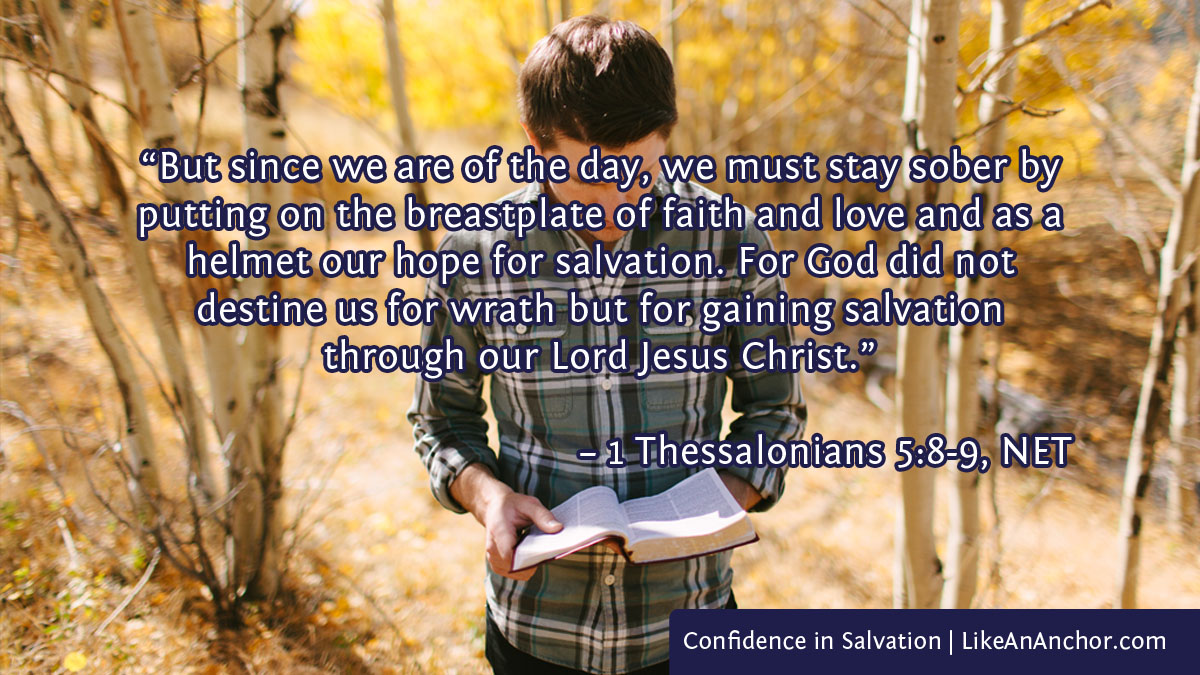
We can have great confidence and boldness in the fact that “God did not destine us for wrath but for gaining salvation through our Lord Jesus Christ” (1 Thes. 5:9, NET). He doesn’t set us up for failure. In fact, He wants us to succeed! He’s already proved how invested He is in saving us by Jesus literally dying in our place. We don’t need to worry that God thinks we’re not good enough (Jesus cared enough to die for us while we were yet sinners [Rom. 5:8]) or that He’ll give up on us partway through the salvation process (Phil. 1:6).
Therefore, since we have been declared righteous by faith, we have peace with God through our Lord Jesus Christ, through whom we have also obtained access into this grace in which we stand, and we rejoice in the hope of God’s glory. …
Much more then, because we have now been declared righteous by his blood, we will be saved through him from God’s wrath.For if while we were enemies we were reconciled to God through the death of his Son, how much more, since we have been reconciled, will we be saved by his life?
Romans 5:1-2, 9-10, NET
Image by Anggie from Lightstock
Here, Paul uses the term “reconciliation” for the salvation already accomplished–the restoration of relationship between us and God when Jesus’s sacrifice covered our sins–and “we will be saved” for the final salvation that we look forward to when Jesus returns and we become fully part of God’s family. We are assured without a doubt that Jesus accomplished salvation in our lives when we entered a covenant relationship with Him, and that God will finish the work that He started in us unless we choose to stop working with Him (Phil. 2:12-13; Heb. 2:1-3).
There is a delicate balance we must maintain between humility and confidence. We must confidently expect that God will deliver on His promises of eternal life while at the same time recognize that we could be disqualified from receiving those promises if we reject and abandon God. Even the apostle Paul didn’t dare say he’d already attained the resurrection during most of his life (1 Cor. 9:27; Phil 3:10-14); it was only right at the end of his life that he could say, “I have kept the faith” and will inherit the crown (2 Tim. 4:6-8). Self-righteous confidence is a danger we must be careful to avoid; our confidence should rest in God, not ourselves (Luke 18:9-14; Rom. 2:17-29). And when our confidence is placed firmly in God, then we have nothing to fear.
Yahweh is my light and my salvation. Whom shall I fear? Yahweh is the strength of my life. Of whom shall I be afraid? … Though war should rise against me, even then I will be confident. …
I am still confident of this: I will see the goodness of Yahweh in the land of the living. Wait for Yahweh. Be strong, and let your heart take courage. Yes, wait for Yahweh.
One of the interesting, seemingly contradictory, things about Christianity is that it is both very simple and deeply complex. The basics of following God are easily grasped once He opens your mind to understand, and at the same time there’s so much depth to His truth that you’ll never exhaust the possibility for learning more.
At its most basic, God’s way is simple and it’s all contained in the Bible. We can read the scriptures and see that God created all things, He wants a relationship with people, and that under the Law governing the universe people deserve a death-penalty for sins, but that Jesus Christ died in our place so that we could live forever as part of God’s family. All we have to do is repent (turn away from) our sins (which we can recognize as sin by comparing our actions to God’s law), believe in Jesus as the Messiah and Son of God, and commit to following Him the rest of our lives.
Then, we have the rest of our lives to study the Bible, learn about the culture and languages it was written in, pray to and talk with God, and figure out just what’s involved in following Him for the rest of our lives. We get to experience the same feeling Paul did when He wrote, “Oh, the depth of the riches and wisdom and knowledge of God! How unsearchable are his judgments and how unfathomable his ways!” (Rom. 11:33, NET). As we dive deeper into those riches, though, we need to be careful we don’t get distracted from the foundations of our faith.
Remember The Foundations
I did a study 10 years ago (can’t believe it’s been that long!) on the concepts the author of Hebrews calls foundational: “repentance from dead works, of faith toward God, of the teaching of baptisms, of laying on of hands, of resurrection of the dead, and of eternal judgment” (Heb. 6:2-3, WEB). Those are core doctrines of Christianity. Repentance is what you’re supposed to do when you first enter a relationship with God, and involves turning away from your sins. Faith is key to the next step: actively believing (or faith-ing) in Jesus Christ and accepting His sacrifice. Baptism is when we commit to God in covenant, and there’s an ongoing aspect as well. Laying on of hands is linked with setting us apart for God (along with a few other things). Understanding the resurrection of the dead and eternal judgement aligns our perspective for the future with God’s plan.
We need to be careful not to forget the simple foundations as we continue our Christian walk. Sure we want to learn more about what God expects of us when we’re in a relationship with Him and how to follow Him whole-heartedly, but that doesn’t mean we should forget that repentance, belief, and commitment are the core things (Mark 16:16; Acts 2:38; 16:31; 19:4; Romans 10:9). Following God isn’t hard (Matt. 11:30). It can be challenging to stick with it, but figuring out what God wants or how to follow Him isn’t complicated.
Image by Inbetween from Lightstock
Appreciate The Depth
I am very thankful that God both keeps things simple and invites us to keep learning and growing. I would get so discouraged if God kept changing the requirements, expected perfection with no slips, or hid something that’s key to pleasing Him and earning the rewards He promised. At the same time, I’d get so bored if there wasn’t more to learn and discover in the Bible.
Ironically, the most famous verse talking about “simplicity in Christ” is one of the places that we can dig deeper and learn something that isn’t immediately apparent (at last in English translations). Let’s start by looking at the verse in two different translations.
But I am afraid that somehow, as the serpent deceived Eve in his craftiness, so your minds might be corrupted from the simplicity that is in Christ.
2 Cor. 11:3, WEB (bold added)
But I am afraid that just as the serpent deceived Eve by his treachery, your minds may be led astray from a sincere and pure devotion to Christ.
2 Corinthians 11:3, NET (bold added)
Already, just looking at this verse in two different translations shows us there’s something more to learn. One says “simplicity that is in Christ” and one says “sincere and pure devotion to Christ.” The NET has a footnote on their translation pointing out that most manuscripts don’t have “and pure,” but several early ones do and that provides strong evidence that the original letter included both haplotētos (“sincerity”) and hagnotētos (“purity”) (NET translation comment on 2 Cor. 11:3). It doesn’t change the meaning much, but it does give us something to think about.
Then we have the difference between “simplicity” and “sincerity.” We often look at the Greek and Hebrew behind the English translation when trying to puzzle out a meaning, but I think we often forget that English words can also change meanings over time or have multiple meanings. In the Oxford English Dictionary, “There are 13 meanings … for the noun simplicity, three of which are labelled obsolete” (it’s behind a paywall, though, so we can’t access those definitions). Perhaps the meaning of “simplicity” has changed since 1611 when translators used it in the King James Version. Even today, though, there are four common meanings: 1) “the state of being simple, uncomplicated, or uncompounded,” 2) “lack of subtlety or penetration,” 3) “freedom from pretense or guile,” and 4) “directness of expression.” In this case, it’s the English word “simple” that has multiple meanings and leads to confusion, not the Greek or Hebrew words.
Following With Sincerity
Image by Anggie from Lightstock
Most people I’ve heard talk about this verse assume that “simple” means “uncomplicated.” But the fact that another translation used “sincerity” indicates that perhaps we should read “simple” as meaning “freedom from pretense.” A Greek dictionary confirms that we’re on the right track with this interpretation. Thayer defines haplotes (G572) as ” singleness, simplicity, sincerity, mental honesty,” including “the virtue of one who is free from pretense and hypocrisy.” So this verse isn’t actually talking about how easy it is to follow Christ. It’s about following Him with integrity and devotion, which also fits the context better.
I wish that you would be patient with me in a little foolishness, but indeed you are being patient with me!For I am jealous for you with godly jealousy, because I promised you in marriage to one husband, to present you as a pure virgin to Christ. But I am afraid that just as the serpent deceived Eve by his treachery, your minds may be led astray from a sincere and pure devotion to Christ. For if someone comes and proclaims another Jesus different from the one we proclaimed, or if you receive a different spirit than the one you received, or a different gospel than the one you accepted, you put up with it well enough!
2 Corinthians 11:1-4, NET
Here, Paul’s focus isn’t on how uncomplicated or easy Christianity is. He’s concerned about his readers being lured away by people who spread false teachings. He doesn’t want us to become like those who “will not tolerate sound teaching. Instead, following their own desires, they will accumulate teachers for themselves, because they have an insatiable curiosity to hear new things.And they will turn away from hearing the truth” (2 Tim. 4:3-4, NET). There is plenty of depth within God’s truth to satisfy our desire to learn without us running off after some counterfeit teaching that adds to or takes away from God’s word (Deut. 4:2; Prov. 30:5-6; Ecc. 3:14; Rev. 22:18-19).
As we progress in our Christian walks, we need to be on guard against several dangers in relation to the knowledge that we’re given. We might become haughty, thinking we understand everything and that there’s nothing new for us to learn, when in reality we’re someone who “does not yet know to the degree that he needs to know” (1 Cor. 8:2, NET). On the other hand, we might become discontent with the basics of God’s way and start adding things on, having “itching ears” that seek out whatever new thing or controversy catches our attention (1 Tim. 6:3-4; 2 Tim. 4:2-4). We must guard ourselves, neither straying from the foundations of God nor forgetting there is always more to learn from Him.
There is great depth to the entire Bible, but for me, Paul’s writings in particular are something I can come back to over and over again and keep discovering deeper meaning. I wrote about Philippians 3 nine years ago, and I want to go there again today to dig deeper into one particular phrase.
I strive to lay hold of that for which Christ Jesus also laid hold of me.
Philippians 3:12, NET
This is such an evocative phrase. Other possible translations include “I am apprehended of Christ Jesus” (KJV), “the Messiah Yeshua took hold of me” (CJB), “I have been taken possession of by Christ [Jesus]” (DARBY), “Christ grabbed hold of me for just this purpose” (CEB), and “Christ Jesus has made me his own” (ESV). There’s a forward-focus and intentionality here that makes me want to learn more about how and why Jesus laid hold of Paul and, likely, us as well.
Setting the Stage
Let’s start by putting this phrase in context. It’s in the letter that “Paul and Timothy” wrote “to all the saints in Christ Jesus who are in Philippi” (Phil. 1:1, NET). Paul was imprisoned at the time of the writing (Phil. 1:12-14), but it’s a very encouraging letter. It’s full of confidence, hope, and an exhortation to keep living faithful lives. Unlike some letters, Paul wasn’t focused on correcting a problem in this church. Rather, he urged them on to Godly living and unity in the church.
In the section we call chapter 3, Paul talked about his own walk in more detail than we often find. He summarized the earthly credentials that he could have been proud of (Phil. 3:3-6), then said he now regards them as “liabilities” and “dung” compared to the far higher value of knowing Jesus (Phil. 3:7-9).
My aim is to know him, to experience the power of his resurrection, to share in his sufferings, and to be like him in his death, and so, somehow, to attain to the resurrection from the dead.
Not that I have already attained this—that is, I have not already been perfected—but I strive to lay hold of that for which Christ Jesus also laid hold of me. Brothers and sisters, I do not consider myself to have attained this. Instead I am single-minded: Forgetting the things that are behind and reaching out for the things that are ahead, with this goal in mind, I strive toward the prize of the upward call of God in Christ Jesus. Therefore let those of us who are “perfect” embrace this point of view.
Philippians 3:10-15, NET
Here, Paul was talking about himself but then he expands it to others. All those who are “perfect” should embrace the same point of view he has about striving toward the goal and laying hold of the thing “for which Christ Jesus also laid hold of” us. Paul then continued with exhortation to imitate him and others who are faithfully living this way (Phil. 3:17). He concluded with more appeals to unity and more encouragement, urging his readers not to give up and to embrace the peace that God offers (Phil. 4:1-9). Even his appeal for support emphasizes contentment and mutual aid rather than his own pressing needs (Phil. 4:10-20).
The Greek word translated “lay hold of” is katalambano (G2638). Spiros Zodhiates lists three primary meanings: 1) “To lay hold of seize, with eagerness, suddenness,” 2) “In allusion to the public games, to obtain the prize with the idea of eager and strenuous exertion, to grasp, seize upon,” and 3) “Figuratively, to seize with the mind, to comprehend.” He links Phil. 3:12 with the second meaning. The word is used 15 times in the New Testament, and looking at some of the other uses can help us get some additional context for the meaning here in Philippians.
One thing we learn from looking at the other uses of katalambano is that it’s not an extremely specific word. Like the English words “take hold of,” the meaning depends a lot on context. Sometimes it’s a bad thing, as when a demon seizes a child (Mark 9:18), being caught in the act of adultery (John 8:3-4), or being overtaken by darkness (John 12:35, see also John 1:5 and 1 Thes. 5:4). Several times, it’s used in the sense of that third, figurative meaning that Zodhiates highlights (Acts 4:13; 10:34; 25:25; Eph. 3:18). The second meaning, the one we’re focusing on today, appears in three of Paul’s letters: Romans 9:30, 1 Corinthians 9:24, and Philippians 3:12-13. The one in 1 Corinthians is particularly relevant to our study today.
Do you not know that all the runners in a stadium compete, but only one receives the prize? So run to win (katalambano). Each competitor must exercise self-control in everything. They do it to receive a perishable crown, but we an imperishable one.
So I do not run uncertainly or box like one who hits only air. Instead I subdue my body and make it my slave, so that after preaching to others I myself will not be disqualified.
1 Corinthians 9:24-27, NET
This is katalambano in the sense of obtaining or attaining (two words used in other English translations) a prize. When we’re looking at verses where Paul uses the word in this sense, there is an emphasis on continuing on toward a future goal. Jesus called us with purpose and set us on a path toward a prize that everyone can win if we continue striving for our imperishable crown. It’s not a prize that we’re competing against others to win, but one where we all compete together, striving to get ourselves and our brethren to fully grasp that prize.
Yet, my brothers, I do not consider myself to have “arrived”, spiritually, nor do I consider myself already perfect. But I keep going on, grasping ever more firmly that purpose for which Christ grasped me. My brothers, I do not consider myself to have fully grasped it even now. But I do concentrate on this: I leave the past behind and with hands outstretched to whatever lies ahead I go straight for the goal—my reward the honour of being called by God in Christ.
Philippians 3:12-14, PHILLIPS
This version translates katalambano as “grasped” three times here in verses 12 and 13. The image of us grasping for eternal life (Phil. 3:11) like a runner racing toward a prize is a familiar one, but I think this is the only time that we have it paired with Jesus grasping on to us. That’s a really amazing thing to think about. He grabs us for the purpose of getting us to eternal life just as eagerly as we strive to grasp onto that prize.
“There are many dwelling places in my Father’s house. Otherwise, I would have told you, because I am going away to make ready a place for you.And if I go and make ready a place for you, I will come again and take you to be with me, so that where I am you may be too. …
“Just as the Father has loved me, I have also loved you; remain in my love. …No one has greater love than this—that one lays down his life for his friends. You are my friends if you do what I command you. …You did not choose me, but I chose you and appointed you to go and bear fruit”
John 14:2-3; 15:9,13-14, 16, NET
We can see Jesus’s focus on bringing more children into His Father’s family throughout His life, but perhaps it’s illustrated most clearly in the dialog during this final Passover with His disciples and the prayer that follows. Jesus doesn’t use the phrase “take hold of” here, but it’s a similar idea. He loves us so much He laid down His life for us, and He wants us to walk with Him in this life and finally join Him and His father in their kingdom. He wasn’t just talking about His disciples at the time, either; He makes clear in His prayer that we’re included as well.
“I am not praying only on their behalf, but also on behalf of those who believe in me through their testimony,that they will all be one, just as you, Father, are in me and I am in you. …The glory you gave to me I have given to them, that they may be one just as we are one—I in them and you in me—that they may be completely one, so that the world will know that you sent me, and you have loved them just as you have loved me.
“Father, I want those you have given me to be with me where I am, so that they can see my glory that you gave me because you loved me before the creation of the world.”
John 17:20-24, NET
Jesus’s desire that those who belong to him will “be with me where I am” will be fully realized when we finally “lay hold of that for which Christ Jesus also laid hold of” us. He wants us to become part of His family and “attain to the resurrection from the dead” (Phil. 3:11, NET). God has grasped onto our lives for an eternal, life-giving reason. They want us to firmly take hold of that same vision for the future and keep moving forward with focus, hope, and commitment. “With this goal in mind,” we should imitate Paul and “strive toward the prize of the upward call of God in Christ Jesus” (Phil. 3:14, NET).
Over the past couple weeks, I’ve been pondering a topic that I’ve had such a difficult time writing about that I skipped one of my regular posting weeks and then picked another topic for my end of May post. It all started when my husband pointed out a Bible commentary that condemned Rahab for her lie even though it saved the lives of the two spies, and maintains there is never any acceptable reason for a lie (see Beyond Today Bible Commentary: Joshua 2). This stance comes down absolutely on the subject of sin and lies: lies are always a sin and never excusable under any circumstances. Then just a few days later, I read about Christians online sharing made up statistics and excusing it because the lie might encourage people to pray (see “Lying for Jesus: When Did Truth Become UnChristian?” by Sheila Wray Gregoire). This is a completely opposite view, one that approaches truth lackadaisically without any respect for the Bible’s teachings on truth and lies.
The Bible is very clear that lying is a sin and God hates it when people deal falsely. Framed in more positive wording, God’s people ought to follow the Truth and speak only truthful things. And yet we have that example of Rahab, where it seems that a good thing came from her lie, and also the example of the midwives who defied Pharaoh’s command to kill baby boys then concealed the truth, whom God rewarded for their actions. Does that mean they didn’t actually lie? Or that God is sometimes okay with lying? Or might there be some thing else going on, something that hits on a deeper topic of how we approach God’s rules and–more importantly–how God wants us to see His rules and understand His grace.
Image by MarrCreative from Lightstock
The Midwives In Egypt
Rahab is probably the most famous Biblical example of a lie that makes us question whether or not God approved of the deception. In that situation, though, the story does not explicitly state either way what God thought of the lie. It is probable that God did consider this a sin and that it would have been better to find another way to redirect the soldiers, but that because she did the best she could and because she was learning to fear the Lord, God extended grace. There’s one other story, though, where it’s harder for us to condemn the lie.
The king of Egypt spoke to the Hebrew midwives, of whom the name of the one was Shiphrah, and the name of the other Puah, and he said, “When you perform the duty of a midwife to the Hebrew women, and see them on the birth stool, if it is a son, then you shall kill him; but if it is a daughter, then she shall live.” But the midwives feared God, and didn’t do what the king of Egypt commanded them, but saved the baby boys alive. The king of Egypt called for the midwives, and said to them, “Why have you done this thing and saved the boys alive?”
The midwives said to Pharaoh, “Because the Hebrew women aren’t like the Egyptian women; for they are vigorous and give birth before the midwife comes to them.”
God dealt well with the midwives, and the people multiplied, and grew very mighty. Because the midwives feared God, he gave them families.
Exodus 1:15-21, WEB
Only one of the commentaries I looked at comes down on the view that this was a lie and dogmatically says, “Their disobedience in this was lawful, but their deception is evil” (Geneva Study Bible). Commentaries on this passage tend to hedge the midwives’ response by saying it “was probably true; but it was not the whole truth” (Ellicott’s Commentary for English Readers; see also Jamieson-Fausset-Brown Bible Commentary, Pulpit Commentary, and Matthew Poole’s Commentary). However, the commentaries’ justification for saying it’s a half truth smacks of racism or at least incomplete information (i.e. European writers in the 1800s saying Arabic women are reported to deliver babies easily). It’s also countered by the text itself saying the midwives, “didn’t do what the king of Egypt commanded them, but saved the baby boys alive,” which heavily implies that they were there for the births or at the very least could have obeyed the king if they so chose. If they were, in fact, present for the births then saying that the Hebrew women “give birth before the midwife comes to them” was not true. Yet despite this untruth, we are told very clearly, “God dealt well with the midwives” and “Because the midwives feared God, he gave them families.”
In this particular situation, it seems that the midwives had a choice between concealing the truth or participating in murder. I suppose they did have a third choice of telling the king that they disobeyed his command, but that would have also lead to death (and possibly not just for them). This sort of situation is rare, but it’s not unheard of. If someone’s life is in your hands and you’re talking to someone who wants to kill them, telling the whole truth could very easily mean you’ve betrayed someone to death (which is not looked on well in Matt. 24:10). It sounds almost heretical to type this, but it seems from this situation that there was at least one time when God was flexible with His command against lying. At the very least, He extended grace to cover the lie and it was neither condemned nor held against the midwives.
Image by Pearl from Lightstock
Is There Ever A Lesser Evil?
As I’m pondering the midwives’ situation, I wonder if the person who asked Jesus about the greatest commandment might have had similar questions as I do about what to do when you’re stuck in a situation where you can’t clearly see a good choice. If you’re in a situation like the midwives where you have to choose between obeying God’s commands to respect human authority, not commit murder, and to tell the truth, how do you decide which command is most important?
“Teacher, which commandment in the law is the greatest?” Jesus said to him, “‘Love the Lord your God with all your heart, with all your soul, and with all your mind.’ This is the first and greatest commandment. The second is like it: ‘Love your neighbor as yourself.’ All the law and the prophets depend on these two commandments.”
Matthew 22:36-40, NET
The Hebrew midwives never read this verse, but it might give us a clue to their thought process. We can’t obey human authority if they tell us to disobey God; God is a higher authority and we must love Him and follow Him will all our heart, soul, and mind. We cannot commit murder, firstly because God tells us not to but it is also completely incompatible with loving your neighbor as yourself. In the midwives’ situation, it seemed that telling the whole truth had to take a backseat to following the greatest commands. Could they have handled it in a more truthful way and still had a good outcome? Possibly, but whether it’s the case that they didn’t sin at all or they sinned in lying because they didn’t know what else to do, God still rewarded them for their actions. He has the right to extend grace in whatever situation He wants.
On a cosmic, eternal scale, there are not levels of severity to sin. If you keep every command except one, “you have become a violator of the law” and have “become guilty of all of it” (James 2:10, 11, NET; see James 2:8-13). The law gives us “the knowledge of sin” and ensures that “the whole world may be held accountable to God” by clearly showing how God defines sin (Rom. 3:19-20, NET). We’re all guilty in God’s eyes, no matter how “small” our sins might seem, and we all need Jesus’s sacrifice. Paul says that this truth helps show the righteousness and justice of God, who holds all accountable yet freely offers forgiveness and grace through Jesus Christ (Rom. 3:19-26).
No matter which of God’s laws you violate, “the payoff of sin is death” on an eternal timescale and you need “the gift of God [which] is eternal life in Christ Jesus our Lord” (Rom. 6:23, NET). But on an earthly level, we also know that some sins are less destructive than others and God’s laws for ancient Israel reflected that. Every sin would earn you an eternal death penalty (i.e. you can’t live forever unless you accept Jesus’s Christ’s sacrifice on your behalf) but not every sin earned you a physical death penalty when living in a nation ruled by God’s law. For example, murder was a death-penalty sin (Lev. 24:17; Num. 35:30-31) but theft required you pay back more than you stole (Ex. 22:1). If someone lied in a court of law, then the false witness was punished the same way “he had intended to do to the accused” (Deut. 19:19, NET; see Deut. 19:16-19). God didn’t order the same legal penalty for every sin; there was more nuance than that.
We should never think, “I can get away with breaking this one of God’s laws because it’s not a big deal,” but if we’re legitimately in a position where we have to choose between participating in murder or lying about something, I think the choice is clear. You would still need to repent of the lie, but God has a great deal of mercy for people, especially when they are not flagrantly defying Him because they think His laws don’t matter or that they can get away with it.
Maintain Careful Respect For God
Image by WhoisliketheLord Studio from Lightstock

Scripture is clear that God’s laws are very important and He acts justly at all times. We can rely on Him not to go around changing His laws willy-nilly. He has the sovereign right to deliver and enforce laws, and when we agree to live in relationship with Him, part of our covenant obligation is obedience. At the same time, one of the consistent things we know about His character is that He extends lots of mercy and grace to people who slip, and that He reserves the right to amend His plans in response to human behavior (e.g. withholding destruction from Nineveh after the city repented).
For lying in particular, we’re told in no uncertain terms that it originates with the devil and that those who live untruthful lives are abominable to God (Prov. 12:19, 22; John 8:44; 1 John 2:21). We can count on Him to cover that sin in some very specific circumstances, like for Rahab and the midwives, but we ought not take the grace that He shows to people who lied to save a life as license to lie for anything we think is a good cause. This is where those people we mentioned who spread false research even after knowing it was fabricated made a mistake.
Absolutely not! Let God be proven true, and every human being shown up as a liar, just as it is written: “so that you will be justifiedinyour words and will prevail when you are judged.”
But if our unrighteousness demonstrates the righteousness of God, what shall we say? The God who inflicts wrath is not unrighteous, is he? (I am speaking in human terms.)Absolutely not! For otherwise how could God judge the world? For if by my lie the truth of God enhances his glory, why am I still actually being judged as a sinner? And why not say, “Let us do evil so that good may come of it”?—as some who slander us allege that we say. (Their condemnation is deserved!)
Romans 3:4-8, NET (bold italics mark a quotation from Ps 51:4)
The Bible does not give us license to lie whenever we think we have a good reason. Here, Paul specifically addresses a situation where people thought to forward the gospel by lying, and shows that you are still a sinner if you violate God’s law thinking to do good. We need to obey God the way He tells us to. But it is also worth mentioning here if you lied for what you thought was a good reason, you can still realize your mistake and repent. God is always ready to respond to sincere human repentance with forgiveness and grace.
I almost didn’t share this post because it’s such a tricky thing to write about, but I think it’s good to have these types of conversations because they do come up in hypotheticals and sometimes in real-life. I have heard people say that they worry about being in a situation like Europeans who hid Jews during the Holocaust because they’re concerned that God would condemn them as sinners if they lied when asked, “Are there Jews hiding here?” I don’t think we need to worry about that so much. God is not up there waiting to pounce on us, watching for us to fail if we’re in an impossible situation and can’t think of a better way out.
To directly address the title of this post, “Is There Ever A Good Reason To Lie?” I think the answer is both no and yes. “No” in the sense that lying is always a sin, but “yes” in the sense that there are rare situations where you can’t see any other way to obey another of God’s commands (e.g. “love your neighbor as yourself”) than to conceal the truth. God always looks on our hearts, and there’s a big difference between lying because you can’t think of any other way to save a life (and then repenting of the lie) and lying because you’re too proud to admit your were wrong (especially if you then convince yourself you don’t need to repent).
You might have read that title and wondered if I’ve lost my faith or my mind. But I wanted an attention-grabbing title to talk about something that I think of whenever I’m reading isolated quotes from the book of Job.
This book records dialog between Job, his three friends (Eliphaz the Temanite, Bildad the Shuhite, and Zophar the Naamathite), a young man named Elihu, and God Himself. At the end of the book, God rebukes the three friends, saying, to Eliphaz,”My wrath is kindled against you, and against your two friends; for you have not spoken of me the thing that is right, as my servant Job has” (Job 42:7, WEB). Here, we see God pointing out that the things these three men said about him were not right. Their words are recorded in the Bible, but those words don’t reflect a correct view of the world or a proper understanding of God.
For those of us who believe that the Bible is the inspired word of God, we often assume that if we’re studying a topic and look up all the verses using a specific keyword or we read a scripture that someone quotes, then whatever that individual verse says must be true. That is often the case, but we can get into trouble if we don’t read the context. Sometimes a verse might be part of a larger argument that changes how we understand a specific phrase (this happens a lot in Paul’s writings). Sometimes the verse might be part of a recorded dialog where the speakers says things that aren’t true. The Bible contains the Truth, but if we take pieces of it out of context or misunderstand what’s going on, we can still take things away from reading the Bible that are not true.
Image by Ben White from Lightstock
A Wrong Conclusion About Suffering
Sometimes, the Bible records incorrect assumptions people made about God. If we read the rest of the story these incorrect assumptions are corrected, but if we just read the person’s incorrect statement and think, “Well, it’s in the Bible so it must be true,” then we can make the same mistakes they did. When we lift a quote from the book of Job, for example, we need to check who said it, what the larger context is, and if it fits with the rest of scripture. We don’t want to risk making the same mistakes Job’s friends did. For example, these men assumed that people who suffer must have sinned and are being punished by God. It’s a mistake people in Jesus’s time were making (John 9:2-3) and it’s one you’ll still hear some people today repeating. They can even trot out some scriptural evidence for it.
Call to mind now: Who, being innocent, ever perished? And where were upright people ever destroyed?
Job 4:7, NET (Eliphaz the Temanite speaking)
If your children sinned against him, he gave them over to the penalty of their sin. …
Surely, God does not reject a blameless man, nor does he grasp the hand of the evildoers.
Job 8:4, 20 NET (Bildad the Shuhite speaking)
These are a couple arguments that Job’s friends used to try and persuade him that he must be guilty of some great sin that caused God to kill his children, take away his wealth, and strike him with a horrible sickness. However, we readers know that something entirely different was going on behind the scenes: Job was “a blameless and upright man” who became the central player in a wager between Yahweh and Satan. Even without that highly unusual circumstance, the rest of the Bible reveals suffering does not just happen because you did something wrong and good people often suffer even while doing what is right.
Limiting God In Our Minds
Another example of how we can arrive at a wrong conclusion based on taking a Biblical person’s mistaken words out of context comes from the book of Habakkuk. When God told Habakkuk, “Look, I am about to empower the Babylonians” to sweep violently across the earth (Hab. 1:6, NET; see Hab. 1:5-11), Habakkuk had concerns. He protested, “You are too just to tolerate evil; you are unable to condone wrongdoing. So why do you put up with such treacherous people?” (Hab. 1:13, NET). God responded that He would certainly do exactly as He’d said (Hab. 2). It seems that Habakkuk had an idea of what God couldn’t or wouldn’t do, and God corrected his misunderstanding.
The whole book of Habakkuk is only 3 chapters long; you can easily read it all in one setting. But we can still take Habakkuk’s words out of context and make his same mistake today. I’ve actually heard people use Habakkuk’s words, “Thou art of purer eyes than to behold evil, and canst not look on iniquity” (Hab. 1:13, KJV) to say that God can’t be in the presence of sin. That’s an incorrect assumption that contradicts much of the rest of the Bible (for example, God let Satan come before Him in Job and he’s as sinful as you can get). And yet, people take this misconception and create whole doctrines, such as saying the Father must have forsaken Jesus and turned His face away when His Son hung on the cross because Jesus took on the world’s sins and God can’t be in the presence of evil. The Bible doesn’t say that! Such an assumption is based on us turning Habakkuk’s misconception into a rigid rule to the point that we place limits on what God can and can’t do that don’t actually exist.
Ask For Understanding
Image by Anggie from Lightstock
It is good to question the things we read. We should also keep in mind, though, that our goal isn’t to disprove the Bible or dismantle correct doctrines. We question, examine, and study in order to learn what is true and correctly understand God’s words.
The brothers sent Paul and Silas off to Berea at once, during the night. When they arrived, they went to the Jewish synagogue. These Jews were more open-minded than those in Thessalonica, for they eagerly received the message, examining the scriptures carefully every day to see if these things were so. Therefore many of them believed, along with quite a few prominent Greek women and men.
Acts 17:10-12, NET
The Bereans are often held up as a good example of examining the scriptures, and rightly so. Notice, though, that their response to hearing the gospel was not to search through the scriptures trying to prove their own idea but “to see if these things were so.” They studied to figure out what was true.
God’s word is Truth, but we must be cautious in how we read it and ask God to guide us to a proper understanding. If we take things out of context or misunderstand what’s being said in a scripture, we might come away from Bible reading with ideas that are not true. It requires God’s spiritual intervention to open our minds to understand the scriptures (Psalm 119:18; Luke 24:45; 1 Cor. 2:6-16). We should approach His word with humility, a willingness to learn, and commitment to understanding God’s word rather than just picking out bits that sound good.