Obedience Without Worry

I recently reread C.S. Lewis’ Mere Christianity, and I’d like to start today’s post with one of the many quotes that stood out to me:

“Handing everything over to Christ does not, of course, mean that you stop trying. To trust Him means, of course, trying to do all that He says. There would be no sense in saying you trusted a person if you would not take his advice. Thus if you have really handed yourself over to Him, it must follow that you are trying to obey Him. But trying in a new way, a less worried way. Not doing these things in order to be saved, but because He has begun to save you already.”

It’s a perfect way of describing the relationship between faith and works. We’re not saved by anything we do, but being saved inspires us to obedience and therefore faith-fueled action.

A Different Perspective on Law

This whole idea also makes me think of Psalm 119, which we were just looking at a couple months ago. The writer of Psalm 119 crafted a beautiful poem that pays homage to God’s law, precepts, and ordinances with every line. It’s a celebration of God’s precious words and of the positive effect following his instructions can have on our lives.

Blessed are those whose ways are blameless, who walk according to Yahweh’s law. Blessed are those who keep his statutes, who seek him with their whole heart. (Psalm 119:1-2, all quotes from WEB translation)

I will delight myself in your commandments, because I love them. I reach out my hands for your commandments, which I love. I will meditate on your statutes. (Psalm 119:47-48)

How I love your law! It is my meditation all day. Your commandments make me wiser than my enemies, for your commandments are always with me. (Psalm 119:97-98)

When was the last time you thought of God’s commandments as a delight? Or felt like exclaiming, “I love His law!” All too often, modern churches describe God’s law either as a burden we’re well rid of or as something we still have to put up with and must fear breaking. The people closest to God, though, have historically seen His words as something precious; a gift given for our good. He is to be obeyed, but not out of a sense of obligation. We obey because we love, and because we are loved.

Read more

Staying Loyal to Our Core Identity as Children of God, and Using It to Create Unity

Who and what are you?

We can all answer this question a variety of different ways. Our identities are multifaceted things — human, female, Christian, daughter, American, writer, friend, white, Midwestern (to give you some of mine). Some are chosen by us, some are given by God, nature, or other people. The things we identify with, wherever those identities come from, shape who are are.

Sometimes our identities might be in conflict with each other, or with those of other people. We need to be able to handle and resolve those conflicts. On the small scale, it might be something like “student” vs. “friend” (such as finding a balance between needing time to study and finding time to maintain friendships). On a larger scale, it might be something like “national” vs. “religious” (such as wanting to uphold your country’s ideals, but finding some of them at odds with your faith, and needing to choose between them). Or it could be an interpersonal situation where you find yourself interacting with people who have different political affiliations, ethnicities, faiths, and priorities than you do.

How we resolve these inner and outer conflicts says something about who we are and what we value. As Christians, we have an identity that is meant to be first in our priorities and underlie every other part of our lives. But we don’t always live as if this is truly the case. Sometimes we choose to put other beliefs and identities first, and if we do that too often it can damage our relationship with our primary identity as children of God.

Staying Loyal to Our Core Identity as Children of God, and Using It to Create Unity | LikeAnAnchor.com
Photo credit: Claudine Chaussé via Lightstock

The Problem of Conflicting Identities

I recently listened to a podcast episode titled “A First Step Toward Racial Reconciliation,” which was an interview with Mark Vroegop. His book Weep with Me: How Lament Opens A Door For Racial Reconciliation is coming out next month. In this interview, he talks about how the church should be the best place to resolve racial differences because “the gospel creates an identity that gets underneath all other identities.” Read more

Justice Belongs To God

One of the things we discussed in last week’s post about a Christian’s role in seeing justice done was that there are very few situations where God says it’s okay for us to judge other people. There’s an important reason for that which we only just touched on last week. It’s that justice and the application of judgement belong to God. We are to become like Him, yes, but there are certain roles that He does not share with us, at least not yet.

Paul says that one day the saints will judge the world and even angels. We’re not there yet, though there are certain situations where we can practice such as settling disputes in the church or discerning when there’s a sin being committed (1 Cor. 5:1-5, 11-13; 6:1-3). We’re not entrusted with final judgement, though, nor with the execution of justice or vengeance. In fact, we’re instructed to step aside and let God handle it whenever we’re tempted to take any vengeful action.

Judged by the Word of God

Back in Deuteronomy, Moses told Israel not to show partiality in judgement or be afraid of judging fairly (no matter what other people think) “for the judgement is God’s” (Deut. 1:17 all scriptures from the WEB translation). Judgement belongs to God, and He cares a great deal about seeing justice done properly. That’s one of the main reasons “You shall not pervert justice. You shall not show partiality. You shall not take a bribe” (Deut. 16:19). Of course, these instructions were given to handle legal disputes in a nation where God’s law was the standard of government. We now live in nations with secular law systems and most of us aren’t involved in that. But the principles still apply. God cares about justice done rightly, and His definition of “rightly” might not always match with our human impulses. Read more

What Is a Christian’s Role in Seeing Justice Done?

Last week, we talked about Jesus’ heart for reconciliation. We studied how He’s strongly motivated to save sinners; to seek out the worst sort of people (us included) and make them clean. This presupposes that we are unclean without Him. That we’ve done something to separate us from God and need to be reconciled in order to have a relationship with Him.

Reconciliation is related to the concept of godly justice. If God were not a just God who will judge every human being for their actions, there would be no need for reconciliation and forgiveness. It is because we do things worthy of judgement that we need to be set right with God. There is such a thing as wrong and right in this world, and we attest to this fact every time our blood boils at seeing an innocent person hurt or our concepts of fairness violated.

Part of being set right with God involves a transformation in how we think. We’re to be like Him, motivated to reconcile with others and also to see justice done. We humans often see judgement and mercy as an either/or dichotomy, but God sees them both as important things which must be exercised in careful balance. Justice and mercy are both among the weightiest matters of His law and they must not be “left undone” (Matt. 23:23). Moreover, once we become part of His people God requires us to “act justly, to love mercy, and to walk humbly with” Him (Mic. 6:8). But how do we do that? What is our role in seeing justice done?

Be Careful How and Who You Judge

In modern English, we tend to see justice as a good thing — fair and equitable upholding of what is right — and judgement as a bad thing — passing a sentence on someone for something done wrong. They’re much more closely connected in scripture, though. For one thing, they’re both translated from the same words — mishpat in Hebrew and krino or krisis in Greek (note: in addition to this, Greek also has separate words for concepts like condemn, katadikazo, and righteous/just, dikaios). Both these words have to do with forming a personal opinion, making distinctions, and/or deciding the outcome of a court case. Justice involves administering God’s law properly to make a judgement, which can be favorable or unfavorable.

We are very strictly warned to be careful how we form opinions, make judgements, and separate people into groups such as “good” and “bad.” Jesus flat-out says, “Don’t judge, so that you won’t be judged.” He goes on to say that however we choose to judge is the way that we will be judged. He also points out that when we cannot see ourselves clearly, it would be hypocritical to try and pass judgements on others (Matt. 7:1-5). This goes along with something Paul said in one of his letters.

Therefore judge nothing before the time, until the Lord comes, who will both bring to light the hidden things of darkness, and reveal the counsels of the hearts. Then each man will get his praise from God. (1 Cor. 4:5, all quotes from WEB translation)

Read more

The Heart of Jesus for Reconciliation

What was Jesus’ reason for coming to earth and preaching the Good News of the gospel? What are the core desires of His heart when He looks at human beings? How can we become more like Him in how we preach and what we desire?

I’ve been thinking about these questions, and others, a lot this week. Part of it’s prompted by some messages I heard last Sabbath and part by recent events. There is a lot of strife and division in today’s world. We fight and bicker and separate ourselves by classes, genders, races, and churches. Such division is not what God desires. In fact, I don’t think it is going too far to say that such things break His heart.

God is grieved deeply by human sinfulness and suffering. He’s also deeply motivated to change things for the better, which means we should be motivated to work toward a better future as well. This truth carries with it a great deal of hope and purpose for us both in this life and in the future. And it’s all connected to the reasons Jesus came to this earth and the core desires of God’s heart.

Why Jesus Came

Jesus Christ is our example. He is the Word made flesh; God who became man. We’re supposed to mimic Him and to tell other people about Him and why He came to this earth. In order to do that, we need to understand these things for ourselves. There’s no better place to start than with what Jesus Himself said about why He came to this earth.

  • To preach. “He said to them, ‘Let’s go elsewhere into the next towns, that I may preach there also, because I came out for this reason.’” (Mark 1:38, all quotes from WEB translation)
  • To call sinners to repentance. “Jesus answered them, ‘Those who are healthy have no need for a physician, but those who are sick do. I have not come to call the righteous, but sinners to repentance.’” (Luke 5:31-32)
  • To give abundant life. “The thief only comes to steal, kill, and destroy. I came that they may have life, and may have it abundantly.” (John 10:10)
  • To die as a sacrifice in our place. “Now my soul is troubled. What shall I say? ‘Father, save me from this time?’ But I came to this time for this cause.” (John 12:27)
  • As a light for those in darkness. “I have come as a light into the world, that whoever believes in me may not remain in the darkness.” (John 12:46)
  • To testify to the truth. “Jesus answered, ‘You say that I am a king. For this reason I have been born, and for this reason I have come into the world, that I should testify to the truth. Everyone who is of the truth listens to my voice.'” (John 18:37)

Read more

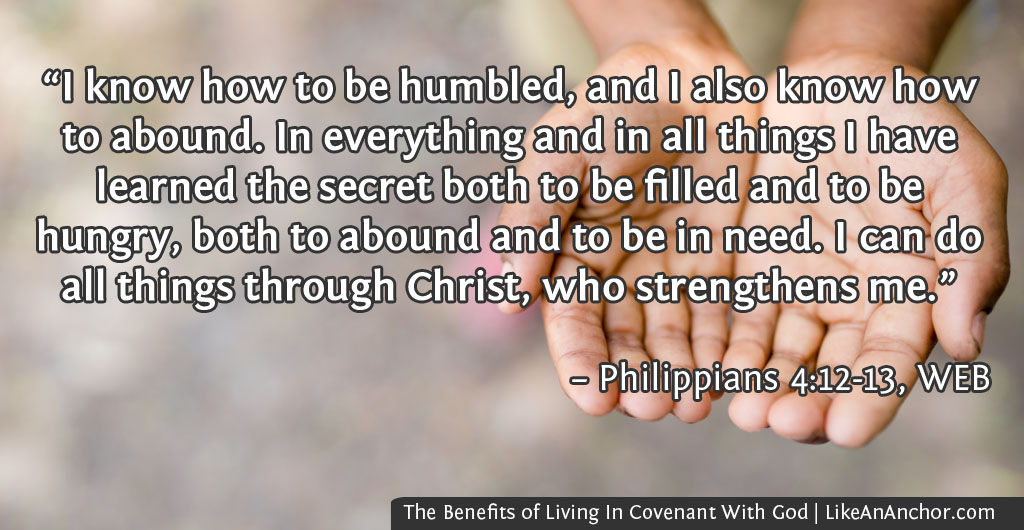
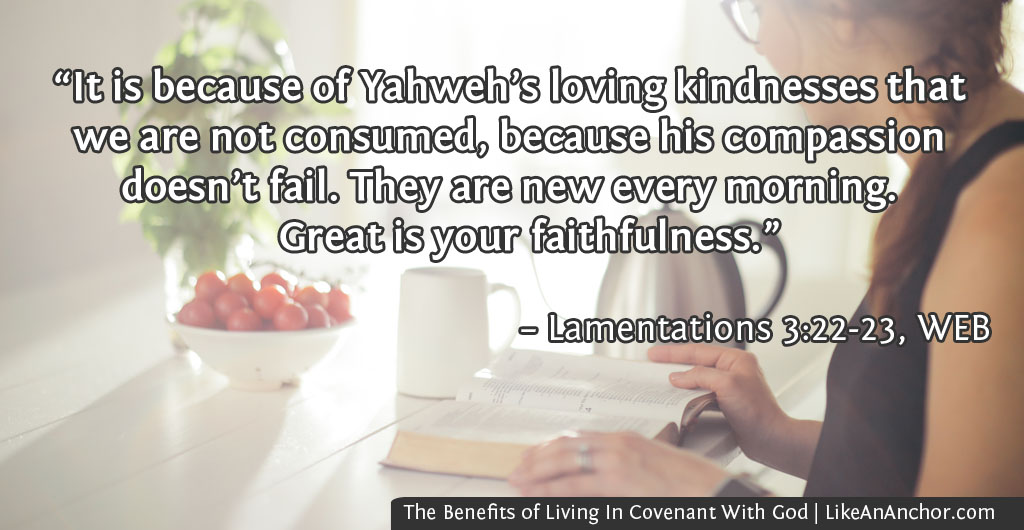
The Benefits of Living In Covenant With God

In his letter to believers in Rome, Paul asked, “If God is for us, who can be against us?” He goes on to explain that God, who gave up His own son for us, will freely give us everything we need. And because God is all powerful and the One who has final say in judgement, nothing can separate us from His love even if the trials we face kill us (Rom. 8:31-39).

Is that a contradiction? One moment Paul says nothing could stand against us, then suddenly he’s talking about us being killed? It might seem odd at first, but Paul’s focus isn’t on the people of God avoiding physical trials and suffering. Physical protection and healing can (and often do!) happen, but that is not our main concern.

 Who will separate us from the love of Christ? Will trouble, or distress, or persecution, or famine, or nakedness, or danger, or sword? As it is written, “For your sake we encounter death all day long; we were considered as sheep to be slaughtered.” No, in all these things we have complete victory through him who loved us!

Romans 8:35-37, NET, with  quotation from Ps 44:22

Paul quotes from a psalm that laments the deaths of God’s covenant people and asks God not to reject them forever (Ps. 44:17-26). It seems that Paul would tell the Psalmist, and us, that suffering does not mean God has forsaken us. In fact, we “have complete victory” even in the midst of all that.

Bold, Rational Confidence

I don’t want to deal with trouble (G2347, thlipsis, tribulation and affliction that’s external), distress (G4730, stenochoria, great distress, particularly inner distress), persecution (G1375, diogmos, pursuit, persecution), famine (G3042, limos), nakedness (G1132, gumnotes, total lack of clothing), danger (G2794, kindunos, peril), or sword (G3162, machaira, a sword for slaughter or execution). I dare say none of us do. But Paul makes it sound like it wouldn’t be a big deal. And he should know, considering all he went through (2 Cor. 11:23-28). When Paul talks about suffering as a Christian, he speaks from experience.

For I am convinced that neither death, nor life, nor angels, nor heavenly rulers, nor things that are present, nor things to come, nor powers, nor height, nor depth, nor anything else in creation will be able to separate us from the love of God in Christ Jesus our Lord.

Romans 8:38-39, NET

Paul’s confidence isn’t just based on hear-say. It is based in faith as well as first-hand experience. To quote Adam Clarke’s commentary, “The confidence expressed by the apostle at the end of this chapter is as rational as it is bold.” This section of Romans is a brilliant piece of writing and a glorious affirmation that those who trust God have nothing to worry about. We’ve already more than won the battle through the victory of Him who loves us.

Faithful To The Covenant

That kind of makes it sound like there’s nothing left for us to do, though, and that is not the overall message of Romans. Going back to the Psalm that Paul quotes from, we find a line that reads, “All this has come on us, yet we haven’t forgotten you. We haven’t been false to your covenant” (Ps. 44:17, WEB). Paul’s background was that of a Jewish rabbi, and in their writings they often quote part of an Old Testament passage and assume their readers will connect the present argument to that passage’s larger context. Paul is writing about covenants, and he expects us to understand that.

With that in mind, I think the parallel Clarke draws is a sound one. He writes, “We abide faithful in the new covenant of our God; and He is faithful who has promised to support and make us more than conquerors; i.e. to give us a complete triumph over sin, and death, and hell, not leaving one enemy unsubdued” (commentary on Rom. 8:37). It reminds me of something else Paul wrote in another letter.

This saying is trustworthy:
If we died with him, we will also live with him.
If we endure, we will also reign with him.
If we deny him, he will also deny us.
If we are unfaithful, he remains faithful, since he cannot deny himself.

2 Timothy 2:11-13, NET

There’s a reciprocal aspect to our relationship with God. It’s actually connected to grace, though that’s too big a topic to dive into now (here’s a link to a great booklet on the subject). His faithfulness is a constant, but we can’t reap the benefits of it without being in covenant with Him and remaining faithful ourselves.

Remember to Ask For Help

God is eager to help His people, but we have to be willing to let Him. It seems strange that we’d ever reject God’s help, but a story from one of Judah’s kings shows that it does happen. Asa was one of the good kings who “did that which was good and right in Yahweh his God’s eyes” (2 Chr. 14:2-4, WEB). He demonstrated a reliance on God when his enemies attacked, praying for and receiving deliverance (2 Chr. 14:9-15). After this, God sent a prophet to tell him, “Yahweh is with you, while you are with him; and if you seek him, he will be found by you; but if you forsake him, he will forsake you” (2 Chr. 15:2, WEB). This isn’t anything so crude as a “you scratch my back, I’ll scratch yours” bargain. There’s covenant obligations in relationship, as we’ll see shortly.

The writer of Chronicles tells us “the heart of Asa was perfect all his days” (2 Chr. 15:17, WEB). We also know that he and the people of Judah “entered into the covenant to seek Yahweh, the God of their fathers, with all their heart and with all their soul” (2 Chr. 15:12, WEB). But even so, something happened. In the 36th year of Asa’s reign, he turned to the king of Syria to handle a problem with the king of Israel instead of turning to God. After this happened, God sent a seer to remind Asa where his trust should have been and explain why things didn’t work out so well (2 Chr. 16:1-7).

“Weren’t the Ethiopians and the Lubim a huge army, with chariots and exceedingly many horsemen? Yet, because you relied on Yahweh, he delivered them into your hand. For Yahweh’s eyes run back and forth throughout the whole earth, to show himself strong in the behalf of them whose heart is perfect toward him. You have done foolishly in this; for from now on you will have wars.”

2 Chronicles 16:8-9, WEB

Asa’s heart was perfect, and so God was eagerly looking out for opportunities to act on his behalf. He had already spotted this situation, but Asa decided not to ask for help and instead trust himself, a pattern which continued the rest of this life (2 Chr. 16:10-13). Asa lost the help available from God because he did not ask for the benefits of being in covenant with God.

God is Eager To Hear From You

I wonder how often we miss out on God’s eagerness to show Himself strong on our behalf simply because we don’t think to ask. Maybe the main thing we need to do in order to have Paul’s perspective on life’s extreme challenges is to turn to God and ask Him for help. God has a different perspective on things than we do, and sometimes He sees the things that seem most overwhelming and challenging to us in a completely different way (this is a major lesson of Job).

You don’t have, because you don’t ask. You ask, and don’t receive, because you ask with wrong motives, so that you may spend it on your pleasures.

James 4:2-3, WEB

Just before the “If God is for us, who can be against us?” passage, Paul says that even if we don’t know what to pray the Spirit will fill in the gaps so long as we turn to God. He also assures us, “We know that all things work together for good for those who love God, for those who are called according to his purpose,” and points us to focus on our future glory as children of God (Rom. 8:28-30, WEB).

Nothing can separate us from Christ’s love. Nothing can vanquish us because He has already won the pivotal battle of the war we’re fighting. We need to stick close to Him (i.e. love him with a perfect heart and stay faithful to the covenant) because it’s in Him that “we are more than conquerors” (Rom. 8:37, WEB). Beyond that, all we need to do to have Paul’s confidence is to remember to always turn to God and ask Him to share His help, strength, and perspective with us. Confidence and peace, knowing that God will not abandon you, is one of the chief benefits to living in covenant with God.

Featured image credit: Aaron Kitzo via Lightstock