Did you know that in the King James Version of the New Testament, the word “ordain” is found in 21 verses and it’s translated from 14 different Greek words? I had no idea it was such a complicated subject. It’s related to the blog post I was working on for this week, but between recovering from a horrible stomach illness and traveling for the Feast of Tabernacles, I did not have time to complete a study that turned out to be more involved than I expected.
So instead today, I’m just going to share a reflection on one verse that is pivotal to understanding the Feast of Tabernacles (also called Sukkot). It’s one that describes something that ought to be easy, but was surprisingly difficult to do this year.
You shall rejoice in your feast, you, your son, your daughter, your male servant, your female servant, the Levite, the foreigner, the fatherless, and the widow who are within your gates. You shall keep a feast to Yahweh your God seven days in the place which Yahweh chooses, because Yahweh your God will bless you in all your increase and in all the work of your hands, and you shall be altogether joyful.
Deuteronomy 16:14-15, WEB
I remember growing up and thinking of the Feast as the highlight of the year. It’s not that way yet for a 1-year-old, though, who doesn’t understand why she had to sit in the car for a whole day and have her routine upended for a week then spend another whole day driving home. Plus, everyone in our cabin got sick. There was a lot more feeling altogether miserable than feeling altogether joyful, at least from our perspective.
“Joy” is an interesting subject in the Bible. It’s not just a happy feeling; it’s a conscious choice. Joy is an enduring quality that people can have even when things are going bad and there’s no apparent reason for happiness. We grow to have joy-filled lives as we walk with God through life’s trials and see His consistent trustworthiness. I saw that this past week in my dad, who was so glad to be spending the Feast with his family and grandchildren that none of the bad things that happened affected his peace or joy. I realized this past week that I have a lot more growing to do before I have that kind of inner peace and joy, but maybe I’ll also manage to learn that lesson by the time I’m a grandparent.
Last week, I’d stayed up later than usual and instead of reading a chapter in Acts before bed, I turned to the Psalms to find a short passage to read. I just happened to open the Bible (a Tree of Life Version that I keep in my nightstand) to Psalm 126. Something about this translation caught my eye, and it prompted today’s post. Here’s the full psalm to start us off:
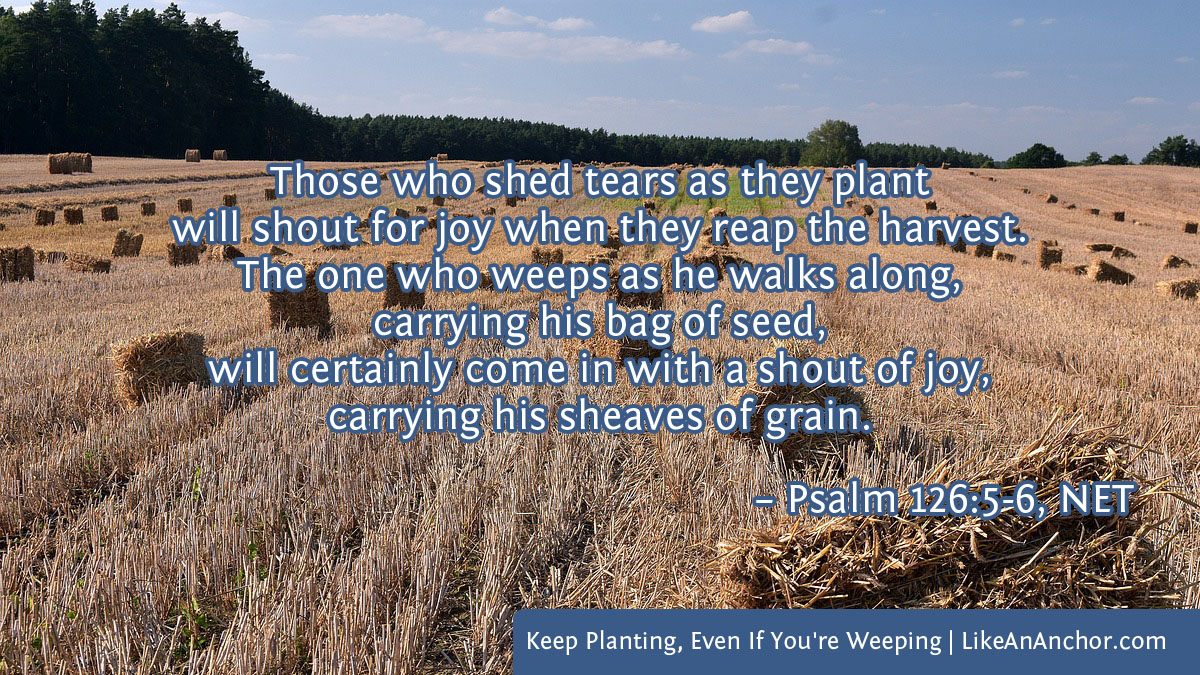
1 When Adonai restored the captives of Zion, it was as if we were dreaming. 2 Then our mouth was filled with laughter, and our tongue with a song of joy. Then they said among the nations, “Adonai has done great things for them.” 3 Adonai has done great things for us —we are joyful! 4 Restore us from captivity, Adonai, like streams in the Negev. 5 Those who sow in tears will reap with a song of joy. 6 Whoever keeps going out weeping, carrying his bag of seed, will surely come back with a song of joy, carrying his sheaves.
Psalm 126, TLV
It’s that last verse that captured my attention: “Whoever keeps going out weeping, carrying his bag of seed, will surely come back with a song of joy, carrying his sheaves.” It might (if you’re at all familiar with American gospel songs and Protestant hymns) make you think of the 1874 hymn “Bringing in the Sheaves.” For me, the part that captured my attention is this “keeps going out” line.
In Psalm 126:6, some translations simply say, “He who goes out weeping” (WEB) but the TLV and others like the NKJV include this sense of continuing to go out while you’re weeping. The setting for this psalm is restoration from captivity. Israel had gone into captivity, and now God delivered them and brought them back to the land. The psalmist is looking back on this and making an agricultural analogy.
Suppose you’re in the spring, ready to plant, but something happens. It’s a set back, a tragedy, a calamity, a grief-inducing event. It’s the sort of thing that would make you weep. At that point, you have a choice. You can “keep going out” and sowing into the future, or you could give up. But you know that if you want to reap a harvest, you need to plant seed. Similarly, the metaphorical future “harvest” that we get in our own lives is determined (at least in part) by what we “sow” now.
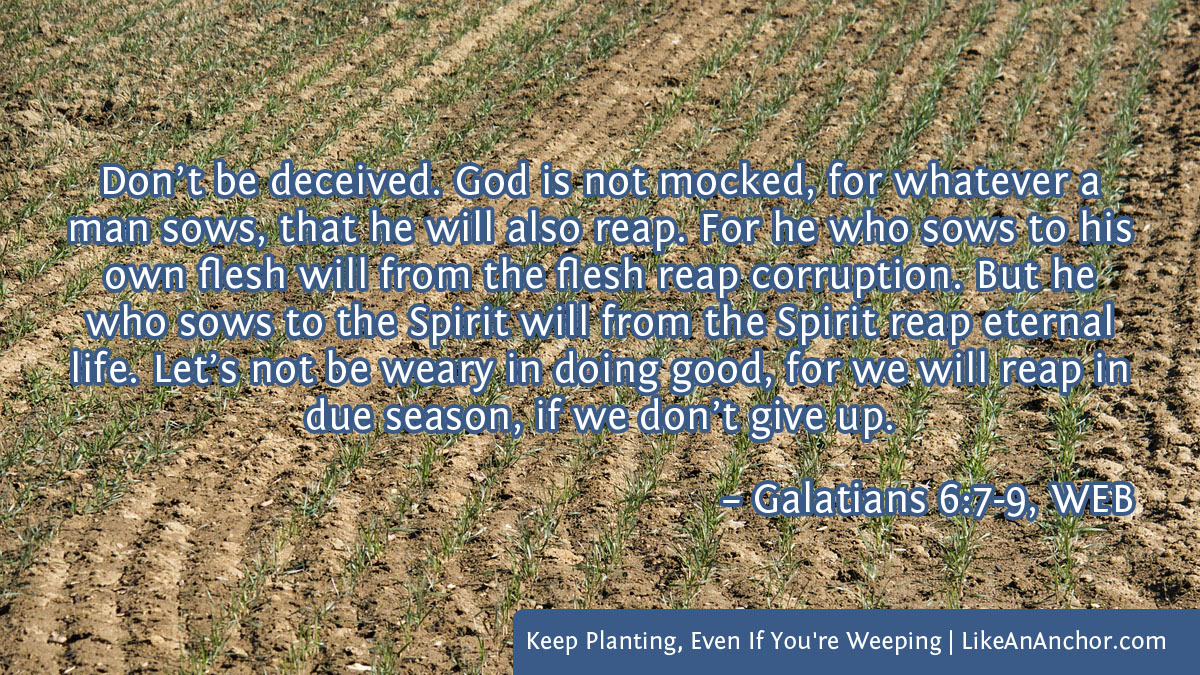
Do not be deceived. God will not be made a fool. For a person will reap what he sows, because the person who sows to his own flesh will reap corruption from the flesh, but the one who sows to the Spirit will reap eternal life from the Spirit. So we must not grow weary in doing good, for in due time we will reap, if we do not give up.
Galatians 6:7-9, NET
If the agricultural metaphor isn’t working for you, we can relate it to other things with a cause and effect. If you put a steady diet of unhealthy food into your body, you’ll get an unhealthy body; if you eat healthy foods, you’ll have a healthier body. Sowing (like how we eat and whether we exercise) is an investment in the future, for better or worse.
Notice that Paul says “we must not grow weary in doing good” and that we should “not give up.” Sowing is a long-term investment. It takes time for the seed to sprout, grow, and bear fruit. We might not see the results of it for quite some time. As Psalm 126 says we need to “keep going out” to sow, trusting that God will give us a good harvest.
The word “hope” isn’t used in the psalm that we’re looking at today, but it’s an essential ingredient for what we’re talking about here.
For it is written in the law of Moses, “Do not muzzle an ox while it is treading out the grain.” God is not concerned here about oxen, is he? Or is he not surely speaking for our benefit? It was written for us, because the one plowing and threshing ought to work in hope of enjoying the harvest.
1 Corinthians 9:9-10, NET (bold italics mark a quotation from Deut. 25:4)
Here, Paul is saying that teachers of the word have the right to make their living by preaching the gospel (1 Cor. 9). The basic principle is that if you put the work into something, you have a right to expect to enjoy the results of that labor. Hope in the Bible isn’t something nebulous. When hope is related to God, there’s a level of certainty to it. God provides a solid anchorage for our hope (Heb. 6:19), giving us good reason to confidently expect that if we keep going out sowing, we will eventually bring in a harvest with joy.
Not only this, but we ourselves also, who have the firstfruits of the Spirit, groan inwardly as we eagerly await our adoption, the redemption of our bodies.For in hope we were saved. Now hope that is seen is not hope, because who hopes for what he sees? But if we hope for what we do not see, we eagerly wait for it with endurance.
One of the things that we humans can find frustrating is that God is a long-term thinker. When He promises to give us the desires of our heart, for example (Ps. 37:6), we want that to happen immediately. I didn’t expect it to take 15+ years and a healthy dose of heartache before He answered my prayers to be a wife and mother, but then I found myself marrying a wonderful man and just over a year later having a beautiful daughter with him. I don’t think I’d be so blessed now if I hadn’t continued “sowing into” my life and my relationship with God during the season of weeping.
When we read, “all things work together for good for those who love God, who are called according to his purpose” (Rom. 8:28, NET), we often forget that Paul is talking on a cosmic timescale. Before the statement about all things working together for good, he says, “I consider that our present sufferings cannot even be compared to the coming glory that will be revealed to us” (Rom. 8:18, NET; see Rom. 8:18-30). Sometimes–even often–a harvest of joy happens now, in our human lives. But even if it doesn’t happen now, it will certainly happen at the end if we don’t give up.
My aim is to know him [Jesus Christ], to experience the power of his resurrection, to share in his sufferings, and to be like him in his death, and so, somehow, to attain to the resurrection from the dead.
Not that I have already attained this—that is, I have not already been perfected—but I strive to lay hold of that for which Christ Jesus also laid hold of me.Brothers and sisters, I do not consider myself to have attained this. Instead I am single-minded: Forgetting the things that are behind and reaching out for the things that are ahead, with this goal in mind, I strive toward the prize of the upward call of God in Christ Jesus. Therefore let those of us who are “perfect” embrace this point of view. If you think otherwise, God will reveal to you the error of your ways.
Philippians 3:10-15, NET
Scripture encourages us to look beyond our immediate circumstances with hope, trusting in the glorious future that God has planned for us. Long-term, if we’re going to “reap” the future God promises to His firstfruits, we need to keep pressing on toward the goal of eternal life. It’s this perspective that lets us “consider it nothing but joy when you fall into all sorts of trials, because you know that the testing of your faith produces endurance” and endurance helps bring us to perfection (James 1:2-3, NET). You’ll reap blessings in this life as well (especially if you have a mindset that looks for and recognizes them), but the biggest blessings we have are the opportunity to become God’s children and the promise of eternal life forever with Him after He “harvests” us with great joy.
As we continue our now two-month study of Isaiah 40-66, I want to connect two of the themes I noted in my very first post at the start of this study. That list of themes included (among other things) “Reminders to ‘fear not!'” and “Joy in our relationships with God.” We already talked about joy in connection to the Sabbath covenant, but there’s a lot more joy here as well. These last 27 chapters of Isaiah record an extended dialog where God shares His feelings, desires, and plans for the future. A large part of those plans and desires have to do with working out wonderful things for His people. We have nothing to fear, and great cause for joy, when we’re in a relationship with God.
It’s really amazing. After all of the grief we put God through when we sin (Gen 6:5-6); after all the heartbreak of watching the people who covenanted with Him as His bride run off after other gods (Jer. 3:20; 5:7; Is. 54:4-8), He still loves us and wants a relationship with us. He wants that relationship so much Jesus died to replace the Old Covenant marriage with a better covenant and better promises (Rom. 7:1-6; Heb. 8:6-10).
The Lord Yahweh’s Spirit is on me, because Yahweh has anointed me to preach good news to the humble. … to comfort all who mourn, to provide for those who mourn in Zion, to give to them a garland for ashes, the oil of joy for mourning, the garment of praise for the spirit of heaviness …
Everlasting joy will be to them. “For I, Yahweh, love justice. I hate robbery and iniquity. I will give them their reward in truth and I will make an everlasting covenant with them.”
Isaiah 61:1, 3,8, WEB
This section of Isaiah has a very hopeful, Messianic message. There are so many prophecies in here looking forward to Jesus’s first coming as well as His second coming. There’s a new covenant, a new marriage relationship, and a new earth that (from our perspective today) have already started happening and will reach fulfillment soon. By “soon” I mean in the same sense that the apostle John did when he said “these are the end times.” We don’t know exactly when Jesus will be back, but His coming is now “nearer to us than when we first believed” and we ought to be making ourselves ready. The promise of His coming should feel real to us, and we should react with fearlessness and joy, just as God’s people are told to do in Isaiah.
Image by Pearl from Lightstock
No Fear of Anyone Who’s Not God
Isaiah chapters 40-66 open with messages of comfort and punishment, a call to prepare the way for the Lord (a prophetic passage pointing to John the Baptist declaring the Messiah), and reminders of God’s sovereignty. He’s incomparable, irreplaceable, and all powerful. Knowing this about God should make us treat Him with the sort of respect, awe, and reverence that’s often called “fearing the Lord.” Knowing that this powerful One calls us His people and promises to help us also gives us joy and confidence. When we fear God, we don’t need to fear anything or anyone else.
“‘You are my servant, I have chosen you and have not cast you away.’ Don’t you be afraid, for I am with you. Don’t be dismayed, for I am your God. I will strengthen you. Yes, I will help you. Yes, I will uphold you with the right hand of my righteousness. … For I, Yahweh your God, will hold your right hand, saying to you, ‘Don’t be afraid. I will help you.’ Don’t be afraid, you worm Jacob, and you men of Israel. I will help you,” says Yahweh. “Your Redeemer is the Holy One of Israel”
Isaiah 41:9-10, 13-14, WEB
Similar wording shows up again and again in this section of Isaiah. The words, “Don’t be afraid, for I have redeemed you. … Don’t be afraid, for I am with you,” also come with a reminder that Yahweh created us and He is our God (Is. 43:1, 5, WEB). Similarly, God reminds us that He is the only true God and Creator while saying, “Don’t fear, neither be afraid” to the people who say, “I am Yahweh’s … and honor the name of Israel” (Is. 44:8, 5, WEB). Again, God says, “Don’t be afraid, for you will not be ashamed. Don’t be confounded, for you will not be disappointed” as He promises, “my loving kindness will not depart from you, and my covenant of peace will not be removed” (Is. 54:4, 10 WEB).
God doesn’t ask us to pretend the bad things never happened, just like He didn’t pretend Israel wasn’t going through terrible times. Instead, He says in Isaiah 51, “Yahweh has comforted Zion … and I will establish my justice for a light to the peoples.” He promises, “my salvation will be forever, and my righteousness will not be abolished” (Is. 51:3, 4, 6, WEB). He also asks why we would fear any oppressor when the God of the universe is on our side? He could stretch out the heavens and break the seas; why wouldn’t He be able to deliver? Why would we doubt His promise that “Those ransomed by Yahweh will return, and come with singing to Zion. Everlasting joy shall be on their heads. They will obtain gladness and joy. Sorrow and sighing shall flee away”? (Is. 51:11, WEB).
Image by Ruby-Rose from Lightstock
The Joy of Salvation
As we look more closely at the declarations of joy in this part of Isaiah, we see that it’s connected with God’s power and deliverance over and over again. We “shout joyfully” to “give the Lord the honor he deserves” (Is. 42:11-12, WEB). Messengers are told to shout with joy as they proclaim that God is on His way with deliverance and salvation (Is. 48:20-21; 52:7-9). God assures His people that there’s no way He’ll get them to the point of deliverance and then fail to follow-through. Rather, His “servants will rejoice” and “sing for joy of heart” (Is. 65:13-19; 66:9-11).
Image by Aaron Kitzo from Pixabay
For as the rain comes down and the snow from the sky, and doesn’t return there, but waters the earth, and makes it grow and bud, and gives seed to the sower and bread to the eater; so is my word that goes out of my mouth: it will not return to me void, but it will accomplish that which I please, and it will prosper in the thing I sent it to do. For you shall go out with joy, and be led out with peace. The mountains and the hills will break out before you into singing; and all the trees of the fields will clap their hands.
Isaiah 55:10-12, WEB
Joy and salvation are connected several times in the Old Testament’s more poetic writings. David wrote, “My soul shall be joyful in Yahweh. It shall rejoice in his salvation” (Ps. 35:9, WEB). After David sinned, his repentant prayer included the request, “Restore to me the joy of your salvation” (Ps. 51:12, WEB). Earlier in Isaiah, he writes about joyfully drawing water “out of the wells of salvation” (Is. 12:3, WEB). Similarly, Habakkuk declares, “I will be joyful in the God of my salvation!” (Hab. 3:18, WEB). This link between joy and salvation is essential for understanding God’s commands to rejoice. Even if there are things in our lives that might make joy seem impossible, they can never negate the deep, lasting joy that comes from knowing God saves us.
The promise of joy and salvation includes everyone who responds to God’s invitation to join His family. In Isaiah, God speaks to “the foreigners who join themselves to Yahweh” and “everyone who keeps the Sabbath from profaning it, and holds fast my covenant.” The promise isn’t exclusive; God welcomes everyone who wants “to serve him, and to love Yahweh’s name, to be his servants.” For these people, God promises, “I will bring these to my holy mountain, and make them joyful in my house of prayer. Their burnt offerings and their sacrifices will be accepted on my altar; for my house will be called a house of prayer for all peoples” (Is. 56:6-8, WEB). That’s an amazing promise, and it’s one that we get to be part of today.
Joy is a topic that intrigues me. It’s not the same thing as happiness, which is much more situation-dependent. Joy is an enduring quality that people can have even when things are going bad and there’s no apparent reason for happiness. It’s also something that feels elusive. Some people seem to radiate joy, but for many of us it’s harder to grasp.
I don’t think of myself as someone who’s typically or consistently full of joy, but I suspect that having it is related to inner peace. It’s hard to have joy when you’re anxious and worried about things, but shalom–the peace that comes with knowing God has made you whole; nothing missing and nothing broken–is an antidote for that anxiety.
Of course all the fruits of the spirit (love, joy, peace, patience, kindness, goodness, faithfulness, gentleness, and self-control) are related to one another so closely that Paul calls them just one “fruit.” We need to keep that in mind when we’re separating out joy and peace for closer study. They don’t stand on their own, but we can focus today’s discussion on them and try to learn more about how we can have both peace and joy in our lives.
I suspect that you can start feeling peace without feeling joy, but it’s pretty hard to have joy without peace. Maybe that’s just my perspective, but I see peace as the opposite of frantic worry. If your mind is scattered, latching on to all the things that you have to worry about, it’s very difficult to shift over to joy without first finding some peace.
Do not be anxious about anything. Instead, in every situation, through prayer and petition with thanksgiving, tell your requests to God. And the peace of God that surpasses all understanding will guard your hearts and minds in Christ Jesus.
Finally, brothers and sisters, whatever is true, whatever is worthy of respect, whatever is just, whatever is pure, whatever is lovely, whatever is commendable, if something is excellent or praiseworthy, think about these things. And what you learned and received and heard and saw in me, do these things. And the God of peace will be with you.
Philippians 4:6-9, NET
That sounds to me like a good foundation for joy. Training our minds to shift off of anxious thoughts and onto whatever is true, respectable, just, pure, lovely, commendable, excellent, or praiseworthy makes it possible for us to have the perspective that joy requires. The God of peace can bring things about in our minds that surpass all understanding. He makes it so we can have peace even if there is trouble around, and joy even if there are things happening that could make us unhappy. Joy comes when we follow God’s example of peace and peacemaking.
There aren’t a whole lot of Bible verses directly linking peace and joy. This one we’re about to look at in Hebrews doesn’t directly say that joy comes along with peace. Instead, it points out that things which don’t seem joyful at the time later produce peace and righteousness.
Now all discipline seems painful at the time, not joyful. But later it produces the fruit of peace and righteousness for those trained by it. Therefore, strengthen your listless hands and your weak knees, and make straight paths for your feet, so that what is lame may not be put out of joint but be healed.
Hebrews 12:11-13, NET
This verse indicates joy doesn’t typically come before peace. Peace comes after we get experience going through trails with God’s help. Experiencing His faithfulness through those trials lays the foundation for a joy-filled life. The author of Hebrews also says righteousness is developed right alongside peace. That link with righteousness is particularly interesting in light of what Paul says here in Romans:
For the kingdom of God does not consist of food and drink, but righteousness, peace, and joy in the Holy Spirit. For the one who serves Christ in this way is pleasing to God and approved by people.
Romans 15:17-18, NET
Joy, peace, and righteousness exist together in maturing Christians who press on faithfully toward the kingdom of God. As we learn to take refuge in God, find our peace in Him, and see Him faithfully aid us over and over again, we also realize how many reasons we have for joy (Neh. 8:10; Ps. 5:11; 16:11; 71:22-23; Is. 12:2-4; 61:10-11). Joy develops as we go through a refining process (Luke 6:22-23; Col. 1:10-11; Jam. 1:2-4; 1 Pet. 1:6-9; 4:12-13). As we cultivate greater peace and joy in our lives, that lays the foundation for a perspective that can say even if everything else in my life is going badly, “yet I will rejoice in Yahweh. I will be joyful in the God of my salvation!” (Hab. 3:17-18, WEB).
I live in a country where the founding documents say people here have the right to “the pursuit of happiness.” Far better than that is the promise in the “founding documents” of the Lord’s Heavenly Country where I now claim citizenship. God says joy is part of what we get when He gives us His spirit. He promises us joyful lives. There might be moments when we feel joy is elusive and need to pray alongside David, “Restore to me the joy of your salvation” (Psalm 51:12, WEB). But the overall trajectory of our lives is heading toward peace and joy that we can experience now, and which will be fully realized when Jesus returns.
For as the rain comes down and the snow from the sky, and doesn’t return there, but waters the earth, and makes it grow and bud, and gives seed to the sower and bread to the eater; so is my word that goes out of my mouth: it will not return to me void, but it will accomplish that which I please, and it will prosper in the thing I sent it to do. For you shall go out with joy, and be led out with peace. The mountains and the hills will break out before you into singing; and all the trees of the fields will clap their hands.
Isaiah 55:10-12, WEB
We can relax into God’s promises, knowing He’s there working to give us joy and peace. We can also be intentional about cultivating peace and joy in our lives. For example, in Paul’s closing remarks for Romans, he prays God would fill his readers with “all joy and peace,” then in 2 Corinthians he instructs his readers to “rejoice” and “live in peace” (Rom. 15:13; 2 Cor. 13:11). As with so many of God’s gifts, we can ask Him to give them and also do our part to make the most of these blessings.
If you look back on the verses we’ve read and referenced today, you might notice that joy and peace are connected to righteousness and salvation (Ps. 51:12; Is. 12:2-4; Rom. 14:17-18, for example). These words show up again and again in scriptures talking about joy and/or peace. That’s no coincidence. Salvation is the biggest reason we have for joy. Knowing that God loves us, forgave us, and redeemed us to welcome us into covenant with Him is a reason for joy that isn’t affected by anything happening outside us. Our relationship with God is the main reason we can have real joy. It’s also something that produces righteousness in us because the closer we stick to God, the more and more we become like Him. As we focus on cultivating peace and joy in our lives, we do well to remind ourselves of the precious gift of salvation and to pursue righteousness (Matt. 6:33; 2 Tim. 2:22). As we put God’s kingdom first, seek His righteousness, and embrace His peace, our lives will fill up more and more with joy that no one can take away from us.
I’ve been having a tough month in terms of mental health. Things are going well in my life but I feel anxious, stressed, and glum.
One of the things I’ve learned is that even with all the tools I have for working through emotionally tough times the things I’m struggling with don’t just go away once you slap a little prayer and therapy on them (at least not all the time). You’ve just got to keep doing things that are healthy for you, allow yourself some time to rest, ask for and give yourself grace when you make mistakes, and keep moving forward. Patience, perseverance, and asking trusted people for help are key to getting through mental health struggles just as they are with any other trials we face.
The Bible talks about our Christian life as running a race. There are times when running this race that people get off track. For example, Paul wrote to the Galatians, “You were running well! Who interfered with you that you should not obey the truth? This persuasion is not from him who calls you” (Gal. 5:7-10, NET). Usually when the Bible speaks of getting off-track it’s talking about sin. But I think we can also apply part of what Paul says here more broadly–the things that hinder us from running are not coming from the God who calls us to follow Him. They’re coming from an adversary who wants to see us fail; one that we can resist with God’s help.
Everyone deals with emotional struggles and mental health issues differently, and those struggles trigger different responses in different people. I tend to withdraw, and I often feel like I want to hide or run away from something. I need to be very careful that this doesn’t make me want to run from God as well.
We’re engaged in spiritual warfare. When we choose to follow Jesus, we’re picking a side in a battle. One of the lies that the enemy tries to tell us is that if you do something God might not like it’s better to run away from Him than run to Him and ask for forgiveness and/or help. Adam and Eve tried hiding in the garden and we’ve been using the same trick ever since. It doesn’t work any better now than it did then.
We human beings are always heading on a path toward either death or life, and it’s far better to run down the path to God rather than the path toward the devil. The only people who should feel like they need to flee God are those that hate him (Psalm 68:1). He’s frightening if you’re setting yourself in opposition to Him, and people who are doing things God hates might feel the need to run when He rises up to take action (Prov. 6:16-19; Is. 59:7). Even then, though He’s astonishingly merciful to people who stop running in the wrong direction and run toward Him instead.
The times when we feel most like running away from God are often the times when we most need to run to Him for help. Whether we’ve actually done something wrong or if we’re beset by groundless fears, heading toward God is the solution. In the first situation we can ask for forgiveness and receive His grace, and in the other we can ask for His peace and receive reassurance.
God’s people are supposed to do the opposite of what people who hate him or don’t know Him do. Jesus’s sheep run from a stranger’s voice, not taking the risk of being led away from their real shepherd (John 10:4-5). We no longer run alongside people in the world toward “lewdness, lusts, drunken binges, orgies, carousings, and abominable idolatries” (1 Peter 4:3-4, WEB). Many of us used to do those things (and if we didn’t do those we committed other sins) and God forgave us, but now He wants us to flee from sexual immorality, idolatry, and all other evil desires (1 Cor. 6:18; 10:14; 2 Tim. 2:22).
People who follow God know it’s safe to run to Him. We run to God for protection (Ps. 143:9; Prov. 18:10; Jer. 16:19). We run in the straight and narrow path lit by God’s word that keeps our feet from stumbling (Ps. 119:105; Prov. 4:11-12; Matt. 7:13-14). We run to Godly things and “follow after righteousness, godliness, faith, love, perseverance, and gentleness” (1 Tim. 6:11, WEB). We run like our Christian life is a marathon that we’ll finish with Jesus running right alongside us.
I run in the path of your commandments, for you have set my heart free.
Psalm 119:32, WEB
I don’t think I’d ever noticed this verse before even though I’ve read Psalm 119 countless times. It might be the translation, since the Hebrew more literally reads “for you make wide my heart,” which can be translated as something like “thou shalt enlarge my heart” (KJV) or “you have broadened my understanding” (NIV). I like this “set my heart free” translation, though. It makes me think of running across a sunlit summer meadow laughing and full of joy. That’s the emotional landscape provided by running in the path of God’s commandments. While we’re not guaranteed happiness 100% of the time, we can be full of joy. Having a heart set free accompanies God’s spirit filling us with “love, joy, peace, patience, kindness, goodness, faithfulness, gentleness, and self-control” (Gal. 5:22-23, NET).
We can’t do any of this joyful running without God’s help. Our success doesn’t depend on our will to run, but on God’s mercy (Rom. 9:15-16). That’s a reassuring thing, especially when our will doesn’t feel up to the task of getting out of bed in the morning much less fighting an epic spiritual battle. We can’t win this race using our own strength, but we don’t have to. We don’t even need to try; we can just ask Jesus for His strength.
That does not, however, mean we shouldn’t strive to run well. We can’t finish the race without God compassionately setting us on the right path in the first place, but we also won’t win if we sit down and give up. God’s mercy and grace should motivate us to run with endurance toward the goal He sets for us.
Do you not know that all the runners in a stadium compete, but only one receives the prize? So run to win. Each competitor must exercise self-control in everything. They do it to receive a perishable crown, but we an imperishable one. So I do not run uncertainly or box like one who hits only air. Instead I subdue my body and make it my slave, so that after preaching to others I myself will not be disqualified.
1 Corinthians 9:24-29, NET
There isn’t just one winner in the race that’s our Christian life, but we should still imitate the high motivation of a runner who wants to achieve victory. Here, Paul highlights the self-control and discipline with which he lives his life because he knows he can’t coast into the kingdom resting on his past accomplishments (Gal. 2:1-2; Phil. 2:15-16). He was highly motivated to stick with this way of life and keep moving forward with Jesus’s strength (2 Cor. 12:7-10; Phil 4:13).
Therefore, since we are surrounded by such a great cloud of witnesses, we must get rid of every weight and the sin that clings so closely, and run with endurance the race set out for us, keeping our eyes fixed on Jesus, the pioneer and perfecter of our faith.
Hebrews 12:1-2, NET
When struggling with anxiety or other mental and emotional concerns, it helps to remember that our life is a long-term race with ups and downs. We’re not facing anything that faithful people before us haven’t dealt with as well (1 Cor. 10:13; Heb. 11:1-40). And we’re certainly not dealing with anything that’s too tough for our God. As we run toward Him asking for help, He will strengthen us to get through the tough patches and run the race set before us with resilience and joy.
There can be great peace and security in having a relationship with God. That’s something He wants us to enjoy. But if you’re struggling, feeling as if you may never measure up to God’s standards, serenity is likely the last thing you feel. It might even be discouraging to see other Christians seem so confident when you’re secretly unsure if you’ll make it through the week as a good and godly person.
One of the most comforting truths revealed in the Bible is that God wants us to succeed. His “mercy triumphs over judgement,” which in Greek means that mercy “boasts against, exalts over” judgement “in victory” (Jas 2:13, NET). When He looks at us, He hopes to see us doing well and He wants to support our growth far more than He wants to pass judgement on us. And when we slip-up or stray off the “straight and narrow” path, He’s eagerly looking for us to come back. God wants as many people as possible to be in His family, and He’s deeply committed to making that happen.
The Compassionate Father
You’re likely familiar with the parable of the prodigal son. In some translations, it’s labeled The Parable of the Compassionate, or Forgiving, Father. This name shifts our focus as we read this parable to notice the father’s role. In this parable, a man’s younger son demanded his share of the inheritance, then went off and “squandered his wealth with a wild lifestyle” (Luke 15:13, NET). Once he’d lost everything and was living destitute, barely scraping by feeding pigs, he realized he’d be better off going home even if his father only let him be a servant rather than acknowledged again as a son.
So he got up and went to his father. But while he was still a long way from home his father saw him, and his heart went out to him; he ran and hugged his son and kissed him. … the father said to his slaves, ‘Hurry! Bring the best robe, and put it on him! Put a ring on his finger and sandals on his feet! Bring the fattened calf and kill it! Let us eat and celebrate, because this son of mine was dead, and is alive again—he was lost and is found!’ So they began to celebrate.
Luke 15: 20, 22-24, NET
This father’s joy is the same joy God and all the hosts of heaven feel when a sinner repents (Luke 15:7, 10). God has felt this joy over us; we’ve all sinned (Rom. 3:23) and we’ve all had to repent many times. We count on God’s mercy to say, “Yes, I forgive you” every time we come to Him repentant and committed to doing better.
God sincerely “desires all people to be saved and come to full knowledge of the truth” (1 Tim. 2:4, WEB). He does not wish “that any should perish, but that all should come to repentance” (2 Pet. 3:9, WEB). His goal is salvation and truth for, and repentance from, everyone (with that last one connected to our acceptance of the first two). We need to opt-in to grace; God doesn’t give people eternal life unless we take Him up on His offer. But He very much wants us to accept His gift and He’s invested in our success.
“But if the wicked person turns from all the sin he has committed and observes all my statutes and does what is just and right, he will surely live; he will not die. None of the sins he has committed will be held against him; because of the righteousness he has done, he will live. Do I actually delight in the death of the wicked,” declares the Sovereign Lord? “Do I not prefer that he turn from his wicked conduct and live?”
Ezekiel 18:21-23, NET
We might sometimes think God seems strict or unfair, but the reality is that His whole focus is on making things turn out well for His people (Rom. 8:28). He says to people He’s working with, “I have plans to prosper you, not to harm you. I have plans to give you a future filled with hope” (Jer. 29:11, NET). That group He’s working with can include any of us; people from all sorts of backgrounds, personalities, and experiences. Through Jesus’s sacrifice, God has opened up the opportunity to live in covenant with Him to anyone who hears His voice and responds.
God delights in people who do their best to follow Him, not in people who are already “perfect.” Which is good for us, since we’re all still quite a ways off from attaining perfection even though we’re headed that direction. What’s important to God is that we stay on the journey toward being more and more like Him.
So then, my dear friends, just as you have always obeyed, not only in my presence but even more in my absence, continue working out your salvation with awe and reverence, for the one bringing forth in you both the desire and the effort—for the sake of his good pleasure—is God.
Philippians 2:12-13, NET
There are so many verses saying God delights in His people. Ps. 149:4; Prov. 11:20; 12:22; Is. 62:4-5; Jer. 32:40-41; Zeph. 3:17 are just a sample that point out He specifically delights in those who keep covenant with Him; who love and obey Him. Doing these things leads to delight for us as well (Ps. 16:11; 21:1; 37:4; 112:1; 119:16, 24, 35, 47, 77, 143, 174; 149:2; Is. 29:19). The more we delight in God and His laws, the more He delights in us. And when we do sin–since, as Paul said, it’s a struggle to do good all the time even when you delight in God’s law (Rom. 7:14-25)–then God delights in our repentance; our choice to run home to our compassionate Father.