Thinking that the Judging/Perceiving preference has to do with how judgmental or perceptive an individual is is a common misconception, especially when people are first learning about Myers-Briggs® types. It’s easy to see where this idea comes from. Judging and Perceiving are right there in the names, after all.
In reality, the Judging-Perceiving distinction is more about describing how we make decisions and learn new information, as well as which side of our personality we prefer to use in the outer world. Before we can answer the question of, “Are Judging types more judgmental?” or a related question such as, “Are Perceiving types more perceptive?” we need to take a closer look at exactly what these terms mean in Myers-Briggs® theory.
If you’re a Perceiving-type, then you use either Sensing or Intuition as your preferred way of learning (i.e. perceiving) new information. The P in your type tells us that for you, this function is outer-world oriented (Extroverted Sensing or Extroverted Intuition). Perceiving traits include flexibility, information seeking and gathering, resistance to structure, improvisation skills, impulsiveness, and a present-moment focus (Personality Hacker, p. 29; Personality Types, p. 48-49).
Feeling and Thinking are both Judging functions. If your’e a Judging-type, then you use either Feeling or Thinking as your preferred way of making decisions (i.e. judging). Having a J in your type tells us that for you, this function is outer-world oriented (Extroverted Feeling or Extroverted Thinking). Judging traits include understanding and valuing structure, a tendency to make and follow plans, long-term focus, organizational skills, comfort with familiar environments, and responsibleness. Read more →
Let’s take a trip back to the early 1st century. It’s a few days before Passover and the Jews are heading to Jerusalem for the Feast. As they travel, they sing the songs of ascent like they do every year. On this particular year, though, there’s an extra level of excitement. A man named Yeshua (Jesus) arrived on the scene a few years ago and many think he could be the Messiah. He’s even riding into Jerusalem on a donkey’s colt, as Zechariah said the Messiah would.
“Hoshiya-na! Baruch haba B’Shem Adonai!” they call. Save us now! Blessed is He who comes in the name of the Lord!
As Yeshua rides in, the people spread their garments in the way. They also cut palm branches as if they were here for the Feast of Tabernacles instead of the Passover and the Feast of Unleavened Bread. They’re expecting the Messiah to kick the Romans out, redeem Israel, and restore the kingdom. They’re hoping for the fulfillment of Tabernacles — the Messiah, son of David, ruling in power and might.
Instead, this Yeshua turns his donkey toward the temple. Once there, he “drove out all of those who sold and bought in the temple, and overthrew the money changers’ tables and the seats of those who sold the doves.” Instead of driving the pagans out of Jerusalem, he drove corruption out of God’s house, saying, “My house shall be called a house of prayer,’ but you have made it a den of robbers!” Read more →
Last Sabbath, I was at a young adult weekend centered on the theme “Desire What The Lord Requires.” All the seminars focused on Michah 6:8, which reads:
He has shown you, O man, what is good. What does Yahweh require of you, but to act justly, to love mercy, and to walk humbly with your God? (WEB)
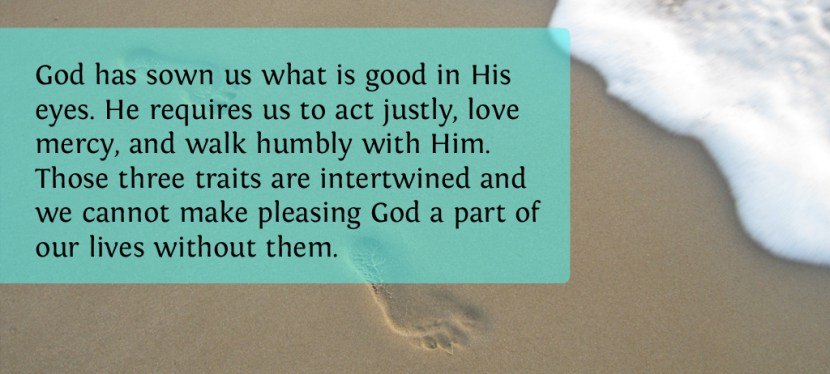
One speaker mentioned something that really stuck in my mind. In this passage, God doesn’t tell His people to be just, merciful, and humble. He uses specific verbs instructing us to act, love, and walk in certain ways. This passage is focused on actions that come from developing God’s character. It goes beyond being like God to actively walking with Him. And though it doesn’t say so here, this should be something that we want to do rather than something we do just because it’s a requirement. God has always been concerned with the state of our hearts and the motives behind why we follow Him. We please Him when we do what He requires willingly and desire the same things He does.
Act Justly
Matthew Henry’s and Adam Clarke’s commentaries says that to do or act justly means “to give to all their due.” Giving everyone what they are “due” from us includes giving God all our hearts, minds, souls, and strength, treating our neighbors as we would like to be treated, and also treating ourselves the way God intends.
Basically, acting justly is summed up in the two greatest commands (Matt. 22:36-40). That’s because the concept of justice is tied to God’s law, and the entire law hangs on the commands Jesus shared about how to love God and our neighbors. Read more →
If you’re a Christian, it’s a good bet you’ve read and/or heard the Sermon on the Mount more than once. And if you’re like me, you probably think you’re pretty familiar with this straight-forward message Jesus delivered during His time here on earth. But in a sermon a few weeks back, the speaker said something that prompted me to take a deeper look.
I hadn’t thought before about what a radical message this must have seemed when first preached. Matthew even tells us people who heard Jesus were “astonished at his doctrine” (Matt. 7:28, KJV). Throughout Jesus’ words, a message is woven that tells us our human way of looking at things is wrong. Something that makes no sense to us might be exactly what God is looking for, and the things we’d consider reasonable might not be what He wants at all. This sermon is about showing us a new way of thinking and living.
Questions Of Law
Following the Beatitudes (which we talked about last week), Jesus described people who follow Him as salt and light. All the attributes listed earlier are meant to be visible in His people, showing the world good works that will cause them to “glorify your Father who is in heaven” (Mat. 5:16, WEB). Jesus then made a statement about how His teachings relate to the Old Testament Law and Prophets. People often like to take Paul out of context and say Christians today have nothing to do with the Law, but that’s not what Jesus (or Paul, for that matter) taught.
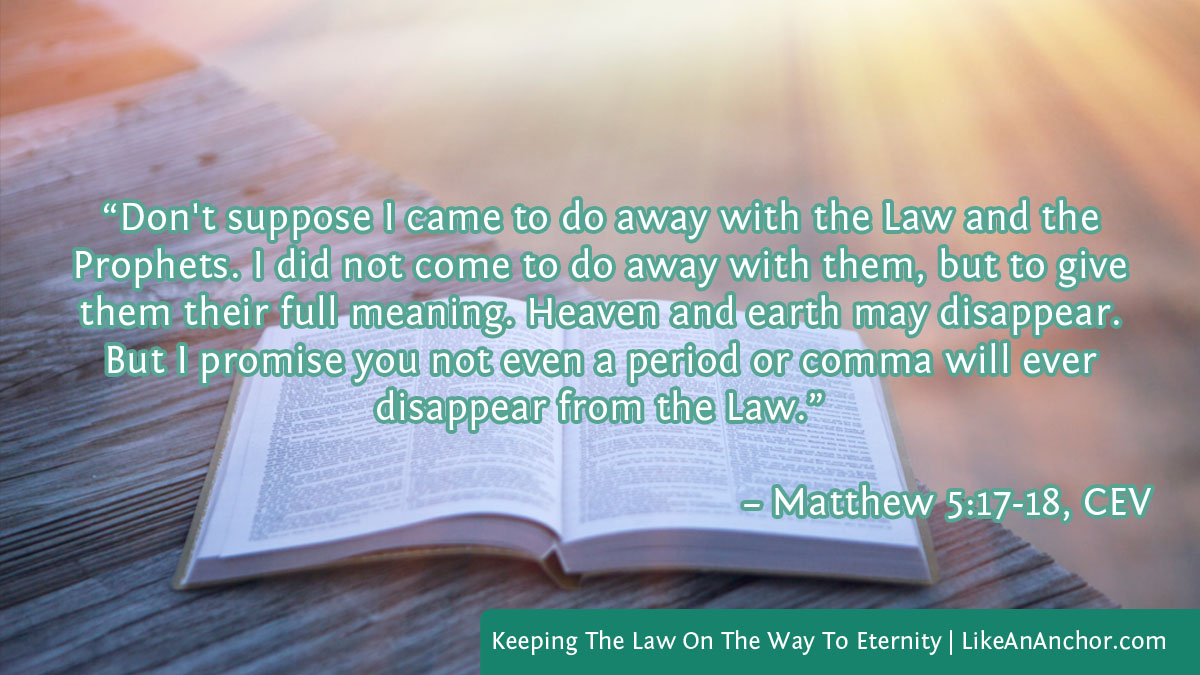
Don’t think that I came to destroy the law or the prophets. I didn’t come to destroy, but to fulfill. For most certainly, I tell you, until heaven and earth pass away, not even one smallest letter or one tiny pen stroke shall in any way pass away from the law, until all things are accomplished.
Matthew 5:17-18, WEB
The Greek word translated “fulfill” here means to fill to the fullest extent (G4137, pleroo). In other words, Christ’s coming crammed the law full of its intended meaning. Thayer’s dictionary says the word means “to cause God’s will (as made known in the law) to be obeyed as it should be and God’s promises (given through the prophets) to receive fulfillment.”
Whoever, therefore, shall break one of these least commandments, and teach others to do so, shall be called least in the Kingdom of Heaven; but whoever shall do and teach them shall be called great in the Kingdom of Heaven. For I tell you that unless your righteousness exceeds that of the scribes and Pharisees, there is no way you will enter into the Kingdom of Heaven.
Matthew 5:19-20, WEB
Clearly, Jesus still intends His followers to keep the commandments. Not only that, He tells them they have to do it better than the most legalistic religious leaders of their day. How on earth were they supposed to do that? And how are we supposed to do that today?
Image by Lamppost Collective from Lightstock
Letter v. Spirit
Jesus explains how to keep the commandments in a fulfilled manner by contrasting the way things had been done with the way He wants them done. We might think of it as the letter of the law contrasted with God’s spirit and intent behind the law. Or better yet, we can say Jesus is clarifying God’s purpose for the Law. For example:
You have heard that it was said to the ancient ones, ‘You shall not murder;’ and ‘Whoever murders will be in danger of the judgment.’ But I tell you, that everyone who is angry with his brother without a cause will be in danger of the judgment; and whoever says to his brother, ‘Raca!’ will be in danger of the council; and whoever says, ‘You fool!’ will be in danger of the fire of Gehenna.
Matthew 5:21-22, WEB
It’s not enough to obey the law that says not to kill someone. Sin starts in the heart and that’s where God looks. He cares if you get to the point where you want to murder a person, not just if you actually violate the command “thou shalt not murder.” He even cares before you get to that point; if you’re unreasonably angry with someone or despise them as an empty headed fool, that’s enough to put you under judgement.
This pattern continued as Jesus kept teaching. Lusting after someone counts as adultery in your heart (Matt. 5:27-28). Divorce shouldn’t be done nearly so often (Matt. 5:31-32). Straightforward communication is better than swearing oaths (Matt. 5:33-37). We’re not to follow the human impulse to retaliate, even though it was allowed under the law (Matt. 5:38-42). We need to love our enemies if we want to be God’s children (Matt. 5:43-48). In many ways, God expects more of New Covenant believers, not less.
Going Beyond Law-Keeping
Image by Pearl from Lightstock
Jesus’s expectations for His people go beyond the Law. The goals of living in the spirit reach higher than living by a strict code, though the spirit and letter both come from God and are connected. If we’re living in the spirit we are keeping the law on the way to becoming like God. Paul discussed this in Galatians, where he said, “walk by the Spirit, and you won’t fulfill the lust of the flesh” (Gal. 5:16, WEB).
Continuing in Galatians, Paul said, “if you are led by the Spirit, you are not under the law.” But right after saying that, he listed sinful things that spirit-led believers don’t do and says “those who practice such things will not inherit God’s Kingdom” (Gal. 5:18-21, WEB). He’s telling us that if we do things that break God’s laws, we won’t be in His kingdom even though the Law isn’t what saves us (Jesus does that).
We should keep the law because we’re walking in the spirit. It’s a side-effect of becoming like God. And so Christians today obey God, but they do it because they’re becoming like and following Him, not because they’re trying to make themselves righteous by their own power. It’s something we do on the way to eternity even though it’s not the method by which we get there.
Therefore you shall be perfect, just as your Father in heaven is perfect.
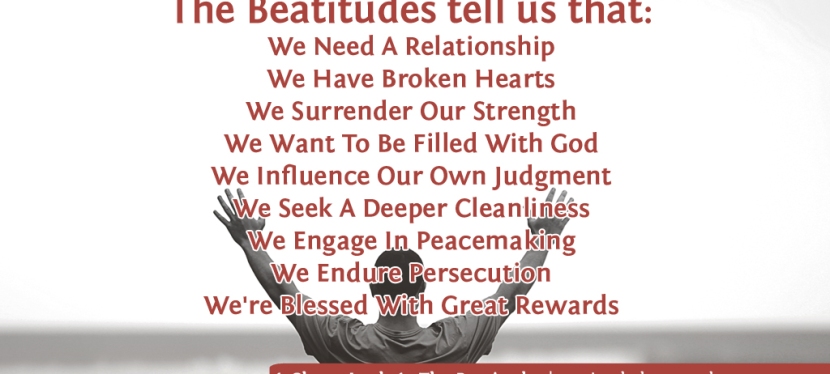
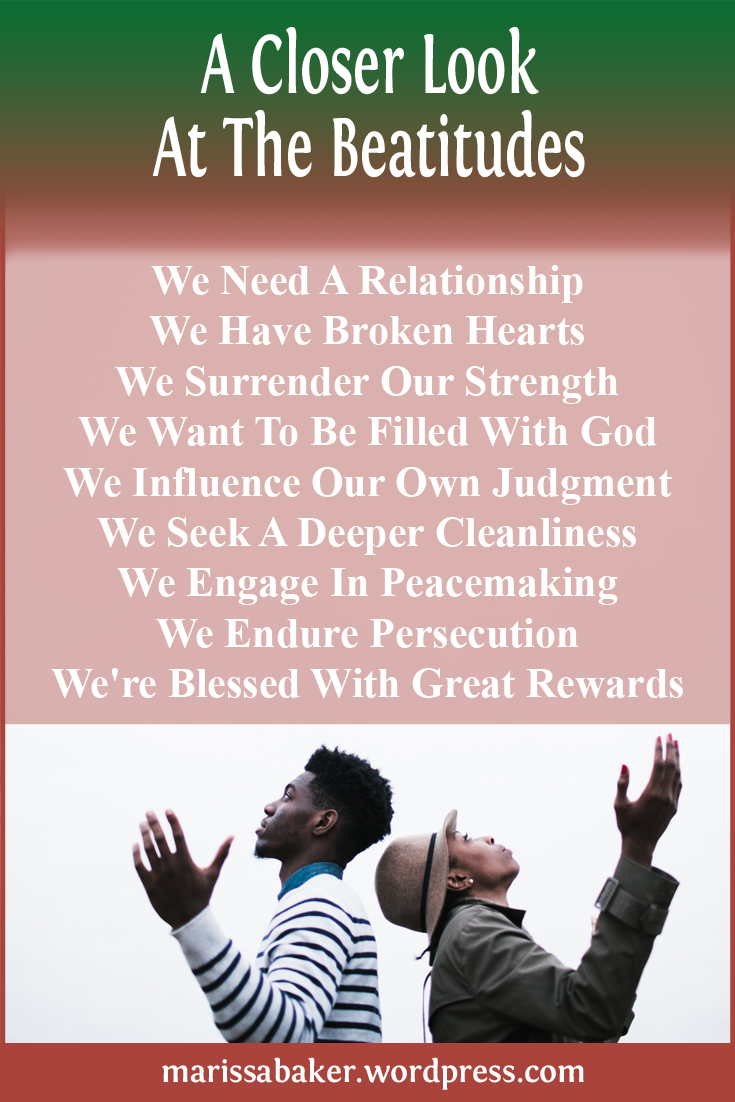
When Jesus delivered the Sermon on the Mount, He began at what we now call the Beatitudes. He says, “Blessed are” the sort of people who probably don’t feel all that blessed — those who are poor, mourning, meek, hungry and thirsty for righteousness, merciful, pure in heart, peacemakers, persecuted, and reviled. We don’t like being poor, or in grief, or humble enough to put others first, or attacked by the people around us. It’s hard work being a peacemaker, or showing mercy, or staying pure of heart, or constantly yearning to get closer to God’s righteousness.
It’s interesting that two of the beatitudes mention righteousness: “Blessed are they which do hunger and thirst after righteousness” and “Blessed are they which are persecuted for righteousness’ sake” (Matt. 5:6, 10, KJV). This word refers to “the condition acceptable to God” and/or “the doctrine concerning the way which man may attain a state of approval by God” (Thayer’s G1343, dikaiosune). It relates to our state of being and the way we live. In fact, when you think about it, all the beatitudes relate to something we do and/or become as we follow God.
Blessed are the poor in spirit: for theirs is the kingdom of heaven. (Matt. 5:3, KJV)
There’s more than one word that could be translated from Greek as “poor.” This one means “reduced to beggary” and “lacking anything” (Thayer’s G4434, ptochos). When we’re like that in our spirits, we’re really in a place to recognize how much we need a relationship with the Father and Jesus. We become the sort of person the Lord is talking about when He says, “to this man will I look, even to he who is poor and of a contrite spirit, and who trembles at my word” (Is. 66:2, WEB).
We Have Broken Hearts
Blessed are they that mourn: for they shall be comforted. (Matt. 5:4, KJV)
We all experience grief. The death of a parent, child, or dear friend. The loss of a hope held close to our hearts. The decay of a relationship. Betrayal from a friend. And even in the midst of that mourning, we’re blessed because God promises comfort (John 14:16-18; 2 Cor. 1:3-7). He can respond to our tears as powerfully as He did for David in the situation recorded in Psalm 6. Read more →
Our society idolizes tolerance. We’re “supposed” to understand the other’s point of view, support them in living however they want, and admit they’re no less “right” than we are. From a Christian’s perspective, though, today’s ideas of tolerance look more like an attack on objective morality. People who disagree with you don’t just want you to tolerate them; they want you to agree with them. And in many cases they’re not willing to extend even tolerance back to you, much less agreement.
There are two extreme reactions Christians might have when faced with a society like ours: 1) go along with society or 2) start attacking people we don’t agree with. But neither of those options is the best one. Better to ask, “Does the Bible offer any guidelines for Christians navigating such as society?” People of God have always had to interact with people outside their faith, and scripture does provide guidelines for how we can approach such relationships.
Don’t Judge People
This first guideline has nothing to do with accepting the wrong things we see ungodly people doing. We can make moral decisions about another person’s actions (e.g. discern between right and wrong) and in the appropriate context tell them they’re not lining up with God’s law (e.g. preach the gospel and call for repentance). But to pronounce a sentence on someone and condemn them is not our right.
For what is it to me to judge those outside? Should you not judge those inside? But those outside God will judge. Remove the evil person from among yourselves (1 Cor. 5:12-13, LEB)
In the verses leading up to these, Paul has been talking about the need for Christians to exercise sound judgement within the church. He’s giving them a directive to put out of the church people who say they follow God yet flagrantly and unrepentantly practice sin. In contrast to that, he tells us it’s not our responsibility to do the same to people outside the church. We can’t condemn non-Christians for not acting like Christians. God’s the one who gets final say on their lives.







 Like An Anchor