Wisdom for A Reason

A couple weeks ago while listening to a sermon, I noticed something about Solomon’s request for wisdom that I’d never realized before. It’s a familiar story: King David’s son Solomon became king in his father’s place, and God came to him in a dream. God told Solomon to ask something of Him, and Solomon asked for wisdom (1 Kings 3).

In Gibeon, Yahweh appeared to Solomon in a dream by night; and God said, “Ask for what I should give you.”

Solomon said, “You have shown to your servant David my father great loving kindness, because he walked before you in truth, in righteousness, and in uprightness of heart with you. You have kept for him this great loving kindness, that you have given him a son to sit on his throne, as it is today. Now, Yahweh my God, you have made your servant king instead of David my father. I am just a little child. I don’t know how to go out or come in. Your servant is among your people which you have chosen, a great people, that can’t be numbered or counted for multitude. Give your servant therefore an understanding heart to judge your people, that I may discern between good and evil; for who is able to judge this great people of yours?”

This request pleased the Lord, that Solomon had asked this thing. God said to him, “Because you have asked this thing, and have not asked for yourself long life, nor have you asked for riches for yourself, nor have you asked for the life of your enemies, but have asked for yourself understanding to discern justice, behold, I have done according to your word. Behold, I have given you a wise and understanding heart, so that there has been no one like you before you, and after you none will arise like you. I have also given you that which you have not asked, both riches and honor, so that there will not be any among the kings like you for all your days. If you will walk in my ways, to keep my statutes and my commandments, as your father David walked, then I will lengthen your days.”

1 Kings 3:5-14, WEB

The part of this story that I hadn’t paid attention to before is why Solomon asked for wisdom. It wasn’t to be the smartest person in the room or so he’d have an advantage in making political decisions. He asked for wisdom so that he could properly judge God’s people; Solomon wanted to govern with justice.
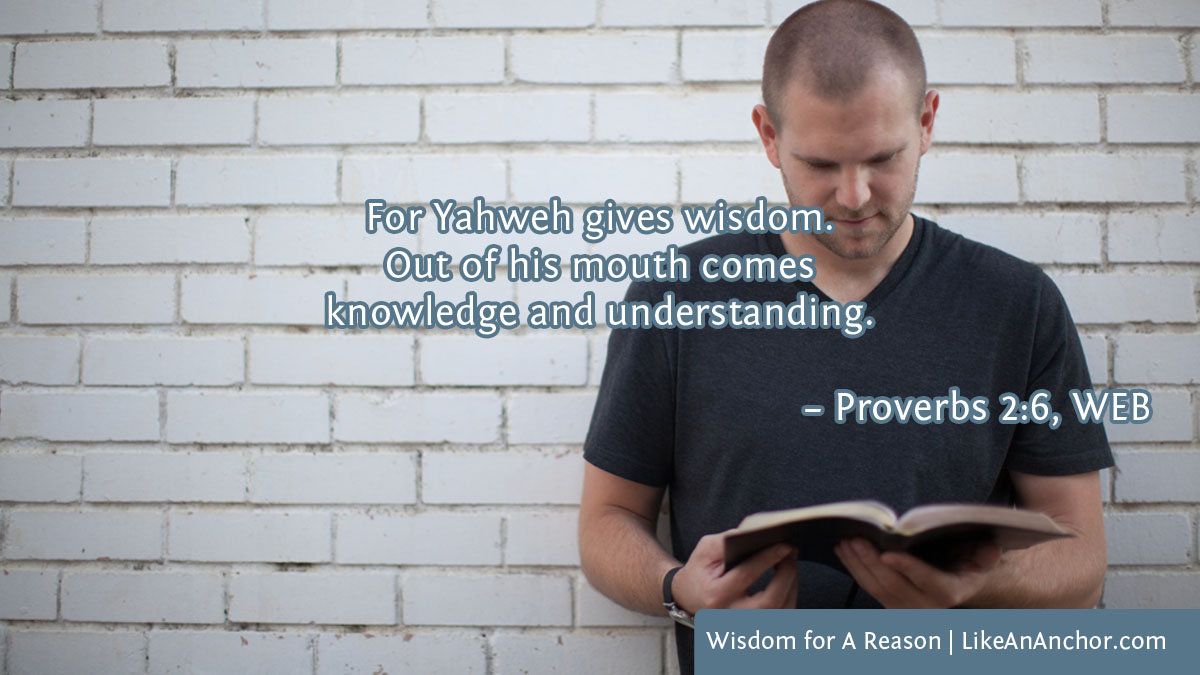
Image of a man reading a Bible overlaid with text from Proverbs 2:6, WEB version: "For Yahweh gives wisdom. Out of his mouth comes knowledge and understanding."
Image by Anggie from Lightstock

Justice, Judgement, and Governance

In the English language, judgement, government, and justice are separate things. We hope they’re connected, but we don’t see the judicial system or people who govern/rule as inseparably about justice. In Hebrew, though, it’s the same word. The root word shapat (which is used in 1 Kings 3:9, 28) means “to exercise [all] the processes of government” (Theological Wordbook of the Old Testament [TWOT], entry 2443). Ancient understanding didn’t really separate what we think of as different branches of government nor did they separate the law from the lawgiver: “the centering of law, rulership, government in a man was deeply ingrained” (TWOT 2443). This makes perfect sense when we think of God as the Lawgiver and Ruler. The Bible treats His Law as an extension of His character, and a good king of Israel was expected to act as God’s representative in upholding divine law.

The derivative word mishpat (used in 1 Kings 3:11, 28) has “at least thirteen related, but distinct, aspects of the central idea, which if to be rendered by a single English word with similar range of meaning ought by all means to be the word ‘justice’” (TWOT 2443c). These 13 meanings include “the act of deciding a case of litigation,” “a sentence or decision issuing from a magistrate’s court,” “an ordinance of law,” “one’s right under law,” and “sovereignty, the legal foundation of government in the sense of ultimate authority or right.” We get to see Solomon use his gift of wise judgement immediately, as the next thing recorded in this narrative is the story of the two mothers arguing over one living child. Both claim to be the baby’s mother and that a child who died belonged to the other. Solomon wisely figured out who the real mother was without even needing to conduct an investigation.

All Israel heard of the judgment (mishpat) which the king had judged (shaphat); and they feared the king, for they saw that the wisdom of God was in him to do justice (mishpat).

1 Kings 3:28, NET

Solomon’s wisdom wasn’t confined to judicial matters or government–God’s blessing exceeded Solomon’s initial request (1 Kings 4:229-34)–but that was the central reason he gave for requesting wisdom. It seems from the way that Solomon talked about his new responsibilities that he was worried he wouldn’t be able to govern as well as he ought, and he asked for supernatural help to discern and do justice. There was a purpose behind his request, and it was related to the role he was meant to fill in ruling and serving God’s people.
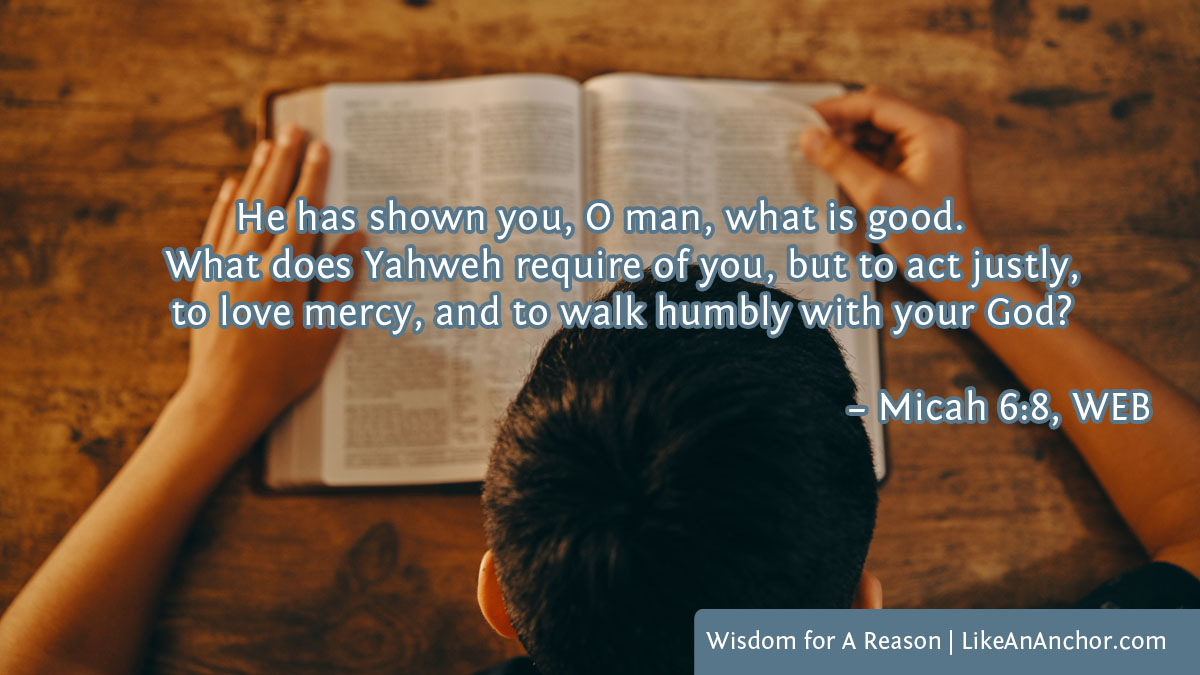
Image of a man reading the Bible overlaid with text from Micah 6:8, WEB version: "He has shown you, O man, what is good. What does Yahweh require of you, but to act justly, to love mercy, and to walk humbly with your God?"
Image by Matt Vasquez from Lightstock

Next-Level Justice and Love

As I pondered Solomon’s reason for asking God to give him wisdom, it made me think of what Paul told the Corinthians about wisdom and knowledge. In the opening part of 1 Corinthians, Paul made a distinction between wisdom as the world defines it and wisdom that God gives through His holy spirit. Earthly wisdom can get in the way of us following God–we get so impressed with what we know and how we wisely apply our knowledge that it’s hard for us to realize how much we need God and how little our own talents impress Him (Jer. 9:23-24; 1 Cor. 1:26-31). It took Solomon a long time to realize this, even with his wisdom being a gift from God (Ecc. 12:9-14).

The wisdom that Paul talked about is “not a wisdom of this age or of the rulers of this age, who are perishing. Instead we speak the wisdom of God, hidden in a mystery, that God determined before the ages for our glory” (1 Cor. 2:6-7, NET). It’s a different sort–or maybe a different level–of wisdom than Solomon had. This fits into a larger pattern in the New Testament of Jesus taking things from God’s Old Covenant interactions with people to a higher, deeper, more spiritual level.

We see good examples of this in the Sermon on the Mount, [where He mentions a law (e.g “You have heard that it was said, ‘Do not commit adultery’ [Matt. 5:27, NET]) and then shares the New Covenant application (e.g. “But I say to you that whoever looks at a woman to desire her has already committed adultery with her in his heart” [Matt. 5:28, NET]). He goes through this pattern several times, revealing that God expects more of us under the New Covenant because we’re to keep the spirit and intent of the law, not just the letter.

There is one law that seems like an outlier to this pattern. In the past, God’s law let you exact equal retribution for a crime (e.g. “An eye for an eye and a tooth for a tooth” (Ex. 21:24; Lev. 24:20; Matt. 5:38). Jesus doesn’t say to be more extreme with this law, but rather “do not resist the evildoer” (Matt. 5:39, NET). It might not seem like a logical escalation to us, but when God takes justice to the next level, it turns into mercy, long-suffering, peace, and love (Matt. 5:38-48).

Heading

Image of a woman reading the Bible, overlaid with blog's title text and the words, "When we ask God for wisdom and knowledge,  we should remember why He gives these sorts of gifts and know how He wants them to be used."
Image by Pearl from Lightstock

Wisdom by itself doesn’t do much for us. There has to be a purpose behind it, and it has to be the right kind of wisdom (i.e. “wise in what is good and innocent in what is evil” [Rom. 16:19, NET]). In 1 Corinthians, Paul discussed both wisdom and knowledge (which aren’t the same thing, but are connected). This church had several issues they needed to work through, including a mistaken idea that they had all the answers.

 With regard to food sacrificed to idols, we know that “we all have knowledge.” Knowledge puffs up, but love builds up. If someone thinks he knows something, he does not yet know to the degree that he needs to know.

1 Corinthians 8:1-2, NET

Having knowledge isn’t a problem in itself; we’re actually supposed to have some types of knowledge (1 Cor. 12:8; 14:6; 15:34). But no matter how much we know, we still have incomplete knowledge and a limited perspective compared to God. Also, not everyone has the same understanding, and there are times that acting on your knowledge–even if you’re right–can undermine someone else’s faith (1 Cor. 8:4-13). If you’re using your knowledge to increase your pride or hurt other people, then it’s worse than useless.

And if I have prophecy, and know all mysteries and all knowledge, and if I have all faith so that I can remove mountains, but do not have love, I am nothing. 

1 Corinthians 13:2, NET

Wisdom is often defined as using knowledge in the right way. I think there’s a connection here between Solomon’s wisdom to do justice and Paul’s teaching that knowledge is useless without love. Just like there was a reason behind the wisdom Solomon asked for, so there should be a driving factor behind our use of knowledge as well. Without love (a central aspect of God’s character and law [Rom. 13:10; Gal. 5:14; 1 John 4:8, 16]), intellectual gifts are pointless.

Solomon spent a lot of time in Ecclesiastes bemoaning how empty his life felt even with so much wisdom. He ultimately came to the conclusion that wisdom is definitely better than folly, but that the most important thing is to “Fear God, and keep his commandments; for this is the whole duty of man” (Ecc. 12:13, WEB). When we ask God for wisdom, knowledge, and understanding (which He will give us if we ask [James 1:5]), we should remember why He gives these sorts of gifts–so that we can follow His example and develop His character in us, including His love and justice.

He has told you, O man, what is good,
and what the Lord really wants from you:
He wants you to carry out justice, to love faithfulness,
and to live obediently before your God.

Micah 6:8, NET

Featured image by Pearl from Lightstock

How Do We Learn From God’s Judgements?

As I wrote last week’s post about “Seeking and Learning Righteousness,” I kept mentioning the connection between learning righteousness and paying attention to God’s judgements. The key scripture we looked at in that post reads, “Yes, with my spirit within me I will seek you earnestly; for when your judgments are in the earth, the inhabitants of the world learn righteousness” (Is. 26:9, WEB). 

It’s clear from this and other verses we looked at last week that we can learn righteousness from God’s judgements. But how? That was a question I thought of while writing, but didn’t really have the time to address. To answer this, we first need to understand what Isaiah means by God’s judgements.

More than Simply “Judgements”

The word translated “judgement” in Isaiah 26:9 is the Hebrew mishpat (H4941). Common translations include “judgement, justice, ordinance” (Brown-Driver-Briggs). This word is not confined to what we think of as the judicial function of government. The root word shapat means “to exercise [all] the processes of government” (Theological Wordbook of the Old Testament [TWOT], entry 2443). Furthermore, ancient understanding didn’t really separate the law from the lawgiver–“the centering of law, rulership, government in a man was deeply ingrained” (TWOT 2443). This makes perfect sense when we think of God as the Lawgiver and Ruler. The Bible treats His Law as an extension of His character.

For mishpat specifically, there are “at least thirteen related, but distinct, aspects of the central idea, which if to be rendered by a single English word with similar range of meaning ought by all means to be the word ‘justice'” (TWOT 2443c). These 13 meanings include “the act of deciding a case of litigation,” “a sentence or decision issuing from a magistrate’s court,” “an ordinance of law,” and “one’s right under law,” among others.” One other key meaning is “sovereignty, the legal foundation of government in the sense of ultimate authority or right.” People today expect this to be centered in laws and governing documents, but in scripture “The mishpat is God’s” (TWOT 2443c; Deut. 1:17). He has all authority, and when He exercises judgement/justice He does so as head of everything (not just a single branch of government).

When we speak of learning from God’s mishpat, that includes learning from His sovereign authority, His ordinances of law, and His just legislative rulings. Mishpat appears 421 times in the Old Testament so obviously we can’t look at every verse right now, but we can look at some examples of how God expected people to interact with His mishpat.

  • God chose to share His plans about Sodom and Gomorrah with Abraham before it happened because “I have known him, to the end that he may command his children and his household after him, that they may keep the way of Yahweh, to do righteousness and justice (mishpat)” (Gen. 18:19, WEB). One of the reasons the Lord trusted Abraham is because he kept Yahweh’s mishpat and would teach the people under his care to do so as well.
  • The laws/rules/ordinances/commands revealed to Moses at Mount Sinai are called mishpat: “Moses came and told the people all Yahweh’s words, and all the ordinances(mishpat); and all the people answered with one voice, and said, ‘All the words which Yahweh has spoken will we do'” (Ex. 24:3, WEB). (See also Lev. 18:4-5; 20:22; 25:18; 26:46).
  • The people of Israel had to keep all the Lord’s mishpat if they wanted to inherit the promises He made. They were warned not to add to or take away from God’s commands, nor to forget them. They also had a responsibility to pass on the mishpat to their children, as Abraham did to his. If they kept the mishpat, God would give them great blessings (Deut. 4:1-14; 5:1-22, 31-33; 7:12-13; 11:1; 26:16-19).
  • David, whom God described as “a man after my heart, who will do all my will” (Acts 13:22, WEB), said, “I have kept Yahweh’s ways, and have not wickedly departed from my God. For all his ordinances (mishpat) were before me. As for his statutes, I didn’t depart from them” (2 Sam 22:22-23, WEB).
  • We often say Solomon asked God for wisdom, but the specific wording when God responds is, “Because you … have asked for yourself understanding to discern justice (mishpat); behold, I have done according to your word. Behold, I have given you a wise and understanding heart” (1 Kings 3:11-12, WEB).
  • Judgement came on ancient Israel because they forsook God and stopped keeping His judgements/ordinances (1 Kings 11:31-33; Neh. 1:4-7; 9:28-29; Ezk. 5:5-8; 11:10-12; 20:11-24; Dan. 9:4-5). Notice that not keeping God’s mishpat is a sin and is linked with forsaking God Himself.
Image of a man watching a sunset overlaid with text from Deut. 11:1, WEB version:  “you shall love Yahweh your God, and keep his instructions, his statutes, his ordinances, and his commandments, always.”
Image by Aaron Kitzo from Lightstock

Lessons from Ancient Israel’s Relationship With God

I want to spend a little more time looking at ancient Israel’s relationship with God’s mishpat. When God instituted the Sinai Covenant with Israel, it was like a marriage ceremony. The laws and ordinances that He delivered are like the marriage vows that couples make. Both God and the people bound themselves together in a formal relationship–a covenant–and agreed to live by His mishpat (Ex. 24:3). As co-inheritors with Jesus Christ of the covenants God made with His people in the past, His mishpat are still relevant for us today and we can learn from the ways that God’s people in the past related to Him and His justice/ordinances.

There’s a passage in Ezekiel where God summarizes His relationship with the people of Israel thus far, and He pays particular attention to how they related to His mishpat. Ezekiel records that “some of the elders of Israel came to inquire of Yahweh,” and Yahweh responded by telling Ezekiel, “Cause them to know the abominations of their fathers” (Ezk. 20:1, 4, WEB). As we read the history of Israel from the Lord’s perspective, keep in mind that He uses the word “abominations” to describe what the people did. The actions they took against Him and His mishpat were very serious.

“So I caused them to go out of the land of Egypt, and brought them into the wilderness. I gave them my statutes, and showed them my ordinances (mishpat), which if a man does, he will live in them. Moreover also I gave them my Sabbaths, to be a sign between me and them, that they might know that I am Yahweh who sanctifies them.

“But the house of Israel rebelled against me in the wilderness. They didn’t walk in my statutes, and they rejected my ordinances (mishpat), which if a man keeps, he shall live in them. They greatly profaned my Sabbaths. Then I said I would pour out my wrath on them in the wilderness, to consume them. But I worked for my name’s sake, that it should not be profaned in the sight of the nations, in whose sight I brought them out.  Moreover also I swore to them in the wilderness, that I would not bring them into the land which I had given them, flowing with milk and honey, which is the glory of all lands;  because they rejected my ordinances (mishpat), and didn’t walk in my statutes, and profaned my Sabbaths; for their heart went after their idols. Nevertheless my eye spared them, and I didn’t destroy them. I didn’t make a full end of them in the wilderness. I said to their children in the wilderness, ‘Don’t walk in the statutes of your fathers. Don’t observe their ordinances (mishpat) or defile yourselves with their idols.  I am Yahweh your God. Walk in my statutes, keep my ordinances (mishpat), and do them.  Make my Sabbaths holy. They shall be a sign between me and you, that you may know that I am Yahweh your God.'”

“But the children rebelled against me. They didn’t walk in my statutes, and didn’t keep my ordinances (mishpat) to do them, which if a man does, he shall live in them. They profaned my Sabbaths. Then I said I would pour out my wrath on them, to accomplish my anger against them in the wilderness. Nevertheless I withdrew my hand, and worked for my name’s sake, that it should not be profaned in the sight of the nations, in whose sight I brought them out. Moreover I swore to them in the wilderness, that I would scatter them among the nations, and disperse them through the countries; because they had not executed my ordinances (mishpat), but had rejected my statutes, and had profaned my Sabbaths, and their eyes were after their fathers’ idols.”

Ezekiel 20:10-24, WEB

This tragic story is not just ancient history. Paul told New Covenant Christians in Corinth, “These things happened to them as examples and were written for our instruction, on whom the ends of the ages have come. So let the one who thinks he is standing be careful that he does not fall” (1 Cor. 10:11-12, NET). We need to learn from the lessons of Israel’s history in the Old Testament so that we don’t make the same mistakes, such as rejecting the mishpat of our God. Then and today, God wants people who have a relationship with Him to live in and walk in His justice/ordinances/judgements. We’re supposed to become holy as He is holy, and doing what He tells us to is part of that process.

Image of two women reading Bibles overlaid with text from 1 Peter 1:13-15, WEB version:  "“Be sober, and set your hope fully on the grace that will be brought to you at the revelation of Jesus Christ—as children of obedience, not conforming yourselves according to your former lusts as in your ignorance, but just as he who called you is holy, you yourselves also be holy in all of your behavior”
Image by Shaun Menary from Lightstock

Trained in Righteousness Today

Talking about the ordinances of God from the Old Testament makes some modern Christians uncomfortable. This is due to misinformation about how New Covenant believers relate to God’s laws. For example, Paul is often misread as doing away with God’s law. He preempted that reading by asking and answering a question: “Do we then nullify the law through faith? May it never be! No, we establish the law” (Rom. 3:31, WEB). This sentiment echoes something Jesus Himself said.

“Do not think that I have come to abolish the law or the prophets. I have not come to abolish these things but to fulfill them. I tell you the truth, until heaven and earth pass away not the smallest letter or stroke of a letter will pass from the law until everything takes place. So anyone who breaks one of the least of these commands and teaches others to do so will be called least in the kingdom of heaven, but whoever obeys them and teaches others to do so will be called great in the kingdom of heaven. For I tell you, unless your righteousness goes beyond that of the experts in the law and the Pharisees, you will never enter the kingdom of heaven!”

Matthew 5:17-20, NET

The scribes, or “experts in the law,” and Pharisees were a group of people that Jesus called out for putting on a righteous show while neglecting the true spiritual meaning of God’s laws and leaving “justice, mercy, and faith” undone (Matt. 23). Jesus wants His people to follow His words faithfully from the heart, not to put on a righteous show. Aligning ourselves with Jesus is how we become truly righteous.

That’s how the mishpat of God help us learn righteousness. The Law is an expression of God’s character, and keeping it aligns people with Him. Paul compared the Law to a “tutor to bring us to Christ, that we might be justified by faith” (Gal. 3:24, WEB). Even today, the mishpat of God (which we’re to keep on a spiritual and literal level as New Covenant believers with the law written in our hearts) point us to our Savior and help us learn righteousness.

You, however, must continue in the things you have learned and are confident about. You know who taught you and how from infancy you have known the holy writings, which are able to give you wisdom for salvation through faith in Christ Jesus. Every scripture is inspired by God and useful for teaching, for reproof, for correction, and for training in righteousness, that the person dedicated to God may be capable and equipped for every good work.

2 Timothy 3:14-17, NET

When Paul wrote these words to Timothy, the “holy writings” and “scripture” he refered to are what we now call the Old Testament. Over and over in those scriptures, we learn that righteousness and justice are something that God loves and that those who love Him will keep His mishpat (Deut. 11:1; 30:16; Ps. 33:5; 37:28). God pleads with His people to walk in and follow His mishpat and practice righteousness because that’s the way to life (Lev. 18:5; Neh. 9:29; Ezk. 18:9). Then, just as today, God “wants all people to be saved and to come to a knowledge of the truth” (1 Tim. 2:4, NET; see also 2 Pet. 3:9 and Ezk. 18; 33).

There are no human beings who can claim to be perfectly righteous on their own, “for all have sinned” (Rom. 3:10, 23, WEB). It is Jesus Christ’s act of righteousness that makes it possible for us to really become righteous (Rom. 5:17-18). Now that He has called us, we are obligated to obey God our Savior as servants of righteousness (Rom. 6:12-23). We’re not justified by our own righteousness, but having been justified by Jesus we must choose to live according to His righteousness. God’s mishpat train us in how to do that.

Called To Holiness

Image of a man praying with the blog's title text and the words "Scriptures say we can learn righteousness from God's 
judgements.  How?"
Image by WhoisliketheLord Studio from Lightstock

Like Timothy, we need God’s word “for teaching, for reproof, for correction, and for training in righteousness” so that we who are “dedicated to God may be capable and equipped for every good work” (2 Tim. 3:16-17, NET). God has called us for a purpose, which involves becoming part of His family. We’re literally supposed to become like Him. This is a process that won’t be completed until Jesus Christ’s return.

When Paul tells his readers they are “called to be saints,” the word translated “saints” literally means a holy thing/people (Rom. 1:7; G40 hagios). Peter expands on this idea when he says we must be “obedient children” who, “like the Holy One who called you, become holy yourselves in all of your conduct, for it is written, ‘You shall be holy, because I am holy‘” (1 Peter 1:15-16, NET [bold italics a quote from  Lev 19:2]). God expects holiness and righteous conduct from those He calls into a relationship with Him.

The simplest way to put this is that we’re to follow Jesus’s holy and righteous example (Acts 3:14; 1 Cor. 11:1; Eph. 5:1-2). Expand on it a little more, and you get the two greatest commandments–love God and love your neighbor (Mark 12:28-34; Rom. 13:8-10). For more detailed instructions on how to be holy and righteous, we go to the Lord’s words, laws, ordinances, and teachings (those mishpat we’ve been talking about). God’s word shows us what people who are becoming holy do and do not do. As we obey His commands out of love for Jesus and the Father, we are training in righteousness and becoming holy like He is holy.


Featured image by Matt Vasquez from Lightstock

Isaiah Study: The Lord’s Desire for Justice

Since starting a university master’s program two years ago, I’ve participated in several diversity trainings and class assignments that prompted us to evaluate our core values. One thing I realized is that while a buzz-word like “equity” just makes me feel tired since I’ve heard it so much, the idea of “justice” stirs a deep desire for things in the world to be right. I think many of us (perhaps even most of us) want fairness and justice. We feel there’s a way things should be, and we’re irritated when that isn’t the case. We hate injustice, especially if it’s directed at us but often if we see it happening to others as well.

In Mere Christianity, C.S. Lewis proposes that our sense of right and wrong is a clue pointing to God’s existence and revealing His nature. Even in our modern age of moral relativism, people still have some idea of how the world “should” be (though different groups often dramatically disagree about what that looks like). Many of us still have in mind “some kind of Law or Rule of fair play or decent behaviour or morality or whatever you like to call it” (Lewis) that hints at a larger ideal to strive toward. Lewis expands on this recognition of a need for justice when he talks about his time as an atheist.

My argument against God was that the universe seemed so cruel and unjust. But how had I got this idea of just and unjust? A man does not call a line crooked unless he has some idea of a straight line. What was I comparing this universe with when I called it unjust? If the whole show was bad and senseless from A to Z, so to speak, why did I, who was supposed to be part of the show, find myself in such violent reaction against it? …

Of course I could have given up my idea of justice by saying it was nothing but a private idea of my own. But if I did that, then my argument against God collapsed too— for the argument depended on saying that the world was really unjust, not simply that it did not happen to please my private fancies. Thus in the very act of trying to prove that God did not exist—in other words, that the whole of reality was senseless—I found I was forced to assume that one part of reality—namely my idea of justice—was full of sense

C.S. Lewis, Mere Christianity, Chapter 1

Lewis maintains that knowledge of justice points to the existence of a God who embodies justice, and the Bible supports that. Scripture reveals that God is deeply concerned with justice and that it’s one of His driving motivations. This shows up clearly in Isaiah 40-66, the passage of scripture we’ve been studying over the past couple months. These last 27 chapters of Isaiah record a message from God where He speaks candidly about His desires, motivations, and plans. If you go back and read the very first post, you’ll see I made a list of key themes from this section of scripture to study more extensively. One of those themes was that “God is motivated by justice.”

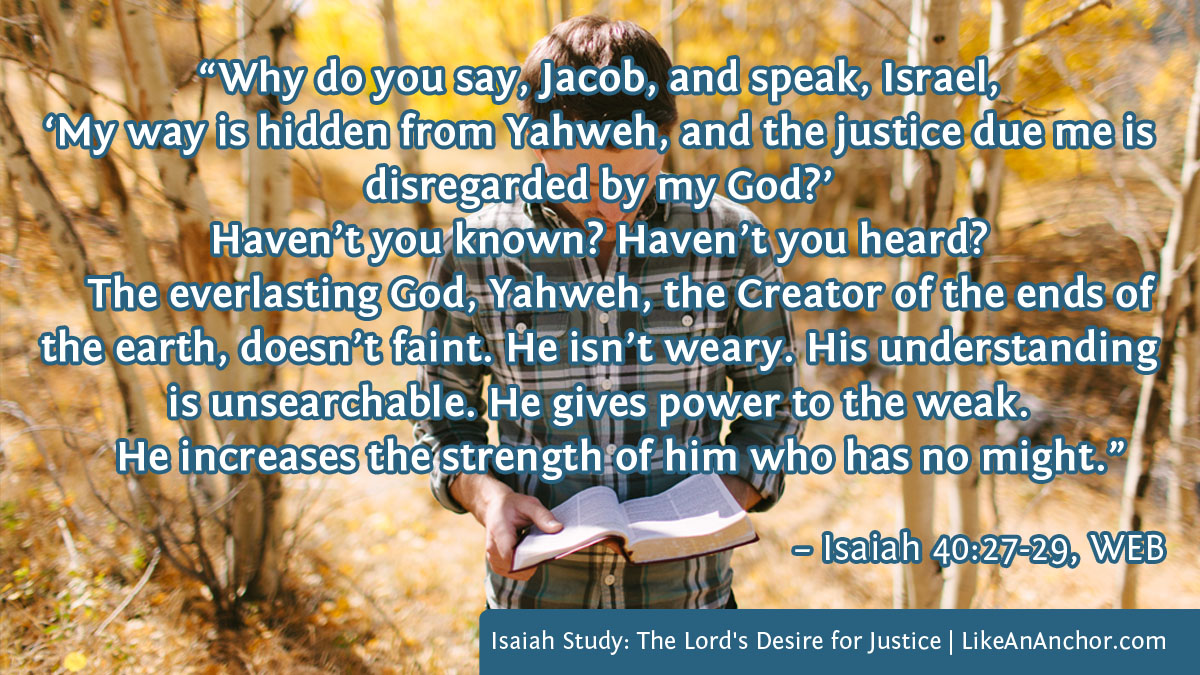
Image of an oasis in a desert overlaid with text from Isaiah 40:27-29, WEB: "“Why do you say, Jacob, and speak, Israel, ‘My way is hidden from Yahweh, and the justice due me is disregarded by my God?’ Haven’t you known? Haven’t you heard? The everlasting God, Yahweh, the Creator of the ends of the earth, doesn’t faint. He isn’t weary. His understanding is unsearchable. He gives power to the weak. He increases the strength of him who has no might.”
Image by HarveyMade from Lightstock

Justice, Righteousness, and Judgement

“Justice” is a complex word when we’re working with Hebrew to English translations. In the King James Version, “justice” appears 5 times in this section of Isaiah and it’s translated from tsedeq (H6664 and H6664); a word that WEB translates “righteousness.” In the WEB translation, “justice” is used 14 times and it’s translated from mishpat (H4941), which the KJV translates as “judgment.” So we have two Hebrew words here, and three different English translations. That’s not really surprising if you’ve compared Old Testament translations or studied Hebrew even a little bit. Hebrew has a smaller pool of available words than English, and relies on context and word pictures to paint pictures that we might use half a dozen English words to express.

When I’m trying to understand the nuances of a Hebrew word, I like to look it up in the Theological Wordbook of the Old Testament (TWOT). This resource says the root word for tsedeq “basically connotes conformity to an ethical or moral standard” (entry 1879). It has to do with justice and “rightness,” and it’s connected to righteously living in accordance with God’s law. It’s also closely connected with God. He is righteous and just, and so His commands are as well. The TWOT says there’s a “forensic” and legal aspect to tsedeq. When people break His commands, God is righteous to punish them for it. He is also righteous when He provides “salvation as vindication,” acting to clear our names in a legal sense.

Mishpat and its root shapat (TWOT entry 2443) are concerned with “the process of government.” While shapat is often translated “judge,” it really includes all the functions of a proper government–not just what we think of as the “judicial branch.” It’s also closely connected with a ruler; the law and the one giving the law aren’t separated the way we do today. God’s role as ruler, judge, and lawgiver are all connected. When we see mishpat translated “justice,” that’s the best word available in English to represent a concept with “at least thirteen related, but distinct, aspects of the central idea” related to judicial government, authority, and legislation (TWOT entry 2443c). In connection with God, justice involves “the just claims of God. God, who is Lord, can demand and He does demand” (Koehler, qtd. in TWOT). God wants things to be right in the world, and He’s the one who tells us what right, just, and correct looks like.

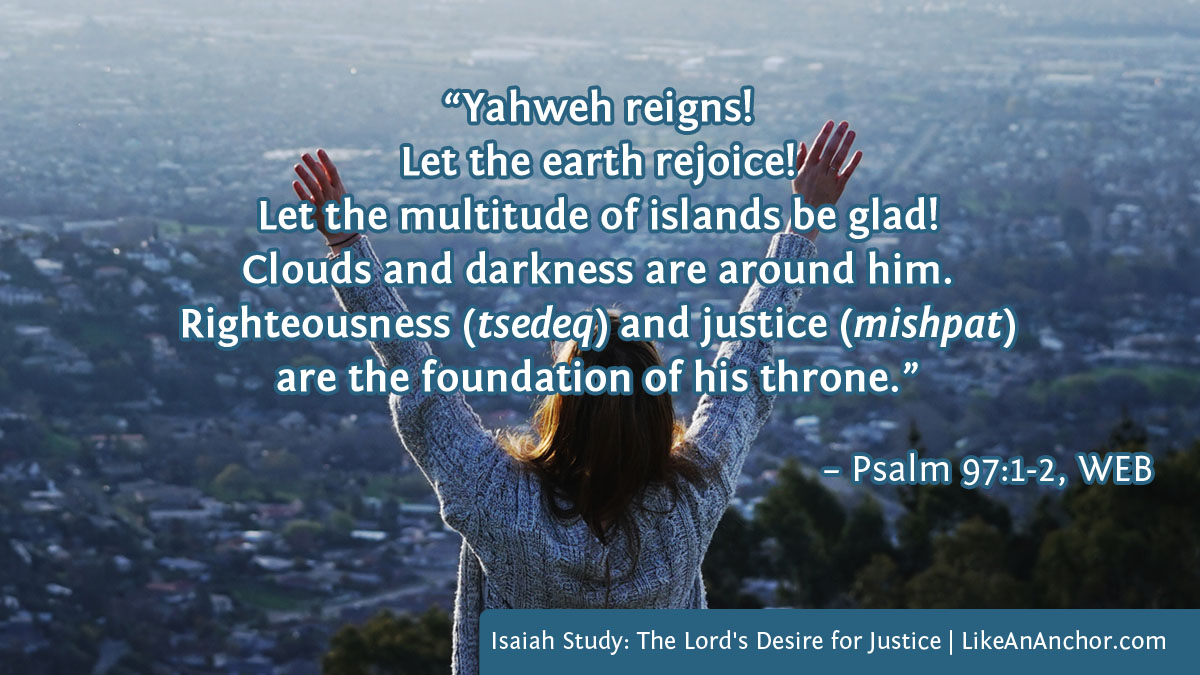
Image of a woman with her arms raised in worship overlaid with text from Psalm 987:1-2, WEB translation: "Yahweh reigns! Let the earth rejoice! Let the multitude of islands be glad! Clouds and darkness are around him. Righteousness (tsedeq) and justice (mishpat) are the foundation of his throne."
Image by Ruby-Rose from Lightstock

The Justice-Bringing Messiah

That was a long introduction, but it gives us a lot to think about in regards to justice. While justice does involve our ideas of fairness and what’s right, it’s also more than that. In the Bible, real justice is connected to God’s character, authority, and laws. It’s also a central concept in this section if Isaiah, and it underlies all the other topics we’ve discussed so far. “God is Incomparable and Irreplaceable,” and His justice is a key part of His character. There is “Joy in the Sabbath Covenant With God” in part because His sense of rightness involves rewards for acting justly and walking with Him. When we are “Looking Toward the Messiah,” we see that a big part of Jesus’s role in both His comings involves satisfying God’s justice. God’s activity in “Doing A New Thing” involves bringing justice to all the nations in the future. Finally, “The Contrast Between Righteousness and Wickedness” that God describes involves how each group does or does not align with His justice.

We can see how integral this idea of justice is from the very beginning of the message in Isaiah 40-66. This section of scripture opens with God saying that He has punished sins and now He will pardon them. It says God is a ruler brining reward and recompense to His kingdom. No one can compare to Him; other so-called rulers are nothing (Is. 40:1, 10-26). Even in the verses where mishpat and tsedeq aren’t used directly, we can clearly see themes of authority, law, righteousness, and justice. With those aspects of God’s character in mind, how can people possibly say, “My way is hidden from Yahweh, and the justice due me is disregarded by my God?” (Is. 40:27, WEB).

In reality, the “justice due” to us isn’t something we should want because “all have sinned” and “the compensation due sin is death.” However, “the gift of God is eternal life in Christ Jesus our Lord” (Rom. 3:23; 6:23, LEB). When we looked at the Servant Song prophecies a few weeks ago, we only briefly touched on the role of the Messiah in bringing justice but it’s an important part of Jesus’s mission. Just look at how many times justice is mentioned in this first Servant Song.

 “Behold, my servant, whom I uphold,
    my chosen, in whom my soul delights:
    I have put my Spirit on him.
    He will bring justice to the nations.
He will not shout,
    nor raise his voice,
    nor cause it to be heard in the street.
He won’t break a bruised reed.
    He won’t quench a dimly burning wick.
    He will faithfully bring justice.
He will not fail nor be discouraged,
    until he has set justice in the earth,
    and the islands wait for his law.”

Isaiah 42:1-4 WEB

This is one of the Servant Songs quoted in the New Testament; Matthew references it when showing his readers how Jesus’s actions on earth link back to prophecies from the Old Testament (Matt. 12:15-21). Jesus’s actions in healing and helping people demonstrated His commitment to justice. He also highlights justice as one of ” the weightier matters of the law” when talking with the Pharisees (Matt. 23:23).

Image of a woman studying her Bible overlaid with text from Matt. 12:17-18, 20, NET translation: This fulfilled what was spoken by the prophet Isaiah: “Here is my servant whom I have chosen, the one I love, in whom I take great delight. I will put my Spirit on him, and he will proclaim justice to the nations. ...
He will not break a bruised reed or 
extinguish a smoldering wick,
until he brings justice to victory.”
Image by Pearl from Lightstock

God’s Love for Justice

We see further evidence of God’s love for justice in another prophecy that’s sandwiched between the Servant Songs in Isaiah 50:4-11 and Isaiah 52:13– 53:12

“Listen to me, you who follow after righteousness,
    you who seek Yahweh. …

“Listen to me, my people;
    and hear me, my nation,
for a law will go out from me,
    and I will establish my justice for a light to the peoples.
My righteousness is near.
    My salvation has gone out,
    and my arms will judge the peoples. …
my salvation will be forever,
    and my righteousness will not be abolished.”

Isaiah 51:1, 4-6, WEB
Image of a woman's hand turning pages in a Bible with the blog's title text and the words "God’s desire for justice drives Him on to  accomplish 
salvation and share His righteousness with the world. "
Image by Delanie from Lightstock

Notice how close the connection is between justice, righteousness, salvation, and God’s law. God loves justice, as He says very clearly near the end of Isaiah: “For I, Yahweh, love justice” (Is. 61:8, WEB). When we love the God of Justice, we’ll also want to practice justice. Without justice, we don’t have a relationship with God.

Behold, Yahweh’s hand is not shortened, that it can’t save;
    nor his ear dull, that it can’t hear.
But your iniquities have separated you and your God,
    and your sins have hidden his face from you,
    so that he will not hear. …

They don’t know the way of peace;
    and there is no justice in their ways.
They have made crooked paths for themselves;
    whoever goes in them doesn’t know peace.
Therefore justice is far from us,
    and righteousness doesn’t overtake us.
We look for light, but see darkness;
    for brightness, but we walk in obscurity. …

Yahweh saw it,
    and it displeased him that there was no justice.
He saw that there was no man,
    and wondered that there was no intercessor.
Therefore his own arm brought salvation to him;
    and his righteousness sustained him.
He put on righteousness as a breastplate,
    and a helmet of salvation on his head.

Isaiah 59: 1-2, 8-9, 15-17, WEB

You might want to take some time and read all of Isiah 53 here; it’s got a lot to say about how upset God is when there’s no justice and how motivated He is to fix that problem. He wants the people He’s in a relationship with to “Maintain justice and do what is right” (Is. 56:1-2). He also wants His people to receive justice–to have Him as their good and righteous ruler acting with authority to make justice happen. His desire for justice drives Him on to accomplish salvation and share His righteousness with the world. We benefit every day from God’s desire for justice and His love of righteousness.

Featured image by Inbetween from Lightstock

What Happens When God Takes Justice to the Next Level?

In the sermon on the mount, Jesus talks about commands given to ancient Israel and then gives new guidelines for how to obey God from a heart level. He wants us to shine as lights in the world so that all “can see your good deeds and give honor to your Father in heaven” (Matt. 5:14-16, NET).

As preface to taking the commands to a spiritual level, Jesus says, “Do not think that I have come to abolish the law or the prophets. I have not come to abolish these things but to fulfill them” (Matt. 5:17, NET). In other words, He has come “to cause God’s will (as made known in the law) to be obeyed as it should be, and God’s promises (given through the prophets) to receive fulfillment” (Thayer’s dictionary entry on G4137, pleroo). And lest anyone think that the new covenant Jesus brings will make obedience any less of a priority, he adds, “unless your righteousness goes beyond that of the experts in the law and the Pharisees, you will never enter the kingdom of heaven!” (Matt. 5:20, NET).

We must have a righteousness that “goes beyond” the letter of the law. It’s no longer enough to not murder; Jesus expects us not to despise or condemn others as well (Matt. 5:21-22). Not cheating on our spouses isn’t enough; we’re not even to lust after someone who doesn’t belong to us (Matt. 5:27-28). God has always cared more about the state of the human heart than what we do, and now that desire for heart and spirit-level obedience is made even more explicit. We might even say that what Jesus reveals demands a higher degree of commitment to God than what He expected under the Old Covenant.

A Life for a Life

One of the commands Jesus talks about is, “You have heard that it was said, ‘An eye for an eye, and a tooth for a tooth” (Matt 5:38, WEB). This alludes to three passages in the Torah (according to the reference list in MySword Bible app): Exodus 21:24, Leviticus 24:20, and Deuteronomy 19:21.

The rest of the people will hear and become afraid to keep doing such evil among you. You must not show pity; the principle will be a life for a life, an eye for an eye, a tooth for a tooth, a hand for a hand, and a foot for a foot.

Deuteronomy 19:2-21, NET

The NET footnote on this verse says, “This kind of justice is commonly called lex talionis or ‘measure for measure’… It is likely that it is the principle that is important and not always a strict application. That is, the punishment should fit the crime and it may do so by the payment of fines or other suitable and equitable compensation.” This interpretation may well be true, and perhaps Jesus had this in mind when He mentioned this law in His sermon. Maybe people had begun applying it too strictly and missed the heart of God for fairness and justice.

Jesus does not, however, tell people they need to keep applying this law but in a slightly different way. For the other “you have heard … but I say to you” passages, Jesus reinforces keeping the law and makes it more broadly applicable while taking it to a heart level. For example, “Do not break an oath” becomes “do not take oaths at all” (Matt. 5:33-37). This time, though, the exact connection to a broader spiritual application isn’t so direct.

What Happens When God Takes Justice to the Next Level? | LikeAnAnchor.com
Image by Peter H from Pixabay

Mercy over Judgement

You have heard that it was said, ‘An eye for an eye and a tooth for a tooth.’ But I say to you, do not resist the evildoer. But whoever strikes you on the right cheek, turn the other to him as well. And if someone wants to sue you and take your tunic, let him have your coat also. And if anyone forces you to go one mile, go with him two. Give to the one who asks you, and do not reject the one who wants to borrow from you.

Matthew 5:38-42, NET, quoting Exodus 21:24; Leviticus 24:20.

In the past, God’s law let you exact equal retribution for a crime. Someone knocks your tooth out, they lose their tooth. God is a God of justice and judgement, and every time there is sin someone has to pay for it. One thing implied by that rule of justice is that when you transgress the law you will also be punished. That’s where we start to realize how much we need God to also be a God of mercy, and indeed He is.

For the one who obeys the whole law but fails in one point has become guilty of all of it. For he who said, “Do not commit adultery,” also said, “Do not murder.” Now if you do not commit adultery but do commit murder, you have become a violator of the law. Speak and act as those who will be judged by a law that gives freedom. For judgment is merciless for the one who has shown no mercy. But mercy triumphs over judgment.

James 2:10-13, NET , quoting Exodus 20:13-14

God wants to show us mercy. He delights in seeing it triumph over judgement. But if we want God to show us mercy, we must also show mercy when we have that opportunity. When someone hits you you don’t hit them back; you turn the other cheek, turn vengeance over to God, and live at peace with everyone you can (Rom. 12:17-21).

Mimicking Jesus’s Mercy

What Happens When God Takes Justice to the Next Level? | LikeAnAnchor.com
Image by Gianni Crestani from Pixabay

It is worth noting that when Jesus says, “resist not an evil doer,” the Greek word is anthistemi (G436). The only positive case of it being used between people is when Paul stood up to Peter’s hypocrisy in shunning Gentile believers (Gal. 2:11-17). It is also used when we’re told to “resist the devil” (James 4:7; 1 Peter 5:8-9) and to “withstand in the evil day” wearing God’s armor (Eph. 6:13). The command in the Sermon on the Mount does not mean we can’t correct someone in the spirit of love when they’ve made an error or that we do not resist the power behind all evil. We are, however, to commit ourselves to showing mercy and letting go of the option to revenge ourselves on someone else.

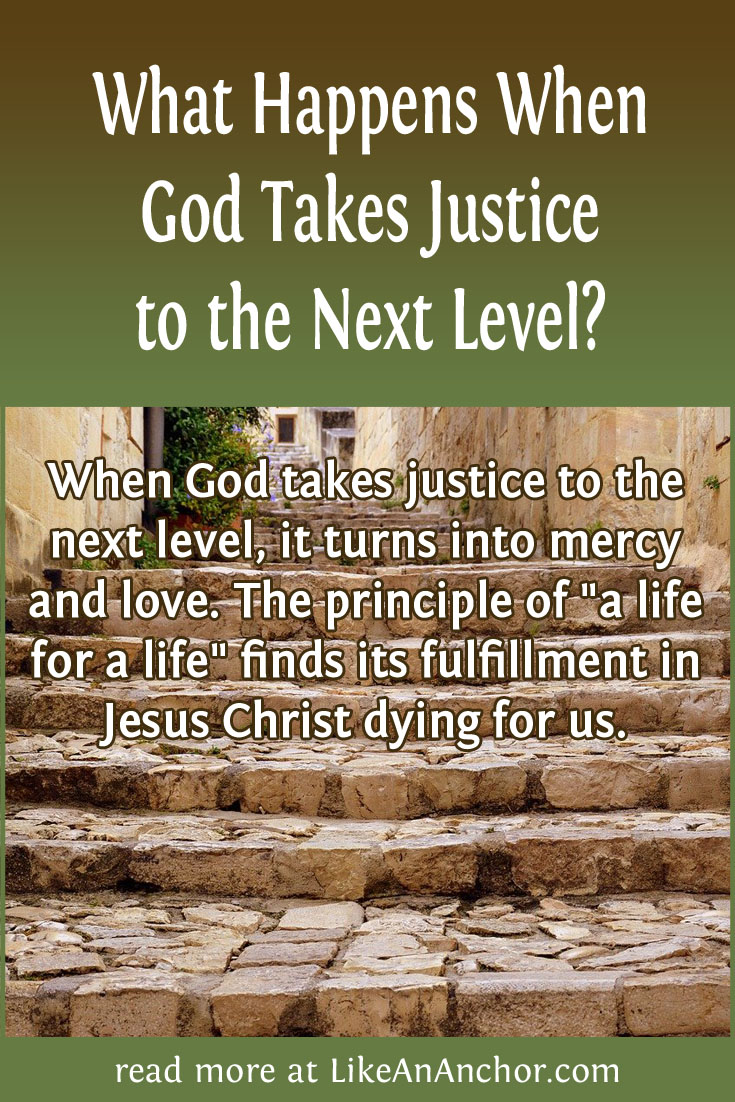
When God takes justice and fairness to the next level, it turns into mercy, long-suffering, peace, and love. The principle of “a life for a life” finds its fulfillment in Jesus Christ dying to free us from all the things we’ve done that deserve death. He gave His life to redirect the “compensation due sin,” which “is death” (Rom. 6:23, LEB), to Himself even though He did not deserve to suffer and die.

Our human nature might rise up against this “turn the other cheek” passage and say that it isn’t fair to let others get away with these sorts of things. But it also was not “fair” that Jesus died instead of us to pay the penalty for our sin. His mercy triumphed over judgement, and if we follow Him in spirit and in truth our mercy should also triumph over judgement.

Featured image by christian schwartz from Pixabay

Justice Belongs To God

One of the things we discussed in last week’s post about a Christian’s role in seeing justice done was that there are very few situations where God says it’s okay for us to judge other people. There’s an important reason for that which we only just touched on last week. It’s that justice and the application of judgement belong to God. We are to become like Him, yes, but there are certain roles that He does not share with us, at least not yet.

Paul says that one day the saints will judge the world and even angels. We’re not there yet, though there are certain situations where we can practice such as settling disputes in the church or discerning when there’s a sin being committed (1 Cor. 5:1-5, 11-13; 6:1-3). We’re not entrusted with final judgement, though, nor with the execution of justice or vengeance. In fact, we’re instructed to step aside and let God handle it whenever we’re tempted to take any vengeful action.

Judged by the Word of God

Back in Deuteronomy, Moses told Israel not to show partiality in judgement or be afraid of judging fairly (no matter what other people think) “for the judgement is God’s” (Deut. 1:17 all scriptures from the WEB translation). Judgement belongs to God, and He cares a great deal about seeing justice done properly. That’s one of the main reasons “You shall not pervert justice. You shall not show partiality. You shall not take a bribe” (Deut. 16:19). Of course, these instructions were given to handle legal disputes in a nation where God’s law was the standard of government. We now live in nations with secular law systems and most of us aren’t involved in that. But the principles still apply. God cares about justice done rightly, and His definition of “rightly” might not always match with our human impulses. Read more

What Is a Christian’s Role in Seeing Justice Done?

Last week, we talked about Jesus’ heart for reconciliation. We studied how He’s strongly motivated to save sinners; to seek out the worst sort of people (us included) and make them clean. This presupposes that we are unclean without Him. That we’ve done something to separate us from God and need to be reconciled in order to have a relationship with Him.

Reconciliation is related to the concept of godly justice. If God were not a just God who will judge every human being for their actions, there would be no need for reconciliation and forgiveness. It is because we do things worthy of judgement that we need to be set right with God. There is such a thing as wrong and right in this world, and we attest to this fact every time our blood boils at seeing an innocent person hurt or our concepts of fairness violated.

Part of being set right with God involves a transformation in how we think. We’re to be like Him, motivated to reconcile with others and also to see justice done. We humans often see judgement and mercy as an either/or dichotomy, but God sees them both as important things which must be exercised in careful balance. Justice and mercy are both among the weightiest matters of His law and they must not be “left undone” (Matt. 23:23). Moreover, once we become part of His people God requires us to “act justly, to love mercy, and to walk humbly with” Him (Mic. 6:8). But how do we do that? What is our role in seeing justice done?

Be Careful How and Who You Judge

In modern English, we tend to see justice as a good thing — fair and equitable upholding of what is right — and judgement as a bad thing — passing a sentence on someone for something done wrong. They’re much more closely connected in scripture, though. For one thing, they’re both translated from the same words — mishpat in Hebrew and krino or krisis in Greek (note: in addition to this, Greek also has separate words for concepts like condemn, katadikazo, and righteous/just, dikaios). Both these words have to do with forming a personal opinion, making distinctions, and/or deciding the outcome of a court case. Justice involves administering God’s law properly to make a judgement, which can be favorable or unfavorable.

We are very strictly warned to be careful how we form opinions, make judgements, and separate people into groups such as “good” and “bad.” Jesus flat-out says, “Don’t judge, so that you won’t be judged.” He goes on to say that however we choose to judge is the way that we will be judged. He also points out that when we cannot see ourselves clearly, it would be hypocritical to try and pass judgements on others (Matt. 7:1-5). This goes along with something Paul said in one of his letters.

Therefore judge nothing before the time, until the Lord comes, who will both bring to light the hidden things of darkness, and reveal the counsels of the hearts. Then each man will get his praise from God. (1 Cor. 4:5, all quotes from WEB translation)

Read more