I recently reread C.S. Lewis’ Mere Christianity, and I’d like to start today’s post with one of the many quotes that stood out to me:
“Handing everything over to Christ does not, of course, mean that you stop trying. To trust Him means, of course, trying to do all that He says. There would be no sense in saying you trusted a person if you would not take his advice. Thus if you have really handed yourself over to Him, it must follow that you are trying to obey Him. But trying in a new way, a less worried way. Not doing these things in order to be saved, but because He has begun to save you already.”
It’s a perfect way of describing the relationship between faith and works. We’re not saved by anything we do, but being saved inspires us to obedience and therefore faith-fueled action.
A Different Perspective on Law
This whole idea also makes me think of Psalm 119, which we were just looking at a couple months ago. The writer of Psalm 119 crafted a beautiful poem that pays homage to God’s law, precepts, and ordinances with every line. It’s a celebration of God’s precious words and of the positive effect following his instructions can have on our lives.
Blessed are those whose ways are blameless, who walk according to Yahweh’s law. Blessed are those who keep his statutes, who seek him with their whole heart. (Psalm 119:1-2, all quotes from WEB translation)
I will delight myself in your commandments, because I love them. I reach out my hands for your commandments, which I love. I will meditate on your statutes. (Psalm 119:47-48)
How I love your law! It is my meditation all day. Your commandments make me wiser than my enemies, for your commandments are always with me. (Psalm 119:97-98)
When was the last time you thought of God’s commandments as a delight? Or felt like exclaiming, “I love His law!” All too often, modern churches describe God’s law either as a burden we’re well rid of or as something we still have to put up with and must fear breaking. The people closest to God, though, have historically seen His words as something precious; a gift given for our good. He is to be obeyed, but not out of a sense of obligation. We obey because we love, and because we are loved.
I was reading Psalm 119 the other day and one of the verses that caught my eye reads, “It is good for me that I have been afflicted, that I may learn your statutes” (Psalm 119:71, all quotes from WEB translation). Most of us don’t think it’s good when we’re depressed, chastened, weakened, oppressed, and bowed down (those are all meanings of the Hebrew word anah, H6031, which this translation renders “afflicted”). In fact, we’re pretty sure those things sound terrible, especially now that we’re all experiencing some of them as a result of the current pandemic. And yet, this psalmist said affliction was “good” because what they endured helped them learn the Lord’s statues (choq, H2706,could also be translated ordinance, limit, or law).
There’s no getting around it. Christianity is tough. When you think about it, though, it’s not any tougher than life outside the faith and if you’re inside you have God’s help so that balances things out in Christianity’s favor. Jesus promised us His help, presence, and protection but He also assured us that we would face trials, persecution, and suffering. Better teachers than I have tried to explain why — The Problem of Pain by C.S. Lewis and Where Is God When It Hurts? by Philip Yancey, for example — but one thing we can’t get around is the fact that pain is a part of life. And that’s true whether you’re a Christian or not.
One of the ways Christianity helps make sense of suffering is by saying it is a product of a world that has gone wrong. God didn’t want things to be this way, but they are now and until He comes back to set things right He’s going to find ways to make good come out of afflictions.
Delight in the Law
Psalm 119 is an acrostic psalm divided into 22 stanzas, one for each letter in the Hebrew alphabet. There are several verses within this psalm that talk about affliction, and we find the first in the zayin stanza.
Remember your word to your servant, because you gave me hope. This is my comfort in my affliction, for your word has revived me. (Psalm 119:49-50)
A later verse in the lamed stanza puts this idea even more strongly:
Unless your law had been my delight, I would have perished in my affliction. I will never forget your precepts, for with them, you have revived me. (Psalm 119:92-93)
It is not just knowing or obeying God’s law, but finding joy in it that helps get us through tough times. All the knowledge of His words we can gather won’t do us much good unless we really care about what He tells us. But when we hold fast to Him — and by extension His word and the things that He cares about — it’s possible to find comfort, joy, and help even in afflictions. The psalmists did, and we can too. Read more →
The apostle John had a particularly close relationship with Jesus. Though Jesus loved all of “his own who were in the world,” John is identified in particular as a disciple “whom Jesus loved” (John 13:1, 23; 19:26; 20:2, 21:7, 20-24). If we want to know Jesus — and we do, because that’s part of salvation and eternal life (John 17:3; Phil. 3:8) — then who better to learn from than John?
We’re taking a short break from our series on godly wisdom because I really felt like this was the topic I should be studying this week. Love and relationship are so important to God. Knowing Him and being known by Him are central to salvation, Christianity, and our eternal hope. We have to know Him in His way, though. Jesus said there will be people at the end who think they know Him and yet never had a relationship with Him (Matt. 7:21-23). That’s a scary thought, but John makes sure to leave us guides in his writings for how to love Jesus and how to tell whether or not we truly know Him.
Knowing God is Essential to Life
John’s writings are among my favorite in the New Testament. He highlights Jesus’ power and divinity — the things that make Him so much higher than us — more than any other gospel writer, yet He also highlights Jesus’s love and His longing for relationship — the things that make Him closer to us. The way John talks about Jesus and the Father makes it clear that the powerful, eternal, creator God longs for a relationship with us.
In the beginning was the Word, and the Word was with God, and the Word was God. The same was in the beginning with God. All things were made through him. Without him, nothing was made that has been made. In him was life, and the life was the light of men. … The Word became flesh, and lived among us. (John 1:1-4, 14, WEB)
Jesus came here not just to die for our sins and reconcile us to God, but also to get to know us. He is the good shepherd who knows His sheep and is known by His own, who choose to follow Him (John 10:14, 27). He calls us His followers, friends, chosen, and beloved (John 15:12-16). And He reveals that knowing Him and the Father is key to eternal life (John 17:3). The importance of knowing and being known by God cannot be overstated.
We often like to think of concepts like love and grace as something with “no strings attached.” If there’s a commitment or reciprocation implied, then we may start to get defensive and resent that it’s not “freely given.” That idea would have been ludicrous to the people of Jesus’ day. Grace is a reciprocal arrangement (we don’t have time to go into that in this post, but click here for an excellent booklet on the subject). Love has to do with commitment and covenants that attach us to God. In a way that seems odd to modern readers, relationship with God is connected to obedience and law.
“One who has my commandments and keeps them, that person is one who loves me. One who loves me will be loved by my Father, and I will love him, and will reveal myself to him.” … “If a man loves me, he will keep my word. My Father will love him, and we will come to him, and make our home with him.” (John 14:21, 23, WEB)
Really knowing Jesus goes beyond saying we believe in Him. It includes letting that belief change the way we live. We demonstrate how much we respect and care about Him by living according to His commandments. And since John points out that Jesus is also the Word — one of two God-beings who’ve been here for eternity — that includes the commands He gave in the Old Testament as well as the New. Jesus stated in no uncertain terms that He wasn’t here to get rid of everything He’d taught before as the Word, but rather to elevate those commands to an even higher level under a New Covenant (Matt. 5:17-48).
John further explores the topic of knowing Jesus in his first epistle. He begins, much as he did in writing his version of the gospel, with Jesus’ eternal existence as the Word of life. Then he shares that “God is light, and in him is no darkness at all,” which means we have to walk in light in order to fellowship with God (1 John 1:1-2:2).
This is how we know that we know him: if we keep his commandments. One who says, “I know him,” and doesn’t keep his commandments, is a liar, and the truth isn’t in him. But God’s love has most certainly been perfected in whoever keeps his word. This is how we know that we are in him: he who says he remains in him ought himself also to walk just like he walked. (1 John 2:3-6, WEB)
As this letter continues, John keeps coming back to themes of love, law, sin, and relationship with God. 1 John is one of those Bible books that it’s good to read in one setting (it’s not that long) to get a better feel for the points the writer is making in-context. As you read through it, one thing he continues to repeat is that we can’t have a relationship with God if we insist on breaking His commandments.
Whoever remains in him doesn’t sin. Whoever sins hasn’t seen him and doesn’t know him. Little children, let no one lead you astray. He who does righteousness is righteous, even as he is righteous. (1 John 2:1-2, WEB)
If we go back toward the beginning of the letter, we see John has already clarified that the children of God don’t practice sin, but if we slip up we can still repent and Jesus will restore our relationship with God (1 John 2:1-2). He’s not saying a Christian who sins is automatically disqualified for salvation. But he is saying that salvation comes with the expectation from God that we’ll respond to His work in us by starting to live lives modeled after His righteous standards.
We declare by our choices whether we are children of God, who practice righteousness, or children of the devil, who practice lawlessness (1 John 3:8-10). Again and again John emphasizes that children of God keep God’s law, chiefly the two laws that Jesus and Paul identified as the most important — love God and love others (Matt. 22:36-40; Rom. 13:9-10). All other commands hinge on those two. God is love and we need to love as He does, in deed and in truth (1 John 3:11-24; 4:7-21). That’s just how we do things in the family of God.
As John wraps-up this letter, he ties what he’s written about loving and knowing God together with what he wrote about loving our brethren. He also addresses a common complaint about how “hard” it is to obey God.
By this we know that we love the children of God, when we love God and keep his commandments. For this is loving God, that we keep his commandments. His commandments are not grievous. (1 John 5:2-3, WEB)
Many people think of commandment keeping as something burdensome, but John tells us that’s far from true. Living within God’s law yields blessings, not hardship. Our attitude toward God’s law should be like that expressed in Psalm 119. This psalmist is in love with the law because it belongs to the God whom he loves. God’s laws are an expression of His character. If we want to be like the Lawgiver and receive the blessings that come from walking with Him, then we’ll respect His word.
Psalm 119 speaks of God’s law as a source of delight, strength, liberty, hope, comfort, life, wisdom, righteousness, peace, and much more. How we keep God’s law is different now — elevated to a spiritual level in the New Covenant — but it still matters (this is largely what Romans is about). God cares about the relationship we have to His words and whether or not we love Him enough to do what He tells us to do. Which brings us to the question of today’s title, “Do I love God enough to obey Him?”
It’s easy to say we love God but it’s harder to follow-through on the things that prove our love is genuine. If we truly love Him, though, obeying His word shouldn’t be a problem for us. It’ll still be a struggle at times to submit our own will to that of our sovereign God, but it’s something worth doing. The blessings of knowing God far outweigh any aspects of obedience that we might find inconvenient. And when we love God and follow His words, continuing to turn back to Him if/when we make mistakes, then we’ll have the assurance that we know Him and are known by Him as well.
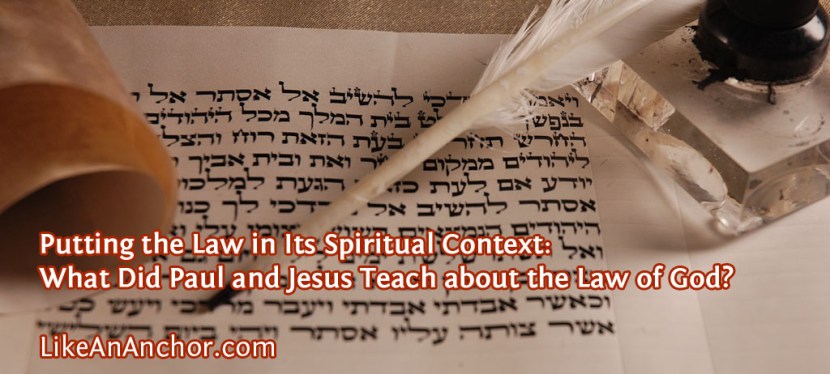
During His ministry on earth, Jesus said He was not here to destroy the law. Yet we also have record of the Jews saying He “broke the Sabbath” (Matt. 5:17; John 5:18). Do those two statements contradict?
Similarly, Paul said his own writings “establish the law,” but he also asked his readers why they would be “subject to ordinances” now that they live by faith (Rom. 3:31; Col. 2:20). Aren’t those statements contradictory as well?
These statements actually don’t contradict each other, but to understand why you have to know something about the Jewish world at the time. On one hand, you have God’s law that He delivered to His people through Moses (the Torah). On the other hand, you have additional rules, regulations, and traditions that were put in place by human beings.
So if we look more closely, we see Christ was not here to destroy God’s law, but He did loose the Sabbath from restrictions added by human teachers. Similarly, in Romans Paul is talking about establishing the law of God, but in Colossians he is talking about walking away from “the commandments and doctrines of men” (Col. 2:20-23).
So what does all this have to do with modern Christians? We’ll take a close look at this question in today’s post, and I think we’ll find that these statement that at first appear contradictory actually teach us about how we are supposed to relate to God’s law. They also teach us how to respond when other people (including teachers and leaders) start to change or add to God’s word.
Torah Teachers and Lawbreakers
For a long time, I’ve been confused about the opening verses for Matthew 23. They read like this:
Then Jesus spoke to the multitudes and to his disciples, saying, “The scribes and the Pharisees sit on Moses’ seat. All things therefore whatever they tell you to observe, observe and do, but don’t do their works; for they say, and don’t do.”
Matthew 23:1-3, WEB
I used to think Jesus was telling people to follow the extra traditions because we should respect authority even if it’s corrupt. That didn’t seem quite right, but it was the best I could figure out. Then a heard a sermon about the true meaning of legalism that explained things differently and (I think) more accurately.
Sitting in Moses’ seat refers to the scribes and Pharisees teaching the Torah that Moses taught. The Apostles make a similar observation later, saying they don’t need to focus their efforts on teaching Torah because the synagogues are already reading Moses every sabbath (Acts 15:21). Torah is important, but it was already being taught. That is why Jesus said to “observe and do” what the Jewish leaders said to do — because they were teaching God’s law.
These leaders were not, however, doing the law themselves and that’s why we’re told not to imitate their works. In fact, by saying “they say and don’t do” Christ is identifying them as lawbreakers (Matt. 23:4-36, particularly verse 23). They legalistically followed doctrines of men but broke the laws of God.
Jesus tells us to do what the scribes and Pharisees said inasmuch as they were faithfully teaching God’s words, but not to follow their example because they weren’t really keeping God’s law. This connects to an earlier point He made in the Sermon on the Mount.
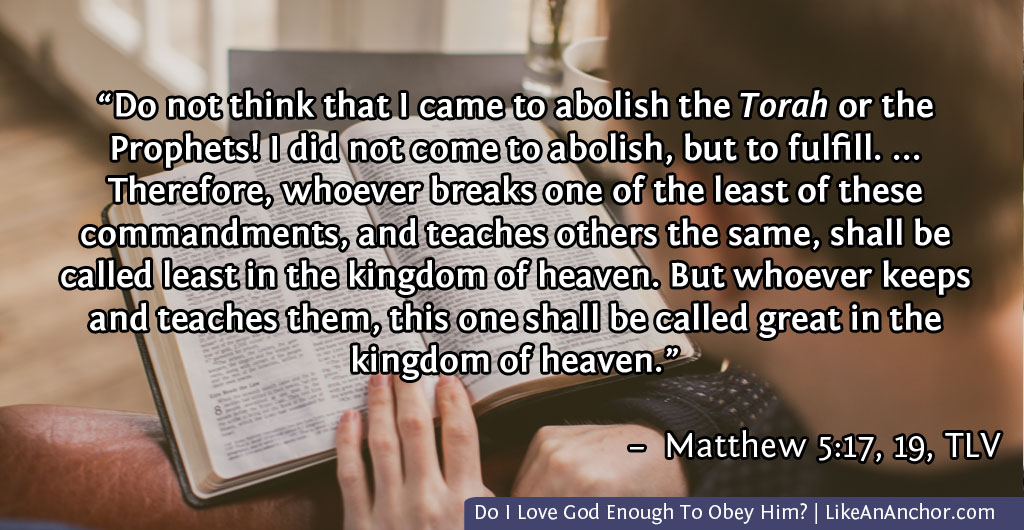
Do not think that I have come to destroy the law or the prophets. I have not come to destroy them but to fulfill them. For truly I say to you, until heaven and earth pass away, not one tiny letter or one stroke of a letter will pass away from the law until all takes place. Therefore whoever abolishes one of the least of these commandments and teaches people to do so will be called least in the kingdom of heaven, but whoever keeps them and teaches them, this person will be called great in the kingdom of heaven. For I say to you that unless your righteousness greatly surpasses that of the scribes and Pharisees, you will never enter into the kingdom of heaven.
Matthew 5:17-20, LEB
I imagine it shook some of Jesus’ hearers to learn He expected them to follow God’s word with more righteousness than the scribes and Pharisees. That group was the most righteous that Jews could get, following every little ordinance to the letter. But as Jesus teaches in Matthew 23, their “righteousness” was not the type of righteousness that God seeks. Jesus wants His people to follow His words faithfully from the heart, not to put on a more righteous show. Aligning ourselves with Jesus is how we become truly righteous.
These passages of Jesus’ teachings are key to understanding Paul’s writings. As a faithful apostle he would not have contradicted Jesus by abolishing God’s commands or teaching people to break the law. Rather, Paul’s writings expand on how we relate to God’s laws as spirit-led Christians.
Photo credit: me
Inward Judaism
In the Old Testament, God promised a new kind of covenant relationship with His people, one where the Law would be written in their minds and hearts instead of imposed from the outside (Jer. 31:33). That happened when Jesus came as the Messiah (Heb. 8). So now we come to Paul — a rabbi who was once a Pharisee and became a faithful follower of Jesus (Phil. 3:4-6). Paul teaches how we should relate to God’s law under the New Covenant. He teaches that it’s not so much about “do”s and “don’t”s, but about inward transformation that makes us spiritual like God instead of fleshy.
For he is not a Jew who is one outwardly, neither is that circumcision which is outward in the flesh; but he is a Jew who is one inwardly, and circumcision is that of the heart, in the spirit not in the letter; whose praise is not from men, but from God.
Romans 2:28-29, WEB)
In this chapter of Romans, Paul tells his readers God cares more about how you live than your pedigree or your professions of lawfulness. “It isn’t the hearers of the law who are righteous before God, but the doers of the law will be justified” (Rom. 2:13, WEB). We need to keep the Law because we have a relationship with the Lawgiver which changes our character, not because we think the law will save us on its own. New Covenant believers still keep God’s law, but our relationship with it is different.
As Romans progresses, Paul builds an explanation for how post-Crucifixion believers relate to God’s law. We’ve all sinned and stand condemned under the law of God, which is incapable on its own of making anyone righteous. We can only be saved by Christ’s atoning sacrifice (Rom. 3:20-27). This doesn’t get rid of God’s law, though. “May it never be! No, we establish the law” (Rom. 3:31, WEB). Paul himself (perhaps anticipating how his words might be misread) makes sure that we understand his arguments establish God’s law rather than say it doesn’t matter.
Our walks as Christians should be closely identified with Jesus and affected by our participation in Him. We are buried into His death, raised to new life with Him, and now walk in Him freed from sin (Rom. 6:1-11). Because of this, we must not let sin rule over us. Instead of serving sin, we are now servants of righteousness (Rom. 6:12-23).
In dying with Christ, we also died to the condemnation from sinning/breaking the law and we are now joined to the Lawgiver in a New Covenant marriage “so that we serve in newness of the spirit, and not in oldness of the letter” (Rom. 7:1-6). There’s a struggle inside us about how we relate to the law that only Jesus can reconcile. “The law indeed is holy, and the commandment holy, and righteous, and good” (Rom. 7:12). It is also “spiritual, but I am fleshly, sold under sin” (Rom. 7:14). We want to do what God says but wrestle with human inability to be good.
For I joyfully agree with the law of God in my inner person, but I observe another law in my members, at war with the law of my mind and making me captive to the law of sin that exists in my members. Wretched man that I am! Who will rescue me from this body of death? Thanks be to God through Jesus Christ our Lord! So then, I myself with my mind am enslaved to the law of God, but with my flesh I am enslaved to the law of sin.
Romans 7:22-25, LEB
Jesus makes it possible for our inner man, which hopefully agrees with God’s law as Paul did, to live in alignment with Him even though we fall short of God’s perfect standard. We rejoice with God’s law and walk in the spirit, free from the fear that came with not measuring up under the old covenant. There’s no condemnation now because in Christ, we walk not after the flesh but in the spirit (Rom. 8:1-14).
We learn more about this flesh vs. spirit distinction in Paul’s other writings, notably Galatians 5:13-26. Instead of following our fleshly desires into sin or being preoccupied by trying to make ourselves perfect by our own power, we focus on walking in the spirit. This process necessarily results in change. Paul makes it clear that if we aren’t changing from flesh to spirit then we’re not in Christ. It’s as simple as that. Following Jesus and truly modeling His love results in us fulfilling the law in its proper, spiritual context as God always desired. Righteousness happens as a sort of side-effect when we’re following Christ and living a life that is truly spirit-led.
Do you desire the same things God desires? That’s one of the questions asked in a new book I’m reading called What Does Your Soul Love? It’s written by Alan and Gem Fadling, and it’ll be available for purchase September 17th. I’m about halfway through right now and it’s given me quite a bit to think about. One thing I really like is the way they explain how our resistance to living a godly way of life is connected to Paul’s discussion of flesh versus spirit.
Our desires lie at the root of why we act the way we do. But even when we line-up the things we say we want with the things God wants, we might still find ourselves in the same position Paul was in his letter to Rome. He said he delights “in God’s law after the inward person,” but still finds “the good which I desire, I don’t do; but the evil which I don’t desire, that I practice” (Rom. 7:14-25). When we try to follow God, we encounter resistance from within ourselves as well as from without.
The resistance from outside is usually easier to identify and counter, at least to a certain extent. But what about the resistance inside? What can we do about that?
What Is “The Flesh”?
Just a couple weeks ago, I shared a 2-part post about Galatians. It’s on my mind again now since that letter seems particularly relevant to today’s discussion. If we’re going to talk about how our flesh resists living in the spirit, the last two chapters of Galatians are crucial. But first, let’s clear up a potential misunderstanding.
“The flesh here is not the physical body, but a way of life we’ve grown used to living in a world that does not recognize the reality of God and his kingdom. It is a dynamic within whereby we grab for what we need, not trusting (or knowing of) God’s generosity to provide. It is an ‘I can do it myself’ approach to living that presumes the absence of the loving God” — Alan and Gem Fadling
I’d also add that “flesh” includes an attitude of “I can decide right and wrong for myself” that presumes to know better than God or to think that He doesn’t really care. When we look at Paul’s description of the flesh, it includes following desires and taking actions that God has said are wrong. To keep doing those things when we should be walking in the spirit is to disregard our Creator and Savior’s wishes (Gal. 5:16-21). Read more →
We don’t follow God primarily because we want to get something from Him, or at least we shouldn’t. We follow Him because we love Him, He is our savior, and nothing on earth can compare to having a relationship with Him. But we also shouldn’t ignore the fact that following God does mean we’ll receive good gifts from Him.
Following God gives us hope for eternal life. He promises that all who believe in Him shall never see death. Even if that were the only gift, it would be more than enough. However, the good things we receive from God don’t all wait until after you die. He also does wonderful things in our lives right now.
We can’t expect all (or even most) of God’s blessings will be physical ones, though. While He does promise to provide for our needs and even blesses some with physical prosperity, none of us escape trials and hardships in this life. In fact, Christians are promised they will suffer in following Christ’s footsteps. If we only expect God to do things for us in the physical realm then we’ll miss a lot of the blessings He pours out on us. So today, let’s take look at one Psalm that describes some of the incredible things that following the Lord can do for us.
Psalm 19 begins by saying, “the heavens declare the glory of God.” After waxing eloquent about how the universe reveals the Creator, David begins to speak of other ways the Lord, Yahweh, reveals Himself to us. Then David explains how those revelations affect those who believe. Read more →




![Image of a Bible open on a table overlaid with Matt. 23:24, TLV version: “Woe to you, Torah scholars and Pharisees, hypocrites! You tithe[a] mint and dill and cumin, yet you have neglected the weightier matters of Torah—justice and mercy and faithfulness. It is necessary to do these things without neglecting the others. O blind guides, straining out a gnat while swallowing a camel!](https://likeananchor.com/wp-content/uploads/2019/08/law-spirit-3.jpg)



 Like An Anchor