A few weeks ago, I started a study on sheep, lambs, and shepherds in the Bible. One of the most interesting things I came across was looking into the words for “shepherd” and “pastor” in both English and Hebrew. As I mentioned last week, I don’t usually spend time looking at English words since they’re a translation choice rather than something that gives insight into the original intent, but sometimes it’s interesting. For example, in the case of “pastor,” it’s curious to see how the meaning of the word has changed over the years in Western Christianity. That study made me want to look into the roles of shepherds/pastors a little bit more. I wanted to see how looking at the Greek could add to understanding this, and dig more into our modern ideas of what a shepherd or pastor does.
Pasturing the Flock
First, a quick recap of the shepherd study from a few weeks ago. In Hebrew, the word translated “shepherd” is connected to the words for pasture, tend, and graze (Theological Wordbook: Old Testament 852). The shepherd is one who makes sure the flocks are fed in good pastures. In English, the word “shepherd” comes from sheep+herd and it means someone who herds sheep (Online Etymology Dictionary). But the English word “pastor” comes from the same Latin root as “pasture” (Online Etymology Dictionary). So really, “pastor” might be a more exact translation of râ‛âh than “shepherd” is, though the way those English words are used today makes shepherd the less confusing choice. (Interestingly, râ‛âh is translated “pastors” eight times in the 1611 KJV translation of Jeremiah.)
What about in Greek? In the KJV, WEB, and NET translations, “shepherd” and the one use of “pastor” (Eph. 4:11) are both translated from poimēn (G4166). The verb form is poimainō (G4165) and it’s translated in KJV as “rule” or “feed” but in WEB and NET as “shepherd,” “tend,” or “rule.” The word simply means to care for flocks of all sorts; it’s more like “flock-tender” than “sheep-herder” (Zodhiates G4165). Also, there’s another specific word, boskō (G1006), for taking animals to a pasture to graze. Bosko represents feeding where poimaino “involves total care” (Zodhiates G1006).
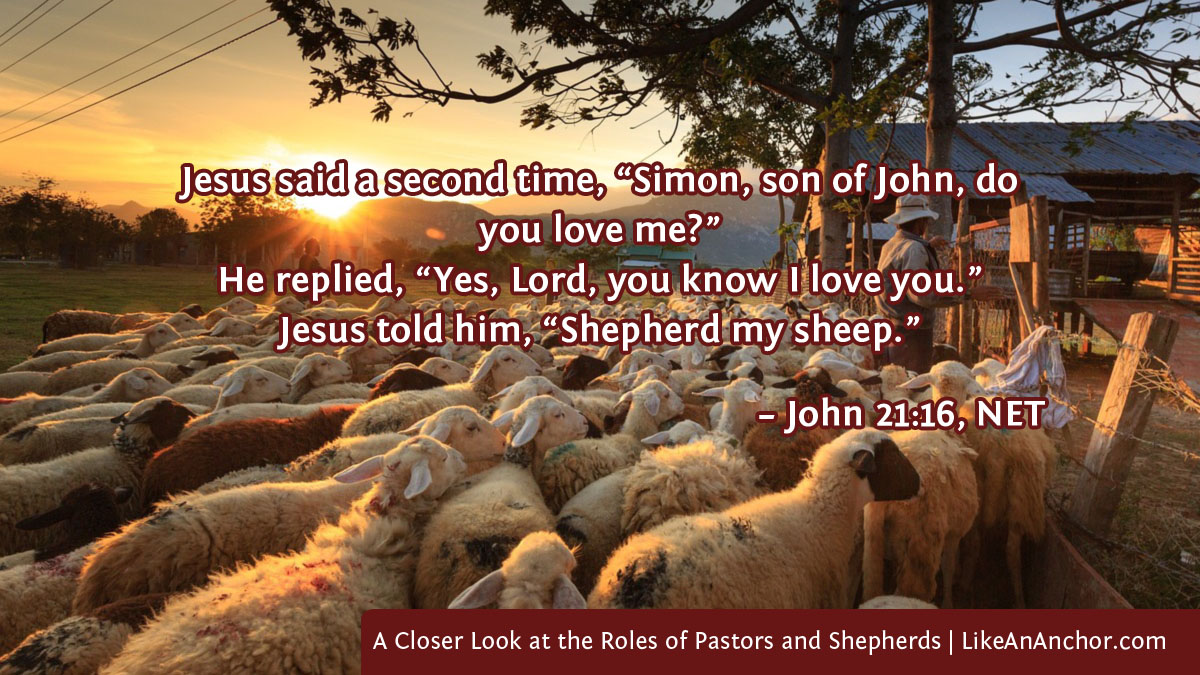
We see both of those feeding and shepherding words in Jesus’s conversation with Peter at the end of John’s gospel. He told Peter, “feed my lambs,” “tend my sheep,” and “feed my sheep” (John 21:13-17, WEB). The word translated “tend” is poimainō and the one translated “feed” is boskō. In other words, Jesus is telling Peter that it’s his role to provide wholistic care for the flock and to specifically feed them and provide pasture. Later, Peter passed this instruction on to his “fellow elders,” telling them to feed or “shepherd the flock of God” (poimainō in this case) (1 Peter 5:1-3).

Feeding and Caring
The one time that translations like KJV and NET use the word “pastor” in the New Testament, it’s in Ephesians 4:11. Here, Paul is talking about unity in the body of Christ and the roles of people within His body. The WEB translation sticks with “shepherd” in this case, but let’s look at it in the NET.
He, the very one who descended, is also the one who ascended above all the heavens, in order to fill all things. And he himself gave some as apostles, some as prophets, some as evangelists, and some as pastors and teachers, to equip the saints for the work of ministry, that is, to build up the body of Christ, until we all attain to the unity of the faith and of the knowledge of the Son of God—a mature person, attaining to the measure of Christ’s full stature.
Ephesians 4:10-13, NET
Several translations see “pastors and teachers” as a linked concept. The freely paraphrased Voice and Message translations say “pastor-teachers,” while the Amplified Bible says “and some as pastors and teachers [to shepherd and guide and instruct].” Now, I’ll admit I resist this reading because I want pastors and teachers to be separate things (since I can call myself a teacher but not a pastor and I don’t want them to collapse into the same role), but that’s a selfish reason for preferring one translation over another so we’re going to push on with this study and see what we can learn.
Pastors take sheep to pasture. And since it’s translated from poimainō, it involves total care for the sheep. This does connect with “teacher” as a role when we think of the connection between God’s word and daily sustenance. For example, God wanted Israel to learn “that man does not live by bread only, but man lives by every word that proceeds out of Yahweh’s mouth” (Deut. 8:3, WEB). It’s such an important lesson that Jesus quotes it in His show-down with Satan (Matt 4:1-4; Luke 4:1-4).
Righteous Job “treasured up the words of his [God’s] mouth more than my necessary food” (Job 23:12, WEB). One Psalmist calls God’s words sweet like honey (Ps. 119:103, NET). The Lord says when His word can’t be found in a land, it’s like a famine (Amos 8:11-12). There’s even a fascinating connection for Ezekiel and John between eating words given by God and speaking prophecies (Eze. 2:8-3:4; Rev. 10:8-11). Also, when we’re properly feeding on the word of God, we can all become teachers.
For though you should in fact be teachers by this time, you need someone to teach you the beginning elements of God’s utterances. You have gone back to needing milk, not solid food. For everyone who lives on milk is inexperienced in the message of righteousness, because he is an infant. But solid food is for the mature, whose perceptions are trained by practice to discern both good and evil.
Hebrews 5:12-14, NET
So if shepherding involves caring for the flock of God, including feeding them, and teaching involves sharing God’s words which are like food for our spiritual lives, then shepherding/pastoring and teaching are closely connected. They’re not exactly the same thing, but it would seem that a primary job for pastors is to feed the flock. That’s not a shocking revelation; most pastors in Christian churches today are also teachers. But maybe we don’t always think about feeding as the primary role of pastors.
The Importance of Feeding
There is a lengthy passage in Ezekiel 34, along with a shorter one in Jeremiah 23:1-8, where the Lord condemns ancient Israel’s leadership for not doing their job properly. They didn’t protect the flock from dangers. They focused on taking care of themselves rather than putting the flock first. And, perhaps the worst offense of all based on how many times God mentions it, is that they did not feed the sheep.
Yahweh’s word came to me, saying, “Son of man, prophesy against the shepherds of Israel. Prophesy, and tell them, even the shepherds, ‘The Lord Yahweh says: “Woe to the shepherds of Israel who feed themselves! Shouldn’t the shepherds feed the sheep? You eat the fat. You clothe yourself with the wool. You kill the fatlings, but you don’t feed the sheep. …
“As I live,” says the Lord Yahweh, “surely because my sheep became a prey, and my sheep became food to all the animals of the field, because there was no shepherd, and my shepherds didn’t search for my sheep, but the shepherds fed themselves, and didn’t feed my sheep.” Therefore, you shepherds, hear Yahweh’s word: The Lord Yahweh says: “Behold, I am against the shepherds. I will require my sheep at their hand, and cause them to cease from feeding the sheep. The shepherds won’t feed themselves any more. I will deliver my sheep from their mouth, that they may not be food for them.”
“‘For the Lord Yahweh says: “Behold, I myself, even I, will search for my sheep, and will seek them out. … I will feed them with good pasture; and their fold will be on the mountains of the height of Israel. There they will lie down in a good fold. They will feed on fat pasture on the mountains of Israel. I myself will be the shepherd of my sheep, and I will cause them to lie down,” says the Lord Yahweh. “I will seek that which was lost, and will bring back that which was driven away, and will bind up that which was broken, and will strengthen that which was sick; but I will destroy the fat and the strong. I will feed them in justice.”’
Ezekiel 34:1-3, 8-11, 14-16, WEB
In sharp contrast, we see Jesus coming as both the Good Shepherd (John 10) and the Bread of Life (John 6). As the Shepherd who guards the sheepfold, Jesus says, “I am the door. If anyone enters through me, he will be saved, and will come in and go out, and find pasture” (John 10:9, NET). Perhaps, knowing the important role of a shepherd in feeding His flock, some of those listening to Him would have thought back to the miracle of the loaves and the fishes, and what Jesus taught after that about true sustenance.
“Do not work for the food that disappears, but for the food that remains to eternal life—the food which the Son of Man will give to you.” …
Jesus said to them, “I am the bread of life. The one who comes to me will never go hungry, and the one who believes in me will never be thirsty.” …
“I am the living bread that came down from heaven. If anyone eats from this bread he will live forever. The bread that I will give for the life of the world is my flesh.” … Jesus said to them, “I tell you the solemn truth, unless you eat the flesh of the Son of Man and drink his blood, you have no life in yourselves. The one who eats my flesh and drinks my blood has eternal life, and I will raise him up on the last day. For my flesh is true food, and my blood is true drink.” …
“The Spirit is the one who gives life; human nature is of no help! The words that I have spoken to you are spirit and are life.”
John 6:27, 35, 51, 53-55, 63 NET
If you’re reading this article the weekend it posts, then Passover just over two weeks away. Eating Jesus’s “flesh” (unleavened bread) and “blood” (wine) is something we do on that day every year (Luke 22:15-20; 1 Cor. 11:23-25). But He’s also our sustenance year-round. We need to keep coming to Jesus to satisfy our spiritual hunger and thirst. We need to keep reading His words that are spirit and life. And if we’re someone with a teaching and/or pastoring/shepherding role, we need to make sure we’re sharing this spiritual food with others as well.
Recognizing Good Shepherds

As I already mentioned, I think I can call myself a teacher, but I’m definitely not a pastor. I went back and forth on actually writing this post because it really isn’t my role to tell pastors how to do their jobs. But I do think knowing something about what the Bible says about pastors/shepherds helps each of us as sheep.
First, we need to recognize that human shepherds are fallible. Jesus is the Chief Shepherd. He’s the one who supplies all our needs and who the Father has given has ultimate Authority over His flock. Jesus doesn’t approve of it when people He lets tend His sheep fail in their duties, and He doesn’t abandon the sheep to substandard care. If you’ve had bad experiences with church leadership, that doesn’t mean Jesus doesn’t care (see those verses we talked about in Ezekiel 34). Also, sometimes people who are overall good leaders need grace and forgiveness because they’re human too.
Second, knowing what we can expect from a human shepherd who’s following Jesus’s example helps us recognize if there’s a teacher or pastor that we shouldn’t be listening to. Jesus said, “Beware of false prophets, who come to you in sheep’s clothing, but inwardly are ravening wolves. By their fruits you will know them” (Matt. 7:15-16, WEB). The same can likely be said of false shepherds. We’re to honor and respect those who serve in the church, but we’re also not supposed to follow them blindly if they’re going off after something other than the true Shepherd.
Finally, studying pastors and teachers reminds us that they do have a very important role in the church. There’s a tendency many of us have–especially if we’ve been burned by some of those wolves in sheep’s clothing–to be very skeptical of church leadership. We may think or act as if we’re the ones in charge and resist following someone’s leadership even if it’s a question of preference rather than something that’s actually, doctrinally important.
Now we ask you, brothers and sisters, to acknowledge those who labor among you and preside over you in the Lord and admonish you, and to esteem them most highly in love because of their work. Be at peace among yourselves.
1 Thessalonians 5:12-13, NET
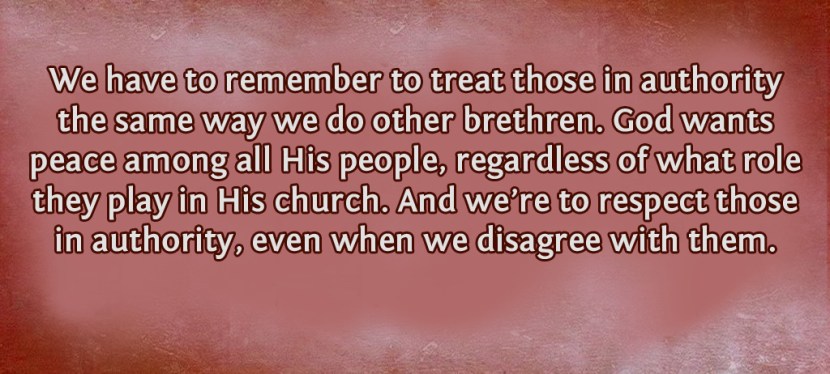
Remember, the peace that God expects among people in His church includes the church leadership. They’re not to “lord over” the flock (Matt. 20:25-26; 1 Pet. 5:2-4) but they do have roles of leadership and authority, and they deserve respect. Paul even says to give “double honor” to church elders if they “provide effective leadership,” especially when they “work hard in speaking and teaching” (1 Tim. 5:17, NET). When things in the church are working the way God intends, then we all work together as a family with each part of the body filling different roles and some of those parts have more authority than others (all under the headship of Jesus, of course). We’re all learning submission and respect together, ultimately by submitting to Jesus’s leadership as the Good Shepherd.
Featured image by Pexels from Pixabay

Song Recommendation: “My Shepherd Will Supply My Need – Psalm 23” by The Tabernacle Choir Choral Music




 Like An Anchor