When Should We Value Human Life?

In the abortion debate, one of the things people like to argue is at what point the fetus qualifies as a living human being. Is it when the heart starts beating around 3 weeks? Is it when we can detect higher brain functions at at 22–24 weeks? Is it when the fetus is “viable” without the mother? Or after the baby has been born?

There’s plenty of science to indicate that a unique human entity is created either at the moment of conception or at cellar division about 24 hours later. The zygot, and then the fetus, is alive when a genetically unique cell forms that can grow, metabolize, and respond to stimuli. You can click here to read an excellent white paper on the subject written by Maureen L. Condic, Ph.D, Associate Professor of Neurobiology and Anatomy at the University of Utah School of Medicine. She concludes,

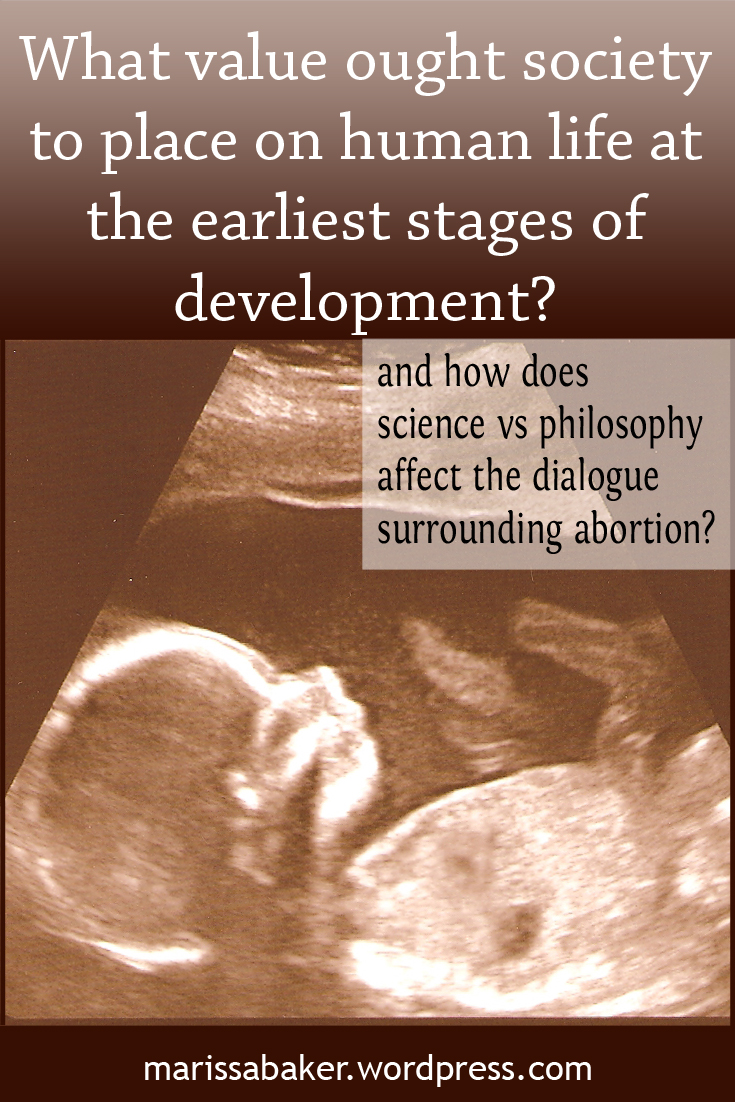
This view of the embryo is objective, based on the universally accepted scientific method of distinguishing different cell types from each other, and it is consistent with the factual evidence. It is entirely independent of any specific ethical, moral, political, or religious view of human life or of human embryos. Indeed, this definition does not directly address the central ethical questions surrounding the embryo: What value ought society to place on human life at the earliest stages of development?

I was on a pro-choice action network website, and they’re perfectly willing to admit that the fetus is alive and that it’s human (click here for the article I was reading). What they contend is that the fetus isn’t a human being yet (they distinguish “human being” from “human”). They also contend that a fetus does not have the right to live parasitically at the expense of its mother if she doesn’t want to carry to term because her person-hood and right to choose is not in dispute. They’ll then turn the argument to the “rights of the woman,” asking why we’re so ready to sacrifice her right to decide whether or not to have a baby on the altar of a fetus’s “hypothetical” right to be born.

Even at this point in the argument, you can see it really isn’t about science or objective fact. The facts are that the fetus is genetically unique, human, and alive from the moment of conception. That’s not in dispute. In reality, the question we should be asking is not, “When does the fetus become human?” but rather, “At what point do we value human life?”
When Should We Value Human Life? | marissabaker.wordpress.com
Photo Credit: “hello in there!” by Adrienne Bassett, CC BY via Flickr

The main leg the pro-life movement has to stand on is convincing society that we should value the life of unborn people so much that killing them is legally considered murder. We can use the science, but ultimately that’s not going to convince people to fight against abortion. People who support the legal right to terminate pregnancies know fetuses are alive — they just don’t think it matters. Our battle needs to be fought on philosophical and moral grounds.

Recent polls show that while more American’s describe themselves as pro-choice than pro-life right now, 51% think abortion should only be legal “under certain circumstances” verses 19% saying legal “under any circumstances (Gallup Polls). Getting into more detail about exactly what this means, we see 84% of Americans want tight restrictions on abortion: 25% say it should be legal in the first 3 months, and the others are divided between only in cases of rape or incest, to save the life of the mother, and not legal at all. (Marist Poll).

The Marist Poll also reports that even though only 13% of respondents favored banning abortion under every circumstance, 60% believe abortion is morally wrong. In today’s America we hate the idea of imposing our morality on other people, but we still do that every day we continue to (rightly!) maintain that murder, rape and pedophilia are wrong. Why is it so hard for us to extend that moral stand to protecting unborn life? And how far are we going to let this go? When we as a society set arbitrary limits on what makes a human life qualify as a human being, we’re on a very slippery slope. In 2011, two researchers in Australia published a paper titled “After-birth abortion: why should the baby live?” I’ve not read the whole paper, but this is the researcher’s own succulent abstract statement of what their work is about:

Abortion is largely accepted even for reasons that do not have anything to do with the fetus’ health. By showing that (1) both fetuses and newborns do not have the same moral status as actual persons, (2) the fact that both are potential persons is morally irrelevant and (3) adoption is not always in the best interest of actual people, the authors argue that what we call ‘after-birth abortion’ (killing a newborn) should be permissible in all the cases where abortion is, including cases where the newborn is not disabled.

While these researchers were not widely supported and later claimed their argument was taken out of context, it was a step in a disturbing trend. Informal evidence suggests college students are increasingly in favor of “after-birth abortions” up to 4 or 5 years old because they believe children that age aren’t “self-aware” yet (never mind that psychologists say children become “self-aware” between 1 to 3 years, usually 18 months).

It’s ridiculous to suggest that a fetus suddenly becomes a human being at 3 months, or at birth, or whatever age you decide to go with, but that he or she isn’t a human being a few minutes, hours, or days earlier. When you take such an argument to it’s farthest extent, you either have to believe human life is precious from conception or arbitrarily define a point at which humans are protected and before which they are not.

While we’re on the subject of valuing human life, I want to point out that a pro-life argument should never be anti-women. As one blogger who works with at-risk women points out, “Abortion isn’t so much about a woman having a choice — but a woman feeling like she has no choice at all.” While I want abortion to be illegal because I firmly believe no human being has the right to decide they can kill another, I also want to create a world where women don’t feel they have to or should have abortions. Where violence against pregnant women who want to keep their child stops. Where people are honest about what actually happens to both the mother and unborn child during an abortion. Where we consider the physical, emotional and psychological risks to the mother and stop pretending abortion is pro-woman.

It is our right and it is our duty to stand up to injustice, to speak out against moral wrongs and fight to correct them. And if we’re Christians, this is doubly the case. We’re called to “choose life, that both you and your descendants may live” (Deut. 30:19). God talks about knowing His people pre-birth and calling prophets and judges “from the womb”  (Judg. 13:5; Is. 49:1, 5; Jer. 1:5; Gal 1:15). Other verses talk about Him forming children inside the womb and being involved in birth (Job 31:15; Ps. 22:9; 139:13; Is 44:2), and about in-womb children reacting like and being treated as people (Gen 25:23; Luke 1:41). For Christians to say that murder is wrong but killing an unborn child is not just doesn’t add-up. There are certain areas in which we cannot be like our culture, and this is one of them.
The Single INFJ

It’s strange that a personality type for which “homemaker” is one of the top recommended career options has such a difficult time finding love. While not true of all INFJs, many of us are romantics in every sense of the word. We’re idealists who still believe in soul-mates. We’re eager to dive deep into relationships and prioritize the people closest to us. We’re among the MBTI types least likely to cheat in a romantic relationship.

But we also shy away from any type of deep relationship if we don’t feel completely safe. Our idealism means we often have unrealistic expectations for our (potential) romantic partners. The soul-mate type of understanding we crave is hard to find. And so here I am, turning 27 this year having been on 4 dates since I was 19 (all with guys I chose not to go out with a second time) and yet still wanting to be in a relationships (almost) just as much as ever.

So what’s a single INFJ to do? It sounds cliche, but I agree with Amelia Brown on Introvert, Dear that it’s important  to focus  on “the relationship you have with yourself.” If you’re not comfortable with yourself, you’re never going to be happy, regardless of whether or not you’re in a relationship with someone else. Also, if you haven’t taken ownership of your life, your choices, and your struggles then you’re going to have a harder time cultivating the sort of strong, lasting relationship INFJs crave. Read more

Not Wanting To Write

It’s about 4:30 in the afternoon Sunday as I write this. Usually by this time I’m either proof-reading a completed post for Monday or wrapping-up my work on a finished idea. What’s worse, I don’t even I care that haven’t written a post yet. I mean, I’d probably care tomorrow when I wake up and realize I failed all of you readers, but at this point I’ve had too little sleep and too much Netflix to function as my normal self.

Well, perhaps not entirely. At least I’m writing about not wanting to write. It’s a start. I’ve been writing professionally long enough to know you can’t just sit around waiting for inspiration to strike if you want to get a blog post, article, story or book written. People who do that aren’t writers.

Not Wanting To Write | marissabaker.wordpress.com
photo credit: “Content writer” by Ritesh Nayak, CC BY-SA via Flickr

If you aren’t a writer you can get away with not writing when you don’t want to. Hobbies and pastimes are voluntary. But when writing is what you do you don’t just stop. In fact, if you’re doing things right, most of the time it feels like you can’t stop writing. For writers, not-writing should feel stranger than writing.

There’s a myth out there that writing is easy (“Oh, so you’re a writer? That’s cool. I might write a novel in my spare time some day”). It’s not. Yes, there will be days when the words flow out and you’re convinced what you’re writing is pure genius and you just know these words have the power to touch people’s souls. But mostly you have to sit down everyday with your pen or your laptop or your typewriter and make the words move from brain to fingers.


Struggling to write is perfectly okay just so long as you don’t give up. I suppose it’s that way with most things, actually. Anything worth doing is going to be hard at some point. What’s important is that we don’t stop, at least not for long. By all means take a break, eat a little chocolate and watch some anime (my sister hooked me on Fullmetal Alchemist Brotherhood), but don’t stay there.

It’s about 7:30 in the afternoon as I finish writing this. Look at that — we’ve got a finished blog post, even with the distractions of searching for quotes about writing and playing Star Trek Online. And you know what? I think I just might keep writing. My short story collection needs one more story, and there’s a character named Taline just waiting to be discovered …


Clothed in Holiness

“What do you think dignity’s all about?”

The directness of the inquiry did, I admit, take me rather by surprise. “It’s rather a hard thing to explain in a few words, sir,” I said. “But I suspect it comes down to not removing one’s clothing in public.” (Kazuo Ishiguro, The Remains of the Day)

This quote comes from a delightful little book about a British butler looking back on his life. Much of his reminisces center around this idea of dignity. He connects dignity with “a butler’s ability not to abandon the professional being he inhabits.” A butler who cannot do this is “like a man who will, at the slightest provocation, tear off his suit and shirt and run around screaming.” In short, a good butler keeps himself covered in the role he is committed to no matter how trying the circumstances.

Clothed in Holiness | marissabaker.wordpress.com
Photo: Messianic Dance Troupe by Larry Jacobsen

I would probably not have connected this with the Bible if not for a message I heard on the same day I was taking The Remains of the Day back to the library. The Rabbi at my local Messianic congregation taught on the priestly garments and how we choose to “cover” ourselves with either good or bad actions, words, and character traits. Read more

Dark Side or Light?

The dark side is quick, easy and powerful. The light side requires commitment, bravery and peace. They are always at odds, always battling in the galaxy as a whole, between groups of people, and even within individual hearts and minds.

Star Wars has always been about the classic battle between good and evil. This same battle rages in our world as well, which is one of the reasons this franchise is so popular. We can all relate to the humanity and struggles of the people in this “galaxy far, far away.” It’s a sort of myth or fairy tale for the modern age. And, like many iconic stories, it can prompt discussions about a variety of topics important today, including faith and religion.

Do you walk on the dark side or the light? | marissabaker.wordpress.com

In Star Wars, the Dark Side is the “quick and easy” path, just as in the Bible the path toward destruction is wide and easy to find. Darkness has a strong, seductive pull which actually mirrors an analogy in Proverbs where evil is compared to a crafty harlot while wisdom is a gentle, godly woman. Like the Bible, Star Wars teaches the Dark Side isn’t better – the good characters resist it and win, the bad characters find that it ruins their lives and the lives of those around them. Read more

The Foundation: Eternal Judgement

We’re wrapping up our series on the foundational principles of Hebrews 6 today. “Eternal judgement” is the final point the writer of Hebrews lists as a “principle of the doctrine of Christ.”

Therefore, leaving the discussion of the elementary principles of Christ, let us go on to perfection, not laying again the foundation of repentance from dead works and of faith toward God, of the doctrine of baptisms, of laying on of hands, of resurrection of the dead, and of eternal judgment. And this we will do if God permits. (Heb. 6:1-3)

The Foundation: Eternal Judgement| marissabaker.wordpress.com

There’s a good reason why Christians have to live lives of obedience and service to God. We will give account of ourselves at the end, and receive a judgement whether we were good or evil.

Read more