Agape and Philia: Overlapping Dimensions of God’s Love

Love is a central theme in the Bible. It’s inarguably one of the most important things in scripture, because “God is love” and He presents love not only as central to His character but to our Christian walk as well.

You might have heard that there are multiple Greek words for love. Eros is love that desires. Philia is friendship love. Storge is family love. Agape is selfless love. Only philia and agape appear in the Bible (except for storge in a few derivative or compound words), but this still makes English translation challenging since we only have one word for love. Some Bible versions try to deal with this by translating agape as charity (KJV) or philia as “brotherly kindness” (certain WEB verses, for example). In many cases, though, both are simply translated “love.”

While the brief definitions I gave in the previous paragraph are correct, they’re incomplete. Pages of dictionaries, a plethora of scholarly papers, and numerous books have been written trying to define Christian love and tease out the differences between philia and agape. In many cases, these definitions focus on agape, often because the authors see philia as a lesser sort of love. It is true that agape is used far more often than philia in scripture. However, this does not mean that agape is a higher form of love, that it’s never used negatively, or that it doesn’t overlap in meaning with philia. Both words are important and both are used of God’s love for us, our love for God, and love between people.

Image of two people's clasped hands overlaid with text from John 15:12-14, NET version: “My commandment is this – to love (agapao) one another just as I have loved you. No one has greater love (agape) than this – that one lays down his life for his friends (philos). You are my friends if you do what I command you.”
Image by Jantanee from Lightstock

What is the Historical Context for Agape?

The Bible writers didn’t invent a new word for love when they used agape, but finding out what the word meant in pre-Christian writings has been a challenge (if anyone knows of good sources on this, please send them to me!). In Classical Greek, the focus was more on eros (particularly for Plato) and philia (particularly for Aristotle) (Holst, 2021). The only sources I’ve found on how the word was used before Christianity are Biblical Greek dictionaries.

Thayer’s Greek Lexicon, originally published in 1889, stated that the word form agape is “a purely Biblical and ecclesiastical word” (Greek 26. Agapé, n.d.). He states that “secular authors” including Aristotle and Plutarch used the form agapasis, and he does “not remember to have met with it” in the Jewish writers Philo and Josephus. Agape does appear in the Septuagint (the Greek translation of the Hebrew Old Testament that dates from the 3rd to 1st centuries B.C.), which provides some background for how Jesus and other NT writers (particularly Paul, John, Peter, and Jude) use the word.

According to a search of the Greek Septuagint with Strong’s numbers in the Bible software program eSword, agape appears 15 times in 14 verses in the Old Testament (2 Sam. 13:15; Ecc. 9:1, 6; Song 2:4-5, 7; 3:5, 10; 5:8; 7:7; 8:4, 6-7; Jer. 2:2). In these verses, agape is used for human love, including romantic love. The root word of agape, agapao, appears 209 times in 196 verses as the main word for “love” in the Greek Old Testament. This includes the love of God for us (for example, Deut. 4:37; 7:13; Prov. 3:12; Is. 43:4; Mal. 1:2) and the love we’re supposed to have for God (for example, Deut. 6:5; 10:12; Prov. 15:9 Is. 56:6). Its usage is not, however, confined to Godly love. It’s used much the same way that the English word “love” is today, with a range of meaning depending on context.

The modern Christian understanding of agape is heavily influenced by Swedish theologian Anders Nygren, who began publishing his multi-part work Eros and Agape in 1930. For Nygreen, eros was central to Greek society and stood in sharp contrast to the Christian agape, which was an utterly unique type of love (Grant, 1996; Holst, 2021). Nearly every paper I’ve found on the topic of agape cites Nygren’s work, either in passing or in a direct response to his claims. Nygren ignored philia entirely, and claimed that agape is a type of love that originates with God alone and involves His “pure, unmotivated love for human beings” (Holst, 2021, p. 55). Following in Nygren’s footsteps, I often hear agape defined as the highest love. Other loves are often minimized as emotional and unstable. As we’ll see, this is a skewed reading of the Biblical texts.

What is the Historical Context for Philia?

There’s more historical information about philia. For Aristotle, philia “is the human good which nobody would choose to live without” (Holst, 2021, p. 56). He devoted two books to the subject of philia, typically translated “friendship,” and it is central to his code of ethics. For Aristotle, friendship is a virtue linked with justice and trust. It also has to do with understanding the virtuous self in relation to community with others.

In the Septuagint, philia appears 9 times, all in Proverbs. The related word philos appears 27 times. These words are used to describe romantic, friendly, and familial love, love for things, and the actions of kissing or embracing (e.g. Gen. 27:14; 37:4; 50:1; Prov.  7:18; 8:17; 10:12; 29:3; Hos. 3:1). In the Septuagint, at least, philia is a slightly more specific word for love than agape. It’s still used in a variety of ways, but it is used for affectionate and friendly love rather than used more generally for all types of love as agapao is.

Though philia is mostly connected to friendships, it’s not only for people who are already close friends but also for guests because hospitality “lays the basis for all friends to begin to trust each other” (Holst, 2021, p. 65). It is in this dynamic of “guest friendship” that Holst (2021) argues philia enhances our understanding of agape because both involve relating to other people. Economist Luigino Bruni (2010) borrows the phrase “l’inconditionnalité conditionnelle” (conditional unconditionality) from sociologist Alain Caillé to describe philia as something that takes a first step toward friendship unconditionally, but is then “conditional” upon the other person responding (p. 400-01). We shall return to this idea later.
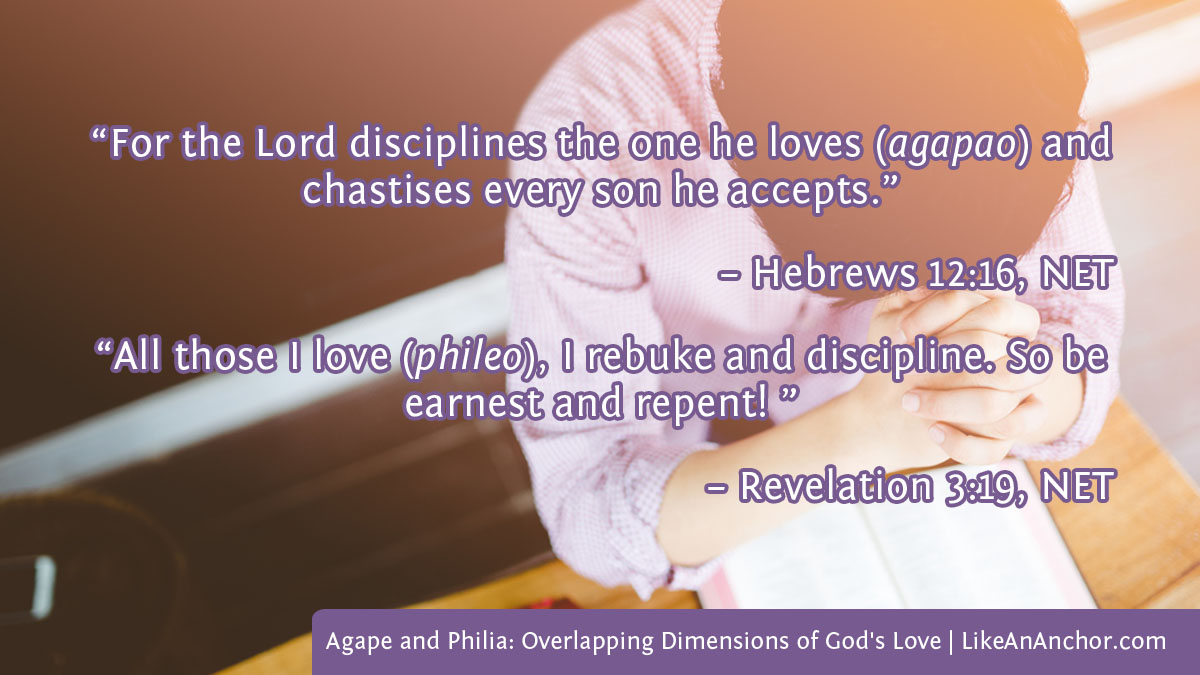
Image of a man sitting at a table with his head bowed over a Bible overlaid with two quotations:  “For the Lord disciplines the one he loves (agapao) and chastises every son he accepts.” (Hebrews 12:16, NET) and "All those I love (phileo), I rebuke and discipline. So be earnest and repent!” ( Revelation 3:19, NET)
Image by WhoisliketheLord Studio from Lightstock

What About Love for God?

Nygren’s definition of agape fits with the way that I hear people talk about agape in church today, save for one thing. For him, “agape toward God is impossible. Agape is of God. The human response to God is faith” (Grant, 1996, 6). Nygren apparently based this assumption on Paul’s writings and ignored the gospels and John’s letters completely. This aspect of Nygren’s stance on agape is similar to Aristotle’s view on philia. For Aristotle, philia can only exist between two equals, making friendship between humans and a god impossible (Bruni, 2010).

In examining the Bible as a whole, it becomes clear that not only are people capable of loving God, but that we are required to do so. But what sort of love can we have for God? In the Septuagint, agapao is the word for “love” that’s used to describe God’s love for us and our love for God. In the New Testament, agape, agapao, and philia are all used for godly love. For example, God the Father loves the Son with both agape (John 3:35) and phileo (John 5:20). Our love for God is typically identified as agape, but also (far more rarely) as philia (John 16:27; 1 Cor. 16:22).

There’s an exchange between Peter and Jesus that’s often cited to clarify the difference between agape and philia. It takes place after Jesus’s arrest, Peter’s denial of Jesus, and Jesus’s death and resurrection. Here is that passage in the Amplified Bible, which takes care to clarify which type of love Jesus and Peter are referring to.

So when they had finished breakfast, Jesus said to Simon Peter, “Simon, son of John, do you love Me more than these [others do—with total commitment and devotion]?” He said to Him, “Yes, Lord; You know that I love You [with a deep, personal affection, as for a close friend].” Jesus said to him, “Feed My lambs.” Again He said to him a second time, “Simon, son of John, do you love Me [with total commitment and devotion]?” He said to Him, “Yes, Lord; You know that I love You [with a deep, personal affection, as for a close friend].” Jesus said to him, “Shepherd My sheep.” He said to him the third time, “Simon, son of John, do you love Me [with a deep, personal affection for Me, as for a close friend]?” Peter was grieved that He asked him the third time, “Do you [really] love Me [with a deep, personal affection, as for a close friend]?” And he said to Him, “Lord, You know everything; You know that I love You [with a deep, personal affection, as for a close friend].” Jesus said to him, “Feed My sheep.”

John 21:15-17, AMP

When I hear a minister in the churches I attend talk about this passage, they usually make it sound like Peter just couldn’t measure up to the type of love that Jesus demanded. Agape is a higher form of love than philia, they say, and Peter missed the mark. But Spiros Zodhiates (1992) has a different reading. He says that claiming friendship, philia, with Jesus “was an upgrading by Peter of his devotion to Christ” (p. 65). Peter had denied knowing Jesus, much less being friends with Him, and “the Lord did not accept Peter’s self-upgraded love from agape (26) to philia (5373), friendship” (Zodhiates, 1992, p. 65). It is presumptuous to declare ourselves God’s friends, though He can make that claim on us (Luke 12:4; John 15:13-15; James 2:23).

These two different readings illustrate the different ways that we can look at the relationship between agape and philia. We can read one as a greater love and one as a lesser love, or we can read them as different types of love. Zodhiates (1992) notes that scholars often produce “strained and awkward interpretations” when they try to draw rigid distinctions between the two words (p. 1445). There are differences, but there is also a lot of overlap between these two Biblical words for love. They are even used interchangeably in certain contexts. For example, in the phrase, “disciple whom Jesus loved,” John uses the word phileo in John 20:2 and agapao in John 21:7. Similarly, when two different authors talk about God correcting those he loves, one uses agapao (Heb. 12:6) and one uses phileo (Rev. 3:19). It really doesn’t seem useful to say one is better or worse than the other or even to draw too many distinctions between the two. They are both powerful ways to love.

Conditionality in Relation to Agape and Philia

While there is a lot of commonality between agape and phlia, including contexts where they are interchangeable, there are also some differences we can look at. I want to return to this idea of “unconditional conditionality” related to philia. Though Bruni (2010) is writing about eros, philia, and agape as categories of economic reciprocity, his analysis of the terms in relation to social-historical context and scripture provides insight into the nuances of meaning. For philia, the one who moves to initiate the friendship initially does so unconditionally, without underlying motives (Bruni, 2010, p. 399-400). If, however, the other person does not respond, the friendship is interrupted. In the same way, Jesus places a condition upon His philia: “You are my friends (philos) if you do what I command you” (John 15:14, NET). Similarly, God the Father’s philia for human beings happens because of how they feel about the Son: “the Father himself loves (phileo) you, because you have loved (phileo) me and have believed that I came from God” (John 16:27, NET). We can have friendship-love with God only when we respond to His unconditional offer and reciprocate with trust, love, and loyalty.

In contrast, agape for Bruni (2010) is unconditional, relational, potentially universal, and expects nothing in return (p. 403). He bases his definition on the way that agape works in Christian communities, citing another Greek word koinonia to describe the fellowship present in a body of believers led by Jesus, who epitomized agape (p. 404). The parable of the unforgiving slave (Matthew 18:23-35) provides for Bruni an example that hints at the reciprocal expectations of a philia relationship (philia serving as an ethical framework for relationships in Greek society [Holst, 2021]) but then supersedes them with the agapic expectation to freely receive gifts from God and then freely give to others (Bruni, 2010, p. 405).

For this is the way God loved (agapao) the world: He gave his one and only Son, so that everyone who believes in him will not perish but have eternal life.

John 3:16, NET

God’s agape isn’t dependent on human response. We’re supposed to respond to His love, but He is agape, expresses agape, and is motivated by agape regardless of how people react to Him. When Jesus told His followers to “love (agapao) your enemy,” He followed it by saying this is part of being like our “Father in Heaven, since he causes the sun to rise on the evil and the good, and sends rain on the righteous and the unrighteous” (Matt. 5:44-45, NET). God also demonstrated His agape for His enemies when Jesus died for us while we were still sinners alienated from and opposed to God (Rom. 5:6-11).

God the Father and Jesus Christ are going to have love that is unconditional, benevolent, and wants what’s best for you regardless of your response to Him. They’ve already demonstrated their agape for everyone by Jesus dying to make reconciliation possible. This universal love does not, however, mean that we don’t have a role to play. We still need to repent, believe, and commit to God if we want to receive the salvation that He offers and to fully participate in His love. There’s a relational aspect to both philia and agape that helps explain the overlaps in meaning between the two words.
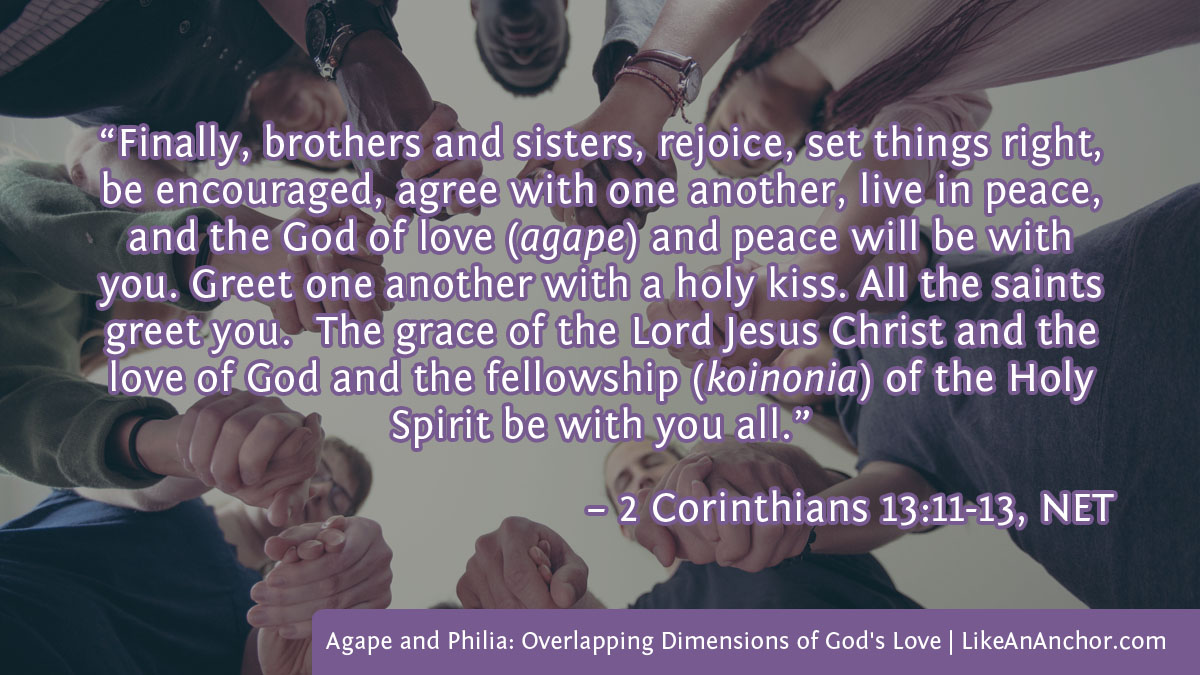
Image of people holding hands in a circle overlaid with text from 2 Corinthians 13:11-13, NET version: “Finally, brothers and sisters, rejoice, set things right, be encouraged, agree with one another, live in peace, and the God of love (agape) and peace will be with you. Greet one another with a holy kiss. All the saints greet you.  The grace of the Lord Jesus Christ and the love of God and the fellowship (koinonia) of the Holy Spirit be with you all.” 
Image by Pearl from Lightstock

The Dimension of Emotion

One of the criticisms I hear leveled at philia is that it’s an emotional love, unlike the purportedly more rational and stable agape. This is not a weakness of philia, but it is a characteristic. According to Thayer’s lexicon, Christ tells us to agape, not philia, our enemies “because love as an emotion cannot be commanded, but only love as a choice” (Greek 5368. Phileó, n.d.). This is not, however, the whole story. There are certain people that we are required or encouraged to have philia for as well as agape.

Paul wrote, “If any man doesn’t love (phileo) the Lord Jesus Christ, let him be cursed,” or “anathema” (1 Cor. 16:22, WEB). We must have emotional, friendly, affectionate love for Jesus as well as unconditional, committed love. Far more often, though, the command to love God is expressed with agape. The most important commandment is “Love (agapao) the Lord your God with all your heart, with all your soul, with all your mind, and with all your strength.’ The second is: ‘Love your neighbor as yourself’” (Mark 12:30-31, NET).

We also must have both philia and agape love for other people in the church. The compound word philadelphia (love+brother) is often translated “brotherly kindness” or “brotherly love.” It’s something that we’re commanded to have for our brethren, the other people in God’s church with whom we share fellowship (koinonia) (Rom. 12:10; 1 Thes. 4:9; Heb. 13:1; 1 Pet. 1:22; 3:8). Unlike our enemies, with whom we are not required to share mutual interests or affection, our brothers and sisters in Christ are people that we are supposed to care about.

The Vast Importance of Love

Thus far, I’ve focused a lot on philia because I think it’s often overlooked or minimized in discussions of Biblical love. Both philia and agape are part of faith; character traits that we must add on to the foundation of our commitment to God (2 Pet. 1:5-7). But I want to be careful that examining the importance of philia doesn’t minimize the importance of agape.

Forms of the word agape are used 535 times in the New Testament (eSword search for G25, G26, G27 [agapao, agape, agapetos) in contrast to forms of the word philia appearing 55 times (eSword search for G5384, G5360, G5373 [philos, phileo, philia]). Those numbers don’t include the times philia is part of a compound word (like philadelphia/philadelphus [G5360/G5361, used 7 times), but uses of agape still outnumber philia by quite a wide margin. It’s also the word used in some of the most pivotal discussions of love in the Bible, such as 1 John 2-5.

Image of a Bible laying open in the sunlight, overlaid with blog's title text and the words, "The Bible uses two main Greek words for love: philia and agape. Together, they help us understand God's incredible love for us and the type of love we’re 
supposed to have."
Image by Lamppost Collective from Lightstock

Dear friends, let us love one another, because love is from God, and everyone who loves has been fathered by God and knows God. The person who does not love does not know God, because God is love. By this the love of God is revealed in us: that God has sent his one and only Son into the world so that we may live through him. In this is love: not that we have loved God, but that he loved us and sent his Son to be the atoning sacrifice for our sins.

Dear friends, if God so loved us, then we also ought to love one another. No one has seen God at any time. If we love one another, God resides in us, and his love is perfected in us. … We love because he loved us first.

If anyone says “I love God” and yet hates his fellow Christian, he is a liar, because the one who does not love his fellow Christian whom he has seen cannot love God whom he has not seen. And the commandment we have from him is this: that the one who loves God should love his fellow Christian too.

1 John 4:11-16, 19-21, NET

Every time “love” appears in 1 John, it’s translated from a form of the word agape. Here we see that God is love, that He loves us, that we can love in the same way because of Him, and that if we really love Him we’ll love all of His people as well. We see that godly agape is enabled by God; i.e. we love because He loved.

We should note here that there are also ungodly expressions of agape (Luke 11:43; John 3:19; 12:43; 1 John 2:15), which is why it’s inaccurate to simply define agape as “godly love.” There are even passages that talk about the agape of God in contexts where a clarification likely wouldn’t be necessary if agape was always “of God” (Rom. 5:5; 8:39; 2 Thes. 3:5; 1 John 2:5; 3:17; Jude 1:21). With this caveat, we can say that the New Testament writers almost exclusively focus on the godly version that’s defined in 1 Corinthians 13.

Love is patient, love is kind, it is not envious. Love does not brag, it is not puffed up.  It is not rude, it is not self-serving, it is not easily angered or resentful. It is not glad about injustice, but rejoices in the truth. It bears all things, believes all things, hopes all things, endures all things. Love never ends.

1 Corinthians 13:4-8, NET

We have no such Biblical definition for philia, perhaps because friendly, affectionate love is much easier to understand (and more often explored in secular writings of the time) than unselfish, unconditional love. Paul also tells us in this passage that agape is absolutely essential to the Christian walk, and that it’s even more important than hope and faith (1 Cor. 13:1-3, 13). There are broad definitions we can give for philia and agape, including certain general distinctions between the two, that have an historical, scholarly, and most important biblical basis. What we must not do, however, is make the claim that agape is the highest or only form of godly love just because it sounds good (see Truth Be Told podcast episode, “It’ll Preach, But Is It True?). Philia and agape together—along with related words used by Biblical writers—help us understand God’s incredible love for us. There are some differences between the two, and agape is highlighted as a chief Christian virtue, but the two words also overlap quite a bit, especially in the context of godly love.

References

Bruni, L. (2010). Éros, Philia et Agapè. Pour une théorie de la réciprocité, plurielle et pluraliste [Eros, Philia and Agape. For a Theory of Reciprocity, Plural and Pluralist]. In La gratuité: Eloge de l’inestimable (pp. 389–413). Revue du M.A.U.S.S.

Grant, C. (1996). For the Love of God: Agape. The Journal of Religious Ethics, 24(1), 3–21.

Greek 26. agapé. (n.d.). Bible Hub. https://biblehub.com/greek/26.htm

Greek 5368. phileó. (n.d.). Bible Hub. https://biblehub.com/greek/5368.htm

Holst, J. (2021). Philia and Agape: Ancient Greek Ethics of Friendship and Christian Theology of Love. In S. Hongladarom & J. J. Joaquin (Eds.), Love and Friendship across Cultures: Perspectives from East and West (Singapore, pp. 1–191). Springer Nature Singapore. https://doi.org/10.1007/978-981-33-4834-9

Zodhiates, S. (Ed.). (1992). The Complete WordStudy Dictionary: New Testament. AMG Publishers.


Featured image by Lamppost Collective from Lightstock

3 Keys to Biblical Motherhood

I wasn’t quite sure what today’s post would be about until I’d been working on it for nearly a week. I knew I wanted to look at motherhood in the Bible, then as I studied three things gradually stood out to me as key points the Biblical writings emphasize. Society often places a ton of pressures on mothers to be perfect, and in the church it’s often described as the most important thing a woman can do.

For most of my life, when I studied women’s roles in the Bible and in the church, I was trying to find hints for what is expected of unmarried women without children. That’s a bit challenging, because instructions are often addressed to wives or talk about children. Now that I’m married and pregnant, though, all those verses are suddenly more relevant. I find it encouraging to study the Bible and see God really expects three basic things from mothers: pray for their kids, love their kids, and teach/train them in God’s way of life.

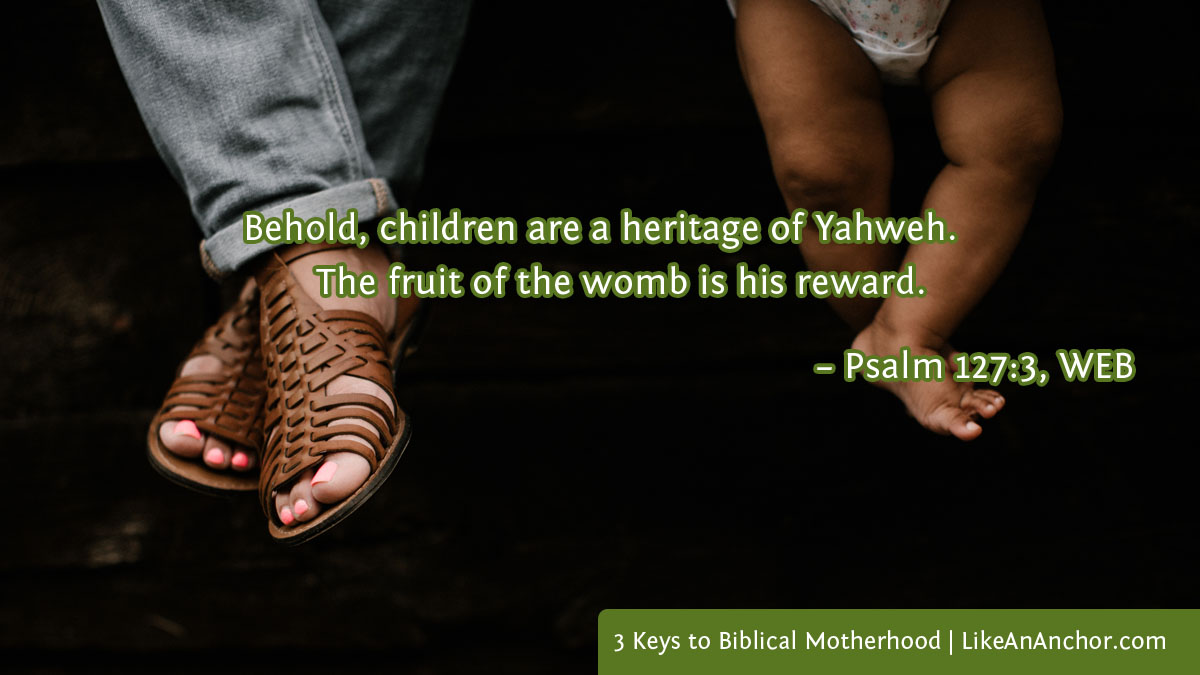
Image of a woman's and a toddler's feet overlaid with text from Psalm 127:3, WEB version: "Behold, children are a heritage of Yahweh. The fruit of the womb is his reward."
Image by Brimstone Creative from Lightstock

Praying For Children

I’ve long been fascinated by God’s interactions with the patriarch’s wives. He’s called the God of Abraham, Isaac, and Jacob, but He’s also the God of Sarah, Rebecca, Leah, and Rachael and we have record of Him interacting with the women as well as the men (God spoke directly with Sarah and Rebecca [Gen. 18:9-15; 25:20-26] and Leah’s name choices imply a relationship with Him [Gen. 29:31-35]) . Interestingly, all these interactions are related to their roles as mother. God definitely talks to and works with women who aren’t mothers as well, but for many women who talked with God, their interactions with Him involve their children. Either they’re asking for a child, or God’s telling them they’ll have a child, or they’re seeking God’s help with a child.

Christians are under no obligation to get married or have kids if they don’t want to (there are even verses where Paul counsels it could be best to remain single), but the Bible assumes that the majority of people will marry and that they’ll want to have kids. As we discussed in last week’s post, God loves children and He cares deeply about how His people raise the children that He gives to them as a gift.

She was in bitterness of soul, and prayed to Yahweh, weeping bitterly. She vowed a vow, and said, “Yahweh of Armies, if you will indeed look at the affliction of your servant and remember me, and not forget your servant, but will give to your servant a boy, then I will give him to Yahweh all the days of his life, and no razor shall come on his head.” …

When she had weaned him, she … brought the child to Eli [the priest]. She said, “Oh, my lord, as your soul lives, my lord, I am the woman who stood by you here, praying to Yahweh. I prayed for this child, and Yahweh has given me my petition which I asked of him.”

1 Samuel 1:10-11, 24-27, WEB

I love that God listens to women’s prayers or even just thoughts for and about their children. We see this first in Hagar’s story, where she was clearly worried about her son but doesn’t even have to make a specific prayer for God to respond to her plight (Gen. 16:6-15; 21:8-21). We see it in Rebecca, who had a question about her pregnancy that God personally responded to (Gen. 25:20-26). We see it in Hannah (whose story I just quoted), who asked God for a son and received exactly what she requested (1 Sam. 1:1-2:11). From the many examples of praying mothers in the Bible and God’s careful attention to their prayers, we can see that praying for children is a key part of Biblical motherhood.

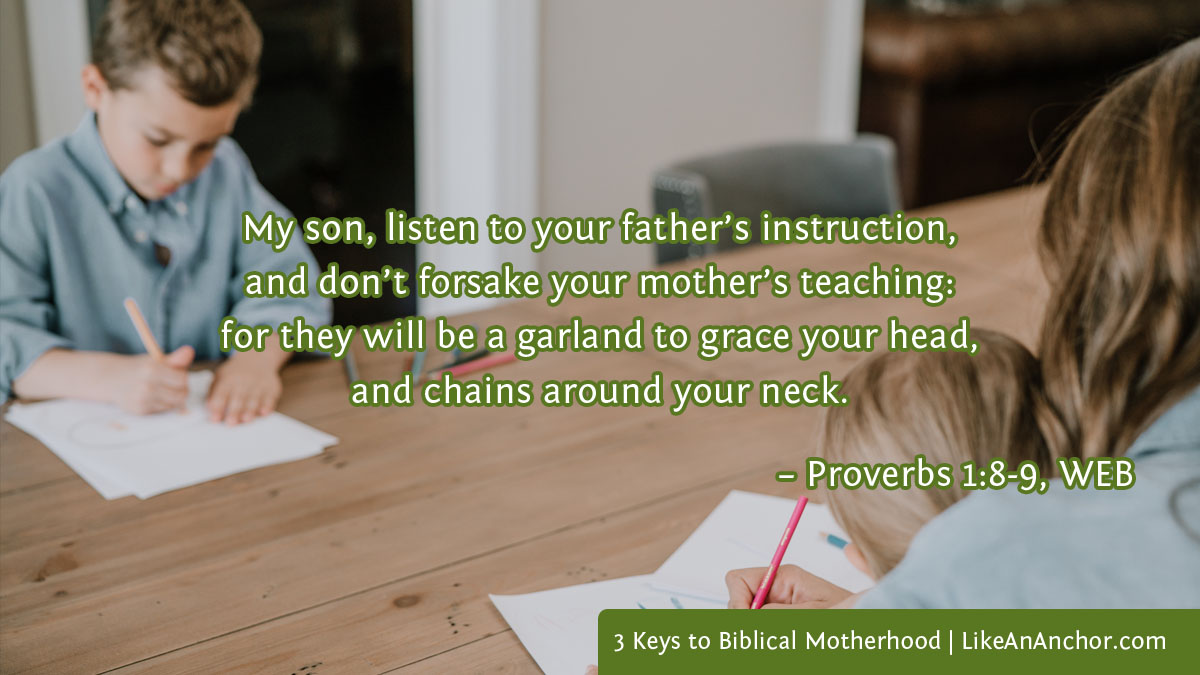
Image of a mother coloring at a table with her son and daughter, overlaid with text from Prov. 1:8-9, WEB version: "My son, listen to your father’s instruction, and don’t forsake your mother’s teaching: for they will be a garland to grace your head, and chains around your neck."
Image by Brimstone Creative from Lightstock

Teaching Your Children

My husband and I were both homeschooled, and we’re planning to homeschool our children as well. I’m so excited about this, particularly now that I have teaching and tutoring experience working with everyone from 5-year-old beginning readers to teens struggling with homework to Ph.D. candidates looking for editing help on their dissertations. I love teaching and I’m excited to teach my children and discover their learning styles.

One of the things that the Bible assumes (and commands!) is that fathers and mothers will both be teaching, training, and disciplining (disciple-ing) their children. When we look at Moses’s words in Deuteronomy about passing on God’s teachings to children, we can remember that his audience was “all Israel” (Deut. 1:1; 5:1). That’s the whole assembly of the congregation, men and women.

Therefore you shall lay up these words of mine in your heart and in your soul. You shall bind them for a sign on your hand, and they shall be for frontlets between your eyes. You shall teach them to your children, talking of them when you sit in your house, when you walk by the way, when you lie down, and when you rise up. You shall write them on the door posts of your house and on your gates; that your days and your children’s days may be multiplied in the land which Yahweh swore to your fathers to give them, as the days of the heavens above the earth.

Deuteronomy 11:18-21, WEB

When you have kids, God expects you to make His way of life part of their everyday learning. Even if you don’t homeschool, you’re still responsible for teaching your children the word of the Lord. That goes for both mothers and fathers.

My son, keep your father’s commandment,
    and don’t forsake your mother’s teaching.
Bind them continually on your heart.
    Tie them around your neck.

Proverbs 6:20-21, WEB

Mothers taught both boys and girls (for example, all of Proverbs 31 is “The words of king Lemuel; the revelation which his mother taught him). There’s a good chance that Jesus’s mother Mary was His primary teacher, since she was from a priestly family and spent time in the home while Joseph would have been busy with his work as a carpenter (Metsämuuronen, 2019). Jewish children of Jesus’s time grew up steeped in religious tradition, learning prayers, keeping Sabbath and the feasts, and eating kosher foods. They were likely taught “the contents of the main scriptures and proverbs” and learned how to “read something” from their mothers before beginning formal schooling at the age of six or seven (Metsämuuronen, p. 5). If there was a local synagogue, both boys and girls would have gone there to learn Torah until around age thirteen. If not, it was the parents’ responsibility to continue their schooling.

Teaching and training children in God’s way of life is still a responsibility for parents, regardless of how else their children are being taught things more traditionally considered school subjects. It’s not something we can leave to chance or hope they learn through osmosis at church or from our examples. We need to be intentional about it. As such an important responsibility, teaching and training children is a key aspect of Biblical motherhood.

Love the Children

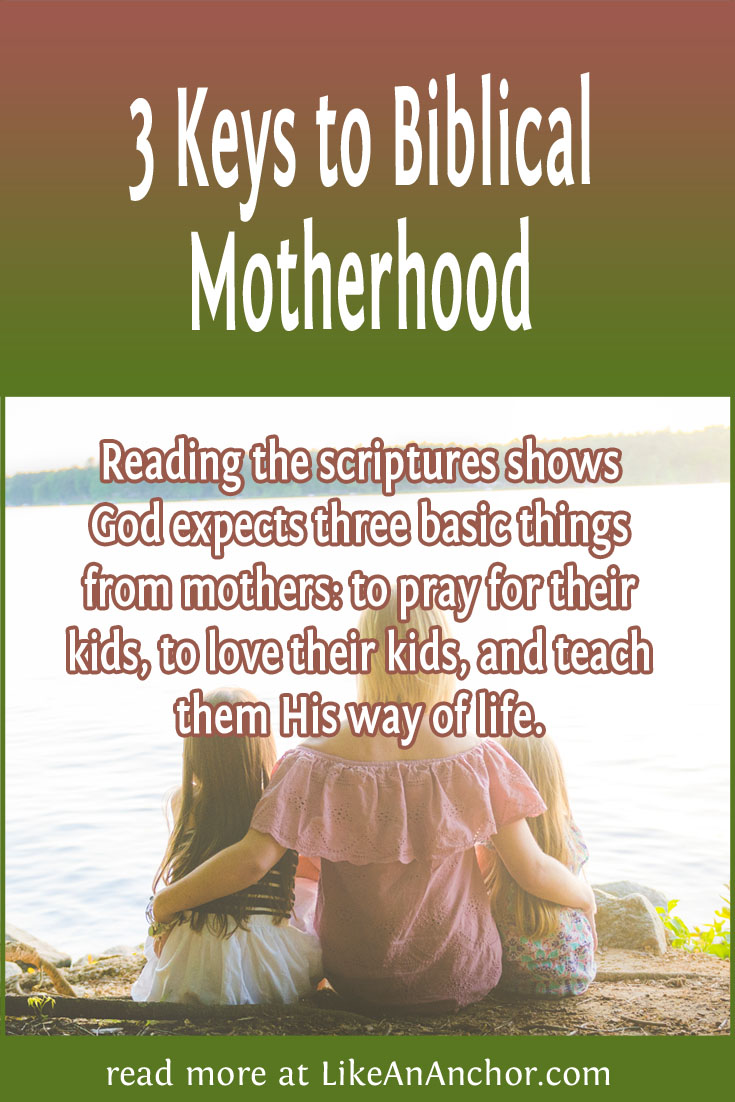
Image of a mother sitting by a lake with two little girls, overlaid with blog's title text and the words, "Reading the scriptures shows God expects three basic things from mothers: to pray for their kids, to love their kids, and teach them His way of life."
Image by Anggie from Lightstock

Praying for their children is something we see mothers in the Bible do. Teaching their children is something they were commanded to do. Another command, which involves older mothers teaching new mothers, is to love our children.

But as for you, communicate the behavior that goes with sound teaching. … Older women likewise are to exhibit behavior fitting for those who are holy, not slandering, not slaves to excessive drinking, but teaching what is good. In this way they will train the younger women to love their husbands, to love their children, to be self-controlled, pure, fulfilling their duties at home, kind, being subject to their own husbands, so that the message of God may not be discredited.

Titus 2:1, 2-5, NET

It seems a little odd that the older women have to train the younger women how “to love their children.” We tend to think that love is something that just happens and people don’t need to work on it, especially for women with their maternal instinct. There are also hints in the Bible that it’s natural and normal for women to cherish their own children (Is. 49:15-16; 1 Thess. 2:7). But just like we learn to love a spouse more fully and deeply (rather than simply settling for impulsive, romantic love), we can also learn how to love our children better.

I know there’s a lot involved in being a good mother, but I suspect most of it is going to fall into these broad categories (based not just on Bible study, but practical observations of and conversations with mothers I know and admire). It’s kind of like how the entire law is fulfilled by truly following the command to love God and love your neighbor (Matt. 22:35-40; Rom. 13:8-10). If we’re praying for our children, teaching them God’s way, and loving them truly, then maybe the rest is simply details on how to do that properly.


Featured image by Pearl from Lightstock

Learning God’s Law So We Can Love The Way He Loves

Every seven years, at the Feast of Tabernacles (Sukkot), God commanded ancient Israel to read the Law to the entire assembly (Deut. 31:10-13). This festival was one of three pilgrimage feasts during the year, and so most of the people would have gathered together to worship God for eight days (Lev. 23:33-43). That made it the perfect time to ensure as many people as possible heard the reading of the law. Remember, back then people wouldn’t have had personal copies of the Bible to read for themselves. They would (when the nation was working as God intended) learn from their parents as they grew up and from hearing the law read by priests. Eventually, by the time Jesus was growing up, many local synagogues had a copy of the Law and there was formal education for all the young people to learn God’s words and way.

Now when we observe the Feast of Tabernacles (at least the way we do things in my church), we hear sermons every day. We don’t read through the Torah every seven years, but we do hear from God’s word every day and because we all have Bibles, we can read the law for ourselves. But this week, I started wondering if I take full advantage of the opportunity I have to read God’s law. I spend most of my Bible study time looking at topics, and though I do read through the Bible cover-to-cover and then start over again it takes me a long while to do that. I might average going through it every 7 years or less, but it’s hard to say.

When Moses delivered the command to read the Law at the Feast of Tabernacles, he said, “you must read this law before them within their hearing. Gather the people—men, women, and children, as well as the resident foreigners in your villages—so they may hear and thus learn about and fear the Lord your God and carefully obey all the words of this law” (Deut. 31:11-12, NET). Notice the imperative here: you must read the law. It’s not optional, and everyone was included. There was a good reason behind this command. The people needed to hear and learn so that they would fear the Lord and carefully obey His commands. God’s people had a choice between living in covenant with Him and enjoying abundant life, or disobeying and walking down a path toward death (Deut. 30:11-20). He wanted them to have all the information they needed to choose life, just like He wants for people today (1 Tim. 2:3-4; 2 Peter 3:9).

Today, though, many of us aren’t sure what our relationship should be to God’s law. First-century Christians had these questions too, and Paul addresses the topic in many of his letters. We looked at part of his discussion related to how New Covenant believers inherit God’s law in last week’s post. The New Covenant doesn’t come with a brand new law, but rather a deeper, spiritual, and heart-level relationship with God’s laws (Jer. 31:31-33; Matt. 5:17-48). There are certain aspects of the commands in the Old Testament that don’t apply today (e.g. the temple sacrifices are fulfilled by Jesus’s sacrifice) but the rules God gave for living as His covenant people (e.g. the Ten Commandments) are still relevant because they teach us how to become “perfect, just as your Father in heaven is perfect” (Matt. 5:48, WEB).

Image of a man reading a book overlaid with text from Jeremiah 31:31, 33, NET version:  “Indeed, a time is coming,” says the Lord, “when I will make a new covenant with the people of Israel and Judah. ... I will put my law within them and write it on their hearts and minds. I will be their God and they will be my people.”
Image by Creative Clicks Photography from Lightstock

No Love Without Law

While listening to a sermon at the Feast of Tabernacles this year, one verse caught my ear in a way I’d never quite thought of before. It’s part of the Olivet prophecy where Jesus answer His disciples’ question, “Tell us, when will these things happen? And what will be the sign of your coming and of the end of the age?” (Matt. 24:3, NET). It’s interesting that rather than directly answering their “when” and “what” question, He gave them warnings and things they’d need to know as the time for His second coming drew closer. One of these warnings concerns the persecution of Jesus’s disciples. That started happening pretty much right away, is still happening today to Christians in many parts of the world, and will keep happening more and more as we get closer to Jesus’s return.

“Then they will hand you over to be persecuted and will kill you. You will be hated by all the nations because of my name. Then many will be led into sin, and they will betray one another and hate one another. And many false prophets will appear and deceive many, and because lawlessness will increase so much, the love of many will grow cold. But the person who endures to the end will be saved. And this gospel of the kingdom will be preached throughout the whole inhabited earth as a testimony to all the nations, and then the end will come.”

Matthew 24:9-14, NET

Today, I want to focus on the line, “because lawlessness will increase so much, the love of many will grow cold.” You might be more familiar with a translation like, “Because iniquity will be multiplied,” but “lawlessness” is the more accurate translation. The Greek word is anomia (G458). It is derived from a (used to make a word negative) and nomos (G3551), which means law. In a Biblical sense, that mostly refers to the Law of God. Therefore, anomia means “the condition of without law” either “because ignorant of it” or “because of violating it” (Thayer G458). It can also be translated “contempt,” “iniquity, wickedness,” or “unrighteousness” because that’s the result of living lawlessly.

This statement from Jesus might seem odd to some. Why would a lack of law mean that there’s no love? Depending on your background, you might think that laws are oppressive and restrictive rather than loving. Or you might already see laws in a more Biblical sense, as guards to keep us from hurting ourselves and others. As Paul says, “the law is holy, and the commandment is holy, righteous, and good” (Rom. 7:12, NET). God reveals His laws to us as an expression of His divine character and a guide for how to live rightly in the world He created. If we obey those commands and laws, we’ll be developing His character in us.

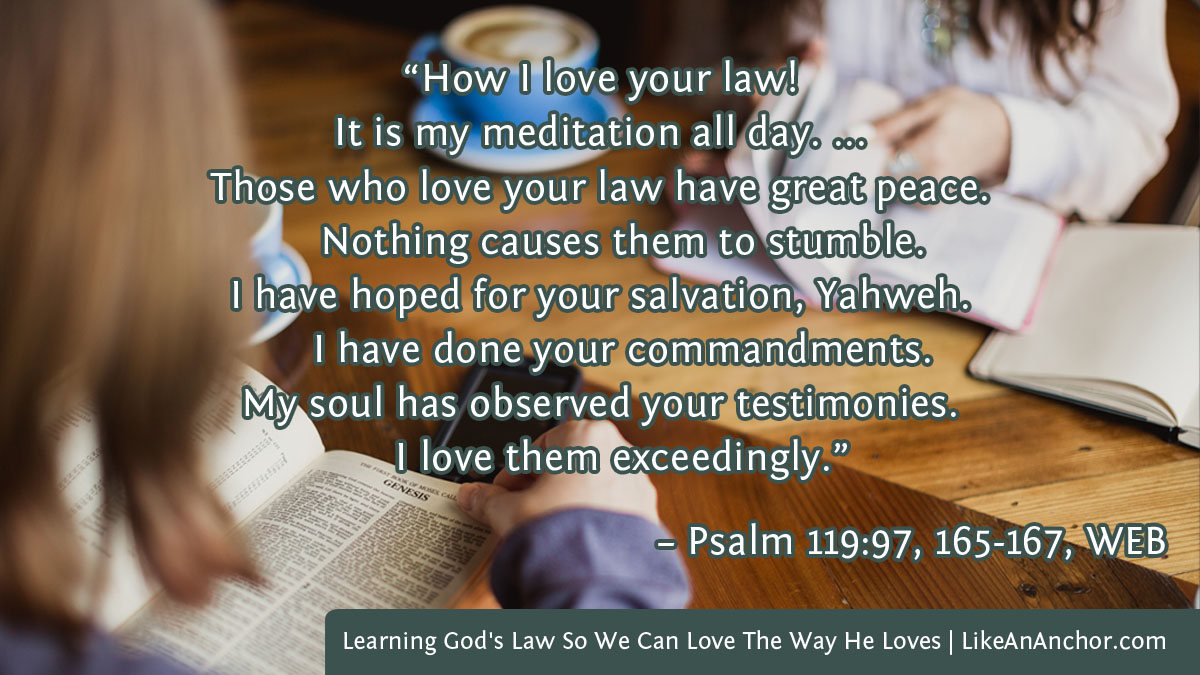
Image of two women Bible studying overlaid with text from Psalm 119:97, 165-167, WEB version:  “How I love your law! It is my meditation all day. ... Those who love your law have great peace. Nothing causes them to stumble. I have hoped for your salvation, Yahweh. I have done your commandments. My soul has observed your testimonies. I love them exceedingly.”
Image by Shaun Menary from Lightstock

Learning to Love Like God

“God is love” (1 John 4:8, 16), and it comes as no surprise that we’re instructed to make His love an integral part of our character. Paul calls love “the more excellent way,” excelling even faith and hope (1 Cor. 12:31-13:13). He also says that if we’re truly loving one another, then we’re fulfilling God’s law.

Owe no one anything, except to love one another, for the one who loves his neighbor has fulfilled the law. For the commandments, “Do not commit adultery, do not murder, do not steal, do not covet,” (and if there is any other commandment) are summed up in this, “Love your neighbor as yourself.” Love does no wrong to a neighbor. Therefore love is the fulfillment of the law.

Romans 13:8-10, NET (BOLD ITALICS IN ORIGINAL TO MARK OT QUOTES)

Over and over throughout scripture, we see God’s love paired with His law. Loving God and loving your neighbor are the two greatest commandments, according to Jesus Himself (Matt. 22:36-40). God gave us His laws because He loves us and He expects us to obey His laws if we love Him. The apostle John expands on this idea, saying that we can tell whether or not we genuinely love God by how well we’re following His commandments.

(My little children, I am writing these things to you so that you may not sin.) But if anyone does sin, we have an advocate with the Father, Jesus Christ the Righteous One, and he himself is the atoning sacrifice for our sins, and not only for our sins but also for the whole world.

Now by this we know that we have come to know God: if we keep his commandments. The one who says “I have come to know God” and yet does not keep his commandments is a liar, and the truth is not in such a person. But whoever obeys his word, truly in this person the love of God has been perfected. By this we know that we are in him. The one who says he resides in God ought himself to walk just as Jesus walked.

1 John 2:1-6, NET
Image of a man studying the Bible with the blog's title text and the words "As we move ever closer to Jesus's return or the end of our lives, we would be wise to consider if our relationship with God's law shows Him our love, or if something else is going on that we might need to repent of and correct."
Image by Anggie from Lightstock

We’re not saved by keeping God’s commandments, but when we have a saving, transforming, relationship with Jesus and the Father we will be keeping their commandments. We’re saved by God’s grace, and then the proper response to that grace is to faithfully keep covenant with God and do as He says. If we don’t want to obey God, then we don’t really love Him or know Him. That might be a hard truth to swallow sometimes, but that’s what John teaches us here because he learned it from Jesus (John 14:15, 21; 15:10-12).

 Everyone who practices sin also practices lawlessness; indeed, sin is lawlessness. And you know that Jesus was revealed to take away sins, and in him there is no sin. Everyone who resides in him does not sin; everyone who sins has neither seen him nor known him. Little children, let no one deceive you: The one who practices righteousness is righteous, just as Jesus is righteous.

1 John 3:4-7, NET

Here once again, we see that word anomia. People who are genuinely part of God’s covenant don’t live lawlessly. As John pointed out earlier in his letter, we might sometimes sin (and when we do, we have Jesus as Advocate to help us repent and return) but we shouldn’t be living habitually sinful lives. One of the key reasons that Jesus came to this world and died was “to set us free from every kind of lawlessness and to purify for himself a people who are truly his, who are eager to do good” (Titus 2;14, NET). We need to take this seriously and not dishonor Him, or treat Him in an unloving way, by living lawless lives.

When Jesus comes back, He will tell the lawless, “I never knew you” (Matt. 7:21-23). That’s certainly not what we want to hear! Rather, we want to be those who’ve responded to His love by loving Him and our fellow Christians so much that we obey God’s word as a result of our transformative relationship with Him. As we move ever closer to Jesus’s return or the end of our lives (whichever comes first), we would be wise to consider whether our relationship with God’s law shows Him our love, or if something else is going on that we might need to repent of and correct.

Jesus warned that “because lawlessness will increase so much, the love of many will grow cold.” We need to be careful that the lawlessness in the world around us doesn’t cool our love, and that we are not living lawlessly ourselves. John treats loving other people and keeping God’s commandments as something we can look at to see if we’re sincerely loving and following God, and we can follow his example when we examine ourselves and study our Bibles. The more we love God, spend time with Him, and internalize His words, the better we’ll know how to love the way that He loves.


Featured image by Pearl from Lightstock

Song Recommendation: “How I Love Thy Law, O Lord” (one of my favorite hymns that my church has in their hymnal)

Mercy for the Unloved: A Story In Hosea, Peter, and Paul

I love reading the book of Hosea. It’s the sort of love story we might be very tempted to say must be fictional if we weren’t convinced of the Bible’s authenticity. It starts out like this:

When the Lord first spoke through Hosea, he said to him, “Go marry a prostitute who will bear illegitimate children conceived through prostitution, because the nation continually commits spiritual prostitution by turning away from the Lord.”

Hosea 1:2, NET

If this was the very first thing God said to you directly, you might privately wonder if it’s really Him. This just doesn’t sound like a good idea, though it’s an excellent illustration of how the nation of ancient Israel treated the Lord. Even the children’s names tell a story that continues all the way into the New Testament.

So Hosea married Gomer, the daughter of Diblaim. Then she conceived and gave birth to a son for him. Then the Lord said to Hosea, “Name him ‘Jezreel,’ because in a little while I will punish the dynasty of Jehu on account of the bloodshed in the valley of Jezreel, and I will put an end to the kingdom of Israel. At that time, I will destroy the military power of Israel in the valley of Jezreel.”

She conceived again and gave birth to a daughter. Then the Lord said to him, “Name her ‘No Pity’ (Lo-Ruhamah) because I will no longer have pity on the nation of Israel. For I will certainly not forgive their guilt. But I will have pity on the nation of Judah. I will deliver them by the Lord their God; I will not deliver them by the warrior’s bow, by sword, by military victory, by chariot horses, or by chariots.”

When she had weaned “No Pity” (Lo-Ruhamah), she conceived again and gave birth to another son. Then the Lord said: “Name him ‘Not My People’ (Lo-Ammi), because you are not my people and I am not your God.”

Hosea 1:3-9, NET

Continuing to read Hosea reveals a fascinating story. On one level, you have Hosea and Gomer’s love story (if you have trouble wrapping your mind around that or are just curious about imagining the feelings involved, I highly recommend the book Redeeming Love by Francine Rivers). On another level, you have God’s expression of great love for His own unfaithful bride, and what that reveals about His long-term plan. That second story carries into the New Testament as well; Peter and Paul both quote Hosea and reference the lesson from Gomer’s illegitimate children’s names to teach a lesson about how God is working today.

Image of a circle of people holding hands overlaid with text from Hosea 2:1, 23, WEB version: “Say to your brothers, ‘My people!’ and to your sisters, ‘My loved one!’ ... I will have mercy on her who had not obtained mercy; and I will tell those who were not my people, ‘You are my people;’ and they will say, ‘My God!’”
Image by Claudine Chaussé from Lightstock

My People! My Loved One!

Before jumping into the New Testament, lets look at what else God has to say about Lo-Ruhamah and Lo-Ammi in His message to Hosea. The first names He gives them aren’t the end of the story.

However, in the future the number of the people of Israel will be like the sand of the sea that can be neither measured nor numbered. Although it was said to them, “You are not my people,” it will be said to them, “You are children of the living God!” Then the people of Judah and the people of Israel will be gathered together. They will appoint for themselves one leader, and will flourish in the land. Certainly, the day of Jezreel will be great!

Then you will call your brother, “My People” (Ammi)! You will call your sister, “Pity” (Ruhamah)!

Hosea 1:10-2:1, NET

Even while asking Hosea to illustrate in heartbreaking detail how much unfaithful Israel hurt their Lord and Husband, God points to a time when He will reconcile with His people. The changes in the children’s names signify a change in the relationship between God and humanity.

“However, in the future I will allure her;
I will lead her back into the wilderness,
and speak tenderly to her.
From there I will give back her vineyards to her,
and turn the ‘Valley of Trouble’ into an ‘Opportunity for Hope.’
There she will sing as she did when she was young,
when she came up from the land of Egypt.
At that time,” declares the Lord,
“you will call, ‘My husband’;
you will never again call me, ‘My master.’
For I will remove the names of the Baal idols from your lips,
so that you will never again utter their names! ….

“I will commit myself to you forever;
I will commit myself to you in righteousness and justice,
in steadfast love and tender compassion.
I will commit myself to you in faithfulness;
then you will acknowledge the Lord.

Hosea 2:14-17, 19-20, NET

Isn’t this a beautiful picture? Not only does God change His people’s names so they are “My people,” “My loved one!” (Hos. 2:1, WEB). He also changes the land’s name so the “Valley of Trouble” turns “into an ‘Opportunity for Hope’” (Hos. 2:15, NET). Then He even changes the name they’ll know Him by, so “that you will call me ‘my husband,’ and no longer call me ‘my master’” (Hos. 2:16, WEB).

In Hebrew thought and language, “The concept of personal names … often included existence, character, and reputation” (Theological Wordbook of the Old Testament, entry 2406). When someone names a child or when God renames someone, it’s “often descriptive of the parent’s wishes or expectations for the personality that was to mature” (TWOT 2406). The name changes here are about changing who we are and how we relate to God. They reveal God’s heart. He wants us to be His beloved people and he wants a husband-wife relationship with us more than a master-servant one. These name changes are also Messianic–they point to something that Jesus did when He died for us.

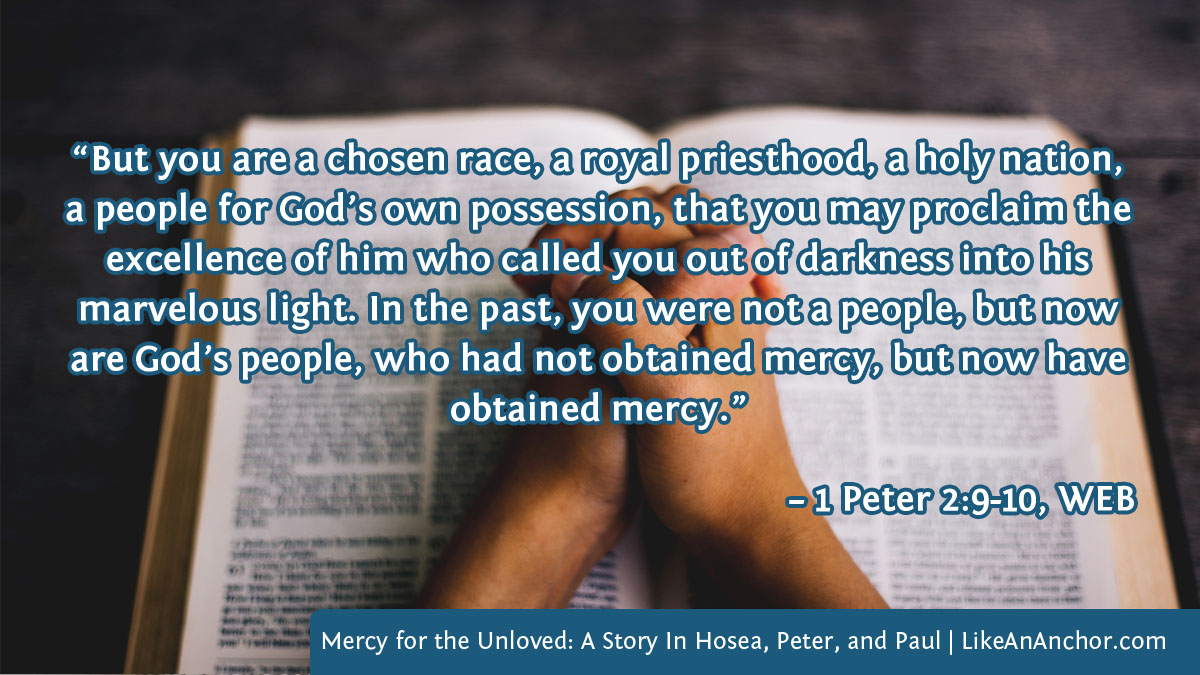
Image of hands clasped over a Bible overlaid with text from 1 Peter 2:9-10, WEB version: “But you are a chosen race, a royal priesthood, a holy nation, a people for God’s own possession, that you may proclaim the excellence of him who called you out of darkness into his marvelous light. In the past, you were not a people, but now are God’s people, who had not obtained mercy, but now have obtained mercy.”
Image by Jantanee from Lighstock

Peter and Paul on the People of God

Paul and Peter both quote Hosea’s book in their writings, specifically referencing the name changes for Lo-Ruhamah and Lo-Ammi. Let’s start with Peter, since reading the general epistles provides good background information for understanding Paul. For more on this epistle, see my post Crash-Course In Peter: Pre-Reqs for Paul, Part Two. Peter writes to Jewish and Gentile believers and connects both of them to a long history of faith. One of several scriptures he references to back up that point comes from Hosea.

So as you come to him, a living stone rejected by men but chosen and precious in God’s sight, you yourselves, as living stones, are built up as a spiritual house to be a holy priesthood and to offer spiritual sacrifices that are acceptable to God through Jesus Christ. For it says in scripture, “Look, I lay in Zion a stone, a chosen and precious cornerstone, and whoever believes in him will never be put to shame.” So you who believe see his value, but for those who do not believe, the stone that the builders rejected has become the cornerstone, and a stumbling-stone and a rock to trip over. They stumble because they disobey the word, as they were destined to do. But you are a chosen racea royal priesthooda holy nationa people of his own, so that you may proclaim the virtues of the one who called you out of darkness into his marvelous light. You once were not a people, but now you are God’s people. You were shown no mercy, but now you have received mercy.

1 Peter 2:4-10, NET (italics and bold in original)

The NET translation puts references to the Old Testament in italics and direct quotes in bold to make it easy to see which parts of the NT directly link back to OT scriptures. Here, Peter quotes or alludes to Is. 28:16, Ps. 118:22, Is. 8:14, Ex. 19:5-6; Is. 43:20-21; Mal. 3:17, and Hos. 1:6, 9; 2:23. Paul does a very similar thing in the book of Romans (I also wrote a Crash Course in Romans post, so you can check that out or read the whole letter if you want context to these statements).

 You will say to me then, “Why does he still find fault? For who has ever resisted his will?” But who indeed are you—a mere human being—to talk back to God? Does what is molded say to the molder, “Why have you made me like this?” Has the potter no right to make from the same lump of clay one vessel for special use and another for ordinary use? But what if God, willing to demonstrate his wrath and to make known his power, has endured with much patience the objects of wrath prepared for destruction? And what if he is willing to make known the wealth of his glory on the objects of mercy that he has prepared beforehand for glory—even us, whom he has called, not only from the Jews but also from the Gentiles? As he also says in Hosea:

I will call those who were not my people, ‘My people,’ and I will call her who was unloved, ‘My beloved.’”
And in the very place where it was said to them, ‘You are not my people,’
there they will be called ‘sons of the living God.’”

And Isaiah cries out on behalf of Israel, “Though the number of the children of Israel are as the sand of the seaonly the remnant will be saved for the Lord will execute his sentence on the earth completely and quickly.” Just as Isaiah predicted,

“If the Lord of Heaven’s Armies had not left us descendants,
we would have become like Sodom,
and we would have resembled Gomorrah.”

What shall we say then?—that the Gentiles who did not pursue righteousness obtained it, that is, a righteousness that is by faith, but Israel even though pursuing a law of righteousness did not attain it. Why not? Because they pursued it not by faith but (as if it were possible) by works. They stumbled over the stumbling stone, just as it is written,

Look, I am laying in Zion a stone that will cause people to stumble
and a rock that will make them fall,
yet the one who believes in him will not be put to shame.

Romans 9:19-33, NET (italics and bold in original)

Here, Paul quotes many of the same scripturas Peter did: Is. 29:16; 45:9; Hos 2:23; 1:10; Isa 10:22-23; 1:9; 28:16; 8:14. He’s also making a similar point. Not only did Jesus’s sacrifice redeem those who are physical descendants of Israel who believe in Him as the Messiah, but He is also making those who were once part of other nations His beloved people.

Hope for All God’s People

Image of two people's hands clasped together with the blog's title text and the words "In Hosea, God promised to take a people that were not His and on whom He no longer had pity and transform them into something new. Then, as Peter and Paul discuss, He followed-through on that promise when Jesus's sacrifice opened the way of life to all people."
Image by Jantanee from Lightstock

Much like in 1 Corinthians, where Paul expects his readers to connect quotes and allusions in that letter to the Feast of Unleavened Bread, Peter and Paul both assume their readers have an understanding of the Old Testament scriptures. Their Jewish readers would have heard the scriptures read at the synagogues their entire lives, and Gentile converts were expected to make a regular practice of listening to those as well (Acts 15:19-21). They would recognize these quotes. The most Biblically literate among them would also put the quotes in context, drawing on the original writer’s whole message when they interpreted Peter’s and Paul’s writings.

Christianity really isn’t a new religion that started after Jesus died–it was the next step in God’s plan that He’d been working on since before the beginning of our world. Peter and Paul reinforce this by quoting prophecies God gave in Hosea with fulfillment in the New Testament church. In Hosea, God promised to take a people that were not His and on whom He no longer had pity and transform them into something new. Then, as Peter and Paul discuss, He followed-through on that promise when Jesus’s sacrifice opened the way of life to all people. Those of a nation that had been chosen by God then rejected Him now had a chance to enter a covenant with Him again. Those who hadn’t been part of the family before are now welcomed in with open arms.

It’s an incredible message of hope. God follows through on His promises. He doesn’t leave those who are unloved and haven’t received mercy in that state. He calls them Beloved and pours out His mercy on them when they come to Him through Jesus Christ. Those promises are still in effect today. We can trust that God loves us this passionately; that He chooses us and claims us for His own special people. Just like He promised so long ago.


Featured image by Inbetween from Lightstock

Song Recommendation: “Out of Egypt” by Carolyn Hyde

Falling in Love With the God Who Plans to Marry Us

If you’re reading this blog post the weekend it was published, then Yom Teruah (Day of Trumpets, also called Rosh Hoshanna) is about to happen. This year, the first day of the seventh Hebrew month falls on Monday, Sept. 26. All around the world, people will blow shofars and gather to celebrate this day God calls holy to Him.

Last year, I wrote about the many different theories for what this day pictures. God simply calls it “a solemn rest for you, a memorial of blowing of trumpets, a holy convocation” (Lev. 23:24, WEB). There are several ideas about what this day pictures in the New Covenant now that Jesus has filled the Law up to its fullest extent (Matt 5:17-20; see Thayer’s definition of pleroo). I think the strongest argument links this day with Jesus’s return to claim His bride.

I’ve been thinking about love and marriage a lot lately. I recently started dating a man I’ve been friends with for years and I’m kind of in awe of how wonderful this relationship is; I thought we’d be good together but I hadn’t realized exactly how good. This giddy, happy, can’t-wait-to-see-him feeling is how we should feel as we wait for Jesus to come back to earth. We should be longing to see Him, eager to have our Bridegroom give us His new name (Rev. 3:12).

Promised in Marriage

I know the idea of being romantically in love with God and having Him in love with us makes some people uncomfortable. For some, thinking of Jesus as lover as well as Lord is a struggle; the in-love emotion seems a strange thing to try and balance with the respect due God. I suspect it’s a particularly weird analogy for men in the church, who are asked to picture themselves as a bride for their spiritual relationship to Christ while also modeling His role as Husband in their relationship with their own wives if they get married (Eph. 5:25-33). Still, church as bride and Jesus as Groom is one of the most common analogies for our relationship used in scripture, so it’s worthwhile to try and wrap our minds around it.

Usually at this point in a study about Jesus as our Bridegroom, I’d start talking about Jewish wedding traditions. Today, though, I want to focus just on how scripture talks about this relationship. For more on the Jewish background and historical context, check out my posts “The Bridegroom’s Pledge” and “The Bridegroom Cometh!

I wish that you would be patient with me in a little foolishness, but indeed you are being patient with me! For I am jealous for you with godly jealousy, because I promised you in marriage to one husband, to present you as a pure virgin to Christ. But I am afraid that just as the serpent deceived Eve by his treachery, your minds may be led astray from a sincere and pure devotion to Christ.

2 Corinthians 11:1-3, NET

There isn’t much room to argue with this verse. If we’re following Jesus, then we’re promised to Him in marriage. Our goal is to be pure for Him at that marriage; in other words, wholly faithful to Him now whatever our past was like. The “foolishness” Paul talks about here involves defending his apostolic mission from naysayers, moderate boasting about the mission God sent him on, and the shocking idea that his readers might listen to someone preaching “another Jesus” (2 Cor. 10-11). It isn’t foolish to think of Jesus as our future Husband. It’s foolish to let anything distract from our focus on being faithful to Him.

Image of a man reading a book, with text from Rev. 19:7-8, NET version: "“Hallelujah! For the Lord our God, the All-Powerful, reigns! Let us rejoice and exult and give him glory, because the wedding celebration of the Lamb has come, and his bride has made herself ready.”
Image by Creative Clicks Photography from Lightstock

The Marriage Covenant

If you followed along with my recent Isaiah study, you might remember that the topic of God’s marriage covenant with Israel came up in Isaiah 40-66. When God established His covenant with Israel at Mount Sinai (often called the Mosaic covenant), He was setting up a marriage relationship (see Is 54:5-8). They would be His people and He would be their God. When they stopped worshiping Him or brought foreign gods into their hearts, He took that as adultery. Ezekiel 16 summarizes this well.

“Yes, I swore to you, and entered into a covenant with you,” says the Lord Yahweh, “and you became mine. … You were exceedingly beautiful, and you prospered to royal estate. Your renown went out among the nations for your beauty; for it was perfect, through my majesty which I had put on you,” says the Lord Yahweh.

“But you trusted in your beauty, and played the prostitute because of your renown, and poured out your prostitution on everyone who passed by. … Moreover you have taken your sons and your daughters, whom you have borne to me, and you have sacrificed these to them to be devoured. …

“I will judge you, as women who break wedlock and shed blood are judged; and I will bring on you the blood of wrath and jealousy.” …

For the Lord Yahweh says: “I will also deal with you as you have done, who have despised the oath in breaking the covenant. Nevertheless I will remember my covenant with you in the days of your youth, and I will establish an everlasting covenant with you. … Then you will know that I am Yahweh; that you may remember, and be confounded, and never open your mouth any more, because of your shame, when I have forgiven you all that you have done,” says the Lord Yahweh.

Ezekiel 16:8, 13-15, 20, 38, 59-60, 62-63, WEB

Love story” is my favorite metanarrative the Bible gives us to describe the big, important story God is creating. When we pull back and look at God’s plan as revealed in the whole Bible, we see a story of romance where God married a people who were then unfaithful to Him, and whom He died for in order to bring back to Him. You’re simply never going to find a better love story than that. Even the most beautifully romantic fairy tales are pale reflections of God’s love for His bride. He’s passionate about us and He wants us in a faithful, lasting covenant relationship with Him.

Image of a woman with rolling hills in the background, with text from Isaiah 54:5, NET version: “For your husband is the one who made you—
the Lord of Heaven’s Armies is his name. He is your Protector, the Holy One of Israel. He is called ‘God of the entire earth.’”
Image by PhotoGranary from Lightstock

Falling in Love With God

There’s a really interesting connection between love and obedience in the Bible. The greatest commandment is to “love the Lord your God with all your heart, and with all your soul, and with all your mind, and with all your strength” (Mark 12:28-34, WEB). All the other commandments depend on loving God and loving your neighbor (Matt. 22:36-40). Love is the basis for our obedience; the foundation for following God’s other laws. It’s also a lot easier to enjoy being obedient if you’re in love with God and trust that His commands are good for us.

But what if you don’t feel “in-love” with God? Real love is as much an action as it is a feeling, so we can (and ought to) do the things that people who love God do regardless of how we feel. As much as I enjoy relating to God’s word academically, though, I also think it’s appropriate to get excited about God and our relationship with Him. There’s likely more than one way to do this, but one of the things that helps me connect with my love for God is reading about His love for me.

Image of a smiling woman worshipping with the blog's title text and the words "As wonderful as it is to be in love with God now, how much more wonderful will it be after He comes back for us, marries His church, and establishes His 
kingdom here on earth?"
Image by Pearl from Lightstock

Yahweh appeared of old to me, saying,
“Yes, I have loved you with an everlasting love.
Therefore I have drawn you with loving kindness.”

Jeremiah 31:3, WEB

“I will betroth you to me forever.
Yes, I will betroth you to me in righteousness, in justice, in loving kindness, and in compassion.
I will even betroth you to me in faithfulness;
and you shall know Yahweh.”

Hosea 2:19-20, WEB

God, being rich in mercy, because of his great love with which he loved us, even though we were dead in offenses, made us alive together with Christ—by grace you are saved!

Ephesians 2:4-5, NET

In just those three verses, we see God passionately declaring His love for His people, and one of those people reminding us of the “great love with which He loved us.” The reality of God’s love is awesome. We were dead and His love brought us back to life. We made mistakes and He still wants to keep us with Him forever. He treats us with loving kindness and calls His love faithful and everlasting.

We are recipients of God’s love now, which is an incredible thing. We’re still waiting, though, for a time when things will be even better. When Jesus returns, we’ll “be like Him” and we’ll get to “see him just as he is” (1 John 3:2, NET). Make no mistake, Jesus is present with us now. We don’t get to see Him, though. Our conversations don’t happen face-to-face. As wonderful as it is to be in love with Him now, how much more wonderful will it be after He comes back for us, marries us, and establishes His kingdom here on earth? That’s the sort of wonderful, exciting thing we can look forward to as we begin this fall holy day season.

The Spirit and the bride say, “Come!” He who hears, let him say, “Come!” He who is thirsty, let him come. He who desires, let him take the water of life freely. … He who testifies these things says, “Yes, I come quickly.”

Amen! Yes, come, Lord Jesus.

Revelation 22:17, 20, WEB

Featured image Jess Bailey from Pixabay

Song Recommendation: “Even So Come” by Chris Tomlin

A Song of God’s Vineyard

I want to start today with a scripture passage. It’s a bit long, but it sets the stage perfectly for what we’ll be talking about in this post.

Let me sing for my well beloved a song of my beloved about his vineyard.
My beloved had a vineyard on a very fruitful hill.
He dug it up,
gathered out its stones,
planted it with the choicest vine,
built a tower in the middle of it,
and also cut out a wine press in it.
He looked for it to yield grapes,
but it yielded wild grapes.

“Now, inhabitants of Jerusalem and men of Judah,
please judge between me and my vineyard.
What could have been done more to my vineyard, that I have not done in it?
Why, when I looked for it to yield grapes, did it yield wild grapes?
Now I will tell you what I will do to my vineyard.
I will take away its hedge, and it will be eaten up.
I will break down its wall, and it will be trampled down.
I will lay it a wasteland.
It won’t be pruned or hoed,
but it will grow briers and thorns.
I will also command the clouds that they rain no rain on it.”

For the vineyard of Yahweh of Armies is the house of Israel,
and the men of Judah his pleasant plant:
and he looked for justice, but, behold, oppression;
for righteousness, but, behold, a cry of distress.

Isaiah 5:1-7, WEB

Love songs like this are one reason I love the book of Isaiah so much. It starts out sounding like something from Song of Solomon, with someone singing to Yahweh, their beloved. Then the song turns sour (like the grapes in this vineyard) as Israel turned their hearts away from their lover. God Himself interjects to finish the story. They turned their back on Him even though He did everything right, and for Him this isn’t an empty claim. No one can do more than God to show love and to provide fertile ground to grow in. It wasn’t unreasonable of Him to look at a people He “planted” and expect they’d yield fruits of justice and righteousness instead of oppression and distress.

I recently started reading a new one-year devotional called Worship The King by Chris Tiegreen. January 15-19 are all based on Isaiah 5:1-7, and one of the things Tiegreen points out is that, God’s question, “What more could I do?” is in some ways rhetorical. There was one more thing He could do, and He did it when He sent Jesus to die for our sins (p. 18). If you’ve ever wondered why Jesus spent so much time talking about agriculture and vineyards in His parables, this is it. He’s continuing a metaphor God started using in the prophets to show how He fits into God’s love story.

Vineyard Parables

There are three primary vineyard parables that Jesus shared during His ministry. One is focused on reward for workers in a vineyard (Matt. 20:1-16), and another on two sons whose father told them to work in his vineyard (Matt. 21:27-32). Then, right after that parable where only one son did his father’s will by working in the vineyard, Jesus says this:

“Hear another parable. There was a man who was a master of a household who planted a vineyard, set a hedge about it, dug a wine press in it, built a tower, leased it out to farmers, and went into another country. When the season for the fruit came near, he sent his servants to the farmers to receive his fruit. The farmers took his servants, beat one, killed another, and stoned another. Again, he sent other servants more than the first; and they treated them the same way. But afterward he sent to them his son, saying, ‘They will respect my son.’ But the farmers, when they saw the son, said among themselves, ‘This is the heir. Come, let’s kill him and seize his inheritance.’ So they took him and threw him out of the vineyard, then killed him. When therefore the lord of the vineyard comes, what will he do to those farmers?”

Matthew 21:33-40, WEB

The people Jesus is talking with are pretty sure they know the answer to that last question. The master will kill the servants and “lease out the vineyard to other farmers who will give him the fruit in its season.” In response, Jesus points them back to a scripture predicting the Messiah would be rejected by the people who should have been looking for His arrival (Psalm 118:22-23). The other servants who came before Him were prophets like Isaiah and many others whom Israel ignored. Now, the Master’s Son is here.

Jesus doesn’t point His listeners back to Isiah’s song about the vineyard, but we can easily see the parallels. Here in Jesus’s parable, though, the link between Him and the vineyard is made more explicit. God has a vineyard like the one Isaiah sang about. Jesus coming as the Master’s Son is the one thing more that God can do to receive the fruit His vineyard owes Him. And then the leaders of His people killed Him just like the wicked workers in this parable. Jesus points beyond that death when He says, “God’s Kingdom will be taken away from you and will be given to a nation producing its fruit” (Matt. 21:41-46). That doesn’t mean Jewish or Israelite people won’t be in God’s kingdom (as Paul points out using another agricultural example in Romans 11). It does mean that staying in a fruit-producing relationship with God is far more important to your long-term spiritual wellbeing than whether or not your ancestors had a covenant with Him.

Our Role as Vines

Fruitfulness is something God comes back to again and again. In another vineyard song from Isaiah, God speaks of a time when “Jacob will take root. Israel will blossom and bud. They will fill the surface of the world with fruit” (Is. 27:2-12, WEB). Even in this song, though, it speaks of issues with the vineyard that must be forgiven before the vines can thrive. As other prophets point out, the vines that God cultivated for thousands of years weren’t always as fruitful as they should have been (Jer. 2:19-22; 12:10-11; Ezk. 19:10-14). It’s an issue that could really only be solved by Jesus’s sacrifice. Even after that sacrifice, though, fruitfulness requires our participation. Jesus addressed this idea in another parable, this time about a fig tree.

He spoke this parable. “A certain man had a fig tree planted in his vineyard, and he came seeking fruit on it, and found none. He said to the vine dresser, ‘Behold, these three years I have come looking for fruit on this fig tree, and found none. Cut it down. Why does it waste the soil?’ He answered, ‘Lord, leave it alone this year also, until I dig around it and fertilize it. If it bears fruit, fine; but if not, after that, you can cut it down.’”

Luke 13:6-9, WEB

As vines and trees in God’s vineyard, we have a say in whether or not we produce fruit. He provides fertile ground where we can thrive. He prunes and forgives us, keeping us spiritually healthy. He feeds everyone connected to Jesus–the Root that we all rely on as branches who are part of Him as the Vine (John 15:1-16). But we’re human beings, not vines that always stay exactly where we’re planted. Whether or not we stay in that good soil is our choice. We need to keep seeking God’s correction and forgiveness as we grow to be more and more like Him. And we need to stay rooted in the vine. Only then will the Father be glorified by the fruit that we produce and the love song that we sing to Him.

Featured image by alohamalakhov from Pixabay

Song Recommendation: “Dance With Me” by Paul Wilbur