Personality Type Myth-Busting: Are Certain Personality Types Less Intelligent Than Others?

If you’ve done much reading about Myers-Briggs® types, you’ve probably come across the claim that Intuitives are smarter than Sensors. Or perhaps you’ve seen people talk about Thinking types being more intelligent than Feeling types.

Both of these ideas are untrue. They’re based on inaccurate stereotypes about the types and/or misunderstandings about the unique sort of intelligence that each type uses. In reality, every personality type is intelligent and no one type is smarter than any other. They do have different kinds of intelligence, though, and there are situations where one type might appear smarter than others just based on what skills the situation calls for.
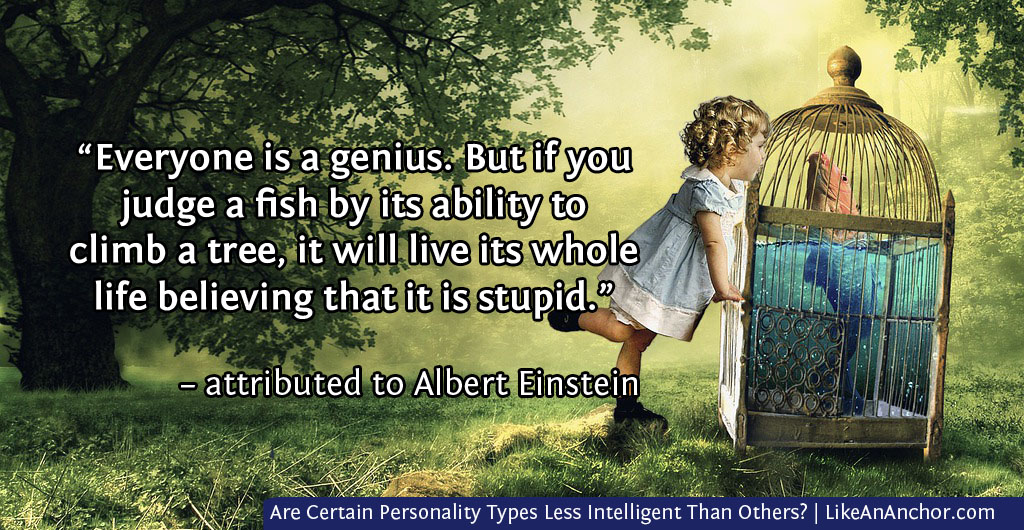
Are Certain Personality Types Less Intelligent Than Others? | LikeAnAnchor.com
Photo credit: Marianne Sopala via Pixabay

The Problem of Measuring Intelligence

The idea that Sensing types aren’t smart is actuality based on something Isabel Meyers mentions in her book Gifts Differing. She said that Intuitive types tend to score higher on IQ tests. What people who spread this rumor miss is that she also pointed out that the structure of IQ tests puts Sensors at a disadvantage which has nothing to do with whether or not they’re smart. Read more

7 Fictional Characters That You’ll Relate To If You’re An ENFJ

What fictional characters do you relate to as an ENFJ?

Just as we can describe real people using the Myers-Briggs® typology system, we can also type well-written fictional characters. Some of fiction’s most iconic and intriguing characters are ENFJs and today we’re going to talk about seven that I think real-life ENFJs will find relatable.

One great thing about looking at character personality types is that it helps us better understand people who have different types than we do. Fictional ENFJs can serve as examples for what real-life ENFJs might be like, and also show how much variation can exist between individuals with the same type.

The things that makes ENFJs such great fictional characters are also the things that make them so engaging in real life. ENFJs tend to have extraordinary charisma, keen insight into other people’s needs and desires, and a genuine desire to help others. They make wonderful leaders, teachers, and counselors and in many cases those are roles we see them filling in fiction as well as real life.

Charles Xavier

Professor X is usually typed either as an INFJ or ENFJ. But for the film versions at least, I think he’s more of an ENFJ (though all NF types could probably find him relatable due to his idealism and drive to help others). Especially as a young man, Charles is very outgoing and friendly in social situations and puts the well-being of others as one of the his primary concerns. He’s also more live-in-the-moment than most INFJs, which is partly a result of having Extroverted Sensing as his tertiary instead of inferior function.

In many ways, Xavier’s superhuman abilities are an extension of the ways that an NFJ’s mind naturally works. For example, Extroverted Feeling is often linked to an ability to feel others’ emotions. Pair that with pattern-recognizing Introverted Intuition and it can almost seem like INFJs and ENFJs have the ability to read minds. Real-life ones can’t, of course, nor can they predict the future or see into someone’s past. But they do have a keen insight into understanding how people think and can put together patterns well enough to predict probable outcomes. Read more

What Are Your Strengths As An INFJ Personality Type?

Learning about our unique strengths as INFJs helps us realize what gifts we can access most readily. It also gives us some guidelines for learning to use those gifts effectively in work, interpersonal relationships, and our private lives. These strengths don’t make INFJs “better” than any other type (each type has their own valuable strengths) but they are an important part of our personalities.

We often use our personality strengths so easily that we don’t think of them as gifts. For example, it’s so natural for INFJs to pick up on other peoples emotions that it might just seem like a slightly annoying thing we do automatically, rather than a unique gift we can use to relate to other people. But the strengths that are so much a part of the INFJ personality types are not common in the world at large. If we ignore our gifts or assume they are not useful, we deprive ourselves of confidence and deprive the world of our unique skills.

As I’ve been working on the second edition of The INFJ Handbook, one of the things I’m expanding is the chapters on INFJ strengths and weaknesses, as well as the one with personal growth tips. That re-writing that sparked the idea for this post, which is a shortened version of one of the chapters in my upcoming handbook. Read more

7 Fictional Characters That You’ll Relate To If You’re An ISFP

What fictional characters do you relate to as an ISFP?

Just as we can describe real people using the Myers-Briggs® typology system, we can also use the system to type well-written fictional characters. Some of fiction’s most iconic and intriguing characters are ISFPs and today we’re going to talk about seven that I think real-life ISFPs will find relatable.

One great thing about looking at character personality types is that it helps us better understand people who have different types than we do. Fictional ISFPs can serve as examples for what real-life ISFPs might be like, and also show how much variation can exist between individuals with the same type.

One of the things that makes ISFPs such great fictional characters is their strong, personal moral compass and their commitment to living life authentically. Plus, they pair that introverted side with a zest for life that carries over into the outer world as well.

Arya Stark

Arya’s fiercely individualistic nature and vivid moral worldview hint at a strong preference for Introverted Feeling (Fi). That, coupled with her sensory, in-the-moment skills that come with her co-pilot Extroverted Sensing, make her a relatable character for many ISFPs (there’s quite a bit of debate about which type she is, though, as she’s relatable for many other SPs and FPs as well). Some ISFPs (like Arya) can be pretty social and enjoy the company of others, but from what I remember of the books, and what I’ve heard about her character in the TV show, it seems like she’s leading with Fi.

Many real-life ISFPs can identify with Arya’s strong morals and ethics, which are intensely personal. It’s also pretty common for ISFPs to have a strong sense of their own identity and resist efforts to make them fit into other’s expectations, as Arya does. She also prefers to keep her feelings private and interact with the outer world through taking action or voicing an opinion rather than expressing her inner self in words. Read more

What Do Other People Think of INFJs?

INFJs are supposed to be really good at reading other people’s emotions, guessing their thoughts, and seeing things from their perspectives. In many situations, that’s true. But there’s one type of situation where many INFJs (including myself) feel like we have a blind spot.

It’s like there’s a mental block when I’m trying to see myself from other people’s perspectives. I have to ask my closest friends how I come across in conversations, whether or not someone’s response to me was positive, and if what I said made sense. I suspect that for me personally much of this is related to social anxiety, because I’m not as paranoid around people who I know well. But I’m also not the only INFJ who struggles with this. We tend to assume that people think we’re weird and that they won’t like us because we’re so different from other people.

However, I’ve also talked with enough non-INFJs to know that quite a few of them actually do like us. Our INFJ weirdness isn’t guaranteed to scare everyone away. In fact, what makes each of us us “weird” is also what makes us attractive to the kind of people who connect well with our unique, authentic selves. So today, let’s take a look at how other people actually see INFJs. I’d also like to invite any non-INFJs reading this post to share your thoughts in the comments section. We’d love to hear from you!

Socially Awkward

You’re probably wondering why this is at the top of my list, since most INFJs already know/fear that they come across as socially awkward. But I can’t write a post like this and ignore the fact that we do give others this impression. People aren’t judging us nearly as much as we think they are, but they do notice how awkward we make ourselves when we try too hard to fit in. Read more

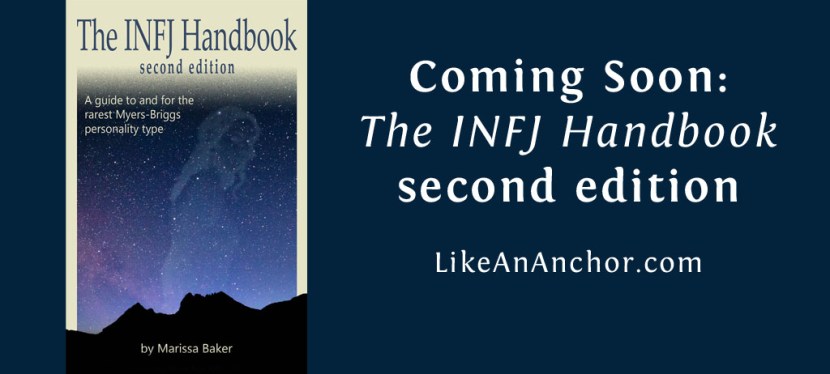
I’d like to hear from INFJ men for The INFJ Handbook second edition

I’m so excited to announce that I’m releasing a second edition of The INFJ Handbook this summer. This will be an updated and expanded edition with lots of new information. Plus, I’ll be able to offer this in a print version as well as an ebook for all of you who’ve contacted me and asked where you could buy a physical copy.

In the first edition of The INFJ Handbook, I asked several INFJs to share their perspectives on having an INFJ personality type. Since all my contributors for the first edition were women, I’d like to get some INFJ men to share their perspectives for the second edition.

Update: Now closed to further responses. Thank you so much to everyone who contacted me to share their answers to these questions! I’ll be updating everyone soon with a release date for the book.

If you identify as a man and an INFJ personality type, I’d love to hear from you. Here’s a list of questions that I’m curious to get your perspective on:

  • How do you experience Intuition? What happens when you try to explain your intuitions to others?
  • Even though INFJ’s use Feeling more comfortably, we also have a Thinking side to our personalities. What does it look like for you to use your Thinking side in a healthy way? (for example: playing strategy games, analyzing your favorite topic, etc)
  • What stresses you out so much that you start acting unlike your normal self?
  • What do you consider the biggest strengths and weaknesses of your personality type?
  • Are there any struggles you face that you believe are unique to INFJ men?
  • Are there any personal growth tips you’d like to share with other INFJs?
  • What do you wish other people knew about INFJs?

You can answer as many or as few of these questions as you want. If there’s something else you’d like to share that isn’t covered in these questions, please feel free to add that as well.

If you’d like to contribute to this second edition of The INFJ Handbook, you can leave a comment under this post or click here to email me. Thank you so much! I’m really looking forward to reading what you have to share 🙂