Note: before you read this post, you should know that it quotes outdated information about type distributions. Currently, ENTJs are the rarest type in the population. I may rewrite/update this post at some point in the future, but for now you can read more about current type distributions at this link: “How Rare Is Your Myers-Briggs® Personality Type?”
As an INFJ, I often see people talking about how it’s the rarest personality type. According to every type distribution I’ve seen this statement is true. However, I’ve also seen quite a few INFJs treat this rarity as if there’s a huge gap between how rare we are compared to the other personality types. Some also treat this rarity as meaning that we INFJs are so rare no one else can relate to us and/or that it makes us extra special.
While INFJs are the rarest type overall, there are other types that are almost as rare. And when we break type distributions down by gender, INFJ is not the rarest type among women (though it is among men). You can see the Estimated Frequencies of the Types in the United States Population in this chart:
Relative Rarity For Each Type
As you can see from the type distribution chart at the start of this post, most of the Intuitive types each make up less than 5% of the population. The estimates from Center of Application for Psychological Type cover a pretty broad range, though. The Myers-Briggs® Foundation offers more specific estimates in addition to the ranges. These percentages pin-point INFJ at 1.5%, ENTJ 1.8%, INTJ at 2.1%, and ENFJ at 2.5%. They’re all pretty rare. Read more →
What fictional characters do you relate to as an INFJ?
Just as we can describe real people using the Myers-Briggs® typology system, we can also type well-written fictional characters. Some of fiction’s most iconic and intriguing characters are INFJs and today we’re going to talk about seven that I think real-life INFJs will find relatable.
One great thing about looking at character personality types is that it helps us better understand people who have different types than we do. Fictional INFJs can serve as examples for what real-life INFJs might be like, and also show how much variation can exist between individuals with the same type.
The things that makes INFJs such great fictional characters are some of the same things that make them such interesting people. Though the rarest personality type on the planet, INFJs are fairly common in fiction. They’re thoughtful, introspective characters with a unique way of looking at the world and a keen interest in other people.
Alyosha Karamazov
It’s fascinating to read the narrator of Fyodor Dostoevsky’s The Brothers Karamazov discuss the story’s hero Alexi Karamazov (more often called by his nickname Alyosha/Alesha). He spends most of the introduction apologizing for presenting readers with such an unusual hero. “He is by no means a great man,” the narrator explains, but he is doubtless “a strange man, even an odd one.” He was strange “from the cradle,” growing up a quiet child preoccupied by something inside him while at the same time loving people. I’m sure many INFJs can relate to that in their own childhoods — liking other people but being too preoccupied by their inner worlds to be considered sociable.
As the story progresses, we see Alyosha dreads conflict with a loathing that I think all INFJs (and the other FJ types as well) can relate to. We see him weeping when others are hurt, displaying the empathy that’s so much a part of real-life INFJs. We see him make social blunders in an effort to make everyone happy and at peace, all with an INFJ’s insistence on working toward harmony in all situations. Like so many INFJs, he’s sensitive, emotional, indecisive on certain things (though quite decisive in others), and isn’t afraid to appear weak so long as he’s being true to his beliefs. Read more →
What fictional characters do you relate to as an ESTJ?
Just as we can describe real people using the Myers-Briggs® typology system, we can also type well-written fictional characters. Some of fiction’s most iconic and intriguing characters are ESTJs and today we’re going to talk about seven that I think real-life ESTJs will find relatable.
One great thing about looking at character personality types is that it helps us better understand people who have different types than we do. Fictional ESTJs can serve as examples for what real-life ESTJs might be like, and also show how much variation can exist between individuals with the same type.
The things that makes ESTJs such great fictional characters are much the same things that makes them such interesting people in real life. They tend to be well organized, disciplined, and skilled at making tough decisions. This makes them excellent leaders, something we see in most of the ESTJ characters on this list.
Bryan Mills
I haven’t seen Taken, but Susan Storm lists Bryan Mills as the ESTJ in her post “The Greatest Movie Heroes of Every Myers-Briggs® Personality Type.” She says that he “He embodies the quick-thinking precise nature of the ESTJ. He knows how to take charge, create an effective plan, and can easily give instructions to other people over the phone on how to move forward.” Like so many TJ types, he’s able to put emotions aside and take decisive, logical action.
As for the other aspects of his character, Susan says, “Mills shows his Introverted Sensing (Si) in the way he systematically pays attention to everything around him.” Like other ESTJs, he’s a detail-oriented person and can easily recall important information. He also relies on skills acquired in his past to solve the problems of his present situations — something SJ types tend to do very well.
Quote from Taken (2008). Image: Liam Neeson as Bryan Mills
Eve Baird
Eve Baird from The Librarians is a fairly stereotypical example of an ESTJ in fiction, embodying the ESTJ’s blunt demeanor, no-nonsense attitude, and ability to keep things moving forward. ESTJs like Eve are grounded in reality and care about keeping the world running as it should be, a trait Eve devotes to keeping the Library safe and magical artifacts out of the wrong hands. Though she can seem gruff, she’s very loyal and cares deeply about people (a TJ trait that’s often overlooked).
Like other ESTJs, Eve’s preferred mental process of Extroverted Thinking involves measuring and managing impersonal criteria when making decisions. There are examples of this in literally every episode. Her co-pilot process is Introverted Sensing, which filters everything she learns learn through the lens of her own memories and experiences. That’s not to say ESTJs are inflexible. Once given enough information to work with, they’re quick to adapt their actions to match the situation. Anything else would be inefficient. This is partly due to the fact that they prioritize effectiveness, and partly due to their tertiary Extroverted Intuition.
Quote from The Librarians Season 2, episode 9 (2015). Image: Rebecca Romijn as Eve Baird and Noah Wyle as Flynn Carsen
Leia Organa
Leia Organa of the Star Wars saga has a much different personality type than your typical princess figure in fiction. Most are Feeling types, but Leia’s response to Darth Vader, her criticism of her seemingly inept rescuers in A New Hope, and the way she instantly takes charge of every situation are characteristic of dominant Te types. She’s a take-charge sort of person who is fiercely loyal to family and values, and expects the same level of commitment from others.
Like other Sensing types, Leia’s focus is on the here and now. Even through she and the Rebellion (and later the Resistance) are fighting to change the future of the galaxy, she does that by shaping the present in a practical way. Her strengths as an ESTJ type make her a fantastic leader both in the Rebellion against the Empire and, later, in a variety of political and leadership roles. She also makes good use of her tertiary Extroverted Intuition (especially later in life) to help her see multiple solutions to problems and adapt quickly to changing situations.
Quote from of The Last Jedi (2017). Image: Carrie Fisher as Leia Organa
Nick Fury
Nick Fury from the MCU might be more of an ENTJ than an ESTJ, but I include him on this list because I think ESTJs will find the way he uses the TJ side of his personality relatable and (depending on how you read his character) there’s also an argument to be made that he is an ESTJ type. Either way, Fury leads with a strong Extroverted Thinking function and (like many real-life ESTJs) he’s good at crashing through red tape to get the job done. He has zero patience for people who make stupid decisions, and he has cultivated the power needed to go around them.
Fury is motivated to make the world a safer place, even if he has to do that in ways that make other people like ISFJ Captain America uncomfortable. He’s concerned with the big picture and future security (more typical of ENTJs, but could be an ESTJ’s tertiary Extroverted Intuition). He is also highly pragmatic and makes decisions based on what he has learned in the past (more typical of ESTJs).
Quote from of The Avengers (2012). Image: Samuel L. Jackson as Nick Fury
Olivier Armstrong
If you haven’t yet watched Fullmetal Alchemist Brotherhood I highly recommend it. It’s full of amazing characters, including ESTJ Olivier Armstrong. She is an extremely talented leader who commands absolute loyalty from her troops. While people might see her (and, in many cases, real-life ESTJs) as harsh and critical, those who get to know her find her scrupulously honest and see she doesn’t expect anything less of herself than she demands from others.
Major General Armstrong is the sort of character who self-confident, aggressive, go-getting ESTJs will find highly relatable. She doesn’t let other people, circumstances, or even herself stand in the way of what she wants to accomplish. She lives in a world of concrete facts and is devoted to a strong, efficient moral code much like many real-life SJ types.
Quote and image from Fullmetal Alchemist Brotherhood).
Peter Pevensie
Peter Pevensie has been my favorite character from The Chronicles of Narnia since seeing the 2005 movie for The Lion, The Witch, and the Wardrobe (I didn’t read the books until later). In our modern world, ESTJs have a reputation for being the hard-hitting, no-nonsense types that steamroll anyone in their way. Peter’s an example of the more gentle, guardian-like role that characterizes certain ESTJ types.
Like many ESTJs, Peter likes to be in charge but he doesn’t abuse his power. He uses it for others’ good, and is reliable, practical, and logical in all his roles from eldest sibling to high king. He takes his responsibilities very seriously, even making them part of his identity, and has a hard time adjusting to the real world once he has to leave Narnia. Like many real-life SJ types, he doesn’t like change and it takes him a while to figure out how to navigate new situations if he doesn’t have an existing framework for interpreting reality.
Quote from The Lion, the Witch, and the Wardrobe by C.S. Lewis (1950). Image: William Moseley as Peter Pevensie
Tiana
Like many real-life ESTJs, Tiana from Disney’s The Princess and the Frog is never shy about sharing her thoughts or making decisive decisions. She’s assertive and expressive in the face of friends, creditors, and villains alike. With her strong work ethic, family-focus, and adherence to doing what’s right, Tiana is strong example of the SJ Guardian type. She also has another trait I’ve noticed in SJs — they are, as Naveen observes, “secretly funny.”
Even better, Tiana isn’t an SJ stereotype. Many people assume types using Introverted Sensing as one of their functions are unimaginative, solidly traditional, and somewhat boring. That’s far from being true. Like other Sensing types, SJs are concerned with taking in information about the world around them, but they’re also interpreting that information in a highly subjective way. And so you get Tiana, building up a dream of the future that doesn’t look practical to outside observers, but makes perfect sense within her framework of reality. Her dream is solid, detailed, planned, and responsible.
Quote and image from The Princess and the Frog (2009)
What did you think of this list? If you’re an ESTJ, which fictional characters do you relate to best? Is there anyone you’d add to or take off of this list? I’d love to hear your thoughts!
You might meet an INFJ who picks up on so much about you that it seems like they’re reading your mind.
Or perhaps you know an ESFJ so in-tune with how people work in groups that every event they plan is an unqualified success.
You might find yourself in a group lead by an ENFJ who manages to make every single person there feel included.
Maybe you meet an ISFJ who knows exactly how to act in dozens of different social situations and always makes the people they interact with feel valued.
The FJ types all use a mental process called Extroverted Feeling, or “Harmony” (to use Personality Hacker’s nickname). ENFJs and ESFJs use it as their favorite (or primary) mental function. INFJs and ISFJs use it as their co-pilot (or auxiliary) function. Today, we’re going to take a closer look at how this cognitive function helps INFJs, ISFJs, ENFJs, and ESFJs read other people. Read more →
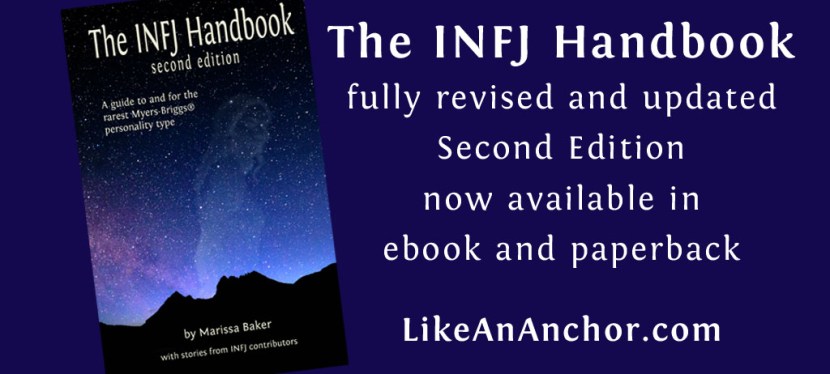
Happy book birthday to The INFJ Handbook, second edition!
This handbook takes you through an introduction to Myers-Briggs® theory, dives deep into the nuances of the INFJ personality type, and offers tips for personal growth. Also included are chapters on how other people see INFJs and things that INFJs want other personality types to know. All throughout, you’ll find quotes from eleven men and women who contributed their true stories of life and self-discovery as INFJs.
In this new edition of The INFJ Handbook, every chapter has been updated, re-written, and fact-checked to present INFJs and those who want to understand them with a deeper look into their personalities.
I’m giving away two copies of The INFJ Handbook. I’ll get in touch with each winner after the giveaway to ask if you’d prefer an ebook copy (available worldwide) or a signed paperback (US only to save on postage).
For introverts like me, learning about your personality is often a huge relief. We read books like Susan Cain’s Quiet, Marti Olsen Laney’s The Introvert Advantage, or Laurie Helgoe’s Introvert Power and we marvel that there are other people like us. We’re not alone anymore. All our weirdness finally makes sense.
Except, introversion didn’t explain everything about my personality. Those writing about introversion were careful to point out that it isn’t the same thing as shyness. I was shy, though, so how did I fit in? Learning from Elaine Aron’s books that I’m a highly sensitive person helped explain why certain environments and situations feel overwhelming, but it didn’t explain the racing heart, sweaty palms, and anxious thoughts that followed me into interactions with people.
I had my first panic attack in a Blockbuster when I was about 14 or 15 years old. That was when I realized there was something going on other than just shyness. Another 15 years later and I now know that I struggle with generalized anxiety, social anxiety, and depression. I won’t get into all that here but if you’re curious you can click to read “My Anxiety Story.”
One of the good things that has come out of all this is that I can write about introversion, social anxiety, and what it means to have both. I can’t speak for everyone, though. Our personalities and anxieties are highly individual and if you’re socially anxious it’s going to be a different experience for you than it is for me. There are commonalities, however, and I think there’s a good chance you’ll identify with some of my confessions as a socially anxious introvert. Read more →


 Like An Anchor