Hallowed Be Your Name

Sometimes when I pray, I think of Jesus’s model prayer (often called “the Lord’s Prayer”) as an outline to keep my mind from wandering or to help me think of things I should pray for. As I was doing this about a week ago, I started pondering the phrase “may your name be regarded as holy.” I wanted to think about that idea more deeply. When I pray this, am I praying that I would see God’s name as holy, or that others will? What does it mean to really consider God’s name as holy? Also, why does it say “your name” rather than “you”?

Requesting What Should Be

When you think of the model prayer, you probably think of the traditional phrase “hallowed be your name” rather than “may your name be regarded as holy.” I’m not sure where I first heard this alternate translation. It’s not actually used in any of the English-language translations on Bible Gateway for Matthew 6:9 or Luke 11:2. In the Greek, though, a literal translation is likely closest to “may your name be held in reverence” or “may your name be considered holy” (NET footnote). I probably heard someone use the “regarded as holy” version in a sermon or read about it in a book or article (like this one, for example).

The word “hallowed” isn’t used much in modern English, but it means “regarded as holy; venerated; sacred” (Dictionary.com). It is not simply a statement like “holy is your name,” as we modern readers might assume. Rather, it is a prayer for what should be. The two translations that I quote most often on this blog modernize “hallowed be thy name” (KJV) as, “may your name be kept holy” (WEB) and “may your name be honored” (NET). Those are both good ways to bring this concept into modern English.

 “Therefore you shall keep my commandments, and do them. I am Yahweh. You shall not profane my holy name, but I will be made holy among the children of Israel. I am Yahweh who makes you holy, who brought you out of the land of Egypt, to be your God. I am Yahweh.”

Leviticus 22:31-34, WEB

God’s name is holy, and regarding His name as holy is the proper state of things. It will happen among His people, and it ought to happen among the nations as well. Take a look at one of the things God says about His people to the prophet Ezekiel.

“I scattered them among the nations, and they were dispersed through the countries. I judged them according to their way and according to their deeds. When they came to the nations where they went, they profaned my holy name; in that men said of them, ‘These are Yahweh’s people, and have left his land.’ But I had respect for my holy name, which the house of Israel had profaned among the nations where they went.

“Therefore tell the house of Israel, ‘The Lord Yahweh says: “I don’t do this for your sake, house of Israel, but for my holy name, which you have profaned among the nations where you went. I will sanctify my great name, which has been profaned among the nations, which you have profaned among them. Then the nations will know that I am Yahweh,” says the Lord Yahweh, “when I am proven holy in you before their eyes.”

Ezekiel 36:19-23, WEB

God cares a great deal about how people regard His name. Even when His people don’t seem to care about how they represent Him, He still acts with “respect for my holy name,” takes steps to “sanctify my great name,” and proves Himself holy both to His own people and to the nations observing.

Image of a man praying with a Bible on the table in front of him, overlaid with text from Lev. 22:31-33, WEB version: “Therefore you shall keep my commandments, and do them. I am Yahweh. You shall not profane my holy name, but I will be made holy among the children of Israel. I am Yahweh who makes you holy, who brought you out of the land of Egypt, to be your God. I am Yahweh.”
Image by WhoisliketheLord Studio from Lightstock

His Great Name

In Hebrew thought, names “often include existence, character, and reputation” (Theological Wordbook of the Old Testament, entry 2405 shem). This is especially true of God’s names. He shares several names with people that reveal aspects of His character, such as El Shaddai (God Almighty). He also shares His personal name, YHWH, typically pronounced as Yahweh (also written as Jehovah, a hold-over from English’s Germanic roots when “J” was pronounced more like “Y”). This name is represented in most English translations as LORD, with all caps to distinguish it from Adonai, the actual Hebrew word for “lord.” One reason I like using the WEB translation for the Old Testament is that they use “Yahweh” instead of “LORD,” making it much easier for us to see when God is using His name rather than a title.

With the concept of “name” tied so closely to someone’s character and reputation, it shouldn’t surprise us that in some Biblical “passages shem Yahweh is so inextricably bound up with the being of God that it functions almost like an appearance of Yahweh (Ex 23:20-21; Isa 30:27)” (TWOT 2405). Similarly, “The name of God also signifies the whole self-disclosure of God in his holiness and truth (Ps 22:22)” (TWOT 2405). Because God Himself is holy, His name should also be regarded as holy.

There are warnings to go along with humans using this name. One of the 10 commandments says, “You shall not take the name of the Lord your God in vain” (Ex. 20:7). We often think of this just as a command not to use God’s name as a swear word, but there’s a lot more to it than that. The word translated “take” can refer to using or carrying something, and since names are tied to character and reputation, this command likely refers to how we represent God (and how we regard His name) as much as it does to how we use His name in our speech.

“You shall not misuse the name of Yahweh your God, for Yahweh will not hold him guiltless who misuses his name.”

Exodus 20:7, WEB

Some modern Jews and Messianic believers refer to God as Ha Shem (Hebrew for “the name”) rather than risk taking His name in vain by using one of His names or titles. But Yahweh introduced Himself by name to His people and directly told Moses to use this name, so I wonder sometimes if not using this name (so long as it’s in an appropriately reverential manner) might be a worse blunder than using it. He wants to have a familial relationship with us, not a super formal one.

 Moses said to God, “Behold, when I come to the children of Israel, and tell them, ‘The God of your fathers has sent me to you,’ and they ask me, ‘What is his name?’ what should I tell them?”

God said to Moses, “I AM WHO I AM,” and he said, “You shall tell the children of Israel this: ‘I AM has sent me to you.’” God said moreover to Moses, “You shall tell the children of Israel this, ‘Yahweh, the God of your fathers, the God of Abraham, the God of Isaac, and the God of Jacob, has sent me to you.’ This is my name forever, and this is my memorial to all generations.”

Exodus 3:13-15, WEB

I do want to add a quick note here to address the idea that we should only use Hebrew names for God. We can use the names He used to originally reveal Himself, but we don’t have to. He’s perfectly fine with translations, as we can see from the New Testament. For example, the name “Yahweh” doesn’t show up in New Testament writings at all. They use the Greek equivalent of “God,” “Father,” and “Lord” instead. It’s perfectly okay with God to talk about Him and to Him in any language you know (not just Hebrew or Greek) (Acts 2:1-12).

Image of a group of people holding hands to pray overlaid with text from Matt. 6:9-10, LEB version:   Therefore you pray in this way: “Our Father who is in heaven, may your name be treated as holy. May your kingdom come, may your will be done on earth as it is in heaven.”
Image by Claudine Chaussé from Lightstock

What Do I Know of Holy?

I’ve talked about the concept of holiness before, but mostly in the context of God making something holy. If a thing or person is holy, they are set apart or sanctified for God’s divine use. But what does it mean that God Himself is holy?

The Greek word translated “hallowed” or “kept holy” is hagiazo (G37). The basic meaning is “to make holy, sanctify.” Usually, it’s about something that wasn’t holy withdrawing (or being set apart) from common things to make them holy. For something that’s already holy, the verb can also mean “to regard and venerate as holy” (Zodhiates, G37 III). God is already and inherently holy, but humans get to choose whether or not they take action to recognize His holiness.

In Hebrew, “holy” is qadash (verb; TWOT 1990), qodesh (noun; TWOT 1990a), or qadosh (adjective; TWOT 1990b). This word “connotes the concept of ‘holiness,’ i.e. the essential nature of that which belongs to the sphere of the sacred and which is thus distinct from the common or profane” (TWOT 1990a). In relation to God specifically, “the biblical viewpoint would refer the holiness of God not only to the mystery of his power, but also to his character as totally good and entirely without evil” (TWOT 1990a). He is ethically perfect, “intrinsically holy,” “free from the moral imperfections and frailties common to man,” and totally distinct from sin or profane things (TWOT 1990b).

To regard God as holy, we need to recognize truths of His essence and character. We need to have a grasp and appreciation of the fact that He is holy to the core of His being. And when we pray, “may your name be held in reverence” or “may your name be considered holy,” we’re praying that others will recognize these truths as well.

Our Response to Holiness

Image of a smiling woman with an arm lifted in praise, overlaid with blog's title text and the words, Why did Jesus tell us to pray, "hallowed be they name" or "may your name be regarded as holy," and what does it mean?
Image by Pearl from Lightstock

God’s holy name also demands something of us. As the model prayer goes on, Jesus counsels us to also pray, “may your will be done on earth as it is in heaven” (Matt. 6:10, NET). Part of God’s will is that we become holy, set apart and sanctified for Him.

For I am Yahweh your God. Sanctify yourselves therefore, and be holy; for I am holy. … I am Yahweh who brought you up out of the land of Egypt, to be your God. You shall therefore be holy, for I am holy.

Leviticus 11:44, 45, WEB

So then, be perfect, as your heavenly Father is perfect

Matthew 5:48, NET

When we recognize God’s holiness and perfection, we should also realize that we ourselves are far from living up to His standard. If we seek a relationship with Him, we should also seek to live in a way that sets us apart from sin and uncleanness so we become more and more like our perfect God. We don’t need to become obsessed with doing everything just right; the Pharisees, for example, tried keeping the law perfectly but ended up missing the whole point (Matt. 23). But we do need to recognize our need for holiness, turn away from things antithetical to God’s nature, ask for and receive forgiveness through Jesus Christ, and then commit to walking with God as His special people.

There’s a special blessing that God commanded the Old Testament priests to speak over His people. At the end of the blessing, Yahweh said this was how “they shall put my name on the children of Israel” (Num. 6:27, WEB). When God calls or puts His holy name over something, that “signifies ownership, possession, and protection” (TWOT 2405). We belong to Him as His own special people (Ps. 100:3; 1 Cor. 6:19-20; 1 Pet. 2:9). He wants us to share in His holiness and charges us with carrying His name into the world as we shine His light into the darkness around us.


Featured image by Pearl from Lightstock

The Lord Is a Warrior, and That’s a Good Thing

I’ve been revisiting my Spiritual Warfare series of posts as I work on my next study guide about the Armor of God. While most of that series’ focus is on us fighting spiritual battles with God’s help, studying that topic also highlights a role God fills which I don’t think we talk about all that often. We often discuss the Lord as shepherd, priest, savior, king, deliverer, and much more. He’s also a warrior, but when was the last time you heard anyone quote Isaiah 63:1-6, where the Lord is dressed in garments stained red with the blood of those who opposed Him?

I suspect part of the reason we shy away from discussing verses like that is we’re not really sure what to do with them. I’m as much guilty of that as anyone else. Take, for example, God’s command that ancient Israel completely wipe out the inhabitants of the promised land when they went in to claim their inheritance. I understand that God is righteous in all He does and that His perspective is different than mine, and I know this is a command He was within His rights to give. I trust Him, but I still don’t want to think too much about the violence of that.

At the same time, knowing God can and does fight is strangely comforting. I want the Warrior God by my side when I read that “our struggle is not against flesh and blood, but against the rulers, against the powers, against the world rulers of this darkness, against the spiritual forces of evil in the heavens” (Eph. 6:12, NET). I can’t fight that on my own. Maybe knowing what kind of enemy we face and how helpless we’d be against it on our own is why so many Bible writers find the image of God as a warrior something to rejoice about.

The Warrior God

It’s a long passage when typed out in verse like this, but I want to quote the first part of Isaiah 63 so we can take a closer look at it together. While the violent imagery is probably the first thing we notice when reading this, I also want to notice the tone. How does the author want us to feel about this picture of God?

Who is this who comes from Edom,
with dyed garments from Bozrah?
Who is this who is glorious in his clothing,
marching in the greatness of his strength?
“It is I who speak in righteousness,
mighty to save.”
Why is your clothing red,
and your garments like him who treads in the wine vat?

“I have trodden the wine press alone.
Of the peoples, no one was with me.
Yes, I trod them in my anger
and trampled them in my wrath.
Their lifeblood is sprinkled on my garments,
and I have stained all my clothing.
For the day of vengeance was in my heart,
and the year of my redeemed has come.
I looked, and there was no one to help;
and I wondered that there was no one to uphold.
Therefore my own arm brought salvation to me.
My own wrath upheld me.
I trod down the peoples in my anger
and made them drunk in my wrath.
I poured their lifeblood out on the earth.”

Isaiah 63:1-6, WEB

Isaiah isn’t startled or horrified by the idea of God trampling His enemies in a winepress. He’s impressed. He uses words like, “glorious,” “greatness,” and “righteousness” to describe the Lord in this passage. When Yahweh is speaking, He talks of His vengeance and wrath as being connected to salvation and redemption.

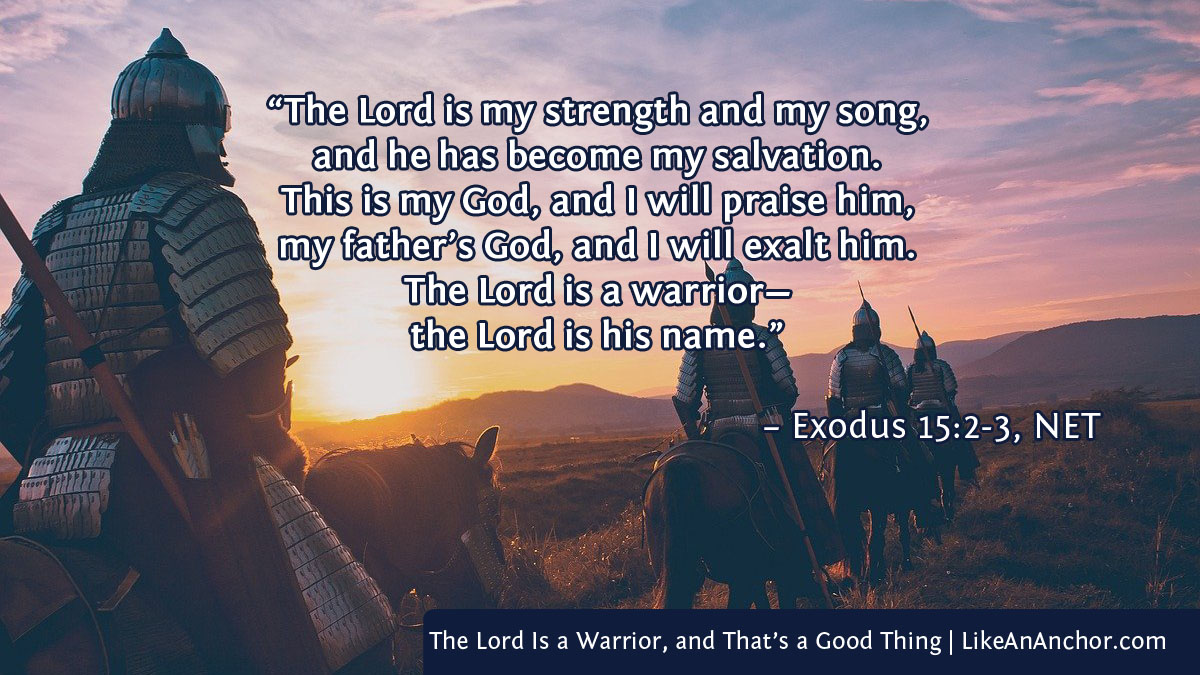
It might not be the first thing that comes to mind when we think of God, but the Lord as a warrior is a solidly Biblical image. And, like everything else God is, His actions as Warrior are a good thing. There are many other passages that speak to this theme as well, particularly in songs praising the Lord for filling the role of warrior king. For example, after ancient Israel crossed the Red Sea and saw the Egyptian army destroyed, the song they sang started out like this:

“I will sing to Yahweh, for he has triumphed gloriously.
He has thrown the horse and his rider into the sea.
Yah is my strength and song.
He has become my salvation.
This is my God, and I will praise him;
my father’s God, and I will exalt him.
Yahweh is a man of war.

Exodus 15:1-3, WEB

We’re probably far more familiar with “God of peace” as a title for Yahweh, but “man of war” is just as valid a description. That seems contradictory at first, but sometimes peace requires a warrior to maintain it. For example, Paul writes, “The God of peace will quickly crush Satan under your feet” (Rom. 16:20, NET). There’s no disconnect for God to fill both roles.

Warrior Messiah

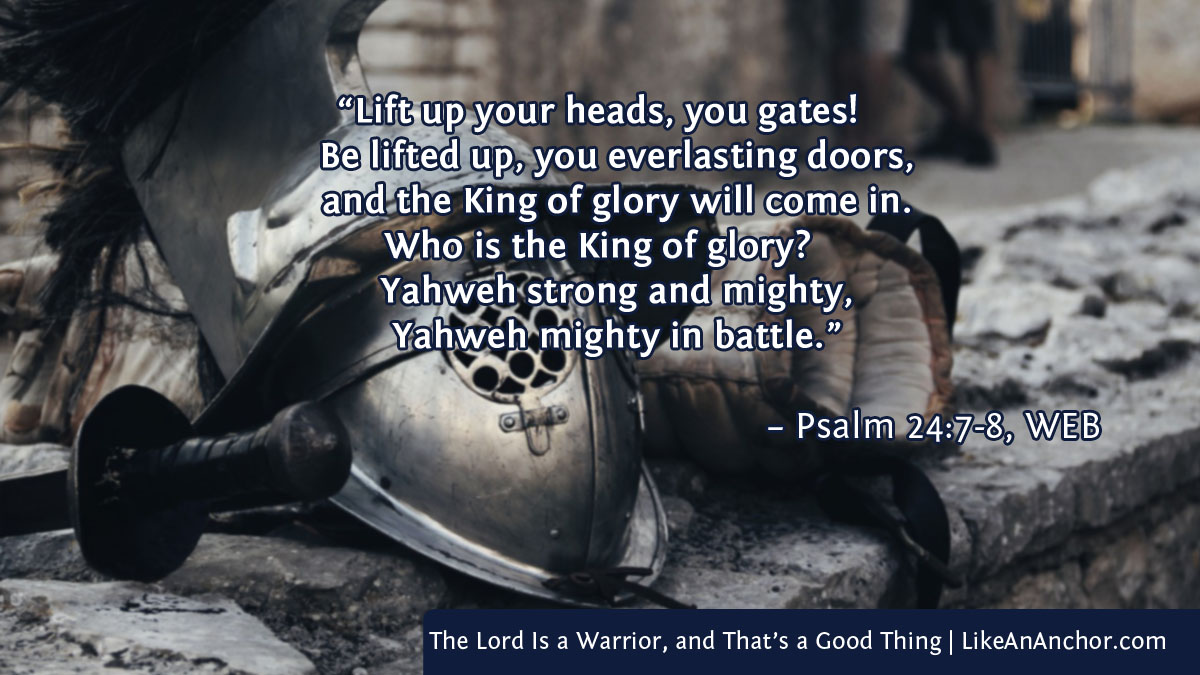
Continuing this theme of exalting God as a Warrior, David praises “the King of glory” who is “Yahweh strong and mighty, Yahweh mighty in battle. … Yahweh of Armies is the King of glory!” (Ps. 24:8, 10, WEB). That’s a Messianic psalm, which means this mighty warrior God is the being we now know as Jesus Christ. This psalm isn’t an isolated passage. The sons of Korah also write a similar Messianic psalm:

My heart overflows with a noble theme.
I recite my verses for the king.
My tongue is like the pen of a skillful writer.
You are the most excellent of the sons of men.
Grace has anointed your lips,
therefore God has blessed you forever.
Strap your sword on your thigh, mighty one:
your splendor and your majesty.
In your majesty ride on victoriously on behalf of truth, humility, and righteousness.
Let your right hand display awesome deeds.
Your arrows are sharp.
The nations fall under you, with arrows in the heart of the king’s enemies.
Your throne, God, is forever and ever.
A scepter of equity is the scepter of your kingdom.
You have loved righteousness, and hated wickedness.
Therefore God, your God, has anointed you with the oil of gladness above your fellows.

Psalm 45:1-7, WEB

Reading these messianic prophecies, it’s easy to understand why so many Jewish people of Jesus’s day were confused about why He wasn’t overthrowing the Romans and restoring the kingdom to Israel right then. Even the 11 apostles thought He might do that (Luke 19:11; Acts 1:6). They didn’t realize until later that Jesus fulfilled the prophecies of a Messiah who would suffer for our sins in His first coming–winning victory in the spiritual battle against the devil–and that He’d return a second time with His warrior role more visible.

Then I saw heaven opened and here came a white horse! The one riding it was called “Faithful” and “True,” and with justice he judges and goes to war. His eyes are like a fiery flame and there are many diadem crowns on his head. He has a name written that no one knows except himself. He is dressed in clothing dipped in blood, and he is called the Word of God. The armies that are in heaven, dressed in white, clean, fine linen, were following him on white horses. From his mouth extends a sharp sword, so that with it he can strike the nations. He will rule them with an iron rod, and he stomps the winepress of the furious wrath of God, the All-Powerful. He has a name written on his clothing and on his thigh: “King of kings and Lord of lords.”

Revelation 19:11-16, NET

This sounds a lot like that passage where we started in Isaiah, doesn’t it? Here’s the King of kings and Lord of lords wearing a garment dipped in blood and treading the winepress of God’s wrath. This shouldn’t surprise us, knowing that “Jesus Christ is the same yesterday and today and forever!” (Heb. 13:8, NET). He’s just as much a warrior today as He will be in the future and as He was in the past.

Making Warriors of Us

As we continue to walk with God, we learn more and more about the spiritual warfare that’s part of our Christian experience. When God called us to join His family, He also revealed our part in a grand metanarrative that spans creation’s history. There’s a battle going on in the spiritual realm between good and evil and we’re right in the thick of it. As a Warrior, God is perfectly capable of defending us. He also equips us to defend ourselves and to fight alongside Him.

Now I, Paul, appeal to you personally by the meekness and gentleness of Christ (I who am meek when present among you, but am full of courage toward you when away!)— now I ask that when I am present I may not have to be bold with the confidence that (I expect) I will dare to use against some who consider us to be behaving according to human standards. For though we live as human beings, we do not wage war according to human standards, for the weapons of our warfare are not human weapons, but are made powerful by God for tearing down strongholds. We tear down arguments and every arrogant obstacle that is raised up against the knowledge of God, and we take every thought captive to make it obey Christ.

2 Corinthians 10:1-5, NET

Here again we have this contrast between peace (in this case meekness and gentleness) and war. Paul is appealing to His readers using Jesus’s meek, gentle character in order to stir them up to fight. I think part of this seeming disconnect has to do with the way God fights. When God goes into battle, He does so from a standpoint of righteousness, justice, and faithfulness (Is. 11:5; 59:17). His warfare is consistent with the rest of His character, and ours should be too.

Paul told Timothy that in order to “fight the good fight,” he “must hold firmly to faith and a good conscience” (1 Tim. 1:18-19). God equips us with weapons that are effective against spiritual enemies and even for taking our own thoughts captive as we wage war inside our own minds (Rom. 7:23). As we draw nearer to Him and learn more and more about who He truly is, we’ll be better equipped to face spiritual battles with the Warrior God at our side.

Featured image by azboomer from Pixabay

Song Recommendation: “Out of Bozrah” by The Lumbrosos (this video also shows a dance that goes with the song; I always loved dancing this one)

Who or What is the “Morning Star”?

A comment on last week’s post about names got me thinking about “Morning Star” as a title for Jesus Christ. Many of His titles are easy to interpret. They make a lot of sense–of course He’s called Savior, Redeemer, Lord, High Priest, and Lamb of God. We have tons of evidence for and explanations of those titles and roles. In contrast, Morning Star isn’t quite so easy to define.

I’ve studied Jesus as the Light before, and touched on the Morning Star title in those posts (see “The Sun of Righteousness” and “The Light From The Beginning“). I haven’t dug deep into this particular title, though, or addressed the fact that there’s also a verse describing Satan as a “morning star” (though that depends on which translation you’re using).

The phrase “morning star” is used infrequently through the Bible, and not always of Jesus. To understand how this title is used, we need to understand how the Bible talks about stars and which Old Testament passages inform the New Testament verses saying Jesus is the Morning Star. As we’ll see, this title has to do with Jesus’s authority, His light, and His role understanding God’s ways.

Morning Stars in the Bible

“Morning Star” isn’t only used as a title for Jesus. The words show up in other verses as well, and looking at those can help give us a feel for what Morning Star means when used as a title. Let’s start with looking at the Hebrew words in the Old Testament.

In the story of Job, God shows up in-person to answer Job’s questions with some questions of His own. He asked, “Where were you when I laid the foundations of the earth? … Or who laid its cornerstone, when the morning stars sang together, and all the sons of God shouted for joy?” (Job 38:4, 6-7, WEB). This verse uses the Hebrew words kokab (H3556, “star”) and boqer (H1242, “morning, break of day”) (definitions from BDB lexicon). It’s the only time in the Bible those two words are used together. There’s other talk of stars in the Bible–both literal stars and as figurative language for spiritual beings–but this is the only place in the Old Testament that really narrows in on the idea of “morning stars.”

Other phrases translated “morning star” in English versions of the Old Testament use different words. When Job “cursed the day he was born” and said “Let its morning stars be darkened” (Job. 3:1, 8, NET) the Hebrew word translated “morning” more often means “twilight” (though it can be evening or morning twilight, H5399). It’s not the same phrase as God uses later in Job 38:7. Similarly, the verse in Isaiah talking about Satan’s fall is sometimes translated “morning star, son of the dawn” (Is. 14:12, NIV). However, a more accurate translation of heylele (H1966) would be “shining one.”

How you have fallen from heaven, shining one, son of the dawn! How you are cut down to the ground, who laid the nations low! You said in your heart, “I will ascend into heaven! I will exalt my throne above the stars of God! I will sit on the mountain of assembly, in the far north! will ascend above the heights of the clouds! I will make myself like the Most High!” Yet you shall be brought down to Sheol, to the depths of the pit.

Isaiah 14:12-15, WEB

This passage is talking about one who shone like the dawn and arrogantly thought he could exalt himself “above the stars of God” (that word in v. 13 is kokab). I don’t want to spend too much time on this point, but the question “Aren’t Jesus and Satan both referred to as the morning star?” does come up from time to time and can be confusing. Though the titles may have some similarities, the comparison highlights the differences between these two beings. Just like Jesus as the Lion of Judah is far more powerful than Satan as a roaring, ravenous lion, so does Jesus as the Morning Star and Light of the World outshine Satan’s former glory as a shining one.

The Star of Jacob

The clearest connection between an Old Testament prophecy and Jesus as the Morning Star comes from a section of scripture that doesn’t include the word “morning.” This prophecy was delivered by Balaam, a prophet hired by Balak, king of Moab, to curse the nation of Israel. God did not permit him to speak curses over them, though; he was only allowed to speak blessings (Num. 22-24).

“Balaam the son of Beor says,
the man whose eyes are open says;
he says, who hears the words of God,
knows the knowledge of the Most High,
and who sees the vision of the Almighty,
falling down, and having his eyes open:
I see him, but not now.
I see him, but not near.
A star will come out of Jacob.
A scepter will rise out of Israel,
and shall strike through the corners of Moab,
and crush all the sons of Sheth.
Edom shall be a possession.
Seir, his enemy, also shall be a possession,
while Israel does valiantly.
Out of Jacob shall one have dominion,
and shall destroy the remnant from the city.”

Numbers 24:15-19, WEB (emphasis added)

This is the only Old Testament passage I’ve found that explicitly identifies the promised Messiah as a star. That being the case, this prophecy is likely something Peter was thinking of when he wrote these words:

For he received honor and glory from God the Father, when that voice was conveyed to him by the Majestic Glory: “This is my dear Son, in whom I am delighted.” When this voice was conveyed from heaven, we ourselves heard it, for we were with him on the holy mountain. Moreover, we possess the prophetic word as an altogether reliable thing. You do well if you pay attention to this as you would to a light shining in a murky place, until the day dawns and the morning star rises in your hearts.

2 Peter 1:17-19, NET

Here in these verses, Peter chooses not to use the standard Greek word for star (aster, G792). Rather, he uses the word phosphorous , which means “light bringing” (G5459). The reason that it’s translated “morning star” is because it’s often used of the planet Venus as the “day star” (Thayer’s dictionary). It is also is “a Hellenistic word that was sometimes used of emperors and deities” (NET footnote). This strengthens the connection back to Numbers 24:17 by connecting to the authority Jesus has as the scepter-carrying Star of Jacob. 17

What Peter’s doing here is connecting his audience back to prophecies in the Old Testament scriptures that point to Jesus as the Messiah, then he references one of those prophecies while drawing a parallel between Jesus as the Morning Star and Light that shines into our minds. That connection is made even more explicit through Jesus’s own words at the end of Revelation (though He uses aster) .

“I, Jesus, have sent my angel to testify these things to you for the assemblies. I am the root and the offspring of David, the Bright and Morning Star.”

Revelation 22:16, WEB

The Morning Star Dawns in Us

If we look back at the verse in Peter’s letter, we see he’s talking about how the Bible (specifically the “prophetic word”) is something we ought to “pay attention to … as you would to a light shining in a murky place, until the day dawns and the morning star rises in your hearts.” There’s a connection between Jesus’s title Morning Star and the way that truths of His word dawn on us. He is the great light shining into the world’s darkness; “the dawn from on high” who visited us (Matt. 4:13-16; Luke 1:76-79).

Even if our Good News is veiled, it is veiled in those who are dying, in whom the god of this world has blinded the minds of the unbelieving, that the light of the Good News of the glory of Christ, who is the image of God, should not dawn on them. For we don’t preach ourselves, but Christ Jesus as Lord, and ourselves as your servants for Jesus’ sake, seeing it is God who said, “Light will shine out of darkness,” who has shone in our hearts to give the light of the knowledge of the glory of God in the face of Jesus Christ.

2 Corinthians 4:3-6, WEB

From the Old Covenant times until now, the righteous have been associated with light, dawn, and the sun (Ps. 112:3-5; Prov. 4:17-19; Is. 62:1; Dan. 12:2-3; Matt. 13:43). God is light, and if we walk in His ways (i.e. live righteously) then we will shine with His light (1 John 1:5-7). It’s because of Jesus shining into us that we have the chance to shine with God’s righteousness. This idea of Jesus dawning understanding into us may be why His letter to the church at Thyatira says this:

He who overcomes, and he who keeps my works to the end, to him I will give authority over the nations. He will rule them with a rod of iron, shattering them like clay pots; as I also have received of my Father: and I will give him the morning star. He who has an ear, let him hear what the Spirit says to the assemblies.

Revelation 2:26-29, WEB

It’s sort of a weird phrase. Based on what we’ve studied on this topic, Jesus giving people “the morning star” may be connected to understanding, righteousness, and/or authority. It’s hard to tell for sure, though. Like so many things in the Bible, “morning star” is something we could study over and over again, and probably find a deeper understanding each time. I’m not sure where we might take this study next, but I feel it’s still at the beginning stages. Who knows, maybe we’ll come back to it again in another two years (that’s about how long it’s been since the last post I wrote which touched on the Morning Star).

If you have thoughts on this study or it inspires you to dig into the topic of stars in the Bible, let me know in the comments. I’d love to hear what you think and learn about this!

Featured image by Bruno /Germany from Pixabay

The Honor Of His Name

We talk quite often about how we ought to live our lives as Christians — the things we should and should not do, which laws we must keep, the characteristics of Jesus Christ that should show up in our lives. We also talk about what motivates this way of living. If our hearts aren’t right, the outward stuff doesn’t matter. God cares about why we do what we do as much (or more) as He cares about our actions.

The “why” is connected with how we view God. Are we obeying His rules because we see Him as an intimidating authority figure, or because we respect Him as Creator? Do we follow Jesus because of what we hope to get out of being Christian, or because we love Him and trust that He wants what’s best for us?

Those questions are concerned with how God relates to us. Beyond that is the question of how we view God as Himself. God is the self-existent One who inhabits eternity. We often think of Him in terms of how He relates to humanity, but there’s far more to Him than that. How should we view God simply because He is God?

click to read article, "The Honor Of His Name" | marissabaker.wordpress.com
photo credit: “Prayer #2” by Connor Tarter, CC BY-SA via Flickr

Inherent Glory

In Hebrew, the word translated glory and honor in the verses we’ll cover literally means “to be heavy.” It’s not an abstract or subjective concept. There’s substance behind the honor and glory discussed in the Bible. Kabod (H3519) and the related word kabad (H3513) are used figuratively of an honorable social position backed-up with a “weightiness of character.” This makes the recipient of glory worthy of that honor (TWOT entry 943). Read more

Searching For Balance

I’ve been rather preoccupied with the idea of Balance lately, both in the world around me and internally. A lack of balance frustrates me so much and yet many people seem to gravitate toward polarities rather than searching for middle ground.

Searching For Balance | marissabaker.wordpress.com
scales credit: StockMonkeys.com

Let’s look at Christianity for a quick example. I’m not sure if this is the case in your churches, but in the groups I attend the question of Sacred Names comes up every once in a while. One the one hand, you have people who only use the Hebrew names like Yahweh and Yeshua and claim others “have rejected the name of their God.” I’ve even heard of people who won’t talk with other Christians unless they can pronounce the sacred names “correctly” (which varies depending on who you talk with). Then on the other hand, you have people who say Sacred Namers have fallen into “a satanic doctrine that leads people into idolatry.”

It just seems so ridiculous to me. To the first claim, if God wanted us all speaking Hebrew He wouldn’t have confused the languages at the tower of Babel. Read more

Covenants of Righteousness and Mercy

This isn’t the first time a Bible study has brought tears to my eyes. Usually that happens when I’m studying God’s love, but there’s also something inspiring, humbling and wonderful about His righteousness and mercy. They’re aspects of God’s essential character, and the more I learn about who the Father and Yeshua are, the more inclined I feel to just sit here in awe.

In Matthew 5:48 Jesus said, “you shall be perfect, just as your Father in heaven is perfect.” We have a responsibility to grow toward perfection, developing God’s character inside us. If we’re going to mimic His character, we have to study and learn about who and what He is, so we can display those traits as well.

Covenants of Righteousness and Mercy | marissabaker.wordpress.com

I’ve already written many posts on this blog about “God is love” (there’s even a whole ebook free if you click here), so that’s not what we’re going to focus on today. Instead, I want to spend our time together this Sabbath focusing on two key character traits that are aspects of God’s love.

The Lord is Righteous

If you search for the phrases “the Lord is …” and “God is …” trying to find descriptions of His character, the first you come to is in Exodus.

And Pharaoh sent and called for Moses and Aaron, and said to them, “I have sinned this time. The Lord is righteous, and my people and I are wicked. (Ex. 9:27)

Even a pagan ruler on the receiving end of God’s judgement recognized that “the Lord is righteous.” In Hebrew, the word is tsaddiyq (H6662). For human beings, righteousness involves fulfilling the commands of God. It “consisted in obedience to God’s law and conformity to God’s nature” (Theological Wordbook of the Old Testament, entry 1879). Like love, righteousness isn’t just something God shows toward us — it is one of His essential character traits. We define righteousness by pointing to God’s standard.

“Behold, the days are coming,” says the Lord, “That I will raise to David a Branch of righteousness; a King shall reign and prosper, and execute judgment and righteousness in the earth. In His days Judah will be saved, and Israel will dwell safely; now this is His name by which He will be called: THE LORD OUR RIGHTEOUSNESS. (Jer. 23:5-6)

Covenants of Righteousness and Mercy | marissabaker.wordpress.comNot only is God Himself righteous, but all our righteousness is found in Him. This prophecy points to Christ’s role as the one who makes us righteous. Only by following in Yahweh Tsidkenu’s footsteps can we continue in righteousness.

As we’ve seen, God’s righteousness is closely connected to His law. It follows that as a Being of righteousness He must institute penalties for disobedience as well as rewards for obedience. Daniel recognized this in his prayer for the exiles.

As it is written in the Law of Moses, all this disaster has come upon us; yet we have not made our prayer before the Lord our God, that we might turn from our iniquities and understand Your truth. Therefore the Lord has kept the disaster in mind, and brought it upon us; for the Lord our God is righteous in all the works which He does, though we have not obeyed His voice. (Dan. 9:13-14)

It is righteous for God to let evil befall a nation that broke their covenant with Him. Covenants aren’t just about the good things both parties get out of the agreement — they also include consequences for breaking the covenant, which is what we do when we sin (Dan. 9:4-5). Because God is righteous, He keeps the entire covenant — including the part that stipulates consequences for sin.

The Lord is Mercy

Daniel also calls on another of God’s essential character traits; one that goes hand-in-hand with righteousness.

And I prayed to the Lord my God, and made confession, and said, “O Lord, great and awesome God, who keeps His covenant and mercy with those who love Him, and with those who keep His commandments, we have sinned and committed iniquity, we have done wickedly and rebelled, even by departing from Your precepts and Your judgments.

O Lord, righteousness belongs to You, but to us shame of facebecause we have sinned against You. To the Lord our God belong mercy and forgiveness, though we have rebelled against Him. (Dan. 9:4-5, 7, 9)

If God was not mercy as well as righteousness, we would be in grave straits indeed. We have all sinned, and if God righteously rewarded us for that we would all be dead (Rom. 3:23; 6:23). Yet Jesus Christ took on Himself the death penalty required by covenant. Instead of rewarding us as we deserve He offers mercy, as He did to “a blasphemer, a persecutor, and an insolent man” who became the Apostle Paul (1 Tim. 1:13).

But God, who is rich in mercy, because of His great love with which He loved us, even when we were dead in trespasses, made us alive together with Christ (by grace you have been saved) (Eph. 2:4-5)

Mercy is as much a part of God’s being as love and righteousness, and it has always been this way. Back in the Torah, Moses makes a prayer for Israel very similar to Daniel’s plea. The people have rebelled, and Moses is asking for God’s mercy to mingle with His righteousness.

And now, I pray, let the power of my Lord be great, just as You have spoken, saying, ‘The Lord is longsuffering and abundant in mercy, forgiving iniquity and transgression; but He by no means clears the guilty, visiting the iniquity of the fathers on the children to the third and fourth generation.’ Pardon the iniquity of this people, I pray, according to the greatness of Your mercy, just as You have forgiven this people, from Egypt even until now.” (Num. 14:17-19)

Covenants of Righteousness and Mercy | marissabaker.wordpress.comMoses is directly referencing God’s own description of Himself in Exodus 34:6-7. These are the character traits of “God is love” which back-up the covenant God makes with His people

In the Old Testament verses we’ve been quoting, “mercy” is translated from the Hebrew chesed (H2617). The Theological Wordbook of the Old Testament points out that this word is often connected with covenant — most likely in that God’s covenant is a result of His chesed and includes the promise of His loving kindness. As those in covenant with God, we’re expected to show mercy as well.

Blessed are the merciful, for they shall obtain mercy. (Matt. 5:7)

In Greek, “mercy” is elos (G1656). It’s different from grace, which is a special kind of gift from God that consists of removing the penalty for sin. Mercy goes along with that and takes a step farther by alleviating the miserable consequences of sin (Zodhiates Key-Word Study Bible).

Jesus has compassion and mercy on us because He sympathizes with our weakness, having experienced what it’s like to be human even though He never sinned (Heb. 4:15-16). We, too, should exercise mercy towards others. As sinners ourselves, we’re in a unique position to respond to the suffering we see in others with loving kindness rather than condemnation. We must learn to follow God’s example of mingling righteousness and mercy. We never forget or ignore the covenant laws and our commitment to righteousness, but we also remember to always act out of mercy and love.