Finding Treasures, New and Old, in the Pages of Scripture

Have you ever been reading a familiar part of the Bible–one of the gospels, for example–and came across something you’d never noticed before? I don’t know how many dozens of times I’ve read Matthew, and just a few weeks ago I noticed a verse that I don’t think I’ve ever thought about before. It comes right after a collection of several parables about the kingdom of heaven, and Jesus says,

“Have you understood all these things?” They replied, “Yes.” Then he said to them, “Therefore every expert in the law who has been trained for the kingdom of heaven is like the owner of a house who brings out of his treasure what is new and old.”

Matthew 13:51-52, NET

As I’ve pondered this verse over the past few weeks while studying the kingdom of God, one thing that jumps out at me is the importance Jesus puts on the old and the new. Treasuring both seems like a different recommendation than what some other scriptures teach us about how to relate to the old and the new. But Jesus also makes this sound like something we’re supposed to do. An “expert in the law” (also translated “scribe” or “Torah scholar/teacher”) who is trained (or “discipled”) for the kingdom seems like someone who has paid close attention to Jesus’s teachings and understand them. So how can we imitate this disciple-scholar’s approach to the kingdom of God?

An Old and New Commandment

Describing someone who is trained or discipled for the kingdom as bringing out old and new treasures can seem strange in light of Jesus’s other teachings. The parables of the new patch on an old garment and new wine in old wineskins make it seem like the new and old is incompatible (Luke 5:36-39). Later, Paul writes about cleaning out the old so we can be new, and of the old passing away because we are new in Christ (1 Cor. 5:7; 2 Cor 5:17). Part of figuring out this puzzle involves asking the question, “Old and new what?” because not all these passages are talking about the same old and new things. In addition to keeping that in mind, I think the key to unlocking this mystery is found in John’s writings:

Dear friends, I am not writing a new commandment to you, but an old commandment which you have had from the beginning. The old commandment is the word that you have already heard. On the other hand, I am writing a new commandment to you which is true in him and in you, because the darkness is passing away and the true light is already shining.

1 John 2:7-8, NET

Jesus did not do away with the old commandments and words of God (Matt. 5:17-20). He did, however, bring something new to add to it, including a new covenant which would supersede the old (Heb. 8-9). Part of participating in this new covenant involves us cleaning old things that are incompatible with godliness out of our lives (that’s what Paul was talking about in the Corinthians passages). It also involves properly balancing and appreciating the new and old treasures of God’s word.

Called into the New, Founded on the Old

People often think of Christianity as something new that Jesus started. The way scripture talks about it, though, “Christian” is just a new name applied to believers who were continuing to follow the teachings of the one true God and align with His unfolding plan as Jesus revealed the next steps. Our faith’s roots aren’t found in the first century C.E.–they’re found “in the beginning” when God created the heavens and the earth. Jesus coming as the Messiah was the next step in the plan God had laid out even before He laid the foundations for the earth (Matt. 25:34; Eph. 1:4; 1 Pet. 1:20).

As part of His work here on earth, Jesus revealed more fully how to worship God and invited us to “serve in the new life of the Spirit and not under the old written code” (Rom. 7:6, NET). Now, is Paul saying here that the old has no value? “Absolutely not!” Rather, he argues that “we uphold the law” when we live by faith” (Rom. 3:31; 6:15; 7:7).

For God, who said “Let light shine out of darkness,” is the one who shined in our hearts to give us the light of the glorious knowledge of God in the face of Christ.

2 Corinthians 4:6-7, NET

The work God is doing in us and the knowledge He gives us are amazing treasures. Part of this treasure of understanding involves an appreciation of the value both of the new and old things that God has given His people. Through His extraordinary power and mercy, we are called into a new thing founded on very old truths.

Finding and Keeping Kingdom Treasures
If we go back to the kingdom of heaven parables that Jesus shared before making the statement where we started this post, we find that He talked about treasure there, too.

“The kingdom of heaven is like a treasure hidden in the field, which a man found and hid. And because of his joy, he goes out and sells all that he has and buys that field.

“Again, the kingdom of heaven is like a merchant searching for fine pearls. Upon finding a pearl of great value, he went out and sold all that he had and bought it.” …

Then He said to them, “Therefore every Torah scholar discipled for the kingdom of heaven is like the master of a household who brings out of his treasure both new things and old.”

Matthew 13:44-46, 52, TLV

God’s kingdom is a treasure so precious we should be willing–and even joyful–to give up whatever is needed to get the kingdom (Matt. 10:21; Luke 18:22). And we should be collecting and treasuring things related to the kingdom, such as the “treasures of wisdom and knowledge” hidden in Jesus (Col. 2:3, see also Matt. 6:19-21). As we continue to learn and grow, let’s appreciate the rich history of our faith and our own personal experiences, as well as the new things God teaches and the glorious future He has planned.

Featured image by Oliver Eyth from Pixabay

Fighting For Truth Within God’s House

Dear friends, although I was making every effort to write to you concerning our common salvation, I considered it a necessity to write to you to encourage you to contend for the faith delivered once and for all to the saints. (Jude 1:3, LEB)

Way back in the first century, Jude had planned to write fellow believers concerning their common salvation. However, he had to change the topic because “certain men have slipped in stealthily” (v. 4) to spread destructive heresies.

When we read an instruction to “contend for the faith,” we typically think of preaching to the world and fighting for God’s truth in an ungodly society. But Jude is talking about the need to do this inside the church. And if they were dealing with problems like this back in the first century, you can be sure we’ll be facing them today as well.

A List of Wickedness

Jude said that we need to fight for the faith even inside the church because of ungodly people who sneaked in. As the letter unfolds, he explains in detail what sort of things these people were doing. It’s a long list, but I think it’s an important one to look at in detail. Read more

Don’t Be Something Jesus Would Throw Out Of His Father’s Temple

Let’s take a trip back to the early 1st century. It’s a few days before Passover and the Jews are heading to Jerusalem for the Feast. As they travel, they sing the songs of ascent like they do every year. On this particular year, though, there’s an extra level of excitement. A man named Yeshua (Jesus) arrived on the scene a few years ago and many think he could be the Messiah. He’s even riding into Jerusalem on a donkey’s colt, as Zechariah said the Messiah would.

Hoshiya-na! Baruch haba B’Shem Adonai!” they call. Save us now! Blessed is He who comes in the name of the Lord!

As Yeshua rides in, the people spread their garments in the way. They also cut palm branches as if they were here for the Feast of Tabernacles instead of the Passover and the Feast of Unleavened Bread. They’re expecting the Messiah to kick the Romans out, redeem Israel, and restore the kingdom. They’re hoping for the fulfillment of Tabernacles — the Messiah, son of David, ruling in power and might.

Instead, this Yeshua turns his donkey toward the temple. Once there, he “drove out all of those who sold and bought in the temple, and overthrew the money changers’ tables and the seats of those who sold the doves.” Instead of driving the pagans out of Jerusalem, he drove corruption out of God’s house, saying, “My house shall be called a house of prayer,’ but you have made it a den of robbers!” Read more

Keeping The Law On The Way To Eternity

If you’re a Christian, it’s a good bet you’ve read and/or heard the Sermon on the Mount more than once. And if you’re like me, you probably think you’re pretty familiar with this straight-forward message Jesus delivered during His time here on earth. But in a sermon a few weeks back, the speaker said something that prompted me to take a deeper look.

I hadn’t thought before about what a radical message this must have seemed when first preached. Matthew even tells us people who heard Jesus were “astonished at his doctrine” (Matt. 7:28, KJV). Throughout Jesus’ words, a message is woven that tells us our human way of looking at things is wrong. Something that makes no sense to us might be exactly what God is looking for, and the things we’d consider reasonable might not be what He wants at all. This sermon is about showing us a new way of thinking and living.

Questions Of Law

Following the Beatitudes (which we talked about last week), Jesus described people who follow Him as salt and light. All the attributes listed earlier are meant to be visible in His people, showing the world good works that will cause them to “glorify your Father who is in heaven” (Mat. 5:16, WEB). Jesus then made a statement about how His teachings relate to the Old Testament Law and Prophets. People often like to take Paul out of context and say Christians today have nothing to do with the Law, but that’s not what Jesus (or Paul, for that matter) taught.

Don’t think that I came to destroy the law or the prophets. I didn’t come to destroy, but to fulfill. For most certainly, I tell you, until heaven and earth pass away, not even one smallest letter or one tiny pen stroke shall in any way pass away from the law, until all things are accomplished.

Matthew 5:17-18, WEB

The Greek word translated “fulfill” here means to fill to the fullest extent (G4137, pleroo). In other words, Christ’s coming crammed the law full of its intended meaning. Thayer’s dictionary says the word means “to cause God’s will (as made known in the law) to be obeyed as it should be and God’s promises (given through the prophets) to receive fulfillment.”

Whoever, therefore, shall break one of these least commandments, and teach others to do so, shall be called least in the Kingdom of Heaven; but whoever shall do and teach them shall be called great in the Kingdom of Heaven. For I tell you that unless your righteousness exceeds that of the scribes and Pharisees, there is no way you will enter into the Kingdom of Heaven.

Matthew 5:19-20, WEB

Clearly, Jesus still intends His followers to keep the commandments. Not only that, He tells them they have to do it better than the most legalistic religious leaders of their day. How on earth were they supposed to do that? And how are we supposed to do that today?

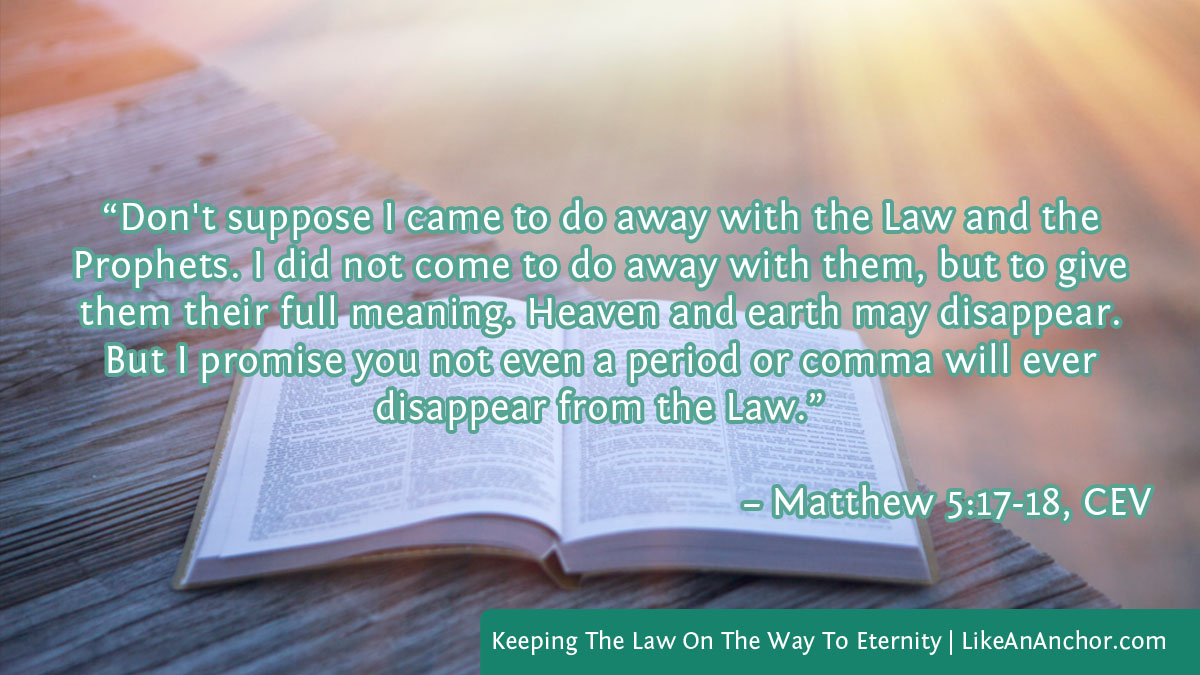
Image of an open Bible overlaid with text from Mat. 5:17-18, CEV version: “Don't suppose I came to do away with the Law and the Prophets. I did not come to do away with them, but to give them their full meaning. Heaven and earth may disappear. But I promise you not even a period or comma will ever disappear from the Law.”
Image by Lamppost Collective from Lightstock

Letter v. Spirit

Jesus explains how to keep the commandments in a fulfilled manner by contrasting the way things had been done with the way He wants them done. We might think of it as the letter of the law contrasted with God’s spirit and intent behind the law. Or better yet, we can say Jesus is clarifying God’s purpose for the Law. For example:

You have heard that it was said to the ancient ones, ‘You shall not murder;’ and ‘Whoever murders will be in danger of the judgment.’ But I tell you, that everyone who is angry with his brother without a cause will be in danger of the judgment; and whoever says to his brother, ‘Raca!’ will be in danger of the council; and whoever says, ‘You fool!’ will be in danger of the fire of Gehenna.

Matthew 5:21-22, WEB

It’s not enough to obey the law that says not to kill someone. Sin starts in the heart and that’s where God looks. He cares if you get to the point where you want to murder a person, not just if you actually violate the command “thou shalt not murder.” He even cares before you get to that point; if you’re unreasonably angry with someone or despise them as an empty headed fool, that’s enough to put you under judgement.

This pattern continued as Jesus kept teaching. Lusting after someone counts as adultery in your heart (Matt. 5:27-28). Divorce shouldn’t be done nearly so often (Matt. 5:31-32). Straightforward communication is better than swearing oaths (Matt. 5:33-37). We’re not to follow the human impulse to retaliate, even though it was allowed under the law (Matt. 5:38-42). We need to love our enemies if we want to be God’s children (Matt. 5:43-48). In many ways, God expects more of New Covenant believers, not less.

Going Beyond Law-Keeping

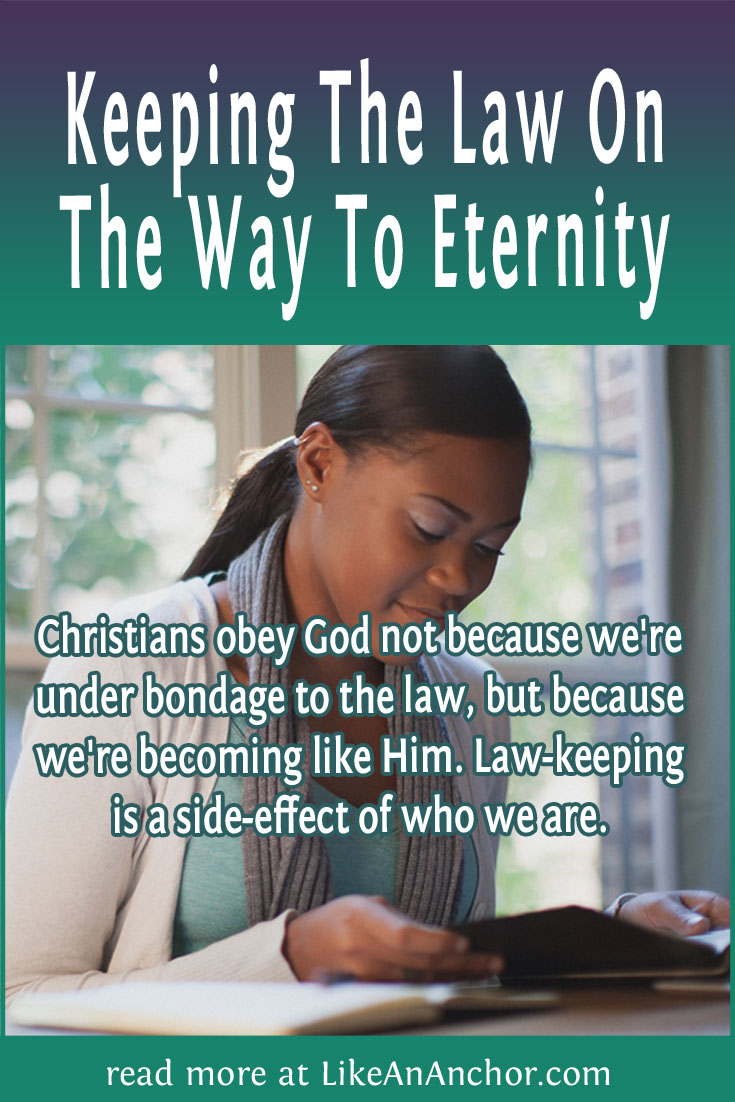
Image of a woman reading the Bible, overlaid with blog's title text and the words, "Christians obey God not because we're under bondage to the law, but because we're becoming like Him. Law-keeping is a side-effect of who we are."
Image by Pearl from Lightstock

Jesus’s expectations for His people go beyond the Law. The goals of living in the spirit reach higher than living by a strict code, though the spirit and letter both come from God and are connected. If we’re living in the spirit we are keeping the law on the way to becoming like God. Paul discussed this in Galatians, where he said, “walk by the Spirit, and you won’t fulfill the lust of the flesh” (Gal. 5:16, WEB).

Continuing in Galatians, Paul said, “if you are led by the Spirit, you are not under the law.” But right after saying that, he listed sinful things that spirit-led believers don’t do and says “those who practice such things will not inherit God’s Kingdom” (Gal. 5:18-21, WEB). He’s telling us that if we do things that break God’s laws, we won’t be in His kingdom even though the Law isn’t what saves us (Jesus does that).

We should keep the law because we’re walking in the spirit. It’s a side-effect of becoming like God. And so Christians today obey God, but they do it because they’re becoming like and following Him, not because they’re trying to make themselves righteous by their own power. It’s something we do on the way to eternity even though it’s not the method by which we get there.

Therefore you shall be perfect, just as your Father in heaven is perfect.

Matthew 5:48, WEB

Featured image by Matt Vasquez from Lightstock

Save

Addressing Disunity In The Churches of God

Recently, a friend shared a post titled “After 20 Years … there remains but a poor case for a divided Church of God.” It’s arguing that there’s no good excuse for the church of God to exist in different organizations. It broke apart because of doctrinal differences, but now people believing the same things are divided up into innumerable different groups. Why haven’t they got back together yet?

It’s a lamentation I’ve heard pretty much my entire life. My parents met attending the Worldwide Church of God and I was only 6 years old when the major split happened. I’ve grown up in off-shoots of that church group including United Church of God and various independent groups such as Christian Biblical Church of God and the now-nonexistant Bellville Church of God.

  • Quick note for my regular readers: this post is addressed to people in church groups that split off from the Worldwide Church of God (most in 1995) due to major doctrinal differences. If you read something here that seems “odd” it’s probably because of not sharing my target audience’s background. Please bear with me going off on this specific topic for one post 🙂

I don’t really remember Worldwide. But I’ve heard about the huge church groups with hundreds of attendees each week and the Feasts of Tabernacles where multiple thousands gathered to celebrate God’s holy days. I’ve heard (and still hear) Herbert Armstrong quoted in multiple sermons every year. I’ve seen groups trying to re-create the “good old days” when the church had a central government, word-wide cultural influence, and its own university. And I read articles like the one my friend shared that wonder why we don’t have that any more and urging a return to unity.

I’m writing my post today because I feel this type of argument is glossing over the true issues. Perhaps we’re so nostalgic for what was that we’re missing a greater what could be.

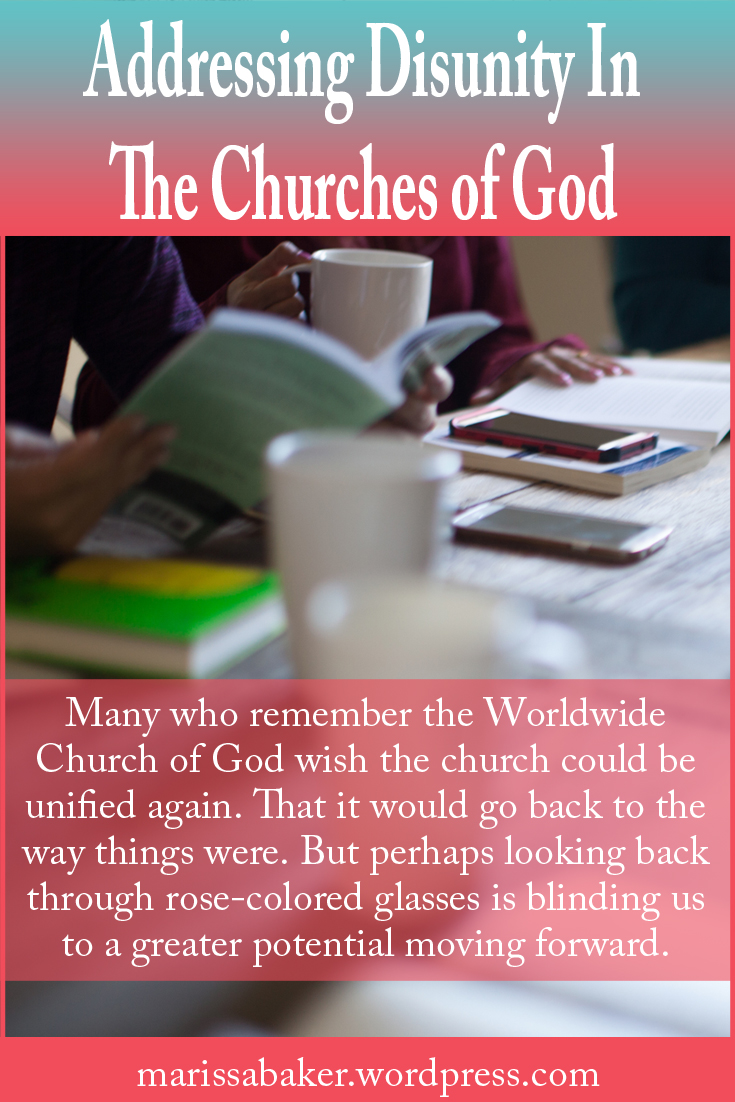
Addressing Disunity In The Churches of God | marissabaker.wordpress.com
Photo by Pearl, via Lightstock

Defining “Disunity”

First, we have to decide what we mean by disunity and division. This writer said he observed division when a church group of 800-1,000 people was split into four different congregations due to an administrative decision. He also describe the many different groups that grew out of a Worldwide background as currently disunified. It seems he means that division exists when all God’s people in a given location aren’t meeting together and when there are different church groups in existence instead of a single over-arching organization.

But is that an accurate description? Should we expect God’s church to all fall under one human label or to all meet in the same location? Or do some people just think that’s a good idea because that’s what they thought was going on in Worldwide? This gets to a key question: How does the Bible define “the church of God”? We can’t even try to be the ideal version of something until we know what that ideal version looks like. Read more

Firstfruits From the Rejects

All the holy days point to Jesus Christ, often in multiple ways. For the soon-approaching Pentecost — the Feast of Firstfruits — Jesus is Himself “the firstfruits of those who have fallen asleep” because He was the first of God’s people to raise from the dead to eternal life (1 Cor. 15:20-23). He’s also the one who redeemed us, making it possible for us to be firstfruits, and He’s the reason we receive the Holy Spirit, which was first given to the New Testament church on Pentecost (John 14:26; 16:7).

On the surface, the term “firstfruits” simply refers to the first agricultural produce of the harvest season. In the Hebrew scriptures, firstfruits were offered to God before you harvested anything for yourself. This offering occurred after Passover on a Sunday morning and kicked-off the 50-day count to Pentecost (Lev. 23:1-21).

Firstfruits From the Rejects | marissabaker.wordpress.com
photo credit: “Barley” by Susanne Nilsson , CC BY-SA

Pentecost, also called the Feast of Weeks or Feast of Harvest, pays a key role in God’s plan. Even churches that no longer keep the other holy days often mark Pentecost because that’s when the Holy Spirit was given to the New Testament church (Acts 2:1-4). In Leviticus 23, instructions about the wave-sheaf, 50-day count, and Pentecost occupy more than 1/3 of the entire chapter. Clearly, there’s something here we’re supposed to take careful note of.

Gleanings and Ruth

Embedded in the holy days discussion of Leviticus 23 is a peculiar verse. It doesn’t seem related to the chapter’s subject, yet it follows immediately after the instructions about Pentecost.

When you reap the harvest of your land, you shall not wholly reap the corners of your field when you reap, nor shall you gather any gleaning from your harvest. You shall leave them for the poor and for the stranger: I am the Lord your God. (Lev. 23:22)

Why would God put this law in place while discussing the holy days? It doesn’t seem to make sense. It does, however, connect Pentecost with the story of Ruth. In Jewish tradition, Ruth is read every Pentecost, and perhaps that’s a clue as to why the law of gleanings is discussed here.

When Ruth and Naomi arrived in Bethlehem they’re both poor and Ruth was a “stranger,” a Moabitess instead of an Israelite. She more than qualified for gleaning under the law given in Leviticus, as well as the repetition in Deuteronomy 24:19 which added the “fatherless” and the “widow” to the list of those who could glean.

Instead of just letting Ruth glean, Boaz offered her protection (Ruth 2:9), provided food for her (2:14), and told his reapers to drop grain on purpose so she could glean as much as she wanted (2:15-16). When she first meets Boaz, Ruth’s relation to him is strikingly similar to us when first encountering Christ. He is good, and wealthy, and powerful while we have nothing. We don’t deserve anything from Him, and yet He offers us blessings beyond expectation.

Firstfruits From the Rejects | marissabaker.wordpress.com
photo credit: “Wheat” by Susanne Nilsson , CC BY-SA

Opening Salvation

When Jesus died, He opened up the covenants to non-Israelites. Prior to accepting His sacrifice, we were all “strangers from the covenants of promise, having no hope and without God in the world” (Eph. 2:12). We were the sort of people who couldn’t expect more than the gleanings.

But He answered [the Gentile woman] and said, “It is not good to take the children’s bread and throw it to the little dogs.” And she said, “Yes, Lord, yet even the little dogs eat the crumbs which fall from their masters’ table.” (Matt. 15:26-27)

Jesus did honor this woman’s faith and heal her daughter (Matt. 15:21-28), but by-and-large people outside Israel didn’t have access to God before the cross. Strangers who converted, like Ruth (Ruth 1:16; 2:12), were the exception rather than the rule. That didn’t really happen until after Christ’s Passover sacrifice, His ascension to the Father on wave-sheaf Sunday (click here for a timeline), and the Pentecost recorded in Acts 2.

Then Peter said to them, “Repent, and let every one of you be baptized in the name of Jesus Christ for the remission of sins; and you shall receive the gift of the Holy Spirit. For the promise is to you and to your children, and to all who are afar off, as many as the Lord our God will call.” (Acts 2:38-39)

Peter didn’t realize this included Gentiles until latter (Acts 10:34-35, 44-48; 11:18), but speaking by inspiration of the Spirit He still proclaimed salvation for all whom God calls. This was a huge step in God’s plan to save the world through Jesus Christ (John 3:16; 12:47), and it’s connected with Pentecost.

Redeemed Firstfruits

In the epistle of James, we’re told the Father “brought us forth by the word of truth, that we might be a kind of firstfruits of His creatures” (James 1:18). The church is composed of the first people God will “harvest” from the world. We’re a rather unusual sort of firstfruits, though.

For you see your calling, brethren, that not many wise according to the flesh, not many mighty, not many noble, are called. But God has chosen the foolish things of the world to put to shame the wise, and God has chosen the weak things of the world to put to shame the things which are mighty; and the base things of the world and the things which are despised God has chosen, and the things which are not, to bring to nothing the things that are, that no flesh should glory in His presence. (1 Cor. 1:26-29)

God picks us up from the things devalued and discarded by the world. In other words, He finds His firstfruits among the gleanings. He’s taking people who are underwhelming and overlooked and transforming us into something glorious. Like Ruth, we were strangers who are brought into fellowship with God’s people by a Redeemer (Ruth 2:20; Tit. 2:13-14).

Firstfruits From the Rejects | marissabaker.wordpress.com
photo credit: “Wheat” by Susanne Nilsson , CC BY-SA