Examining Our Relationship With God’s Restrictions

I’ve been rereading one of my favorite one-year devotional books, and I’d like to start today’s post by quoting part of one devotional entry.

God is holy, and we must conform to His holiness. This means restrictions on our behavior. But when the restraints become the essence of our faith, as they did for the Pharisees, we are far from the heart of God. … Faith is about following His character. That’s the whole point of obedience.

Chris Tiegreen, 365 Pocket Devotions, Day 49

It’s very easy for humans to go to extremes. On the one hand, you’ll meet Christians who build their lives around what they can and cannot do as if keeping the law perfectly can save them. On the other hand, you’ll meet Christians who say they don’t have to be obedient to God’s law because grace covers all that. The truth is somewhere in between. Obedience isn’t what saves us, but it is the right and proper response to receiving salvation. Having the right understanding of our relationship with God helps us have a right understanding of our relationship with His law.
Image of a man reading the Bible overlaid with text from John 14:15, NET version: “If you love me, you will obey my commandments.”
Image by Matt Vasquez from Lightstock

Start With Love

There are certain things that God expects from people who follow Him. It is much like any healthy relationship. I expect people that I am friends with to generally treat me well and follow a basic standard of good conduct, and they expect the same from me. If one of us violated these unspoken “rules” of friendship, the friendship would dissolve or at the very least become more distant. Healthy relationships require things like regular communication, trustworthiness, reciprocity, a way to resolve conflicts, and mutual respect for the other’s needs, morals, and boundaries.

Our relationship with God works the same way, and He doesn’t leave us guessing about how the relationship works. He invites us into a covenant relationship with Him and lets us know exactly what He expects from us as well as what we can expect from Him. It’s actually pretty simple, and can be boiled down into just two commandments:

Jesus said to him, “‘Love the Lord your God with all your heart, with all your soul, and with all your mind.’ This is the first and greatest commandment. The second is like it: ‘Love your neighbor as yourself.’ All the law and the prophets depend on these two commandments.”

Matthew 22:37-40, NET

There are lots of other commands in scripture, of course (both Old and New Testament), but they are all just elaborations on these two expectations. At the most basic level, God’s restrictions on our behavior are all connected to making sure that we love Him and love the people around us in the right way. Remembering that helps us have the right perspective on obedience.

Owe no one anything, except to love one another, for the one who loves his neighbor has fulfilled the law. For the commandments, “Do not commit adultery, do not murder, do not steal, do not covet,” (and if there is any other commandment) are summed up in this, “Love your neighbor as yourself.” Love does no wrong to a neighbor. Therefore love is the fulfillment of the law.

Romans 13:8-10, NET

I like how Paul frames all the “do not” commandments as telling us how to love the way God does. A lot of times people describe God’s laws as restrictive or oppressive or outdated, but at the heart of it all is healthy relationships with God and with other people. He wants what is best for us, and He wants a personal relationship with us. His instructions reflect that truth.

Check Your Heart
Image of a woman reading the Bible, overlaid with blog's title text and the words, "How and why we obey God is a matter of vital importance."
Image by Pearl from Lightstock

God knows what our motives are. He looks inside our hearts and searches our minds to understand us even better than we understand ourselves (1 Sam. 16:7; Jer. 17:5-10). He knows if we’re flippantly disregarding His laws because we don’t care about what He says, and He also knows if we’re obeying from wrong motives.

“Not everyone who says to me, ‘Lord, Lord,’ will enter into the kingdom of heaven—only the one who does the will of my Father in heaven. On that day, many will say to me, ‘Lord, Lord, didn’t we prophesy in your name, and cast out demons in your name, and do many powerful deeds in your name?’ Then I will declare to them, ‘I never knew you. Go away from me, you lawbreakers!’”

Matthew 7:21-23, NET

This has got to be one of the most sobering passages in the entire Bible. Jesus warns us that calling Him Lord is not enough to get into the kingdom of heaven. Even doing wonderful things in His name isn’t enough. Only those who do the Father’s will and are known by Jesus Christ will be in His kingdom.

“I am the good shepherd. I know my own and my own know me—just as the Father knows me and I know the Father …

“My sheep listen to my voice, and I know them, and they follow me. I give them eternal life, and they will never perish; no one will snatch them from my hand. My Father, who has given them to me, is greater than all, and no one can snatch them from my Father’s hand.” 

John 10:14-15, 27-29

Once again, it comes back to relationships. We must listen to Jesus and follow Him, “conforming to His holiness” and “following His character,” as Tiegreen puts it. So, how do you view the restrictions God places on our behavior?

As something you must do perfectly or else you’ll lose your salvation?

As something not worth bothering with?

As guides for how to live in close relationship with God and enjoy all the blessings that accompany adopting His character?

I don’t really like to think of God’s laws as “restrictions.” They do restrict my behavior, but I see them more as guides, guardrails, and insights into God’s character. We keep the law because we’re walking in the spirit; law-keeping is a side-effect of becoming like God. Christians today ought to obey God because we want to be like Him and follow Him faithfully, and His law tells us how to do that.


Featured image by Inbetween from Lightstock

Is God Unreasonable When He Asks Us To Give Things Up?

I’ve been thinking about this question since hearing a sermon on it last weekend. It’s a question I’d settled in my own mind some time ago, but I realized there’s an argument for why God’s expectations are reasonable that I hadn’t considered before.

People often accuse God of being unreasonable, particularly in the context of His commandments. It can be hard to accept that God has the right to ask us to give up things we might want or that He’s being reasonable in those requests. For example, we need look no farther than the gospel accounts.

The young man said to him, “I have wholeheartedly obeyed all these laws. What do I still lack?” Jesus said to him, “If you wish to be perfect, go sell your possessions and give the money to the poor, and you will have treasure in heaven. Then come, follow me.” But when the young man heard this he went away sorrowful, for he was very rich.

Matthew 19:20-22, NET

We don’t know exactly what was going on in this wealthy man’s mind or what he chose to do in response to Jesus’s statement, but we know that he was sad and that he walked away. He may, perhaps, have felt that Jesus’s instruction was unreasonable. If we were to ask Jesus, “What do I still lack?” there’s a very good chance He would give us a different response than to sell all our possessions, but I suspect it would be an equally challenging task.

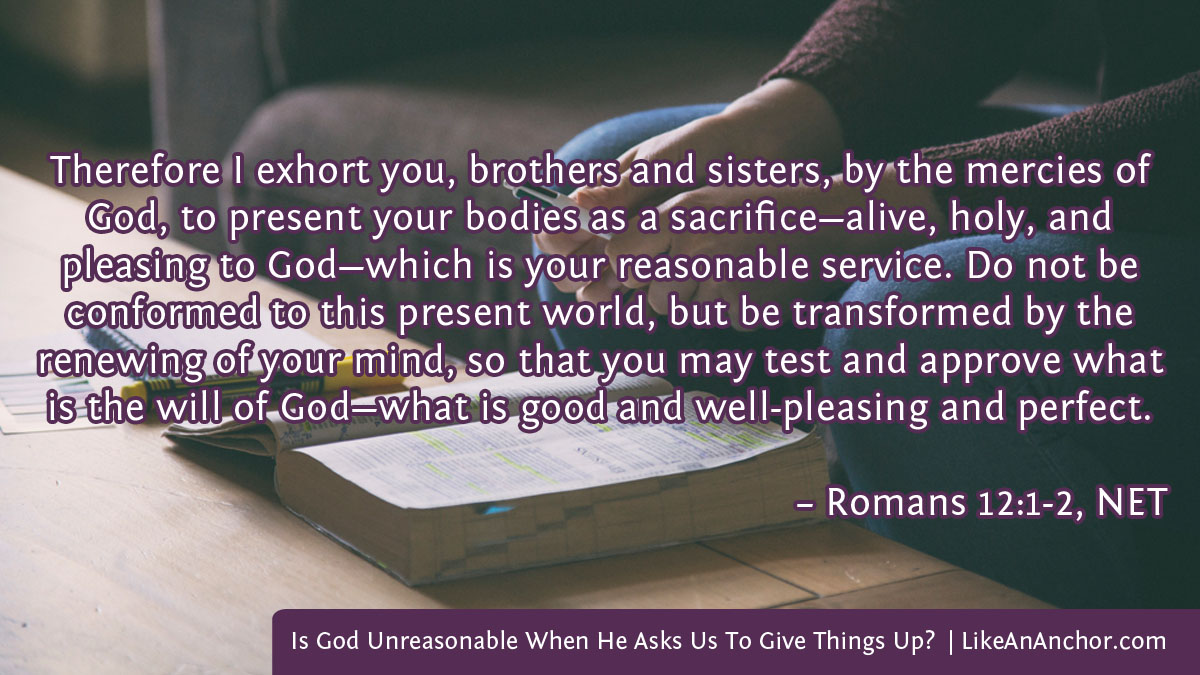
Image of a man sitting on a couch studying the Bible overlaid with text from Romans 12:1-2, NET version: "Therefore I exhort you, brothers and sisters, by the mercies of God, to present your bodies as a sacrifice—alive, holy, and pleasing to God—which is your reasonable service. Do not be conformed to this present world, but be transformed by the 
renewing of your mind, so that you may test and approve what is the will of God—what is good and well-pleasing and perfect."
Image by Chris Mainland from Lightstock

The Sovereignty of God

For me, God’s sovereignty is the first of two things that settled the questions of whether or not God’s demands are reasonable. He created humanity, including me, and the entire universe. His laws are simply part of the way the universe is structured. He has the right to tell us how to live because He is in charge and it is good of Him to tell us how to live because He knows what we need to do in order to get the best outcome.

 You will say to me then, “Why does he still find fault? For who has ever resisted his will?” But who indeed are you—a mere human being—to talk back to God? Does what is molded say to the molder, “Why have you made me like this? Has the potter no right to make from the same lump of clay one vessel for special use and another for ordinary use?

Romans 9:19-21, NET (bold italics mark a quotation from Isa 29:1645:9)

From the perspective that God has rights over what He created (including me), it was not terribly hard for me to make peace with things like not trying out for local theatrical productions because of performances and rehearsals on Friday evenings and Saturday. God has the right to designate certain days as holy and He wants me to keep His Sabbath, so I give up things that conflict with that. I grew up with the mindset that it’s just what you do and I never personally hit a point where I resented that. People in my church congregation would lose jobs, for example, because they wouldn’t work on Saturdays and that’s not something we compromise on. It always worked out in the end.

Jobs or hobbies that conflict with following Him are not the only thing God asks us to give up, though. He also asks us to give up revenge, inappropriate anger, selfishness, pettiness, bitterness, fear, and grudges. He asks us to give up any desires or actions that run counter to His laws. It is often much harder to bring your emotions and thoughts in line than your actions, though it is all closely connected, but God has the right to ask this of us.

Image of four people sitting around a table studying their bibles overlaid with text from 2 Cor. 6:16-18, NET version: "We are the temple of the living God, just as God said, “I will live in them and will walk among them, and I will be their God, and they will be my people.” Therefore “come out from their midst, and be separate,” says the Lord, “and touch no unclean thing, and I will welcome[e] you, and I will be a father to you, and you will be my sons and daughters.”
Image by Ben White from Lightstock

We Owe Him So Much

The second thing that settled the question of “Is God unreasonable?” for me is thinking of all the things He has done for us. This really hit me years ago when I started the Bible studies which eventually led to my first ebook God’s Love Story (available free when you subscribe to my newsletter). In the universe that God created and under His laws, “the compensation due sin is death” (Rom. 6:23, LEB). The outlook would be very bleak for us imperfect humans if it stopped there, “but the gift of God is eternal life in Christ Jesus our Lord” (Rom. 6:23, LEB). Jesus died in place of all who will accept His substitutionary sacrifice. Now, we are “the church of God that he obtained with the blood of his own Son” (Acts 20:28, NET). As such, we have certain obligations.

 Or don’t you know that your body is a temple of the Holy Spirit who is in you, whom you have from God? You are not your own, for you were bought with a price. Therefore glorify God in your body and in your spirit, which are God’s.

1 Corinthians 6:19-20, WEB

People in the modern world, particularly Western culture, tend to think of “grace” as a free gift with no expectation that those who receive grace would do anything afterwards. It wasn’t that way in Biblical culture. Grace, the Greek word charis, was linked to relationships and carried relational expectations. It’s connected to covenants, the type of relationship that God makes with His people. Grace is freely given, but with the expectation that those who accept this gift have reciprocal obligations. We don’t try to pay God back for what He’s done (it would be impossible), but we are supposed to respond a certain way because we’ve received such incredible gifts from Him (salvation, forgiveness, hope of eternal life). Because I have a grace-based, covenant relationship with God, it is reasonable of Him to ask things of me and for me to respond by doing as He says.

God’s Level of Commitment

Image of ____, overlaid with blog's title text and the words, "When God asks us to devote our entire lives to Him, it's a perfectly reasonable request if you understand what’s going on."
Image by Anggie from Lightstock

This third argument for why it’s reasonable of God to ask things of us is the one I hadn’t thought of before. Let us return, for a moment, to the story of the rich young man that we read at the beginning of this blog post. After the rich man walked away, Peter asked a question.

 Then Peter said to him, “Look, we have left everything to follow you! What then will there be for us?” Jesus said to them, “I tell you the truth: In the age when all things are renewed, when the Son of Man sits on his glorious throne, you who have followed me will also sit on twelve thrones, judging the twelve tribes of Israel. And whoever has left houses or brothers or sisters or father or mother or children or fields for my sake will receive a hundred times as much and will inherit eternal life.”

Matthew 19:27-29, NET

When Jesus called His 12 disciples who would (with the exception of Judas Iscariot) become apostles, they gave up their former lives to follow Him. A tax collector and several fishermen became the students of a traveling rabbi because they believed He was the promised Messiah sent from God. Understandably, Peter wondered what the pay-off would be. But Peter and all of us who follow Jesus aren’t the only ones who gave something up.

You should have the same attitude toward one another that Christ Jesus had,
who though he existed in the form of God
did not regard equality with God
as something to be grasped,
but emptied himself
by taking on the form of a slave,
by looking like other men,
and by sharing in human nature.
He humbled himself,
by becoming obedient to the point of death
—even death on a cross!

Philippians 2:5-8, NET

To slightly paraphrase the sermon that inspired this topic, “Peter gave up a fishing boat, Jesus gave up a throne.” Now, you might reply to this point that it wasn’t the same for Jesus because He got to go back to His throne and become immortal God again, but that’s basically the same reward that’s awaiting Peter and all the other faithful believers as well. We’re not going to be exalted as high as Jesus, but we will be welcomed into God’s family and made co-heirs with Jesus Christ.

God is 100% committed to expanding His family and building relationships with His people that will last into eternity. Jesus emptied Himself to share in human nature and die for us. When He asks us to be fully committed to Him, even if that means giving up some things we might like to keep, He’s not asking more of us than He was willing to do.

As the sovereign creator, the one who paid a high price to redeem us, and a leader who doesn’t ask of us anything He hasn’t done Himself, it is reasonable for God to have expectations from us. Not only that, but these expectations are good for us. His purpose is to give us eternal life. When God asks us to devote our entire lives to Him, it’s a reasonable request and we can do so willingly when we shift our perspective to reflect the reality of who God is and what He is doing.


Featured image by Pearl from Lightstock

Song Recommendation: “Who Am I” by Casting Crowns

Be Careful How You Listen

Are you a good listener?

Being a good listener is an important skill, and not one that everyone masters. There’s a difference between hearing something and really listening to it. I might hear that my husband is talking, for example, but if I’m distracted in the kitchen or thinking about something else I’m not really listening to him and might not even register what he says. The same is true when we’re interacting with God. We might hear or read His words, but unless we’re paying attention we aren’t actually listening.

As I was reading through Luke’s gospel in the Tree of Life translation, I noticed a phrase I hadn’t really thought about before: “So pay attention how you listen” (Luke 8:18, TLV). The other translations that I most frequently use say, “Be careful therefore how you hear” (WEB) and “So listen carefully” (NET). The New English Translation’s footnote says the Greek literally means “Take heed therefore how you hear” and it could also be translated, “Therefore pay close attention.”

God speaks to us. Most commonly through His written word, but also through other people inspired by His holy spirit and directly into our hearts and minds. We need to make sure we’re actively listening to His voice and acting on what we hear, not just hearing without doing.

Image of a man sitting at a table reading a Bible overlaid with text from  Ecc. 5:1, WEB version: Guard your steps when you go to God’s house; for to draw near to listen is better than to give the sacrifice of fools, for they don’t know that they do evil.
Image by Matt Vasquez from Lightstock

Context for Hearing

Whenever we’re looking at a passage from the Bible, it’s helpful to look at the context. An isolated phrase like this might seem to mean something on it’s own, but mean something else when read in the context of the rest of the sentence or passage. Or it might mean just what it seems to mean, but take on deeper significance when we read what’s going on around it. The latter is what’s happening in the case of this passage from Luke. In this section of the gospel account, Luke records Jesus’s parable of the sower. After hearing that parable, the disciples asked Jesus what it meant. Notice how often He mentioned hearing in His explanation:

He said, “You have been given the opportunity to know the secrets of the kingdom of God, but for others they are in parables, so that although they see they may not see, and although they hear they may not understand.

“Now the parable means this: The seed is the word of God. Those along the path are the ones who have heard; then the devil comes and takes away the word from their hearts, so that they may not believe and be saved. Those on the rock are the ones who receive the word with joy when they hear it, but they have no root. They believe for a while, but in a time of testing fall away. As for the seed that fell among thorns, these are the ones who hear, but as they go on their way they are choked by the worries and riches and pleasures of life, and their fruit does not mature. But as for the seed that landed on good soil, these are the ones who, after hearing the word, cling to it with an honest and good heart, and bear fruit with steadfast endurance.”

Luke 8:10-15, NET (bold italics mark a quotation from Is. 6:9)

Hearing the word of God is a starting point. But just hearing it doesn’t guarantee a good outcome. Sometimes the word is snatched away before it makes anything more than a surface-level impact. Sometimes people respond joyfully when they hear, but they don’t actually let it take deep root in their lives. Others hear, but the word isn’t as important to them as other things. And then there are the ones who hear, really listen, cling to the word at the heart-level, and then do something with what they heard.

“No one lights a lamp and then covers it with a jar or puts it under a bed, but puts it on a lampstand so that those who come in can see the light. For nothing is hidden that will not be revealed, and nothing concealed that will not be made known and brought to light. So listen carefully, for whoever has will be given more, but whoever does not have, even what he thinks he has will be taken from him.”

Luke 8:16-18, NET

If we do something with what we hear–if we listen and act on it–then that will become apparent in our lives. The more we use what we hear, the more God will give us to listen to.

Image of  a  young woman standing in church services reading a Bible with text from Deut. 5:1, NET version:  Then Moses called all the people of Israel together and said to them: “Listen, Israel, to the statutes and ordinances that I am about to deliver to you today; learn them and be careful to keep them!”
Image by José Roberto Roquel from Lightstock

The Greatest Commandment

When someone asked Jesus what the most important commandment was, He famously answered it’s to love God and to love your neighbor. The instruction to “love the lord your God” is a quote from the Deuteronomy 6 passage known as the Shema, and in Mark’s account Jesus quotes more of the passage than He did in Matthew.

Now one of the experts in the law came and heard them debating. When he saw that Jesus answered them well, he asked him, “Which commandment is the most important of all?” Jesus answered, “The most important is: ‘Listen, Israel, the Lord our God, the Lord is one. Love the Lord your God with all your heart, with all your soul, with all your mind, and with all your strength.’ The second is: ‘Love your neighbor as yourself.’ There is no other commandment greater than these.” 

Mark 12:28-31, NET (bold italics mark quotations from Deut. 6:4-5 and  Lev. 19:18)

The instruction to “listen” or “hear” (depending on the translation) is an important part of the commandment. According to The Bible project, “The opening line, ‘Hear, O Israel,’ does not simply mean to let sound waves enter your ears. Here, the word shema means to allow the words to sink in, provide understanding, and generate a response—it’s about action. In Hebrew, hearing and doing are the same thing” (Tim Mackie, “What’s the Meaning of the Jewish Shema Prayer in the Bible?”). Though the New Testament was written in Greek, Jesus and the other Jewish people who wrote the Bible were steeped in Hebrew thought. When they talked about hearing or listening, they would have thought about acting on what was heard. James talks about this in his epistle.

But be doers of the word, and not only hearers, deluding your own selves. For if anyone is a hearer of the word and not a doer, he is like a man looking at his natural face in a mirror; for he sees himself, and goes away, and immediately forgets what kind of man he was. But he who looks into the perfect law of freedom and continues, not being a hearer who forgets, but a doer of the work, this man will be blessed in what he does.

James 1:22-25, WEB

We need to “do” the law of God, not just hear it. The Bible–including the commandments and instructions–isn’t there just to be an interesting academic study. God shared His words to reveal His mind and character, and to show us how we ought to live in order to get the best outcome from our lives. Obeying His commandments is a way to connect with, understand, and become like Him if we really listen to Him and act on what we hear.

Hearing Builds Our Faith

Image of a woman doing Bible study, overlaid with blog's title text and the words, "We must actively listen when God speaks and act on what we hear, not just hear without doing."
Image by Anggie from Lightstock

Last week, we discussed a short phrase from Paul’s letter to Rome: “the obedience of faith.” Today’s post builds on that discussion in many ways, because faith is linked with what we hear from God.

 For everyone who calls on the name of the Lord will be saved. How are they to call on one they have not believed in? And how are they to believe in one they have not heard of? And how are they to hear without someone preaching to them? And how are they to preach unless they are sent? As it is written, “How timely is the arrival of those who proclaim the good news.” But not all have obeyed the good news, for Isaiah says, “Lord, who has believed our report?” Consequently faith comes from what is heard, and what is heard comes through the preached word of Christ.

Romans 10:13-17, NET (bold italics mark quotations from Isa. 52:7; 53:1; Nah. 1:15; Joel 2:32)

Faith is vital to our lives as Christians. According to Paul in this passage, faith comes from hearing the word of Jesus the Messiah. That would be all the words that came from Him (Old and New Testament) as well as the words about Him. Put that together with what James wrote and what Paul said here about obeying the good news, and we know that hearing the words isn’t going to provide faith on it’s own–it’s listening to and putting the words into action, just as is implied by the Hebrew word shema. Then, once we have a starting faith, we keep adding on to it as we grow in the knowledge of Jesus Christ.

 May grace and peace be lavished on you as you grow in the rich knowledge of God and of Jesus our Lord! …

For this very reason, make every effort to add to your faith excellence, to excellence, knowledge; to knowledge, self-control; to self-control, perseverance; to perseverance, godliness; to godliness, brotherly affection; to brotherly affection, unselfish love. For if these things are really yours and are continually increasing, they will keep you from becoming ineffective and unproductive in your pursuit of knowing our Lord Jesus Christ more intimately.

2 Peter 1:2, 5-8, NET

As we continue to learn and grow as Christians, it’s vital that we put into practice what we hear. Head-knowledge isn’t going to cut it–we need to know Jesus and the Father, not just know about them. Living, vibrant faith is relational, and relationships involve listening closely and taking action to keep that relationship healthy.


Featured image by Brightside Creative from Lightstock

The Obedience of Faith

Romans is one of my favorite books in the Bible. I think it’s because there’s so much depth to it. I like the challenge of reading the book and interpreting it correctly, as well as the profound and encouraging truth contained in this letter. One of the things that makes Romans unique is that Paul was writing to a church he hadn’t visited. It’s an introduction rather than a letter that addresses specific issues he knew about in a congregation. As such, Romans includes statements where Paul explains his theology and his responsibilities as an apostle. The statement that caught my eye and prompted today’s study is found at the beginning of the letter.

From Paul, a slave of Christ Jesus, called to be an apostle, set apart for the gospel of God. This gospel he promised beforehand through his prophets in the holy scriptures, concerning his Son who was a descendant of David with reference to the flesh, who was appointed the Son-of-God-in-power according to the Holy Spirit by the resurrection from the dead, Jesus Christ our Lord. Through him we have received grace and our apostleship to bring about the obedience of faith among all the Gentiles on behalf of his name. You also are among them, called to belong to Jesus Christ. To all those loved by God in Rome, called to be saints: Grace and peace to you from God our Father and the Lord Jesus Christ!

Romans 1:1-7, NET

The specific phrase I want to look at today is “the obedience of faith.” Often, we modern people think of faith as a belief system that we intellectually agree with rather than something that requires obedient action. We make a mistake if we think like that. Faith is an active thing and it’s inextricably linked with obeying God.

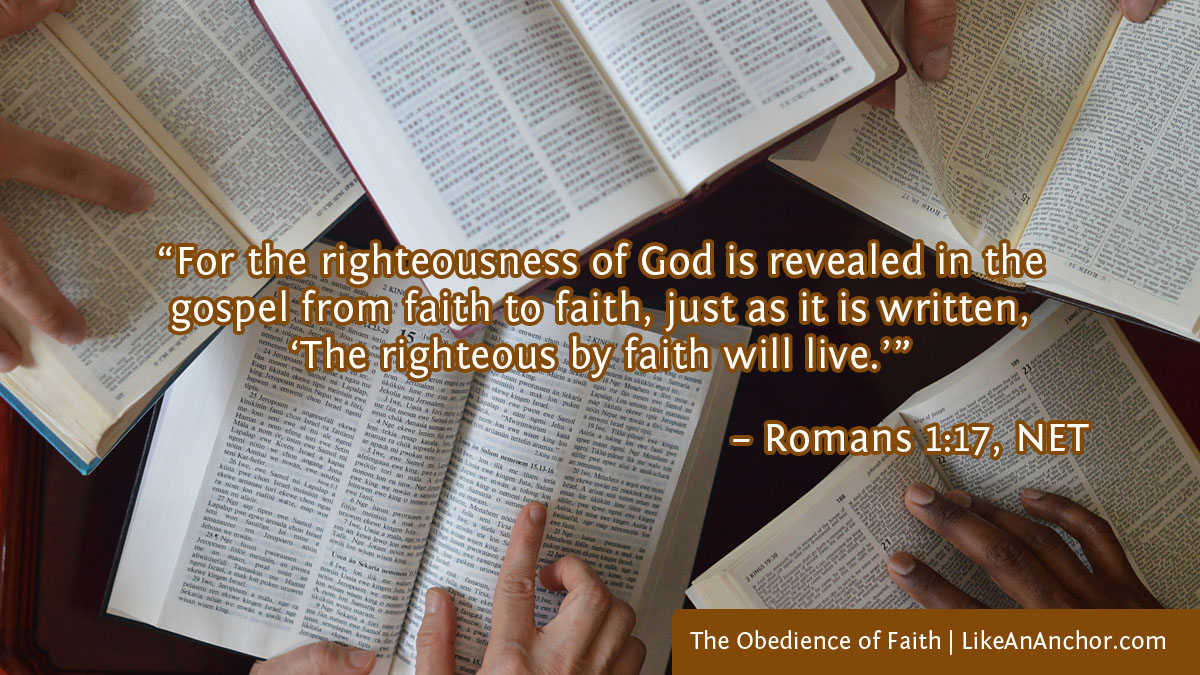
Image of five bibles open on a table with people's hands resting on the pages. This image is overlaid with text from Romans 1:17, NET version: "“For the righteousness of God is revealed in the gospel from faith to faith, just as it is written, ‘The righteous by faith will live.’”
Image by Inbetween from Lightstock

To Bring About Obedience

Through him we have received grace and our apostleship to bring about the obedience of faith among all the Gentiles on behalf of his name.

Romans 1:5, NET

As with much of Romans, the phrase “obedience of faith” has generated scholarly debate about the correct interpretation. Some say that it means obeying “the Christian faith” and others that it means “the obedience faith produces [or requires].” It could also be “an attributive genitive (‘believing obedience’)” or a case where “‘faith’ further defines ‘obedience.’” Finally, the phrase could be “deliberately ambiguous” (NET footnote on Rom. 1:5). As you’ll see, I tend to favor the “obedience faith produces/requires” interpretation.

One thing I find very interesting is that Paul says they received grace and their apostleship “to bring about the obedience of faith among all the Gentiles.” People often say that Romans is Paul’s explanation for why Gentiles (e.g. non-Jewish people) who believe in Jesus as the Messiah don’t have to obey the law. But from the very start of this letter, Paul points out that being a faithful Gentile involves obedience. We can debate exactly what they’re obeying and how to read this phrase, but the link between faith and obedience is unmistakable. And this isn’t the only time Paul mentions it. He circles back to a very similar phrase near the end of the letter.

But I have written more boldly to you on some points so as to remind you, because of the grace given to me by God to be a minister of Christ Jesus to the Gentiles. I serve the gospel of God like a priest, so that the Gentiles may become an acceptable offering, sanctified by the Holy Spirit.

So I boast in Christ Jesus about the things that pertain to God. For I will not dare to speak of anything except what Christ has accomplished through me in order to bring about the obedience of the Gentiles, by word and deed, in the power of signs and wonders, in the power of the Spirit of God. So from Jerusalem even as far as Illyricum I have fully preached the gospel of Christ.

Romans 15:15-19, NET

Once again, Paul says that he received grace from God to be a minister to the Gentiles. His goal is that they become sanctified–holy and set-apart for God. He also says the goal of the wonderous things that Christ accomplished through him was “to bring about the obedience of the Gentiles.” Faith isn’t mentioned here, leaving what they’re to obey open to interpretation if we haven’t read the rest of the letter. If we have read the whole letter, though, then we have a pretty good idea as to what Paul means when he says obedience.

Back at the beginning of the letter, Paul says that God “will reward each one according to his works: eternal life to those who by perseverance in good works seek glory and honor and immortality, but wrath and anger to those who live in selfish ambition and do not obey the truth but follow unrighteousness” (Rom. 2:6-7, bold italics mark a quotation from Ps. 62:12 and Prov. 24:12). If we want eternal life, then we need to obey the truth, follow righteousness, and do good works. This “obedience of faith” is so important that Paul ends the letter with the phrase as well as beginning it.

Now to him who is able to strengthen you according to my gospel and the proclamation of Jesus Christ, according to the revelation of the mystery that had been kept secret for long ages, but now is disclosed, and through the prophetic scriptures has been made known to all the nations, according to the command of the eternal God, to bring about the obedience of faith—to the only wise God, through Jesus Christ, be glory forever! Amen.

Romans 16:25-27, NET
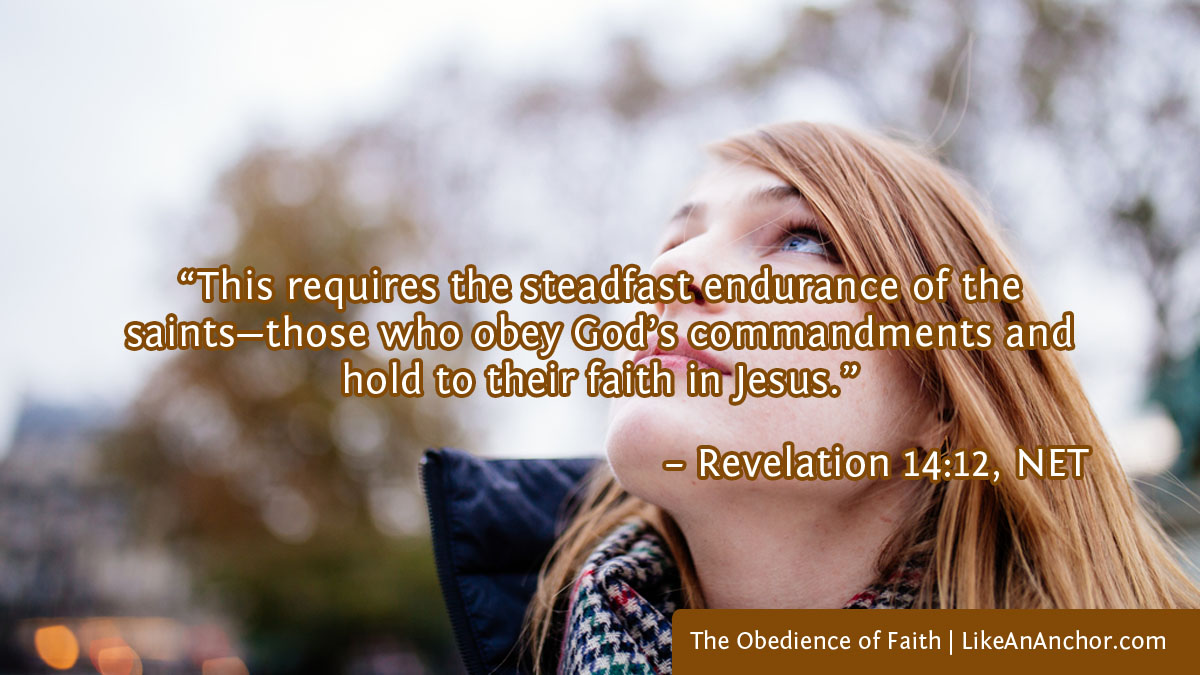
Image of a woman looking up at the sky overlaid with text from Rev. 14:12, NET version: “This requires the steadfast endurance of the saints—those who obey God’s commandments and hold to their faith in Jesus.”
Image by Brightside Creative from Lightstock

Righteousness and Faith

Reading Romans as a whole gives us a fuller picture of Paul’s view of faith, obedience, and the law of God than we could ever get from taking just a few verses in isolation. He does say we’re “not under the law,” but in saying that he doesn’t mean we shouldn’t obey God. Paul sets up the question of obedience for Christians as a choice between two masters. We don’t get the option to not obey someone. Either we’re obeying and serving God or we’re obeying and serving His adversary.

So you too consider yourselves dead to sin, but alive to God in Christ Jesus.

Therefore do not let sin reign in your mortal body so that you obey its desires, and do not present your members to sin as instruments to be used for unrighteousness, but present yourselves to God as those who are alive from the dead and your members to God as instruments to be used for righteousness. For sin will have no mastery over you, because you are not under law but under grace.

What then? Shall we sin because we are not under law but under grace? Absolutely not! Do you not know that if you present yourselves as obedient slaves, you are slaves of the one you obey, either of sin resulting in death, or obedience resulting in righteousness? But thanks be to God that though you were slaves to sin, you obeyed from the heart that pattern of teaching you were entrusted to, and having been freed from sin, you became enslaved to righteousness. 

Romans 6:11-18, NET

We’re not under the penalty of the law or under a covenant that’s only based on an external law. We’re under grace and under a covenant where God puts His law inside our hearts. God has taken things to another level with the New Covenant, and our “obedience resulting in righteousness” has to come “from the heart.”

For Moses writes about the righteousness that is by the law: “The one who does these things will live by them.” But the righteousness that is by faith says … “The word is near you, in your mouth and in your heart” (that is, the word of faith that we preach), because if you confess with your mouth that Jesus is Lord and believe in your heart that God raised him from the dead, you will be saved. For with the heart one believes and thus has righteousness  and with the mouth one confesses and thus has salvation. For the scripture says, “Everyone who believes in him will not be put to shame.” For there is no distinction between the Jew and the Greek, for the same Lord is Lord of all, who richly blesses all who call on him. For everyone who calls on the name of the Lord will be saved.

How are they to call on one they have not believed in? And how are they to believe in one they have not heard of? And how are they to hear without someone preaching to them? And how are they to preach unless they are sent? … Consequently faith comes from what is heard, and what is heard comes through the preached word of Christ.

Romans 10:5, 8-15, 17, NET (bold italics mark quotations from Lev. 18:5; Deut. 30:14; Is. 28:16; Joel 2:32)

Notice that when Paul explains “the righteousness that is by the law” and “the righteousness that is by faith,” he quotes from the Torah both times (first from Leviticus and then from Deuteronomy). God has always wanted a heart-connection with His people. He’s been setting things up so we could get to an intimate relationship with Him from the very beginning, but it wasn’t widely possible until Jesus’s sacrifice enabled forgiveness and reconciliation to God (note that some people, like King David, did have close relationships with God and received forgiveness in the Old Testament, but they were still waiting on the Messiah to fully accomplish the promised salvation [2 Sam. 12:13; Acts 4:11-12; 13:22; Heb. 11:39-40]).

Relational Obedience

Image of a woman reading the Bible, overlaid with blog's title text and the words, "One of the messages Paul emphasized in his letters to believers is that faith is linked to obedience."
Image by Pearl from Lightstock

God wants us to live righteous lives because we have a relationship with Him built on hearing His word and responding in faith, not because we think we can save ourselves by doing the things the law says. We can’t earn salvation by any of our own efforts, but when we receive the gift of salvation we’re supposed to respond in a certain way. In the first century, “grace” was a reciprocal concept–if you received such a great gift, then you owed the giver your loyalty even though you can’t pay back the debt. Similarly, “faith” was an active thing that involved living your whole life with trust, obedience, loyalty, and commitment to the covenant relationship you have with God.

We can see evidence of this perspective sprinkled throughout the New Testament. When “a large group of priests” started believing in Jesus as the Messiah, it’s said they “became obedient to the faith” (Acts 6:7, NET). When the author of Hebrews talks about Abraham’s example of faith, it says he demonstrated that faith by obeying God (Heb. 11:8). And in Revelation, “the saints” are defined as people “who obey God’s commandments and hold to their faith in Jesus” (Rev. 14:12, NET). Obedience and faith are inextricably linked.

You know that from your empty way of life inherited from your ancestors you were ransomed—not by perishable things like silver or gold, but by precious blood like that of an unblemished and spotless lamb, namely Christ. He was foreknown before the foundation of the world but was manifested in these last times for your sake. Through him you now trust in God, who raised him from the dead and gave him glory, so that your faith and hope are in God.

You have purified your souls by obeying the truth in order to show sincere mutual love. So love one another earnestly from a pure heart. You have been born anew, not from perishable but from imperishable seed, through the living and enduring word of God. 

1 Peter 1:18-23, NET

Salvation, forgiveness, redemption, purification–all of that can only be accomplished through the sacrifice of Jesus Christ. But we aren’t just passive recipients of those gifts. When Paul said, “with the heart one believes and thus has righteousness and with the mouth one confesses and thus has salvation” (Rom. 10:10, NET), the word “believes” is translated from pisteou–the verb (action) form of pistis, which is the Greek word translated “faith.” When you read “belief” or “believe” in the New Testament, it’s the action-word version of “faith.” We don’t even have that concept in English–faith is a noun (person, place, or thing) rather than something you do–but “faithing” is a key part of scripture. The work that God is doing in us to accomplish salvation is participatory, and that participation involves obedience (John 14:15; Phil. 1:27; 2:12-13; Gal. 6:7-9; 2 Pet. 1:5-10). Paul knew that, and he made sure his readers did as well. The obedience of faith is a vital aspect to walking with God.


Featured image by Matt Vasquez from Lightstock

Thinking About How Jesus Interacted With The Torah

Recently, I realized that The Bible Project, which I follow on YouTube, also has a podcast hosted by co-founders Tim Mackie  and Jon Collins. I started listening to their Deuteronomy series, which is the end of their walk through the Torah (first five books of the Bible) that spanned all of 2022. It’s been fascinating. I’ve never sat down with the Torah and meditated on it the way they describe doing, though I have read those five books of the Bible several times over the years.

Today, I want to talk about something mentioned in “Deuteronomy Scroll Episode 6: Jesus, Marriage, and the Law.” In this episode, they compare Deuteronomy 24:1-4 with Matthew 19:1-12 and take that as an example of how Jesus read and used the Law. This is a section of the Torah dealing with divorce and remarriage.

Then some Pharisees came to him in order to test him. They asked, “Is it lawful to divorce a wife for any cause?” He answered, “Have you not read that from the beginning the Creator made them male and female, and said, ‘For this reason a man will leave his father and mother and will be united with his wife, and the two will become one flesh’? So they are no longer two, but one flesh. Therefore what God has joined together, let no one separate.”

They said to him, “Why then did Moses command us to give a certificate of dismissal and to divorce her?” Jesus said to them, “Moses permitted you to divorce your wives because of your hard hearts, but from the beginning it was not this way. Now I say to you that whoever divorces his wife, except for immorality, and marries another commits adultery.”

Matthew 19:3-9, NET (bold italics mark OT quotes)

In this podcast episode, Tim and Jon point out that Jesus went back to Genesis to reveal God’s original ideal for marriage. In this particular situation, the Law (given through Moses) isn’t representative of what God wanted from the beginning. It is God’s concession for hard-hearted people living in a fallen world. In other words, God intended marriage to be permanent but in a world where that doesn’t always happen He gave guidelines for divorce. Here, Jesus says infidelity is a justifiable reason for divorce. Later, Paul says that if a believer has an unbelieving spouse who wants a divorce the believer isn’t “bound” to stay married (1 Cor. 7:15). As the Bible Project points out, this hints that Jesus’s statement in Matthew 19 wasn’t taken as a full expression of His views on divorce and remarriage, but rather as the proper way to interpret the specific law in question from Deuteronomy.

My purpose today isn’t to examine divorce and remarriage as a topic, but to use this as a jumping off point for meditating on Jesus’s relationship with the Law. I did something similar in my post “What Happens When God Takes Justice to the Next Level?” In that post, we went through the Sermon on the Mount, where Jesus reveals that He came to fill up the Law to a spiritual level, not destroy it. For example, He said it’s not enough for His followers to obey the command “thou shalt not murder;” He also expects us not to despise or condemn other people (Matt. 5:21-22). That’s very similar to what He does in Matthew 19. It’s not enough to follow the instructions for divorce; Jesus said that, ideally, God doesn’t want divorce to happen at all (though there are some times it can/will).

If you read a Bible that calls attention to Old Testament quotes in the New Testament (NET, for example, puts direct OT quotes in bold italics and allusions to OT passages in italics) then you’ll see that Jesus quoted from the Old Testament extensively. The Blue Letter Bible’s website has a list of quotes and allusions, which you can click here to view. They list 258 quotes or allusions to the Hebrew scriptures in the four gospel accounts, including many from Psalms, Isaiah, and the Torah (especially Deuteronomy and Leviticus). To make things more manageable for today’s post, we’ll just focus on Matthew. This book contains 102 of the quotes and allusions noted by Blue Letter Bible, though not all are quotes from Jesus; many are Matthew linking Jesus’s life to Old Testament prophecies (which is a different, though fascinating, topic).

Image of five bibles on a table for a study overlaid with text from Matt. 5:17, 19, NET version:  “Do not think that I have come to abolish the law or the prophets. I have not come to abolish these things but to fulfill them. ... So anyone who breaks one of the least of these commands and teaches others to do so will be called least in the kingdom of heaven, but whoever obeys them and teaches others to do so will be called great in the kingdom of heaven.”
Image by Inbetween from Lightstock

Useful for Everyday Living

The first time Matthew records Jesus quoting the Old Testament is during the temptation in the wilderness. Here, Jesus goes into the wilderness for 40 days and nights after His baptism. Then, Satan shows up and tries three times to tempt Jesus into sin. Jesus counters each of these temptations with a quote from Deuteronomy (Matt. 4:1-11).

This account highlights and reveals a couple interesting things. First, Jesus had these verses memorized. There’s a good chance, given what we know of first-century Jewish education, he could have had the whole Torah memorized. Second, Jesus’s main counter for an attack by Satan was to quote God’s law. Clearly, He found value in memorizing and living by these verses.

Similarly, Jesus quoted Deuteronomy when He gave practical instructions for resolving a disagreement between brothers in the faith, and may also have been alluding to Leviticus (Matt. 18:15-20; Lev. 19:15-17; Deut. 19:15). He uses principles from the Laws God gave for interacting with other people and upholding justice to show how we should resolve disagreements as His followers.

Additionally, Jesus told a young man who asked Him about eternal life, “‘if you want to enter into life, keep the commandments.’ ‘Which ones?’”’ he asked. Jesus replied, ‘“’Do not murder, do not commit adultery, do not steal, do not give false testimony, honor your father and mother, and love your neighbor as yourself‘” (Matt. 19:17-19, NET). There’s more to that story (Matt. 19:16-26), but for the topic we’re studying the main thing I want to point out is that Jesus taught familiar commandments from Exodus, Leviticus, and Deuteronomy as guides for heading toward eternal life. In short, He treated God’s laws from the Old Testament as something we should still follow that are useful for everyday life.

Back To God’s Intent

As I mentioned in the intro, Jesus quotes several Old Testament laws in the Sermon on the Mount. He does not say these laws are wrong or that we shouldn’t obey them. Rather, He counsels His listeners to pay attention to God’s intent behind the law and obey at a higher level. He expects more of us than simply keeping the Law. He expects us to become like God, who gave the law, and “be perfect, as your heavenly Father is perfect” (Matt. 5:48, NET). Later, He boils the Law down to the most important points.

And one of them, an expert in religious law, asked him a question to test him:  “Teacher, which commandment in the law is the greatest?” Jesus said to him, “‘Love the Lord your God with all your heart, with all your soul, and with all your mind.’ This is the first and greatest commandment. The second is like it: ‘Love your neighbor as yourself.’ All the law and the prophets depend on these two commandments.”

Matthew 22:35-40, NET

Here, Jesus quotes from Deuteronomy 6:5 and Leviticus 19:18. Love is the essence, or fulfillment, of God’s law (Rom. 13:8-10; Gal. 5:14). The other commandments in the Law are details; instructions on how to love God and love your neighbor. And based on Jesus’s conversations about the Law, we really should be doing even better than simply obeying the letter of the law. We need to obey God in the spirit and intent behind the law.

Be Wary of Human Ideas

Image of a woman reading the Bible, overlaid with blog's title text and the words, "We can study God's law, and Jesus's example of interacting with God's law, to learn more about Him and our role as His followers."
Image by Anggie from Lightstock

Now, thinking humanly, we might conclude that if Jesus wants us to keep the law even better, maybe we should put some extra guards around it. That’s a mistake people in Jesus’s day made, too, and He condemns the practice. People do not have the right to elevate human traditions to the level of doctrine, and they especially don’t have the right to replace something God commanded with anything else (Matt. 15:1-20).

Another error that Jesus pointed out was misinterpreting scriptures. One day the “Sadducees (who say there is no resurrection) came to him and asked him” about the levirate marriage law of Deuteronomy. He knew they really wanted to ask about the resurrection rather than that law, and He replied, “You are deceived, because you don’t know the scriptures or the power of God” and He quoted from Exodus to backup the truth of the resurrection (Matt. 22:23-33). In this case, human reasoning got in the way and these people tried to use one of the laws recorded by Moses to prove a point that law had nothing to do with.

When we read the psalms, especially Psalm 119, we see people meditating on God’s Law, loving His commandments, and praying for deeper understanding. We need to continue following that example. In many ways, obeying God is very simple: love Him and love your neighbor. But we’re not yet perfect; we aren’t yet fully “grown up” to be like Jesus Christ (Eph. 4:14-16). We are, however, being conformed to His image and having His mind formed in us (Rom. 8:28-29; 1 Cor. 2:15-16). We can study God’s law–and Jesus’s example of interacting with God’s law–to learn more about Him and our role as His followers.


Featured image by Matt Vasquez

Song Recommendation: “Thy Word” by Amy Grant

How Can A Christian Know When To Follow Human Authority and When To Obey God Rather Than Man?

I’ve been pondering the question posed in today’s title for a number of years now. How much obedience do we owe to human authorities, both inside and outside the church? Is a Christian allowed, per scripture, to speak against people in authority? Are they ever encouraged to stand up and fight against authority that is unjust and immoral? And why are churches, even those that preach the importance of obeying God’s word, so reluctant to talk about submission to authority passages like Romans 13:1-7 and 1  Peter 2:13-19?

Until fairly recently, this was mostly an intellectual puzzle for the American church. Then came questions about baking cakes for same-sex weddings, then whether or not to assemble for services when governors shut down states, now debates over the mask issue, and rising fears that a Covid vaccine might be the Mark of the Beast. We live in confusing times, and they’re forcing us to face questions and wrestle with decisions some of us haven’t had to deal with before.

Those of us who prize our independence might be angry about infringements on our freedom, wrestling with whether to follow our personal choices or do as we’re told. Those of us who struggle with anxiety might be scared — paralyzed, even — both by everything that’s going on and by not knowing what is the right thing to do. Those who are people-pleasers might be running up against the fact that we’ll need to pick a side and can’t make everyone happy.

Today’s post isn’t going to offer answers for the specific issues we’re facing right now. Rather, I hope to highlight scriptures that provide principles which we can use whenever we struggle with how to respond to human authority in a way that honors God. This is a question we will face at some point, if we aren’t facing it already. We need to be prepared to answer these questions, to ourselves and when asked by others, in a Biblically solid way. Read more