What An Incredible Privilege To Have A Relationship With God

After I posted last week’s article, “What Happened to the Ritual Uncleanness Laws After Jesus’s Sacrifice?” I continued meditating on the ramifications of the changes we talked about in that post. I find it especially amazing to think about the difference in how easy it is to access God now.

For example, let’s say I lived during a time in the Old Testament history when Israel was mostly faithful to God and there was a temple with priests serving in it. Something wonderful happens, and I want to thank Yahweh for this gift. I can just pray, but I’m not King David or a prophet and probably don’t have the gift of the Holy Spirit and so maybe it doesn’t feel like that’s the best way to get God’s attention. But I know that the Torah says people can offer an offering to Yahweh with thanksgiving as the motivation (Lev. 7:11-15). I get everything ready to take that offering to the priests, but then my period starts. Now, I’m ritually unclean for at least the next 7 days and I can’t go into the temple or touch any holy thing. If I bled longer than that, I’d have to count 7 days after the bleeding stops, then go to the priest with “two turtledoves, or two young pigeons” as an offering to become ritually clean again. There are actually quite a lot of things that can make me “unclean,” blocking my access to God. Even when I’m clean, I don’t have the same access that a priest would or even a prophet. God doesn’t talk with me, unless I find myself in very unusual circumstances.

Today, if I want to thank God for something, I can do so very easily. I can approach the Father directly in prayer through the name of Jesus Christ whenever I want, and it’s as if I’m stepping into the most holy parts of the temple to come into God’s presence (John 16:23-27; Heb. 10:19-22). There aren’t restrictions on when I can do that, or things that make me so unclean I can’t come to Him in prayer. Even if I sin (which results in a type of defilement that still damages relationship with God), I still get to go to God directly through Jesus to repent and ask for forgiveness (1 John 1:5-10; 2:1-6). I don’t have to go through any other person or do any rituals in order to access God.

I think we take that level of access to God for granted. It doesn’t seem unusual to us; that’s just how it’s always been because we’ve only experienced a relationship with Him under the New Covenant and not under the Old. But when we study Old Testament believers, even considering all the things we have in common with them, it also highlights how much changed with Jesus’s sacrifice. This sort of study can give us a greater appreciation of everything that God the Father and Jesus the Lamb have done for us.
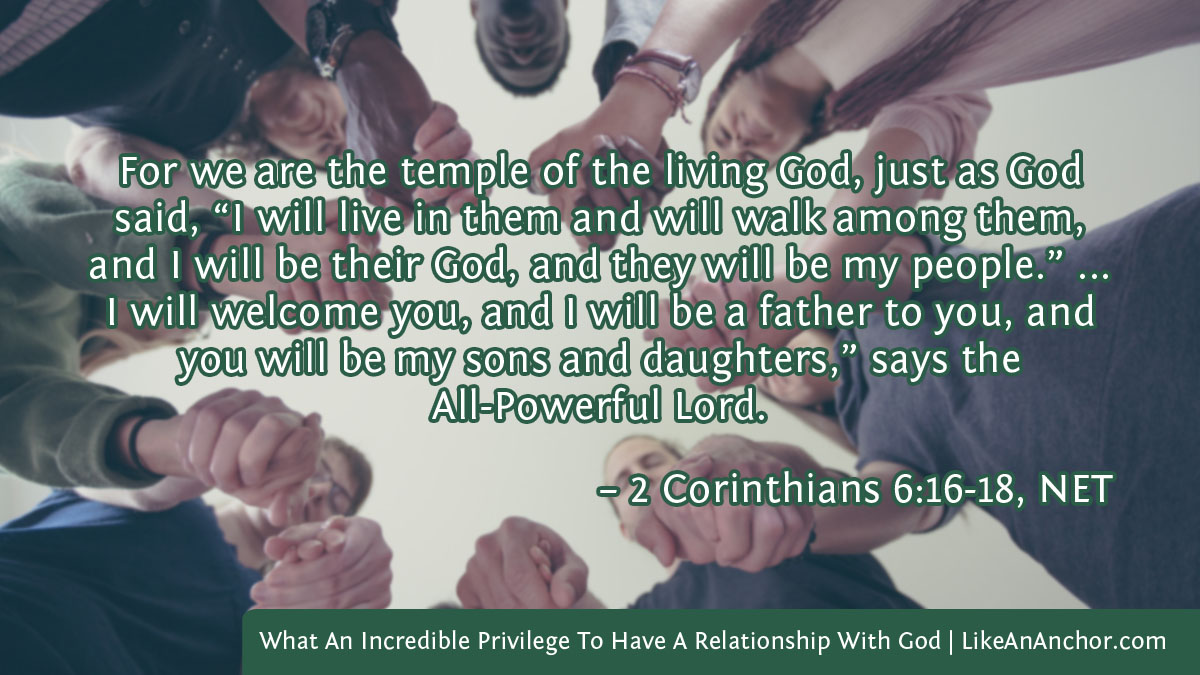
Image of a group of people holding hands to pray overlaid with text from 2 Cor. 6:16-18, NET version:  For we are the temple of the living God, just as God said, “I will live in them and will walk among them, and I will be their God, and they will be my people.” ... I will welcome you, and I will be a father to you, and you will be my sons and daughters,” says the All-Powerful Lord.
Image by Claudine Chaussé from Lightstock

A New, More Relational Covenant

If you’re reading this the day that it posted on my blog, then tomorrow night (the evening of April 21/beginning of Nisan 14) is when we’ll be keeping the Passover this year. When we keep the Passover as New Covenant Christians, it’s in remembrance of Jesus’s pivotal sacrifice and the commencement of the New Covenant.

For I received from the Lord what I also passed on to you, that the Lord Jesus on the night in which he was betrayed took bread, and after he had given thanks he broke it and said, “This is my body, which is for you. Do this in remembrance of me.” In the same way, he also took the cup after supper, saying, “This cup is the new covenant in my blood. Do this, every time you drink it, in remembrance of me.” For every time you eat this bread and drink the cup, you proclaim the Lord’s death until he comes.

1 Corinthians 11:23-26, NET

We’ll be gathering together to remember Jesus and what He did to enact a new covenant, which we’ve agreed to participate in. Passover commemorates the major turning point in God’s plan. For thousands of years, He’d promised His people that He would fix the relationship between them and replace the covenant that they broke with one that was even better. When Jesus died, that happened. The promised Messiah became the once-for-all-time sacrifice that forgives sin, the only High Priest we’ll ever need, and the Head of the body of believers that is the temple where God dwells.

But now Jesus has obtained a superior ministry, since the covenant that he mediates is also better and is enacted on better promises. For if that first covenant had been faultless, no one would have looked for a second one. But showing its fault, God says to them,

Look, the days are coming, says the Lord, when I will complete a new covenant with the house of Israel and with the house of Judah.
It will not be like the covenant that I made with their fathers, on the day when I took them by the hand to lead them out of Egypt, because they did not continue in my covenant and I had no regard for them, says the Lord.
For this is the covenant that I will establish with the house of Israel after those days, says the LordI will put my laws in their minds and I will inscribe them on their heartsAnd I will be their God and they will be my people.
And there will be no need at all for each one to teach his countryman or each one to teach his brother saying, ‘Know the Lord,’ since they will all know me, from the least to the greatest.
For I will be merciful toward their evil deeds, and their sins I will remember no longer.”

Hebrews 8:6-12, NET (bold italics mark a quotation from Jer 31:31-34)

God wants a deep relationship with His people. Notice His focus when describing the New Covenant. He’s writing His laws inside their minds and hearts (not just on scrolls they could hear someone else read). He’s inviting them to call Him their God and claiming them as His people. He promises, “they will all know me.” He also says He’ll be merciful to them and forget the sins that they should justly be punished for. He wants a new kind of relationship with people, one where they know Him at a heart-level and experience relational intimacy with Him. We have that new relationship now, or at least the opportunity for it, and we should appreciate what a great blessing that is.
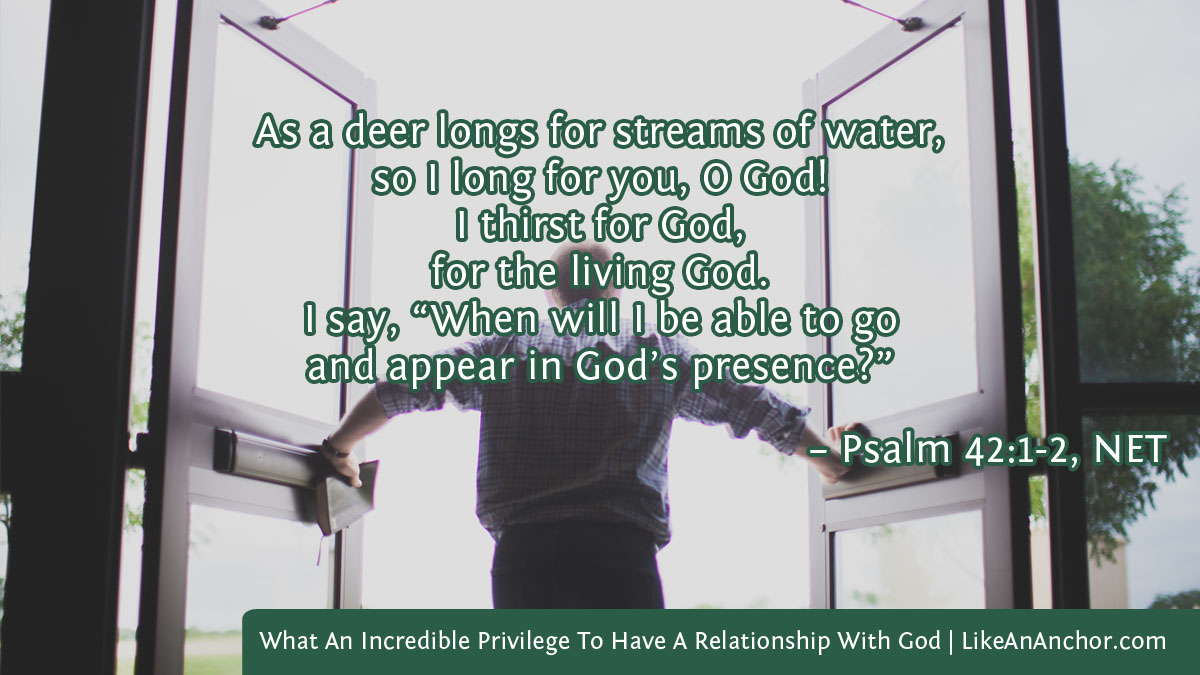
Image of a man pushing open doors and stepping outside overlaid with text from Psalm 42:1-2, NET version:  As a deer longs for streams of water, so I long for you, O God! I thirst for God, I say, “When will I be able to go and appear in God’s presence?”
Image by Pearl from Lightstock

Longing For God’s Presence

In the Old Testament, people placed a very high value on the privilege of encountering God’s presence, perhaps because it was more difficult for an average person to do that. They marvel that they’re able to visit God’s tabernacle or temple. They express delight in having any contact whatsoever with Yahweh. If God actually talked with them, they were awestruck and terrified.

David, one of God’s closest friends in the Old Testament, placed a very high value on the unique relationship he had with Yahweh. Speaking of himself, the king, he sang to God, “You make him glad with joy in your presence” (Ps. 21:6, WEB). When he committed a grave sin, he prayed, “Don’t throw me from your presence, and don’t take your Holy Spirit from me” (Ps. 51:11, WEB). David knew not to take God’s presence in his life for granted. It was precious, something to hold onto and value highly. Other psalmists had similar responses (Psalm 42:1-4; 73:28; 84:1-12).

How lovely are your dwellings,
    Yahweh of Armies!
My soul longs, and even faints for the courts of Yahweh.
    My heart and my flesh cry out for the living God. …

Blessed are those who dwell in your house.
    They are always praising you. …

For a day in your courts is better than a thousand.
    I would rather be a doorkeeper in the house of my God,
    than to dwell in the tents of wickedness.

Psalm 84:1-2, 4, 10, WEB

When was the last time you genuinely longed for God this way? When you cried out for Him because you wanted to be in His presence, not because you wanted something from Him? When you wanted to be near Him, praising Him alongside His other covenant people? When you’d rather be at God’s house or temple (in the New Covenant, that temple is His people) for even just one day than have a thousand days anywhere else?

I’ve sang this psalm before (“Better Is One Day” and “Doorkeeper“), but I think I’ve been guilty of leaving the sentiment in the psalm behind after the music ends. Sometimes I forget to ask God to be with me unless I’m feeling lonely or hurt or in need of something from Him. I’m not always excited to go to church services and sing to God, at least not so excited that it overshadows how much I look forward to anything else.

Better To Walk With God Than Any Other Way

Image of a woman with her hand raised, overlaid with blog's title text and the words, "Rather than take the close, personal relationship we have with God for granted, we should be incredibly thankful for our access to Him."
Image by Anggie from Lightstock

In the New Testament, expressions of thankfulness for the privilege of a close relationship with God seem quieter than the ones we find in the Old Testament. The New Testament doesn’t record new psalms or songs that highlight enthusiastic praises. Most of the New Testament is letters, and if we’re not paying close attention we might miss the passionate emotion behind those letters. But look at how Paul talked about his feelings regarding Jesus’s relationship with him.

 If someone thinks he has good reasons to put confidence in human credentials, I have more … But these assets I have come to regard as liabilities because of Christ. More than that, I now regard all things as liabilities compared to the far greater value of knowing Christ Jesus my Lord, for whom I have suffered the loss of all things—indeed, I regard them as dung!—that I may gain Christ, and be found in him, not because I have my own righteousness derived from the law, but because I have the righteousness that comes by way of Christ’s faithfulness—a righteousness from God that is in fact based on Christ’s faithfulness. My aim is to know him, to experience the power of his resurrection, to share in his sufferings, and to be like him in his death, and so, somehow, to attain to the resurrection from the dead.

Philippians 3:4, 7-11, NET

Paul is expressing a very similar sentiment to what we see in Psalm 84, it’s just not as poetical. His main goal is to know Jesus and become like Him. Nothing else can possibly compare to the great honor of being “found in Him,” no matter how impressive it might look from a human perspective.

See how great a love the Father has given to us, that we should be called children of God! For this cause the world doesn’t know us, because it didn’t know him. Beloved, now we are children of God. It is not yet revealed what we will be; but we know that when he is revealed, we will be like him; for we will see him just as he is.

1 John 3:1-2, WEB

When we really let it sink in that God is making us His children, we should marvel at the greatness of His love. We’ll even get to be like Him in the future and “see him just as he is.” This is a level of closeness and relationship that the people in the Old Testament could only dream about; the psalms rarely mention God as a Father-figure (Ps. 2:7; 68:5; 89:26; 103:13) and the promise “I will be a father to you, and you will be my sons and daughters” wasn’t explicitly clear until the New Covenant (2 Cor. 6:18, NET). The faithful Old Covenant believers will get to experience the same future that we do–they’ll “be made perfect together with us” (Heb. 11:39-40, NET)–but we have a fuller taste during our human lives of the relationship that God wants to have with His people.

Rather than take the close, personal relationship we have with God for granted, we should be even more thankful for our access to God than the people writing Psalms were. It’s incredible that we can talk to and spend time with the creator of the universe, and that He wants us to call Him our Abba, Father (Rom. 8:15). What an incredible privilege to have such a relationship with God!


Featured image by Pearl from Lightstock

Comparing Two Parables That Teach Us How to Wait for God’s Kingdom

If I mention the parable where a ruler travels to a far country and gives his servants money to do something with until he gets back, you likely think of the parable of the talents recorded in Matthew 25. It’s one of the most familiar parables in the Bible. There’s another parable in Luke 19, the parable of the minas, which I think is less familiar to people even though it’s very similar. I was curious to look at both and compare the two.

Chronologically, the Parable of the Minas comes first in the story of Jesus’s ministry. He shared this parable in Jericho as He was heading to Jerusalem for His final Passover (Luke 18:31; 19:1, 11, 28). The Parable of the Talents is also something He shared before His final Passover, but this time after He entered Jerusalem (Matt. 21); it’s part of what we call the Olivet Prophecy (Matt. 24-25). In between these parables, we have Jesus’s “Triumphal Entry” into Jerusalem (Matt. 21:1-11; Luke 19:28-40). As He approached the city, He sent two disciples ahead to fetch a donkey’s colt for Him to ride, fulfilling a prophecy recorded by Zechariah (Zech. 9:9).

As prophesied, “the whole crowd of his disciples began to rejoice and praise God with a loud voice for all the mighty works they had seen” (Luke 19:37, NET). They shouted praises to God, and connected Jesus’s entry to Jerusalem with a Messianic psalm, crying out “Hosanna to the Son of David! Blessed is the one who comes in the name of the Lord! Hosanna in the highest!” (Matt. 21:9-11, NET, quoting Ps 118:25-26). Hosanna literally means “Save us now” (Ps. 118:25, WEB) or “O Lord, save us” (NET footnote on Matthew 21:9).

They had Jesus’s identity right: He is the prophesied Messianic king. However, they didn’t understand that He was here this time to die for our sins and that His kingdom-bringing coming was still in the future. That misunderstanding is one of the reasons Jesus spoke the parables we’re looking at today.

Image of a young woman standing in church services with a Bible overlaid with text from Mark 4:10-11, NET version:  When he was alone, those around him with the twelve asked him about the parables. He said to them, “The secret of the kingdom of God has been given to you.”
Image by José Roberto Roquel from Lightstock

Kingdom Context

When Jesus entered Jericho on His way to Jerusalem, “a man named Zacchaeus … a chief tax collector” was so eager to see Him he climbed a tree to get up above the crowds. Jesus called to Him and said, “I must stay at your house today.” Zacchaeus was overjoyed, but the crowds murmured against Jesus for being “the guest of a man who is a sinner” because tax collectors were seen as traitors (NET footnote on Luke 3:12) (Luke 19:1-7).

But Zacchaeus stopped and said to the Lord, “Look, Lord, half of my possessions I now give to the poor, and if I have cheated anyone of anything, I am paying back four times as much!” Then Jesus said to him, “Today salvation has come to this household, because he too is a son of Abraham! For the Son of Man came to seek and to save the lost.”

While the people were listening to these things, Jesus proceeded to tell a parable, because he was near to Jerusalem, and because they thought that the kingdom of God was going to appear immediately.

Luke 19:8-11, NET

It’s not immediately apparent what the conversation with and about Zacchaeus might have to do with the parable of the minas, but that is clearly the context. Jesus makes the statement about salvation coming to Zacchaeus because “the Son of Man came to seek and to save the lost,” then immediately tells a parable to the people who were listening to those words. Luke tells us that Jesus shared this particular parable because people didn’t understand the timing for the kingdom of God.

Not long after, once Jesus was in Jerusalem, He spoke a parable about the kingdom, answered a question about the resurrection, and challenged people about how they viewed the Messiah (Matt. 22:1-14, 23-33, 41-46). He also spoke woes to “the experts in the law and the Pharisees” who taught God’s law, but don’t actually do what God expects (Matt. 23). Finally, as He walked away from the temple courts, He told His disciples that all those buildings would be torn down. This prompted them to ask Him a private question: “Tell us, when will these things happen? And what will be the sign of your coming and of the end of the age?” (Matt. 24:1-3, NET). Perhaps they’d understood the lesson of the first parable–the kingdom of God would not appear immediately–and now they wanted more information. Jesus did give them warning signs to watch out for, but rather than focusing on the “when,” He highlights how His disciples are to prepare for His second coming and what He expects from their conduct.

“Therefore you also must be ready, because the Son of Man will come at an hour when you do not expect him.

“Who then is the faithful and wise slave, whom the master has put in charge of his household, to give the other slaves their food at the proper time? Blessed is that slave whom the master finds at work when he comes. I tell you the truth, the master will put him in charge of all his possessions. But if that evil slave should say to himself, ‘My master is staying away a long time,’ and he begins to beat his fellow slaves and to eat and drink with drunkards, then the master of that slave will come on a day when he does not expect him and at an hour he does not foresee, and will cut him in two, and assign him a place with the hypocrites, where there will be weeping and gnashing of teeth.

Matthew 24:46-51, NET

This warning is the immediate lead-in to the parable of the 10 virgins, the parable of the talents, and the parable of the sheep and the goats. The word “slave” is used both here in the warning about being ready and in the parables of the talents and minas. In Greek, it’s the word doulos (G1401). It’s often translated “servant,” but “slave” or “bondservant” is a better translation. Doulos means “one who is in a permanent relation of servitude to another, his will being altogether consumed in the will of the other” (The Complete WordStudy Dictionary: New Testament, Spiros Zodhiates, entry 1401). It could be involuntary slavery, or voluntary and total submission to God. Paul and other apostles frequently use the word to refer to themselves and others serving God, including at times every Christian (Rom. 1:1; Gal. 1:10; Phil. 1:1; Col. 4:12; 2 Tim. 2:24; Tit. 1:1; Jas. 1:1; 1 Pet. 2:16; 2 Pet. 1:1; Jude 1:1). Even Jesus Himself was a doulos of the Father (Phil. 2:7).

I wanted to spend some time on this word before we get into the parables themselves because it’s easy to misunderstand, whichever translation you’re reading. The people in these parables are not hired servants who can just walk away whenever they want, but they’re also not in the terrible, involuntary condition that we think of when we read “slave” with our modern eyes. They are bound to the king in the parable the same way Paul was bound to Jesus Christ and God the Father.

Image of a man reading the Bible overlaid with text from 1 Pet. 2:15-16, WEB version: " For this is the will of God, that by well-doing you should put to silence the ignorance of foolish men: as free, and not using your freedom for a cloak of wickedness, but as bondservants of God."
Image by Matt Vasquez from Lightstock

The King Goes Away

The two parables begin in a similar fashion.

 Therefore he said, “A nobleman went to a distant country to receive for himself a kingdom and then return. And he summoned ten of his slaves, gave them ten minas, and said to them, ‘Do business with these until I come back.’ But his citizens hated him and sent a delegation after him, saying, ‘We do not want this man to be king over us!’ 

Luke 19: 12-16, NET

“For it is like a man going on a journey, who summoned his slaves and entrusted his property to them. To one he gave five talents, to another two, and to another one, each according to his ability. Then he went on his journey.”

Matthew 25:14-15, NET

We’re talking about a lot of money in these parables. For the first, “A mina was a Greek monetary unit worth 100 denarii or about four months’ wages for an average worker based on a six-day work week” (NET footnote on Luke 19:13). Putting that in perspective, the median income of an American in 2022 was $37,600 a year, so four month’s wages would be about $12,533. That’s a pretty large sum of money to hand someone all at once, but the amount in the second parable is even larger.

In the second parable, Jesus says the man gives his slaves a talent. This “was a huge sum of money, equal to 6,000 denarii. One denarius was the usual day’s wage for a worker” (NET footnote on Matt. 18:24). That’s about 250 months, or almost 21 years worth of an average worker’s wages. Using our median American salary again, it’s about $783,333 for one talent. The one who got five talents would have about $3.9 million. A mina is a decent chunk of money, but a talent is an unbelievably large sum.

I wonder what people thought hearing these parables, especially the people who heard both parables. The 12 disciples would have heard both, and I doubt they were alone in following Jesus all the way to Jerusalem and continuing to listen to Him. Imagine yourself listening to that first parable, possibly putting yourself inside the story. The boss called you, one of just 10 employees, and said, “Here’s $12,500 to do business with until I get back. Let’s see how you handle it.” Then you listen to the second parable, and it’s a similar situation except this time the boss calls just three of you in and gives one person $800,000, one person $1.6 million, and the last person $3.9 million. It might seem unfair, or leave you confused. You’d be hanging on every one of Jesus’s words to find out what happened next.

Image of a smiling woman reading the Bible overlaid with text from Matt. 24:42, NET version: “Therefore stay alert, because you do not know on what day your Lord will come.”
Image by Pearl from Lightstock

The Rewards

Some time passes in both parables. We don’t know how much, but there’s time for the bondservants to conduct business and increase the money they’d been entrusted with. Then the ruler returns, apparently without sending advance notice of the date of his arrival, the same way Jesus says He will at His second coming.

When he returned after receiving the kingdom, he summoned these slaves to whom he had given the money. He wanted to know how much they had earned by trading. So the first one came before him and said, ‘Sir, your mina has made ten minas more.’ And the king said to him, ‘Well done, good slave! Because you have been faithful in a very small matter, you will have authority over ten cities.’ Then the second one came and said, ‘Sir, your mina has made five minas.’ So the king said to him, ‘And you are to be over five cities.’ 

Luke 19: 15-18, NET

In this parable, the rewards are directly tied to the outcome. The king gave each bondservant identical amounts of money, and he rewarded them according to what they’d done with the money. The parable of the talents flips this.

 The one who had received five talents went off right away and put his money to work and gained five more. In the same way, the one who had two gained two more. But the one who had received one talent went out and dug a hole in the ground and hid his master’s money in it. After a long time, the master of those slaves came and settled his accounts with them. The one who had received the five talents came and brought five more, saying, ‘Sir, you entrusted me with five talents. See, I have gained five more.’ His master answered, ‘Well done, good and faithful slave! You have been faithful in a few things. I will put you in charge of many things. Enter into the joy of your master.’ The one with the two talents also came and said, ‘Sir, you entrusted two talents to me. See, I have gained two more.’ His master answered, ‘Well done, good and faithful slave! You have been faithful with a few things. I will put you in charge of many things. Enter into the joy of your master.’

Matthew 25:16-23, NET

In this parable, the bondservants were given different amounts of money, to “each according to his ability” (Matt. 25:18, NET). Then the king came back, and the two who’d doubled the amount of money were given the same commendation for faithfulness and the promise that the king would put them “in charge of many things.”

I find it interesting that in the parable of the minas, everyone gets the same gift and then the rewards reflect what they did with the gift. Then in the parable of the talents, the gifts reflect the people’s known abilities and when they do something with the gift, they receive the same commendation. Taken together, I find both of them reassuring messages. They indicate that while God does pay attention to our abilities and what we do with the gifts He gives us, everyone who does something with those gifts receives a reward. And it’s a good reward, often with very little difference between what you get and what someone else gets.

Image of a man praying with a Bible overlaid with text from 2 Timothy 4:8, NET version: "Finally the crown of righteousness is reserved for me. The Lord, the righteous Judge, will award it to me in that day—and not to me only, but also to all who have set their affection on his appearing."
Image by WhoisliketheLord Studio from Lightstock

The One Who Did Nothing

If the parables stopped there, the message wouldn’t contain any warning or urgency. But Jesus is trying to teach people about the kingdom of God. He wants them to know it’s not happening right now, but that they need to be doing something while they wait. And so we return to one last bondservant, one who didn’t do as the ruler expected with the gift he’d received.

Then another slave came and said, ‘Sir, here is your mina that I put away for safekeeping in a piece of cloth. For I was afraid of you, because you are a severe man. You withdraw what you did not deposit and reap what you did not sow.’ The king said to him, ‘I will judge you by your own words, you wicked slave! So you knew, did you, that I was a severe man, withdrawing what I didn’t deposit and reaping what I didn’t sow? Why then didn’t you put my money in the bank, so that when I returned I could have collected it with interest?’ And he said to his attendants, ‘Take the mina from him, and give it to the one who has ten.’ But they said to him, ‘Sir, he has ten minas already!’ ‘I tell you that everyone who has will be given more, but from the one who does not have, even what he has will be taken away.’”

Luke 19: 20-26, NET

Then the one who had received the one talent came and said, ‘Sir, I knew that you were a hard man, harvesting where you did not sow, and gathering where you did not scatter seed, so I was afraid, and I went and hid your talent in the ground. See, you have what is yours.’ But his master answered, ‘Evil and lazy slave! So you knew that I harvest where I didn’t sow and gather where I didn’t scatter? Then you should have deposited my money with the bankers, and on my return I would have received my money back with interest! Therefore take the talent from him and give it to the one who has ten. For the one who has will be given more, and he will have more than enough. But the one who does not have, even what he has will be taken from him. And throw that worthless slave into the outer darkness, where there will be weeping and gnashing of teeth.’

Matthew 25:24-30, NET

The phrasing is almost exactly the same in the two parables. One bondservant hid the mina or talent and said it was because he was afraid. The ruler is harsh, he explained, and so it was better not to do anything at all. Maybe the bondservant was afraid of losing money, of not measuring up, and so he was paralyzed by his fear of imperfection (as we might be as Christians, if we worry that God will judge us harshly when we fail). Or perhaps the clue to this bondservant’s motive is in the master’s criticism of him as “evil and lazy;” maybe he knew to do better but thought he’d have more time or that it wasn’t all that important and so didn’t bother doing anything (as we might if we think God doesn’t or shouldn’t expect anything from us).

In both cases, the ruler judges the servant based on his own excuse. If the ruler is a harsh man who expects to receive something back that he didn’t work for himself, the bondservant could have at least put the money in the bank so it was earning interest. It did no good to anyone sitting in a hole in the ground or wrapped up in the back of a drawer. I often think of this as saying, “Well, God, you expect too much so I thought it would be better not to do anything” and having God say something like, “You could have at least gone to church and tithed to support other people who were doing what I asked them to.”

Image of a hands holding a small Bible, overlaid with blog's title text and the words, "The parables of the talents and minas remind us that we have a responsibility to honor the master who gave us great gifts and asked us to do something with them until He returns."
Image by Anggie from Lightstock

Though we’re living about 2,000 years after the people who first heard these parables, we’re in a very similar situation. We wonder when Jesus is coming back. Sometimes we think it could be very soon, sometimes it feels like a long way away. We need to remember that we are living in the end times (John said we have been since the first century [1 John 2:18]), but also that we’re not permitted to know the exact time of Jesus’s return (Acts 1:6-7). We also need to remember that what might seem like a delay is actually God showing great patience and mercy (2 Peter 3:8-10).

The parables of the talents and minas remind us that we have a responsibility to honor the master who gave us great gifts and asked us to do something with them while He’s gone. He is coming back and we’ll give an accounting to Him for how we’ve lived our lives and the choices we’ve made. That’s a good reminder for us, particularly now as we approach Passover this year mindful of Paul’s admonition to examine ourselves before participating in the Passover. God is merciful and gracious. He doesn’t expect too much of us, just that we stay faithful to Him and do something with the gifts He’s given us. If we find we’ve fallen short of that charge, we still have time to repent and ask Him for guidance to follow Him more faithfully.


Featured image by Alyssa Marie from Lightstock

How Do We “Eat” Jesus Christ, and What Does That Even Mean?

As we approach Passover (Pesach) and the Feast of Unleavened Bread (Chag HaMatztot), I like to think about Jesus Christ’s sacrifice and the symbolism associated with that. For New Covenant believers, the principal symbols of Passover are foot washing, eating unleavened bread, and drinking red wine. Those are the three things Jesus did at His last Passover here on earth that He told His followers to continue doing (John 13:1-17; Luke 22:14-20).

Today, I want to specifically focus on the bread that symbolizes Jesus’s body. At first, I’d intended to study altars in the New Testament to dig into Hebrews 13:10 more deeply, but I was only a few minutes into that study when I felt prompted to take things in a different direction this week. We’ll still go to Hebrews, but from a different direction than I’d expected when I first started thinking about the topic.

Image of a piece of flatbread overlaid with text from John 6:35, NET version: Jesus said to them, “I am the bread of life. The one who comes to me will never go hungry, and the one who believes in me will never be thirsty.”
Image by Matt Vasquez from Lightstock

The Bread of Life

Because of my focused interest in covenants, I typically spend more time in my Passover studies focused on the wine that Jesus described as “the new covenant in my blood” (Luke 22:20, NET). Today, though, let’s take a look at the bread part of the Passover service. Matthew and Mark’s accounts are nearly identical, so I’ll just quote one of them and Luke.

 So the disciples did as Jesus had instructed them, and they prepared the Passover. When it was evening, he took his place at the table with the twelve. … While they were eating, Jesus took bread, and after giving thanks he broke it, gave it to his disciples, and said, “Take, eat, this is my body.” 

Matthew 26:19-20, 26 NET

Now when the hour came, Jesus took his place at the table and the apostles joined him. And he said to them, “I have earnestly desired to eat this Passover with you before I suffer. … Then he took bread, and after giving thanks he broke it and gave it to them, saying, “This is my body which is given for you. Do this in remembrance of me.” 

Luke 22:14-15, 19, NET

Here, Jesus and His disciples were observing the first holy time of the year on God’s sacred calendar. As commanded, they’re eating the Passover meal on the evening that begins Nisan 14 on the Hebrew calendar. Per Exodus 12:8, that meal includes “bread made without yeast” or “unleavened bread.” The bread was already there, but Jesus assigned a new, deeper meaning to it. Now when we take Passover, the unleavened bread we eat reminds us of Jesus’s body and His sacrifice. It might also remind us of a discussion recorded in John’s gospel.

Jesus’s miraculous feeding 5,000 people is recorded in every gospel (Matt. 14:13-21; Mark 6:30-34; Luke 9:10-16; John 6:1-13). Interestingly, John includes an extra piece of information: “Now the Jewish Feast of the Passover was near” (John 6:4, NET). This would be the Passover one year before Jesus’s death (NET footnote on John 6:4). John also goes on to describe what happened after the miracle. The crowds followed Jesus to the other side of the lake, hoping for more food. Jesus used the opportunity to talk to them about “food that remains to eternal life—the food which the Son of Man will give to you” (John 6:27, NET). Now, they thought this sounded like a pretty good deal, maybe even better than the manna in the wilderness (Ex. 16.4-36; John 6:28-34). They challenged Him to perform a miracle, and He challenged them to understand at a deeper level.

“I tell you the solemn truth, the one who believes has eternal life. I am the bread of life. Your ancestors ate the manna in the wilderness, and they died. This is the bread that has come down from heaven, so that a person may eat from it and not die. I am the living bread that came down from heaven. If anyone eats from this bread he will live forever. The bread that I will give for the life of the world is my flesh.”

 Then the Jews who were hostile to Jesus began to argue with one another, “How can this man give us his flesh to eat?” Jesus said to them, “I tell you the solemn truth, unless you eat the flesh of the Son of Man and drink his blood, you have no life in yourselves. The one who eats my flesh and drinks my blood has eternal life, and I will raise him up on the last day. For my flesh is true food, and my blood is true drink. The one who eats my flesh and drinks my blood resides in me, and I in him. Just as the living Father sent me, and I live because of the Father, so the one who consumes me will live because of me. This is the bread that came down from heaven; it is not like the bread your ancestors ate, but then later died. The one who eats this bread will live forever.”

John 6:47-58, NET

My guess is that Jesus was thinking ahead one year, to the next Passover when He would tell His disciples the unleavened bread represented His body and the red wine His blood. He wants us to understand how much we need Him. Physical food keeps us alive for a while, but “eating” Him–taking Him inside us and accepting His sacrifice–is far more important. A real relationship with Jesus will keep us alive forever.

Inheritance and Sacrifice

The author of Hebrews spends a lot of time explaining how the Old Testament sacrifices, tabernacle/temple, and priesthood all pointed to Jesus. Near the end of the book, the author says, “We have an altar that those who serve in the tabernacle have no right to eat from” (Heb. 13:10, NET). This hearkens back to an Old Covenant practice: the priests serving in the tabernacle or temple ate from the meat of the sacrifices offered in the temple (Lev. 10:10-18; Num. 18:22-24; 1 Cor. 9:13-14).

The priests and the Levites—all the tribe of Levi—shall have no portion nor inheritance with Israel. They shall eat the offerings of Yahweh made by fire and his portion. They shall have no inheritance among their brothers. Yahweh is their inheritance, as he has spoken to them. This shall be the priests’ due from the people, from those who offer a sacrifice, whether it be ox or sheep, that they shall give to the priest: the shoulder, the two cheeks, and the inner parts. You shall give him the first fruits of your grain, of your new wine, and of your oil, and the first of the fleece of your sheep. For Yahweh your God has chosen him out of all your tribes to stand to minister in Yahweh’s name, him and his sons forever.

Deuteronomy 18:1-5, WEB

The Levites–the tribe that all priests came from under the Old Covenant–didn’t inherit land with the rest of the tribes of Israel. Instead, they inherited a special relationship with Yahweh God. New Covenant believers do not directly correlate to the Old Testament priesthood, but we do have similarities with them and the Levites. Peter tells us we’re part of a “priesthood” and Revelation describes the saints as “priests” (1 Pet. 2:5, 9; Rev. 1:5-6; 20:5-6). We also don’t have an inheritance or citizenship on this earth; our citizenship is in heaven and our inheritance is connected with Jesus Christ (Rom. 8:16-17; Phil. 3:20). The verse we opened with from Hebrews indicates we have another similarity with them as well: we’re allowed to “eat from” the altar.

Jesus Christ is the same yesterday and today and forever! Do not be carried away by all sorts of strange teachings. For it is good for the heart to be strengthened by grace, not ritual meals, which have never benefited those who participated in them. We have an altar that those who serve in the tabernacle have no right to eat from. For the bodies of those animals whose blood the high priest brings into the sanctuary as an offering for sin are burned outside the camp. Therefore, to sanctify the people by his own blood, Jesus also suffered outside the camp. We must go out to him, then, outside the camp, bearing the abuse he experienced.

Hebrews 13:8-14, NET

The author of Hebrews just spent a huge section of this letter explaining that Jesus Christ is both the High Priest and the perfect, once-for-all-time sacrifice offered for sins (Heb. 8-10). If we get to “eat from” the altar where He offered His sacrifice, then we’re eating from Jesus Himself. It’s about partaking of His sacrifice, just like we do at Passover.

Our Participation in Passover

1 Corinthians is a letter closely tied to Passover and the Feast of Unleavened Bread. In that letter, Paul asks a rhetorical question about the Israelite priesthood: “Are not those who eat the sacrifices partners in the altar?” (1 Cor. 10:18, NET). The Greek word translated “partners” is koinonos (G2844), which also means “associate, comrade, companion … sharer, in anything” (Thayer’s Dictionary). It is the root word of “fellowship,” the Greek word koinonia (G2842), which describes a believer’s proper relationship with God and His whole family as a “fellowship, association, community, communion, joint participation” (Thayer’s Dictionary; see 1 John 1:3-7). It’s the word that’s translated “sharing” in the verses leading up to the one we just quoted:

 I am speaking to thoughtful people. Consider what I say. Is not the cup of blessing that we bless a sharing in the blood of Christ? Is not the bread that we break a sharing in the body of Christ? Because there is one bread, we who are many are one body, for we all share the one bread. Look at the people of Israel. Are not those who eat the sacrifices partners in the altar?

1 Corinthians 10:15-18, NET

When we “eat” Jesus Christ’s symbolic body, we’re participating in the altar. Our part in the Passover service is to accept deliverance from God and confirm our covenant commitment to Him. Jesus is the only way to salvation; His sacrifice atones for our sins (Acts 4:11-12; 1 John 2:1-3; 4:9-10). It doesn’t just happen automatically, though: we’re expected to participate to a certain degree, namely, by repenting and believing and committing to follow Him (Mark 1:14-15; 16:16; Acts 2:37-38; Rom. 10:8-11). Once we do that, our lives should change. Passover reminds us of that every year.

For I received from the Lord what I also passed on to you, that the Lord Jesus on the night in which he was betrayed took bread, and after he had given thanks he broke it and said, “This is my body, which is for you. Do this in remembrance of me.” In the same way, he also took the cup after supper, saying, “This cup is the new covenant in my blood. Do this, every time you drink it, in remembrance of me.” For every time you eat this bread and drink the cup, you proclaim the Lord’s death until he comes.

For this reason, whoever eats the bread or drinks the cup of the Lord in an unworthy manner will be guilty of the body and blood of the Lord. A person should examine himself first, and in this way let him eat the bread and drink of the cup. For the one who eats and drinks without careful regard for the body eats and drinks judgment against himself. That is why many of you are weak and sick, and quite a few are dead. But if we examined ourselves, we would not be judged.  But when we are judged by the Lord, we are disciplined so that we may not be condemned with the world.

1 Corinthians 11:23-32, NET

As Thayer’s Dictionary says when defining koinonia, our fellowship with God as part of His body of believers involves “joint participation.” When we participate in Passover, symbolically taking in the body of Jesus that He sacrificed for us, we’re part of something much bigger than ourselves. We’re reminding ourselves of the covenant commitment we made with God, of His sacrifice that we’ve accepted on our behalf, and of the way we ought to live as people transformed by Jesus. That’s one of the reasons we’re supposed to examine ourselves before taking the Passover–to make sure we’re doing so “in a worthy manner” that correctly values Jesus’s sacrifice and the fellowship God invites us into as part of His family.


Featured image by WorldInMyEyes from Pixabay

Relational Investment In The New Covenant

It’s amazing how much you notice the reciprocal nature of God’s relationships with people once you start looking for it. I noticed this when I first read Brent Schmidt’s book Relational Grace, and I’m noticing it even more now that I’m reading his follow-up book, Relational Faith. In both these books, Schmidt explains the context for the Greek words charis (grace) and pistis (faith) are relational and reciprocal; they were connected to patron-client relationships, where a more powerful patron creates a covenant relationship with a client who owes them ongoing loyalty in response to their faithfulness and gracious gifts.

Schmidt writes, “in the first century, pistis implied active loyalty, trust, hope, knowledge, and persuasion in the patron-client relationship or within the new covenant brought about through Christ’s Atonement” (Relational Faith, p. 11). Similarly, everyone knew “receiving charis implied entering into reciprocal covenantal relationships” (Relational Grace, p. 63).

So, I’ve been thinking about faith as active trust and the centrality of reciprocal relationship as we went into the Passover this past week. I also took my Tree of Life translation as the Bible I’d be following along with during the Passover service. And I noticed some interesting things. For one, this Messianic translation uses “trust” instead of the more typical “belief” when translating John 14:1. Second (and this is what we’ll focus on today), the words of the New Covenant in John 13-17 have a lot of reciprocal language.

The Importance of Doing Loyal Things

For purposes of this discussion, I’m using “reciprocal” in the sense of “reciprocity.” Merriam-Webster’s dictionary defines it as “mutual dependence, action, or influence” and ” a mutual exchange of privileges” (Reciprocity). This dictionary also points out that “Reciprocal and mutual share a good deal of meaning; the former may be defined as ‘shared, felt, or shown by both sides,’ and the latter as ‘shared in common'” (Reciprocal). So when we look at this idea in the Bible, we’re looking at places where God says, “Because I do ___, you respond like ___” or where His followers say something like, “It is right for us to do ___, because the Lord has graciously done ___.”

At Jesus’s last Passover on earth with His disciples, He instituted New Covenant symbols and traditions, including the foot washing. During the evening meal, Jesus got up and washed His disciples feet. Then, He told them to reciprocate by doing the same thing for other people.

 If I then, your Lord and Teacher, have washed your feet, you too ought to wash one another’s feet.  For I have given you an example—you should do just as I have done for you. I tell you the solemn truth, the slave is not greater than his master, nor is the one who is sent as a messenger greater than the one who sent him. If you understand these things, you will be blessed if you do them.

John 13:14-17, NET

The proper response to Jesus serving you is to go out and serve others. Then, when you understand and do the things He teaches, you’ll receive blessings. In sharp contrast stands Judas, who responded to His Master’s selfless service with betrayal. You might remember I’ve also been reading The Heliand, a Saxon retelling of the gospel account in the style of epic poetry like Beowulf. In this version, the disciples are cast as warrior-companions who owe fealty to their thane, the great king Jesus the Healer. Though we feel Judas’s betrayal deeply in modern translations, I think the Saxons might have understood even more deeply what it meant to a first-century Jewish, Greek, and Roman audience to break faith with someone who you’d bound yourself to in a covenant that should have been faithful and reciprocal.

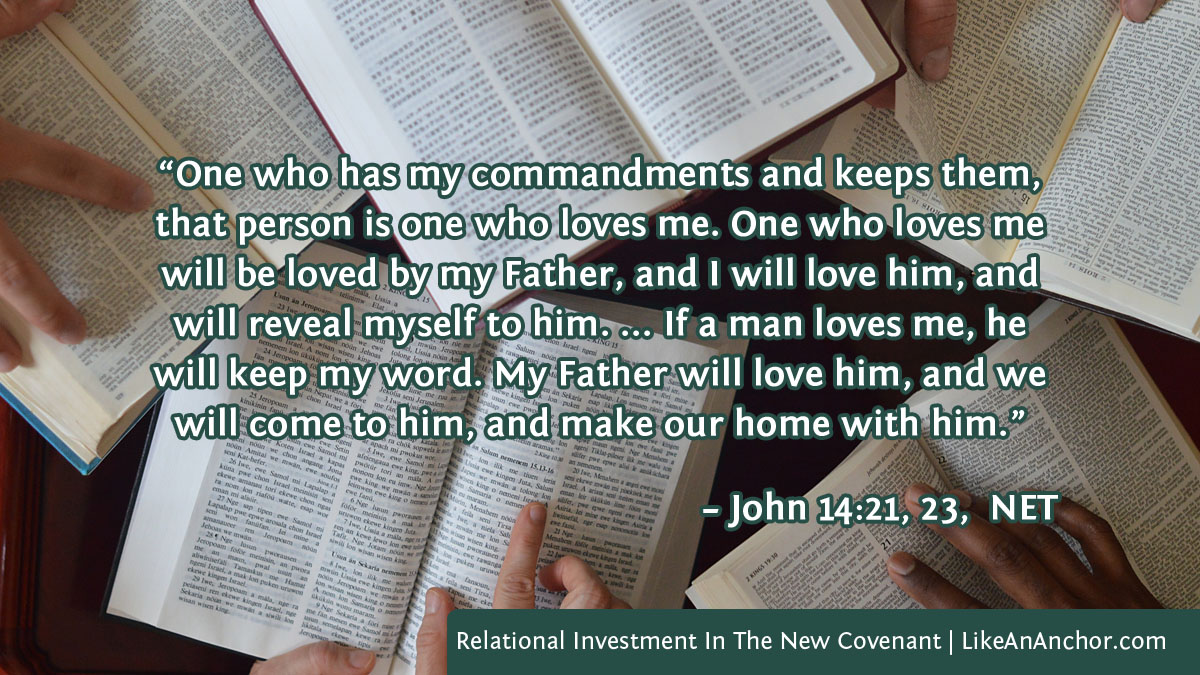
Image of Bibles on a table overlaid with text from John 14:21, 23,  NET version:  “One who has my commandments and keeps them, that person is one who loves me. One who loves me will be loved by my Father, and I will love him, and will reveal myself to him. ... If a man loves me, he will keep my word. My Father will love him, and we will come to him, and make our home with him.”
Image by Inbetween from Lightstock

More Reciprocal Instructions

In my church we often refer to the passage of scripture in John 13-17 as the words of the New Covenant. I encourage you to read through that section of scripture and look at how many times the “if you do this, I will do this” or “because I do this, you should do this” pattern repeats. I’ll just quote one of those passages here:

“You are clean already because of the word that I have spoken to you. Remain in me, and I will remain in you. Just as the branch cannot bear fruit by itself, unless it remains in the vine, so neither can you unless you remain in me.

“I am the vine; you are the branches. The one who remains in me—and I in him—bears much fruit, because apart from me you can accomplish nothing. If anyone does not remain in me, he is thrown out like a branch, and dries up; and such branches are gathered up and thrown into the fire, and are burned up. If you remain in me and my words remain in you, ask whatever you want, and it will be done for you. My Father is honored by this, that you bear much fruit and show that you are my disciples.

 “Just as the Father has loved me, I have also loved you; remain in my love. If you obey my commandments, you will remain in my love, just as I have obeyed my Father’s commandments and remain in his love. I have told you these things so that my joy may be in you, and your joy may be complete.  My commandment is this—to love one another just as I have loved you. No one has greater love than this—that one lays down his life for his friends. You are my friends if you do what I command you.

John 15:3-14, NET

If we live in Jesus, He and His Father will live in us. Because they live in us, we’ll bear much fruit. When we bear fruit, it honors God. And so on. The New Covenant is a reciprocal relationship. Like any healthy relationship, there’s trust and reliance on each other to do things that build up the relationship. And as the far more powerful party in the covenant, God gives far more than we do. In John 13-17, Jesus promises to send the gift of the Holy Spirit. He assures those who are loyal to Him that His Father will hear and respond to their prayers. And the main thing He asks from us in return is love, loyalty and obedience. Over and over we read, “if you love me, keep my commandments,” including the one to love each other (John 13:34-35; 14:15, 21, 23; 15:17).

It’s really amazing to think about. God wants to have a real relationship with us. And not one that’s easily ended when someone decides it’s hard or not what they expected or they don’t “feel like it” anymore. He’s invested in us for the longest-term possible–eternity. He wants us to grow and thrive in this relationship, learning to be like Him since we’re becoming part of His family.

A Real, Mutually Invested Relationship

Image of two people holding hands with the blog's title text and the words  "God wants a real, lasting covenant relationship with us where the trust and investment go both ways."
Image by Jantanee from Lightstock

Now this is eternal life—that they know you, the only true God, and Jesus Christ whom you sent.

John 17:3, NET

Our eternal potential hinges on a meaningful, real, covenantal relationship with God the Father and Jesus the Messiah. We can learn more about the type of relationship they want to have with us by looking at the relationship they share.

Everything I have belongs to you, and everything you have belongs to me, and I have been glorified by them. I am no longer in the world, but they are in the world, and I am coming to you. Holy Father, keep them safe in your name that you have given me, so that they may be one just as we are one.

John 17:10-11, NET

We belong to God, and He gives us to Jesus, and Jesus leaves us safe with God, and they work together so we can be one as they are one. There’s a beautiful, seamless unity in their relationship and they want to welcome us into that oneness as well (John 17). It’s such an astonishing proposition that the apostle John was still marveling at it decades later.

See how glorious a love the Father has given us, that we should be called God’s children—and so we are! The reason the world does not know us is that it did not know Him. Loved ones, now we are God’s children; and it has not yet been revealed what we will be. But we do know that when it’s revealed, we shall be like Him, because we will see Him just as He is. Everyone who has this hope in Him purifies himself, just as He is pure.

1 John 3:1-3, TLV

There are expectations connected to this covenant relationship, but they’re expectations that naturally flow from the type of connection we share with God our Father and Jesus our adopted elder brother and betrothed Husband. For example, I expect that my parents will continue loving me as their daughter; they expect I won’t do things to dishonor them or purposefully disgrace the family. My fiancé and I each expect the other to remain faithful to and invest in our relationship now and after we’re married. It’s very similar in our relationship with God–the trust and investment go both ways.

We know God the Father and Jesus Christ are invested in their relationships with people. They’ve “got skin in the game”–they made us in their own image, poured their time and energy into us, and Jesus even died for us. He talked about that at Passover, too: “No one has greater love than this—that one lays down his life for his friends. You are my friends if you do what I command you” (John 15:13-14, NET). John brings this up again in his epistles as well, saying, “We have come to know love by this: that Jesus laid down his life for us; thus we ought to lay down our lives for our fellow Christians” (1 John 3:16, NET). There’s even a reciprocal aspect to Jesus’s sacrifice; we can’t pay Him back for such a gift, but there is a proper response we’re supposed to have when we recognize the love that motivated His sacrifice.


Featured image by Claudine Chaussé from Lightstock

Behold! The Passover Lamb of God

Silly me. I thought when I started writing last week that I’d only have one post on shepherd, sheep, and lamb imagery in the Bible when there’s enough verses on that topic that multiple books could (and have) been written. As you can see, we’re back on this topic again today.

In last week’s post, we went over the Hebrew words for “sheep” and how they’re used in scripture. We also looked at the word for “shepherd,” and discussed the roles and responsibilities of godly shepherds. But we started with Passover lambs, and that’s what I want to come back to today. One of the things we touched on last week is that because we’ve gone astray from God like sheep from their shepherd, the Messiah had to come and die in our place like a lamb.

Let’s think about that a little more. Because we’re wayward sheep, Jesus came as the lamb. He had to take on human nature so He could live like us and die in our place. He became like us–people compared to sheep, one of the animals sacrificed over and over in the Old Testament because of human sins–so He could die instead of us as the one sacrificed Lamb securing forgiveness forever.

I started digging into this topic because of how close we’re getting to Passover. Now, we’re less than five weeks away. So let’s talk about the Lamb who takes away the sins of the world.

Look, the Lamb of God!

John begins his gospel in a unique way. Rather than starting with Jesus’s miraculous birth, he begins long before that. “In the beginning was the Word, and the Word was with God, and the Word was fully God,” John writes as he begins the gospel account, adding, “Now the Word became flesh and took up residence among us” (John 1:1, 14, NET). Only after establishing Jesus’s preexistence and divinity does he move into the familiar story of John the Baptist testifying that Jesus is the Messiah.

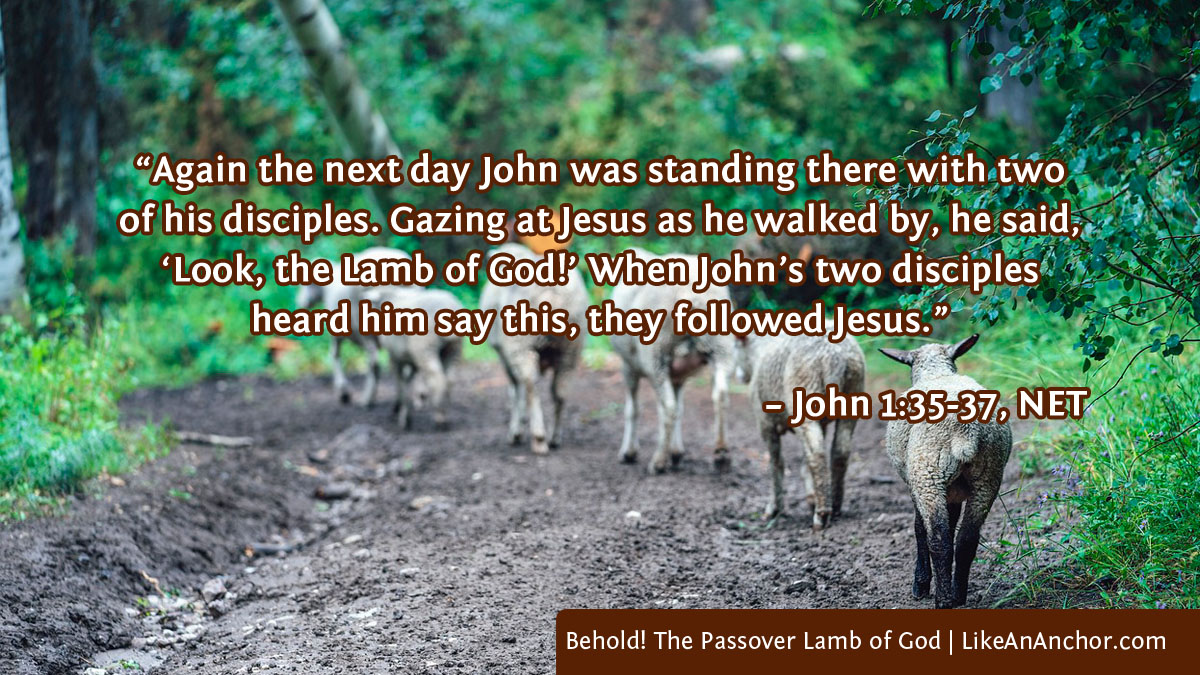
On the next day John saw Jesus coming toward him and said, “Look, the Lamb of God who takes away the sin of the world! This is the one about whom I said, ‘After me comes a man who is greater than I am, because he existed before me.’ I did not recognize him, but I came baptizing with water so that he could be revealed to Israel.”

Then John testified, “I saw the Spirit descending like a dove from heaven, and it remained on him. And I did not recognize him, but the one who sent me to baptize with water said to me, ‘The one on whom you see the Spirit descending and remaining—this is the one who baptizes with the Holy Spirit.’ I have both seen and testified that this man is the Chosen One of God.”

John 1:29-34, NET

We’ve likely read this or heard it dozens of times. Jesus came to die and take away our sins. We know this; it’s one of (if not the) central truths of Christianity. John the Baptist doesn’t stop with that truth, though; he keeps going deeper. Jesus “existed before,” He “baptizes with the Holy Spirit,” and He’s “the Chosen One of God.” And John begins these statements about Jesus by calling Him “the Lamb of God.”

Why A Lamb?

To understand why calling Jesus “the Lamb of God” was such an important statement, we need to look to the Old Testament that John’s Jewish listeners would have been so familiar with.

Gen 22:8 is an important passage in the background of the title Lamb of God as applied to Jesus. In Jewish thought this was held to be a supremely important sacrifice. G. Vermès stated: “For the Palestinian Jew, all lamb sacrifice, and especially the Passover lamb and the Tamid offering [daily burnt offering], was a memorial of the Akedah [binding of Isaac] with its effects of deliverance, forgiveness of sin and messianic salvation” (Scripture and Tradition in Judaism [StPB], 225).

NET Study Note on John 1:29

I knew the moment when Abraham willingly offered his son Isaac and God provided a ram in his place was pivotal, but I guess I hadn’t thought about it as deeply as I could have (see Gen. 22). I wouldn’t have connected it with all the daily sacrifices, though it makes sense since all of them point to the Messiah. And as I think about why Abraham’s willingness to sacrifice Isaac and God’s provision of a ram instead was considered so important, I ask myself, “What would have happened if this situation had gone differently?”

If Abraham hadn’t sacrificed Isaac, the Messenger of the Lord couldn’t have said, “now I know that you fear God because you did not withhold your son, your only son, from me” (Gen. 22:11, NET). Abraham wouldn’t have pictured a father willing to give up his son’s life because of trust in the promise of a great future (Heb. 11:17-19; Jam. 2:20-22).

On the other hand, if Abraham had sacrificed Isaac without God stepping in to provide a sheep substitute, then that would have been the end. Israel wouldn’t have been formed because Isaac wouldn’t have had a son, Jacob, to inherit the promises God made to Abraham and found the nation of Israel. There wouldn’t have been a promise to save the whole world through Abraham’s seed in the Messiah (Acts 3:18-26; Gal. 3:15-17).

No wonder, then, that the Jewish people recognize this time when Abraham was about to sacrifice his son and God stepped in with a substitute as a key moment. Abraham’s assurance that “God will provide for himself the lamb for the burnt offering” (Gen. 22:8, NET) echoed down through the ages, pointing to the time when God would provide a Lamb to take away the world’s sins.

The Passover Lamb

Let’s think back to that first Passover. Generations after Abraham and Isaac, the people of Israel were enslaved in Egypt. They’d cried out to God for help, and He sent Moses as a deliverer. Plagues rained down on Egypt, and still Pharaoh refused to let Israel go. So now it was time for one last plague. God pledged to kill all the firstborn in Egypt, human and animal. But there was a way for His people to escape.

Your lamb shall be without defect, a male a year old. You shall take it from the sheep or from the goats. You shall keep it until the fourteenth day of the same month; and the whole assembly of the congregation of Israel shall kill it at evening. They shall take some of the blood, and put it on the two door posts and on the lintel, on the houses in which they shall eat it. They shall eat the meat in that night, roasted with fire, with unleavened bread. They shall eat it with bitter herbs. …  This is how you shall eat it: with your belt on your waist, your sandals on your feet, and your staff in your hand; and you shall eat it in haste: it is Yahweh’s Passover. For I will go through the land of Egypt in that night, and will strike all the firstborn in the land of Egypt, both man and animal. I will execute judgments against all the gods of Egypt. I am Yahweh. The blood shall be to you for a token on the houses where you are. When I see the blood, I will pass over you, and no plague will be on you to destroy you when I strike the land of Egypt. This day shall be a memorial for you. You shall keep it as a feast to Yahweh. You shall keep it as a feast throughout your generations by an ordinance forever.

Exodus 12:5-8, 11-14, WEB

Thousands of years later, Jesus kept the Passover with His disciples and then died as the Passover lamb (Hebrew days begin at sunset, so when he kept the Passover in the evening and then died the next afternoon, it was all on a single day). In 1 Corinthians, Paul reinforces our understanding of how Jesus relates to Passover when talking about how we now observe Passover and the Festival of Unleavened Bread.

Clean out the old yeast so that you may be a new batch of dough—you are, in fact, without yeast. For Christ, our Passover lamb, has been sacrificed. So then, let us celebrate the festival, not with the old yeast, the yeast of vice and evil, but with the bread without yeast, the bread of sincerity and truth.

1 Corinthians 5:7-8, NET

Pretty much all of the 1 Corinthians letter links to Passover and Unleavened Bread. Here in this passage, Paul clearly identifies Christ as our Passover lamb or simply “our Passover,” since the Greek word for “lamb” isn’t specifically in this passage. Jesus fulfilled (i.e. filled up to the fullest extent) all that the Old Testament Passover pointed to. He’s the one whose sacrifice makes God “pass over” punishment for our sins. He saves our lives. And He’s the lamb that dies in our place.

Messianic Promise For Our Futures

In addition to being the Passover Lamb, Jesus’s coming was a direct fulfillment of promises God made to Abraham. Jesus’s mother Mary and John’s father Zacharias were well aware of this, and highlighted God’s covenant faithfulness to provide a Lamb and once again save Abraham’s children (Luke 1:46-55, 67-75). We also benefit from God’s faithfulness to do that right now. But Jesus’s role as a Lamb isn’t only about what happened in the past or about prophecies that have already been fulfilled.

Jesus is called the Lamb 33 times in Revelation. Here, we see the Lamb opening seals, pouring wrath on a wicked earth, and conquering as Lord of lords and King of kings. We also see Him receiving worship and praise, providing salvation, washing people clean in His blood, acting as their shepherd, and standing with those redeemed from the world.

 After these things I looked, and here was an enormous crowd that no one could count, made up of persons from every nation, tribe, people, and language, standing before the throne and before the Lamb dressed in long white robes, and with palm branches in their hands. They were shouting out in a loud voice, “Salvation belongs to our God, who is seated on the throne, and to the Lamb!” …

“These are the ones who have come out of the great tribulation. They have washed their robes and made them white in the blood of the Lamb! For this reason they are before the throne of God, and they serve him day and night in his temple, and the one seated on the throne will shelter them. They will never go hungry or be thirsty again, and the sun will not beat down on them, nor any burning heat, because the Lamb in the middle of the throne will shepherd them and lead them to springs of living water, and God will wipe away every tear from their eyes.”

Revelation 7:9-10, 14-17, NET (italics mark allusions to Isa 49:10 and  Isa 25:8)

This the future we have to look forward to. When we walk with the Lamb now, following our Shepherd as faithful sheep, we’ll get to stay with Him forever in the future (Rev. 21:9-11, 22-23, 27; 22:1-3). We can even become His wife.

“Hallelujah!
For the Lord our God, the All-Powerful, reigns!
Let us rejoice and exult
and give him glory,
because the wedding celebration of the Lamb has come,
and his bride has made herself ready.
She was permitted to be dressed in bright, clean, fine linen” (for the fine linen is the righteous deeds of the saints).

Then the angel said to me, “Write the following: Blessed are those who are invited to the banquet at the wedding celebration of the Lamb!” He also said to me, “These are the true words of God.”

Revelation 19:6-9, NET

It would have been a huge blessing on its own just to have Jesus as our Passover lamb. Yet here He is shaping our future as well. In Jewish tradition, a song called “Dayenu” has been part of Passover celebrations for over a thousand years. The title means “it would have been enough.” This song lists 15 gifts of God (including deliverance from slavery, the Red Sea parting, and giving the Torah), saying even one of those gifts would have been enough by itself, yet God keeps giving more. When speaking of the Messianic Passover Lamb, it would have been enough if Jesus had died for us but He doesn’t stop there. He’s the Lamb of God yesterday, today, and forever. He’s our savior and our good shepherd. And when we follow in His footsteps as the Lamb, we’ll have Him as our  shepherd and guardian for ever (1 Peter 2:20-25).


Featured image by Anja from Pixabay

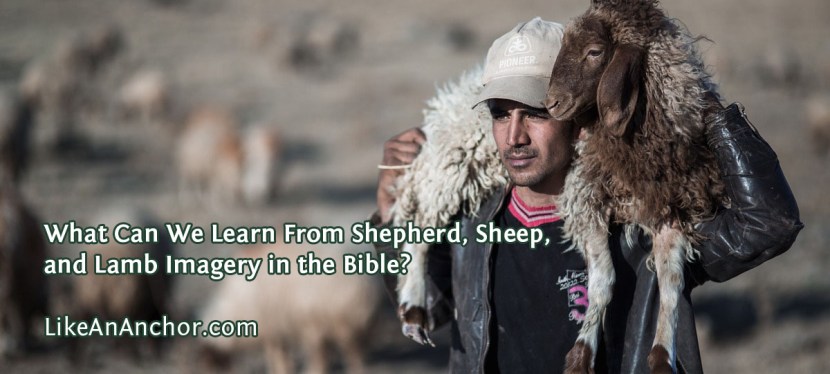
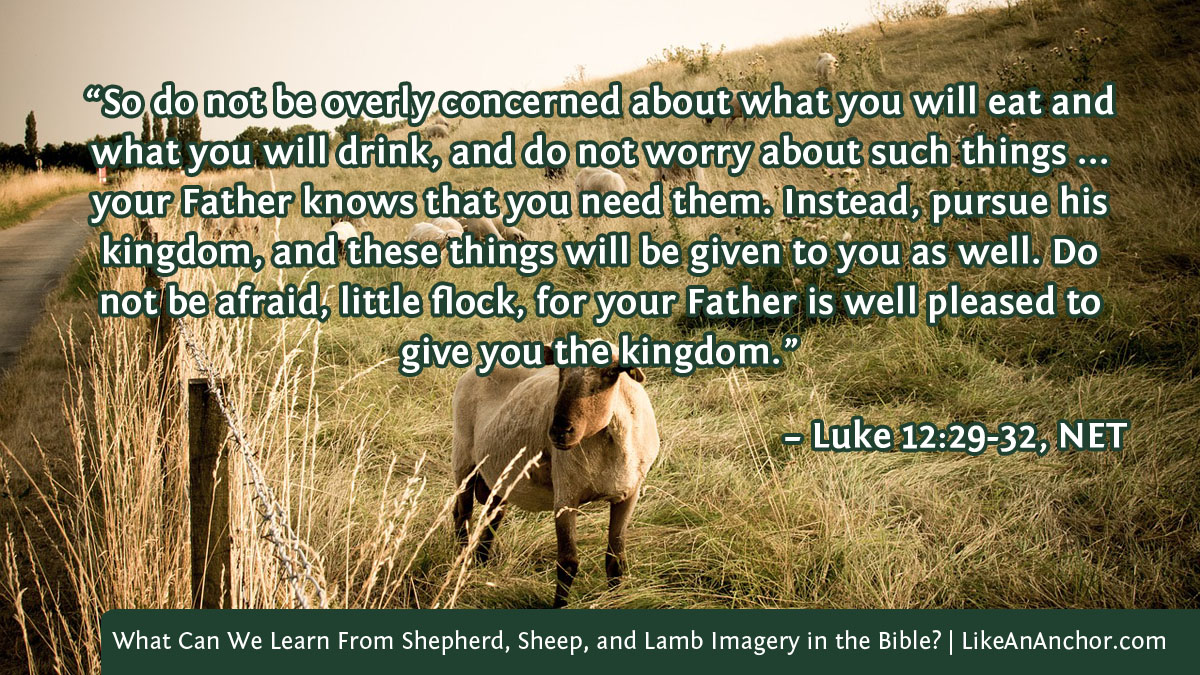
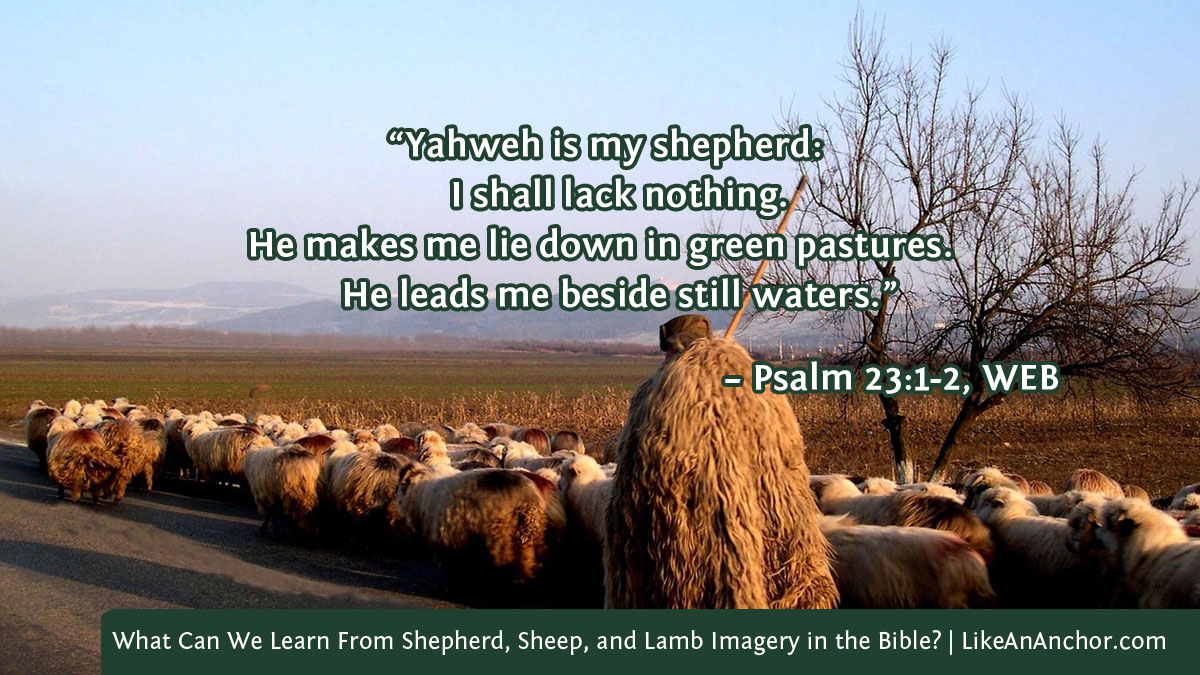
What Can We Learn From Shepherd, Sheep, and Lamb Imagery in the Bible?

This year, we’ll be observing Passover just after sunset on April 4. That’s less than six weeks away. As I began thinking about Passover, I started musing on the shepherd, sheep, and lamb imagery found throughout the Bible. It’s central to Passover; the Old Covenant sacrifice for Passover was a young male from the flock and Jesus fulfilled that with His sacrifice as the Lamb of God, becoming the center of the New Covenant Passover.

That’s not the only place sheep, lambs, and shepherds show up, though. They’re found throughout the scriptures. Much of it’s literal, as we’d expect since God wrote the Bible through people who lived in an agrarian and herding society. These animals were also closely tied to religious worship since sheep and goats were one of the acceptable (and in some cases the commanded) animals used for sacrifice in the Old Testament. There are also important figurative and symbolic meanings. As mentioned already, Jesus is called the Lamb of God. God also casts Himself as a shepherd to His people throughout Old Covenant books and it’s a role Jesus claims in the New Covenant. And this seems an appropriate time of year to dig into all that a bit more.

OT Background on Sheep

Once I started looking into the Hebrew words translated sheep and lamb, I felt a little lost. There are so many different words! The Jewish Encyclopedia helped me make sense of them all:

The most usual terms for the sheep are “seh” and “kebes” (“keseb”); “kar” (Deut. xxxii. 14; Isa. lviii. 7) denotes the young lamb in pasture; “ṭeleh” (Isa. xl. 11 et al.), the suckling lamb; “ayil,” the ram; “raḥel,” the ewe. In the Aramaic portions of the Old Testament the term “emer” occurs (Ezra vii. 17), which term is found also in the cognate languages. The word “ẓon” is used collectively for small cattle, including sheep and goats.

“SHEEP” by Emil G. Hirsch and I. M. Casanowicz

Getting into more detail for how these words are used, I turned to the Theological Wordbook of the Old Testament. Kebs appears 128 times and “only 17 do not occur in the context of sacrifice” (TWOT 949). The (most likely) related keseb is used 13 times and in all but two places it’s used “where a distinction is being drawn between the two kinds of animals of the flock: sheep and goats” (TWOT 950). One of the other words, seh is a little less specific; it can mean lamb, sheep, or goat (TWOT 2237). Seh is the word used of the Passover sacrifice (Ex. 12:3) and of the Messiah (Is. 53:7). Finally, son or zon is a more generic word for “small cattle,” but it’s use typically emphasizes the meaning of flocks of sheep (TWOT 1864).

Your lamb (seh) shall be without defect, a male a year old. You shall take it from the sheep (kebs) or from the goats. You shall keep it until the fourteenth day of the same month; and the whole assembly of the congregation of Israel shall kill it at evening. … This is how you shall eat it: with your belt on your waist, your sandals on your feet, and your staff in your hand; and you shall eat it in haste: it is Yahweh’s Passover.

Exodus 12:5-6, 11, WEB

All we like sheep (zon) have gone astray.
    Everyone has turned to his own way;
    and Yahweh has laid on him the iniquity of us all.

He was oppressed,
    yet when he was afflicted he didn’t open his mouth.
As a lamb (seh) that is led to the slaughter,
    and as a sheep that before its shearers is silent,
    so he didn’t open his mouth.

Isaiah 53:6-7, WEB

Those two verses talking about Passover and Jesus’s sacrifice use the three main Hebrew words for “sheep.” That gives you an idea of how they’re used both literally and figuratively.

Pasturing the Flock

Continuing to explore how the Hebrew words are used, I find it interesting how different the Hebrew word for “shepherd” is than the English one. In English, we get to “shepherd” from sheep+herd–the word means someone who herds sheep (Online Etymology Dictionary). In Hebrew, the word translated “shepherd” is connected to the words for pasture, tend, and graze (TWOT 852). The shepherd is one who makes sure the flocks are fed in good pastures. Practically, there probably isn’t much difference in how shepherd and râ‛âh are used but I find it interesting to think of the Hebrew/Biblical shepherd primarily as one who provides pasture rather than one who herds sheep. The foundational understanding of what a shepherd does and why is a little different in each language.

Now, here’s where it gets really interesting. The word “pastor” comes into English from the same Latin root as “pasture” (Online Etymology Dictionary). So really, “pastor” might be a more exact translation of râ‛âh than “shepherd” is, though the way those English words are used today makes shepherd the less confusing choice. But I suspect this original connection between pastoring and feeding (which is lost in modern use of the word) is why the KJV translators used “feed the church of God” where modern translations use “shepherd” (Acts 20:28). This understanding of a shepherd’s primary role makes God’s condemnation of poor shepherds stand out to me even more than it did before.

Yahweh’s word came to me, saying, “Son of man, prophesy against the shepherds of Israel. Prophesy, and tell them, even the shepherds, ‘The Lord Yahweh says: “Woe to the shepherds of Israel who feed themselves! Shouldn’t the shepherds feed the sheep? You eat the fat. You clothe yourself with the wool. You kill the fatlings, but you don’t feed the sheep. …

“As I live,” says the Lord Yahweh, “surely because my sheep became a prey, and my sheep became food to all the animals of the field, because there was no shepherd, and my shepherds didn’t search for my sheep, but the shepherds fed themselves, and didn’t feed my sheep.” Therefore, you shepherds, hear Yahweh’s word: The Lord Yahweh says: “Behold, I am against the shepherds. I will require my sheep at their hand, and cause them to cease from feeding the sheep. The shepherds won’t feed themselves any more. I will deliver my sheep from their mouth, that they may not be food for them.”

“‘For the Lord Yahweh says: “Behold, I myself, even I, will search for my sheep, and will seek them out. … I will feed them with good pasture; and their fold will be on the mountains of the height of Israel. There they will lie down in a good fold. They will feed on fat pasture on the mountains of Israel. I myself will be the shepherd of my sheep, and I will cause them to lie down,” says the Lord Yahweh. “I will seek that which was lost, and will bring back that which was driven away, and will bind up that which was broken, and will strengthen that which was sick; but I will destroy the fat and the strong. I will feed them in justice.”’

Ezekiel 34:1-3, 8-11, 14-16, WEB

Those are just a few of the things Yahweh says to the shepherds of His people in Ezekiel 34; I encourage you to read the whole chapter along with Jeremiah 23:1-8. God is deeply concerned with the welfare of His sheep, particularly how well they’re being fed. Jesus emphasized this as well, when He told Peter three times “feed my lambs,” “tend my sheep,” and “feed my sheep” (John 21:13-17, WEB). The word translated “tend” in WEB is the Greek verb for tending a flock that’s often translated “shepherd” (G4165, poimainō), but the one translated “feed” is specifically used for taking animals to a pasture to graze (G1006, boskō). In other words, Jesus is telling Peter that it’s his role to pasture and tend the people of God. And then later, Peter told his “fellow elders” to feed or “shepherd the flock of God” (1 Peter 5:1-3).

The Role of Shepherds

As I muse on the role of shepherds in “pasturing” the flock, I’m reminded of how often David in Psalm 23 speaks of being fully satisfied by the food and drink that God provides. The good, perfect shepherd fills His sheep’s needs. The people He lets work under His authority and supervision have a similar role, though Jesus doesn’t delegate everything. He stays the Chief Shepherd, though other shepherds get the chance to work with Him to help care for His flock. “Caring for a flock” is what the Greek word for shepherd means (G4166, poimēn). It’s also the root word for a flock of sheep or spiritual group of people (G4167, poimnē and G4168, poimnion) and for chief shepherd (G750 archipoimēn). That last word is only used once.

So as your fellow elder and a witness of Christ’s sufferings and as one who shares in the glory that will be revealed, I urge the elders among you: Give a shepherd’s care to God’s flock among you, exercising oversight not merely as a duty but willingly under God’s direction, not for shameful profit but eagerly. And do not lord it over those entrusted to you, but be examples to the flock. Then when the Chief Shepherd appears, you will receive the crown of glory that never fades away.

1 Peter 5:1-4, NET

Peter got to spend time with the Chief Shepherd firsthand. He was most likely right there when Jesus spoke about His own role as “the good shepherd” who guards, gives life, takes the sheep to pastures, and never abandons His flock (John 10:1-18).

“The one who enters by the door is the shepherd of the sheep. The doorkeeper opens the door for him, and the sheep hear his voice. He calls his own sheep by name and leads them out. When he has brought all his own sheep out, he goes ahead of them, and the sheep follow him because they recognize his voice. They will never follow a stranger, but will run away from him, because they do not recognize the stranger’s voice.” …

“I am the door for the sheep. All who came before me were thieves and robbers, but the sheep did not listen to them. I am the door. If anyone enters through me, he will be saved, and will come in and go out, and find pasture. …

“I am the good shepherd. I know my own and my own know me—just as the Father knows me and I know the Father—and I lay down my life for the sheep. I have other sheep that do not come from this sheepfold. I must bring them too, and they will listen to my voice, so that there will be one flock and one shepherd.”

John 10:2-5, 7-9, 14-16, NET

The Role of Sheep

Discussing John 10 gives us a natural transition from talking about the role of Shepherd to the role of His sheep. There isn’t a whole lot we need to do as sheep. The Greek word translated sheep is probaton. It literally means “whatever walks forward,” but most usually means sheep or people who could be endearingly compared to those animals (Zodhiates, G4263). We just need to listen to the shepherd and walk after Him. Remember Isaiah 53:6? “All we like sheep have gone astray,” and the Lord laid our iniquities on the Messiah as the sacrificial lamb. Peter quotes that verse in his letter before giving his advice to fellow shepherds.

He himself bore our sins in his body on the tree, that we may cease from sinning and live for righteousness. By his wounds you were healed. For you were going astray like sheep but now you have turned back to the shepherd and guardian of your souls.

1 Peter 2:24-25, NET; bold italics represent quotes from Isaiah 53

We’ve now come full-circle to where we began with “Christ, our Passover lamb” (1 Cor. 5:7, NET). As John the Baptist said, Jesus is “the Lamb of God who takes away the sin of the world!” (John 1:29, NET). It’s a key title for Him, one that’s used 13 times just in Revelation.

I got a bit side-tracked while writing this post. I’d meant to tie it all back to Passover, which we did here at the end, but I hardly touched on Jesus’s role as the Lamb. I got so interested in the shepherd-pastor part of the discussion. We might need to come back to this next week. I hope you found this post, rambling as it was, interesting 🙂


Featured image by Mehmet Turgut Kirkgoz from Pixabay