The Importance Of Genuine Love

Loving other people can be hard. I mean have you met people? Try to have relationship with them and you find out they’re flawed, messy, and might hurt you. Sure they can also be encouraging, positive, and fill your life with joy, but they’re not like that all the time.

Wouldn’t it be easier if you could just have a relationship with God and not deal with other people, at least the ones that are hard to love? It seems like a nice idea to some. “Just me and Jesus,” they say and think that’s all they need.

But that’s not how God means for His church to function. He wants an individual relationship with you, yes, but He also wants you to be part of a church that He collectively describes as the body of Christ and the temple of God. And He expects you to love everyone in that church even when it’s hard.

Because God Is Love

If a man says, “I love God,” and hates his brother, he is a liar; for he who doesn’t love his brother whom he has seen, how can he love God whom he has not seen? This commandment we have from him, that he who loves God should also love his brother. (1 John 4:20-21, WEB)

Those of us who claim to love God have to love the people around us as well. If we don’t love others it proves that we don’t really love God. The reason for this statement is clarified earlier in John’s letter:

Beloved, let us love one another, for love is of God; and everyone who loves has been born of God, and knows God. He who doesn’t love doesn’t know God, for God is love. (1 John 4:7-8, WEB)

Being born into God’s family and having a relationship with Him changes us. When we know the God of love, we learn to love as He does. If we can’t or won’t love other people the way God does, then we don’t really understand Him and haven’t really been born of God. Read more
Becoming One Flesh With Jesus Christ

Today’s post is something of a continuation to last week’s post, The Bridegroom’s Pledge. As Jesus Christ’s bride, the church is supposed to be getting ready for a marriage that will take place when He returns. If this were a human wedding, preparations for it would include things like picking a date and venue, mailing out invitations, and hiring a caterer. But none of those things are any use in preparing for a wedding to Jesus. He needs us to focus on something different, something that will strengthen a relationship He intends to last into eternity.

Diversity In Oneness

He who loves his own wife loves himself. For no man ever hated his own flesh; but nourishes and cherishes it, even as the Lord also does the church; because we are members of his body, of his flesh and bones. “For this cause a man will leave his father and mother, and will be joined to his wife. The two will become one flesh.” This mystery is great, but I speak concerning Christ and of the church. (Eph. 5:28-32, WEB)

In these verses, Paul quotes Genesis 2:24 about the husband and wife becoming one flesh. The Hebrew word for “one” is echad (H259). It’s the same word use in the Shema: “Hear, Israel: Yahweh is our God. Yahweh is one” (Deut. 6:4, WEB).

While echad can mean the number one, in these verses “It stresses unity while recognizing diversity within that oneness” (TWOT entry 61). A husband and wife don’t literally merge into a single being. And God (Elohim) consists of two Beings. But they can be called one because they’re united. That’s the sort of relationship we’re supposed to be developing with Christ. Read more

You’re Not “A Temple of God.” You’re Part of The Temple Of God

We’ve probably all heard that Christianity is about your individual relationship with Jesus. I’ve said that myself. But while God is very much concerned with the state of every individual heart and wants a relationship with you, Christianity is not an individualistic religion. We get that idea from Western culture, not from scripture.

The Bible is written for all peoples and all cultures. But it was also written by people living in a Middle Eastern society, and those of us in the Western world can miss some things Biblical writers took for granted. It rarely occurs to us that Americanized Christianity might not be the same thing as Biblical Christianity, but our culture does color how we read the Bible and in some cases it leads to inaccurate assumptions.

When I was reading Misreading Scripture With Western Eyes by E. Randolph Richards and Brandon J. O’Brien, one of the misconceptions that really stuck with me had to do with the verses about spiritual temples. We tend to read the verses that say “you are a temple of God” and think the “you” is singular” and treat “temple” as plural, assuming that we are each one of God’s temples. But we’re wrong.

Confusion of Plurals

There are three passages where Paul talks with the Corinthians about them being God’s temple. They’re 1 Cor. 3:16, 6:19; and 2 Cor. 6:16. Richards and O’Brian only talk about one of these, but I checked the others in the Greek and their point holds true for all three. They write,

Biblical Greek could differentiate between you singular and you plural, but we miss this in our English translations. … We typically understand the singulars and plurals in this verse backwards. In the original Greek, the you is plural and temple is singular. Paul is saying, “All of you together are a singular temple for the Holy spirit. God doesn’t have millions of little temples scattered around. Together we make the dwelling for the spirit (p. 108)

Read more

Be Of The Same Mind: God’s Intention For Peace In His Church

If God says He hates something, is it a thing we should be doing in the church? Of course not! Those who love God do things that are pleasing in His sight (1 John 3:22). We don’t always do that perfectly, but it’s supposed to be our goal. And when we miss the mark, we repent and change and try again.

One of the things the Lord hates and considers an abomination is “he who sows discord among brothers” (Prov. 6:19, all scriptures in this post are WEB version). In Hebrew, “sow” is shalach (H7971), and it means to send out or shoot forth, as in a growing plant putting out leaves. God hates it when someone plants and spreads strife or contention (medan, H4090) among those who are metaphorical or literal family (ach, H251).

So what does it say about us as a church body when there are divisions, disagreements, and rifts in our relationships and beliefs? In some cases, we can disagree on things that are open to interpretation and still fellowship peaceably, which is the right thing to do (Rom. 14). But all too often, when people in the churches disagree they start attacking or ignoring each other rather than working through their issues, resolving doctrinal conflicts, and seeking peace and unity as God intends.

Be Of The Same Mind: God's Intention For Peace In His Church | marissabaker.wordpress.com
Photo credit: Shaun

Menary via Lightstock

Strife Does Not Come From God

The greatest commandments are to love God with all your heart, mind, soul, and strength and to love your neighbor as yourself. In contrast, strife is stirred up by hatred, not love (Prov. 10:12). And the people who spread strife are called perverse, lovers of disobedience, greedy, and angry (Prov. 16:28; 17:19; 28:25; 29:22). Those aren’t the sort of things God wants to see when He looks at the people in His chruch.

Now the deeds of the flesh are obvious, which are … hatred, strife, jealousies, outbursts of anger, rivalries, divisions, heresies, envy … of which I forewarn you, even as I also forewarned you, that those who practice such things will not inherit God’s Kingdom. (Gal. 5:19-21)

More than half the things in this “works of the flesh” list have to do with discord and disunity. In contrast, the fruit of the Spirit is things like “love, joy, peace, patience, kindness, goodness, faith, gentleness, and self-control” (Gal. 5:22-23). Those are the things that stop arguments before they even start.

This Goes Beyond Not Fighting

Scriptures make it quite clear that God puts a high value on peace. Though He warns us that following Him will set people against you (Matt. 10:34-36; John 15:18-21), that sort of strife should only happen between you and the world. There’s supposed to be peace in the church among God’s people.

So then, let us follow after things which make for peace, and things by which we may build one another up. (Rom. 14:19)

On your part, you’re supposed to do what you can to live peacefully with everyone you meet (Rom. 12:18; Heb. 12:14). This is especially important in the church, where it’s an attainable goal because all the believers are supposed to be working toward peace (1 Thes. 5;13). God intends for there to be unity in His church. Read more

Footwear Of The Gospel

If you’re going into battle, you’re going to need a good pair of shoes. That’s probably not something most of us think about, but what soldiers wear on their feet helps determine how far they can travel in a day and what type of terrain they can fight on. In fact, a good argument can be made that one of the Roman army’s key strengths was improved footwear. Perhaps that’s part of what Paul was thinking about when he wrote this phrase to describe the third piece in the armor of God:

and binding shoes under your feet with the preparation of the good news of peace (Eph. 6:15, LEB)

This piece of armor is related to preparation, the gospel, and peace. It’s a curious combination, especially considering the girdle of truth and breastplate of righteousness have pretty straightforward descriptions. I wasn’t even quite sure what to title this post. Shoes of peace? Prepared footwear? Sandals for preparing good news of peace? I settled on the title you see up there since similar scriptures in Isaiah and Nahum place the focus on carrying good news. Let’s take a look at those.

Footwear Of The Gospel | marissabaker.wordpress.com
Photo credit: DVIDSHUB, CC BY via Flickr

Carrying God’s Words

How beautiful on the mountains are the feet of him who brings good news, who publishes peace, who brings good news, who proclaims salvation, who says to Zion, “Your God reigns!” (Is. 52:7, WEB)

Nahum borrows this phrase in 1:15 and Paul uses it to support his teaching that “faith comes by hearing and hearing by the word of God” (Rom. 10:17, WEB). People must call on the name of the Lord to be saved, but before that they must believe on him and to do that they need to hear about Him. For that to happen, there must be a preacher sent to carry the good news of peace (Rom. 10:13-15). Read more

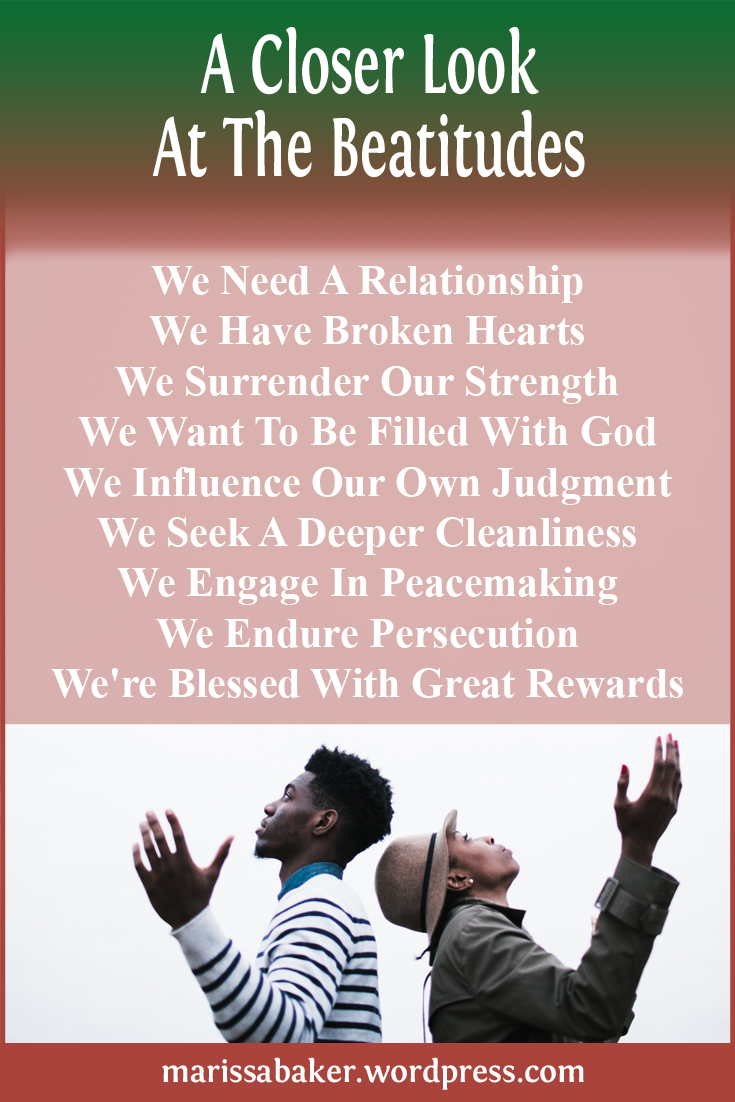
A Closer Look At The Beatitudes

When Jesus delivered the Sermon on the Mount, He began at what we now call the Beatitudes. He says, “Blessed are” the sort of people who probably don’t feel all that blessed — those who are poor, mourning, meek, hungry and thirsty for righteousness, merciful, pure in heart, peacemakers, persecuted, and reviled. We don’t like being poor, or in grief, or humble enough to put others first, or attacked by the people around us. It’s hard work being a peacemaker, or showing mercy, or staying pure of heart, or constantly yearning to get closer to God’s righteousness.

It’s interesting that two of the beatitudes mention righteousness: “Blessed are they which do hunger and thirst after righteousness” and “Blessed are they which are persecuted for righteousness’ sake” (Matt. 5:6, 10, KJV). This word refers to “the condition acceptable to God” and/or “the doctrine concerning the way which man may attain a state of approval by God” (Thayer’s G1343, dikaiosune). It relates to our state of being and the way we live. In fact, when you think about it, all the beatitudes relate to something we do and/or become as we follow God.

A Closer Look At The Beatitudes | marissabaker.wordpress.com
Photo credit: Temi Coker via Lightstock

We Need A Relationship

Blessed are the poor in spirit: for theirs is the kingdom of heaven. (Matt. 5:3, KJV)

There’s more than one word that could be translated from Greek as “poor.” This one means “reduced to beggary” and “lacking anything” (Thayer’s G4434, ptochos). When we’re like that in our spirits, we’re really in a place to recognize how much we need a relationship with the Father and Jesus. We become the sort of person the Lord is talking about when He says, “to this man will I look, even to he who is poor and of a contrite spirit, and who trembles at my word” (Is. 66:2, WEB).

We Have Broken Hearts

Blessed are they that mourn: for they shall be comforted. (Matt. 5:4, KJV)

We all experience grief. The death of a parent, child, or dear friend. The loss of a hope held close to our hearts. The decay of a relationship. Betrayal from a friend. And even in the midst of that mourning, we’re blessed because God promises comfort (John 14:16-18; 2 Cor. 1:3-7). He can respond to our tears as powerfully as He did for David in the situation recorded in Psalm 6. Read more