Pentecost: A Time of Joyful, Spiritual Life

Pentecost kinda sneaked up on me this year. This is the only one of God’s holy days where we’re not given a specific date to observe it on (like the 14th of Nissan or the 1st of the 7th month). It moves around a little each year, always 50 days after the wave offering on the Sunday following Passover. This year, Pentecost is happening tomorrow, on June 5th.

Many Messianics and Jews count the omer each evening as a new day begins, praying a specific blessing. In Leviticus, God told His people through Moses, “You must count for yourselves seven weeks from the day after the Sabbath, from the day you bring the wave offering sheaf; they must be complete weeks. You must count fifty days—until the day after the seventh Sabbath” (Lev. 23:15-16, NET). That’s what the word “Pentecost” means–it’s transliterated from the Greek word pentēkostē, or “fiftieth” (as in we’ve counted up to the fiftieth day).

Much like Passover, Pentecost takes on additional significance for the New Testament church. After Jesus’s resurrection and His ascension to the Father on the Sunday when priests in the temple did the wave sheaf offering, He remained here on earth with His disciples for 40 days. Then, He told them to stay in Jerusalem and wait (Acts 1:1-5). They did as they were told, no doubt expecting something to happen at Pentecost since it was coming up just 10 days from when they last saw Jesus. “Now when the day of Pentecost had come, they were all together in one place,” and the Holy Spirit came on them in a powerful way (Acts 2:1-4).

What about us today? We have instructions from the Old Testament about Pentecost, traditions that tell us God established his Sinai covenant with Israel on this day, and the story of the New Testament era of the church getting its start on Pentecost in the first century. Clearly this day is important and God tells us to keep observing it, but what is the significance for believers today?
A Time of Hope and Sharing

When I’ve written about Pentecost before on this blog, I usually focus on the book of Ruth. It’s traditionally read on Pentecost because of the connection with gleaning. In Leviticus 23, God included these instructions when He told us how to keep Pentecost, which coincided with the wheat harvest:

When you gather in the harvest of your land, you must not completely harvest the corner of your field, and you must not gather up the gleanings of your harvest. You must leave them for the poor and the resident foreigner. I am the Lord your God.’”

Leviticus 23:22, NET

It’s this instruction to landowners that allowed Ruth to glean for grain in Boaz’s field to keep herself and Naomi alive (Ruth 2). She started gleaning during the barley harvest (around Passover time) and continued on through the wheat harvest (around Pentecost time). This is one of the social safety nets God built into ancient Israel. He cares deeply about the poor, widow, and orphan–the people who struggle most to provide for themselves. A good man like Boaz would even order his workers to drop extra grain for someone like Ruth (2:16).

Ideally, harvest isn’t a time for hoarding your new wealth into a barn. It’s a time for sharing your bounty and offering hope for a brighter future. This principle works on a spiritual level as well. If we sow “in righteousness” and “reap according to kindness” while seeking the Lord and doing good, we will “from the Spirit reap eternal life” (Hos. 10:12-13; Gal. 6:7-10, WEB). Pentecost is a joyous festival day where we remember all the good Lord has given us to “harvest” in our lives and gather with others who are also doing their best to sow good things.
Gifts from the Lord

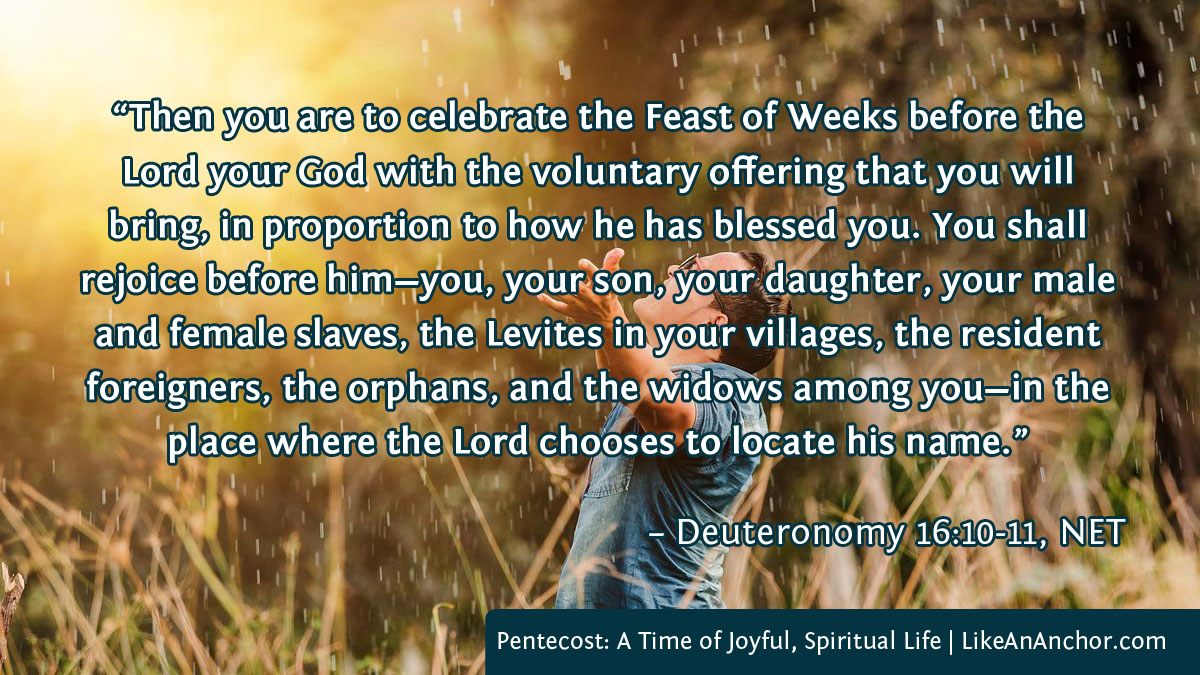
When we look at the book of Exodus, keeping in mind that the Israelites left Egypt right after Passover and it took about two months to travel all the way to Mount Sinai on foot, it seems reasonable to accept the Jewish tradition that says God gave the 10 commandments on Pentecost. That would place the establishment of one of the most important covenants in scripture on this holy day.

At Sinai, Yahweh set Israel apart to Himself as “a kingdom of priests and a holy nation.” He warned them to purify themselves and respect His holiness, then presented the terms of the covenant starting with the 10 commandments (Ex. 19-24). Finally, the people said, “We will do all that Yahweh has said, and be obedient” (Ex. 24:7, WEB). This covenant was an incredible gift–the only fault with it was in the people who couldn’t keep the covenant as perfectly as God did. That’s why we needed a New Covenant established on better promises (Heb. 8).

Jesus enacted this New Covenant on Passover when He shared bread and wine with His disciples (Luke 22:19-20), outlined the terms of the new covenant (John 13-17), and died to end the old covenant and establish the new (Heb. 9:11-28). Then on Pentecost, He started giving His New Covenant church the gifts involved in these better promises.

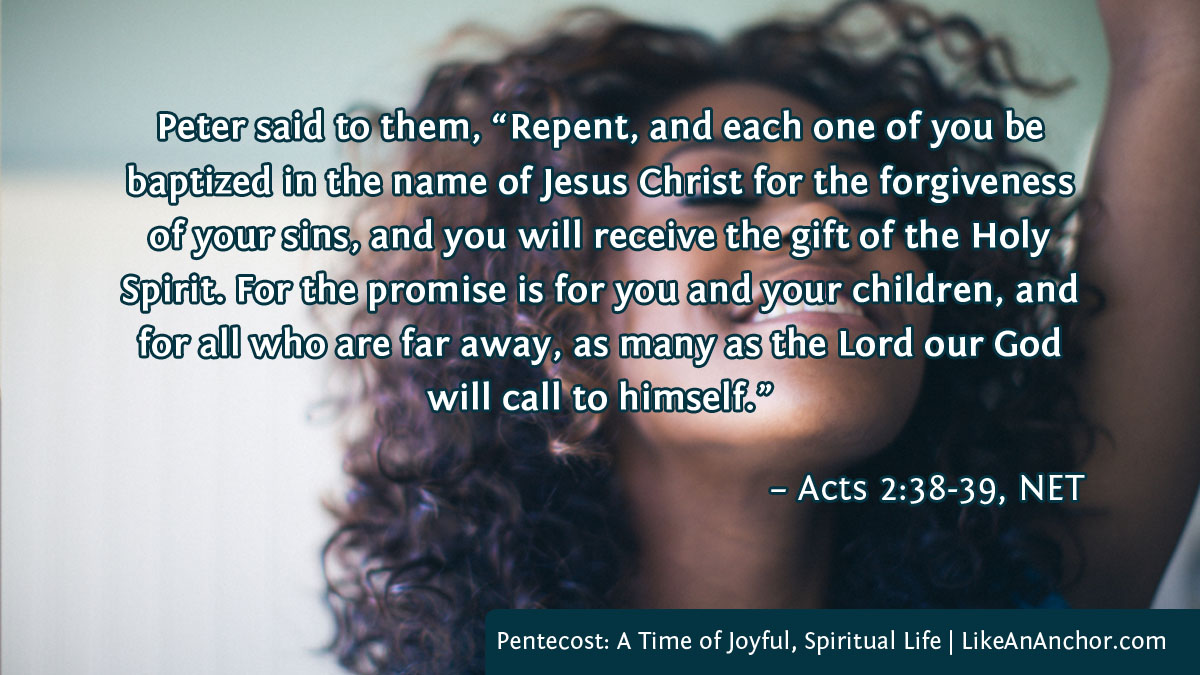
Now when the day of Pentecost had come, they were all together in one place. Suddenly a sound like a violent wind blowing came from heaven and filled the entire house where they were sitting. And tongues spreading out like a fire appeared to them and came to rest on each one of them. All of them were filled with the Holy Spirit, and they began to speak in other languages as the Spirit enabled them. …

Peter stood up with the eleven, raised his voice, and addressed them… “this is what was spoken about through the prophet Joel: ‘And in the last days it will be,’ God says, ‘that I will pour out my Spirit on all people, and your sons and your daughters will prophesy, and your young men will see visions, and your old men will dream dreams. Even on my servants, both men and women, I will pour out my Spirit in those days, and they will prophesy.'”

Acts 2:1-4, 14, 16-18, NET

Life in the Spirit
There is a beautiful symmetry to think that on the same day, centuries apart, God gave His people the Law and the Spirit. For us today who “serve in the new life of the Spirit,” we get to keep the law on a spiritual level as God always intended. Because of Jesus Christ’s sacrifice, “the righteous requirement of the law may be fulfilled in us who do not walk according to the flesh but according to the Spirit” (Rom. 7:5-6; 8:3-5).

Pentecost helps remind us to rejoice in the abundant gifts God gives us, particularly the gift of His Spirit. God Himself is dwelling in us. That’s a wonderful thing. With that in mind, it’s no surprise that Paul writes about the “joy that comes from the Holy Spirit” (1 Thes. 1:6, NET) and says joy is part of the fruit of the spirit (Gal. 5:22). Even after being thrown out of a city for preaching God’s word, “the disciples were filled with joy and with the Holy Spirit” (Acts 13:52, NET). The joy of the Lord is a persistent, irrepressible thing.

We can also have this same joy when we follow God in the spirit and intent of the law.  We know that God’s kingdom consists of “righteousness, peace, and joy in the Holy Spirit. For the one who serves Christ in this way is pleasing to God and approved by people” (Rom. 8:17-18, NET). As we use the gifts God gives us and cultivate spiritual lives, God’s holy days remind us to also embrace the joy that comes along with being a child of the living God.

Now may the God of hope fill you with all joy and peace as you believe in him, so that you may abound in hope by the power of the Holy Spirit.

Romans 15:13, NET

Featured image by J F from Pixabay

How Should We Honor The Days God Sets Apart For Him?

Practicing righteousness. Learning to love. Developing the mind of God. Following Christ. Those are all essentials of the Christian life, and there are many “tools” God has given us to help us succeed in these goals. These include prayer, Bible reading and study, the Holy Spirit inside us, and fasting.

God’s Sabbaths and holy days are also vital, and often overlooked, gifts given to help us align with God and His ways. Keeping these days as God commanded helps line us up with His will, reinforces His plan, and deepens our relationship with Him. Just as responding to an invitation to get together with your physical family lets you build relationships with them, so does responding to our heavenly Father’s invitations help us build relationships with Him, our Bridegroom, and the other children in His family.

For many Christians, keeping God’s holy days is a foreign concept because they’ve been (incorrectly) told “that’s just a Jewish/Old Testament thing. But when you start to recognize there’s lasting value in the days God calls holy to Him, you come up against the question, How do you keep the Sabbaths in a way that honors God?

Even if you have been keeping these days for a while, you know this isn’t always an easy questions to answer. There are certain rules and guidelines in scripture, but they don’t answer all our questions. Plus, knowing what to do, and what not to do, in keeping the holy days is about more than a list of rules. It’s about honoring God’s instructions on how to come before Him. So let’s take a look at what God says to do for these days and how we can obey those commands in the spirit and from our hearts. Read more

Understanding The Days That God Calls Holy To Him

Did you know that there are certain days in the Bible that God calls holy? One of these holy times happens every 7 days and we call it the weekly Sabbath. The other 7 holy days happen at set times in the spring, early summer, and fall.

If you’re reading this when it was posted, the fall holy days ended a couple weeks ago and the spring ones won’t start again for 6 months. This in-between time seems to me like the perfect opportunity for those of us who do keep the holy days to reflect on their meaning, along with how and why we keep them. And if you’ve never observed God’s holy days before, I hope you’ll find value in learning about them and maybe even join us in keeping them.

All the holy days are outlined in Leviticus 23, and then expounded on in other passages as well. In this chapter they’re all called “set feasts” (mo’ed) and “holy convocations (miqra). This identifies them as appointments that God has set at specific times for specific reasons. We talked about these Hebrew words, and others that describe God’s holy days, in last week’s post (click here to read it).

Sabbath

“The children of Israel shall keep the Sabbath, to observe the Sabbath throughout their generations, for a perpetual covenant. It is a sign between me and the children of Israel forever; for in six days Yahweh made heaven and earth, and on the seventh day he rested, and was refreshed.”

Exodus 31:16-7, WEB

As spiritual Israel (Rom. 9:6-8; Gal. 3:29; Eph. 2:12-13), this is part of God’s eternal law that is transferred to us (see post “Inheriting Covenants“). The author of Hebrews talks about this topic from 3:7 to 4:9 and concludes, “There remains therefore a Sabbath rest for the people of God.” The Greek word sabbatismos literally means “keeping Sabbath” (G4520, Thayer’s dictionary).

The Sabbath (which happens every week from sunset on Friday until sunset on Saturday) is a time when we stop doing work and other things that clutter our weeks and enter God’s rest. It’s a time to gather with other believers in God’s presence, to learn from Him, and take on His delights as our own. The Sabbath reminds us of His plan, purpose, and presence, and let’s us practice His rest.

Further study: “Delighting In The Sabbath” by Brian Shaw and Isaiah Study: Joy in the Sabbath Covenant With God

Passover

When the hour had come, he [Jesus] sat down with the twelve apostles. He said to them, “I have earnestly desired to eat this Passover with you before I suffer.”

Luke 22:14-15, WEB

The Passover (Pesach in Hebrew) observance was instituted in Exodus 12, and Israel was told they should keep it and the Feast of Unleavened Bread that followed “throughtout your generations by an ordinance forever” (Ex. 12:14, WEB). Jesus changed/added to (depending on your interpretation) the symbols associated with Passover, but still told his followers to continue keeping it “in remembrance of me” (Luke 22:19; 1 Cor. 11:23-26).

For New Covenant believers, Passover reminds us of God’s deliverance and Jesus’ sacrifice. Drinking the wine and eating the bread symbolize our commitment to and participation in the New Covenant. Passover also lets us “proclaim the Lord’s death until he comes” (1 Cor. 11:26, WEB). It is a way for us to keep in mind of, and remind others, that Jesus died for our sins and that He will return.

Further study: “Passover Questions: Am I Ready To Hear What God Says?” and “Why I’m Keeping Passover On Nisan 14

Feast of Unleavened Bread

Purge out the old yeast, that you may be a new lump, even as you are unleavened. For indeed Christ, our Passover, has been sacrificed in our place. Therefore let us keep the feast, not with old yeast, neither with the yeast of malice and wickedness, but with the unleavened bread of sincerity and truth.

1 Corinthians 5:7-8, WEB

Beginning the day after the Passover, the Feast of Unleavened Bread (Chag HaMatzot) lasts for 7 days. The first and last days are both holy convocations and days when we do no work. For all 7 days, we eat nothing with leavening in it and we eat unleavened bread (Lev. 23:6-8; Ex. 23:15).

As we can see in this quote from Paul’s letter, the early New Testament church was still keeping this Feast. They were doing so in the spirit as well as the letter, recognizing that there’s a purpose behind the symbolism of putting leaven out and taking in unleavened things. These days are a yearly reminder to keep putting off sin and putting on Christ’s nature.

Further study: “Rhythms of Worship” and “Exodus To Corinthians: A Passover Message For The New Testament Church

Feast of Weeks

Now when the day of Pentecost had come, they were all with one accord in one place.

Acts 2:1, WEB

On the Sunday after Passover, ancient Israel performed a ceremony called Firstfruits or Wavesheaf (Lev. 23:9-14). From that day, you count seven Sabbaths plus one day to get 50 days, then o-bserve the Feast of Weeks (better known today as Pentecost or, in Hebrew, Shavuʿoth).

Pentecost is a fascinating holy day. It’s connected with the story of Ruth and our role as firstfruits in God’s harvest. It’s the day Jesus and His Father gave the precious gift of their Holy Spirit to the church. It’s also the only single day called by the Hebrew word a chag (the other holy days designated “Feasts” are the 7-day long Unleavened Bread and Tabernacles). There’s a great deal of significance in this day, and it’s there for us today as well as for earlier believers.

Further study: “Firstfruits from the Rejects” and “The Bridegroom’s Pledge

Day of Trumpets

Speak to the children of Israel, saying, “In the seventh month, on the first day of the month, shall be a solemn rest to you, a memorial of blowing of trumpets, a holy convocation.”

Leviticus 23:24, WEB

There’s not nearly as much information in scripture about the Day of Trumpets/Shouting (Yom Teruah) as for the other holy days, but that doesn’t mean it’s any less important. Many believers (and I think rightly so) see it as the holy day which points to Christ’s return because of the connection with trumpet blasts (1 Thes. 4:16; Rev. 11:15). It’s one of the “shadows” speaking to us of Christ’s reality (Col. 2:16-17).

Further study: “Preparing For The Bridegroom To Come Back” and “With The Sound of Trumpets

Understanding The Days That God Calls Holy To Him | LikeAnAnchor.com
Photo credit: slgckgc via Flikr

Day of Atonement

Yahweh spoke to Moses, saying, “On the tenth day of this seventh month is the day of atonement: it shall be a holy convocation to you, and you shall afflict yourselves; and you shall offer an offering made by fire to Yahweh. … It shall be a Sabbath of solemn rest for you, and you shall deny yourselves. In the ninth day of the month at evening, from evening to evening, you shall keep your Sabbath.”

Leviticus 23:26-27, 32, WEB

The Jews consider the Day of Atonement (Yom Kippur) as the most solemn and holy time of the year. It was the only day a human being could enter the Holy of Holies inside the temple, and even then only the high priest. There was also a ceremony of two goats — one killed for the sins of the people as a picture of Jesus Christ and the other banished as picture of what will happen to Satan (Lev. 16; Heb. 2:17; Rev. 20:1-3).

Today, Atonement reminds us of Christ’s sacrifice, looks forward to a time when Satan is removed from the picture, and invites us to think deeply about our High Priest Jesus Christ. It’s also the only specific day we’re commanded to fast, which in itself has a whole host of spiritual benefits. Exactly how to “fast” is debated, but most people I know (including me) believe it’s a fast of no food or drink for 24 hours. This holy day is briefly mentioned in the New Testament (Acts 27:9).

Further study: “Clean Temples For Yom Kippur” and “Fasting

Feast of Tabernacles

And then every survivor from all those nations coming against Jerusalem will go up year after year to worship the king, Yahweh of hosts, and celebrate the Feast of Booths.

Zechariah 14:16, LEB

The Feast of Tabernacles or Booths (Sukkot) is a week-long feast with an 8th day, the Last Great Day, on the end (Lev. 23:33-36; 39-44). It was a Feast that Jesus kept (John 7:1-10; 37-39), and this prophecy in Zechariah shows it will still be celebrated in the future. It’s a time when we’re told to stay in temporary shelters. Most people I know celebrate this Feast by traveling to a “Feast site” hosted by a church group, staying in a hotel (a place we live temporarily) or camping in a tent (a temporarily set-up shelter), and attending daily church services.

This Feast is a season of great rejoicing, followed on the 8th day by a solemn observance called an atsarah (click here to go to last week’s post on Hebrew words associated with the holy days). Tabernacles reminds us that we’re strangers and pilgrims on this temporary earth, but that a time is coming when God will establish His kingdom here and all people will live in His peace.

Further study: “Tabernacles and Temples” and “Do You Value The Gifts From Your Bridegroom?

Conclusion

This is a long post, but it’s just the briefest overview of the days God calls holy to Him. These days offer a weekly (in the Sabbath) and yearly (in the annual Feasts) rehearsal of God’s plan. He invites — and commands — us to keep these days with Him on His set appointed times because they matter.

“You shall keep my Sabbaths, and have reverence for my sanctuary. I am Yahweh.”

Leviticus 26:2, WEB

We keep His Sabbaths because He is Yahweh — the eternal Lord and the only true God. These days mean something to God, and therefore should mean something to His children. The Sabbaths and Feasts are appointments that God has set at specific times for His people to gather together for specific reasons. God places a high value on these days, calling them “holy” or set-apart for Him. As His children, we should value these days as well.

Free resource! Click here to download a chart summarizing these holy days, including the Hebrew words used for each, when and how they were observed, and New Covenant applications:


Featured image credit: tihanyitom via Pixabay

What Are God’s Holy Days and Why Would We Care?

Prayer is a time we can choose to come before God however we are, whenever we want, and whatever we need. In these cases, we’re sort of “in control” of the interaction. There are also times when God commands/invites us to come before Him on His terms. Those times when God “hosts” us are His weekly Sabbath and the yearly holy days.

Though I’ve been keeping the holy days outlined in Leviticus 23 my whole life, I hadn’t thought about them quite like this before. My family and I kept the Feast of Tabernacles (Sukkot) with a group in West Virginia this year, and one of the Bible studies there was called “Keeping A Holy Convocation.” It’s one of the best, most thought-provoking messages I’ve ever heard and it’s what prompted today’s post (click here to listen to that Bible study).

I won’t take the time here to address the question of whether or not modern believers should keep these holy days, but you can check out my posts “Top 5 Reasons for Christians to Keep God’s Holy Days” and “Rhythms of Worship” if you’re curious. One reason these days are important to us is that they teach us about God’s plan and His priorities, including who we’re meant to be in Him. They’re part of our identity as God-followers, which makes them a key part of our faith and it also relates to this blog’s theme of finding our true selves in God.

This is probably going to be the first post in a series, since there is so much to explore in this topic and I don’t want today’s post to become unreadably long. So for now, let’s just take a look at the ways God describes His holy days. There are 5 key Hebrew words that give us a picture of what these days are and why we should care about them.

Mo’ed

The word mo’ed (Strong’s number H4150) means an appointed time and/or place, as well as an assembly or congregation. The word is used 223 times in the Bible. It’s also translated “season,” as in its first use in Genesis:

God said, “Let there be lights in the expanse of sky to divide the day from the night; and let them be for signs to mark seasons, days, and years” (Gen. 1:14, WEB)

Mo’ed is used of the time for a baby to be born, the right season to keep a commanded Feast day, and for the place of a gathering and/or the people gathered. The Rabbi at my Messianic congregation defines mo’ed as the right person/people, in the right place, at the right time, for the right reason.

Yahweh spoke to Moses, saying, “Speak to the children of Israel, and tell them, ‘The set feasts (mo’ed) of Yahweh, which you shall proclaim to be holy convocations, even these are my set feasts (mo’ed). … These are the set feasts (mo’ed) of Yahweh, even holy convocations, which you shall proclaim in their appointed season (mo’ed). (Lev. 23:1-2, 4 WEB)

The root word of mo’ed is ya’ad (H3259), which means to appoint, assemble, meet, or betroth. The betrothal translation isn’t used much, but I find it interesting given how much the analogy of Christ as our bridegroom is tied-in with the holy days.

Miqra

Miqra (H4744) is considered a synonym for mo’ed and it’s used 23 times in the Bible. It refers to a rehearsal, assembly, or convocation (which means to call together, as for a meeting). God’s feast days are called “holy convocations,” marking them as meeting times set apart for His purposes.

Yahweh spoke to Moses, saying, “Speak to the children of Israel, and tell them, ‘The set feasts of Yahweh, which you shall proclaim to be holy convocations (miqra), even these are my set feasts. … These are the set feasts of Yahweh, even holy convocations (miqra), which you shall proclaim in their appointed season. (Lev. 23:1-2, 4 WEB)

Miqra can also mean reading aloud. Its root word qara (H7121) means to call, cry out, recite, or enunciate a specific message. In some cases, it means calling by or calling on a name.

They read in the book, in the law of God, distinctly; and they gave the sense, so that they understood the reading (miqra). Nehemiah, who was the governor, and Ezra the priest the scribe, and the Levites who taught the people, said to all the people, “Today is holy to Yahweh your God. Don’t mourn, nor weep.” For all the people wept, when they heard the words of the law. (Neh. 8:8-9, WEB)

The use of miqra to mean readings or callings is often connected to the Feasts. Here in Nehemiah, the people had just rediscovered the fall holy days and were devastated to learn how much they’d lost. As the story continues, we see them overjoyed at the chance to keep the Feast of Tabernacles (Neh. 8:11-18).

What Are God's Holy Days and Why Would We Care? | LikeAnAnchor.com
Photo credit: Ruby-Rose via Lightstock

Chag

The previous two words apply to all the holy days of God. This one, chag (H2282), is used more specifically. It means festival or feast, and refers to the three pilgrim feasts of God: Unleavened Bread, Pentecost, and Tabernacles. Chag appears 62 times in the Old Testament.

Three times in the year all of your males shall appear before Yahweh your God at the place that he will choose, at the Feast (chag) of Unleavened Bread and at the Feast (chag) of Weeks and at the Feast (chag) of Booths, and they shall not appear before Yahweh empty-handed. Each person shall give as he is able, that is, according to the blessing of Yahweh your God that he has given to you. (Deut. 16:16-17, LEB)

These holy festival seasons are described with a different word than the other holy days, and there are some differences in how they’re kept. For example, individuals are told to bring offerings during these days, but not on the other holy days. We’re also told to “keep” these days, which is the word chagag (H2287). Chagag is the root word of chag, and it means to hold or keep a feast. It can also be translated “dance” or “reel,” which connects to other instructions to rejoice in these days.

Shabbat

Shabbat and the closely related word shabbaton (H7676 & H7677) refer to a Sabbath observance. These words show up 122 times in the Old Testament. They are used of the weekly Sabbath and of the fall holy days (Lev. 23:24, 32, 39).

Six days shall work be done, but on the seventh day is a Sabbath (shabbat) of solemn rest (shabbaton), a holy convocation; you shall do no kind of work. It is a Sabbath (shabbat) to Yahweh in all your dwellings. (Lev. 23:3, WEB)

The root word is shabbath (H7673), which means to cease, desist, or rest, and that’s something we do on all the holy days. Though shabbat is not used of the spring holy days or Pentecost, instructions about these days still include the command to not work, so we tend to describe them as Sabbaths as well.

Atsarah

This last word only shows up 11 times in the whole Bible. Atsarah (H6116) means an assembly or sacred/solemn meeting of a company or group. The atsarah that belonged to God are among the things that Israel profaned.

When you come to appear before me, who has required this at your hand, to trample my courts? Bring no more vain offerings. Incense is an abomination to me; new moons, Sabbaths, and convocations: I can’t bear with evil assemblies (atsarah). My soul hates your New Moons and your appointed feasts. They are a burden to me. I am weary of bearing them. (Is. 1:12-14, WEB)

In a positive sense, atsarah is only used specifically of the Last Day of Unleavened Bread (Deut. 16:8) and the 8th day concluding the Feast of Tabernacles (Lev. 23:36). Its root word, atsar (H6113), means to restrain, retain, withhold, close up, or refrain. Apparently, these are two most solemn holy days that God commands.

Why So Much Repetition?

What Are God's Holy Days and Why Would We Care? | LikeAnAnchor.com
Photo credit: Pearl via Lightstock

I’ve heard it said that we should listen closely even when God says something once, but when He says something two or more times then we know it’s something to pay extra attention to. Not only does He talk about these holy days more than once, He uses five different words to explain over and over again how special they are.

The God who cared so much about these days in the Old Testament is the same God that we worship today, which should be reason enough for us to care about these days as well. I’m very much looking forward to studying deeper into His holy days, including how He talks about us keeping them and why He wants so much to share them with His people. I hope you’ll join me 🙂

Free resource! Click here to download a chart summarizing these holy days, including the Hebrew words used for each, when and how they were observed, and New Covenant applications:

The Bridegroom’s Pledge

If you’ve been reading this blog for a while, you probably know my favorite way of looking at the Lord’s relationship with His people is as a love story. This seems to be one of God’s favorite analogies as well, since He weaves betrothal and marriage imagery throughout His word.

Pentecost, which takes place tomorrow, isn’t often talked about in the context of God’s love story. It’s best known among Christians as the day when the disciples received the Holy Spirit in Acts 2 and as a harvest festival from the Old Testament. But just a little digging into this day’s context within a Hebrew mindset and Jewish tradition reveals how strongly it’s connected with the love story God is writing between Him and His people.

A Promise To Come Back

The Bridegroom's Pledge | marissabaker.wordpress.com
Photo by Brooke Cagle on StockSnap

The Jewish name for Pentecost is Shavuot, which means “sevens” in reference to counting seven weeks of seven days from the Sabbath after Passover. Pentecost is then kept on the Sunday after the seventh Sabbath (hence the name “Pentecost,” which means count fifty). The root word for Shavuot is shaba, which means the number seven as well as an oath or pledge (TWOT entry 2318 and 2319).

In Jewish wedding traditions, brides are chosen by the groom’s father just as God the Father chooses whom to call into relationship with His Son. The groom pays a bride price for her, just as Jesus (or Yeshua, to use His Hebrew name) bought us with His own blood (1 Cor. 6:15-20). The betrothal agreement was a covenant, the same type of relationship that God has made with His people at least as far back as Noah. Once the bride consents to this arrangement the marriage covenant was sealed with a cup of wine, as Yeshua sealed His covenant with us at Passover (Luke 22:20; 1 Cor. 11:25).

Then the bridegroom went away to prepare a home for His bride, which is what Yeshua told His disciples He’d be doing while He was gone (John 14:1-3). A Jewish bridegroom would be gone for about one to two years before returning to claim his bride. He didn’t just drop off the face of the earth, though. He left a gift with her and made an oath or pledge to come back.

A Gift For The Bride

When Abraham’s servant found a wife for Isaac, he “brought out jewels of silver, and jewels of gold, and clothing, and gave them to Rebekah” (Gen. 24:53, WEB). Similarly, Yahweh talks about the lavish gifts of clothing and jewelry He gave Israel when He entered into covenant with them (Ezk. 16:8-14). Our bridegroom, Yeshua, did something similar for us on the day of Pentecost. Read more

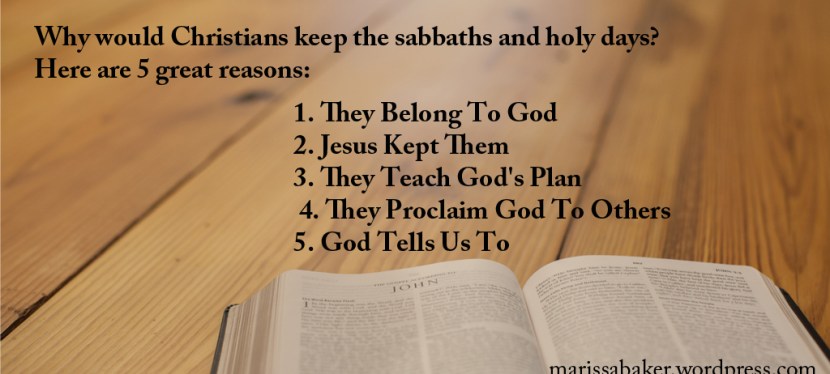
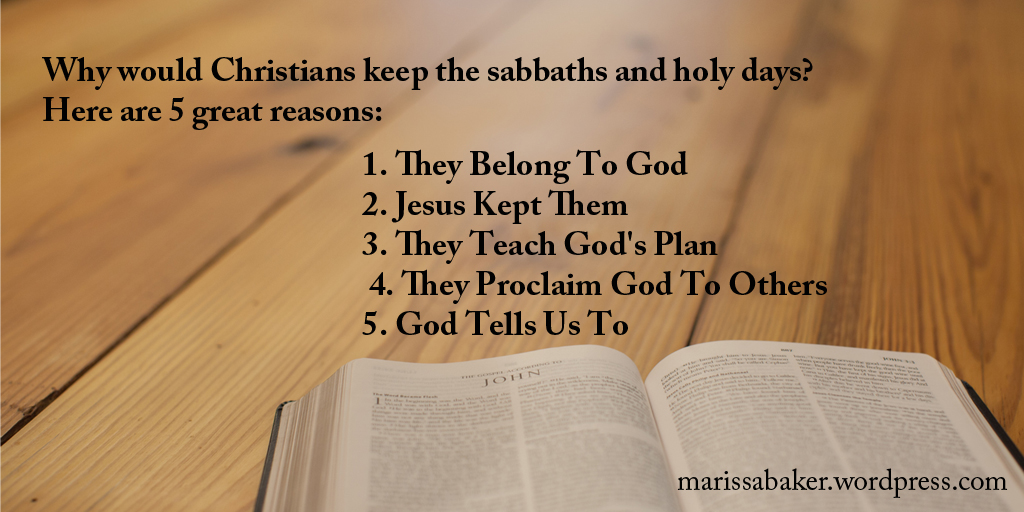
Top 5 Reasons for Christians to Keep God’s Holy Days

Today we celebrate Yom Teruah, also called Feast of Trumpets and Rosh Hashanah. But why? After all, I’m Christian and most people think of this as a Jewish holiday. Same goes for Yom Kippur/Day of Atonement, which we’ll observe 10 days from now, and Sukkot/Feast of Tabernacles that starts in two weeks.

I believe these festival observances, along with others already completed this year, are for Christians today. When Jesus came to this world, it wasn’t to set up a new religion. He was the next step in God’s plan for the world and these days are part of the covenant He makes with His family. He’s still inviting us to gather for “reunions” at certain times of the year.Top 5 Reasons for Christians to Keep God's Holy Days | marissabaker.wordpress.com

1. They Belong To God

And the Lord spoke to Moses, saying, “Speak to the children of Israel, and say to them: ‘The feasts of the Lord, which you shall proclaim to be holy convocations, these are My feasts.” (Lev. 23:1-2)

The holy days aren’t Jewish or exclusively Old Testament. They belong to God Himself. We talk about Leviticus 23 as the chapter where God gives Israel the Feasts, but that’s not quite accurate. God doesn’t say, “Here are your holy days, Israel.” He says, “These are the feasts of the Lord, holy convocations which you shall proclaim at their appointed times” (Lev. 23:4). Read more