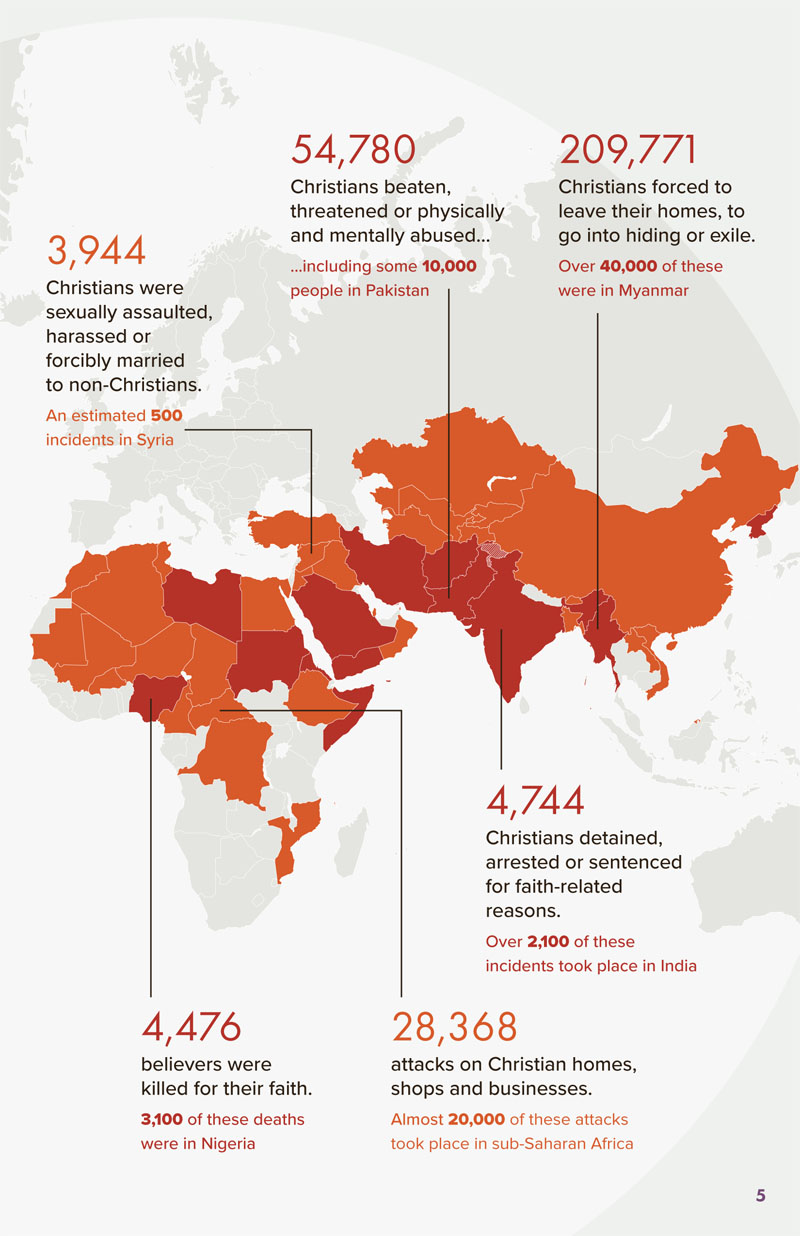
The 2025 World Watch List from OpenDoors released this week. It’s the most authoritative report you can get on locations around the world where Christians face persecution and discrimination because of their faith. OpenDoors conducts on-the-ground research in 150 countries around the world, then shares the top 50 most dangerous countries each year. The organization has a presence in 70 nations where Christians face heavy persecution, lending substantial aid and standing alongside those suffering for their faith in Jesus.
You can download a copy of this year’s World Watch List by clicking here (you can also order print copies for your church, if you want). I encourage you to take some time to thoughtfully read through the reports on each country, the requests from our brethren who live there, and the individual stories bravely shared. Then, if you can, visit the Arise Africa page and add your name to the petition that Open Doors will present to the African Union, the United Nations, other groups as part of a four-year campaign to aid God’s people in sub-Saharan Africa.
One thing that struck me deeply is that when asked how other people can help, persecuted Christians ask for prayer. “Pray for my child,” asks a man who escaped North Korea (p. 9). “Pray that God will give me strength,” asks a woman secretly ministering in Yemen (p. 11). Manga from Nigeria, who was nearly killed for refusing to deny Jesus, asks us to pray “for strength to remain firm” and “that fire for Jesus” would keep burning in their hearts (p. 15). Pastor Soré from Burkina Faso requests prayers that Christians there “stay firm in their faith” (p. 29). A man from Mexico requests prayers for hope, strong hearts, and growth of the church (p. 41). A believer in China shares, “Thank you for praying. I feel that I am not by myself. Through your prayers, I can feel that God has been looking after me to make me feel secure” (p. 23). It’s just like what the early church did–facing persecutions, encouraging each other to stand steadfast in the faith, and praying for one another.
Finally, pray for us, brothers and sisters, that the Lord’s message may spread quickly and be honored as in fact it was among you, and that we may be delivered from perverse and evil people. For not all have faith. But the Lord is faithful, and he will strengthen you and protect you from the evil one. And we are confident about you in the Lord that you are both doing—and will do—what we are commanding. Now may the Lord direct your hearts toward the love of God and the endurance of Christ.
2 Thessalonians 3:1-5, NET
As I mentioned in my 2024 blog recap, we have readers coming to LikeAnAnchor from all around the world. That includes thousands of people in Nigeria and India, as well as hundreds more from many other countries that appear in the World Watch List. I’m very grateful to have you here reading and, as the Apostle Paul frequently said, I remember you and make “mention of you in my prayers.” I don’t know most of you personally, but you are in my thoughts.
My friends, we might feel discouraged or powerless when we think about the opposition that we and/or our brethren in the world are facing, but we must remember the power of the God we serve. Praying to Him isn’t just something we do because we can’t do something more; prayer is one of the most powerful things that we can do to help others. Let’s never forget to pray for our brothers and sisters around the world.
A quick note on next week’s post: if you read my newsletter, you’ll know that I’d planned on sharing a study this week on the connection between waiting and hoping in the Hebrew language. I needed more time for that study, and when I read the World Watch List report this week, I felt moved to share this instead. We’ll be back to our regular Bible study posts next week.
One of the big lessons we can learn from the Bible is that God wants us to be prepared. There are a lot of warnings in the Bible, and we’re told many things in advance so we won’t be surprised. There are also many examples we can look at, particularly things that happened to Jesus Christ, that give us hints about what we might go through.
Following Jesus in Everything
Writing about Jesus, the author of Hebrews said, “he was obligated in all things to be made like his brothers, that he might become a merciful and faithful high priest in things pertaining to God, to make atonement for the sins of the people” (Heb. 2:17, WEB). He became like us, and we’re supposed to become like Him. If Jesus did something, then we shouldn’t be surprised that we’re supposed to do that as well.
“If I then, your Lord and Teacher, have washed your feet, you too ought to wash one another’s feet. For I have given you an example—you should do just as I have done for you. I tell you the solemn truth, the slave is not greater than his master, nor is the one who is sent as a messenger greater than the one who sent him. If you understand these things, you will be blessed if you do them.”
John 13:14-17, NET
We’re supposed to follow Jesus’s example. We’re even supposed to become perfect just like God the Father is perfect (Matt. 5:43-48). We can also expect that many of the things Jesus experienced will be things we go through as well. He took part in flesh and blood like us, He was tempted just like us (though He never sinned), and He learned humility and obedience just like we have to (Heb. 2:14; 4:15; 5:8; Phil. 2:5-8). If something happened to Him, we shouldn’t be surprised that it happens to us.
“Remember what I told you, ‘A slave is not greater than his master.’ If they persecuted me, they will also persecute you. If they obeyed my word, they will obey yours too.”
John 15:20, NET
We might marvel when we look at how the disciples handled persecution in the book of Acts. They even rejoiced “because they had been considered worthy to suffer dishonor for the sake of the name” (Acts 5:41, NET). They’d seen Jesus persecuted and they knew that they shouldn’t expect to be treated better than their master. He put up with unjust persecution for following His father, and so they put up with unjust persecution for following Him. It’s part of following His example.
We get to see how the disciples handled the truth of Jesus’s statement that, “If they persecuted me, they will also persecute you” in the book of Acts. We also get to read about Peter’s take on this topic in his first epistle, where he applied Jesus’s words to the whole church body of believers (and expanded it to include other types of suffering as well).
Dear friends, do not be astonished that a trial by fire is occurring among you, as though something strange were happening to you. But rejoice in the degree that you have shared in the sufferings of Christ, so that when his glory is revealed you may also rejoice and be glad.
1 Peter 4:12-13, NET
Often when something bad–or even just inconvenient–happens to us, our human reaction is to bemoan, “Why me?” Peter thinks we shouldn’t be surprised by tough things, even if it’s something that could be categorized as “a trial by fire.” It isn’t strange, it’s just part of life as followers of Jesus. Our Messiah suffered persecution, so why shouldn’t we? He was tempted and tried (see Matt. 4:1-11), so why wouldn’t we be? That doesn’t make it easy, but it is expected.
We sent Timothy, our brother and fellow worker for God in the gospel of Christ, to strengthen you and encourage you about your faith, so that no one would be shaken by these afflictions. For you yourselves know that we are destined for this. For in fact when we were with you, we were telling you in advance that we would suffer affliction, and so it has happened, as you well know.So when I could bear it no longer, I sent to find out about your faith, for fear that the tempter somehow tempted you and our toil had proven useless.
1 Thessalonians 3:1-5, NET
Like the people of Thessalonica, we’ve been given warnings that life will be hard sometimes. We read the Bible and listen to sermons, and we know that following God doesn’t exempt us from facing trials (though He does promise to work all things out for good in the end and give us a way to endure trials [Rom. 8:28; 1 Cor. 10:13]). That doesn’t always stick in our heads, though, when bad things happen. That’s one reason it’s so important to be connected with Messiah’s community–so people can check on and encourage you just like Paul did for the Thessalonians.
For this is the gospel message that you have heard from the beginning: that we should love one another,not like Cain who was of the evil one and brutally murdered his brother. And why did he murder him? Because his deeds were evil, but his brother’s were righteous. Therefore do not be surprised, brothers and sisters, if the world hates you.
1 John 3:11-13, NET
John spends a lot of this epistle talking about how God loves us and our duty to love Him and each other. He also points out that when we love in a Godly way, it’s a radical departure from how the world lives. We’re supposed to love our fellow Christians–everyone who is fathered by God, practices righteousness, and is growing toward perfection (1 John 3:1-16). In contrast, many people in the world hate those whose deeds are righteous (John 3:19-20;15:18-19). That shouldn’t surprise us–it’s been that way since Cain and Able.
I didn’t plan on this blog post to focus so much on persecution and trials, but when you start studying warnings that’s a main theme that pops out. I suspect it’s because God and the Biblical writers know that the hardships we encounter can keep us from enduring unless we develop a strong root system of faith (see Mark 4:1-20). There are other warnings, though, and cautions so that we’re not surprised.
“For false messiahs and false prophets will appear and perform great signs and wonders to deceive, if possible, even the elect. Remember, I have told you ahead of time.”
Matthew 24:24-25, NET
God tells us a lot about the future. We don’t know when the end time events that He prophesied are going to happen (Acts 1:6-7), but Jesus gave us plenty of warnings about what those times will be like and how we’re supposed to guard ourselves as we get closer to the time of his return (Matt. 24-25, and many other prophecies). He told us these things before they happened so that we won’t be misled (Matt. 24:4-5), alarmed (Matt. 24:6), deceived (Matt. 24:24), unprepared (Matt. 24:42-44; 25:1-13), or shirking our duties (Matt. 24:45-51; 25:14-46).
God doesn’t tell us exactly what’s going to happen or when in our lives, but He doesn’t leave us in the dark about his overarching plan. We won’t know the specifics of trials we face before they happen, but He warns us they will happen and promises He’ll be there through them. He wants us to join His family, and sets us up for success.
“You heard me say to you, ‘I am going away and I am coming back to you.’ If you loved me, you would be glad that I am going to the Father, because the Father is greater than I am.I have told you now before it happens, so that when it happens you may believe.”
John 14:28-29
When we see God follow through on His promises, it strengthens our faith. He’s given us many insights into how the world works, what we can expect, and what we’re looking forward to so that we can develop a deep, strong faith and trust in Him. We can have confidence and peace, knowing that God has already assured us of His good plans and purposes related to us and the world. We can also trust Him through trials, knowing we’ve been warned of them in advance and having the perspective that God will use them to refine us and that He’ll be with us no matter what comes.
Last week, in a post titled “Witness,” I walked through a word study of the Greek word martus and its derivatives. One of my readers extended that study with a fascinating comment he shared on Facebook (click here to read it). He pointed out that, like in Greek, the word for “witness” and “martyr” in Arabic are the same and have layers of meaning. He also suggested that the witness-martyr connection may have originated with Stephen being killed after his witness (Acts 6-7).
Today, I’d like to continue our study of “witness” by looking more closely at Acts. I also want to dig into the Hebrew uses of “witness” in the Old Testament at some point, but we closed on a new house last Monday, I have to be moved out of my apartment halfway through next week, and then I’m getting married so time hasn’t been an abundant commodity right now. Hopefully we can keep digging into that in the weeks to come.
If you’re reading this post on the Saturday it went live, then tomorrow is Pentecost. “Witness” is used in connection with that holy day, so coupled with the comment on last week’s post I had two reasons for focusing on the book of Acts in today’s study.
Witnessing to Jesus
The book of Acts picks up near the end of the 40 days that Jesus spent on earth with His disciples after His resurrection. When He ascended to heaven, there were still 10 days left in the 50-day count from the wave sheaf day (first Sunday after Passover) until Pentecost.
While he was with them, he declared, “Do not leave Jerusalem, but wait there for what my Father promised, which you heard about from me. For John baptized with water, but you will be baptized with the Holy Spirit not many days from now.”
So when they had gathered together, they began to ask him, “Lord, is this the time when you are restoring the kingdom to Israel?” He told them, “You are not permitted to know the times or periods that the Father has set by his own authority. But you will receive power when the Holy Spirit has come upon you, and you will be my witnesses in Jerusalem, and in all Judea and Samaria, and to the farthest parts of the earth.” After he had said this, while they were watching, he was lifted up and a cloud hid him from their sight.
Acts 1:4-9, NET
There are a few key things Jesus told them here. First, He told them to stay in Jerusalem for the baptism of the Holy Spirit. Next, He told them they don’t need to (and indeed aren’t permitted to) know the Father’s timeline for His plan. Rather, they’re going to receive power and then act as “my witnesses.”
Being a witness to Jesus was a vital part of this commission. When the disciples “proposed two candidates” to replace Judas Iscariot as a 12th apostle, the key qualification was that he be “one of the men who have accompanied us during all the time the Lord Jesus associated with us, beginning from his baptism by John until the day he was taken up from us—one of these must become a witness of his resurrection together with us” (Acts 1:15-26, NET). In this case, “witness” was very literal. To be counted among the 12 apostles, the chosen man had to be able to give eye-witness testimony to Jesus’s life, death, and resurrection.
Peter’s Pentecost Witness
You can read all about the pivotal Pentecost after Jesus’s resurrection in Acts 2. The Holy Spirit rushed in like a violent wind, settling on each of the gathered believers as tongues of fire. The sound drew a crowd, who marveled at the spirit-filled disciples speaking in all the native languages represented in the crowd. As the crowd wondered what was going on, Peter spoke to the people.
But Peter stood up with the eleven, raised his voice, and addressed them: “You men of Judea and all you who live in Jerusalem, know this and listen carefully to what I say. …
“Men of Israel, listen to these words: Jesus the Nazarene, a man clearly attested to you by God with powerful deeds, wonders, and miraculous signs that God performed among you through him, just as you yourselves know—this man, who was handed over by the predetermined plan and foreknowledge of God, you executed by nailing him to a cross at the hands of Gentiles. But God raised him up, having released him from the pains of death, because it was not possible for him to be held in its power. …
“This Jesus God raised up, and we are all witnesses of it. So then, exalted to the right hand of God, and having received the promise of the Holy Spirit from the Father, he has poured out what you both see and hear. … Therefore let all the house of Israel know beyond a doubt that God has made this Jesus whom you crucified both Lord and Christ.”
Acts 2:14, 22-24, 32-33, 36, NET
I know I said at the beginning that we weren’t going to have time to get into the Old Testament in this post, but I would like to reference one of God’s laws regarding witnesses: “A single witness may not testify against another person for any trespass or sin that he commits. A matter may be legally established only on the testimony of two or three witnesses” (Deut. 19:15, NET).
God set up a system where one witness’s testimony couldn’t be used as the basis for a court case, but if two or three witnesses agreed that meant something significant. Here in Acts, Peter is standing up not as a single eyewitness, but as one of 12 men who defined themselves as witnesses of Jesus’s life, death, and resurrection. And they weren’t the only ones there. As we discussed in our post about “The Women At Pentecost,” it seems there were at least 120 believers gathered–60 times the number of witnesses legally required to treat a matter seriously.
Image by Claudine Chaussé from Lightstock
Stephen’s Witness
As the book of Acts goes on, we see the disciples continuing to share their eye-witness testimony (Acts 3:11-15; 4:33; 5:27-32; 10:34-43; 13:29-31). They spoke to crowds of people, before Jewish courts, and to gentile converts. Later, God added Paul as another apostle and witness (Acts 23:11; 26:16). The single most well-known story of witness in Acts doesn’t come from any of the apostles, though. It comes from a man named Stephen.
Up until this point, the witnesses mentioned in Acts are all numbered among the 12 disciples/apostles. Then here’s Stephen, one of seven men chosen to make sure that both the Greek-speaking and Hebraic widows received support. These seven men “were well-attested” (literally, they received a good witness from others) and full of God’s spirit (Acts 6:1-5, NET).
If you read my book review for Relational Faith, you might remember that the same Greek word translated “faith” is also translated “persuasion” in the context of Aristotle’s Rhetoric. Given that Stephen’s well-spoken words were what people went after him for, I find it interesting that we’re told he was “a man full of faith and of the Holy Spirit.” He’s going to be using his faith as the basis for persuasive rhetoric when he gives his witness before the council.
Now Stephen, full of grace and power, was performing great wonders and miraculous signs among the people. But some men from the Synagogue of the Freedmen (as it was called), both Cyrenians and Alexandrians, as well as some from Cilicia and the province of Asia, stood up and argued with Stephen. Yet they were not able to resist the wisdom and the Spirit with which he spoke.
Acts 6:8-10, NET
These people couldn’t handle the fact that Stephen was speaking so boldly and wisely or that he was so full of God’s power that he was performing wonders and miracles. So they conspired against him, brought him before the council, and even had false witnesses testify against him.
They brought forward false witnesses who said, “This man does not stop saying things against this holy place and the law. For we have heard him saying that Jesus the Nazarene will destroy this place and change the customs that Moses handed down to us.”
Acts 6:14-15, NET
The false witnesses say one thing, and now the high priest invites Stephen to answer the question, “Are these things true?” (Acts 7:1, NET). Stephen replies by summarizing God’s plan in a powerful sermon. He starts with God calling Abraham and making a covenant with him, reminds his listeners of how the Israelites ended up in Egypt, and finally comes to Moses.
When he saw one of them being hurt unfairly, Moses came to his defense and avenged the person who was mistreated by striking down the Egyptian. He thought his own people would understand that God was delivering them through him, but they did not understand.
Acts 7:24-25, NET
The phrasing Stephen uses here is very similar to how John describes Jesus Christ: He came to His own people as savior but most didn’t recognize or receive Him (John 1:10-12). Stephen is going to circle back to this connection as well. He continues with the story of Moses fleeing Egypt, then returning when God told him to lead the people out of slavery. He recaps the Exodus story, then reminds his hearers of a quote they no doubt recognized: “This is the Moses who said to the Israelites, ‘God will raise up for you a prophet like me from among your brothers” (Acts 7:37, quoting Deut. 18:15).
As Stephen continues, he reminds his listeners that despite the powerful Exodus deliverance, their ancestors didn’t faithfully obey God. They even “had the tabernacle of testimony in the wilderness” and they still weren’t faithful (Acts 7:44, NET; “testimony” is the same Greek word as “witness”). At this point, Stephen shifts from history to explication. He reminds the people that even though “Solomon built a house for him … the Most High does not live in houses made by human hands” (Acts 7:47-48, NET). And just like their ancestors tried to put God in a box and go about their lives without really following him, so Stephen’s listeners are doing by rejecting Jesus as the Messiah.
“You stubborn people, with uncircumcised hearts and ears! You are always resisting the Holy Spirit, like your ancestors did! Which of the prophets did your ancestors not persecute? They killed those who foretold long ago the coming of the Righteous One, whose betrayers and murderers you have now become! You received the law by decrees given by angels, but you did not obey it.”
When they heard these things, they became furious and ground their teeth at him.
But Stephen, full of the Holy Spirit, looked intently toward heaven and saw the glory of God, and Jesus standing at the right hand of God. “Look!” he said. “I see the heavens opened, and the Son of Man standing at the right hand of God!”
But they covered their ears, shouting out with a loud voice, and rushed at him with one intent. When they had driven him out of the city, they began to stone him, and the witnesses laid their cloaks at the feet of a young man named Saul.
They continued to stone Stephen while he prayed, “Lord Jesus, receive my spirit!” Then he fell to his knees and cried out with a loud voice, “Lord, do not hold this sin against them!” When he had said this, he died.
Acts 7:51-60, NET
The false witnesses claimed that Stephen was preaching against the temple and the law, saying Jesus would change Moses’s commands. Stephen says no, what’s actually happening is that his accusers were rejecting salvation and God’s sovereignty just as Israel did in the past when they rejected Moses and refused to stay faithful to God. What a powerful, convicting message for Stephen to deliver. What an incredible gift for him to be able to witness “the glory of God, and Jesus standing at the right hand of God.” And what violent, hideous backlash when his true witness exposed not only the lies of the false witnesses but the hypocrisy of every Jewish person who claimed to know God yet rejected Jesus.
An Example for Us
Image by Jantanee from Lightstock
When I read Stephen’s story, I can’t help but think of Jesus’s words when His disciples asked Him about the signs of the end times.
“You must watch out for yourselves. You will be handed over to councils and beaten in the synagogues. You will stand before governors and kings because of me, as a witness to them. First the gospel must be preached to all nations. When they arrest you and hand you over for trial, do not worry about what to speak. But say whatever is given you at that time, for it is not you speaking, but the Holy Spirit. Brother will hand over brother to death, and a father his child. Children will rise against parents and have them put to death. You will be hated by everyone because of my name. But the one who endures to the end will be saved.”
Mark 13:9-13, NET
What happened to Stephen was just the first in a long history of this exact thing that Jesus warned about. It’s happened to people throughout history who were dragged before secular and religious courts to answer for their faith. It’s happening today to Christians around the world who are hated and persecuted. And it could happen to us as well.
As sobering and even frightening as this warning is, there is also a key piece of encouragement. Jesus says that if we’re ever in a position where we need to witness the way He talked about in the gospels or the way Stephen did in Acts, we don’t need to worry about what to say. The powerful, eloquent sermon that Stephen preached which was exactly what his listeners needed to hear (though they refused to admit it) didn’t just come from Stephen; it was a product of the Holy Spirit inside him. We who follow God faithfully have that same spirit today and we can also trust that Jesus will help us and guide us in whatever circumstances that we’re called to witness about Him.
Featured image by WhoisliketheLord Studio from Lightstock
One of the things I often struggle with in settings like work and school is how much of my faith to share. I’m not an evangelist sort of person, and trying to convert people who don’t know Jesus yet is never something I’ve felt a strong calling to do. I’m much more comfortable–and feel I’m using my gifts far more effectively–when working with an audience of people who already have some kind of Christian framework for how they view the world. I also want to be respectful of other people’s time, personal beliefs, and conversational boundaries. Yet at the same time, I’m not ashamed of my faith and I want to live it out boldly the way I see heroes of faith doing in the Bible. At the very least, I want to let others see that faith is a central part of my life.
This struggle is one I think many Christians today can identify with, particularly as pressure to keep your beliefs to yourself increases. Many Christians in the Western world aren’t facing overt, clear, and violent persecution the way our brethren are in other parts of the world; we’re facing a more subtle, seemingly less dangerous pressure to not talk about Jesus in public, or say “God bless you,” or mention anything which may offend those who believe differently. Yet when we look at the examples of people in the New Testament, we see the apostles and other disciples risking ostracization from their communities as well as death, beatings, and imprisonment rather than be quiet about the gospel. At the same time, though, we’re also told to be wise about how we navigate the world around us. How do we balance all that? And what scriptures might help us figure out the answer?
Loving and Obeying
As we approach this question, I think we need to start from the position of seeking, “What does God ask of me?” and “How can I love Him more fully?” Beginning this sort of studying by wondering how low-profile we can be while still meeting the bare minimum requirements for Christianity would mean prioritizing what the world thinks of us over our relationship with God. We certainly don’t want that, so let’s start our search for answers by putting our relationship with God first.
As I wrote about more extensively last year in a post called “Do I Love God Enough To Obey Him?“, it’s impossible to overstate how important it is for us to know and be known by God. Love is a central part of that relationship–both God’s love for us and our love for God and for the people around us. The Apostle John’s writings make it clear that this love must involve obeying Jesus and the Father. Our relationship with God should change the way we live, and the form that change takes can be described as obedience to God’s commandments on a spiritual level. We’re to love God’s law and become righteous in the same way that He is righteous.
Obedience is not our means to righteousness; it is the clearest expression of our devotion to Jesus. … If we truly love Him, as we say we do, what He says will matter to us profoundly. We will not follow the acceptable parts of His teachings and ignore the objectionable parts. We will not approach our relationship with Him as though we are trying to get by with the bare minimum behavioral changes. We will devour His teachings, turning them over in our hearts, meditating on their application, and living them as clearly as we can.
With that background, the question of how to live out our faith in this world becomes secondary to the question of how we ought to live our lives in close alignment with God. It is as a result of our relationship with God that we have “good works” which we can let shine as a light before all people (Matt. 5:14-16; Phil. 2:15; 4:5; 1 Pet 2:12). We’re supposed to be fully-engaged in living for God, and if that is truly our focus it will be obvious to the people around us. We should want others to notice that there’s something different about us so they will realize God deserves all the glory and praise for whatever is good about us.
Wise, Harmless, and Bold
When looking at scriptures that talk about how to share your faith, there are a few key points that stand out to me. The first is how many times the New Testament talks about boldness when preaching. That description is used over and over in the book of Acts, where the disciples kept talking about Jesus even though they faced threats of imprisonment, beatings, excommunication, and even death for sharing the gospel (Acts 4:29, 31; 9:27; 14:3; 18:26; 19:8; 28:31). Paul also writes about speaking boldly. He encourages others to be bold and asks for prayers that he might speak with boldness (2 Cor. 3:12; Eph. 6:19-20; Phil. 1:14, 20; 1 Thes. 2:2; 1 Tim. 3:13). We should not let fear hold us back from talking about Jesus but being bold isn’t always easy; even Paul wanted the support of prayers so that he could keep preaching the gospel.
Behold, I send you out as sheep among wolves. Therefore be wise as serpents and harmless as doves. But beware of men, for they will deliver you up to councils, and in their synagogues they will scourge you. Yes, and you will be brought before governors and kings for my sake, for a testimony to them and to the nations. But when they deliver you up, don’t be anxious how or what you will say, for it will be given you in that hour what you will say. For it is not you who speak, but the Spirit of your Father who speaks in you.
Matthew 10:16-20, WEB
While we are supposed to be bold and courageous, not worrying about the possibility that we’ll face resistance or prosecution for our faith, we’re also supposed to be wise. Part of that is knowing when to speak and when not to speak. Peter says we should always be ready to give an answer if someone asks us about our faith (1 Pet. 3:15), but that doesn’t mean always speaking up when you haven’t been asked. The world is not a safe place. That fact should never terrify us, especially since we know God is on our side, but it should make us exercise wisdom. A wise person thinks before they speak. They seek God’s help in figuring out when to “hold their peace” and when silence is not an appropriate option (Est. 7:3-4; Prov. 11:12; Is. 62:1; Acts 11:18). As we seek to live rightly and shine Jesus’s light clearly, we also ought to be “wise serpents” and “innocent doves” who are careful to do no harm.
I know that conclusion doesn’t really give a clear answer to the questions we started with about how much you should talk about your faith as society increasingly pressures Christians to stay quiet about their beliefs. Still, I think Bible studies like this one help us keep our priorities clear. It’s easy to get caught up in the day-to-day-level worries about how people might respond to us or whether or not we said the right thing in a conversation. We ought to take a more big-picture approach, seeking first to honor God and letting all the other things fall into place around that central relationship.
I don’t read most of the e-newsletters that show up in my email, but sometimes I do. Open Doors shares prayer requests and updates about persecuted Christians around the world, and Hope Outfitters partners with charities to donate all the money they make off clothing sales to a good cause. I’ll read their newsletters, and often when I do, I become angry and sad. When I read about Christians in India being denied food and medicine unless they renounce their faith or a little girl here in the U.S. whose parents started selling her for sex when she was 6 months old, I want someone do do something about it. People are trying to help–that’s part of what the newsletters talk about–but I want a more permanent solution. I want God to do something about it. The more I hear stories like this, better I understand why David wrote Psalms asking God to “break the teeth of the wicked” (Ps. 3:7, NET) and “pay them back for their evil deeds. Pay them back for what they do. Punish them” (Ps. 28:4, NET).
And yet, even though we have the Psalms as models for the range of emotions that godly people can feel and it is okay to take our anger to God in this way, we are also told not to give into that anger or be consumed by a desire for vengeance. Indeed, Jesus says, “love your enemy and pray for those who persecute you” (Matt. 5:44, NET). This command seems terribly counter-intuitive, especially when the things some people do are so clearly evil.
To be clear, loving our enemies does not mean we ought to “call evil good” or make darkness out to be light (Is. 5:20). God defines what is righteous and what is not, and it is not our place to excuse what He calls wicked. We must beware that our mercy doesn’t turn into a permissive tolerance of sin (1 Cor. 5:1-6). Yet we’re also not to become raging, unforgiving avengers or legalistic judges who take it upon themselves to condemn others. There’s a challenging balance to strike in this, and I think there are several things we can keep in mind to help with that.
God’s Fairness to All
We have certain ideas about fairness and justice that come from a mix of our cultures, our gut reactions, and our thoughts and experiences. Typically, those ideas don’t match up exactly with what God thinks of as right and just. We can see this in the parable of the laborers in the vineyard, whom the landowner gave the same payment whether they’d worked an hour or the whole day (Matt. 20:1-16). The men complained because those who’d worked less were treated as equal to them, but the landowner did give them what he’d agreed and he had the right to pay people what he chose. Whether someone has been a Christian all their life or just a few months, God can give them the same reward while still being impartial and just.
Something similar happens in God’s dealings with the wicked. He is always just, but it doesn’t always look the way we want or expect. And because we are to become like God, Jesus tells us God’s perfect justice should inspire us to treat people the way that God does.
But I say to you, love your enemy and pray for those who persecute you, so that you may be like your Father in heaven, since he causes the sun to rise on the evil and the good, and sends rain on the righteous and the unrighteous. … So then, be perfect, as your heavenly Father is perfect.
Matthew 5:44-45, 48, NET
The Greek word here for “love” is agapao. We don’t have to see our enemies as close friends with whom we have a lot in common and a closed bond (which would have been expressed by the word phileo) but we do need to love everyone, including our enemies, with the same active goodwill and benevolence that God has as a key part of His being. When we struggle to understand why God doesn’t punish certain people right now or stop them before they could do bad things, we need to keep in mind that He is loving and patient as well as good and just (2 Pet. 3:9).
Whenever we’re tempted to grumble about the fact that God shows mercy and patience to certain people, it’s good to remember how He deals with us. Don’t you appreciate God’s patience with your sin? Aren’t you grateful that His idea of justice means showing you mercy and grace? Doesn’t it make you rejoice and praise Him to know that instead of giving us what we fairly deserved (i.e. death for our sins) Jesus died in your place? To quote Chris Tiegreen, “we who have received a clean slate from our Savior can have no complaints against our God of justice. Justice once directed at us was poured out on Another, so we can hardly insist that others receive it” (365 Pocket Devotions, Day 128).
Therefore, as the elect of God, holy and dearly loved, clothe yourselves with a heart of mercy, kindness, humility, gentleness, and patience, bearing with one another and forgiving one another, if someone happens to have a complaint against anyone else. Just as the Lord has forgiven you, so you also forgive others.
Colossians 3:12-13, NET
When we receive mercy, God expects us to show mercy. It’s such a big issue that Jesus even says God will withhold forgiveness from us if we don’t forgive others (Matt. 18:23-35). As God’s people, we’re to put on things like mercy, kindness, gentleness, and patience, remembering all the times we benefit because God treats us with mercy, kindness, gentleness, and patience. The more we remember how much undeserved mercy we have received, the better we can wrap our minds around God’s choice to treat others with mercy as He patiently provides opportunities for them to repent (Rom. 2:4; 1 Tim. 2:3-4; 2 Pet. 3:9).
True Justice is a Promise
Another thing we can keep in mind when we wonder what God’s going to do about evil (and why doesn’t He do it now!?) is His promise that there will be justice. “Our God is a consuming fire” (Heb. 12:29, WEB) who claims vengeance as His own and promises “I will repay” (Rom. 12:19). It’s not our place to try to pay people back for what they’ve done (Prov. 24:29). We ought to care about justice, since it is a godly thing, but only God–who is the Lawgiver and has perfect perspective on human beings’ motives and actions–can administer justice in the way we’re talking about here.
Live in harmony with one another; do not be haughty but associate with the lowly. Do not be conceited. Do not repay anyone evil for evil; consider what is good before all people. If possible, so far as it depends on you, live peaceably with all people. Do not avenge yourselves, dear friends, but give place to God’s wrath, for it is written, “Vengeance is mine, I will repay,” says the Lord.
Romans 12:16-19, NET
There is a day coming “when God will judge the secrets of human hearts,” including our own (Rom. 2:16, NET). We ought to “sigh and cry” and “groan and lament” over the abominable and detestable things done in our world (Ezk 9:4, WEB & LEB). We’re also to pray “thy kingdom come,” and trust in God’s timing. His patience and mercy and love means that He wants to give as many people as possible time to repent. These character traits do not mean He has forgotten the injustices done on this earth or that He will not avenge those who’ve been wronged.
As we ponder the things we ought to focus on instead of anger and vengeance or apathetic helplessness, we probably also realize this is a hard thing to do. Changing the way we think and taking responsibility for the way we feel isn’t easy, but it is possible. It’s particularly doable with the help of the holy spirit. With God’s power working in us to wage war on a spiritual and mental level, we can even “take every thought captive to make it obey Christ” (2 Cor. 10:3-5, NET). Our thoughts often feel outside our control, but with God’s help we can choose what to think and how we react to what’s going on around us.
Finally, brothers and sisters, whatever is true, whatever is worthy of respect, whatever is just, whatever is pure, whatever is lovely, whatever is commendable, if something is excellent or praiseworthy, think about these things.
Philippians 4:8, NET
This is where we want to keep our focus. It’s not that we ignore all the bad things or pretend the world is full of nothing but sunshine and goodness. Rather, we ought not to dwell on the evil as if that were all there is. Then, instead of feeling helplessness or rage when we read or hear about an evil deed we can think on the truth of God’s promised, perfect justice. We can look for respectable, commendable ways to help people in need. We can pray for those excellent, praiseworthy people who are doing things like standing faithfully in the face of persecution or fighting to end sex trafficking. We can keep bringing our thoughts into alignment with Christ’s mind over and over again, asking God to help us hold fast to Him and live with faith, hope, and love until His kingdom comes.
Blessed are those who have been persecuted for righteousness’ sake, for theirs is the Kingdom of Heaven.
Matthew 5:10, WEB
For many Christians around the world and throughout history, the idea that they’ll be persecuted for their faith is not shocking. In fact, Christianity is among the most persecuted religions in the world. Just last year, one report stated that “Christian persecution ‘at near genocide levels'” in certain countries (BBC News, 3 May 2019). More recently, the 2020 World Watch List report released by Open Doors found that “1 in 8 believers, worldwide” “experience high levels of persecution” for their faith in Jesus Christ (click here for more information).
Here in the US, though, we have not experienced anything like this. Moreover, Western Christians in the modern world seem to have a sense that we shouldn’t be persecuted; as if somehow we deserve an exemption because we live in such evolved, democratic societies. And even if we don’t feel like that, persecution is frightening. It may even make us wonder if following Jesus is worth the cost. Perhaps that’s why this is the one beatitude that Jesus immediately elaborates on.
Blessed are you when people reproach you, persecute you, and say all kinds of evil against you falsely, for my sake. Rejoice, and be exceedingly glad, for great is your reward in heaven. For that is how they persecuted the prophets who were before you.
Matthew 5:11-12, WEB
If we are persecuted (or worry we may be persecuted), this is the sort of thing we need to hear; a reassurance that we can hold tight to God and that He’ll take care of us. None of us are alone. God’s people don’t fit in with the rest of the world, and from the very earliest Bible records those who follow God faced opposition from the world. But they didn’t face it by themselves and neither will we, because God is on our side. Not only that, but we have a future goal to look forward to which is amazing enough to make whatever happens to us in this life seem like it really doesn’t matter.
Faithful and Righteous
The Hebrews 11 faith chapter comes to mind while reading about those who are persecuted and blessed. All the people listed there were faithful and righteous, and most faced persecutions of some sort. Abel was murdered. Abraham, Isaac, and Jacob did not get along well with everyone they met, and some stole from or cheated them. Joseph was sold into slavery. Moses suffered abuse for Christ (Heb. 11:26, NET). David was hunted by Saul.
Others were tortured, not accepting their deliverance, that they might obtain a better resurrection. Others were tried by mocking and scourging, yes, moreover by bonds and imprisonment. They were stoned. They were sawn apart. They were tempted. They were slain with the sword. They went around in sheep skins and in goat skins; being destitute, afflicted, ill-treated— of whom the world was not worthy—wandering in deserts, mountains, caves, and the holes of the earth.
Hebrews 11:35-38, WEB
I don’t much like reading this passage. The whole “sawn asunder” (v. 37, KJV) thing especially bothers me. But I think, like the people these verses are talking about did, we need to focus on this part: “That they might obtain a better resurrection.” Or, to quote a translation I recently fell in love with, “to obtain resurrection to a better life” (v. 35, NET).
When We Suffer, We’re Being Like Christ
Jesus promises that God has a reward for those who face persecution “for righteousness’ sake.” This isn’t a concept you hear much about in the world today, but righteousness is a key part of scripture. In a broad sense, Thayer’s dictionary defines it as the “state of him who is as he ought to be” (G1343, dikaiosune). God is righteous and He’s the one who models and defines righteousness for us. It involves obedience to God, personal integrity, “purity of life,” and “correctness of thinking, feeling, and acting” (Thayer).
Peter talks about the idea of suffering for righteousness several times in his first epistle. He says that “it is commendable” if you patiently endure suffering you don’t deserve “because of conscience toward God.” That is, after all, what Christ did (1 Pet. 2:19-25). Jesus suffered for our sins and if we suffer for following Him and doing God’s will, well, that’s better than if we were to suffer for doing wrong (1 Pet. 3:17-18).
But in fact, if you happen to suffer for doing what is right, you are blessed. But do not be terrified of them or be shaken. But set Christ apart as Lord in your hearts and always be ready to give an answer to anyone who asks about the hope you possess. Yet do it with courtesy and respect, keeping a good conscience, so that those who slander your good conduct in Christ may be put to shame when they accuse you.
1 Peter 3:14-16, NET (Old Testament quotes bolded in original)
When Peter wrote this epistle, I wouldn’t be surprised if he was thinking back to something Jesus told him and the other disciples at His last Passover here on earth. Jesus said, “If they persecuted me, they will also persecute you. … they will do all these things to you for my name’s sake, because they don’t know him who sent me” (John 15:20-21).
Count The Cost
Suffering as a Christian is pretty much guaranteed. If you aren’t persecuted for righteousness’ sake, scripture makes it seem like that’s actually more unusual than if you are. That’s one reason we’re told to count the cost before following Jesus; because this life demands commitment and sacrifice (Luke 14:25-35). When Paul counted that cost, even with all the persecutions he suffered (2 Cor. 11:23-28), he concluded that nothing else mattered as much as knowing Christ and that the rewards for following Him will be so amazing the suffering seems as nothing (Rom. 8:18-30).
Yes most certainly, and I count all things to be a loss for the excellency of the knowledge of Christ Jesus, my Lord, for whom I suffered the loss of all things, and count them nothing but refuse, that I may gain Christ and be found in him, not having a righteousness of my own, that which is of the law, but that which is through faith in Christ, the righteousness which is from God by faith, that I may know him, and the power of his resurrection, and the fellowship of his sufferings, becoming conformed to his death, if by any means I may attain to the resurrection from the dead.
Philippians 3:8-11, WEB
Paul says here that he “suffered the loss of all things,” and that’s in addition to all the direct persecutions he talks about in other epistles. But when he counted the cost of following Jesus, he still came to the conclusion that it was all worth the effort. He, like those in the faith chapter, “looked for the city which has the foundations, whose builder and maker is God” (Heb. 11: 10, WEB). He knew the reward for following God far outweighed any downsides.
The reward mentioned in this beatitude brings us full circle in our series of posts. “Blessed are the poor in spirit,” Jesus said at the beginning of this sermon on the mount, “for theirs is the Kingdom of Heaven” (Matt. 5:5, WEB). The New English Translation puts it a little differently: “for the kingdom of heaven belongs to them.”
When John the Baptist and then Jesus came preaching, they both said, “Repent, for the Kingdom of Heaven is at hand!” (Matt. 3:1-2; 4:17). Throughout Matthew’s gospel (other writers use the phrase “kingdom of God”), this emphasis on the kingdom of heaven continues. Jesus told us who would and would not enter the kingdom of heaven, taught us to pray “Let your kingdom come,” and shared analogies for what the kingdom is like (click for verse list).
One of the things Jesus said is, “Not everyone who says to me, ‘Lord, Lord,’ will enter into the kingdom of heaven—only the one who does the will of my Father in heaven” (Matt. 7:21, NET). Just a little earlier in the same sermon where He makes this statement, Jesus gives us a succinct guide in the form of Beatitudes to some of the ways we can align ourselves with God. This is what righteousness is about — not being “experts in the law” but going beyond that and learning to truly be like God (Matt. 5:18-20), even to the point that the same people who hate Jesus will also hate us because we are so much like Him. Yes, that may mean we are among “those who are persecuted for righteousness,” but “the kingdom of heaven belongs to them.” And I think Paul is right when he says getting into that kingdom and being with God forever is worth whatever we might have to give up or go through in this life.
















 Like An Anchor