The Difference Between Having Anxiety and Feeling Anxious

Every human being knows what it’s like to feel anxious about something, but that’s not the same thing as having anxiety. There’s a difference between normal anxiety (which is appropriate to the situation) and dealing with an anxiety disorder (which is a mental health condition).

In day-to-day life it’s actually really hard to define the line between normal worry and too much worry (as Dr. Ramani Durvasula says in “Why It’s So Crucial to Understand Anxiety Disorders“). What pushes you into problematic anxiety can vary depending on the individual. It will also vary for an individual depending on other factors in their lives. In addition, anxiety looks different for everyone who struggles with it. That means my personal examples in this article are an accurate reflection of my anxiety, but won’t be equally relatable for everyone with anxiety.

There are plenty of situations where it’s normal to feel anxious. But when anxiety starts to define your life, or keeps you from functioning normally, or generalizes to everyday situations, there’s a good chance you’re dealing with something different than normal human nervousness. Anxiety can also be a clue that something else is going on. If you think your worry might have crossed a line into too much worry, it’s a good idea to talk with a mental health professional.

Disclaimer: I’m not a counselor or therapist and this article can’t be used to diagnose anxiety or as a treatment guide. If you’re struggling with something talk with a mental health professional. They will be much more helpful than me. I also want to say that there’s nothing shameful about seeking answers or asking for help. And if you do get a diagnosis, remember it’s a starting point for treatment, not a sentence or judgement on who you are. You wouldn’t feel ashamed about finding out you have lyme disease or a heart condition, and there shouldn’t be a stigma against mental health problems either. Read more

Why Is It So Hard For Certain Personality Types To “Just Get Over It”?

You know when you’re struggling with something bad that happened to you and someone says, “Just get over it,” but you know it’s not that simple? For some reason, this particular hurt lodged deep inside and letting go seems well-nigh impossible.

For this post, I’m not talking about a hurt like grief over losing someone you love. We know why things like that are hard to “get over,” and in many cases it wouldn’t be appropriate to move on quickly. Most people recognize that hurts of that sort require time to heal and grieve. I’m talking about interpersonal hurts that might seem “little,” but have a big impact anyway. For example…

  • You express an authentic part of yourself (like your happy, fun-loving side), then people assume that’s all there is to your personality.
  • You receive 99% positive feedback about a project, but that 1% haunts you anyway.
  • You help someone out of the goodness of your heart, but others misinterpret your motives.
  • You decide to open up to someone, then lie awake at night worrying about their reaction.

Hurts like this touch on the core of who we are and/or our relationships with other people. These hurts are often deeply individual, and others might not understand them. If you don’t care what other people think of you, then you’re not going to understand why someone else is so upset about the one person in their life who’s a critic. If you find it easy to adapt to different social situations, you might not understand why someone’s so upset about not being able to express their true self all the time.

The reason why things like this can hurt us so deeply is often nuanced and complicated, but it has a lot to do with how we use the Feeling sides of our personalities. Everyone has a Feeling side (whether or not there’s an F in your four-letter Myers-Briggs® type), and we each use this part of our personality a little differently. Read more

Exchanging Your Foundation Stones

Some people today treat identity as fluid, easy to change or choose. Whatever you “identify as” in the moment is what matters, and the rest of us are supposed to play along. But identity — the answer to “who are you?” — is actually something formed over time. All our experiences, our personality traits, our choices build who/what you are. There are parts of identity that we can’t change, and if you want to change the other parts it requires hard work and a fundamental shift in how we think and behave.

The word “fundamental” comes from the same root as “foundation” (Latin fundare “to found/lay a base for”). Many of our foundations are laid when we’re young. We ask questions like “Who am I?” and “What do I value?” and we figure out answers that stick with us as we grow. We might not be using those words, but nevertheless we pick up things that become part of our identities and create the lenses through which we see the world.

Building Blocks of Self

Let’s think of each of the things making up our identity as blocks that go into our foundations. Someone who grew up in a good, healthy family might have blocks like “I am loved,” “It is safe to trust other people,” and “I am allowed to have healthy boundaries.” Or they might have grown up in a good family, but still incorporated blocks like, “I am loved, but I’m not worthy of it” or “I can only trust people in my family.” Others, who perhaps didn’t grow up in a good situation at all, have blocks like, “I am not worth loving,” “Trusting other people always leads to me getting hurt,” or “My needs and wants will never be honored.”

These foundational ideas don’t always stay the same. You can swap some out or re-write them as more experiences happen and you make choices about how to live your life. You might lose good foundations as you grow and pick up new blocks that aren’t healthy and supportive. On the other hand, you can also over-write bad foundations and put more positive ideas into your identity. Read more

A Time To Move On

Sometimes reminders to grow come as a gentle nudge. Other times they smack you upside the head.

It’s sort of the same way that God sometimes speaks to you in a still small voice and other times He uses a trumpet blast.

This past weekend the Rabbi in my Messianic church gave a message about keeping your eyes on the end goal; on what the “song-writer” of your life has planned for you. The part of this message that really stood out to me is what he said about moving on from grief. He started by reading this verse:

Yahweh said to Samuel, “How long will you mourn for Saul, since I have rejected him from being king over Israel? Fill your horn with oil, and go. I will send you to Jesse the Bethlehemite; for I have provided a king for myself among his sons.” (1 Sam. 16:1, WEB)

Because of Saul’s disobedience and pride, God rejected him and moved on to the next step in His plan. He gave the prophet Samuel time to grieve Saul, since there is “a time to mourn” (Ecc. 3:4), but now God expected him to move on. Similarly, in our lives, there is a season to mourn when something bad happens. However, we’re not meant to stay there.

I was already thinking about my breakup that happened 4 months ago when the rabbi started talking about this subject, and then he specifically used a relationship ending as an example. So when he said, “There are a few people here who really need to hear this message” I felt like I was definitely one of them.

How long will you keep grieving over something that is past and can’t be fixed or recovered? he asked. We need to look to the end, trusting God has better plans and a new season waiting for us. There are times when our situations have to come to a point where things look dead before God can raise up something else that will produce fruit. And all of this ties-in to my own blog post from Saturday, “Are You Growing Or Shrinking?”

I’m starting to feel like God’s trying to get my attention. Read more

Are You Growing Or Shrinking?

A couple weeks ago, a speaker in one of my church groups asked, “Are you using major disruptions in your life to grow or to shrink?”

This question really hit me. As my regular readers know, I’ve had some major disruptions in my life over the past year. They’ve been prompting lots of personal growth, but they also come with the temptation to hide from that growth. There are days when the last thing I want to do is keep going. I want to curl up small in a nest of fluffy blankets and let the whole world go by without noticing me.

One of the main reasons God lets us go through trials is to give us opportunities for growth. In scripture, this is often refereed to as a testing or refining process designed to make us more like God. He doesn’t expect us to fully become like Him in this life. But He does want us to keep growing toward that goal, not shrinking away.

Growth-Ready Mindset

When I say we shouldn’t be “shrinking” I don’t mean that we have to be big, excessively confident, loud, or something of that sort. God can use people like that, sure, but He also uses the quiet, small, “little people.” He works equally well with meek Moses and brash Peter.

God likes working with people who can recognize they’re not complete yet. Everyone must be brought to a point of humility — a place where we know how much we need God — before we can start growing. Read more

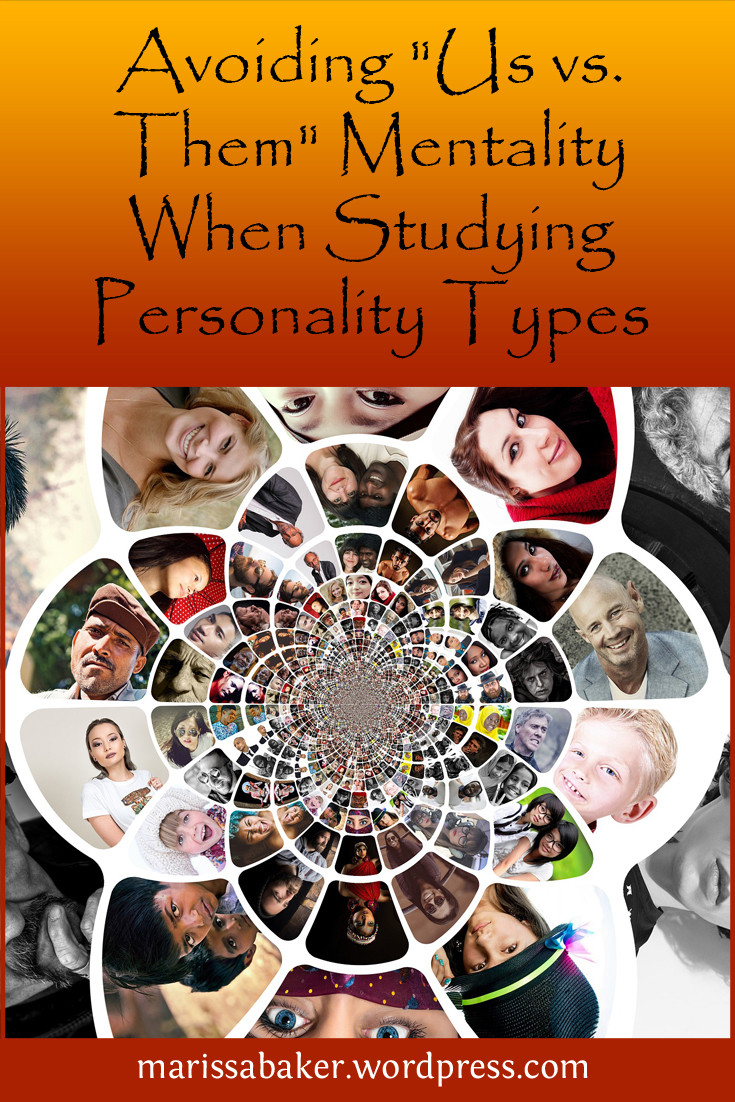
Avoiding “Us vs. Them” Mentality When Studying Personality Types

People like sorting themselves into groups with other people. We identify with those who share our political views, have similar religious traditions, look like us, went to the same schools, etc. This seems to be a normal human thing. But it’s an all-too-easy shift to go from thinking “I am like these people” to thinking “I am not like those other people.” Now we have an “us” group and a “them” group. And the slide into deciding that “we” are better than “them” is one that has lead to all sorts of trouble throughout human history.

Tackling all the “us” vs “them” issues in the world today is far too large a scope for a single post. But I do want to address how this mindset is affecting communities interested in personality types. If there was ever a group that should be able to avoid turning against people unlike themselves it should be those learning about personalities. Sadly, that’s not always the case.

One of the core ideas in personality type systems like Myers-Briggs and the Enneagram is that no one type is better than any other type. Every type has strengths and weaknesses and every type is equally valuable. That’s a central part of these personality systems. They’re designed to help you understand your type and other people’s types so that you can better appreciate the variety inherent to humanity.Avoiding "Us vs. Them" Mentality When Studying Personality Types | marissabaker.wordpress.com

But even though personality types are meant to help us better appreciate other people the opposite happens far too often. Introverts accuse extroverts of ruining the world and hating us. Intuitives spread hurtful myths about Sensing types. INFJs portray themselves (or are described by others) as otherworldly, quasi-mythical creatures. And the list goes on and on.

I’m an INFJ so I’m going to pick on my own type for a while. I’ve seen topics brought up in INFJ-only settings about how it’s completely unnatural (well-nigh impossible) for an INFJ to be racist or sexist or anything like that. We’re so much better than all those other types that so easily fall prey to attacking other groups of people. Oh, no. We’re so much better than those uncouth bumpkin personality types.

What precious little snowflake hypocrites we are.

I’m sure you can see the problem here. And using one’s own type as an excuse to turn against other groups of people isn’t confined to INFJs. People of any type can make sweeping generalizations about extroverts, or thinkers, or SP types, or any other combination of letters. And those generalizations are often both inaccurate and unkind.

So lets get back to using personality type systems the way they were intended. As a tool to better understand both ourselves and other people, and then to better appreciate them as well. Those of us within the type development community have the tools we need to move past thinking about groups of people with an “us versus them” mindset. We can use type to climb inside other people’s perspectives and learn to appreciate that just because someone processes information and makes decisions differently than us doesn’t mean they’re our enemies or our inferiors.