Praising God With All That You Are

Several years ago, I did a study on Hebrew words for praise and discussed six different words translated “praise” in the KJV (yadah, zamar, todah, halel, tehillah, and barak). Last year, when I was studying song in connection to prophecy, I also started collecting scriptures related to singing praise. Finally, this spring, I collected those scriptures into a list of 30 to share with my ladies’ scripture-writing group at church.

One of the things I worried about when I shared this list was that 22 out of 30 were from Psalms. Typically, I like to draw from all over the Bible but for this one, most of the on-topic verses were in Psalms (not surprising, considering what we’re studying). I worried it might start to seem monotonous to write out verses from psalms over and over each day that basically all read as “sing praise to God.” But there’s a lot more variation in those verses than it seems when writing them in English. As I wrote these scriptures throughout February, I also wrote down the Hebrew words translated “sing,” “praise,” and occasionally “thanks.” It’s just two or three words in English, but in Hebrew there’s zamar, zamiyr, zimral, shur, shiyr, yadah, halel, tehillah, tephillah, ranan, renanah, todah, anah, and shaback.

I find the wide variety of Hebrew words that surround the concept of praise and song fascinating, particularly since Hebrew has a far smaller pool of words than English. There are “about eight thousand words” in the Hebrew language, in contrast to “one hundred thousand or more in our language” (Reading the Bible with Rabbi Jesus: How a Jewish Perspective Can Transform Your Understanding, Lois Tverberg, p. 61). Given that vast difference between the two languages, you’d expect that English would be the one with tons of words that are synonymous with praise (it does to a certain extent, but you don’t often see words like commend, compliment, extol, applaud, etc. used in English scripture). Praise must be extremely important to the Hebrew people for them to devote so many of their words to this concept.

To help illustrate this point, let’s look at a concept that the English language places a high value on: the legal system and government. There are a ton of different words for government, branches of government, and the systems of government. But Hebrew doesn’t have words for separating the legislative, executive, and judicial functions of government. They combine everything into one word shapat/mishpat, which Bible translators often render as “justice.” It’s a reflection of a culture where all that authority is centered in God and the king as His representative on earth. In contrast, English reflects a culture where government functions are divided up among different people and conceptualized differently.

It’s similar with praise. In English, we think of praise and worship together and mostly associate it with singing Christian music. We might also include praise in the sense of thanking or acknowledging God for good things that He has done. But praise in Old Testament Hebrew culture is much more varied and vital a concept, and that’s reflected in the number of words the language uses to denote specific types of praise.
Halal–glorifying God with praise

Even if you know nothing about Hebrew, you probably know this word because of our English “hallelujah” (literally, praise Yah[weh]). The root word halal (H1984) appears 165 times in the Old Testament. It can mean to shine, boast, or even “act like a madman” (Brown, Driver, Briggs [BDB]) but most often it means praise. Basically, it “connotes being sincerely and deeply thankful for and/or satisfied in lauding” something or someone (Theological Wordbook of the Old Testament [TWOT], entry 500). One noun form, tehilla (H8416), also appears fairly often in the Old Testament (57 times). It “represents the results of halal as well as divine acts which merit that activity” (TWOT 500c). Tehilla can also be linked specifically to a “song or hymn of praise” (BDB, H8416).

Praise (halal) Yah!
    Praise Yahweh from the heavens!
    Praise him in the heights! …

let them praise (halal) Yahweh’s name,
    for his name alone is exalted.
    His glory is above the earth and the heavens.
He has lifted up the horn of his people,
    the praise (tehilla) of all his saints,
    even of the children of Israel, a people near to him.
Praise (halal) Yah!

Psalm 148:1, 13-14, WEB

Typically in the Bible, halal is used to praise and glorify God. It’s linked with joy, speaking, singing, dancing, and intelligent expression. Interestingly, “most of these occurrences are plural … [showing] that the praise of Jehovah was especially, though by no means uniquely … congregational” (TWOT 500). We can and should praise when we’re alone, but praise is something that’s expected when God’s people gather together. That’s why so many churches sing songs that glorify God as part of their formal services.

Praise (halal) Yah!
    Praise God in his sanctuary!
    Praise him in his heavens for his acts of power!
Praise him for his mighty acts!
    Praise him according to his excellent greatness!
Praise him with the sounding of the trumpet!
    Praise him with harp and lyre!
Praise him with tambourine and dancing!
    Praise him with stringed instruments and flute!
Praise him with loud cymbals!
    Praise him with resounding cymbals!
Let everything that has breath praise Yah!
    Praise Yah!

Psalm 150, WEB

Yadah–confessing God is worthy of praise

Another very common Hebrew word for praise is yadah (H3034). It appears 114 times in the Old Testament. This one is often translated “give thanks,” though it’s also translated “praise” or “confess.” The “thanks” translation can be misleading, though, because there really isn’t an Old Testament equivalent to our concept of “to thank” (TWOT 847). In the Bible, thanks “is a way of praising” God rather than something we do, such as say “thank you” to other people. “Confession” is probably the best English equivalent to yadah (TWOT).

Oh, send out your light and your truth.
    Let them lead me.
    Let them bring me to your holy hill,
    to your tents.
Then I will go to the altar of God,
    to God, my exceeding joy.
I will praise (yadah) you on the harp, God, my God.
Why are you in despair, my soul?
    Why are you disturbed within me?
Hope in God!
    For I shall still praise (yadah) him:
    my Savior, my helper, and my God.

Psalm 43:3-5, WEB

In the sense of praise or thanks, yadah has to do with acknowledgement, “‘recognition’ and ‘declaration’ of a fact” (TWOT 847). The word can be used in a good or bad sense: for example, confessing sin or acknowledging God’s goodness. The noun todah (H8426) has basically the same meaning, and is often associated with offerings (e.g. “thank offering” or “praise offering”) (TWOT 847b).

Barak–blessing or praising

Barak (H1288) is used 285 times in the Old Testament (or 415 if you include all the root’s derivatives), and it’s usually translated “bless.” The basic meaning may be “to kneel” (TWOT 285). It’s often used of God blessing people, but when it’s used of people blessing God it can be seen as a type of praise.

Praise (barak) our God, you peoples!
    Make the sound of his praise (tehilla) heard,

Psalm 66:8, WEB

When we looked at yadah earlier, one of the things I didn’t mention is that the root word is likely related to throwing or casting something with the hands (BDB). It makes me think of Paul’s desire that “the men in every place pray, lifting up holy hands” (1 Tim. 2:8, WEB). Lifting hands when praising God can be controversial (some churches discourage or even forbid it, while in others it’s normal), but it’s definitely Biblical. In psalms, lifting hands is linked with praise.

So I will bless (barak) you while I live.
    I will lift up my hands in your name.

Psalm 63:4, WEB

Lift up your hands in the sanctuary.
    Praise (barak) Yahweh!

Psalm 134:2, WEB

With the link between barak and kneeling as well as its use with lifting hands in praise, I think it’s safe to say we could classify this as one of the physical types of praise. In many cases, we’ll see that praise involves our voices and bodies as well as our thoughts. You can praise God in your mind, but you’re also supposed to praise Him with your voice and with your body (e.g. kneeling, lifting hands, dancing).

Zamar–singing or playing praise music

The word zamar (H2167) basically means to sing or to play an instrument. But it’s used so much in the Old Testament in relation to praise that it’s typically translated “sing praise.” It might not always mean singing, though, as it’s also linked with playing lyre, harp, and tambourine (TWOT 558). This may imply that praise music typically has lyrics, but can also be instrumental. This word appears 45 times in the Old Testament.

I will give thanks (yadah) to Yahweh according to his righteousness,
    and will sing praise (zamar) to the name of Yahweh Most High.

Psalm 7:17, WEB

Make a joyful shout to God, all the earth!
Sing (zamar) to the glory of his name!
    Offer glory and praise (tehilla)!

Psalm 66:1-2, WEB

Words translated “psalm” or melody, like zimrah and mizmor, are derivatives of zamar. Over and over in scripture, you’ll see praise linked with music and specifically song. Whether we have perfect pitch or we’re just making a joyful noise, we shouldn’t be shy to express our adoration for God through music or even shouts of joy.

Make a joyful noise to Yahweh, all the earth!
    Burst out and sing for joy, yes, sing praises (zamar)!
Sing praises (zamar) to Yahweh with the harp,
    with the harp and the voice of melody (zimrah).
With trumpets and sound of the ram’s horn,
    make a joyful noise before the King, Yahweh.

Psalm 98:4, WEB

Ranan–crying out praises

The basic meaning of ranan (H7442) is “to cry out, shout for joy, give a ringing cry” (BDB). Typically, it’s used of crying out to God for some reason, and in psalms it’s often paired with joy and singing. The word might even mean to sing out joyful praises, depending on the context: “The jubilation which is the main thrust of the root … could equally well be expressed in shouting or song” (TWOT 2179). One of the noun forms, renanah (H733) is “a ringing cry, shout (for joy)” and can be translated “singing” (BDB).

Shout for joy to Yahweh, all you lands!
Serve Yahweh with gladness.
    Come before his presence with singing (renanah).
Know that Yahweh, he is God.
    It is he who has made us, and we are his.
    We are his people, and the sheep of his pasture.
Enter into his gates with thanksgiving (todah),
    and into his courts with praise (tehilla).
    Give thanks (yadah) to him, and bless (barak) his name.
For Yahweh is good.
    His loving kindness endures forever,
    his faithfulness to all generations.

Psalm 100, WEB

Shir–songs, often of praise

The words for “sing” and “song” are not confined to religious music, but they are so often linked with praise that it’s worth mentioning them in this study. The Hebrew word shir or shiyrah (H7892) is often used in the psalms, both to describe what is being written (e.g. “a song of ascents” for Ps. 120-134) and as part of the text of the psalm (e.g. “with my song I will thank him” [Ps. 28:7, WEB]).

Praise (halal) Yahweh! Sing (shir) to Yahweh a new song, his praise (tehilla) in the assembly of the saints. 

Psalm 149:1, WEB

Shir is typically used for hymns and psalms of lament. Both can be linked to praise. Many songs of lament “evolve into songs of praise in anticipation of God’s deliverance.” Hymns involve singing to God “in response to something already experienced” (TWOT 23781). Often, this type of song involves praising who or what God is or confessing/thanking Him for things that He has done. As I mentioned earlier, the topic “sing praise” is what prompted this blog post. You can download my free 30-day scripture writing plan and keep studying this topic on your own by clicking here.

Gadal–praising God’s greatness

The TWOT lists gadal (H1431) or gadol (H1419) in the sense of “to magnify” as one of the synonyms for halel (TWOT 500). You’re not likely to find it if you search for Hebrew words translated “praise” in English Bibles (it’s most often translated “great”), but the usage is linked to praise.

Great (gadol) is Yahweh, and greatly to be praised (halal),
    in the city of our God, in his holy mountain.

Psalm 48:1, WEB

I will praise (halal) the name of God with a song (shir),
    and will magnify (gadal) him with thanksgiving (todah).

Psalm 69:30, WEB

The root verb gadal means to “grow up, become great or important … praise, (magnify), do great things” (TWOT 315). In certain verb stems, it can mean “to magnify” or “consider great.” It’s often used to speak of God’s greatness or to talk about how God magnifies Himself. The adjective gadol has a similar range of meanings (TWOT 315d). Together, the two words appear a total of 643 times in the Old Testament.

Rum–lifting God high for praise

The TWOT lists rum (H7311) in the sense of “to exalt” as one of the synonyms for halel (TWOT 500). The root has three basic meanings: “literal height,” “height as symbolic of positive notions such as glory and exaltation,” and “height as symbolic of negative notions such as arrogance and pride” (TWOT 2133). We can “exalt God in praising” Him, or lift His name high. One specific derivative, romam (H7319), means “high praises” (TWOT 2133f).

May the high praises (romam) of God be in their mouths,
    and a two-edged sword in their hand

Psalm 149:6, WEB

Shabach–praise His mighty deeds

The verb shabach (H7623) only appears 11 times in the Old Testament. It means to praise, laud, or commend (BDB). Typically, it’s “used to praise God for his mighty acts and deeds” (TWOT 2313).

Because your loving kindness is better than life,
    my lips shall praise (shabach) you.
So I will bless (barak) you while I live.
    I will lift up my hands in your name.
My soul shall be satisfied as with the richest food.
    My mouth shall praise (halal) you with joyful lips,

Psalm 63:3-5, WEB


Praise (halal) Yahweh, all you nations!
    Extol (shabach) him, all you peoples!
For his loving kindness is great toward us.
    Yahweh’s faithfulness endures forever.
Praise (halal) Yah!

Psalm 117, WEB

Why Study Praise Words?

Image of a smiling man playing the piano, overlaid with blog's title text and the words, "One of our purposes for being here as Christians is to praise God. Studying Hebrew words for praise helps us better understand this vital concept."
Image by Ben White from Lightstock

So why did we spend all this time looking at nine Hebrew words (more if you include derivatives from the root words) that all translate into English so similarly?

In an English Bible, “praise” appears hundreds of times, depending no the translation (254 in WEB, 259 in KJV, 328 in NET, 363 in NIV). It’s a vital concept in scripture, and something that we need to understand how to do if we’re to relate properly to God. One of our purposes for being here as Christians is to praise Him. Our lives should praise God, as well as our lips (Phil. 1:9-11; Heb. 13:14-15).

In Christ we too have been claimed as God’s own possession, since we were predestined according to the purpose of him who accomplishes all things according to the counsel of his will so that we, who were the first to set our hope on Christ, would be to the praise of his glory. 

Ephesians 1:11-12, NET

If we just looked at the English word for praise, we’d think the definition was limited to “express warm approval or admiration of” and “express one’s respect and gratitude toward (a deity), especially in song” (definitions from Google and Oxford Languages). Studying the variety of Hebrew words related to praise gives us a much broader appreciation of praise. It’s more than just approval, admiration, respect, and gratitude. It’s a whole-life, whole-body, whole-heart expression of God’s glory, our thankfulness, and much more.


Featured image by Pearl from Lightstock

So Many Reasons to Praise

When we think of ways to deepen our relationship with God, we often think of things like Bible study, prayer, scripture-based meditation, and fasting. That’s what I typically hear are the best “tools” for connecting with God. As vital as those are, I think we could add “praise” to that list as well.

Through him then let us continually offer up a sacrifice of praise to God, that is, the fruit of our lips, acknowledging his name.

Hebrews 13:15, NET

Is anyone among you suffering? He should pray. Is anyone in good spirits? He should sing praises.

James 5:13, NET

The type of praise James mentions is relatively easy for us. When we’re happy and things are going well, it’s easy to praise God (provided we remember that He’s the one to thank for our blessings). But the author of Hebrews also says we should continually offer up praise to God as a type of sacrifice. That can be a little bit harder. We might fall into a routine of thanking and praising God for the same things in our life, and not be sure what else to add. Or we might be in a season where there doesn’t seem to be anything in our lives to praise God for.

The psalms provide a wealth of ideas for reasons to praise God, and many of them have nothing to do with our personal circumstances. Keeping these in mind can be helpful whether we’re struggling to praise, or if we’ve simply fallen into a routine and want to connect more deeply with Him.

Praise His Name

In the WEB translation (which is my favorite to use for Old Testament), there are 28 verses in psalms that speak of praising God’s name (out of a total of 151 uses of “Praise” in the whole book).


I will give thanks to Yahweh according to his righteousness, and will sing praise to the name of Yahweh Most High.

Psalm 7:17, WEB

Sing to God! Sing praises to his name! Extol him who rides on the clouds: to Yah, his name! Rejoice before him!

Psalm 68:4, WEB

From the rising of the sun to its going down, Yahweh’s name is to be praised.

Psalm 113:3, WEB

let them praise Yahweh’s name,
    for his name alone is exalted.
    His glory is above the earth and the heavens.

Psalm 148:13, WEB

One of the main reasons to praise the Lord is because He is worthy of it (Ps. 18:3). His nature, name, and reputation should inspire us to praise Him.

Image of a happy man playing piano overlaid with text from Psalm 135:3, WEB version: "Praise Yah, for Yahweh is good. Sing praises to his name, for that is pleasant."
Image by Ben White from Lightstock

Praise Because He Deserves Respect

If we respect God, revere Him, and live righteously, then the psalms present praise as a natural response. Those who fear God praise Him. Those who are righteous do as well. When we’re living godly lives, praise is a natural “fruit of our lips” (Heb. 13:15).


You who fear Yahweh, praise him! All you descendants of Jacob, glorify him! Stand in awe of him, all you descendants of Israel!

Psalm 22:23, WEB

For Yahweh is great, and greatly to be praised!
    He is to be feared above all gods.

Psalm 96:4, WEB

Sing praises to God! Sing praises!
    Sing praises to our King! Sing praises!
For God is the King of all the earth.
    Sing praises with understanding.

Psalm 47:6-7, WEB

I find the phrase “sing praises with understanding” such an interesting instruction. I think sometimes people idealize a sort of blind faith that loves God without wanting to make sense of Him, but God doesn’t expect or want us to be content with something so shallow. He wants to teach us and grow us, and as we mature we should learn to understand Him more and more. That understanding will fuel our praise, for the more we understand Him the more we’ll recognize how worthy He is of our praise.

Image of a woman standing on a mountain with her arms raised in praise, overlaid with text from Psalm 48:1, WEB version: "Great is Yahweh, and greatly to be praised, in the city of our God, in his holy mountain."
Image by Ruby-Rose from Lightstock

Praise for His Words

In addition to praising God for who He is, we can also praise Him for what He does. One of the great things that He does, which we all benefit from, is share His instruction with us. The Bible uses several different words to describe instruction from God, including words, ordinances, and statues. The thing they all have in common is that it’s important for us to listen, hear and internalize, and obey when God speaks.

In God, I will praise his word.
    In Yahweh, I will praise his word.
I have put my trust in God.
    I will not be afraid.
    What can man do to me?

Psalm 56:10-11, WEB

Seven times a day, I praise you, because of your righteous ordinances.

Psalm 119:164, WEB

Let my lips utter praise, for you teach me your statutes.

Psalm 119:171, WEB

We should be thankful for the words God shares with us and the instruction He gives us. But I wonder how often we take the time to marvel at the fact that we can read the Bible, a book that God wrote through human beings and preserved through millennia. Today, most people can read the Bible in their own native language (and for those that don’t yet, organizations like Wycliff Bible Translators are working to make translations). For many of us, we have access to dozens of different translations and formats for reading God’s word. That is a great blessing, one that we should praise God for.

Image of folded hands on an open Bible, overlaid with text from Psalm 105:43-45, WEB version: "He brought his people out with joy, his chosen with singing. He gave them the lands of the nations. ... that they might keep his statutes, and observe his laws. Praise Yah!"
Image by Jantanee from Lightstock

Praise for Salvation and Redemption

Another wonderful thing that God has accomplished is our salvation. Do you ever just sit and think of how amazing that is? The Father and Jesus planned far in advance for Him to save humanity by coming to earth like us, living a perfect life, and then dying a horrible death. Without that intervention, we’d all die permanently. But because of His great love and grace, we’re offered the gift of eternal life. And as if that wasn’t enough, He also offers deliverance from physical dangers as well, which is another type of salvation the psalms speak of.


Why are you in despair, my soul? Why are you disturbed within me? Hope in God! For I shall still praise him for the saving help of his presence.

Psalm 42:5, WEB

He rescues me from my enemies.
    Yes, you lift me up above those who rise up against me.
    You deliver me from the violent man.
Therefore I will give thanks to you, Yahweh, among the nations,
    and will sing praises to your name.

Psalm 18:48-49, WEB


I will also praise you with the harp for your faithfulness, my God.
I sing praises to you with the lyre, Holy One of Israel.
My lips shall shout for joy!
My soul, which you have redeemed, sings praises to you!

Psalm 71:22-23, WEB

God’s deliverance, salvation, protection, and redemption are priceless gifts. Whether it’s the salvation happening on a spiritual level when we accept Jesus’s sacrifice and enter covenant with God, or it’s deliverance from enemies and dangers (physical or spiritual). The fact that God is Savior gives us many reasons to praise.

Image of a man reading the Bible in the woods overlaid with text from Psalm 148:4-5, WEB version: "Praise him, you heavens of heavens, you waters that are above the heavens. Let them praise Yahweh’s name, for he commanded, and they were created."
Image by HarveyMade from Lightstock

Praise His Kindness and Goodness

Closely related to praising God for His salvation and redemption is praising Him for His kindness and goodness. These are key aspects of His character that we benefit greatly from.

Because your loving kindness is better than life,
    my lips shall praise you.
So I will bless you while I live.
    I will lift up my hands in your name.
My soul shall be satisfied as with the richest food.
    My mouth shall praise you with joyful lips,

Psalm 63:3-5, WEB

Praise Yahweh, my soul!
    All that is within me, praise his holy name!
Praise Yahweh, my soul,
    and don’t forget all his benefits

Psalm 103:1-2, WEB

Let them praise Yahweh for his loving kindness,
    for his wonderful deeds for the children of men!
Let them exalt him also in the assembly of the people,
    and praise him in the seat of the elders.

Psalm 107:31-32, WEB

The Lord’s loving kindness drives Him to do marvelous things for humanity, even though we do not deserve it. Even the fact that we have water to drink, food to eat, and air to breathe is due to His loving kindness. As James says, “Every good gift and every perfect gift is from above, coming down from the Father of lights” (Jas. 1:17, WEB). If there’s anything in our lives to be thankful for, we have God to praise for that.

Image of a smiling woman with her hand lifted in praise overlaid with text from Psalm 106:1, WEB version: "Praise Yahweh! Give thanks to Yahweh, for he is good, for his loving kindness endures forever."
Image by Pearl from Lightstock
Praise His Power and Might

Another reason that we can praise God brings us back to the idea of praising Him for who He is as well as what He does. Yahweh our God has great power and might. We can praise Him for that greatness, and we can praise Him for how He choses to use His power.


Be exalted, Yahweh, in your strength, so we will sing and praise your power.

Psalm 21:13, WEB


The heavens will praise your wonders, Yahweh,
your faithfulness also in the assembly of the holy ones.

Psalm 89:5, WEB

Give thanks to Yahweh! Call on his name!
    Make his doings known among the peoples.
Sing to him, sing praises to him!
    Tell of all his marvelous works.

Psalm 105:1-2, WEB

When we think of God’s mighty acts of power, we realize that most of them are incredible demonstrations of His love for His people (though there are also mighty demonstrations of His judgment on sin). We can think of historical events like the creation of the world (Gen. 1-2), the parting of the Red Sea (Ex. 14), the Lord defended Judah against an invading army (2 Kings 18-19), or Jesus raising Lazarus from the dead (John 11). We can also think of miracles we’ve seen in our own lives or heard of from fellow Christians.

Image of a man and woman with their hands lifted in praise, overlaid with blog's title text and the words, "Praise is a way for us to connect with and glorify God. Whatever our current circumstances, we have many reasons to praise Him."
Image by Anggie from Lightstock

No matter what is going on in our lives right now, we have many reasons to praise. And when we’re not quite sure what to say, the Psalms provide us with ideas for how to phrase that praise. You also don’t need to confine yourself to the psalms; the word “praise” shows up 254 times in a search of the WEB translation, and just over 100 of those are in books other than psalms. You might find it an interesting study to go through those 254 uses (not all are about praising God, but most are).

Praise Yah!
    Praise God in his sanctuary!
    Praise him in his heavens for his acts of power!
Praise him for his mighty acts!
    Praise him according to his excellent greatness!
Praise him with the sounding of the trumpet!
    Praise him with harp and lyre!
Praise him with tambourine and dancing!
    Praise him with stringed instruments and flute!
Praise him with loud cymbals!
    Praise him with resounding cymbals!
Let everything that has breath praise Yah!
    Praise Yah!

Psalm 150, WEB

Featured image by PhotoGranary from Lightstock

Praise When You Just Don’t Understand

It’s pretty easy to praise when something good happens. You realize that God protected you from an accident, or that He made things line up just right to get a better job. Or you just feel happy and blessed and that bubbles out in praise.

But what about when things don’t make sense and you’re studying and trying to find answers in the Bible but they don’t seem to be there? Or when something bad is happening and you know that there are commands to be joyful even in trials but you just don’t feel happy? Or when something happens to a friend and you don’t know the full story, but you’re upset along with them? Maybe praise is the farthest thing from your mind and instead you just feel confused, angry, or betrayed.

Or what about the times when you take an objective look at your life, everything seems to be going well, but you still feel anxious or depressed? Sometimes the things we’re struggling with are inside our heads, and from the outside it looks like everything’s going great. How do you praise God in those moments, when you’re not sure why you feel terrible and when you might even feel guilty for struggling because God has blessed you so richly?

When we feel confusion, hurt, anger, or anything else that makes it hard to praise God we often also feel distant from Him. God didn’t go anywhere, so it’s up to us to reach out to Him and ask Him to help us feel His presence again. I touched on this topic years ago when I wrote about a breakup and MercyMe’s song “Even If” and also in another study about Lamentations 3. But those were more about hope and trust, and today I want to talk about praise when things don’t make sense to us.

Image of a woman with her hand lifted in praise overlaid with text from 1 Cor. 13:8-10, 12, NET version: “Love never ends. But if there are prophecies, they will be set aside; if there are tongues, they will cease; if there is knowledge, it will be set aside. For we know in part, and we prophesy in part, but when what is perfect comes, the partial will be set aside.  ... then I will know fully, just as I have been fully known.”
Image by Pearl from Lightstock

Remember

Right now, I’m not in a season of my life where I feel super confused about what God is doing. Rather, I’m in a place where I can look back at times where I was confused and realize, “Oh, that’s what was going on.” For years, I’d been going through cycles of praying to God for a husband, going to Him for comfort with a broken heart, and asking if I should give up that dream because it didn’t seem like He was going to work things out for me to get married. And now here I am, getting married in just a few weeks and buying a house and talking about having kids. God didn’t work this out on the timeline I was expecting, but He worked it out better even than I expected; I still catch myself marveling at how good this relationship is and how happy I am with him.

It’s interesting looking back on how hopeless and confused I felt sometimes, knowing now how God was going to work things out. I do believe God allows us free will, and I’m not sure how much of this He had planned exactly, but it sure seems like He was working things out for me and my husband to be together. I want to remember this the next time I wonder what God is doing and why He hasn’t fixed things yet.

Then I thought, “I will appeal to this:
    the years of the right hand of the Most High.”
I will remember Yah’s deeds;
    for I will remember your wonders of old.
I will also meditate on all your work,
    and consider your doings.

Psalm 77:10-12, WEB

Over and over in the Bible, we’re admonished to remember. “Remember all Yahweh’s commandments, and do them,” “remember all the way which Yahweh your God has led you,” and that “your God redeemed you” (Num. 15:39; Deut. 8:2, 15:15 WEB). “Remember the words of the Lord Jesus,” “remember the former days, in which, after you were enlightened,” and “remember the words which were spoken before by the holy prophets and the commandment of us” (Acts 20:35; Heb. 10:32; 2 Pet. 3:2 WEB). Our memory of God’s goodness and faithfulness thus far gives us the hope needed to trust and praise Him when we’re in a season where we don’t know why He’s working the way He is.

Image of four people sitting around a table studying the Bible, overlaid with text from Psalm 78:4-7, WEB version: “We will not hide them from their children, telling to the generation to come the praises of Yahweh, his strength, and his wondrous deeds that he has done. ... that they might set their hope in God, and not forget God’s deeds, but keep his commandments”
Image by Ben White from Lightstock

We Don’t Know The Full Measure

I feel like a lot of times, we can trace our fears, anger, confusion, and frustrations back to not understanding what God is doing. Deep down, we might feel like it’d be a whole lot easier to trust Him if He’d just explain Himself clearly. But God didn’t design us to be all-knowing; I doubt our human minds could handle a fraction of the information we’d need to truly understand things. When we realize that, sometimes we can flip the feeling of frustration with not knowing everything over into awe of the God who does know everything.

But I will always hope,
    and will add to all of your praise.
My mouth will tell about your righteousness,
    and of your salvation all day,
    though I don’t know its full measure.

Psalm 71:14-15, WEB

Psalm 71 is a prayer for protection, asking God not to disappoint you when you run to Him for refuge. There are people in the psalmist’s life hinting that God has forsaken him, but he calls on God to prove them wrong. Verse 15 caught my eye (and gave me the idea for this study) because of the psalmist’s promise to speak of God’s righteousness and salvation even though they don’t fully understand it.

The topic of voicing truths about God when you don’t understand what He’s doing makes me think of Job. God described him as a righteous man at the beginning of the book, but Job still went through horrible trials and the people who should have comforted him instead wanted to diagnose his moral failings. Job and his friends all missed that there was something else going on in the background that they didn’t understand. In the end, Job didn’t get answers to the questions that he’d asked God. Instead, God showed up in person to tell him that he didn’t know the full measure of what was going on (see my post “The Central Question of Job: A Broader Perspective On Suffering“).

Much like Job, we might not always understand why tough things are happening. We might go back and forth trying to figure out possible reasons. Sometimes it might actually be because we did something wrong and we need a wake-up call to change (which is what Job’s friends thought was going on there). Sometimes we might be trying to force our own will on a situation where we need to let go and let God work it out in His timing. Sometimes bad things happen because we live in a fallen world that’s imperfect and is full of other imperfect people who hurt us, intentionally or accidently. And sometimes there might be something going on in the background that we’re ignorant of (which is what was actually happening in Job’s story). No matter what the root cause, it’s important to seek God during these times.

Your hands have made me and formed me.
    Give me understanding, that I may learn your commandments.
Those who fear you will see me and be glad,
    because I have put my hope in your word.
Yahweh, I know that your judgments are righteous,
    that in faithfulness you have afflicted me.
Please let your loving kindness be for my comfort,
    according to your word to your servant.

Psalm 119:73-76, WEB

We can echo this psalmist in praying for understanding so we can obey God’s commandments, hope in his word, and trust in his righteousness. But we also need to make peace with the fact that we won’t always understand everything. That can be challenging for those of us whose relationship with God is largely intellectual, but it’s a truth we need to acknowledge if we’re going to make it past our own egos and have a humble relationship with God.

Balancing Humility and Knowledge

Image of a silhouetted person lifting their hands to pray with the blog's title text and the words "How do we keep on praising and trusting God when we don’t understand what He’s doing?"
Image by Brittney Borowski from Lightstock

When Paul wrote to the Corinthian church, one of the things he addressed in his first letter was a debate they were having regarding whether it was okay to eat meat that had been sacrificed in an idol’s temple, then sold in the market. The reminder he gives his readers for that topic is a good one to keep in mind for other situations as well.

 With regard to food sacrificed to idols, we know that “we all have knowledge.” Knowledge puffs up, but love builds up. If someone thinks he knows something, he does not yet know to the degree that he needs to know.

1 Corinthians 8:1-2, NET

Because God is working with us, we have a certain amount of knowledge. We can even say with accuracy that we know more than most people in the world, at least about the things of God (Ps. 119:99). We certainly shouldn’t devalue the knowledge we have or give up on deepening our knowledge of God (for example, Paul tells us to worship and sing praises with our understanding as well as our spirits/hearts [1 Cor. 14:15]). But we still only “know in part” (1 Cor. 13:9, 12, NET). We need to let the understanding God has blessed us with remind us to be humble before Him.

We need to strike a healthy balance between humility and knowledge. It shouldn’t really be all that difficult; the more we really know about and understand God the more our relationship with Him should inspire true humility in us. And this isn’t just something Paul talked about. Peter’s letters also remind us that humility is vital before God and that He grants deep knowledge to His people.

And all of you, clothe yourselves with humility toward one another, because God opposes the proud but gives grace to the humble. And God will exalt you in due time, if you humble yourselves under his mighty hand by casting all your cares on him because he cares for you.

1 Peter 5:5-7, bolt italics a quote from Prov 3:34 

May grace and peace be lavished on you as you grow in the rich knowledge of God and of Jesus our Lord! I can pray this because his divine power has bestowed on us everything necessary for life and godliness through the rich knowledge of the one who called us by his own glory and excellence.

2 Peter 1:2-3, NET

It can be frustrating to feel like things aren’t going the way you hoped or planned. It can be equally frustrating to feel like you don’t know what’s going on or aren’t sure what you should do next. It might even make us angry (if you’re struggling with anger or have in the past, I recommend checking out this thought provoking Truth Be Told podcast episode). Through whatever it is we’re struggling with or that we’re questioning, we need to remember the big picture.

God is in control. He is trustworthy now and in the future, just like He’s been trustworthy since the beginning of time. It’s okay for us not to know the “full measure;.” We don’t really need all the answers now. Let’s do our best to balance our knowledge (and our desire for knowledge) with humility to obey and trust God while also hoping in His promises and praising Him with all our hearts and minds.


Featured image by Shaun Menary from Lightstock

Hands of Praise

How do you use your hands to praise God? Maybe you lift your hands in worship, or use them to minister to God’s people. Or maybe you haven’t really thought about there being a connection between hands and praise, so this seems like an odd question.

Idioms involving hands abound in the Hebrew language. Being in someone’s hands is to be in their power. Putting one’s hand to something means you’re working on it. Raising your hand against someone is rebellion. Open hands express giving, and closed hands withholding, something.

Hands were lifted when making an oath to God, as Abraham did (Gen. 14:22-23). God lifts His hand when He delivers His people (Ps. 10:12). Priests stretch their hands out when they bless the people and people lift their hands when they bless God (Lev. 9:22; Neh. 8:6). Hands, and specifically lifted hands, can mean different things depending on the context.

Last week, we talked about the Hebrew word yadah (H3034), which means to confess or acknowledge as well as to praise and thank. There’s one other meaning we didn’t touch on, though. Yadah also means to throw or cast (Zodhiates’ dictionary). It’s connected with the Hebrew word for hand, yad (H3027), and as such yadah is considered the Hebrew word which “means to worship with extended hands” (see “8 Hebrew Words for ‘Praise’ Every Christian Needs to Know”).

We can think of yadah as a type of praise we “throw” to God with lifted hands as we declare how wonderful He is and confess that we follow Him. Today, we’re going to look at the ways we petition, pray to, and praise God with our hands. Read more

Thanksgiving and Praise

There really isn’t a word for “thank” in the Old Testament. When worlds like “thanks” or “thanksgiving” appear in English versions of Hebrew scripture, they’re translated from words with the primary meaning of praise and/or confession. It’s a different thing than what we mean when we say “thank you” in English.

Much like we saw last week in the New Testament connection between thanksgiving and grace, the concept of thanks in the Old Testament is inextricably linked to confession, praise, and sacrifice. There’s something more/different going on in these words than we might think just reading it in translation.

Confession, Praise, Sacrifice

The Hebrew word yadah (H3034) is a root with the primary meaning of “to acknowledge or confess.” It is used in three main ways: to confess individual or national sins, to proclaim or declare God’s attributes and works, and to convey man’s praise of men. Its derivative todah (H 8426) has a similar meaning and it is also used of the sacrifices connected to praise and thanksgiving.

Enter his gates with thanksgiving (todah), his courts with praise. Give thanks (yadah) to him; bless his name. (Ps. 100:4, LEB)

Yadah and todah in relation to God are about confessing or acknowledging something that is true. We can confess that we are sinful before God, as all are (Rom. 3:23). We can also confess that God is worthy of all praise, exhalation, and thanks (2 Sam. 22:50). In fact, yadah “is one of the key words for ‘praise'” in the Hebrew scriptures. It’s rendered thanks only because “praise leads regularly to thanksgiving” (Theological Wordbook of the Old Testament, entry 847). Read more

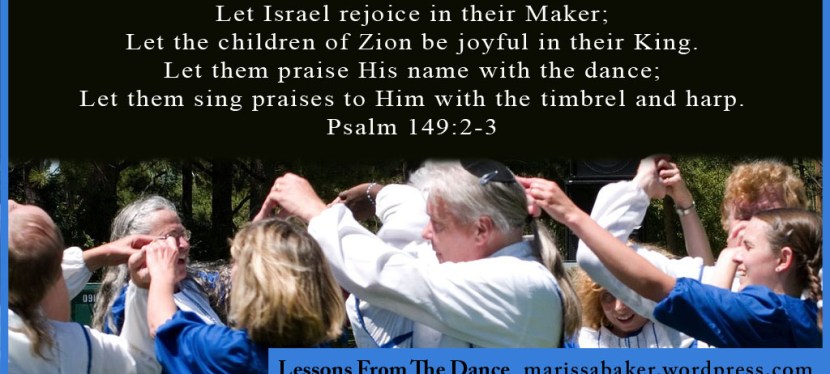
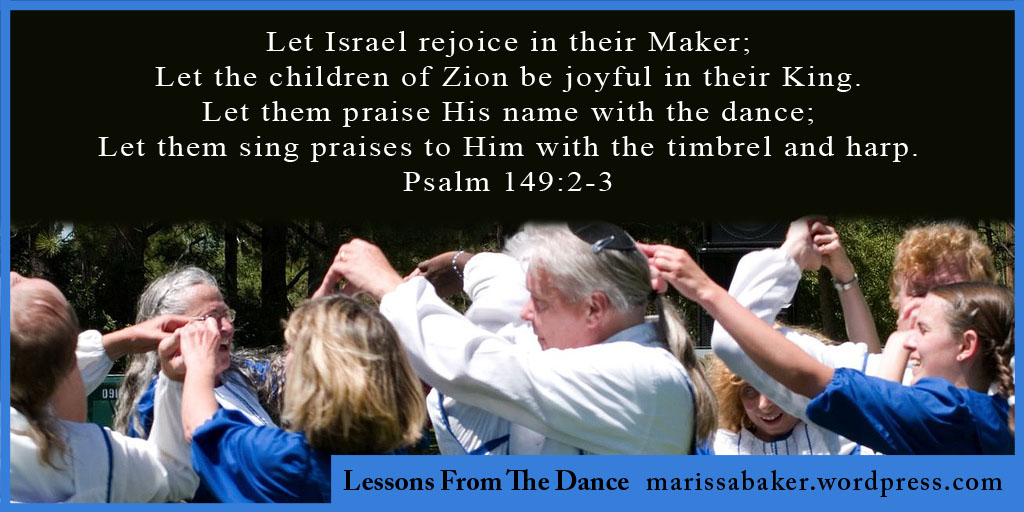
Lessons From The Dance

Due to wisdom tooth surgery on Thursday I’m not dancing this morning (it all went very well, praise God and thanks to a good dentist, but I’ve been advised not to risk dislodging the blood clot that’s helping it heal by any sort of vigorous exercise so soon after surgery). But I was very tempted to risk it and I’m still wishing I could have danced. (Update: 1 hour after this posted, I showed up at church and they’d changed to slower songs so I did get to dance. Hallelujah!)

For those who that last paragraph left a bit confused, I’m referring to what’s known as Davidic or Messianic dance. It’s easier to show a video than to try to describe it in words. Here’s my dance team (several years before I met them) dancing to one of our very favorite songs:

I joined a Messianic dance team early in 2015. My first introduction to the dance was about a year before that, when a dancer shared some basic lessons at a Feast of Unleavened Bread event in Michigan. I absolutely loved it, and I picked up the dances so quickly my mentors say that God has given me a gift for the dance (there’s really no other way to explain why I’m good at it — normally I’m rather clumsy).

Dancing at church, especially to open the service, seems a bit odd to many Christian denominations. But there is Biblical precedent for dance as part of worship and I’ve found the inclusion of dance (and especially being involved in the dance) is a blessing I hadn’t expected. And it has taught me some valuable lessons about dancing in unity with God on a spiritual level.

Basics First

When you’re first learning to dance, you have to start with the basic steps. We don’t just expect new students to know how to do the Hallelu dance. First, we teach them how to do the mayim, tcherkessia, coupe, and 3-point turn that make up the Hallelu step combination. As they learn the basic steps, we start putting the steps together into patterns to match the different songs. And we keep going over and over those basic steps for the first couple months after new dancers join because they’re the basis for every dance we do.

It’s much the same when we first begin our Christian journey. We start out learning about the foundations of repentance and faith. We learn that we should “love the Lord your God with all your heart, with all your soul, and with all your mind” and “love your neighbor as yourself.”  Then we learn how to apply those truths in every day situations.

As we grow, God deepens our understanding and adds more foundational principles like “the doctrine of baptisms, of laying on of hands, of resurrection of the dead, and of eternal judgment” (Heb. 6:1-3). Then we learn more about His expectations for those following Him, what grace truly means, how He wants us to view His commandments, and practical ways to follow Jesus with every step we take. But it all starts with the basics.

Listen To The Music

Even if you know the basic dance steps, they’re not worth much until you set them to music. Music is so much a part of the dance that our dance leader often has trouble recollecting the steps of a dance when she’s trying to walk through and teach them slowly without music. As soon as the music plays, though, it all comes back to her.

You can’t dance without listening to the music. A waltz calls for different steps than a tune in 4/4 time. In some songs, you need to wait for pauses in the music. For others, you have to be thinking two steps ahead because the music moves so fast. Often, listening to the lyrics tells you which part of the dance you’re supposed to be doing in multi-part dances.

In the same way, we have to “tune” our Christian walks to the song God plays through His scriptures. While the Bible doesn’t use the dancing analogy much, it does talk about Jesus coming “to guide our feet into the way of peace” (Luke 1:78) and of God directing the steps of good men (Psalm 37:23, 31; 119:133). We have to study His words so we know the right steps and we need to listen for the guiding of His spirit for how to apply what we learn.

Dance Together

Davidic dance isn’t a solo endeavor. We dance in circles of unity. Every dancer is responsible for knowing the steps to a given dance and how to follow the music. But there are some songs that just don’t stick in your mind as well and there are times (even when you’re no longer a beginner) that you just can’t remember what comes next.

If you can’t remember a step, you can follow one of the other dancers. You’re already watching them to keep in unity, and you know you can count on them for reminders. In turn, they should know they can count on you to know what you’re doing for when they can’t remember a step. We help keep each other on track.

Walking as Christians is made easier by fellowship with other believers. While God will certainly work with people who are isolated from other Christians, His intention is for the body of believers to come together and grow as we build each other up and learn to use our gifts (1 Cor. 12:1-31). We’re on this walk of faith together and we have the opportunity to help each other find the right steps to stay in unity with God.

Lessons From The Dance | marissabaker.wordpress.com
photo credit: “Messianic Dance Troup” by Larry Jacobsen, CC BY via Flickr


Save