Hallowed Be Your Name

Sometimes when I pray, I think of Jesus’s model prayer (often called “the Lord’s Prayer”) as an outline to keep my mind from wandering or to help me think of things I should pray for. As I was doing this about a week ago, I started pondering the phrase “may your name be regarded as holy.” I wanted to think about that idea more deeply. When I pray this, am I praying that I would see God’s name as holy, or that others will? What does it mean to really consider God’s name as holy? Also, why does it say “your name” rather than “you”?

Requesting What Should Be

When you think of the model prayer, you probably think of the traditional phrase “hallowed be your name” rather than “may your name be regarded as holy.” I’m not sure where I first heard this alternate translation. It’s not actually used in any of the English-language translations on Bible Gateway for Matthew 6:9 or Luke 11:2. In the Greek, though, a literal translation is likely closest to “may your name be held in reverence” or “may your name be considered holy” (NET footnote). I probably heard someone use the “regarded as holy” version in a sermon or read about it in a book or article (like this one, for example).

The word “hallowed” isn’t used much in modern English, but it means “regarded as holy; venerated; sacred” (Dictionary.com). It is not simply a statement like “holy is your name,” as we modern readers might assume. Rather, it is a prayer for what should be. The two translations that I quote most often on this blog modernize “hallowed be thy name” (KJV) as, “may your name be kept holy” (WEB) and “may your name be honored” (NET). Those are both good ways to bring this concept into modern English.

 “Therefore you shall keep my commandments, and do them. I am Yahweh. You shall not profane my holy name, but I will be made holy among the children of Israel. I am Yahweh who makes you holy, who brought you out of the land of Egypt, to be your God. I am Yahweh.”

Leviticus 22:31-34, WEB

God’s name is holy, and regarding His name as holy is the proper state of things. It will happen among His people, and it ought to happen among the nations as well. Take a look at one of the things God says about His people to the prophet Ezekiel.

“I scattered them among the nations, and they were dispersed through the countries. I judged them according to their way and according to their deeds. When they came to the nations where they went, they profaned my holy name; in that men said of them, ‘These are Yahweh’s people, and have left his land.’ But I had respect for my holy name, which the house of Israel had profaned among the nations where they went.

“Therefore tell the house of Israel, ‘The Lord Yahweh says: “I don’t do this for your sake, house of Israel, but for my holy name, which you have profaned among the nations where you went. I will sanctify my great name, which has been profaned among the nations, which you have profaned among them. Then the nations will know that I am Yahweh,” says the Lord Yahweh, “when I am proven holy in you before their eyes.”

Ezekiel 36:19-23, WEB

God cares a great deal about how people regard His name. Even when His people don’t seem to care about how they represent Him, He still acts with “respect for my holy name,” takes steps to “sanctify my great name,” and proves Himself holy both to His own people and to the nations observing.

Image of a man praying with a Bible on the table in front of him, overlaid with text from Lev. 22:31-33, WEB version: “Therefore you shall keep my commandments, and do them. I am Yahweh. You shall not profane my holy name, but I will be made holy among the children of Israel. I am Yahweh who makes you holy, who brought you out of the land of Egypt, to be your God. I am Yahweh.”
Image by WhoisliketheLord Studio from Lightstock

His Great Name

In Hebrew thought, names “often include existence, character, and reputation” (Theological Wordbook of the Old Testament, entry 2405 shem). This is especially true of God’s names. He shares several names with people that reveal aspects of His character, such as El Shaddai (God Almighty). He also shares His personal name, YHWH, typically pronounced as Yahweh (also written as Jehovah, a hold-over from English’s Germanic roots when “J” was pronounced more like “Y”). This name is represented in most English translations as LORD, with all caps to distinguish it from Adonai, the actual Hebrew word for “lord.” One reason I like using the WEB translation for the Old Testament is that they use “Yahweh” instead of “LORD,” making it much easier for us to see when God is using His name rather than a title.

With the concept of “name” tied so closely to someone’s character and reputation, it shouldn’t surprise us that in some Biblical “passages shem Yahweh is so inextricably bound up with the being of God that it functions almost like an appearance of Yahweh (Ex 23:20-21; Isa 30:27)” (TWOT 2405). Similarly, “The name of God also signifies the whole self-disclosure of God in his holiness and truth (Ps 22:22)” (TWOT 2405). Because God Himself is holy, His name should also be regarded as holy.

There are warnings to go along with humans using this name. One of the 10 commandments says, “You shall not take the name of the Lord your God in vain” (Ex. 20:7). We often think of this just as a command not to use God’s name as a swear word, but there’s a lot more to it than that. The word translated “take” can refer to using or carrying something, and since names are tied to character and reputation, this command likely refers to how we represent God (and how we regard His name) as much as it does to how we use His name in our speech.

“You shall not misuse the name of Yahweh your God, for Yahweh will not hold him guiltless who misuses his name.”

Exodus 20:7, WEB

Some modern Jews and Messianic believers refer to God as Ha Shem (Hebrew for “the name”) rather than risk taking His name in vain by using one of His names or titles. But Yahweh introduced Himself by name to His people and directly told Moses to use this name, so I wonder sometimes if not using this name (so long as it’s in an appropriately reverential manner) might be a worse blunder than using it. He wants to have a familial relationship with us, not a super formal one.

 Moses said to God, “Behold, when I come to the children of Israel, and tell them, ‘The God of your fathers has sent me to you,’ and they ask me, ‘What is his name?’ what should I tell them?”

God said to Moses, “I AM WHO I AM,” and he said, “You shall tell the children of Israel this: ‘I AM has sent me to you.’” God said moreover to Moses, “You shall tell the children of Israel this, ‘Yahweh, the God of your fathers, the God of Abraham, the God of Isaac, and the God of Jacob, has sent me to you.’ This is my name forever, and this is my memorial to all generations.”

Exodus 3:13-15, WEB

I do want to add a quick note here to address the idea that we should only use Hebrew names for God. We can use the names He used to originally reveal Himself, but we don’t have to. He’s perfectly fine with translations, as we can see from the New Testament. For example, the name “Yahweh” doesn’t show up in New Testament writings at all. They use the Greek equivalent of “God,” “Father,” and “Lord” instead. It’s perfectly okay with God to talk about Him and to Him in any language you know (not just Hebrew or Greek) (Acts 2:1-12).

Image of a group of people holding hands to pray overlaid with text from Matt. 6:9-10, LEB version:   Therefore you pray in this way: “Our Father who is in heaven, may your name be treated as holy. May your kingdom come, may your will be done on earth as it is in heaven.”
Image by Claudine Chaussé from Lightstock

What Do I Know of Holy?

I’ve talked about the concept of holiness before, but mostly in the context of God making something holy. If a thing or person is holy, they are set apart or sanctified for God’s divine use. But what does it mean that God Himself is holy?

The Greek word translated “hallowed” or “kept holy” is hagiazo (G37). The basic meaning is “to make holy, sanctify.” Usually, it’s about something that wasn’t holy withdrawing (or being set apart) from common things to make them holy. For something that’s already holy, the verb can also mean “to regard and venerate as holy” (Zodhiates, G37 III). God is already and inherently holy, but humans get to choose whether or not they take action to recognize His holiness.

In Hebrew, “holy” is qadash (verb; TWOT 1990), qodesh (noun; TWOT 1990a), or qadosh (adjective; TWOT 1990b). This word “connotes the concept of ‘holiness,’ i.e. the essential nature of that which belongs to the sphere of the sacred and which is thus distinct from the common or profane” (TWOT 1990a). In relation to God specifically, “the biblical viewpoint would refer the holiness of God not only to the mystery of his power, but also to his character as totally good and entirely without evil” (TWOT 1990a). He is ethically perfect, “intrinsically holy,” “free from the moral imperfections and frailties common to man,” and totally distinct from sin or profane things (TWOT 1990b).

To regard God as holy, we need to recognize truths of His essence and character. We need to have a grasp and appreciation of the fact that He is holy to the core of His being. And when we pray, “may your name be held in reverence” or “may your name be considered holy,” we’re praying that others will recognize these truths as well.

Our Response to Holiness

Image of a smiling woman with an arm lifted in praise, overlaid with blog's title text and the words, Why did Jesus tell us to pray, "hallowed be they name" or "may your name be regarded as holy," and what does it mean?
Image by Pearl from Lightstock

God’s holy name also demands something of us. As the model prayer goes on, Jesus counsels us to also pray, “may your will be done on earth as it is in heaven” (Matt. 6:10, NET). Part of God’s will is that we become holy, set apart and sanctified for Him.

For I am Yahweh your God. Sanctify yourselves therefore, and be holy; for I am holy. … I am Yahweh who brought you up out of the land of Egypt, to be your God. You shall therefore be holy, for I am holy.

Leviticus 11:44, 45, WEB

So then, be perfect, as your heavenly Father is perfect

Matthew 5:48, NET

When we recognize God’s holiness and perfection, we should also realize that we ourselves are far from living up to His standard. If we seek a relationship with Him, we should also seek to live in a way that sets us apart from sin and uncleanness so we become more and more like our perfect God. We don’t need to become obsessed with doing everything just right; the Pharisees, for example, tried keeping the law perfectly but ended up missing the whole point (Matt. 23). But we do need to recognize our need for holiness, turn away from things antithetical to God’s nature, ask for and receive forgiveness through Jesus Christ, and then commit to walking with God as His special people.

There’s a special blessing that God commanded the Old Testament priests to speak over His people. At the end of the blessing, Yahweh said this was how “they shall put my name on the children of Israel” (Num. 6:27, WEB). When God calls or puts His holy name over something, that “signifies ownership, possession, and protection” (TWOT 2405). We belong to Him as His own special people (Ps. 100:3; 1 Cor. 6:19-20; 1 Pet. 2:9). He wants us to share in His holiness and charges us with carrying His name into the world as we shine His light into the darkness around us.


Featured image by Pearl from Lightstock

Why Does 1 Corinthians 11 Matter Today?

In the first letter we have that Paul sent to the Corinthians, he wrote to address some specific things. Firstly, there were serious issues in this church. They were divided, arguing, and following different human teachers. They also had a big issue with tolerating sin, even priding themselves on how forbearing they were toward a man in their congregation living and sleeping with his stepmother. Paul had to set them right, and he did so by comparing them to ancient Israel and explaining how the Passover and Festival of Unleavened Bread apply to the New Covenant church.

In the midst of all this, Paul also talked about proper conduct within a church community. One of those passages is labeled in the chapter and verse model of our modern Bibles as 1 Corinthians 11:1-16. It’s a passage most people skip over because it has to do with headcoverings and hair length for men and women. It’s the only place in the New Testament where this topic comes up, and it’s one that generates a lot of debate, offense, and division so we tend to ignore it completely. But we miss something important if we skip this passage, even if we don’t agree on how to interpret it.

The Headcovering Passage

People often approach this passage as just being about women’s headcoverings, but it’s addressed just as much to men. Paul opened this discussion by saying, “Be imitators of me, just as I also am of Christ” and praising the Corinthians for maintaining “the traditions just as I passed them on to you” (1 Cor. 11:1, 2, NET). He then made a statement about authority in the churches (the ecclesia, or called-out ones) of God.

But I want you to know that Christ is the head of every man, and the man is the head of a woman, and God is the head of Christ. Any man who prays or prophesies with his head covered disgraces his head. But any woman who prays or prophesies with her head uncovered disgraces her head, for it is one and the same thing as having a shaved head. 

1 Corinthians 11:3-5, NET

In my studies on this topic, I learned that culturally, Jewish men and women covered their heads with scarves or prayer shawls while Greek/Gentile men and women tended not to cover (though they could, mostly as a fashion choice). This passage would have involved a change for Jewish men as well as Gentile women. Men who covered their heads while praying needed to stop, and women who didn’t cover their heads while praying needed to start. Full disclosure, I do cover my head when at a church gathering or praying and studying at home. You can click here to learn more about why and the research I did into the topic.

Context For Paul’s Next Commands About Women

So why can’t we just skip over this divisive passage? For one thing, it’s part of the Bible and if we admit the Bible is the inspired word of God, then there is value in every part of it even if we’re not yet sure what to make of it. This is a significant reason to pay attention to 1 Corinthians 11:1-16, but it’s not the one that we’re going to focus on today. In this post, I want to focus on the important context clues this passage provides for interpreting other parts of the letter.

As the letter continued, Paul covered instructions for keeping Passover correctly (1 Cor. 11:17-34), spiritual gifts and unity in the body (1 Cor. 12), the “more excellent way” of agape love (1 Cor. 13), the use of prophecy or “inspired speaking” in the church (1 Cor. 14:1-25), and proper, orderly conduct during a church meeting (1 Cor. 14:26-40). Paul didn’t address the topic of women again directly until chapter 14, but since he started out this part of the letter by addressing how men and women properly pray and prophecy in the church (men with their heads uncovered, women with their heads covered), we can assume the discussions about keeping Passover, having spiritual gifts and using them properly, and love are addressed equally to men and women in the church. The NET even uses the phrase “brothers and sisters” when Paul addresses believers, because the whole church group is included when Paul uses the word “brethren” (adelphoi in Greek). We all have key roles to play, and very similar responsibilities and gifts.

Then, we come to a place where Paul again addressed women and men separately, with different instructions for each. It’s one of the infamous passages about women being silent in church.

What should you do then, brothers and sisters? When you come together, each one has a song, has a lesson, has a revelation, has a tongue, has an interpretation. Let all these things be done for the strengthening of the church. … Two or three prophets should speak and the others should evaluate what is said. … For you can all prophesy one after another, so all can learn and be encouraged. Indeed, the spirits of the prophets are subject to the prophets, for God is not characterized by disorder but by peace.

As in all the churches of the saints, the women should be silent in the churches, for they are not permitted to speak. Rather, let them be in submission, as in fact the law says. If they want to find out about something, they should ask their husbands at home, because it is disgraceful for a woman to speak in church.

1 Corinthians 14:26, 29, 31-35, NET

If you read Paul’s statement about women being silent by itself, it sounds like women shouldn’t say a word the whole time they’re at a gathering of believers. This doesn’t make sense in the context of other scriptures, which show women were deeply involved in the churches. This is where 1 Corinthians 11 can provide much-needed context to help us figure out what Paul is likely saying in this passage.

“In light of 11:2-16, which gives permission for women to pray or prophesy in the church meetings, the silence commanded here seems not to involve the absolute prohibition of a woman addressing the assembly. Therefore (1) some take be silent to mean not taking an authoritative teaching role as 1 Tim 2 indicates, but (2) the better suggestion is to relate it to the preceding regulations about evaluating the prophets (v. 29). Here Paul would be indicating that the women should not speak up during such an evaluation, since such questioning would be in violation of the submission to male leadership that the OT calls for (the law, e.g., Gen 2:18).”

NET study note on 1 Cor. 14:34

Whether you think women should cover their heads today or not, the fact is that 1 Corinthians 11 addresses the proper way for women to pray and/or prophecy. Obviously women can, and frequently do throughout the scriptures, pray and prophecy outside of church meetings. But the context of this section of scripture is how to do things in the churches, when believers are gathered together, as for a formal church service. It follows, then, that Paul talks about how women can properly pray and prophecy in church in 1 Corinthians 11, then addresses a time when silence is more appropriate in 1 Corinthians 14.

Culture Adds More Context

It also helps to take the cultural context into account when looking at Paul’s writings. Now, there are right and wrong ways to do this. Sometimes, people say that Paul just had a backwards view of women because he was influenced by his culture and so we don’t need to listen to him anymore. But in reality, some of his writings indicate he was pretty radical compared to the culture of his day.

Likewise the women are to dress in suitable apparel, with modesty and self-control. Their adornment must not be with braided hair and gold or pearls or expensive clothing, but with good deeds, as is proper for women who profess reverence for God. A woman must learn quietly with all submissiveness. But I do not allow a woman to teach or exercise authority over a man. She must remain quiet.

1 Timothy 2:9-12, NET

We read this today and we might feel offended that he’d say women have to be quiet and submissive and can’t teach. People of Paul’s day, though, would have read “a woman must learn” and been shocked by that. This statement “was a radical and liberating departure from the Jewish view that women were not to learn the law” (NET footnote on 1 Tim. 2:12). Some Jewish girls received Torah instruction while they were young and if they had a good family they might have learned a little more, but women weren’t generally taught very much and they certainly weren’t selected for advanced study with respected rabbis.

Jesus’s interactions with women as spiritual equals was unusual, and Paul continued His practice. He also assured his readers, though, that women serving in the church, preaching the gospel, and learning God’s words did not mean that women were suddenly going to start taking over roles that God entrusted to men. Women are to learn, yes, but they will also be submissive in the sense that God expects. Women can pray and prophecy, but they won’t (or shouldn’t) be disrupting church meetings or usurping male roles.

We often miss it today with our modern perspectives, but Paul isn’t advocating for either the subjugation of women or for doing away with gender roles in 1 Corinthians and 1 Timothy. It’s actually a more balanced view than we often find in churches today, which in many cases either try to follow society in doing away with different roles for men and women entirely, or follow traditional (mis)interpretations of Paul that bar women from being involved. However you interpret the passage on hair length and headcoverings, it provides much-needed context assuring us that women were deeply involved in the New Testament church and they still can be in the churches today.


Featured image by StockSnap from Pixabay

Song Recommendation: “This Girl” by Lauren Daigle

What An Incredible Privilege To Have A Relationship With God

After I posted last week’s article, “What Happened to the Ritual Uncleanness Laws After Jesus’s Sacrifice?” I continued meditating on the ramifications of the changes we talked about in that post. I find it especially amazing to think about the difference in how easy it is to access God now.

For example, let’s say I lived during a time in the Old Testament history when Israel was mostly faithful to God and there was a temple with priests serving in it. Something wonderful happens, and I want to thank Yahweh for this gift. I can just pray, but I’m not King David or a prophet and probably don’t have the gift of the Holy Spirit and so maybe it doesn’t feel like that’s the best way to get God’s attention. But I know that the Torah says people can offer an offering to Yahweh with thanksgiving as the motivation (Lev. 7:11-15). I get everything ready to take that offering to the priests, but then my period starts. Now, I’m ritually unclean for at least the next 7 days and I can’t go into the temple or touch any holy thing. If I bled longer than that, I’d have to count 7 days after the bleeding stops, then go to the priest with “two turtledoves, or two young pigeons” as an offering to become ritually clean again. There are actually quite a lot of things that can make me “unclean,” blocking my access to God. Even when I’m clean, I don’t have the same access that a priest would or even a prophet. God doesn’t talk with me, unless I find myself in very unusual circumstances.

Today, if I want to thank God for something, I can do so very easily. I can approach the Father directly in prayer through the name of Jesus Christ whenever I want, and it’s as if I’m stepping into the most holy parts of the temple to come into God’s presence (John 16:23-27; Heb. 10:19-22). There aren’t restrictions on when I can do that, or things that make me so unclean I can’t come to Him in prayer. Even if I sin (which results in a type of defilement that still damages relationship with God), I still get to go to God directly through Jesus to repent and ask for forgiveness (1 John 1:5-10; 2:1-6). I don’t have to go through any other person or do any rituals in order to access God.

I think we take that level of access to God for granted. It doesn’t seem unusual to us; that’s just how it’s always been because we’ve only experienced a relationship with Him under the New Covenant and not under the Old. But when we study Old Testament believers, even considering all the things we have in common with them, it also highlights how much changed with Jesus’s sacrifice. This sort of study can give us a greater appreciation of everything that God the Father and Jesus the Lamb have done for us.

Image of a group of people holding hands to pray overlaid with text from 2 Cor. 6:16-18, NET version:  For we are the temple of the living God, just as God said, “I will live in them and will walk among them, and I will be their God, and they will be my people.” ... I will welcome you, and I will be a father to you, and you will be my sons and daughters,” says the All-Powerful Lord.
Image by Claudine Chaussé from Lightstock

A New, More Relational Covenant

If you’re reading this the day that it posted on my blog, then tomorrow night (the evening of April 21/beginning of Nisan 14) is when we’ll be keeping the Passover this year. When we keep the Passover as New Covenant Christians, it’s in remembrance of Jesus’s pivotal sacrifice and the commencement of the New Covenant.

For I received from the Lord what I also passed on to you, that the Lord Jesus on the night in which he was betrayed took bread, and after he had given thanks he broke it and said, “This is my body, which is for you. Do this in remembrance of me.” In the same way, he also took the cup after supper, saying, “This cup is the new covenant in my blood. Do this, every time you drink it, in remembrance of me.” For every time you eat this bread and drink the cup, you proclaim the Lord’s death until he comes.

1 Corinthians 11:23-26, NET

We’ll be gathering together to remember Jesus and what He did to enact a new covenant, which we’ve agreed to participate in. Passover commemorates the major turning point in God’s plan. For thousands of years, He’d promised His people that He would fix the relationship between them and replace the covenant that they broke with one that was even better. When Jesus died, that happened. The promised Messiah became the once-for-all-time sacrifice that forgives sin, the only High Priest we’ll ever need, and the Head of the body of believers that is the temple where God dwells.

But now Jesus has obtained a superior ministry, since the covenant that he mediates is also better and is enacted on better promises. For if that first covenant had been faultless, no one would have looked for a second one. But showing its fault, God says to them,

Look, the days are coming, says the Lord, when I will complete a new covenant with the house of Israel and with the house of Judah.
It will not be like the covenant that I made with their fathers, on the day when I took them by the hand to lead them out of Egypt, because they did not continue in my covenant and I had no regard for them, says the Lord.
For this is the covenant that I will establish with the house of Israel after those days, says the LordI will put my laws in their minds and I will inscribe them on their heartsAnd I will be their God and they will be my people.
And there will be no need at all for each one to teach his countryman or each one to teach his brother saying, ‘Know the Lord,’ since they will all know me, from the least to the greatest.
For I will be merciful toward their evil deeds, and their sins I will remember no longer.”

Hebrews 8:6-12, NET (bold italics mark a quotation from Jer 31:31-34)

God wants a deep relationship with His people. Notice His focus when describing the New Covenant. He’s writing His laws inside their minds and hearts (not just on scrolls they could hear someone else read). He’s inviting them to call Him their God and claiming them as His people. He promises, “they will all know me.” He also says He’ll be merciful to them and forget the sins that they should justly be punished for. He wants a new kind of relationship with people, one where they know Him at a heart-level and experience relational intimacy with Him. We have that new relationship now, or at least the opportunity for it, and we should appreciate what a great blessing that is.

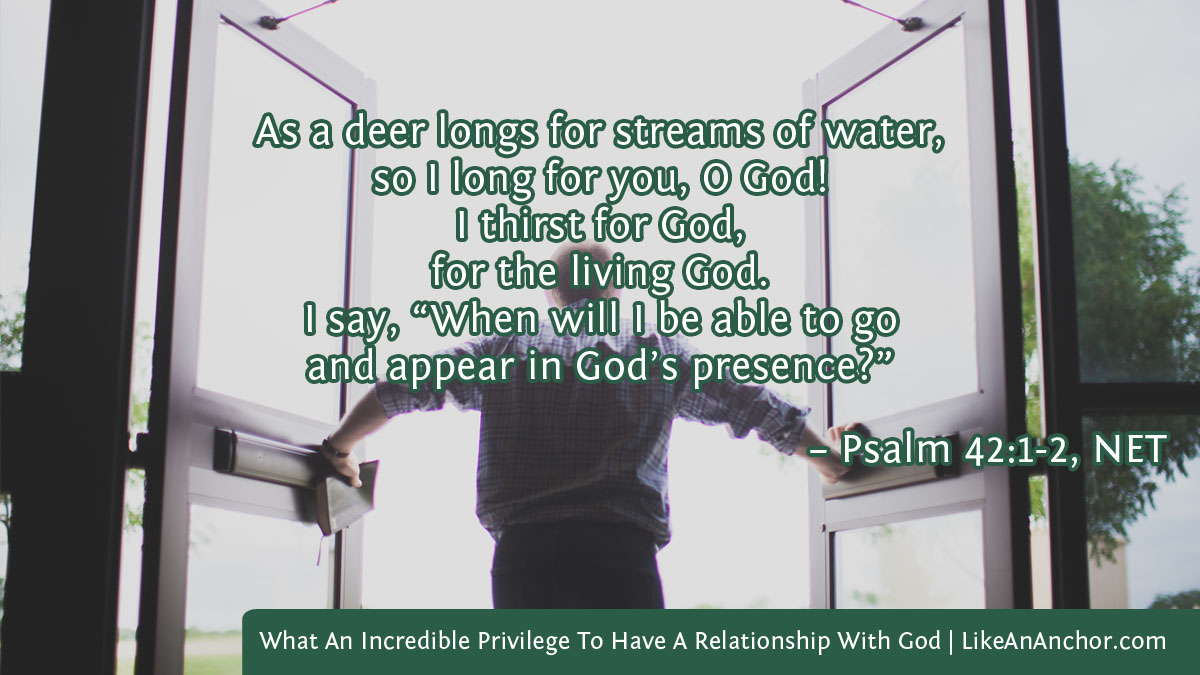
Image of a man pushing open doors and stepping outside overlaid with text from Psalm 42:1-2, NET version:  As a deer longs for streams of water, so I long for you, O God! I thirst for God, I say, “When will I be able to go and appear in God’s presence?”
Image by Pearl from Lightstock

Longing For God’s Presence

In the Old Testament, people placed a very high value on the privilege of encountering God’s presence, perhaps because it was more difficult for an average person to do that. They marvel that they’re able to visit God’s tabernacle or temple. They express delight in having any contact whatsoever with Yahweh. If God actually talked with them, they were awestruck and terrified.

David, one of God’s closest friends in the Old Testament, placed a very high value on the unique relationship he had with Yahweh. Speaking of himself, the king, he sang to God, “You make him glad with joy in your presence” (Ps. 21:6, WEB). When he committed a grave sin, he prayed, “Don’t throw me from your presence, and don’t take your Holy Spirit from me” (Ps. 51:11, WEB). David knew not to take God’s presence in his life for granted. It was precious, something to hold onto and value highly. Other psalmists had similar responses (Psalm 42:1-4; 73:28; 84:1-12).

How lovely are your dwellings,
    Yahweh of Armies!
My soul longs, and even faints for the courts of Yahweh.
    My heart and my flesh cry out for the living God. …

Blessed are those who dwell in your house.
    They are always praising you. …

For a day in your courts is better than a thousand.
    I would rather be a doorkeeper in the house of my God,
    than to dwell in the tents of wickedness.

Psalm 84:1-2, 4, 10, WEB

When was the last time you genuinely longed for God this way? When you cried out for Him because you wanted to be in His presence, not because you wanted something from Him? When you wanted to be near Him, praising Him alongside His other covenant people? When you’d rather be at God’s house or temple (in the New Covenant, that temple is His people) for even just one day than have a thousand days anywhere else?

I’ve sang this psalm before (“Better Is One Day” and “Doorkeeper“), but I think I’ve been guilty of leaving the sentiment in the psalm behind after the music ends. Sometimes I forget to ask God to be with me unless I’m feeling lonely or hurt or in need of something from Him. I’m not always excited to go to church services and sing to God, at least not so excited that it overshadows how much I look forward to anything else.

Better To Walk With God Than Any Other Way

Image of a woman with her hand raised, overlaid with blog's title text and the words, "Rather than take the close, personal relationship we have with God for granted, we should be incredibly thankful for our access to Him."
Image by Anggie from Lightstock

In the New Testament, expressions of thankfulness for the privilege of a close relationship with God seem quieter than the ones we find in the Old Testament. The New Testament doesn’t record new psalms or songs that highlight enthusiastic praises. Most of the New Testament is letters, and if we’re not paying close attention we might miss the passionate emotion behind those letters. But look at how Paul talked about his feelings regarding Jesus’s relationship with him.

 If someone thinks he has good reasons to put confidence in human credentials, I have more … But these assets I have come to regard as liabilities because of Christ. More than that, I now regard all things as liabilities compared to the far greater value of knowing Christ Jesus my Lord, for whom I have suffered the loss of all things—indeed, I regard them as dung!—that I may gain Christ, and be found in him, not because I have my own righteousness derived from the law, but because I have the righteousness that comes by way of Christ’s faithfulness—a righteousness from God that is in fact based on Christ’s faithfulness. My aim is to know him, to experience the power of his resurrection, to share in his sufferings, and to be like him in his death, and so, somehow, to attain to the resurrection from the dead.

Philippians 3:4, 7-11, NET

Paul is expressing a very similar sentiment to what we see in Psalm 84, it’s just not as poetical. His main goal is to know Jesus and become like Him. Nothing else can possibly compare to the great honor of being “found in Him,” no matter how impressive it might look from a human perspective.

See how great a love the Father has given to us, that we should be called children of God! For this cause the world doesn’t know us, because it didn’t know him. Beloved, now we are children of God. It is not yet revealed what we will be; but we know that when he is revealed, we will be like him; for we will see him just as he is.

1 John 3:1-2, WEB

When we really let it sink in that God is making us His children, we should marvel at the greatness of His love. We’ll even get to be like Him in the future and “see him just as he is.” This is a level of closeness and relationship that the people in the Old Testament could only dream about; the psalms rarely mention God as a Father-figure (Ps. 2:7; 68:5; 89:26; 103:13) and the promise “I will be a father to you, and you will be my sons and daughters” wasn’t explicitly clear until the New Covenant (2 Cor. 6:18, NET). The faithful Old Covenant believers will get to experience the same future that we do–they’ll “be made perfect together with us” (Heb. 11:39-40, NET)–but we have a fuller taste during our human lives of the relationship that God wants to have with His people.

Rather than take the close, personal relationship we have with God for granted, we should be even more thankful for our access to God than the people writing Psalms were. It’s incredible that we can talk to and spend time with the creator of the universe, and that He wants us to call Him our Abba, Father (Rom. 8:15). What an incredible privilege to have such a relationship with God!


Featured image by Pearl from Lightstock

3 Keys to Biblical Motherhood

I wasn’t quite sure what today’s post would be about until I’d been working on it for nearly a week. I knew I wanted to look at motherhood in the Bible, then as I studied three things gradually stood out to me as key points the Biblical writings emphasize. Society often places a ton of pressures on mothers to be perfect, and in the church it’s often described as the most important thing a woman can do.

For most of my life, when I studied women’s roles in the Bible and in the church, I was trying to find hints for what is expected of unmarried women without children. That’s a bit challenging, because instructions are often addressed to wives or talk about children. Now that I’m married and pregnant, though, all those verses are suddenly more relevant. I find it encouraging to study the Bible and see God really expects three basic things from mothers: pray for their kids, love their kids, and teach/train them in God’s way of life.

Image of a woman's and a toddler's feet overlaid with text from Psalm 127:3, WEB version: "Behold, children are a heritage of Yahweh. The fruit of the womb is his reward."
Image by Brimstone Creative from Lightstock

Praying For Children

I’ve long been fascinated by God’s interactions with the patriarch’s wives. He’s called the God of Abraham, Isaac, and Jacob, but He’s also the God of Sarah, Rebecca, Leah, and Rachael and we have record of Him interacting with the women as well as the men (God spoke directly with Sarah and Rebecca [Gen. 18:9-15; 25:20-26] and Leah’s name choices imply a relationship with Him [Gen. 29:31-35]) . Interestingly, all these interactions are related to their roles as mother. God definitely talks to and works with women who aren’t mothers as well, but for many women who talked with God, their interactions with Him involve their children. Either they’re asking for a child, or God’s telling them they’ll have a child, or they’re seeking God’s help with a child.

Christians are under no obligation to get married or have kids if they don’t want to (there are even verses where Paul counsels it could be best to remain single), but the Bible assumes that the majority of people will marry and that they’ll want to have kids. As we discussed in last week’s post, God loves children and He cares deeply about how His people raise the children that He gives to them as a gift.

She was in bitterness of soul, and prayed to Yahweh, weeping bitterly. She vowed a vow, and said, “Yahweh of Armies, if you will indeed look at the affliction of your servant and remember me, and not forget your servant, but will give to your servant a boy, then I will give him to Yahweh all the days of his life, and no razor shall come on his head.” …

When she had weaned him, she … brought the child to Eli [the priest]. She said, “Oh, my lord, as your soul lives, my lord, I am the woman who stood by you here, praying to Yahweh. I prayed for this child, and Yahweh has given me my petition which I asked of him.”

1 Samuel 1:10-11, 24-27, WEB

I love that God listens to women’s prayers or even just thoughts for and about their children. We see this first in Hagar’s story, where she was clearly worried about her son but doesn’t even have to make a specific prayer for God to respond to her plight (Gen. 16:6-15; 21:8-21). We see it in Rebecca, who had a question about her pregnancy that God personally responded to (Gen. 25:20-26). We see it in Hannah (whose story I just quoted), who asked God for a son and received exactly what she requested (1 Sam. 1:1-2:11). From the many examples of praying mothers in the Bible and God’s careful attention to their prayers, we can see that praying for children is a key part of Biblical motherhood.

Image of a mother coloring at a table with her son and daughter, overlaid with text from Prov. 1:8-9, WEB version: "My son, listen to your father’s instruction, and don’t forsake your mother’s teaching: for they will be a garland to grace your head, and chains around your neck."
Image by Brimstone Creative from Lightstock

Teaching Your Children

My husband and I were both homeschooled, and we’re planning to homeschool our children as well. I’m so excited about this, particularly now that I have teaching and tutoring experience working with everyone from 5-year-old beginning readers to teens struggling with homework to Ph.D. candidates looking for editing help on their dissertations. I love teaching and I’m excited to teach my children and discover their learning styles.

One of the things that the Bible assumes (and commands!) is that fathers and mothers will both be teaching, training, and disciplining (disciple-ing) their children. When we look at Moses’s words in Deuteronomy about passing on God’s teachings to children, we can remember that his audience was “all Israel” (Deut. 1:1; 5:1). That’s the whole assembly of the congregation, men and women.

Therefore you shall lay up these words of mine in your heart and in your soul. You shall bind them for a sign on your hand, and they shall be for frontlets between your eyes. You shall teach them to your children, talking of them when you sit in your house, when you walk by the way, when you lie down, and when you rise up. You shall write them on the door posts of your house and on your gates; that your days and your children’s days may be multiplied in the land which Yahweh swore to your fathers to give them, as the days of the heavens above the earth.

Deuteronomy 11:18-21, WEB

When you have kids, God expects you to make His way of life part of their everyday learning. Even if you don’t homeschool, you’re still responsible for teaching your children the word of the Lord. That goes for both mothers and fathers.

My son, keep your father’s commandment,
    and don’t forsake your mother’s teaching.
Bind them continually on your heart.
    Tie them around your neck.

Proverbs 6:20-21, WEB

Mothers taught both boys and girls (for example, all of Proverbs 31 is “The words of king Lemuel; the revelation which his mother taught him). There’s a good chance that Jesus’s mother Mary was His primary teacher, since she was from a priestly family and spent time in the home while Joseph would have been busy with his work as a carpenter (Metsämuuronen, 2019). Jewish children of Jesus’s time grew up steeped in religious tradition, learning prayers, keeping Sabbath and the feasts, and eating kosher foods. They were likely taught “the contents of the main scriptures and proverbs” and learned how to “read something” from their mothers before beginning formal schooling at the age of six or seven (Metsämuuronen, p. 5). If there was a local synagogue, both boys and girls would have gone there to learn Torah until around age thirteen. If not, it was the parents’ responsibility to continue their schooling.

Teaching and training children in God’s way of life is still a responsibility for parents, regardless of how else their children are being taught things more traditionally considered school subjects. It’s not something we can leave to chance or hope they learn through osmosis at church or from our examples. We need to be intentional about it. As such an important responsibility, teaching and training children is a key aspect of Biblical motherhood.

Love the Children

Image of a mother sitting by a lake with two little girls, overlaid with blog's title text and the words, "Reading the scriptures shows God expects three basic things from mothers: to pray for their kids, to love their kids, and teach them His way of life."
Image by Anggie from Lightstock

Praying for their children is something we see mothers in the Bible do. Teaching their children is something they were commanded to do. Another command, which involves older mothers teaching new mothers, is to love our children.

But as for you, communicate the behavior that goes with sound teaching. … Older women likewise are to exhibit behavior fitting for those who are holy, not slandering, not slaves to excessive drinking, but teaching what is good. In this way they will train the younger women to love their husbands, to love their children, to be self-controlled, pure, fulfilling their duties at home, kind, being subject to their own husbands, so that the message of God may not be discredited.

Titus 2:1, 2-5, NET

It seems a little odd that the older women have to train the younger women how “to love their children.” We tend to think that love is something that just happens and people don’t need to work on it, especially for women with their maternal instinct. There are also hints in the Bible that it’s natural and normal for women to cherish their own children (Is. 49:15-16; 1 Thess. 2:7). But just like we learn to love a spouse more fully and deeply (rather than simply settling for impulsive, romantic love), we can also learn how to love our children better.

I know there’s a lot involved in being a good mother, but I suspect most of it is going to fall into these broad categories (based not just on Bible study, but practical observations of and conversations with mothers I know and admire). It’s kind of like how the entire law is fulfilled by truly following the command to love God and love your neighbor (Matt. 22:35-40; Rom. 13:8-10). If we’re praying for our children, teaching them God’s way, and loving them truly, then maybe the rest is simply details on how to do that properly.


Featured image by Pearl from Lightstock

So Many Reasons to Praise

When we think of ways to deepen our relationship with God, we often think of things like Bible study, prayer, scripture-based meditation, and fasting. That’s what I typically hear are the best “tools” for connecting with God. As vital as those are, I think we could add “praise” to that list as well.

Through him then let us continually offer up a sacrifice of praise to God, that is, the fruit of our lips, acknowledging his name.

Hebrews 13:15, NET

Is anyone among you suffering? He should pray. Is anyone in good spirits? He should sing praises.

James 5:13, NET

The type of praise James mentions is relatively easy for us. When we’re happy and things are going well, it’s easy to praise God (provided we remember that He’s the one to thank for our blessings). But the author of Hebrews also says we should continually offer up praise to God as a type of sacrifice. That can be a little bit harder. We might fall into a routine of thanking and praising God for the same things in our life, and not be sure what else to add. Or we might be in a season where there doesn’t seem to be anything in our lives to praise God for.

The psalms provide a wealth of ideas for reasons to praise God, and many of them have nothing to do with our personal circumstances. Keeping these in mind can be helpful whether we’re struggling to praise, or if we’ve simply fallen into a routine and want to connect more deeply with Him.

Praise His Name

In the WEB translation (which is my favorite to use for Old Testament), there are 28 verses in psalms that speak of praising God’s name (out of a total of 151 uses of “Praise” in the whole book).


I will give thanks to Yahweh according to his righteousness, and will sing praise to the name of Yahweh Most High.

Psalm 7:17, WEB

Sing to God! Sing praises to his name! Extol him who rides on the clouds: to Yah, his name! Rejoice before him!

Psalm 68:4, WEB

From the rising of the sun to its going down, Yahweh’s name is to be praised.

Psalm 113:3, WEB

let them praise Yahweh’s name,
    for his name alone is exalted.
    His glory is above the earth and the heavens.

Psalm 148:13, WEB

One of the main reasons to praise the Lord is because He is worthy of it (Ps. 18:3). His nature, name, and reputation should inspire us to praise Him.

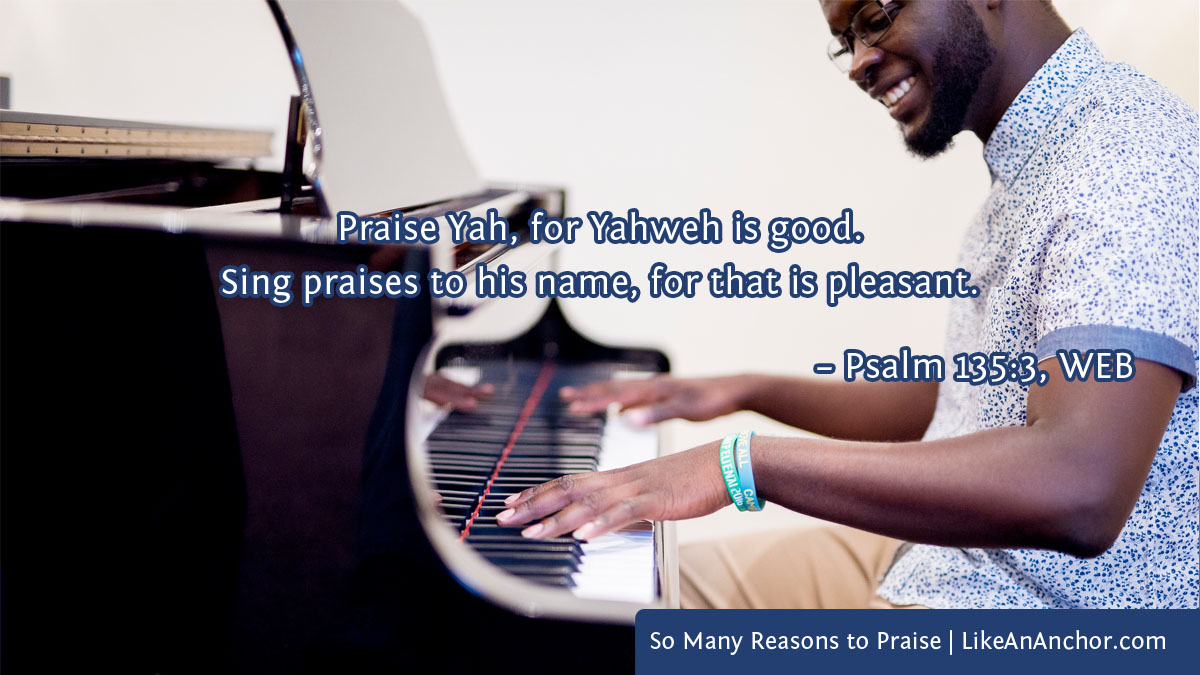
Image of a happy man playing piano overlaid with text from Psalm 135:3, WEB version: "Praise Yah, for Yahweh is good. Sing praises to his name, for that is pleasant."
Image by Ben White from Lightstock

Praise Because He Deserves Respect

If we respect God, revere Him, and live righteously, then the psalms present praise as a natural response. Those who fear God praise Him. Those who are righteous do as well. When we’re living godly lives, praise is a natural “fruit of our lips” (Heb. 13:15).


You who fear Yahweh, praise him! All you descendants of Jacob, glorify him! Stand in awe of him, all you descendants of Israel!

Psalm 22:23, WEB

For Yahweh is great, and greatly to be praised!
    He is to be feared above all gods.

Psalm 96:4, WEB

Sing praises to God! Sing praises!
    Sing praises to our King! Sing praises!
For God is the King of all the earth.
    Sing praises with understanding.

Psalm 47:6-7, WEB

I find the phrase “sing praises with understanding” such an interesting instruction. I think sometimes people idealize a sort of blind faith that loves God without wanting to make sense of Him, but God doesn’t expect or want us to be content with something so shallow. He wants to teach us and grow us, and as we mature we should learn to understand Him more and more. That understanding will fuel our praise, for the more we understand Him the more we’ll recognize how worthy He is of our praise.

Image of a woman standing on a mountain with her arms raised in praise, overlaid with text from Psalm 48:1, WEB version: "Great is Yahweh, and greatly to be praised, in the city of our God, in his holy mountain."
Image by Ruby-Rose from Lightstock

Praise for His Words

In addition to praising God for who He is, we can also praise Him for what He does. One of the great things that He does, which we all benefit from, is share His instruction with us. The Bible uses several different words to describe instruction from God, including words, ordinances, and statues. The thing they all have in common is that it’s important for us to listen, hear and internalize, and obey when God speaks.

In God, I will praise his word.
    In Yahweh, I will praise his word.
I have put my trust in God.
    I will not be afraid.
    What can man do to me?

Psalm 56:10-11, WEB

Seven times a day, I praise you, because of your righteous ordinances.

Psalm 119:164, WEB

Let my lips utter praise, for you teach me your statutes.

Psalm 119:171, WEB

We should be thankful for the words God shares with us and the instruction He gives us. But I wonder how often we take the time to marvel at the fact that we can read the Bible, a book that God wrote through human beings and preserved through millennia. Today, most people can read the Bible in their own native language (and for those that don’t yet, organizations like Wycliff Bible Translators are working to make translations). For many of us, we have access to dozens of different translations and formats for reading God’s word. That is a great blessing, one that we should praise God for.

Image of folded hands on an open Bible, overlaid with text from Psalm 105:43-45, WEB version: "He brought his people out with joy, his chosen with singing. He gave them the lands of the nations. ... that they might keep his statutes, and observe his laws. Praise Yah!"
Image by Jantanee from Lightstock

Praise for Salvation and Redemption

Another wonderful thing that God has accomplished is our salvation. Do you ever just sit and think of how amazing that is? The Father and Jesus planned far in advance for Him to save humanity by coming to earth like us, living a perfect life, and then dying a horrible death. Without that intervention, we’d all die permanently. But because of His great love and grace, we’re offered the gift of eternal life. And as if that wasn’t enough, He also offers deliverance from physical dangers as well, which is another type of salvation the psalms speak of.


Why are you in despair, my soul? Why are you disturbed within me? Hope in God! For I shall still praise him for the saving help of his presence.

Psalm 42:5, WEB

He rescues me from my enemies.
    Yes, you lift me up above those who rise up against me.
    You deliver me from the violent man.
Therefore I will give thanks to you, Yahweh, among the nations,
    and will sing praises to your name.

Psalm 18:48-49, WEB


I will also praise you with the harp for your faithfulness, my God.
I sing praises to you with the lyre, Holy One of Israel.
My lips shall shout for joy!
My soul, which you have redeemed, sings praises to you!

Psalm 71:22-23, WEB

God’s deliverance, salvation, protection, and redemption are priceless gifts. Whether it’s the salvation happening on a spiritual level when we accept Jesus’s sacrifice and enter covenant with God, or it’s deliverance from enemies and dangers (physical or spiritual). The fact that God is Savior gives us many reasons to praise.

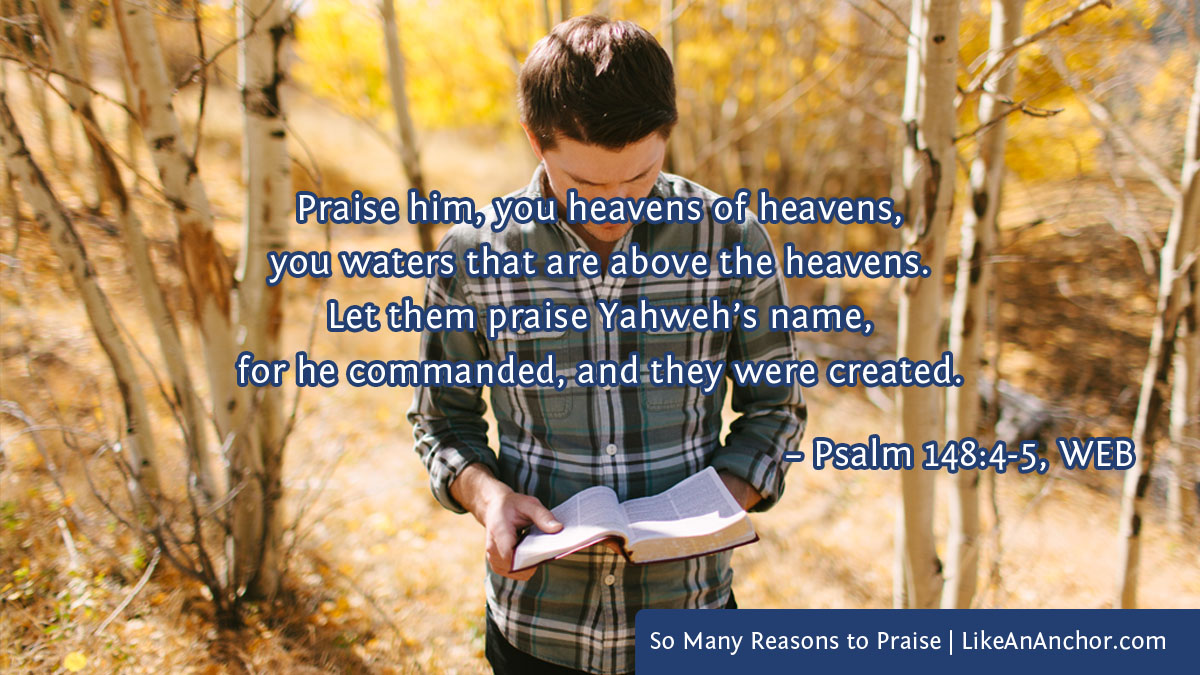
Image of a man reading the Bible in the woods overlaid with text from Psalm 148:4-5, WEB version: "Praise him, you heavens of heavens, you waters that are above the heavens. Let them praise Yahweh’s name, for he commanded, and they were created."
Image by HarveyMade from Lightstock

Praise His Kindness and Goodness

Closely related to praising God for His salvation and redemption is praising Him for His kindness and goodness. These are key aspects of His character that we benefit greatly from.

Because your loving kindness is better than life,
    my lips shall praise you.
So I will bless you while I live.
    I will lift up my hands in your name.
My soul shall be satisfied as with the richest food.
    My mouth shall praise you with joyful lips,

Psalm 63:3-5, WEB

Praise Yahweh, my soul!
    All that is within me, praise his holy name!
Praise Yahweh, my soul,
    and don’t forget all his benefits

Psalm 103:1-2, WEB

Let them praise Yahweh for his loving kindness,
    for his wonderful deeds for the children of men!
Let them exalt him also in the assembly of the people,
    and praise him in the seat of the elders.

Psalm 107:31-32, WEB

The Lord’s loving kindness drives Him to do marvelous things for humanity, even though we do not deserve it. Even the fact that we have water to drink, food to eat, and air to breathe is due to His loving kindness. As James says, “Every good gift and every perfect gift is from above, coming down from the Father of lights” (Jas. 1:17, WEB). If there’s anything in our lives to be thankful for, we have God to praise for that.

Image of a smiling woman with her hand lifted in praise overlaid with text from Psalm 106:1, WEB version: "Praise Yahweh! Give thanks to Yahweh, for he is good, for his loving kindness endures forever."
Image by Pearl from Lightstock

Praise His Power and Might

Another reason that we can praise God brings us back to the idea of praising Him for who He is as well as what He does. Yahweh our God has great power and might. We can praise Him for that greatness, and we can praise Him for how He choses to use His power.


Be exalted, Yahweh, in your strength, so we will sing and praise your power.

Psalm 21:13, WEB


The heavens will praise your wonders, Yahweh,
your faithfulness also in the assembly of the holy ones.

Psalm 89:5, WEB

Give thanks to Yahweh! Call on his name!
    Make his doings known among the peoples.
Sing to him, sing praises to him!
    Tell of all his marvelous works.

Psalm 105:1-2, WEB

When we think of God’s mighty acts of power, we realize that most of them are incredible demonstrations of His love for His people (though there are also mighty demonstrations of His judgment on sin). We can think of historical events like the creation of the world (Gen. 1-2), the parting of the Red Sea (Ex. 14), the Lord defended Judah against an invading army (2 Kings 18-19), or Jesus raising Lazarus from the dead (John 11). We can also think of miracles we’ve seen in our own lives or heard of from fellow Christians.

Image of a man and woman with their hands lifted in praise, overlaid with blog's title text and the words, "Praise is a way for us to connect with and glorify God. Whatever our current circumstances, we have many reasons to praise Him."
Image by Anggie from Lightstock

No matter what is going on in our lives right now, we have many reasons to praise. And when we’re not quite sure what to say, the Psalms provide us with ideas for how to phrase that praise. You also don’t need to confine yourself to the psalms; the word “praise” shows up 254 times in a search of the WEB translation, and just over 100 of those are in books other than psalms. You might find it an interesting study to go through those 254 uses (not all are about praising God, but most are).

Praise Yah!
    Praise God in his sanctuary!
    Praise him in his heavens for his acts of power!
Praise him for his mighty acts!
    Praise him according to his excellent greatness!
Praise him with the sounding of the trumpet!
    Praise him with harp and lyre!
Praise him with tambourine and dancing!
    Praise him with stringed instruments and flute!
Praise him with loud cymbals!
    Praise him with resounding cymbals!
Let everything that has breath praise Yah!
    Praise Yah!

Psalm 150, WEB

Featured image by PhotoGranary from Lightstock

What Does “I Lift Up My Soul” Mean?

Have you ever been curious about the phrase, “I lift up my soul”? It’s something I’ve heard so much by this point in my life as a Christian that I don’t really think about it anymore. There’s even a “To Thee I Lift My Soul” song in our church hymnal. After hearing, reading, and singing it so often, I just assume I know what it means.

Then I read the first couple verses of Psalm 25 again this past Tuesday, and I started wondering. Is “I lift up my soul” just a poetic phrase for prayer–directing your soul up to God? Or might it be something else; like perhaps David saying he’s lifting up his soul like an offering? Maybe the meaning isn’t as clear as I thought. At the very least, I suspect there’s more here to learn.

Image of a woman with her hands raised to heaven, with text from Psalm 25:1-2, CJB version: "I lift my inner being to you, Adonai; I trust you, my God. Don’t let me be disgraced, don’t let my enemies gloat over me.”
Image by Ruby-Rose from Lightstock

Trusting With The Soul

We find the phrase “I lift up my soul” in three psalms where the writers talk about lifting up their souls to God. Let’s take a look at those verses:

To you, Yahweh, I lift up my soul.
My God, I have trusted in you.
Don’t let me be shamed.
Don’t let my enemies triumph over me.

Psalm 25:1-2, WEB

Preserve my soul, for I am godly.
    You, my God, save your servant who trusts in you.
Be merciful to me, Lord,
    for I call to you all day long.
Bring joy to the soul of your servant,
    for to you, Lord, do I lift up my soul.

Psalm 86:2-4, WEB

Cause me to hear your loving kindness in the morning,
for I trust in you.
Cause me to know the way in which I should walk,
for I lift up my soul to you.

Psalm 143:8, WEB

These psalms are all prayers directed at God asking Him for something. They’re also about trust; every one of these psalms mentions it when they’re talking about lifting up the soul. This makes sense since there isn’t much point in prayer if you don’t trust God enough to think He might answer.

As I read these psalms, I see a deeper level of trust than just the basic thinking God might be paying attention. There’s a hopeful expectation here and a certainty that God can and will respond. This type of trusting prayer involves the direction and dedication of the soul (naphesh in Hebrew, which means a breathing, living being). You don’t point your soul toward someone who doesn’t care or lift up your life to them if you don’t think they’ll help. We need trust if we’re going to have a “lift up the soul” type of relationship with God.

Image of a man walking in the woods reading a Bible, with text from Psalm 86:2-4, TLV version: “Watch over my soul, for I am godly. You are my God—save Your servant who trusts in You.
Be gracious to me, my Lord, for to You I cry all day. Gladden the soul of Your servant, for to You, my Lord, I lift up my soul.”
Image by HarveyMade from Lightstock

A Longing Soul

The NET translators opt for a less poetic and more literal phrase when translating “lift up my soul.” In this version, Psalm 25:1 reads, “O Lord, I come before you in prayer.” A footnote on that verse says, “To ‘lift up’ one’s ‘life’ to the Lord means to express one’s trust in him through prayer.” The translators opt for the “prayer” meaning in this verse, though they also see nuances in the Hebrew that they discuss in another footnote.

Hebrew words often have multiple meanings. The word “lift up” is nasa, and it’s no exception to this rule. The basic meaning is to lift, carry, or take. The phrase can gain slightly different meanings depending on context. In the Psalms, for example, it’s used figuratively rather than of literally picking up and carrying an object.

In a footnote on Psalm 143:8, the NET translators say, “The Hebrew expression נָאָשׂ נֶפֶשׁ (naʾas nefesh, ‘to lift up [one’s] life’) means ‘to desire; to long for.'” From this perspective, nasa seems synonymous with the longing soul spoken of in other psalms and songs where the writers want to be close with God more than anything else (Psalm 63:1; 84:1-2; 130:6).

Yes, in the way of your judgments, Yahweh, we have waited for you.
    Your name and your renown are the desire of our soul.
With my soul I have desired you in the night.
    Yes, with my spirit within me I will seek you earnestly;
    for when your judgments are in the earth, the inhabitants of the world learn righteousness.

Isaiah 26:8-9, WEB

This also makes me think of King Solomon’s prayer at the temple dedication. He asked that God would hear His wayward people’s prayers if they “return to you with all their heart and being … and direct their prayers to you” (1 Kings 8:48, NET). Similarly, Samuel urged Ancient Israel, “direct your hearts to Yahweh, and serve him only” (1 Sam. 7:3, WEB). Paul does much the same thing in one of his letters, praying, “may the Lord direct your hearts toward the love of God and the endurance of Christ” (2 Thes. 3:5, NET).

The desires of our souls and the directions of our hearts show God what matters to us. When things are right between us, our prayers show that He matters to us. Lifting up our longing souls to Him demonstrates that He’s our hearts’ desire.

Image of a woman worshiping with hand raised and a smile on her face, with text from Psalm 143:8, TLV version: “Make me hear Your lovingkindness in the morning,
for in You I trust. Show me the way I should go, for to You I lift up my soul.”
Image by Pearl from Lightstock

Other Things We Could Lift Up

Trusting God with our lives and showing our desire for Him in our prayers is a very good thing. There are also negative things that we could lift our souls to, but shouldn’t. In Psalm 24:4, the writer says that only someone “who has not lifted up his soul to falsehood” can dwell with God. In Hosea 4:8, God charges His people will wickedness when they “set their heart on their iniquity” (“set their heart” is the same phrase in Hebrew as “lift their soul”). We can choose whether we aim our souls in the right direction or turn them toward evil.

The Theological Wordbook of the Old Testament (TWOT) lists three categories of meaning for nasa. The first is a literal or figurative lifting up, which we’ve already looked at. The second is “bearing the guilt or punishment of sin” (entry 1421). There are several Bible verses that say the soul/person who sins will bear/lift/carry their iniquity for that transgression. Here are two examples:

“If anyone (naphesh) sins, doing any of the things which Yahweh has commanded not to be done, though he didn’t know it, he is still guilty, and shall bear (nasa) his iniquity. He shall bring a ram without defect from of the flock, according to your estimation, for a trespass offering, to the priest; and the priest shall make atonement for him concerning the thing in which he sinned and didn’t know it, and he will be forgiven.

Leviticus 5:17-18

The soul (naphesh) who sins, he shall die. The son shall not bear (nasa) the iniquity of the father, neither shall the father bear (nasa) the iniquity of the son. The righteousness of the righteous shall be on him, and the wickedness of the wicked shall be on him.

Ezekiel 18:20, WEB

When we sin, we’re carrying that like something we’ve lifted up and put on our shoulders. We don’t bear the iniquity of someone else, but we are responsible for the things that we do as a living, breathing naphesh. This would be a big problem for us if we had to keep carrying all our sins, but God provides a solution.

Carrying Away Our Sins

Image of a woman looking up at the sky with the blog's title text and the words "As people who've had Jesus lift away our sins, we can lift up our souls and lives to Him trusting that God will continue to hear and deliver us."
Image by Brightside Creative from Lightstock

The third category of meanings for nasa describes the solution to the problem of us bearing the load of our gilt and sin. If you’re carrying something, someone else can come in, lift that burden, and carry it away. That’s what Jesus does with our sins. Because of His sacrifice, “Sin can be forgiven and forgotten, because it is taken up and carried away” (TWOT entry 1421).

Yet it pleased Yahweh to bruise him.
    He has caused him to suffer.
When you make his soul (naphesh) an offering for sin,
    he will see his offspring.
He will prolong his days
    and Yahweh’s pleasure will prosper in his hand.
After the suffering of his soul (naphesh),
    he will see the light and be satisfied.
My righteous servant will justify many by the knowledge of himself;
    and he will bear (nasa) their iniquities.
Therefore I will give him a portion with the great.
    He will divide the plunder with the strong;
because he poured out his soul to death
    and was counted with the transgressors;
yet he bore the sins of many
    and made intercession for the transgressors.

Isaiah 53:10-12, WEB

There are so many verses that speak of Jesus taking away our sins, washing away our sins, and removing sin from us (for example, John 1:29; Rom. 11:26-27; Heb. 9:25-26; 1 John 3:5). Our souls were weighed down with sin, but He lifts that burden off our shoulders. We don’t have to carry our guilt anymore. We get to do something else with our souls now.

The psalmists wrote centuries before Jesus’s sacrifice but (judging by the Messianic psalms he wrote) we know at least David had an idea of the incredible deliverance God promised. These writers also had the Old Covenant sacrifices pointing toward the Messiah’s ultimate sacrifice that would take away sin once and for all. They knew less about God’s plan for redemption than we do today, yet they were still so filled with trust and confidence in God that they lifted up their souls to Him.

How much more should we lift our souls to God now that we’ve been freed from carrying around the burden of sin? Lightened and rescued by Jesus’s sacrifice, we lift our hands, hearts, and souls to God with joy and thanksgiving, confident in His goodness and faithfulness.

For there is one God and one intermediary between God and humanity, Christ Jesus, himself human, who gave himself as a ransom for all, revealing God’s purpose at his appointed time. … So I want the men in every place to pray, lifting up holy hands without anger or dispute.

1 Timothy 2:5-6, 8, NET

Featured image by Temi Coker from Lightstock

Song Recommendation: “Lift” by Sue Samuel