Thoughts on Sharing the Gospel

As I mentioned in my email newsletter that went out this past Wednesday, I’ve been reading quite a bit of New Testament historical fiction. One of the series–Angela Hunt’s “Jerusalem Road”— made me think about is how weird it would have been to live at the time of Jesus. We look back from our modern perspective and think it would have been amazing to be alive at that time and have the chance to actually meet and talk with Jesus. But I wonder if it’s more likely we’d have been confused and perplexed by this seemingly ordinary man who suddenly started performing miracles and who claimed to be the literal Son of God.

It’s hard for me to imagine not knowing Jesus is the Messiah (the Hebrew word for “Christ,” which means “anointed”). I grew up going to church. Not only that, I grew up in a culture that was shaped by Christianity and where most people I met had at least a basic understanding of who Jesus is and what Christians believe. It’s so natural for me to think of Him as the Son of God and accept that He lived, died, and rose from the dead. But that all would have been brand-new to early 1st century people.

As our modern culture moves farther and farther away from Christianity, more and more people don’t have much–if any–Christian cultural background or Bible knowledge. Those of us in the U.S. and similar countries can’t really assume anymore that if we talk with someone about our faith they’ll have any foundational Biblical knowledge to build on. It’ll be more like Paul preaching to Gentiles who’d never heard of Jesus and thought Yahweh was only a God for the Jews than it is like Peter preaching to Jewish people who already had a faith background but needed to hear how Jesus is relevant to them.
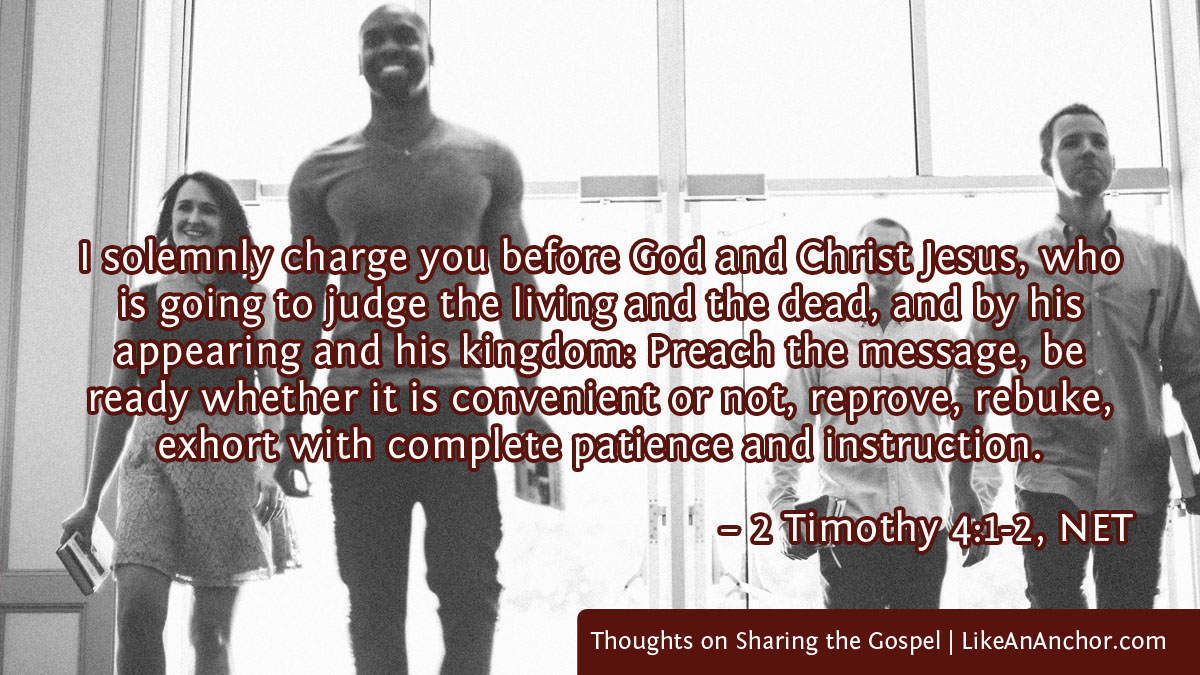
Image of four smiling people walking toward the camera overlaid with text from  2 Tim. 4:1-2, NET version: "I solemnly charge you before God and Christ Jesus, who is going to judge the living and the dead, and by his 
appearing and his kingdom: Preach the message, be ready whether it is convenient or not, reprove, rebuke, exhort with complete patience and instruction."
Image by Matt Vasquez from Lightstock

What Are the Gospels Doing?

I’ve also been pondering a related thought, this time about sharing Jesus with someone rejecting Him rather than someone who never knew about Him. I know of someone who was Christian but is now adopting Jewish beliefs, and I’ve heard that this person challenged someone to prove that Jesus is the Messiah and the Son of God using only the Old Testament. In many ways, that’s a ridiculous thing to ask. You can prove just from the Old Testament that there is a promised Messiah coming, but if you’re going to prove that it’s Jesus you need to cite evidence that His life lines up with those prophecies. As I thought about this topic more, I realized this is exactly the point of the gospels. They’re there to convince readers of who Jesus is.

Now Jesus performed many other miraculous signs in the presence of the disciples, which are not recorded in this book. But these are recorded so that you may believe that Jesus is the Christ, the Son of God, and that by believing you may have life in his name.

John 2o:30-31, NET

Have you ever noticed how many times the gospel writers (especially Matthew) say things like, “it is written” or “that it might be fulfilled”? They’re constantly referencing back to the Old Testament writings and linking them to Jesus, showing that He fulfilled prophecies. Just like Jesus came to fill the law and the prophets to the fullest and just like He had to open His disciples eyes to understand the scriptures about Himself (Matt. 5:17-20; Luke 24:25-48), so are the gospel accounts there to open up the scriptures for us and show that Jesus is the Messiah. Of course, God the Father is the one who opens minds to comprehend these truths (John 6:44), but He also responds to those who diligently seek Him (Matt. 7:7-11) and expects His people to help share His truths with the world (Matt. 28:18-20; 2 Tim. 4:1-2).

Preaching the Word of Christ

Image of two people studying a Bible together, overlaid with blog's title text and the words, "Pondering ways that talking about God today is similar to the first century."
Image by Anggie from Lightstock

I feel like a lot of times when we talk about our faith, we want to jump right into the details. We like to explain what makes our church’s Christianity different from other churches. We want to make sure people know God has expectations for them and their conduct if they commit to following Him. But that only matters to people if they already know about Christianity and they already care what God thinks about them. If they don’t have that already, they need to hear the gospel–the good news about who Jesus is and what He taught–before all the details about how to follow Him.

 For with the heart one believes and thus has righteousness and with the mouth one confesses and thus has salvation. For the scripture says, “Everyone who believes in him will not be put to shame.” For there is no distinction between the Jew and the Greek, for the same Lord is Lord of all, who richly blesses all who call on him. For everyone who calls on the name of the Lord will be saved.

How are they to call on one they have not believed in? And how are they to believe in one they have not heard of? And how are they to hear without someone preaching to them? And how are they to preach unless they are sent? As it is written, “How timely is the arrival of those who proclaim the good news.” But not all have obeyed the good news, for Isaiah says, “Lord, who has believed our report?” Consequently faith comes from what is heard, and what is heard comes through the preached word of Christ.

Romans 10:10-17, NET (bold italics mark quotations from Isa 28:16; Joel 2:32; Isa 52:7; Nah 1:15; Isa 53:1)

The details about how to follow Jesus are important–He included many of those “how-to” details in His message, and His followers filled in more information in their letters that make up the rest of the New Testament. But at it’s core, the gospel is very simple. People hear the preached word of Christ, they respond in faith and obey the good news, and their belief results in righteous living. Remember, God’s sincere desire is that everyone turn away from wickedness, turn to Him, and choose life (1 Tim. 2:1-4; 2 Peter 3:9; Eze. 18:21-32). That should be our desire as well, and the ways we talk about Him should reflect that.

I know this wasn’t really my typical blog post format this week. It was more musings and reflections than a topical Bible study. I just really struggled coming up with a topic this week, and so I wrote about the ideas my thoughts kept coming back to pondering.


Featured image by Ben White from Lightstock

Song Recommendation: “The Basics of Life” by 4HIM (a song I haven’t thought about in probably 10 years, but which popped into my head while writing this post)


How Do I Convince People They’re Wrong and God Is Right?

The world seems like it’s going crazy. Looking around at what’s going on brings to mind Bible verses like “everyone did what was right in his own eyes” and “there is no fear of God before his eyes” (Jud. 17:6; Ps. 36:1). Not only do people reject God, but they reject the entire idea of absolute morality as well, opting for a subjective, situational version that can change moment-to-moment and person-to-person.

In the midst of this, many Christians want to fight for and defend the truth of our faith. We want to show the world they’re wrong and prove that God is right. We think that to “contend earnestly for the faith once delivered,” we need to offer logical, scientifically supported, convincing arguments to counter the lies running rampant in our culture.

But I don’t think we’re going to convince many people that God’s word is the truth (rather than just one of many truths) by arguing with them. There’s definitely a place for apologetics, and people with the knowledge and expertise to enter debates and stand up for truth are invaluable. In general, though, I question whether telling people how wrong they are and what they need to change is a good first step for introducing them to the faith.

If we start out by lecturing people about how much God hates their sin or how wrong they are about ideas they hold dear, why would they react any way other than defensively? And if they don’t acknowledge God as real yet, why would we expect them to care what we say He wants them to do?

Keeping Your Audience In Mind

God’s truth doesn’t change with the times. But those who are wise keep their audiences in mind when they speak the truth. When Paul spoke to Jews in Antioch, he knew his already religious audience could best be reached by using scriptures to prove Jesus is the long-awaited Messiah (Acts 13:14-41). When he preached to people in Athens without any Biblical background, however, he started by talking about who God is and why we should care. He even quoted one of their own philosophers as part of his argument (Acts 17:18-31). Tailoring the message to fit his audience was a deliberate, conscious choice that Paul made. Read more

As For Me, I Will Serve The Lord: INTJ Christians

Today’s post about INTJ Christians is the fifth in a series talking with Christians of different personality types. I started this series because when I began discussing faith with different personality types, I noticed they don’t all feel equally valued and understood in Christian churches. If Christianity is a faith meant for all people (and I believe it is), then why aren’t we doing a better job of connecting with all personality types?

Our walks with God don’t all look the same. We’re influenced by our backgrounds, variations in beliefs, and individual personalities. And even though the goal is for us all to become “like God,” that doesn’t mean we become indistinguishable from each other. God created great variety in people and I believe He did that for a reason. So let’s spend today’s post hearing from and talking about the unique perspectives of INTJ Christians.

Identifying With Bible Characters

The first question I asked for this project was which Bible characters and/or stories you identify with most. INTJs tended to chose Bible Character who they felt shared their perspective on the world. Because an INTJ’s dominant function of Introverted Intuition (Ni) gives them a perspective on things that’s unique to them, I wasn’t surprised that the six INTJs who shared their stories with me each chose a different character except for two who mentioned Paul. Read more

Preparing For The Bridegroom To Come Back

In Christ’s day, a Jewish bride-to-be had to be ready for her bridegroom to arrive at any moment. She prepared herself, and listened for the trumpet blasts and shouts signaling his eminent arrival. Jesus’ first coming followed a similar pattern, with a “friend of the bridegroom” telling people he was on His way. Scripture indicates His return will also follow a pattern like this.

As we approach the fall holy days of Yom Teruah (Feast of Trumpets), Yom Kippur (Day of Atonement), and Sukkot (Feast of Tabernacles), my mind has been on Jesus’ return. These days picture parts of God’s plan that have not yet been fulfilled, including Messiah’s second coming.

Here on this blog, we’ve often talked about how Jesus’ relationship with the church is like that of a Jewish bridegroom with his bride (you can read more about this in my posts “The Bridegroom’s Pledge” and “The Bridegroom Cometh!“). After the betrothal, the bride wouldn’t know exactly when the groom was going to come back for the wedding. She had to be ready, listening for the trumpet blasts and shouts signaling his eminent arrival. In much the same way, we don’t know when Christ will return and it’s very important that we get ready and keep watching for Him to come back. Read more

To Seek And Search Out By Wisdom: INTP Christians

I started my project about Christians of different Myers Briggs types because of comments I’ve received from INTP Christians. INTPs are often stereotyped as the “least religious type” and hearing from so many INTPs made me curious about how different types approach their faith. And so I’m very excited to share this post where we dive-into the perspective of INTP Christians.

This is the fourth post in a series talking with Christians of different personality types. When you start discussing faith with different people of different types, you notice not all the personalities feel equally valued and understood in Christian churches. If Christianity is a faith meant for all people why aren’t we doing a better job of connecting with all personality types?

Our walks with God don’t all look the same. We’re influenced by our backgrounds, variations in beliefs, and individual personalities. And even though the goal is for us all to become “like God,” that doesn’t mean we become indistinguishable from each other. God created great variety in people and I believe He did that for a reason. So let’s spend today’s post hearing from and talking about the unique perspectives of INTP Christians. I also want to take a moment to thank the five INTPs who got in touch with me, shared their perspectives, and let me quote them.

Identifying With Bible Characters

The first question I asked people was which Bible characters and/or stories they identified with most. The INTPs’ choices reflect highly individual thought processes and ways of relating to the Bible. The only overlap is that several INTPs explain their choices by saying they personally identify with an aspect of their chosen character’s story.

Meredith says she relates to Moses not wanting to confront Pharaoh “probably because he didn’t want to come across as stupid and weak,” “to Asa, doing good stuff and being devoted for a while, and then pouting at God’s disciplinary measures when I messed up,” and to Solomon, who “was a very intellectual person.” Anonymous commenter kittyess also mentioned Solomon, but in her case it’s because he was “struggling with the apparent meaninglessness of life yet trying to find joy and contentment in life through God.” The fact that two INTPs mentioned Solomon, together with this type’s interest in digging down to the truth of the matter, is the reason I chose a quote from Ecclesiastes for this post’s title. Read more

That Which Every Joint Supplies: INFP Christians

This is my third post in a series about Christians of different Myers-Briggs types. When you start talking with people in the churches, it quickly becomes clear that while we share a common faith there is quite a variety among us as well. Some of that has to do with background, some with the denomination we’re part (or not part) of, and some with personality. And if we want our churches to be a welcoming place for all people who seek to know Jesus, it’s a good idea for us to understand how different personality types relate to their faith.

Our walks with God don’t all look the same. We’re influenced by our backgrounds, variations in beliefs, and individual personalities. And even though the goal is for us all to become “like God,” that doesn’t mean we become indistinguishable from each other. God created great variety in people and I believe He did that for a reason. So let’s spend today’s post hearing from and talking about the unique perspectives of INFP Christians.

I heard from five INFPs who responded to most of the questions I asked. In general, INFPs are private people and I’m not surprised that the response rate was lower than what I saw for the INFJ post and the ENFP post I wrote earlier. One INFP who I talked with in-person said she wouldn’t feel comfortable submitting even an anonymous response. Still, I hope any INFP Christians reading this post will feel safe commenting and adding their thoughts to the conversation. I’d love to hear from more of you! Read more