Ideas to Hold Loosely and Closely

I was thinking the other day about the topic of prophecy. Specifically, about how attached some people get to their ideas of how Biblical predictions for the future are going to play out. They want to figure out (or think they already know) when Jesus will return, what the mark of the beast is, which modern nation correspond to names used in prophecy, and other specifics. But I think we need to get comfortable accepting that there are some things we simply don’t know. For some future events, Jesus told His disciples that we are “not permitted to know” the details (Acts 1:6-7). For other things, even though we are permitted to “know the mysteries/secrets of the kingdom of heaven” (Matt. 13:11), it takes time to learn the “deep things of God” and we will never fully understand all there is to know in this human life (Rom. 11:33; 1 Cor. 2:10). With that in mind, I think it is healthy to hold our pet interpretations of prophecies loosely.

I have often wondered how people who are absolutely, 100% sure that God will do things a certain way will react if they’re wrong. Will they miss what God is doing because they are looking somewhere else? Will they get upset with Him if He comes back on a day they weren’t expecting? Will they be so focused on figuring out prophecy that they’ll neglect something more important? And as I wonder these things about other people, I also have to turn these questions back on myself and see if there are any areas where I am doing something similar. For me, it’s not so much about prophecy, but about interpretations of more complex scriptures or less clear points of doctrine. I need to remember that my speculations and pet theories might be wrong.

We must be very careful that the knowledge we (think) we have doesn’t blind us to the reality that we have so much more still to learn (1 Cor. 8:2; 10:12). For things that are speculative, unclear, and/or unrevealed it is the mark of a humble and teachable mind to admit that we don’t really know. We can have ideas that we think are true, and they may even be good ideas solidly grounded in Biblical reasoning, but there are some things that we simply can’t know with 100% certaintly. We should hold those ideas loosely, willing to reconsider them and to give them up if we learn something that tells us we were wrong.

At the same time, there are prophecies, commands, and doctrines that are clearer than others. God gives us promises that He has not yet fully fulfilled, and we can be 100% certain that He will keep those promises. Those are things that we should hold onto tightly, never letting them go or permitting our faith to be shaken. For example, the timing for Jesus’s return is something that we cannot know. If we have ideas for when that might happen, we should hold those ideas loosely. But we so know for certain that Jesus will return and that He will set up God’s kingdom on earth. That is a promise that we should hold close and let it make a home in our hearts.

Image of a man reading the Bible overlaid with text from 1 Thess. 5:21, WEB version:  "Test all things, and hold firmly to that which is good."
Image by Matt Vasquez from Lightstock

Things to Hold Fast, and Things To Let Go

Depending on which English translation of the Bible you’re reading, the phrase “hold fast” is used multiple times in scripture. There are some things that we are told to hold fast to, and there are others things that people are warned against holding onto. On the negative side, the people of ancient Israel were warned not to “hold fast” to the pagan nations living around them (Joshua 23:8-13). Later in ancient Israel’s story, God asked why the people “continually turn away from me in apostasy” and “hold fast to their deception” (Jer. 8:5, NET). By Jesus’s time, the Jewish people had rejected the ways of pagan nations around them, but some were still holding onto a different type of deception.

The Pharisees and the experts in the law asked him, “Why do your disciples not live according to the tradition of the elders, but eat with unwashed hands?” He said to them, “Isaiah prophesied correctly about you hypocrites, as it is written:

This people honors me with their lips,
but their heart is far from me.
They worship me in vain,
teaching as doctrine the commandments of men.’

Having no regard for the command of God, you hold fast to human tradition.”

Mark 7:3-8, NET (bold italics mark a quotation from Isa 29:13)

The Pharisees Jesus spoke with here held tightly to the wrong things. They should have held on tight to God’s commandments, but instead they held fast to human traditions and let the commandments slip away. We need to be careful that we don’t do the same thing by holding so tight to human traditions or ideas (including our own) that we let the most important things slip. Some of the key things that the Bible tells us to hold fast to are
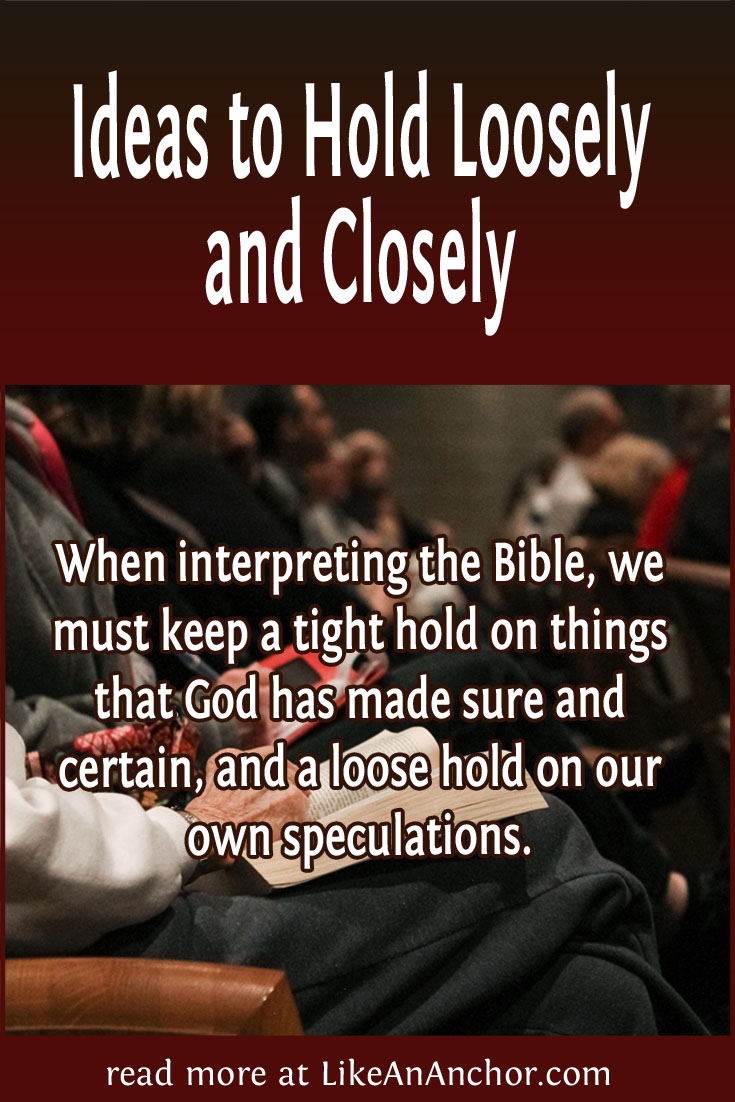
Image of a group of people sitting in church pews, overlaid with blog's title text and the words, "When interpreting the Bible, we must keep a tight hold on things that God has made sure and certain, and a loose hold on our own speculations."
Image by Brown Bag Photography from Lightstock

Holding fast to the right things has a lot to do with staying faithful. No matter what people say or weird ideas that pop into our heads, we need to hold tight to God, to His clear instructions, to His promises, and to our commitment to Him. We must not let any of the less certain things draw us away from that. There’s nothing wrong with studying prophecy and having ideas for how things might happen, or with studying difficult scriptures and doctrinal topics and having thoughts on how we should interpret those. We just need to make sure we are holding on to the right things, keeping a tight hold on things that God has made sure and certain and a loose hold on our own ideas and theories.


Featured image by Pearl from Lightstock

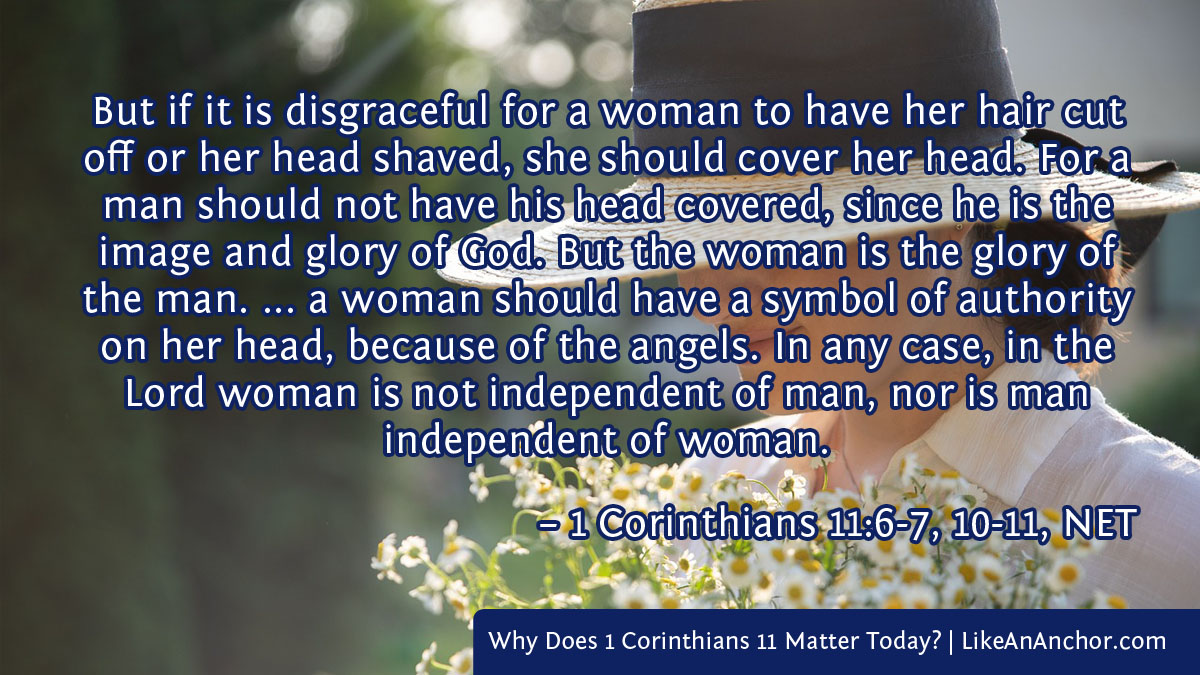
Why Does 1 Corinthians 11 Matter Today?

In the first letter we have that Paul sent to the Corinthians, he wrote to address some specific things. Firstly, there were serious issues in this church. They were divided, arguing, and following different human teachers. They also had a big issue with tolerating sin, even priding themselves on how forbearing they were toward a man in their congregation living and sleeping with his stepmother. Paul had to set them right, and he did so by comparing them to ancient Israel and explaining how the Passover and Festival of Unleavened Bread apply to the New Covenant church.

In the midst of all this, Paul also talked about proper conduct within a church community. One of those passages is labeled in the chapter and verse model of our modern Bibles as 1 Corinthians 11:1-16. It’s a passage most people skip over because it has to do with headcoverings and hair length for men and women. It’s the only place in the New Testament where this topic comes up, and it’s one that generates a lot of debate, offense, and division so we tend to ignore it completely. But we miss something important if we skip this passage, even if we don’t agree on how to interpret it.

The Headcovering Passage

People often approach this passage as just being about women’s headcoverings, but it’s addressed just as much to men. Paul opened this discussion by saying, “Be imitators of me, just as I also am of Christ” and praising the Corinthians for maintaining “the traditions just as I passed them on to you” (1 Cor. 11:1, 2, NET). He then made a statement about authority in the churches (the ecclesia, or called-out ones) of God.

But I want you to know that Christ is the head of every man, and the man is the head of a woman, and God is the head of Christ. Any man who prays or prophesies with his head covered disgraces his head. But any woman who prays or prophesies with her head uncovered disgraces her head, for it is one and the same thing as having a shaved head. 

1 Corinthians 11:3-5, NET

In my studies on this topic, I learned that culturally, Jewish men and women covered their heads with scarves or prayer shawls while Greek/Gentile men and women tended not to cover (though they could, mostly as a fashion choice). This passage would have involved a change for Jewish men as well as Gentile women. Men who covered their heads while praying needed to stop, and women who didn’t cover their heads while praying needed to start. Full disclosure, I do cover my head when at a church gathering or praying and studying at home. You can click here to learn more about why and the research I did into the topic.

Context For Paul’s Next Commands About Women

So why can’t we just skip over this divisive passage? For one thing, it’s part of the Bible and if we admit the Bible is the inspired word of God, then there is value in every part of it even if we’re not yet sure what to make of it. This is a significant reason to pay attention to 1 Corinthians 11:1-16, but it’s not the one that we’re going to focus on today. In this post, I want to focus on the important context clues this passage provides for interpreting other parts of the letter.

As the letter continued, Paul covered instructions for keeping Passover correctly (1 Cor. 11:17-34), spiritual gifts and unity in the body (1 Cor. 12), the “more excellent way” of agape love (1 Cor. 13), the use of prophecy or “inspired speaking” in the church (1 Cor. 14:1-25), and proper, orderly conduct during a church meeting (1 Cor. 14:26-40). Paul didn’t address the topic of women again directly until chapter 14, but since he started out this part of the letter by addressing how men and women properly pray and prophecy in the church (men with their heads uncovered, women with their heads covered), we can assume the discussions about keeping Passover, having spiritual gifts and using them properly, and love are addressed equally to men and women in the church. The NET even uses the phrase “brothers and sisters” when Paul addresses believers, because the whole church group is included when Paul uses the word “brethren” (adelphoi in Greek). We all have key roles to play, and very similar responsibilities and gifts.

Then, we come to a place where Paul again addressed women and men separately, with different instructions for each. It’s one of the infamous passages about women being silent in church.

What should you do then, brothers and sisters? When you come together, each one has a song, has a lesson, has a revelation, has a tongue, has an interpretation. Let all these things be done for the strengthening of the church. … Two or three prophets should speak and the others should evaluate what is said. … For you can all prophesy one after another, so all can learn and be encouraged. Indeed, the spirits of the prophets are subject to the prophets, for God is not characterized by disorder but by peace.

As in all the churches of the saints, the women should be silent in the churches, for they are not permitted to speak. Rather, let them be in submission, as in fact the law says. If they want to find out about something, they should ask their husbands at home, because it is disgraceful for a woman to speak in church.

1 Corinthians 14:26, 29, 31-35, NET

If you read Paul’s statement about women being silent by itself, it sounds like women shouldn’t say a word the whole time they’re at a gathering of believers. This doesn’t make sense in the context of other scriptures, which show women were deeply involved in the churches. This is where 1 Corinthians 11 can provide much-needed context to help us figure out what Paul is likely saying in this passage.

“In light of 11:2-16, which gives permission for women to pray or prophesy in the church meetings, the silence commanded here seems not to involve the absolute prohibition of a woman addressing the assembly. Therefore (1) some take be silent to mean not taking an authoritative teaching role as 1 Tim 2 indicates, but (2) the better suggestion is to relate it to the preceding regulations about evaluating the prophets (v. 29). Here Paul would be indicating that the women should not speak up during such an evaluation, since such questioning would be in violation of the submission to male leadership that the OT calls for (the law, e.g., Gen 2:18).”

NET study note on 1 Cor. 14:34

Whether you think women should cover their heads today or not, the fact is that 1 Corinthians 11 addresses the proper way for women to pray and/or prophecy. Obviously women can, and frequently do throughout the scriptures, pray and prophecy outside of church meetings. But the context of this section of scripture is how to do things in the churches, when believers are gathered together, as for a formal church service. It follows, then, that Paul talks about how women can properly pray and prophecy in church in 1 Corinthians 11, then addresses a time when silence is more appropriate in 1 Corinthians 14.

Culture Adds More Context

It also helps to take the cultural context into account when looking at Paul’s writings. Now, there are right and wrong ways to do this. Sometimes, people say that Paul just had a backwards view of women because he was influenced by his culture and so we don’t need to listen to him anymore. But in reality, some of his writings indicate he was pretty radical compared to the culture of his day.

Likewise the women are to dress in suitable apparel, with modesty and self-control. Their adornment must not be with braided hair and gold or pearls or expensive clothing, but with good deeds, as is proper for women who profess reverence for God. A woman must learn quietly with all submissiveness. But I do not allow a woman to teach or exercise authority over a man. She must remain quiet.

1 Timothy 2:9-12, NET

We read this today and we might feel offended that he’d say women have to be quiet and submissive and can’t teach. People of Paul’s day, though, would have read “a woman must learn” and been shocked by that. This statement “was a radical and liberating departure from the Jewish view that women were not to learn the law” (NET footnote on 1 Tim. 2:12). Some Jewish girls received Torah instruction while they were young and if they had a good family they might have learned a little more, but women weren’t generally taught very much and they certainly weren’t selected for advanced study with respected rabbis.

Jesus’s interactions with women as spiritual equals was unusual, and Paul continued His practice. He also assured his readers, though, that women serving in the church, preaching the gospel, and learning God’s words did not mean that women were suddenly going to start taking over roles that God entrusted to men. Women are to learn, yes, but they will also be submissive in the sense that God expects. Women can pray and prophecy, but they won’t (or shouldn’t) be disrupting church meetings or usurping male roles.

We often miss it today with our modern perspectives, but Paul isn’t advocating for either the subjugation of women or for doing away with gender roles in 1 Corinthians and 1 Timothy. It’s actually a more balanced view than we often find in churches today, which in many cases either try to follow society in doing away with different roles for men and women entirely, or follow traditional (mis)interpretations of Paul that bar women from being involved. However you interpret the passage on hair length and headcoverings, it provides much-needed context assuring us that women were deeply involved in the New Testament church and they still can be in the churches today.


Featured image by StockSnap from Pixabay

Song Recommendation: “This Girl” by Lauren Daigle

Finding Jesus in the Old Testament

Several times during Jesus’s ministry, He told people that the scriptures they read told them about Him. For example, He told some, “You study the scriptures thoroughly because you think in them you possess eternal life, and it is these same scriptures that testify about me” (John 5:39, NET). Remember, they would have just had the Old Testament at this time. The gospel events were happening in front of them, but they didn’t have written records yet pointing out which prophecies Jesus fulfilled and cross-referencing Old and New Testament writings the way we do today. And yet, Jesus told people that “everything written about me in the law of Moses and the prophets and the psalms must be fulfilled” (Luke 24:44, NET). He expected at least some of the people He spoke with to recognize that the law, prophets, and psalms all pointed to a Messiah and that He was that promised Messiah.

When I think about these scriptures, I wonder if I could have recognized that there was a coming Messiah from reading the Old Testament (OT). Even with the benefit of New Testament (NT) perspective, I struggle to see Him in the law of Moses. Not even all of the psalms and prophecies that NT writers identify as Messianic seem like something I’d have recognized when just reading the OT. Like the disciples on the road to Emmaus, we need Jesus to intervene in our minds to open our understanding (Luke 24:13-35). In fact, there are scriptures indicating it’s impossible to understand God’s word or have a relationship with Him unless the Father and Jesus take an active role in your life (John 6:44; 14:6).

At this point, we might ask ourselves several different questions, such as, “How much did believers in the Old Testament know?” and “How did salvation through Jesus (since you can’t be saved through anyone else [Acts 4:12]) work for people who lived and died before His sacrifice?” For today, though, I want to focus on the question, “Which verses in the Old Testament clearly point to Jesus Christ?” Or, since we’ll be looking at the OT that was written in Hebrew, to Yeshua the Messiah?

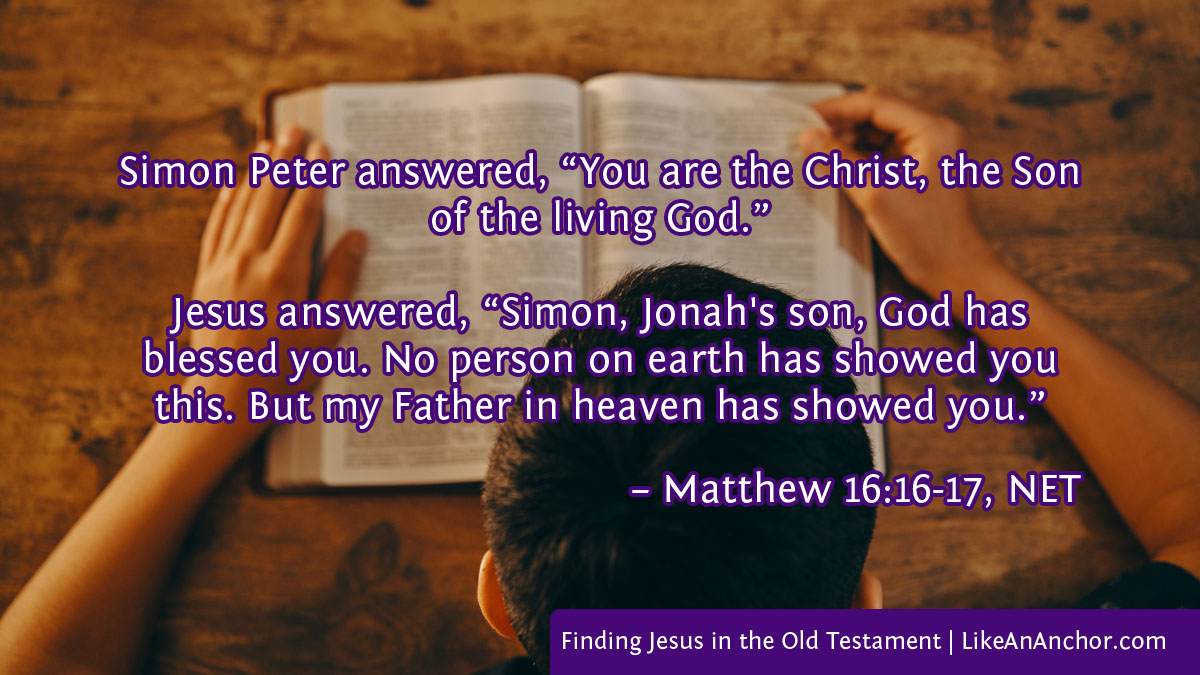
Image of a man studying the Bible overlaid with text from Matt. 16:16-17, NET version:  Simon Peter answered, “You are the Christ, the Son of the living God." Jesus answered, “Simon, Jonah's son, God has blessed you. No person on earth has showed you this. But my Father in heaven has showed you.”
Image by Matt Vasquez from Lightstock

Clarifying Names

The name “Jesus” is the English transliteration (representing a word from one language with the sounds and alphabet of another) of the Greek name Iēsous, which comes from the Hebrew name Yehoshua or Yeshua (H3091). The name means “Yahweh is salvation,” from the words Yahweh or Yehovah (H3068, God’s proper name [Ex. 4:15-16]) and yasha (H3467, “to save, be saved, be delivered” [BDB]). Yasha is the main root of a group of Hebrew words. Frequently used derivatives include yeshuah (H3444, salvation), teshuah (H8668, help, rescue, salvation) , and names such as Joshua, Hosea, Isaiah (Theological Wordbook of the Old Testament [TWOT] entry 929).

You won’t ever see the name “Jesus” in the Old Testament, but you frequently see the name Yeshua: it is translated into English as Joshua. There’s no prophecy in the Old Testament that says the Messiah will be named Yeshua. When Jesus was born, His name likely wouldn’t have stood out too much. Joshua is a popular name even today, and I doubt it was unusual in Jesus’s day considering the historic Yeshuas that people would have been familiar with (e.g. Moses’s successor Joshua son of Nun and Joshua the son of Josedech who appears in Haggai’s prophecies).

“Christ” is more of a title than a name. It is a transliteration into English of the Greek word christos (G5547), which is a translation (rendering the meaning of a word into the corresponding word in another language) of the Hebrew word mashiyah or Messiah (H4899). Both the Greek and Hebrew words mean “anointed” (Thayer; BDB). The root word mashach (H4886, anoint or rub with oil) is used most frequently of kings and priests sanctified for the Lord, and it’s also used twice of prophets (TWOT 1255). For example, it’s used when Yahweh chose Saul as the first king of Israel.

“Tomorrow about this time I will send you a man out of the land of Benjamin, and you shall anoint (mashach) him to be prince over my people Israel. He will save (yasha) my people out of the hand of the Philistines; for I have looked upon my people, because their cry has come to me.”

1 Samuel 9:16, WEB

Mashiyah (H4899, anointed one) is most frequently used in the Old Testament to refer to kings (TWOT 1255c). It also became closely associated with the God-being we now know as Jesus. By the time Jesus arrived, the Jews of His day were looking for the promised Messiah or Christ (Luke 3:15; 22:67; John 1:41-42; 4:25-29; 7:26). We still call prophecies from the OT that point to Jesus Messianic passages. It might surprise us, then, that if we compare all the verses using yasha and its related words to all the verses using masach and its related words, there are only 5 scriptures that use both and none of them are Messianic prophecies (1 Sam. 9:16; 2 Sam. 22:51; Psalm 8:50; 20:6; 28:8).

Image of a woman studying the Bible overlaid with text from John 4:25-26, NET version:  The woman said to him, “I know that Messiah is coming” (the one called Christ); “whenever he comes, he will tell us everything.”
Jesus said to her, “I, the one speaking to you, am he.”
Image by MarrCreative from Lightstock

Prophecies of the Messiah

There actually aren’t as many OT prophecies identifying the coming Messiah/Christ by the title “anointed” as you might think. It honestly surprised me, but when you realize that the Hebrew word mashiyah was “almost exclusively reserved as a synonym for ‘king'” (TWOT 1255c), then it becomes more understandable how OT readers realized that the spirit-filled, victorious, salvation-bringing God-being who would come in the name of the Lord should be called Messiah. We can see this in some of the disciples’ reactions to first meeting Jesus.

One of the two who heard John and followed him was Andrew, Simon Peter’s brother. He first found his own brother, Simon, and said to him, “We have found the Messiah!” (which is, being interpreted, Christ). He brought him to Jesus. … Philip found Nathanael, and said to him, “We have found him, of whom Moses in the law, and the prophets, wrote: Jesus of Nazareth, the son of Joseph.” …

Jesus saw Nathanael coming to him, and said about him, “Behold, an Israelite indeed, in whom is no deceit!”

Nathanael said to him, “How do you know me?”

Jesus answered him, “Before Philip called you, when you were under the fig tree, I saw you.”

Nathanael answered him, “Rabbi, you are the Son of God! You are King of Israel!”

John 1:40-42, 45, 47-49, WEB

Andrew called Jesus “the Messiah.” Phillip called Him the one “of whom Moses in the law, and the prophets, wrote.” Nathaniel called Him, “the Son of God” and “King of Israel.” They knew they were waiting for the Messiah, God’s son and the King of Israel, from reading the law and the prophets. Thanks to the Father’s revelation working in their lives, they could correctly identify that Jesus was the Christ (Matt. 16:13-20). Perhaps they were all thinking of Psalm 2, where the author talks about “Yahweh and … his Anointed,” who is also “King on my holy hill of Zion” and the Son of God.

Daniel also prophesied about “the Anointed One, the prince” (Dan. 9:25-26, WEB). Isaiah spoke of a descendent of David who would be full of God’s spirit and rule on David’s throne (implying an anointing even when it’s not explicitly mentioned) (Isaiah 9:1-7; 11:1-5; 61:1). Psalms talk about a strong, ruling, righteous, and anointed king (Ps. 45:1-7; 110:1-5). With those scriptures, as well as whatever oral traditions might have been passed down (depending on how much the people of God knew about His plan that didn’t make it into official scriptural writings), the people of Jesus’s day had the background needed to know they were looking for a Messiah. Even then, not everyone who met Jesus (Yeshua) was able to recognize that He was the Christ (Messiah). They needed God to give them eyes to see, ears to hear, and hearts to understand (Mat. 13:10-17).

Asking to Understand

Image of two hands holding a small Bible, overlaid with blog's title text and the words, "When you know where and how to look, you can see Jesus all throughout the Old Testament writings."
Image by Maura Griesse from Lightstock

When you know where to look, it’s not that hard to find Jesus in the Old Testament or to read the OT and see that there’s a coming Messiah. But without God working in your mind and heart, you won’t know to look. People can read the Bible over and over, even memorize huge sections, but still miss key truths because they’re just reading on their own with a human perspective. God is the one who makes His Bible come alive.

I think sometimes Christians forget how thankful we ought to be to God for letting us understand His word. And when we do that, we might also forget that we don’t yet know everything fully (1 Cor. 8:1-2; 13:12). For me at least, studying the prophecies of Jesus in the OT helps me realize that. Without God’s help and the records of fulfilled prophecies in the NT, I’d understand much less than I do now. And maybe there’s still more to learn, if I’m willing to ask.

“Ask and it will be given to you; seek and you will find; knock and the door will be opened for you. For everyone who asks receives, and the one who seeks finds, and to the one who knocks, the door will be opened. Is there anyone among you who, if his son asks for bread, will give him a stone? Or if he asks for a fish, will give him a snake? If you then, although you are evil, know how to give good gifts to your children, how much more will your Father in heaven give good gifts to those who ask him!”

Matthew 7:7-11, NET

We need to remember to thank God for the understanding He has granted us, and keep asking to know Him more deeply. One way we can participate in knowing Him at a deeper level is to prayerfully study His entire Bible. The questions I opened with today–“How much did believers in the Old Testament know?” and “How did salvation through Jesus work for people who lived and died before His sacrifice?”–are the types of questions a speaker at my church invited listeners to study in a message I heard last week.

That message focused on Abraham, and it’s fascinating to look at the conversations God had with him and at what the NT writers say about Abraham and God’s relationship. One verse even talks about the gospel being preached to Abraham, and in another Jesus said that Abraham “was overjoyed to see my day” (John 8:56; Gal. 3:7-16). Abraham probably knew a lot more about the Messiah than I’d realized just from reading his story, and he didn’t even have scrolls to study of the law, psalms, and prophets. Perhaps we can also understand more deeply by studying the relationships and revelation that God granted to those Old Testament heroes of faith (the people in Heb. 11, for example) and by asking God to speak into our lives similar to the way that He spoke to them.


Featured image by Inbetween from Lightstock

Song Recommendation: “Psalm 45 (A Noble theme)”

Inspiring Music: The Connection Between Song and Prophecy

Years ago when I was studying the topic of prophecy in the Bible, I noticed a link between prophecy and music that I thought seemed strange at the time. When we think of prophecy, we typically think of foretelling future events. We might also think of “inspired speaking,” which is the more general sense of both the Hebrew naba (H5012 “prophecy”) and the Greek propheteia (G4394 “prophecy”). Thus, a prophet (nabiy [masculine] or nebiyah [feminine] in Hebrew and prophetes in Greek) is someone who shares a message inspired by God; they’re a spokesperson for Him.

It’s likely impossible to read the Bible without noticing the importance of music, especially in the Psalms. People of God sing a lot, often accompanied by lively music and dancing. With this in mind, perhaps the link between music and prophecy shouldn’t surprise me, but it did. I hear this much less often now, but when I was a teen I was warned repeatedly against the dangers of getting too caught up in the emotions of worship music. Those emotions could stir you up to ignore theologically questionable lyrics or make a fool out of yourself swaying and back and forth in church (or so the argument went). And yet, people in the Bible deliberately sought out music as part of not only their praise but also to help them hear God’s voice.

Prophets as Singers

Revisiting this study started with my mom suggesting that someone should put together a study on music for our monthly scripture writing group. So far, I’ve come up with 20 scriptures for the topic “Inspiring Music.” They’re not all direct links between prophecy and music, but they all have to do with inspiration and singing or playing musical instruments. Several of these verses have to do with prophets and prophetesses who used music when sharing inspired words.

Miriam the prophetess, the sister of Aaron, took a tambourine in her hand; and all the women went out after her with tambourines and with dances. Miriam answered them,

“Sing to Yahweh, for he has triumphed gloriously.
He has thrown the horse and his rider into the sea.”

Exodus 15:20-21, WEB

Now Deborah, a prophetess, the wife of Lappidoth, judged Israel at that time. …

Then Deborah and Barak the son of Abinoam sang on that day, saying,

“Because the leaders took the lead in Israel,
    because the people offered themselves willingly,
be blessed, Yahweh!

Judges 4:4; 5:1-2, WEB

With two of the Old Testament prophetesses singing like this, Brown-Driver-Briggs dictionary even includes “gift of song” as part of their definition for nebiyah. The Theological Wordbook of the Old Testament notes that it’s rare, but musicians are “designated nebi’im” (entry 1277). We see another example of this when David appointed “some of the sons of Asaph, Heman, and Jeduthun to prophesy as they played stringed instruments and cymbals” (1 Chr. 25:1-3, NET). It shouldn’t come as any surprise to us that music can be divinely inspired, but seeing it linked with prophecy underscores the importance God places on musical praise, worship, and teaching.

Inspired By Music

In addition to these examples of prophets and prophetesses as musicians, we also have an example of a prophet who listened to music.

Elisha said, “As Yahweh of Armies lives, before whom I stand, surely, were it not that I respect the presence of Jehoshaphat the king of Judah, I would not look toward you, nor see you. But now bring me a musician.” When the musician played, Yahweh’s hand came on him. 

2 Kings 3:14-15, WEB

Here, three kings came to Elisha asking him to talk with God for them. Though he wouldn’t have responded to the kings of Israel and Edom, Elisha said he would seek God’s guidance out of respect for the king of Judah. In order to do that, he asked for a musician and it was while he listened to music that “Yahweh’s hand came on him.” It’s a fascinating precedent for someone using music to help them communicate and connect with God.

Music was a key part of worship in God’s temple, particularly after King David appointed singers and musicians for worship in the tabernacle. That type of ministry through music continued into Solomon’s day and beyond whenever kings and righteous leaders reinstituted true worship (1 Chr. 6:31-32; 2 Chr. 23:18; Neh. 12:44-46).

He [Hezekiah] set the Levites in Yahweh’s house with cymbals, with stringed instruments, and with harps, according to the commandment of David, of Gad the king’s seer, and Nathan the prophet; for the commandment was from Yahweh by his prophets.  The Levites stood with David’s instruments, and the priests with the trumpets. Hezekiah commanded them to offer the burnt offering on the altar. When the burnt offering began, Yahweh’s song also began, along with the trumpets and instruments of David king of Israel. All the assembly worshiped, the singers sang, and the trumpeters sounded. All this continued until the burnt offering was finished.

2 Chronicles 29:25-28, WEB

Share Your Song

The emphasis on music isn’t just an Old Testament thing. Much as there was music in the physical tabernacles and temples of old, God expects to see music in His spiritual temple that’s made up of all faithful believers.

 Let the peace of Christ be in control in your heart (for you were in fact called as one body to this peace), and be thankful. Let the word of Christ dwell in you richly, teaching and exhorting one another with all wisdom, singing psalms, hymns, and spiritual songs, all with grace in your hearts to God.

Colossians 3:15-16, NET

When God looks at His church, there are some specific things He expects to see. He wants us to be at peace with each other and have peace inside us. He wants to see Jesus’s words in us “richly,” overflowing in “teaching and exhorting with wisdom.” And He wants to see us “singing psalms, hymns, and spiritual songs.” The context indicates that singing is part of our teaching and exhortation (our inspired and inspiring words); a conclusion reinforced by another letter Paul wrote.

And do not get drunk with wine, which is debauchery, but be filled by the Spirit, speaking to one another in psalms, hymns, and spiritual songs, singing and making music in your hearts to the Lord, always giving thanks to God the Father for all things in the name of our Lord Jesus Christ,

Ephesians 5:18-20, NET

When we’re filled with the Spirit, that’s going to inspire music both aloud and in our hearts. I know it can be hard sometimes to get excited about singing. Maybe you don’t like the way your voice sounds or you’re turned-off by the style of music at your church. I like singing, but there are some hymns that sound an awful lot like a funeral dirge to me and I just can’t work up much involvement singing those. But there are other hymns that I love, and when I’m at home I’m free to pick a style of Christian music I like and dance around singing them all I want. If we want to make music part of our worship, surely we can all find songs that match our tastes well enough that we can sincerely use them to glorify God. At the very least, we can appreciate the words of the music we sing at church and recognize the value God places on music.

In addition to the encouraging and exhorting aspect of “speaking to one another in psalms, hymns, and spiritual songs,” there’s also a link to thankfulness. Thanksgiving is a key aspect of praise and of song, and it should accompany our teaching, exhorting, and singing. (2 Sam. 22:50, Ps. 33:2, and others). In this as in so many other things, it comes down to the state of your heart. When we have God’s spirit inside us, want to encourage others, and have a thankful attitude, then godly music is one of the ways for us to both express our appreciation for the Lord and strengthen our relationship with Him.

Featured image by Wolfgang Heubeck from Pixabay

Isaiah Study: Doing A New Thing

Today’s article is the fifth blog post since I started studying Isaiah 40-66. In the first post, I made a list of key themes that I want to study more extensively in this section of scripture. The list included (among other things) the message that God is doing and making something new. This theme is very closely connected to the one we discussed in last week’s post about looking toward the Messiah. It’s also connected with another point we touched on a few weeks ago; that one way God proves He is God is by revealing His new plans to the prophets before they happen.

I can only imagine how awed Isaiah must have been to receive this revelation. How encouraging it must have been to learn that God has such an amazing plan to set things right; to realize that a Messiah would soon come to usher in the salvation of the world! I wonder how much of the timing he understood. Did Isaiah know we’d still be reading these words thousands of years later, joining him in marveling at all that God has done in the past and will do in the future? Peter seems to think he did.

Concerning this salvation, the prophets sought and searched diligently. They prophesied of the grace that would come to you, searching for who or what kind of time the Spirit of Christ, which was in them, pointed to, when he predicted the sufferings of Christ, and the glories that would follow them. To them it was revealed, that they served not themselves, but you, in these things, which now have been announced to you through those who preached the Good News to you by the Holy Spirit sent out from heaven; which things angels desire to look into.

1 Peter 1:10-12, WEB

Here, Peter tells us that people like Isaiah did know they were speaking to us–we who know the Messiah and have received His salvation. Peter was also among those to whom Jesus said “many prophets and kings desired to see the things which you see, and didn’t see them, and to hear the things which you hear, and didn’t hear them” (Luke 10:24, WEB; see also Matthew 13:14-17). The prophets didn’t see everything as clearly as we do know. God has revealed to us things so glorious that the angels desire to look into them. We see His future plan for “glories that would follow” more clearly, particularly as we look back on the prophets’ words about the new things God still has in store for us.

Declaring a New Way to Save

At the end of the first Servant Song prophecy, God says, “Behold, the former things have happened and I declare new things. I tell you about them before they come up” (Is. 42:9, WEB). That’s one of the main things that God is doing in this section of Isaiah. There’s so much emphasis on the Messiah and on the new things God will do through Him. Jesus’s coming changed things dramatically for God’s people. Once we were sinners condemned to death, now we’re redeemed from that penalty. Once we were under the Law as a “guardian” of our conduct; now we keep the Law from the heart on a spiritual level (Gal. 3:23-25; Rom. 8:1-14). Once we saw God’s plan only dimly, now He’s revealed it to His people more clearly (Matt. 13:10-11; 1 Cor. 2:9-10; Eph. 3:4-6; 1 Pet 1:10-12).

When Isaiah’s original readers heard God “declare new things” about the Messiah, Jesus’s first coming was still in the future. At this time, God told Israel “from this point on I am announcing to you new events” (Isa. 48:6, NET). Knowing there’s a Messiah bringing a new way to save isn’t news for us anymore–from our perspective, He arrived here on earth nearly 2,000 years ago. However, we can still get excited for what His coming meant for us and for other new things that God is planning.

Look, I am about to do something new.
Now it begins to happen! Do you not recognize it?
Yes, I will make a road in the wilderness
and paths in the wastelands.
The wild animals honor me,
the jackals and ostriches,
because I put water in the wilderness
and streams in the wastelands,
to quench the thirst of my chosen people,
the people whom I formed for myself,
so they might praise me.

Isaiah 43:19-21, NET

The context for this passage is redemption. God is revealing that He will rescue Israel from the Babylonians, but then the language shifts to declaring a future redemption as well. The “road in the wilderness” and God’s work with the wild animals foreshadows Millennial imagery in Isaiah 65 (which we’ll get to later in this post). God began His new work of bringing peace to earth with Jesus’s first coming, and He’s still working on that exciting project today as we–and all of creation–await Jesus’s second coming.

For I consider that our present sufferings cannot even be compared to the coming glory that will be revealed to us. For the creation eagerly waits for the revelation of the sons of God. For the creation was subjected to futility—not willingly but because of God who subjected it—in hope that the creation itself will also be set free from the bondage of decay into the glorious freedom of God’s children.

Romans 8:19-21, NET

Something New For Us

In addition to God’s new revelations about how He plans to save and transform the world, He also revealed something new that’s happening in each of us. He promises He’ll give His people new names as He does the part of His new work that takes place inside each of them.

For the sake of Zion I will not be silent;
for the sake of Jerusalem I will not be quiet,
until her vindication shines brightly
and her deliverance burns like a torch.
Nations will see your vindication,
and all kings your splendor.
You will be called by a new name
that the Lord himself will give you.
You will be a majestic crown in the hand of the Lord,
a royal turban in the hand of your God.
You will no longer be called, “Abandoned,”
and your land will no longer be called “Desolate.”
Indeed, you will be called “My Delight is in Her,”
and your land “Married.”
For the Lord will take delight in you,
and your land will be married to him.

Isaiah 62:1-4, NET

Here, we’re told two of the new names God gives to the people He’s working with. We’re also told “you will be called by a new name that the Lord himself will give you.” If we were just looking at this verse on its own, we might think that refers to the new names Hephzibah (“My Delight is in Her”) and Beulah (“Married”). However, we also learn more about other new names in the book of Revelation. Jesus mentions two of His letters to the seven churches.

To the angel of the church in Pergamum write the following: … The one who has an ear had better hear what the Spirit says to the churches. To the one who conquers, I will give him some of the hidden manna, and I will give him a white stone, and on that stone will be written a new name that no one can understand except the one who receives it.’

Revelation 2:12, 17, NET

To the angel of the church in Philadelphia write the following: … The one who conquers I will make a pillar in the temple of my God, and he will never depart from it. I will write on him the name of my God and the name of the city of my God (the new Jerusalem that comes down out of heaven from my God), and my new name as well.

Revelation 3:7, 12, NET

The first new name mentioned is highly individual; only the person who receives the name even knows what it is. The second new name is one that we’ll share with Jesus Christ. I don’t want to get too off-track from today’s topic, so we’ll keep this discussion about names brief. For now, let’s remember that names in Hebrew thought are closely tied to a person’s reputation and character. When God puts His name on us, He’s trusting us with His family’s reputation and claiming us as people who are like Him.

God also has a long history of giving new names to people He works closely with, including Abraham, Sarah, Israel, Peter, James, John, and Paul (Genesis 17:4-5, 15-16; 32:28; Mark 3:16-17; Acts 13:9). There’s something very special about getting a new name from God, and it seems that it has to do with receiving a new position in life. New names come with a new way of living or a new attainment of something that God is working on in us. It’s fitting, then, that we’re told we’ll get new names when God is handing out rewards to faithful people after Jesus returns to this earth. That’s also when we’ll be revealed as the glorious children of God (Rom. 8:18-24).

New Heavens and New Earth

Isaiah has a lot to say about the Millennial reign of Jesus Christ and the new earth which will follow. In Revelation 20, we’re told that after Jesus’s second coming Satan will be locked away for a thousand years, the faithful will rise from the dead, and they’ll “be priests of God and of Christ, and will reign with him one thousand years” (Rev. 20:6, WEB). Then in Revelation 21-22, we learn of “a new heaven and a new earth” that will come after that. We don’t get many details about what the Millennium or the world after that will look like here in Revelation, but we learn more through God’s descriptions through Isaiah of His future holy mountain (Isaiah 2:1-4; 11:1-10).

“For, behold, I create new heavens and a new earth;
    and the former things will not be remembered,
    nor come into mind.
But be glad and rejoice forever in that which I create;
    for, behold, I create Jerusalem to be a delight,
    and her people a joy.
I will rejoice in Jerusalem,
    and delight in my people;
and the voice of weeping and the voice of crying
    will be heard in her no more.
    “No more will there be an infant who only lives a few days,
    nor an old man who has not filled his days;
for the child will die one hundred years old,
    and the sinner being one hundred years old will be accursed.
They will build houses and inhabit them.
    They will plant vineyards and eat their fruit.
They will not build and another inhabit.
    They will not plant and another eat:
for the days of my people will be like the days of a tree,
    and my chosen will long enjoy the work of their hands.
They will not labor in vain
    nor give birth for calamity;
for they are the offspring of Yahweh’s blessed
    and their descendants with them.
It will happen that before they call, I will answer;
    and while they are yet speaking, I will hear.
The wolf and the lamb will feed together.
    The lion will eat straw like the ox.
    Dust will be the serpent’s food.
They will not hurt nor destroy in all my holy mountain,”
    says Yahweh.

Isaiah 65:17-25, WEB

Isn’t this an incredible picture of the future? This is what we have to look forward to after Jesus returns to earth. It’s this future that we’ll be picturing when we observe Sukkot (the Feast of Tabernacles) in just a few months. Given the connection between Sukkot and the Millennial reign of Jesus Christ, it’s fitting that the last thing the Lord says in Isaiah about His new heavens and new earth relates to God’s holy calendar and His Sabbath days. This verse also connects to our post about Sabbath-keeping in Isaiah 40-66.

“For just as the new heavens and the new earth I am about to make will remain standing before me,” says the Lord, “so your descendants and your name will remain. From one month to the next and from one Sabbath to the next, all people will come to worship me,” says the Lord.

Isaiah 66:22-23, NET

These verses promise that in the midst of all this newness, there will also be a reliable stability. God is still on His throne. His character and the way He wants to do things are not going to change. We’ll still have patterns of worship to follow. We’ll still have relationships with Him, though they will then be closer than ever before.

We know Jesus is coming back, but it’s easy to let that slip our minds as we go through our day-to-day lives. But if we hold onto the vision in Isaiah and other future-pointing passages of scripture, we can also hold onto the excitement of being part of the “new thing” God is doing. And that can help us stay encouraged and joyful as we move forward into the future.

Featured image by Inbetween from Lightstock

Song Recommendation: “The Holy City” by Stanford Olsen and The Tabernacle Choir

Bonus song I found while searching for a different “New Heaven, New Earth” song: “Новое небо” by Simon Khorolskiy

Isaiah Study: Looking Toward the Messiah

In Jewish communities, and many Messianic Jewish groups as well, there’s a tradition of reading through the Torah once a year. The first five books of the Bible (the Law or Torah) are divided into sections called parashot. Those are paired with selections from the Prophets, called haftarot, that link the Torah to events in Israel’s history. All around the world, synagogues read the same sections each week. They’ve been doing this on the same schedule every year since around 400-500 AD.

I already knew about the Torah portions from my time attending with a Messianic congregation, so that didn’t surprise me when I read about it in Reading the Bible with Rabbi Jesus: How a Jewish Perspective Can Transform Your Understanding by Lois Tverberg. But I was surprised to learn this tradition is based on one that’s much older. In 1806, thousands of early Jewish texts were discovered that included “multiple synagogue lectionary lists” splitting the Torah into “150-170 readings, likely taking about three and a half years to complete” (Tverberg p. 195-96). This older tradition read through the Torah just like people do today, but the selected readings from the prophets were different. In the older tradition, the readings are more focused on “a glorious future kingdom and a coming Messianic age” (p. 197).

So what does all this have to do with our ongoing study of Isaiah 40-66? While we can’t know exactly which passages from the Prophets Jesus and His followers heard alongside the Torah in their synagogues (the liturgy readings weren’t standardized until later) we can make a reasonable guess based on the early scripture lists we do have. In those lists, “over half of the prophetic readings came from Isaiah, especially chapters 40-66, which focus on promises of redemption and renewal” (Tverberg p. 199). Those are the same passages we’ve been studying. They’re also passages that Jesus quoted and Paul references in many of his letters (click here for a list of Isaiah quotes in the New Testament).

If you’re familiar with the Servant Song prophecies in Isaiah, the choice of these scriptures to point toward the Messiah shouldn’t come as a surprise. All four of these famous Messianic prophecies come from the last part of Isaiah. Those aren’t the only Messianic messages in the final 27 chapters, though. If you read the first post in this series, you’ll see I made a list of key themes that I want to study more extensively. The list included (among other things) a focus on redemption, deliverance, salvation, and restoration that are connected to the promise that God will call a Servant to redeem His servants. This is also related to God’s covenant faithfulness; the Messiah is coming because God is faithful to His promises.

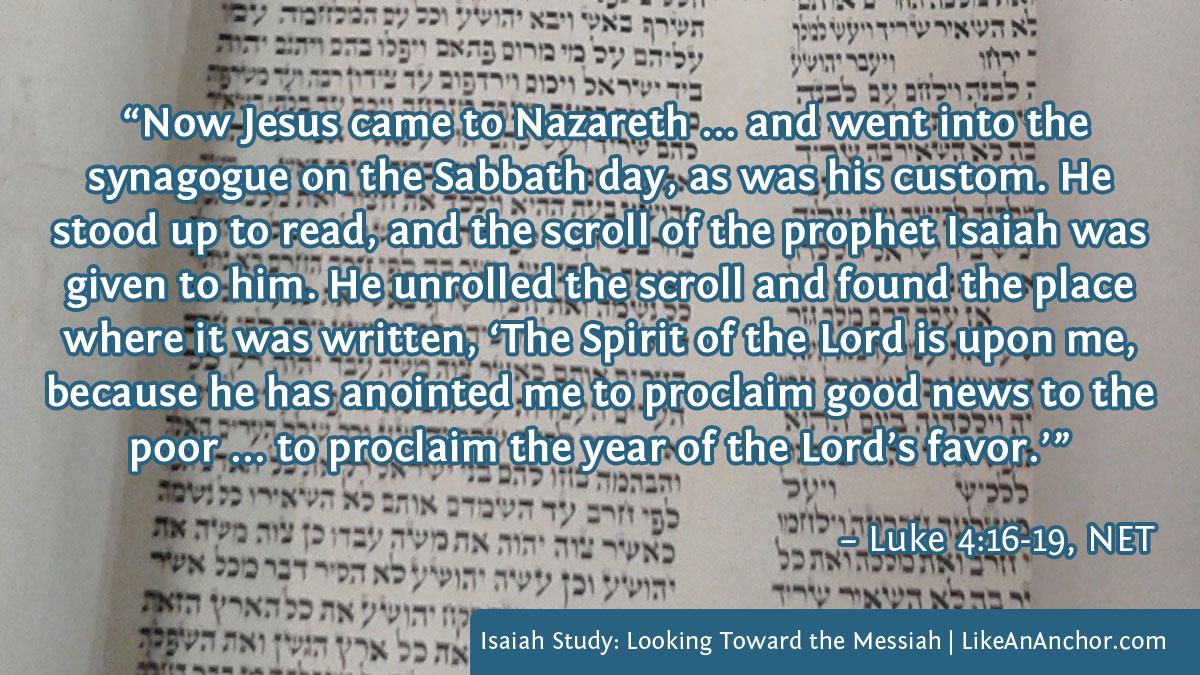
Image shows an open scroll with Hebrew writing with a quote from Luke 4:16-19, NET version:  “Now Jesus came to Nazareth ... and went into the synagogue on the Sabbath day, as was his custom. He stood up to read, and the scroll of the prophet Isaiah was given to him. He unrolled the scroll and found the place where it was written, ‘The Spirit of the Lord is upon me, because he has anointed me to proclaim good news to the poor ... to proclaim the year of the Lord’s favor.’”
Image by Marissa Baker

The Servant Songs

We’ve been talking about the Servant Songs for weeks now, but haven’t taken a close look at them yet. In my first post,  I mentioned you can find these prophecies in Isaiah 42:1–9; 49:1–13; 50:4-11; 52:13– 53:12. I also said these aren’t the only the only prophecies in Isaiah 40-66 and that God’s words in this section aren’t just for people who were anticipating the Messiah’s first coming. They’re also for us today, who are awaiting Jesus’s second coming. We can see that as we look through the four servant songs all together.

First Song

The first Servant Song speaks of the Messiah as a servant chosen by God (Is. 42:1–9). The Servant “will bring justice to the nations” without shouting or raising his voice. This prophecy also speaks of Yahweh (the name God applies to Himself in Ex. 3:15) holding the Servant’s hand and making Him “a covenant for the people, as a light for the nations.” Yahweh affirms this will happen; it’s one of the “new things” He’s declaring in this section of Isaiah. You’ll find this first Servant Song quoted in Matthew 12:15-21, Luke 2:26-32, and Romans 15:12.

Second Song

The second Song is written in first-person; the Servant is speaking (Is. 49:1-13). He says, “Yahweh has called me from the womb” to accomplish reconciliation by bringing God’s covenant people back to Him. Again, Yahweh calls the Servant “a light to the nations, that you may be my salvation to the end of the earth.” This passage speaks of the Servant accomplishing powerful deliverance, backed-up with Yahweh’s power and might. It’s quoted in Luke 2:28-32, Acts 13:47, and 2 Corinthians 6:2. In Acts 13:47, Paul and Barnabas apply part of this prophecy to their work as they follow in the Messiah’s footsteps. This indicates that while the Servant Songs are Messianic (they point to Jesus), at least part of this one can also apply to those following in Jesus’s footsteps.

Third Song

The third song presents the Servant more as suffering than triumphant (Is. 50:4-11). It speaks of Yahweh teaching the servant and giving Him wisdom for working with people. It also speaks of the Servant voluntarily submitting to suffering inflicted by other people, and affirms that “the Lord Yahweh will help me.” Like the second Song, this one is written from the Servant’s perspective and affirms His trust in Yahweh. According to SimplyBible.com’s list of Isaiah quotes, this song is not quoted directly in the New Testament. I suspect, though, that the gospel writers might have had this Song in mind when they wrote about people being astonished at the wisdom and authority of Jesus’s teachings (Matt. 13:54; Mark 1:22; Luke 4:32).

Fourth Song

The final servant song might be the most famous (Is. 52:13– 53:12). It’s certainly the one I’m most familiar with; in my church we read it every Passover. It’s also the Servant song that’s most often quoted in the New Testament (Matt. 8:16-17; Mark 15:27-28; Luke 22:37; John 12:37-38; Acts 8:32; Rom. 10:16; 15:21; 1 Pet. 2:22-25). And that list only includes direct quotes; there are other scriptures, like Christ’s discussion of servants ruling kingdoms, that likely allude to this passage (Luke 22:25-30).

In this Passage, God says that His Servant “will cleanse many nations,” but in the process He will suffer so much His face will become unrecognizable. This is one of the Messianic prophecies that speaks most clearly and graphically of the terrible things Jesus suffered to pay the price for our transgressions. Again, there are themes of justice and light, as well as inheriting a kingdom, but the focus is on the suffering of Messiah and what He means to accomplish with with His suffering.

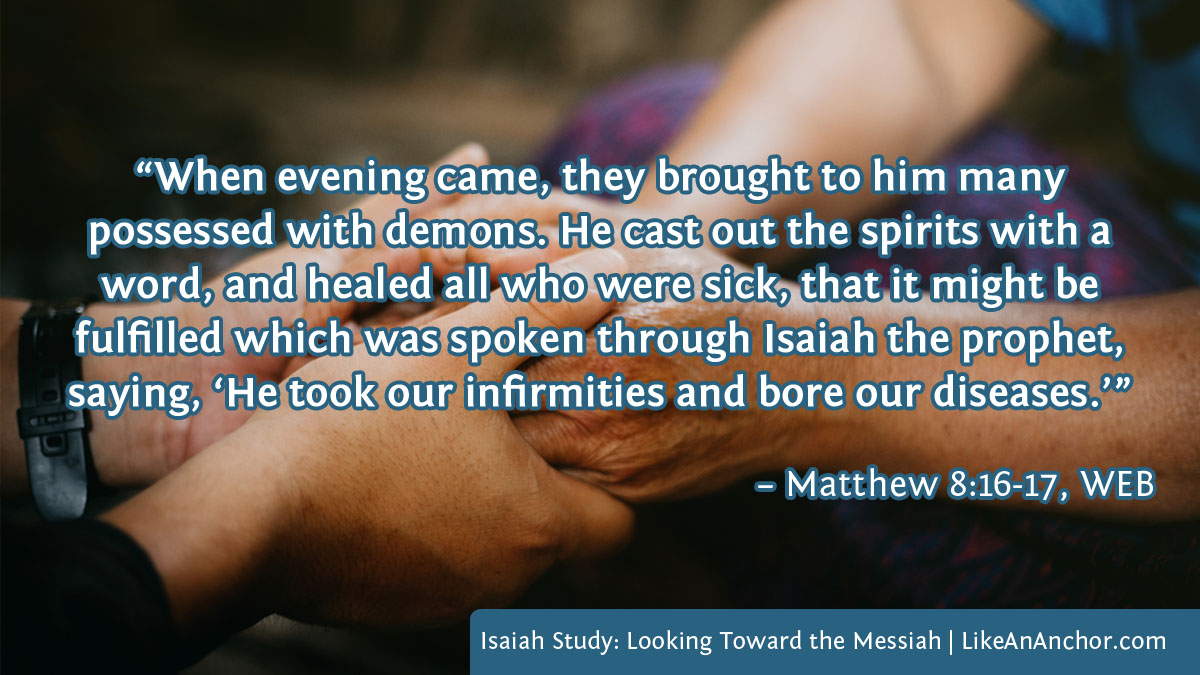
Image shows two people's hands clasped together with a quote from Matthew 8:16-17, WEB version: “When evening came, they brought to him many possessed with demons. He cast out the spirits with a word, and healed all who were sick, that it might be fulfilled which was spoken through Isaiah the prophet, saying, ‘He took our infirmities and bore our diseases.’”
Image by Jantanee from Lightstock

A Mission of Redemption, Salvation, and Release

In the WEB translation for Isaiah 40-66, the word “redeem” shows up 24 times. “Salvation” is here 19 times and “save” 12 times. “Deliver” is used 12 times. “Help” 10 times. “Restore” is here 4 times, “release” 3 times, and “preserve” 2 times. (These numbers also include related words like “deliverer” and “redeemed”). These words related to God’s work in saving His people show up all through Isaiah 40-66; not just in the Servant Songs. Throughout these chapters, God is focused on the redemption, salvation, deliverance, and restoration of His people. He’s sharing His plans to help, release, and preserve us.

But now Yahweh who created you, Jacob,
and he who formed you, Israel, says:
“Don’t be afraid, for I have redeemed you.
I have called you by your name.
You are mine.
When you pass through the waters, I will be with you,
and through the rivers, they will not overflow you.
When you walk through the fire, you will not be burned,
and flame will not scorch you.
For I am Yahweh your God,
the Holy One of Israel,
your Savior.”

Isaiah 43:1-3, WEB

Break out into joy!
Sing together, you waste places of Jerusalem;
for Yahweh has comforted his people.
He has redeemed Jerusalem.
Yahweh has made his holy arm bare in the eyes of all the nations.
All the ends of the earth have seen the salvation of our God.

Isaiah 52:9-10, WEB

The Lord Yahweh’s Spirit is on me,
because Yahweh has anointed me to preach good news to the humble.
He has sent me to bind up the broken hearted,
to proclaim liberty to the captives
and release to those who are bound,

Isaiah 61:1, WEB

Passages like these are found all around the Servant Songs, sprinkled throughout Isaiah 40-66. They reveal God’s redeeming purpose and join the Servant Songs in pointing toward the Messiah. Jesus even quoted the passage from Isaiah 61 (with one line added from Isaiah 58:6) when He went into the synagogue to His hometown on the Sabbath day. It appears that He was reading the Torah portion and associated passage from the Prophets that day, and used Isaiah 61 to teach about His role as God’s servant (Luke 4:15-21). The way He read this passage might not seem too startling to us, but by saying that He’s fulfilling this prophecy Jesus boldly proclaimed Himself as the Messiah. It was such a startling claim that His hearers were “filled with rage” and threw him out of town (Luke 4:22-30).

If you read through Isaiah 40-66, you’ll see God is talking about deliverance on multiple levels. He’s speaking to Ancient Israel at the time, promising deliverance from captivity. He’s also pointing to a time when the Messiah would come with spiritual deliverance from sin–that’s what happened when Jesus came to this earth and died for us. On top of that, God’s revelations at the end of Isaiah look farther forward to a time when the entire world will be renewed and restored.

A New Thing

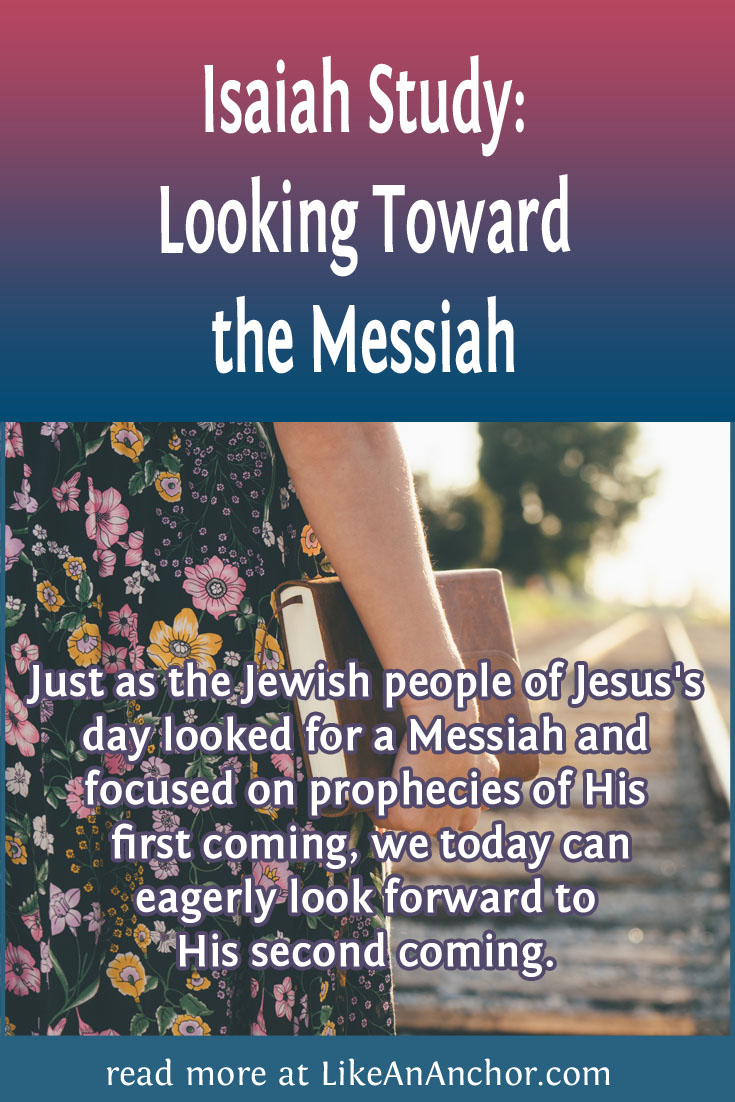
Image of a woman looking down a railway track holding a Bible. It is overlaid with the blog's title text and the words "Just as the Jewish people of Jesus's day looked for a Messiah and focused on prophecies of His first coming, we today can eagerly look forward to 
His second coming.
Image by Kristen McDow from Lightstock

It’s fascinating to see links between the New and Old Testament. Studying these patterns gives us a deeper appreciation for the Bible and a deeper understanding of Jesus. Sometimes, though, it might not seem all that relevant today since the prophecies are already fulfilled. But we can still learn from them, and not all of them are entirely done yet. Just as the Jewish people of Jesus’s day looked for a Messiah and focused on prophecies of His first coming, we today can look forward eagerly to His second coming. Let’s take another look at the end of the first Servant Song prophecy.

“I am Yahweh.
    That is my name.
    I will not give my glory to another,
    nor my praise to engraved images.
Behold, the former things have happened
    and I declare new things.
    I tell you about them before they come up.”

Sing to Yahweh a new song,
    and his praise from the end of the earth,
    you who go down to the sea,
    and all that is therein,
    the islands and their inhabitants.

Isaiah 42:9, 10, WEB

While the Servant Song seems to wrap up in verse 9 (though Yahweh also discusses “my servant” in verses 18-19 while rebuking those who trust in false gods), a new song continues in verse 10. It’s the first time in this part of Isaiah that God directly states He’s doing something new and exciting. As we’ll see more thoroughly in next week’s post, this “new thing” that He’s doing with the Messiah is the beginning of a larger project to make all things new.

We’re still waiting for the complete fulfillment of the Messianic prophecies in Isaiah. Reading God’s promises to send the Messiah back to redeem us mightily, establish His kingdom, and complete His “new” work can still encourage us as we await Jesus’s return.

Featured image by Inbetween from Lightstock