Shutting people out of your life after they’ve hurt you or someone you love isn’t specific to INFJs, but it happens often enough that we’ve given it a name: The INFJ Door Slam. I like the definition given in an article by Jenn Granneman titled “How INFJs Deal with Conflict: 10 Confessions” (which is no longer available online).
“It means you’ve hurt me so much, I’m no longer investing any of my (limited) supply of energy in you. It means I’ve come to resent you. If you value me, don’t let it get to this point. It’s really hard to go back.”
An INFJ door slam may or may not involve actually cutting a person out of your life. Depending on the circumstances, a door slam can range from ignoring someone completely, to limiting contact to the bare minimum, to acting almost normal. In some cases the person who’s been door slammed can’t help but notice, while in others they don’t realize anything has changed (though something definitely has, at least in the INFJ’s mind). Read more →
Myers-Briggs types have much to tell us about ourselves and other people. Our MBTI type reflects our preferences for crowded parties or small gathering, describes how we connect with other people, shows us how we naturally respond to stress, and gives us a picture of our innate strengths and weaknesses. Another thing it’s often used for is trying to predict what type of person we’ll be attracted to, and most compatible with, in a romantic sense. Unfortunately, MBTI only gives part of the picture in this regard.
Types in Love
Disclaimer: some of the links in this post are affiliate links. This means that, at no additional cost to you, I will receive a commission if you click on the link and make a purchase on that website.
Use of the MBTI for romance is subject to much debate. Isabel Myer wrote in Gifts Differing*, chapter 11, that “it seems only reasonable that the greater mutual understanding between couples with more likeness than difference should lead, on the whole, to greater mutual attraction and esteem.” This was supported by her study of 375 married couples who were most frequently “alike on three of their four preferences rather than on only two, as would be expected by chance.” However, Isabel Myer was an INFP woman happily married to an ISTJ man. According to her own personality theory, they “shouldn’t” have gotten along, especially since she thought that shared S-N preferences were the most important for predicting a couple’s happiness together and understanding of each other. Obviously type isn’t the only important ingredient for happiness.
Elizabeth and Darcy from Pride and Prejudice, an NF – NT couple
David Keirsey’s book Please Understand Me II* agrees with Myers on the importance of S-N pairings, saying that his SP Artisan types are most compatible with SJ Guardians, and that NF Idealists are most compatible with NT rationals. His ideal pairing is someone who shares your S-N preference and is your opposite in the other three preferences. For example, he would pair an INFJ with an ENTP.
Continuing with INFJs as our example, these theories have influenced many INFJ profiles online. Jennifer Soldner’s Guide To INFJ Relationships lists ENFP, ENTP, INTJ and INFJ as the best matches for an INFJ. The worst matches are ESFP, ESTP, ESTJ, and ENTJ (note that this last one contradicts Keirsey’s rule for pairing NF and NT types). For the most part, these suggestions seem logical at first, much like Isabel Myer said when theorizing that people will get along best if they are similar. It doesn’t explain, however, why one study found that INFJs were most likely to marry either INFJs or ESTPs, or why Myers herself was happy married to someone so dissimilar in terms of type. Clearly there’s something else going on here.
The “Something Else”
Even with their generalizations about which types get along most easily together, both Isabel Myers and David Keirsey admit there are other very important ingredients to a lasting romantic relationship.
Individual relationships defy generalizations, and it should be stressed that two well-adjusted people of any two temperaments can find ways of making their marriage work for them.” (Keirsey)
“Understanding, appreciation, and respect make a lifelong marriage possible and good. Similarity of type is not important, except as it leads to these three. Without them, people fall in love and out of love again; with them, a man and woman will become increasingly valuable to each other and know that they are contributing to each other’s lives.” (Myers)
A mutual willingness to work together and actively build-up the relationships is more important than compatible MBTI types. One aspect of this is understanding the other person and learning how to love them. Becoming familiar with their Myers-Briggs type will help tremendously, but it’s not enough by itself. You also benefit from an understanding of Love Languages.
The five love languages theory was first published in 1995 by Gary Chapman, a relationship counselor and pastor. He says every person has a “language” that they use to communicate and receive love, either Words of Affirmation, Quality Time, Receiving Gifts, Acts of Service, or Physical Touch. Everyone has one primary love language, and you might have a secondary love language as well. If someone’s partner is not speaking their love language, they will not feel loved. There’s a test on Chapman’s website if you don’t know what your love language is and want to find out.
Layering Love Languages
In theory, any MBTI type can be combined with any one of the five love languages. I’m guessing, however, that there are some love languages that are more likely for certain MBTI types. Let’s take a quick look at the characteristics for the four type groups as related to different love languages.
SP types are typically concerned with outward, concrete ways of viewing the world, and focus on the here and now. Keirsey describes their preferred role in a romantic relationship as “playmate.” I could see SP types being particularly inclined toward Receiving Gifts, Quality Time, or Physical Touch as a primary love language. These all involve doing something for or with the loved one, which would appeal strongly to SP types.
Duty-fulfilling SJ types tend to play what Keirsey described as a “helpmate” role in relationships. They are stable, traditional, and thoroughly dependable people. SJ types might be most in tune with Acts of Service, Quality Time or Words of Affirmation as a love language. These love languages visibly or verbally confirm that a SJ’s loved ones appreciate their constant reliability.
NF types are idealistic, enjoy abstract thought, and are natural romantics. Keirsey described their role in a romantic relationship as “soulmate.” They search for deep, genuine connections. Quality Time and Words of Affirmation seem like the most likely love languages, though Physical Touch and Acts of Service are also good possibilities. The key for NF types is genuine depth in a relationship, so they are inclined towards a language that increases emotional intimacy.
The NT types are highly intellectual, and Keirsey described their relationship role as “mindmate.” They are logical, abstract, and have little tolerance for the superficial. Words of Affirmation and Quality Time seem like the most likely love languages for an NT type, but after reading two different forum topics on MBTI types and love languages (one on Typology Central and one on Personality Cafe) I learned many NTs favor Physical Touch as well. My personal theory is that NT types view Service and/or Gifts with suspicion, wondering what the other person wants from them, while the others seem more genuine.
What about you? What are your Myers-Briggs type and love language(s)? Do you see a connection between the two? Share in the comments!
While trying to decide on my next topic, I saw that “how to be friends with an INFJ” was one of the top searches on my blog this past week. I’ve addressed the issue of friendship in some of my other posts about INFJs, but never written an entire post about it. It’s also something that has been on my mind recently, and it is a not infrequent topic of discussion between me and some close friends.
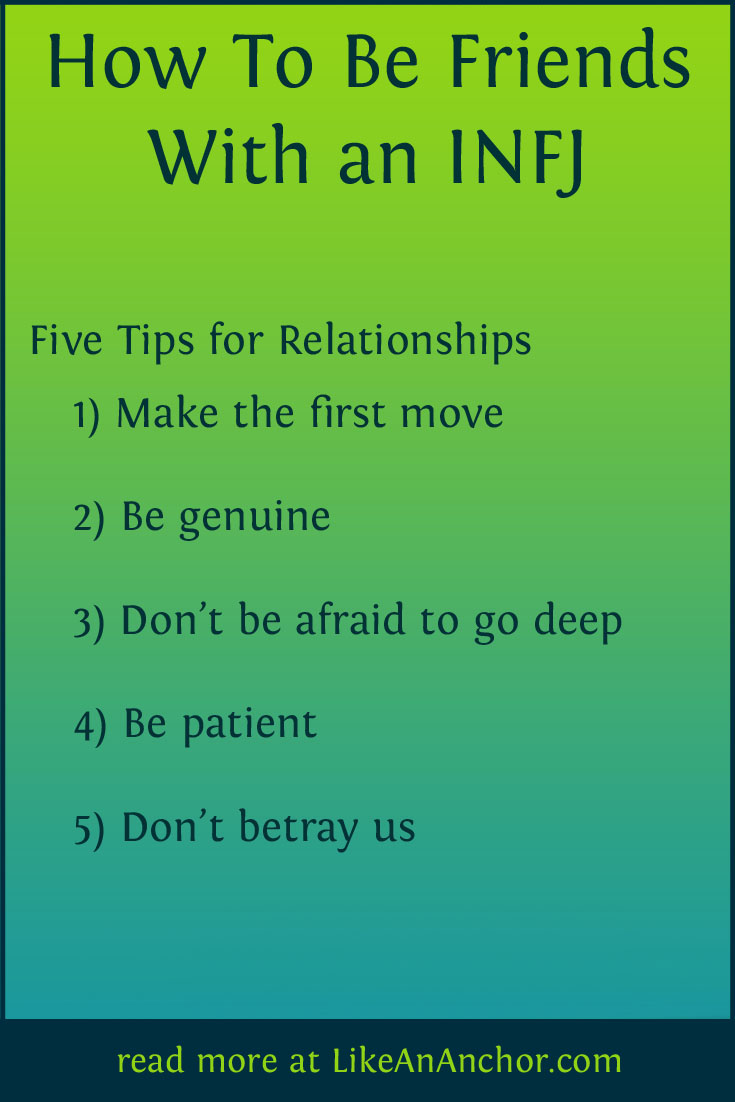
If you want to make friends with an INFJ, or get to know one better, there are a few key points to keep in mind. Some of these are true for all friendships, and especially friendships with INFJs, and others are more INF-specific. They are also a good first-step if you are romantically interested in an INFJ and want them to notice you.
INFJs use extroverted feeling (Fe) to relate to the outside world. This means that we can draw energy from emotional interactions, and may appear more extroverted than other introverts. This is also true of ISFJs, who are often considered the most “extroverted” introverts since they love people so much.
Still, we are introverts, and we’re most comfortable talking with people we already know. If you want to get to know an INFJ, you’ll probably have to be the one who initiates a conversation. That lets us know you are interested in talking with us, which puts us at ease since we aren’t worried about whether or not we’re imposing on your time when you’d rather be doing something else.
Pairing Introverted Intuition (Ni) with Fe gives INFJs an almost super-human empathy. Many INFJs literally feel other people’s emotions, and we’re quick to pick up on unspoken cues that don’t match spoken words. We might not be able to tell what you’re holding back or lying about, but we can tell you’re not being genuine and that’s a huge turn off.
If an INFJ suspects you of being less than genuine, they loose interest very quickly. If you’re a new acquaintance, they might simply avoid seeing you again. If you’re someone they can’t avoid, then they will keep conversations civil but superficial. We don’t trust our true selves with people when we can’t get a read on what their true selves are like.
3) Don’t Be Afraid to Go Deep
INFJs have little interest in shallow conversations. We would rather have a few close friends than many casual acquaintances. The way the word “friend” is used has always bothered me as being imprecise. I have acquaintances, friends, and then close friends, but I just refer to them all as “friends” to avoid offending anyone who thinks they are a friend and then finds out I think of them as an acquaintance. People who meet INFJs often think that they know them well, while the INFJ thinks “they really don’t know me at all.”
If you want to be one of an INFJs close friends, then you have to make an effort to get beyond the superficial. INFJs respond very well to this, so once you indicate that you are interested in going beyond small-talk the sharing will go both ways. We like conversation, and we will talk as well as listen if we feel safe and interested. Here’s a great article called How To Turn Small Talk Into Smart Conversation. When I read this as an INFJ, my reaction was, “I wish more people would introduce themselves like this. I would be so much more interested in talking to them.”
Even if you’ve taken the first step to initiate a friendship, been completely honest, and encouraged deep conversation it can take quite a while for an INFJ to really open up. We have many layers, and the longer we are in a stable friendship with you, the more layers we’ll let you see. INFJs form instant perceptions of whether or not we can trust people, so first-impressions are important, but we also modify our impression based on how we observe your behavior over time. A bad first impression can be reversed if we see you making an effort to be friendly and trust-worthy, and a good first impression can be deepened as we see that what we’ve already shared with you stays safe.
Patience also comes into play during conversations. INFJs have trouble getting all their thoughts out into words. If the topic of conversation is something they’ve already thought about, they can speak readily and coherently. If it’s new and unfamiliar we typically do one of two things: 1) nod and make some general comments while our brains frantically race to come up with something to say. Usually that “something” shows up a week later in the shower. 2) start putting our thoughts into words, and sorting through ideas verbally. The final idea might take some time to emerge.
The second reaction is the one you’re going for in a friendship with INFJs. If we’re comfortable enough to think out-loud, it means we trust you. As long as you give us time to come up with an answer rather than look at us like we’re crazy, then we’ll relax and the conversation can continue to move forward. If you cut us off or jump to conclusions about what we think before we’ve had time to express outselves, we feel like you aren’t really interested in what we’re thinking and be hesitant to share with you later.
5) Don’t Betray Us
INFJs hold grudges. We might forgive readily (depending on the circumstances), but we don’t forget. It’s not something I’m proud of, but it is my automatic response. The closer you get to an INFJ, the harder it is to bounce-back to a close friendship after you’ve hurt us. The more we like you and the more we have invested in you, the more chances we’ll give you, but there’s a point at which we just give up and shut you out.
An INFJ might not completely sever ties with someone who has hurt them (depending on the nature of that betrayal), but they will withdraw. For example, if you give an INFJ the impression that you want to carry on a regular correspondence filled with deep discussion and then ignore her for 3 months and forget to answer any of her questions when you do reply, she will have no interest in continuing the correspondence.
Why Bother?
So why go to all this effort? What do you get out of a relationship with an INFJ?
For one thing, INFJs are surprisingly good fun to be around. We have a great sense of humor, delight in occasional spontaneity, and can talk about pretty much anything you like. But you don’t see all that until you make the effort to become friends. Until then, INFJs will hover in the background (away from other people) or blend in like a chameleon (with other people) to avoid stressful, superficial interactions.
INFJs are also good listeners, and we love to offer counsel. Sometimes we feel like our friends’ therapist, but we rarely mind. We want to help, and we’re good at suspending judgement. Since we’re so empathic, we aren’t often surprised by anything you tell us even if you thought you were doing a good job of keeping it hidden. Once it’s out in the open, we are sympathetic listeners who ask questions and want to fully understand what’s going on before we offer suggestions or any kind of judgements.
We’re also fiercely loyal. We don’t let many people get close, and we want to hold on to the very few that do become our true friends. We’ll do just about anything to keep the people we love in our lives. INFJs take the time to build-up their relationships, cultivate deepening friendships, and keep in touch with what’s going on in the lives of people we care about. We’re supportive, encouraging, and willing to adapt ourselves to make others happy as long as it doesn’t conflict with our core values. So get out there and start making friendships with INFJs. I don’t think you’ll regret it!
Descriptions of the INFJ personality type often emphasize our peaceful natures and ignore any hint of a “dark side.” For example, one commenter on my INFJ Loki post argued my typing is inaccurate because he couldn’t imagin an INFJ “carrying on a constant fight with everyone around you for the majority of your existence.” He knows INFJs are generally peaceful and conflict-avoidant, and couldn’t buy an INFJ as this type of villain.
People also describe INFJs as disconnected from the world, and unlikely to feel involved in the reality of what’s going on around us. All too often, people incorrectly assume this means we don’t care about what other people do or things that happen. This isn’t true. As Amelia Brown points out in her post The Dark Side Of The INFJ Personality Type, INFJs can be stubborn, judge others harshly, and abruptly cut people out of their lives. We do notice, and care, what’s going on enough to have a pretty decisive reaction in some cases.
Though INFJs are generally peaceful, gentle, and dislike engaging in confrontations, we’re not completely harmless (just ask my siblings). Every personality type has a dark side, and INFJs can be just as scary as anyone else.
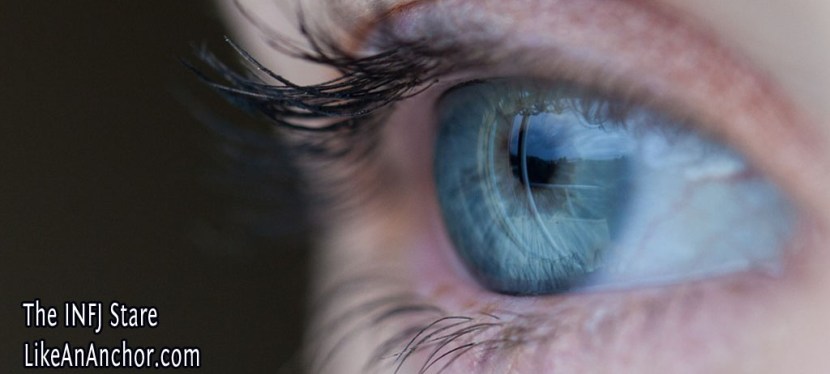
Last week, I noticed that one of the Google searches that led to my blog was “INFJ stare.” My reaction was, “We have a stare?” I immediately posted the question to Facebook and performed a Google search of my own. One of my friends sent me this image of the dreaded “INFJ Death Stare:”
Apparently, only non-INFJs consider this a “stare of death.” We INFJs don’t really think about it much at all until someone points it out. But other types do notice. In one forum I found, an ISTP asked, “What’s going on in your head when you do it? Why do INFJ girls stare at me after every other thing I say? It makes me feel like I’m creeping them out or something, but they continue to talk to me regardless how creepy I may/may not be.”
What’s Going On Behind The Stare
Among INFJs, the consensus is that we don’t meant to give you a death stare. It’s simply our default thinking expression. The INFJs who know that they stare actually spend quite a bit of time trying not to creep people out with it. We’re awkward enough as it is without having to worry about people asking why we’re giving them the death stare.
This isn’t the same thing as “resting bitch face.” People don’t generally describe the INFJ death stare as being rude or angry. It’s just hard for other people to read. And once I’d read several comments along those line, I realized I do indeed have an INFJ stare. I just didn’t realize it at first because the people who’ve asked me about it generally describe it as “spacing out.”
According to an analysis on infjs.com, eyes are the “most prevailing part” of a perception-dominant type’s faces. The typical INFJ will maintain a very steady focus on people or objects for long stretches of time, and when we shift our gaze to something new our whole head turns to look. Of the infamous stare, this writer says, “The eyes fall into a dream-like state and stare off into the distance. The eyes will appear to be looking through the object of it’s focus, rather than being fixated on it.”
One of the results that I found while looking up INFJ stares was an extensive two-part analysis of why Benedict Cumberbatch might be an INFJ. That’s where I found this gif. It’s no secret that I’m a fan of his, but this was a little over-the-top-obsessed even for me. I did, however, find it an amusing read. It also demonstrates that INFJ eyes are apparently interesting enough that some people will spend hours of time analyzing them.
While listening to a church service this past weekend, I realized I was making an effort to soften my eyes and smile a little instead of just staring at the speaker. I hadn’t really thought about before, but I have been trying to teach myself a more open and welcoming “default expression.” My sister once described this as my “interview face.” I suppose even though I hadn’t been thinking that I had a “death stare,” I still realized it made people uncomfortable and was trying to change it.
If you’re an INFJ, you’re probably already trying not to make people uncomfortable with you’re staring (which also makes it more effective when you want to give someone a death stare, since they won’t have seen it before).
If you’re talking to an INFJ and we do start staring off into the distance or through you, try not to be offended by it. We really don’t mean to make you uncomfortable. At least, not usually 😉

 *, chapter 11, that “it seems only reasonable that the greater mutual understanding between couples with more likeness than difference should lead, on the whole, to greater mutual attraction and esteem.” This was supported by her study of 375 married couples who were most frequently “alike on three of their four preferences rather than on only two, as would be expected by chance.” However, Isabel Myer was an INFP woman happily married to an ISTJ man. According to her own personality theory, they “shouldn’t” have gotten along, especially since she thought that shared S-N preferences were the most important for predicting a couple’s happiness together and understanding of each other. Obviously type isn’t the only important ingredient for happiness.
 * agrees with Myers on the importance of S-N pairings, saying that his SP Artisan types are most compatible with SJ Guardians, and that NF Idealists are most compatible with NT rationals. His ideal pairing is someone who shares your S-N preference and is your opposite in the other three preferences. For example, he would pair an INFJ with an ENTP.





 Even though there’s a “J” in INFJ, we’re a Perception-Dominant type Introverted intuition is a perceiving function, and that’s what we lead with (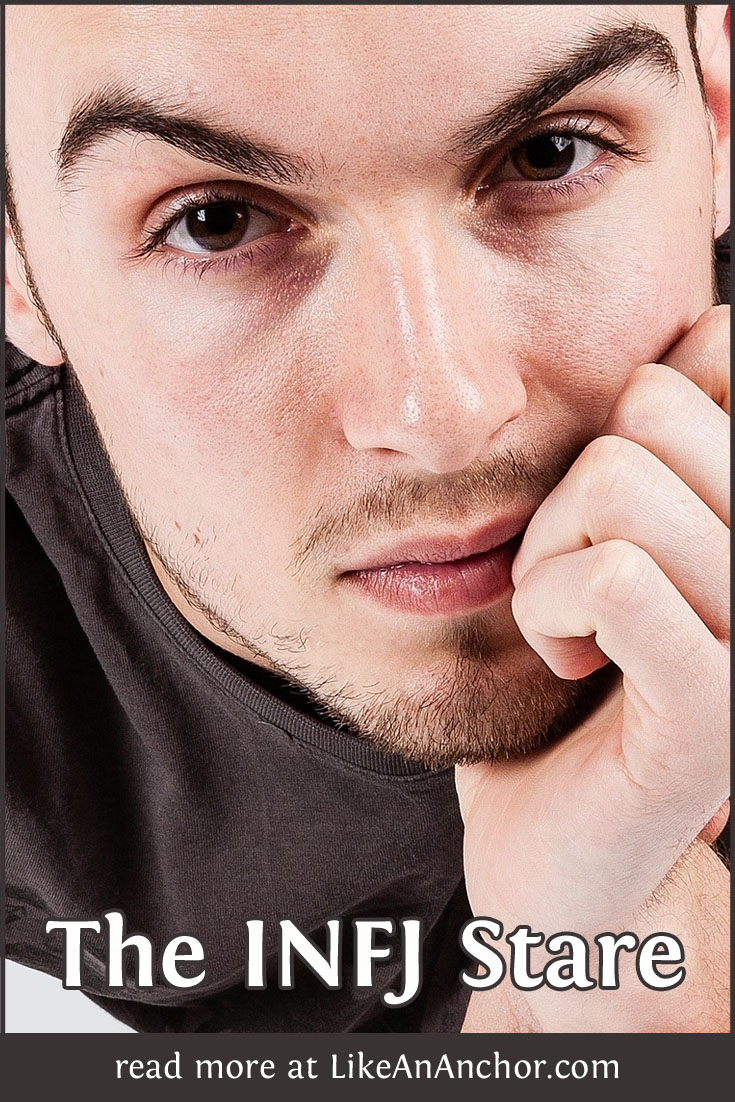
 Like An Anchor