Do you ever feel like God just loves you because that’s something He does for everyone, not because He actually likes you?
That’s how I started the seminar I gave back in December, which I’m finally getting around to sharing on this blog. I’m willing to say that I’m not the only person who’s ever felt this way about God’s love, at least some of the time. There are a couple different things that play-in to this idea, but I think at least part of it is that usually when we talk about love in the Bible, we focus on the Greek word agape, which describes God’s unconditional love for all people. But there’s another word for love that talks about God’s affection for His friends. Depending on which resource you look at there are up to eight different words for “love” in Greek, though most people focus on these four:
- Agape — selfless, benevolent love
- Philos — friendly, affectionate love
- Storge — natural, family love
- Eros — passionate, romantic love
We’re going to talk about agape and phileo, since those are the two used in the Bible. Together, agape and the root word agapao appear a total of 263 times in the New Testament. Philos and the closely related word phileo are used only 54 times, though it also appears in several compound words like philadelphos (brotherly love) and philostorgos (family love).
It would be pretty easy to look at these numbers and say agape is the most important kind of love in the Bible. And considering it’s the word used in the phrase, “God is love,” I’d say that’s a pretty good description. It’s also the word for love that’s defined in 1 Corinthians 13. There isn’t any other word that gets such a thorough analysis in scripture. But maybe our emphasis on agape, even though it’s correct, comes at the expense of a good understanding of another important word, phileo.
Do You Love Me?
The difference between agape and philos might not seem significant at first glance. But there’s a conversation in John’s gospel that illustrates how different these two words for love can be. This conversation takes place after Jesus’ resurrection. His disciples had gone fishing and He met them on the beach, had dinner with them, and then asked Peter a question. In most Bible versions I’m familiar with, both agape and philos are translated in these verses as “love.” I like the World English Bible, since it makes clear that there are two different concepts at play.
Jesus said to Simon Peter, “Simon, son of Jonah, do you love [agape] me more than these?”
He said to him, “Yes, Lord; you know that I have affection [phileo] for you.”
He said to him, “Feed my lambs.” He said to him again a second time, “Simon, son of Jonah, do you love me?”
He said to him, “Yes, Lord; you know that I have affection for you.”
He said to him, “Tend my sheep.” He said to him the third time, “Simon, son of Jonah, do you have affection for me?”
Peter was grieved because he asked him the third time, “Do you have affection for me?” He said to him, “Lord, you know everything. You know that I have affection for you.”
Jesus said to him, “Feed my sheep.”
John 21:15-17, WEB
The few times I’ve heard people address this passage, they usually say Jesus was asking Peter to reach for a higher form of love and Peter just wasn’t getting it. They think Peter couldn’t measure up to agape, so he used a lesser word to describe his love. But Peter’s the guy who stepped out of a boat and started walking across the water to get to Jesus (Matt. 14:26-29). He doesn’t hold himself back. And just a few days before this conversation he’d denied even knowing Jesus, so I imagine he’s anxious to show that he really does love Him.
I don’t think Peter saw phileo as a lesser form of love. I think he was trying to say, “Yes, of course I love you with agape. But even more than that I’m your friend – we share common interests and I care about you.” And that’s why he was so sad when Jesus used the word phileo when he asked the third time, “Do you love me?” Because it must have seemed like Jesus was asking, “Do you really care about me, Peter?”
A Closer Look At Philos
The difference between these two kinds of love isn’t as simple as just saying agape is godly love and phileo is friendly love. Both words are used of God’s love for people and of our love for God. There’s quite a bit of overlap in how they’re used, but we can still make a few general observations.
Agape doesn’t always involve emotion, although it can, but it always means being interested in the ultimate good of the ones you love. It’s the word used to describe the kind of love that prompted God to sacrifice His own son for the entire world, and which He commands us to show toward our enemies (John 3:16; Luke 6:27). God doesn’t tell us we have to have warm fuzzy feelings for our enemies, but He does want us to care about what happens to them and hope for a good outcome in much the same way He wants everyone to “choose life” (Deut. 30:19; 2 Pet. 3:9).
Phileo tends to be more specific than agape, since you only feel it for those you share goals and interests with. In fact, it’s often translated “friend” instead of love.” This word always involves affection and emotion. Jesus uses phileo when He talks about how He and the Father work together (John 5:20). Paul uses it to talk about the relationship between believers who have a common interest in following God (Tit. 3:15). But the thing about phileo that’s really amazing happens when it’s used of a relationship between God and a human being.
Friends of God
There are a few specific people who the Bible identifies as personal friends of God. Jesus had friends when he lived on this earth, such as Lazarus and John (John 11:11; 20:2). There were also people in the Old Testament who were friends with God. James tells us that Abraham was called God’s friend after “he offered Isaac his son on the altar” (James 2:23). At that point, Abraham had faithfully demonstrated for years that his interests were in line with God’s plan. That type of shared interests is part of phileo, the friendship love.
Abraham is not the only person in the Old Testament who God treated as a friend. We’re told “the Lord spoke to Moses face to face, as a man speaks to his friend” (Ex. 33:11). God also called David “a man after My own heart, who will do all My will” (Acts 13:22). As these people’s interests lined up with God’s and they moved in the direction He was leading, they became His friends. Christ’s friendship with His disciples followed much the same pattern, and that is the kind of relationship we’re now offered with God the Father and with Jesus Christ.
God’s Conditional Love
Jesus said, “Greater love has no one than this, that someone lay down his life for his friends. You are my friends, if you do whatever I command you” (John 15:13 WEB). In this verse, “friends” is translated from phileo. Because phileo involves sharing common interests with the people you love, this particular love that Jesus offers is conditional upon us keeping His commandments (unlike agape, which is often, though not always, framed as unconditional).
God is going to have a certain amount of agape for you whether you keep His commandments or not. In other words, He has a love for all people that wants the best for them and hopes that they will choose to follow Him and enter a relationship so that our shared love can increase and become more affectionate and intimate. If you want God to be your friend and to enjoy a deeper level of love and connection with Him, then you have to share His interests. You need to be in covenant with Him (in that way, love is very similar to grace). God’s invitation to have a deeper relationship with Him through covenant isn’t something we’re supposed to think of as a strict/unkind “do this or I won’t love you” ultimatum. Rather, it’s about developing a real relationship based on shared interests, character traits, and goals.
God’s commands (and the whole Bible, really) are a guide-book for developing His character. They reveal the things that He cares deeply about and if we want to be His friends, then we need to care about those things as well. And that’s why it’s so important to develop a regular Bible study practice–so we can keep getting to know who God is and what He wants and how we can become like Him.
Developing God’s Interests
Shared interests and goals are an essential part of the type of love described by phileo. When we’re thinking about that in the context of developing a friendship with God, it means that we’re literally becoming the type of person that Jesus Christ is.
As our Teacher, Jesus is the template we pattern ourselves after. In a Hebrew mindset, someone who is following a teacher, or Rabbi, isn’t just there to learn what the teacher knows. Their goal is to become the type of person that teacher is. And this should also be our goal as we seek friendship with God. The more we become like Him in how we think, act, and speak, the closer we are to being full-grown Christians who’ve attained “to the measure of the stature of the fullness of Christ,” as Paul says in Ephesians 4:13 (WEB).
Just as I have loved you, you also love one another. By this everyone will know that you are my disciples.
John 13:34-35, WeB
Just as he who called you is holy, you yourselves also be holy in all of your behavior.
1 Peter 1:15, WEB
These verses are just a couple examples of how we grow to become like Christ. Loving others the exact same way Jesus loves us will show everyone that we’re really His students. And Peter reminds us that we’re called to become holy the same way that God is holy. In fact, the more we become like God, the closer a relationship we’ll have with Him. And the closer a relationship we have with Him, the more we’ll become like God. It’s a lovely cycle of increasing intimacy, commonality, and affection.
God’s Friendship Love For Us
Another part of developing God’s mindset and becoming friends with Him is having a proper perspective on who the Father and Son really are and how They both feel about us. This is actually one of my favorite verses in the whole Bible. It’s Jesus speaking to His disciples on His last Passover. He says,
“In that day you will ask in my name; and I don’t say to you, that I will pray to the Father for you, for the Father himself loves [phileo] you, because you have loved me, and have believed that I came from God.”
John 16:26-27, WEB
In John’s Passover account, Jesus uses philos to describe how He feels about His disciples several times. But this is the only place where it’s used of how God the Father feels for us. By using the word phileo in this passage instead of agape, Christ is telling us that God feels affection for us and He has shared interests with us on the condition that we love and believe in Jesus.
With these words, Jesus assures His disciples and us today that the Father personally listens to our prayers because of His friendly, affectionate love for us and because of our belief on His Son Jesus. If you can honestly say you love Jesus and believe that He’s the son of God, then God Himself wants to be your friend. God is agape and He has a baseline level of that kind of love for every person in the world (John 3:16-17). God’s phileo, on the other hand, is reserved for those He’s in relationship with–the ones who share His interests, believe in His word, and enter a covenant with Him.
Our Friendship With God
As I mentioned earlier, agape is used much more frequently than phileo, so there aren’t as many verses we can look at to keep expanding on this topic. But we do have a few that give us a glimpse into how God feels about us as part of His family.
“As many as I love, I reprove and chasten. Be zealous therefore, and repent. Behold, I stand at the door and knock. If anyone hears my voice and opens the door, then I will come in to him, and will dine with him, and he with me.”
Revelation 2:19-20, WEB
Now, I know that part about reproving and chastening doesn’t sound very affectionate but it’s part of us being in God’s family. If He didn’t care about us, He would just let us go off and do our own thing and reap the consequences. That’s not in His nature, though. He wants to see us choose good things because He has agape love for us. And once we start to choose Him, then His affection drives Him to build an ever deepening relationship with us. We get to experience His agape more deeply and we get to share phileo with Him as we draw closer to Him by entering covenant with Him and keeping His commandments.
Because this is a relationship, the friendship love has to go both ways. We’re supposed to reflect affection right back at God the Father and Jesus Christ. And even though people will tell you that agape is more important than phileo as a type of love, it turns out that having this kind of love for our Creator is not optional.
If any man love not the Lord Jesus Christ, let him be Anathema Maranatha.
1 Corinthians 16:22, KJV
The word anathema (G331) means something that is accursed or given up to destruction. Greek scholar Spiros Zodhiates says it does not “denote punishment intended as discipline but being given over or devoted to divine condemnation.” Maran-atha (G3134) is an Aramaic word which literally means “our Lord has come.”
When you break this phrase down, it’s telling us that someone who does not love–and that is phileo–Jesus Christ will be judged at the Lord’s coming, and probably not in the way they were hoping. It could be translated, “If anyone does not affectionately love the Lord Jesus Christ, let him be set aside for condemnation when the Lord returns.”
How To Become God’s Friends
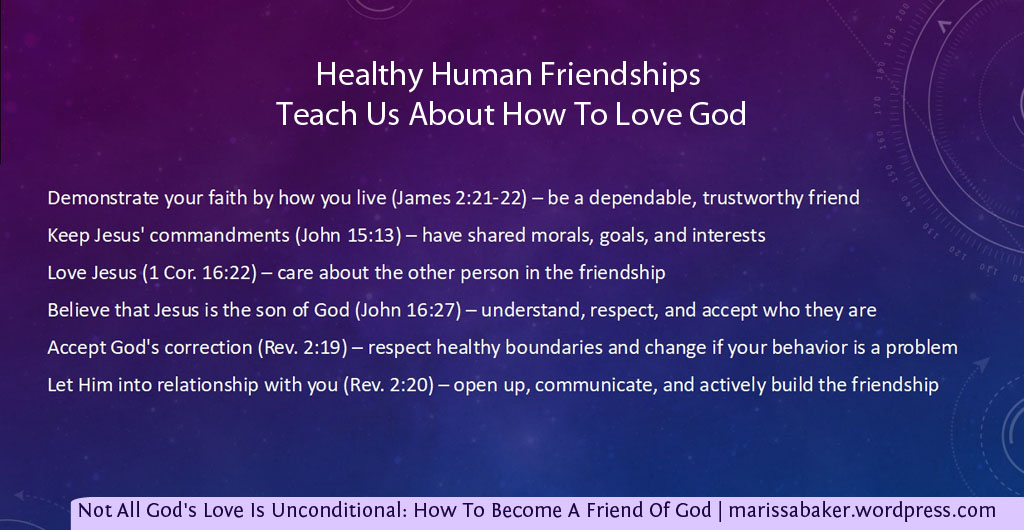
We’ve covered quite a few verses about loving and being loved by God, so let’s start pulling it all together and answer the question implied by this blog post’s title: How do you become a friend of God? When you boil it down to the main points in the verses we looked at, it actually seems pretty simple:
- What James writes about Abraham points out the importance of demonstrating your faith by how you live (James 2:21-22)
- Jesus Himself said we need to keep His commandments if we want to be His friends (John 15:13)
- Paul shared that it’s vitally important to love Jesus Christ (1 Cor. 16:22)
- Jesus shared that His Father’s love is connected to our love for Him and belief in Jesus as the son of God (John 16:27)
- Christ’s letter to Laodicea tells us it’s important to accept God’s correction and to let Him into relationship with you (Rev. 2:19-20)
And that’s pretty much it. That’s all you have to do if you want to befriend the creator of the universe. It looks simple in neat little bullet points, but I think we all know that when we start trying to put it into practice it’s not always that easy. The points about how to become God’s friends might be easier to grasp, though, when we think of our experiences making friends with other human beings. The same things that are important in healthy human friendships are important to a relationship with God.
And Now We Add Agape
Before we close, there is one more point I want to make. Let’s think back to when Jesus asked Peter, “Do you love me?” I think Peter initially thought phileo was a better kind of love because of how much it involves emotions. But phileo is not complete on its own; it needs agape added to it. Agape is the kind of love that keeps loving when feelings are gone or when they are crowded out by fear. In that regard, it’s very much like faith which keeps believing even though it can’t see exactly what’s going to happen next. And Peter did learn this lesson, for it’s in his epistle that we are told to add agape to our expressions of phileo for other people.
For this very reason, make every effort to add to your faith excellence, to excellence, knowledge; to knowledge, self-control; to self-control, perseverance; to perseverance, godliness; to godliness, brotherly affection (phileo); to brotherly affection, unselfish love (agape). For if these things are really yours and are continually increasing, they will keep you from becoming ineffective and unproductive in your pursuit of knowing our Lord Jesus Christ more intimately.
2 Peter 1:5-8, NET
We need to learn this lesson today just as much as Peter’s first readers did. Our love for God and our fellow believers needs an element of emotion and feeling–we’re supposed to be friends with them. Our love also needs to be stable and unconditional because we must act with love even when we don’t feel “in love.” Both types of love are needed to maintain a friendship with God.











 Like An Anchor