Weightier Matters

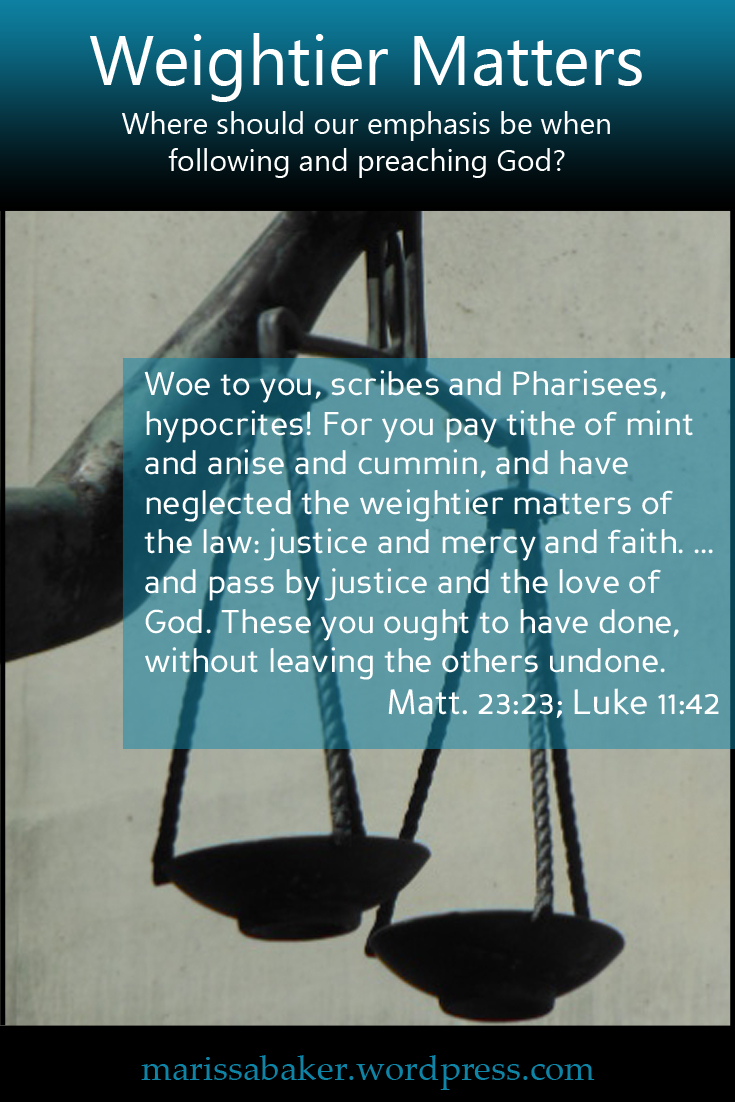
The scribes and Pharisees had a lot going for then. They were well-educated, well-respected, and held positions of authority in the community of believers. People thought they were important, and they were. Then this guy Jesus showed up and started condemning them for not following God correctly.

Can you imagine how this looked? Here are these men who’ve been the authority on worship tradition for years confronted by a young carpenter who just appeared out of nowhere. He didn’t even go to a good school! Worse, they know He’s right. But if they admit it, they lose their power.

weighty_matters
photo credit: Michael Coghlan “It Hangs in the Balance,” CC BY-SA

A similar thing can happen in our churches today. When leadership is focused on maintaining church tradition, there’s a danger of developing a Pharisaical attitude. A certain amount of resistance to change is needed to keep from forsaking sound doctrine, but often church tradition isn’t rooted in the Bible at all and if that’s the case it’s fair-game for reexamination. We can also, as the Pharisees did, error in emphasizing certain doctrines to the neglect of others. Read more

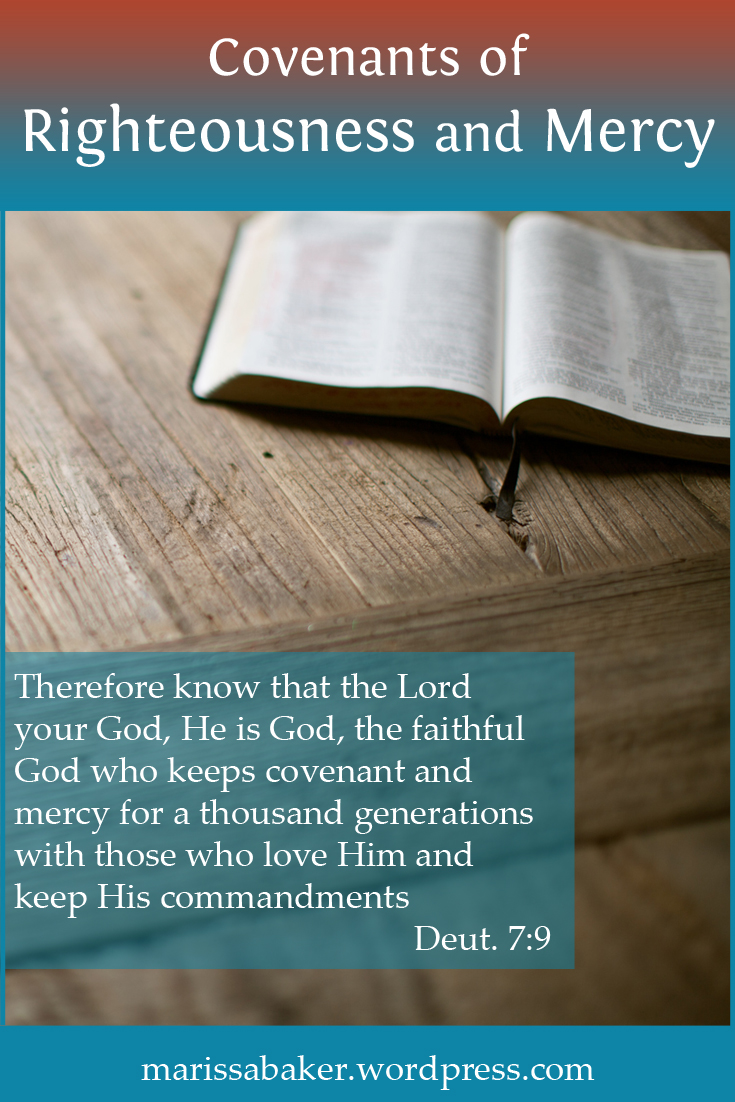
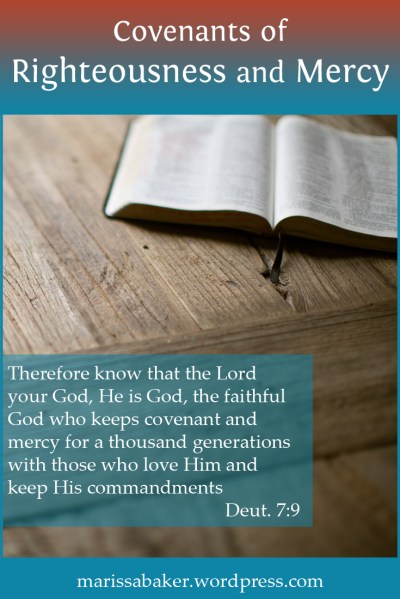
Covenants of Righteousness and Mercy

This isn’t the first time a Bible study has brought tears to my eyes. Usually that happens when I’m studying God’s love, but there’s also something inspiring, humbling and wonderful about His righteousness and mercy. They’re aspects of God’s essential character, and the more I learn about who the Father and Yeshua are, the more inclined I feel to just sit here in awe.

In Matthew 5:48 Jesus said, “you shall be perfect, just as your Father in heaven is perfect.” We have a responsibility to grow toward perfection, developing God’s character inside us. If we’re going to mimic His character, we have to study and learn about who and what He is, so we can display those traits as well.
Covenants of Righteousness and Mercy | marissabaker.wordpress.com

I’ve already written many posts on this blog about “God is love” (there’s even a whole ebook free if you click here), so that’s not what we’re going to focus on today. Instead, I want to spend our time together this Sabbath focusing on two key character traits that are aspects of God’s love.

The Lord is Righteous

If you search for the phrases “the Lord is …” and “God is …” trying to find descriptions of His character, the first you come to is in Exodus.

And Pharaoh sent and called for Moses and Aaron, and said to them, “I have sinned this time. The Lord is righteous, and my people and I are wicked. (Ex. 9:27)

Even a pagan ruler on the receiving end of God’s judgement recognized that “the Lord is righteous.” In Hebrew, the word is tsaddiyq (H6662). For human beings, righteousness involves fulfilling the commands of God. It “consisted in obedience to God’s law and conformity to God’s nature” (Theological Wordbook of the Old Testament, entry 1879). Like love, righteousness isn’t just something God shows toward us — it is one of His essential character traits. We define righteousness by pointing to God’s standard.

“Behold, the days are coming,” says the Lord, “That I will raise to David a Branch of righteousness; a King shall reign and prosper, and execute judgment and righteousness in the earth. In His days Judah will be saved, and Israel will dwell safely; now this is His name by which He will be called: THE LORD OUR RIGHTEOUSNESS. (Jer. 23:5-6)
Covenants of Righteousness and Mercy | marissabaker.wordpress.comNot only is God Himself righteous, but all our righteousness is found in Him. This prophecy points to Christ’s role as the one who makes us righteous. Only by following in Yahweh Tsidkenu’s footsteps can we continue in righteousness.

As we’ve seen, God’s righteousness is closely connected to His law. It follows that as a Being of righteousness He must institute penalties for disobedience as well as rewards for obedience. Daniel recognized this in his prayer for the exiles.

As it is written in the Law of Moses, all this disaster has come upon us; yet we have not made our prayer before the Lord our God, that we might turn from our iniquities and understand Your truth. Therefore the Lord has kept the disaster in mind, and brought it upon us; for the Lord our God is righteous in all the works which He does, though we have not obeyed His voice. (Dan. 9:13-14)

It is righteous for God to let evil befall a nation that broke their covenant with Him. Covenants aren’t just about the good things both parties get out of the agreement — they also include consequences for breaking the covenant, which is what we do when we sin (Dan. 9:4-5). Because God is righteous, He keeps the entire covenant — including the part that stipulates consequences for sin.

The Lord is Mercy

Daniel also calls on another of God’s essential character traits; one that goes hand-in-hand with righteousness.

And I prayed to the Lord my God, and made confession, and said, “O Lord, great and awesome God, who keeps His covenant and mercy with those who love Him, and with those who keep His commandments, we have sinned and committed iniquity, we have done wickedly and rebelled, even by departing from Your precepts and Your judgments.

O Lord, righteousness belongs to You, but to us shame of facebecause we have sinned against You. To the Lord our God belong mercy and forgiveness, though we have rebelled against Him. (Dan. 9:4-5, 7, 9)

If God was not mercy as well as righteousness, we would be in grave straits indeed. We have all sinned, and if God righteously rewarded us for that we would all be dead (Rom. 3:23; 6:23). Yet Jesus Christ took on Himself the death penalty required by covenant. Instead of rewarding us as we deserve He offers mercy, as He did to “a blasphemer, a persecutor, and an insolent man” who became the Apostle Paul (1 Tim. 1:13).

But God, who is rich in mercy, because of His great love with which He loved us, even when we were dead in trespasses, made us alive together with Christ (by grace you have been saved) (Eph. 2:4-5)

Mercy is as much a part of God’s being as love and righteousness, and it has always been this way. Back in the Torah, Moses makes a prayer for Israel very similar to Daniel’s plea. The people have rebelled, and Moses is asking for God’s mercy to mingle with His righteousness.

And now, I pray, let the power of my Lord be great, just as You have spoken, saying, ‘The Lord is longsuffering and abundant in mercy, forgiving iniquity and transgression; but He by no means clears the guilty, visiting the iniquity of the fathers on the children to the third and fourth generation.’ Pardon the iniquity of this people, I pray, according to the greatness of Your mercy, just as You have forgiven this people, from Egypt even until now.” (Num. 14:17-19)

Covenants of Righteousness and Mercy | marissabaker.wordpress.comMoses is directly referencing God’s own description of Himself in Exodus 34:6-7. These are the character traits of “God is love” which back-up the covenant God makes with His people

In the Old Testament verses we’ve been quoting, “mercy” is translated from the Hebrew chesed (H2617). The Theological Wordbook of the Old Testament points out that this word is often connected with covenant — most likely in that God’s covenant is a result of His chesed and includes the promise of His loving kindness. As those in covenant with God, we’re expected to show mercy as well.

Blessed are the merciful, for they shall obtain mercy. (Matt. 5:7)

In Greek, “mercy” is elos (G1656). It’s different from grace, which is a special kind of gift from God that consists of removing the penalty for sin. Mercy goes along with that and takes a step farther by alleviating the miserable consequences of sin (Zodhiates Key-Word Study Bible).

Jesus has compassion and mercy on us because He sympathizes with our weakness, having experienced what it’s like to be human even though He never sinned (Heb. 4:15-16). We, too, should exercise mercy towards others. As sinners ourselves, we’re in a unique position to respond to the suffering we see in others with loving kindness rather than condemnation. We must learn to follow God’s example of mingling righteousness and mercy. We never forget or ignore the covenant laws and our commitment to righteousness, but we also remember to always act out of mercy and love.

Thoughts on A Book of Celtic Wisdom

I recently read a little book called Anam Cara: A Book of Celtic Wisdom by John O’Donohue. A blog reader mentioned the idea of an anam cara, or “soul friend,” in a message, and I simply had to look it up. You can usually tell how interesting I found a non-fiction book by the number of sticky notes poking out by the time I’m done reading. Case in point:

Soul Friends | marissabaker.wordpress.com

It’s not that I agreed with everything in the book, but rather that I found its musings on the nature of life and connection between people fascinating. The first quote I placed a note next to was also one that I’d read in the article that initially pointed me toward this book.

Anam is the Gaelic word for soul and cara is the word for friend. So anam cara in the Celtic world was the “soul friend.” In the early Celtic church, a person who acted as a teacher, companion, or spiritual guide was called an anam cara. It originally referred to someone to whom you confessed, revealing the hidden intimacies of your life. With the anam cara you could share your inner-most self, your mind and your heart. (p.13)

I love this idea, which comes from Chapter 1: The Mystery of Friendship. I’ve been toying with the idea of incorporating it into a new title for this blog. Perhaps “Soul Teacher”? I’m not sure yet.

A couple pages after this quote, the writer takes this discussion in a direction dear to my heart. He describes Jesus as “the secret anam cara of every individual” (p. 15). Isn’t that a beautiful picture? Jesus is our “soul friend,” our most intimate companion, teacher and spiritual guide, the One to whom you can reveal your most hidden self.

Consequently, love is anything but sentimental. In fact, it is the most real and creative form of human presence. Love is the threshold where divine and human presence ebb and flow into each other. (p.15)

Can We Heal Ourselves?

I loved the first chapter of this book. It was in later chapters that I became frustrated with aspects of O’Donahue’s ideology. In Chapter 3: Solitude Is Luminous, he talks about healing wounds in a way that really resonates with me, but I feel his solutions don’t go deep enough.

It’s true we often seem “destructively addicted to the negative” because confronting it seems to difficult. “If we maintain our misery at this surface level,”O’Donohue writes, “we hold off the initially threatening but ultimately redemptive and healing transfiguration that come through engaging with our inner contradiction.” I’d agree with this — we have to get to know ourselves before we can learn, grow and change ourselves. But O’Donohue isn’t advocating change so much as self-acceptance though befriending “the negative” and recognizing “that it is not destructive. It often seems that morality is the enemy of growth” (p. 115).

There are simply some things in our lives that shouldn’t be accepted. It’s not healthy or safe to befriend the dark side, and we can’t always turn negatives into something benign just by being nice to them. I have to believe it’s possible to grow and remain moral at the same time.

And yet, O’Donohue has a point that we must beware going to the other extreme of spending too much time analyzing and dragging up our pasts. Searching for your problems over and over again won’t help you overcome them, and self-knowledge is only useful if you can act on it in some way to heal and grow. He compares people who go through endless cycles of self-analysis to gardeners who dig up their potatoes every day and replant them a different way.

People in our hungry modern world are always scraping at the clay of their hearts. They have a new thought, a new plan, a new syndrome, that now explains why they are the way they are. …. Negative introspection damages the soul. It holds many people trapped for years and years, and ironically, it never allows them to change (p. 122).

The very next line is where he lost me: “It is wise to allow the soul to carry on its secret work in the night side of your life” (p. 122). Much like he suggests befriending our negativity is the best way of dealing with it, he believes our wounds can heal themselves if we give our souls space and approach our ” hurt indirectly and kindly” (123). But our souls aren’t designed to heal themselves. They’re healed by God.

I feel this idea of self-healing is connected to the writer’s idea of the divine residing inside our souls. Though he references Christianity heavily, that’s not the only theology O’Donohue draws on — the theology of this book is a mishmash of Irish Catholicism, Celtic paganism, and mysticism. He’s not comfortable with the idea of a “faraway divinity,” and so adopts the idea that the divine is within us. He’s missing a third option, though.

Biblicaly, the divine is outside us, but He’s not far away. “The word is very near you, in your mouth and in your heart,” and the living Word wants to dwell inside us (Deut. 30:14; Rom. 10:8). I suppose you could say the divine resides inside us after we submit ourselves to Christ, but we have to ask Him in — not start out looking inside our own souls for the answers.

You Have A Purpose

I want to share with you a passage in this book that I found hugely encouraging. It’s also from Chapter Three.

To be born is to be chosen. No one is here by accident. … Your identity was not offered for your choosing. In other words, a special destiny was prepared for you. But you were also given freedom and creativity to go beyond the given, to make a new set of relationships and to forge an ever new identity, inclusive of the old but not limited to it. … Destiny sets the outer frame of experience and life; freedom finds and fills its inner form. …

You were sent to a shape of destiny in which you would be able to express the special gift you bring to the world. Sometimes this gift may involve suffering and pain that can neither be accounted for nor explained. There is a unique destiny for each person. Each one of us has something to do here that can be done by no one else. If someone else could fulfill your destiny, then they would be in your place and you would not be here. … When you begin to decipher this, your gift and giftedness come alive. Your heart quickens and the urgency of living rekindles your creativity. (83-84)

This past Shabbat, the speaker at my Messianic congregation talked about Leah. She was not as pretty as her younger sister Rachel and she was unloved by her husband. She probably thought she didn’t make much of an impact on the world. And yet, her example of faith is recorded in the Bible for everyone to read, and her children founded the priestly lineage of Levi and the royal lineage of Judah, among other nations. She’s a direct ancestor of notable personages like Moses, David and Jesus Christ Himself. Her life matters more than she ever knew.
You also have a purpose in this world, even if you can’t see it. This isn’t to perpetuate an idea that you’re a “special unicorn” who is better than other people. Rather, it’s to say that of us has a unique gift that’s of real value, and you have a hand in shaping how it impacts the world.

Love On Fire

Sometimes, Bible study ideas can come from an unexpected source. One of the speakers at our Feast of Tabernacles site last month was a man whose messages rarely catch my attention, but he gave an excellent sermonette about falling in “true love” with God.

Though the holy days for this year are several weeks in the past, these subjects are relevant year-round. Since the Feast, or Sukkot, pictures Christ’s millennial reign, it’s also connected with the marriage to His church, which takes place a little earlier. We will be living and reigning with Jesus as His bride, teaching and serving alongside Him (Rev. 20:4). But first, we have to get there.

Love On Fire | marissabaker.wordpress.com
photo credit: Indi Samarajiva, CC BY via Flickr

True Love

God is love. it’s not just something God has like a person can have feelings of happiness or a sense of humor. Love (and the word is agape) is God. All real love — that selfless seeking of another’s good because you care about them so much — is of God.

And we have known and believed the love that God has for us. God is love, and he who abides in love abides in God, and God in him. (1 John 4:16)

When we’re filled with love, we’re filled with God’s essential character. “If we love one another, God abides in us, and His love has been perfected in us” (1 John 4:12). The opposite is true as well: it’s impossible to love God or abide in Him while harboring an attitude of hate (1 John. 4:20).

He who has My commandments and keeps them, it is he who loves Me. And he who loves Me will be loved by My Father, and I will love him and manifest Myself to him. … If anyone loves Me, he will keep My word; and My Father will love him, and We will come to him and make Our home with him. (John 14:21, 23)

Love creates relationship with God. It’s also inseparably connected to commandment keeping — if we love God, we’ll live as He said to, thereby showing love for God. This results in a relationship Jesus described as “abiding in” Him and His Father, and Them in us.

As the Father loved Me, I also have loved you; abide in My love. If you keep My commandments, you will abide in My love, just as I have kept My Father’s commandments and abide in His love. (John 15:9-10)

Perfect love results in perfect unity — mutual indwelling like the Father and Jesus have together and want to share with us (John 17:21-23). God’s love is the only love that can build the kind of relationship that leads to eternity, and that’s why we have to keep sharing the same love we’re being given (John 13:34; 15:12).

Burning Love

We’ve spent quite a lot of time on this blog, and in my God’s Love Story ebook (which you can download free), talking about what God’s love is like. Our love for God and each other is supposed to be exactly like God’s love for us. It’s selfless, sacrificial love. it’s unabashed seeking of what is best for the beloved. It’s love shared between the best of friends. It’s the highest form of romantic love (non-sexual; we’re talking about agape, not eros).

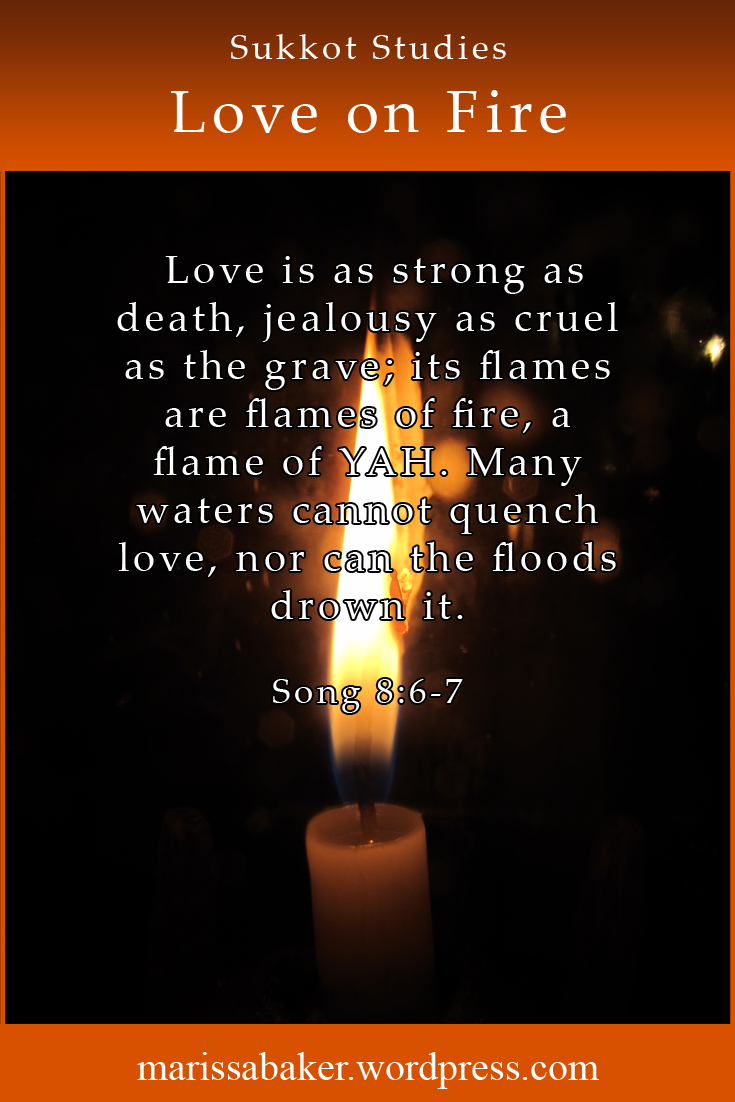
Set me as a seal upon your heart, as a seal upon your arm; for love is as strong as death, jealousy as cruel as the grave; its flames are flames of fire, a flame of YAH. Many waters cannot quench love, nor can the floods drown it. If a man would give for love all the wealth of his house, it would be utterly despised. (Song 8:6-7)

You might say these lovely verses from the Song of Songs are the Old Testament companion scripture to 1 Corinthians 13. Love is a fire fueled by YAH (which is a poetic form of YHWH usually hidden in English translations of this verse). Love like that can’t be put-out by anything the world throws at it, and it can’t be bought anymore than you can buy the holy spirit (Acts 8:18-21).

After Jesus’ resurrection, He appeared to two disciples on the road to Emmaus (Luke 24). He walked with them incognito and “expounded to them in all the Scriptures the things concerning Himself.” After they were allowed to recognize Him over dinner and He “vanished out of their sight” these disciples make an interesting observation (which I’m indebted to the aforementioned sermonette for connecting with the subject of God’s love).

And they said to one another, “Did not our heart burn within us while He talked with us on the road, and while He opened the Scriptures to us?”(Luke 24:32)

They recognized that “burning hearts” was a sign of Jesus being alongside them. When we’re abiding in Him and walking in obedience, we will be filled with the unquenchable love of God like a burning fire.

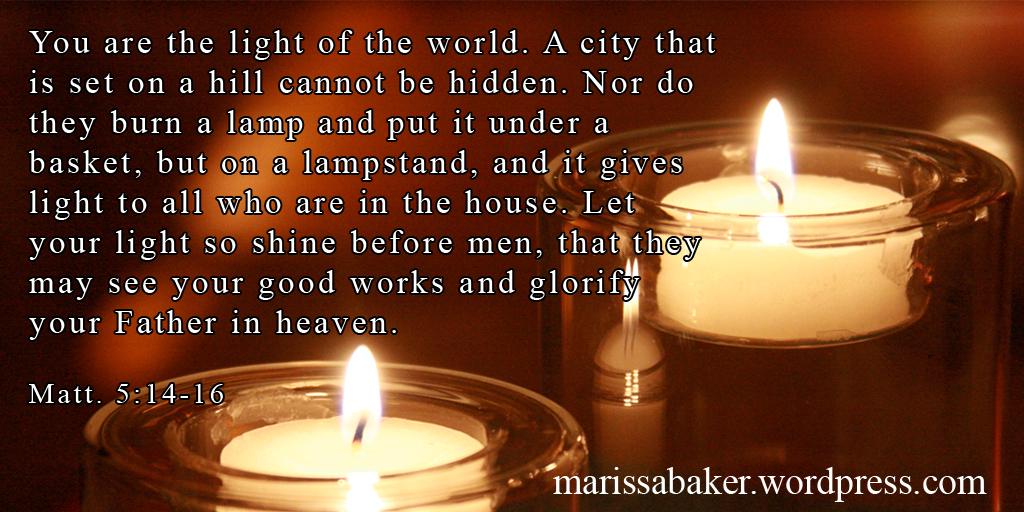
The Greek word translated “burn” in Luke 24 can refer to a literal flame, but there are several other places in scripture where it’s used to describe a condition inside people (G2545, kaio). John the baptist was described as “the burning and shining lamp” (John 5:35). We’re told to be watchful servants and ordered, “Let your waist be girded and your lamps burning (Luke 12:35). Kaio is also the word used when Jesus talks about us letting our lights shine like a burning lamp in the world (Matt. 5:14-16).

Love On Fire | marissabaker.wordpress.com
photo credit: Ashton, CC BY-SA, via Flickr

We need to let our lights, fueled by God’s love, burn so they can be seen. As we walk in the love of God, keeping His commandments and abiding in Him, unquenchable love should flow out from us to our brethren and neighbors.

Unveiled

How many people do you really open up to? Even if you’re an “open book,” there are probably things you don’t share with everyone. There are secrets, aspects of our personality, and thoughts that we only show closest friends, family or a spouse. You may have parts of you hidden so deep no one sees them.

not sure who to credit; found on Pinterest

What about in your relationship with God? Even though He knows everything about us, we can still chose to hold things back from Him. We can tell Him to stay away, keeping Him at arms length and refusing to let go and surrender to His work in us.

Opening up and letting myself be seen is a challenge I face in human relationships, and in this fall holy day season I’ve been thinking about whether I try to do the same thing with God. I think that I’m more open with Him than with anyone else, but are there still things that I’m trying to hold back or hide?

Open To Me

Jesus is supposed to be our friend and lover. He wants to know you more thoroughly than anyone else ever will, but He wants you to chose that relationship. He won’t force Himself into your life, though He will knock.

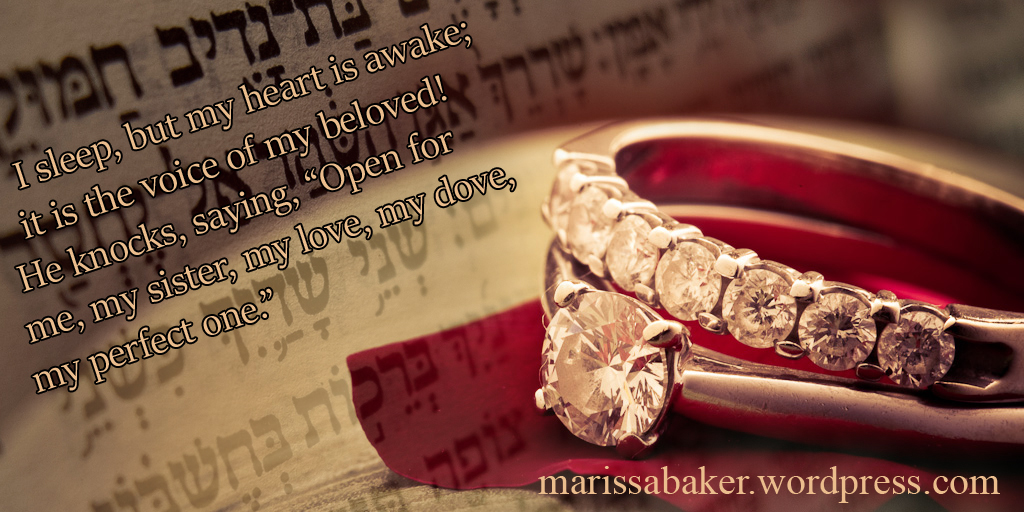
I sleep, but my heart is awake; it is the voice of my beloved! He knocks, saying, “Open for me, my sister, my love, my dove, my perfect one; for my head is covered with dew, my locks with the drops of the night.” (Song 5:2)

The woman in this part of the Song of Songs has “slumbered and slept,” and now Christ is outside asking to come in. “He sues for entrance who may demand it; he knocks who could easily knock the door down” (Matthew Henry’s Commentary). He doesn’t upbraid her for shutting Him out — He just wants her to let Him in. Have we also locked Him out? perhaps through carelessness if not deliberately?

she did not say, I will not open, but, How shall I? Note, Frivolous excuses are the language of prevailing slothfulness in religion; Christ calls to us to open to him, but we pretend we have no mind, or we have no strength, or we have no time (Matthew Henry)

Matthew Henry talks about this as “The slights which careless souls put upon Jesus Christ,” and which actually demonstrate “a great contempt” for their savior. When we ignore Jesus’ request to come into our lives, we reject His work in us.

Here, in the Song, the woman finally opens the door when she sees His hand at the door. Unfortunately, she waited too long for welcoming Christ in to be easy.

I opened for my beloved, but my beloved had turned away and was gone. My heart leaped up when he spoke. I sought him, but I could not find him; I called him, but he gave me no answer. The watchmen who went about the city found me. They struck me, they wounded me; the keepers of the walls took my veil away from me. (Song 5:6-7)

If we aren’t willing to open ourselves up to Christ when He knocks, He will be harder to find. If we don’t unveil ourselves to Him, we might find ourselves lost, alone and stripped of our covering pretenses before we find Him again. This can happen multiple times in a Christian’s life, just as this pattern is repeated in the Song (Song 3:1-4). Our lives are often a dance of drifting away and coming back to Christ.

Torn Veils

Unveiled | marissabaker.wordpress.comVeils keep us from fully experiencing God. The veil in the temple separated the Holy of Holies — where God’s spirit appeared — from the rest of the temple complex. Prior to Christ’s sacrifice, only the High Priest could enter, and only once a year (Heb. 9:1-8). The moment Jesus died, “the veil of the temple was torn in two from top to bottom” (Matt. 27:51). His death removed the most visible separation between God and His people.

There was another veil mentioned in the Old Testament that Paul talks about in the New. After Moses spoke to God, he shone so much with God’s reflected glory that Israel feared him. Moses wore a veil to hide his shining face before everyone but God (Ex. 34:29-35). Paul wrote about this veil in his second letter to Corinth.

But their minds were blinded. For until this day the same veil remains unlifted in the reading of the Old Testament, because the veil is taken away in Christ. But even to this day, when Moses is read, a veil lies on their heart. Nevertheless when one turns to the Lord, the veil is taken away. (2 Cor. 3:14-16)

Christ has torn away all the veils between the Lord and His people. The temple veil which tore at His death opened the way into His sanctuary, and when we turn our hearts to Him He takes away the veil shielding true understanding of the Torah.

But we all, with unveiled face, beholding as in a mirror the glory of the Lord, are being transformed into the same image from glory to glory, just as by the Spirit of the Lord. (2 Cor. 3:18)

We have to unveil our faces if we want to see His unvelied face. To know Him, we must want to be known. He took the first step — will we be equally open with Him?

Being Seen

Psalm 139 talks about God knowing us thoroughly — all our thoughts, every part of our personality. It also includes a very important line where David invites God into this deep, intimate relationship.

Search me, O God, and know my heart; try me, and know my anxieties; and see if there is any wicked way in me, and lead me in the way everlasting. (Ps. 139:23-24)

David’s willingness to be seen by God, and his request that God know him, are key to the sort of closeness described earlier in Psalm 139. Today, we can have that same sort of intimacy with our Lord if we let Him in.

Behold, I stand at the door and knock. If anyone hears My voice and opens the door, I will come in to him and dine with him, and he with Me. (Rev. 3:20)

Our Beloved is knocking on our doors, asking us to let Him in. Turn your face to Him, take off the barriers you’re putting up between you and Jesus. See, and be seen.

Unveiled | marissabaker.wordpress.com

Credits for photos used in blog images this week:

  • Veil” by Dan Thoburn, CC BY via Flickr
  • Red Drapery” by Sherrie Thai, CC BY via Flickr
  • Diamond Samples” by Seth Lemmons, CC BY via Flickr
  • Song 7:5” by Raffaele Esposito, CC BY via Flickr

Updated “God’s Love Story” E-Book

In honor of the fall Holy Days season, which we kicked-off yesterday with Yom Teruah (Feast of Trumpets), I’m re-releasing an updated version of my “God’s Love Story” booklet. It’s now available in multiple e-book formats through Smashwords and Amazon (the book is free on Smashwords, but Amazon doesn’t have that option when you’re setting up a new e-book).Updated "God's Love Story" E-Book by Marissa Baker

Throughout history, God calls out to His people asking one simple question, “Do you love Me?” Christianity isn’t a boring “let’s go to church and sit in a pew for an hour” sort of religion. It’s a romance with the creator of the universe; a “fairy tale” staring the Prince of Peace, Who laid down His life to rescue His bride from captivity to sin.

Click here to download “God’s Love Story” for free on Smashwords