God Will Save (Lessons from Hosea, part three)

The name Hosea means “salvation,” fitting since the Biblical book that bears his name has strong salvational themes running through it. Two weeks ago, we started studying this book by talking about how Hosea modeled God’s redemption of Israel by taking back his own unfaithful wife. Then last week, we looked at how warnings against rejecting God give us hope as well as caution, because the flip side of choosing to walk away from God is the ability to choose a relationship with Him. This week, we’ll wrap-up discussion of Hosea with more focus on this hope of salvation through relationship with our Savior.

Return To God

Last week, we said Israel’s main problem was that they rejected God and had no knowledge of Him. They also had another problem, one they share with the church of Laodicea.

So then, because you are lukewarm, and neither cold nor hot, I will vomit you out of My mouth. Because you say, ‘I am rich, have become wealthy, and have need of nothing’—and do not know that you are wretched, miserable, poor, blind, and naked (Rev. 3:16-17)

This is exactly what the people God was upset with said in Hosea:

And Ephraim said, ‘Surely I have become rich, I have found wealth for myself; in all my labors they shall find in me no iniquity that is sin.’ (Hos 12.8)

They claimed they were wealthy and self-sufficient, but the truth of the matter was that while  “Israel is a luxuriant vine that yields its fruit,” the fruit wasn’t any good — “You have plowed iniquity; you have reaped injustice; you have eaten the fruit of lies” (Hos. 10:1, 13, ESV). The solution for this problem, both in Hosea and Revelation, is essentially the same.

I counsel you to buy from Me gold refined in the fire, that you may be rich; and white garments, that you may be clothed, that the shame of your nakedness may not be revealed; and anoint your eyes with eye salve, that you may see. (Rev. 3:18)

“So you, by the help of your God, return; observe mercy and justice, and wait on your God continually. (Hos. 12:6)

The message is clear — stop acting as if you don’t need God. Trust Him, come back to Him, and ask for His help. It requires the humility to recognize you are lacking something, and admit you need God to supply it. It means choosing to produce good, rather than evil, fruit. At it’s most basic, it is seeking a relationship with your Creator and letting Him save you.

Sow for yourselves righteousness; reap in mercy; break up your fallow ground, for it is time to seek the Lord, till He comes and rains righteousness on you. (Hos. 10:12)

“I Will Love Them”

In Hosea 11, God compares Israel’s early history to a beloved child who He taught “to walk, taking them by their arms; but they did not know that I healed them” (Hos. 11:1, 3). They ignored Him and ran away from Him, which got them into all sorts of trouble.

My people are bent on backsliding from Me. Though they call to the Most High, none at all exalt Him. How can I give you up, Ephraim? How can I hand you over, Israel? How can I make you like Admah? How can I set you like Zeboiim? My heart churns within Me; My sympathy is stirred. I will not execute the fierceness of My anger; I will not again destroy Ephraim. For I am God, and not man, the Holy One in your midst; and I will not come with terror. (Hos. 11:7-9)

Israel was warned what would happen to them if they chose to walk away from God, and they were punished for their wrong decisions. Yet God still loved them so much that He continued showing mercy and calling for them to come back to a relationship with Him.

Yet I am the Lord your God ever since the land of Egypt, and you shall know no God but Me; for there is no savior besides Me. I knew you in the wilderness, in the land of great drought. When they had pasture, they were filled; they were filled and their heart was exalted; therefore they forgot Me. … O Israel, you are destroyed, but your help is from Me. I will be your King; where is any other, that he may save you in all your cities? (Hos. 13:4-6, 9-10)

God’s insistence on cultivating a friendship with people who have destroyed themselves is remarkable. Why would He want them — and why would He want us? — after all we have done? yet His promises to save us, to know us, and to redeem us stand firm.

I will heal their backsliding, I will love them freely, for My anger has turned away from him (Hos. 14:4)

These are promises we can count on. When God says, “I will ….”, He means it. He is committed to healing and loving his people. With such promises to rely on, we have no justifiable reason not to walk towards God. He wants very much to save us from sin and death, if only we’ll let Him.

O Israel, return to the Lord your God, for you have stumbled because of your iniquity … Who is wise? Let him understand these things. Who is prudent? Let him know them. For the ways of the Lord are right; the righteous walk in them, but transgressors stumble in them. (Hos. 14:1, 9)


Are We “Too Picky”?

If you’re single (and you don’t want to be), you’ve probably asked yourself the question, “Am I being too picky?” There’s got to be a reason why you’re not in a relationship with someone, right? and you’re sure the reason has something to do with you. People of the opposite sex do exist, and if you’re not in a relationship with one of them you might think that 1) you’re not attractive and so they aren’t asking you out, or 2) you’re too picky and so you’re avoiding/turning down relationships with certain people.

As a 25-year-old single woman, I ask myself this question, too. And I’ve been encouraged to do so by much of the relationship advice I’ve read. You might have read some of this, too. I’m talking about those articles that tell girls to tear-up their “perfect man” list and give any decent guy a chance if he asks them out. Which sounds pretty good in theory, but that’s pretty much how two of the three dates I’ve been on were with guys literally old enough to be my father, and the third was with an atheist who obviously didn’t meet my first requirement that a guy I date have a strong, Christian faith.

Now, I’m not saying you should hang onto unrealistic expectations that will leave you like this skeleton over here –> but you do need to have some standards, and you don’t have to feel guilty for insisting people meet those standards. You are under no obligation to “pity date” anyone, or fling yourself at the first living breathing human who shows the slightest bit of interest in you.

“The One”

This weekend, I spent a good bit of time catching up on Boundless.org articles that I’d missed and checking out TrueLoveDates.com. What stood out to me on Boundless was two articles that offer step-by-step guides for men and for women on how to get married. They can both be summed up in the deceptively simple advice “be more attractive.”

Well, thank you Boundless-author. Previous to reading this article I was going for unattractive. I’ll change that now, and dates will magically appear.

Or not.

“What if I meet the one?”

These articles are part of a three-part relationship series. The first article was devoted to debunking the myth of “the one.” I actually agree with most of what he writes in this one — many Christian singles are too passive, waiting for God to drop their perfect match in their lap or hit them with a revelatory bolt of lightning when he or she shows up. But usually when people tell you to stop looking for “the one”/”your soulmate,” they are also telling you “you’re too picky” (also see my article “Why I Still Believe In Soul Mates“).  And I think it’s a little more complicated than this Boundless authors seems to think.

He says that if you’re a guy, there are only two reasons you’re not in a relationship: “1. You’re not asking. 2. No one’s saying yes.” The solutions are equally simple: “Man up” and “Be awesome.”

If you’re a girl, the reasons you’re single are “1. You’re saying “no” a lot” or “2. No one’s asking.” We’re given three things we can do to turn this around: “Demonstrate respect,” “Look good,” and “Be fun.”

Be (at least a little) Picky

Much as I love Boundless, TrueLoveDates.com had much more helpful tips this time. It’s a website run by Christian relationship counselor Debra Fileta. I’m really looking forward to reading more of her blog posts, and eventually her book. She has some great insight into the whole dating vs. courtship thing, but I won’t digress on that topic right now.

Her most recent articles have been 10 Guys You Should NEVER Date, 10 Girls You Should NEVER Date, and The Boyfriend Checklist: 10 Guys You SHOULD Date (I assume her next post will be a girlfriend checklist). They are focused on qualities you should either avoid or look for in a potential boyfriend or girlfriend, and eventually spouse. And they presuppose a certain level of picky-ness — that you won’t settle for Mr. On Again & Off Again, or Ms. Nothin’ In There But Air, or Mr. Sorta Spiritual, or Ms. One-Way-Street.

Even more helpful lists can be found in Fileta’s article What Women Really Want in a Man and What Men Really Want in a Woman. They are great, both for “this is what you should look for” and “this is the kind of person you need to be.” She says women want honesty, purity, strength, compassion, and humility. Men want realness, confidence, beauty, and passion. These aren’t impossible standards, and you really should be “picky” enough not to settle for less.

Choose God (Lessons from Hosea, part two)

Last week, we began a study of Hosea, and covered the first three chapters. We looked at how Hosea’s marriage to a prostitute pictured God’s covenant with unfaithful Israel in the Old Testament, and how that serves as a warning to us. We need to learn from Israel’s example and not follow their pattern of repeatedly rejecting God, but rather hold fast to Him as He fulfills His promises to reestablish a marriage covenant with His people.

As we continue in Hosea, we see God addressing the reasons for Israel’s unfaithfulness. Everything that separated Israel from God was Israel’s fault.  God never let down His side of the bargain — Israel got into trouble because they walked away from Him. This holds true for the New Testament as well.

If we endure, we shall also reign with Him. If we deny Him, He also will deny us. If we are faithless, He remains faithful; He cannot deny Himself. (2 Tim 2:12-13)

God is always faithful to His promises, including His promise that sin will be punished. Like with Israel, it is still up to us to choose between life and death, blessings and cursing (Deut. 30:9).

Lack of Knowledge

Hear the word of the Lord, you children of Israel, for the Lord brings a charge against the inhabitants of the land: “There is no truth or mercy or knowledge of God in the land.” (Hos 4:1)

God gives three reasons for His “controversy” with Israel. They lacked truth, did not show mercy, and had no knowledge of Him. This resulted in “swearing and lying, killing and stealing and committing adultery” (Hos. 4:2). The farther they strayed from God, the more corrupt and destructive they became.

My people are destroyed for lack of knowledge. Because you have rejected knowledge, I also will reject you from being priest for Me; because you have forgotten the law of your God, I also will forget your children. (Hos 4:6)

This verse specifically refers to knowledge about God and His ways. The New Testament tells us that “the wisdom of this age” — knowledge that the world esteems — is coming to nothing (1 Cor. 2:6), but that “all the treasures of wisdom and knowledge” are hidden for us to find in the Father and Christ (Co. 2:2-3).

Chapters 4 and 5 cover punishments for Israel, and deal with prophecies of an Assyrian invasion and Judah’s alliances with Egypt and Syria. In chapter 6, the people say, “Come, and let us return to the Lord,” but they are not sincere (Hos. 6:1, 4).  Their sham repentance is not what God was looking for.

For I desire mercy and not sacrifice, and the knowledge of God more than burnt offerings. But like men they transgressed the covenant; there they dealt treacherously with Me. (Hos. 6:6-7)

God is all about relationship. He wants to know the people we’ll become when we learn to know Him. All the religious services and laws given to Israel weren’t the “point” of the Old Covenant. They were supposed to be an outward sign of an inward condition — a heart full of truth, mercy, and the knowledge of God.

Because of Unbelief

Israel’s lack of relationship with God was a result of choices they make to walk away from Him.

When I would have healed Israel, then the iniquity of Ephraim was uncovered, and the wickedness of Samaria. For they have committed fraud; a thief comes in; a band of robbers takes spoil outside. They do not consider in their hearts that I remember all their wickedness; now their own deeds have surrounded them; they are before My face. (Hos. 7:1-2)

Wickedness, lies, adulteries (Hos. 7:3-4) — their sins kept piling up until God could say of the people that “none among them calls upon Me” (Hos 7:7). The entire nation rejected the One who they had entered into a covenant with.

Woe to them, for they have fled from Me! Destruction to them, because they have transgressed against Me! Though I redeemed them, yet they have spoken lies against Me. They did not cry out to Me with their heart when they wailed upon their beds.
They assemble together for grain and new wine, they rebel against Me; though I disciplined and strengthened their arms, yet they devise evil against Me; they return, but not to the Most High; they are like a treacherous bow. Their princes shall fall by the sword for the cursings of their tongue.  (Hos. 7:13-16)

quotescover-JPG-96Israel did this continually in the Old Testament. Psalm 78 records that even though “their heart was not steadfast with Him, nor were they faithful in His covenant” that God was “full of compassion” and held back His anger many times (Ps. 78:37-38). He was grieved by their sins, because they would not let Him be their God. Though He acted as their Redeemer, Deliverer, and Rock, “again and again they tempted God, and limited the Holy One of Israel” (Ps. 78:35, 41-42). By not believing in Him, they rejected His good works in their lives.

This rejection of God continued into the New Testament as well. Matthew 13:58 records that Jesus “did not do many mighty works” in His hometown “because of their unbelief.” Mark’s account of this incident phrases it, “He could do no mighty work there, except that He laid His hands on a few sick people and healed them” (Mark 6:4-6). Where there was belief, simply touching the edge of Christ’s garments brought healing (Mark 5:27-29, 34). Where there was no faith, He was actually limited in how many miracles He could perform.

Make A Choice

Israel was given a choice whether or not to follow God and welcome His involvement in their lives. Many of them made the wrong choice, as Paul describes in Romans 11 when comparing God’s people to an olive tree where some of the natural branches were removed. In this analogy, Gentile New Testament Christians are wild olive branches grafted into the Rootstock. Once there, we also have a choice to make.

You will say then, “Branches were broken off that I might be grafted in.” Well said. Because of unbelief they were broken off, and you stand by faith. Do not be haughty, but fear. For if God did not spare the natural branches, He may not spare you either. Therefore consider the goodness and severity of God: on those who fell, severity; but toward you, goodness, if you continue in His goodness. Otherwise you also will be cut off.  And they also, if they do not continue in unbelief, will be grafted in, for God is able to graft them in again. (Rom. 11:19-23)

Like so many serious warnings in the Bible, this contains hope as well as caution. The Bible provides us with records of Israel rejecting God, being punished, and returning to Him again and again. God leaves as many doors open as possible for people to come back to Him, and He’s eager to “graft them in again” if they repent. These doors are open to us as well. But God still wants us to learn from Israel’s mistakes and choose not to leave Him at all, because even though He is a God of enormous mercy there is a point where we can go too far away to get back to Him.

For if we sin willfully after we have received the knowledge of the truth, there no longer remains a sacrifice for sins, but a certain fearful expectation of judgment, and fiery indignation which will devour the adversaries. Anyone who has rejected Moses’ law dies without mercy on the testimony of two or three witnesses. Of how much worse punishment, do you suppose, will he be thought worthy who has trampled the Son of God underfoot, counted the blood of the covenant by which he was sanctified a common thing, and insulted the Spirit of grace? (Heb. 10:26-29)

Like He did in Deuteronomy 30 with Israel, today God sets before His people a choice between life or death, blessings or cursing, and good or evil. He wants us — pleads with us — to choose life, blessings, and good, but the choice is still ours to make.

Love Languages and MBTI Types

Myers-Briggs types have much to tell us about ourselves and other people. Our MBTI type reflects our preferences for crowded parties or small gathering, describes how we connect with other people, shows us how we naturally respond to stress, and gives us a picture of our innate strengths and weaknesses. Another thing it’s often used for is trying to predict what type of person we’ll be attracted to, and most compatible with, in a romantic sense. Unfortunately, MBTI only gives part of the picture in this regard.

Types in Love

Disclaimer: some of the links in this post are affiliate links. This means that, at no additional cost to you, I will receive a commission if you click on the link and make a purchase on that website.

Use of the MBTI for romance is subject to much debate. Isabel Myer wrote in Gifts Differing*, chapter 11, that “it seems only reasonable that the greater mutual understanding between couples with more likeness than difference should lead, on the whole, to greater mutual attraction and esteem.” This was supported by her study of 375 married couples who were most frequently “alike on three of their four preferences rather than on only two, as would be expected by chance.” However, Isabel Myer was an INFP woman happily married to an ISTJ man. According to her own personality theory, they “shouldn’t” have gotten along, especially since she thought that shared S-N preferences were the most important for predicting a couple’s happiness together and understanding of each other. Obviously type isn’t the only important ingredient for happiness.

Elizabeth and Darcy from Pride and Prejudice, an NF – NT couple

David Keirsey’s book Please Understand Me II* agrees with Myers on the importance of S-N pairings, saying that his SP Artisan types are most compatible with SJ Guardians, and that NF Idealists are most compatible with NT rationals. His ideal pairing is someone who shares your S-N preference and is your opposite in the other three preferences. For example, he would pair an INFJ with an ENTP.

Continuing with INFJs as our example, these theories have influenced many INFJ profiles online. Jennifer Soldner’s Guide To INFJ Relationships lists ENFP, ENTP, INTJ and INFJ as the best matches for an INFJ. The worst matches are ESFP, ESTP, ESTJ, and ENTJ (note that this last one contradicts Keirsey’s rule for pairing NF and NT types). For the most part, these suggestions seem logical at first, much like Isabel Myer said when theorizing that people will get along best if they are similar. It doesn’t explain, however, why one study found that INFJs were most likely to marry either INFJs or ESTPs, or why Myers herself was happy married to someone so dissimilar in terms of type. Clearly there’s something else going on here.

The “Something Else”

Even with their generalizations about which types get along most easily together, both Isabel Myers and David Keirsey admit there are other very important ingredients to a lasting romantic relationship.

Individual relationships defy generalizations, and it should be stressed that two well-adjusted people of any two temperaments can find ways of making their marriage work for them.” (Keirsey)

“Understanding, appreciation, and respect make a lifelong marriage possible and good. Similarity of type is not important, except as it leads to these three. Without them, people fall in love and out of love again; with them, a man and woman will become increasingly valuable to each other and know that they are contributing to each other’s lives.” (Myers)

The 5 Love Languages by Gary Chapman

A mutual willingness to work together and actively build-up the relationships is more important than compatible MBTI types. One aspect of this is understanding the other person and learning how to love them. Becoming familiar with their Myers-Briggs type will help tremendously, but it’s not enough by itself. You also benefit from an understanding of Love Languages.

The five love languages theory was first published in 1995 by Gary Chapman, a relationship counselor and pastor. He says every person has a “language” that they use to communicate and receive love, either Words of Affirmation, Quality Time, Receiving Gifts, Acts of Service, or Physical Touch. Everyone has one primary love language, and you might have a secondary love language as well. If someone’s partner is not speaking their love language, they will not feel loved. There’s a test on Chapman’s website if you don’t know what your love language is and want to find out.

Layering Love Languages

In theory, any MBTI type can be combined with any one of the five love languages. I’m guessing, however, that there are some love languages that are more likely for certain MBTI types. Let’s take a quick look at the characteristics for the four type groups as related to different love languages.

SP types are typically concerned with outward, concrete ways of viewing the world, and focus on the here and now. Keirsey describes their preferred role in a romantic relationship as “playmate.” I could see SP types being particularly inclined toward Receiving Gifts, Quality Time, or Physical Touch as a primary love language. These all involve doing something for or with the loved one, which would appeal strongly to SP types.

Duty-fulfilling SJ types tend to play what Keirsey described as a “helpmate” role in relationships. They are stable, traditional, and thoroughly dependable people.  SJ types might be most in tune with Acts of Service, Quality Time or Words of Affirmation as a love language. These love languages visibly or verbally confirm that a SJ’s loved ones appreciate their constant reliability.

NF types are idealistic, enjoy abstract thought, and are natural romantics. Keirsey described their role in a romantic relationship as “soulmate.” They search for deep, genuine connections. Quality Time and Words of Affirmation seem like the most likely love languages, though Physical Touch and Acts of Service are also good possibilities. The key for NF types is genuine depth in a relationship, so they are inclined towards a language that increases emotional intimacy.

The NT types are highly intellectual, and Keirsey described their relationship role as “mindmate.” They are logical, abstract, and have little tolerance for the superficial. Words of Affirmation and Quality Time seem like the most likely love languages for an NT type, but after reading two different forum topics on MBTI types and love languages (one on Typology Central and one on Personality Cafe) I learned many NTs favor Physical Touch as well. My personal theory is that NT types view Service and/or Gifts with suspicion, wondering what the other person wants from them, while the others seem more genuine.

What about you? What are your Myers-Briggs type and love language(s)? Do you see a connection between the two? Share in the comments!

*indicates affiliate links

How To Be Friends With an INFJ

While trying to decide on my next topic, I saw that “how to be friends with an INFJ” was one of the top searches on my blog this past week. I’ve addressed the issue of friendship in some of my other posts about INFJs, but never written an entire post about it. It’s also something that has been on my mind recently, and it is a not infrequent topic of discussion between me and some close friends.

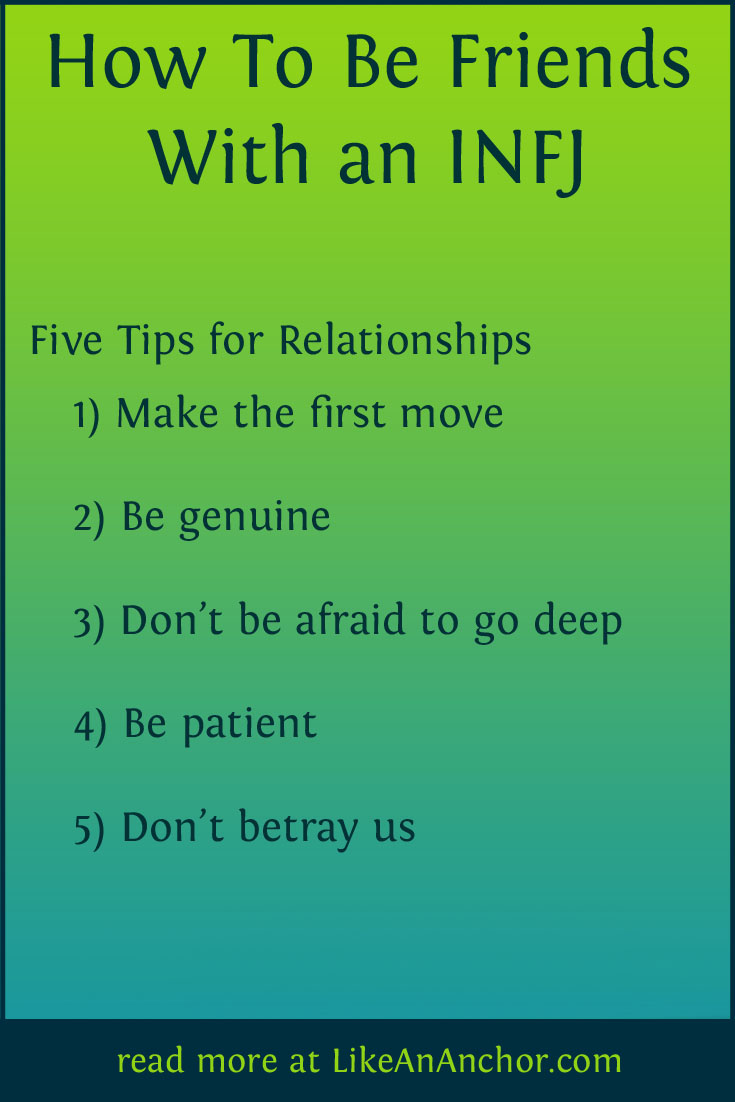
If you want to make friends with an INFJ, or get to know one better, there are a few key points to keep in mind. Some of these are true for all friendships, and especially friendships with INFJs, and others are more INF-specific. They are also a good first-step if you are romantically interested in an INFJ and want them to notice you.How To Be Friends With an INFJ | LikeAnAnchor.com

Five Tips for Relationships

1) Make the First Move

from INFJ Doodles

INFJs use extroverted feeling (Fe) to relate to the outside world. This means that we can draw energy from emotional interactions, and may appear more extroverted than other introverts. This is also true of ISFJs, who are often considered the most “extroverted” introverts since they love people so much.

Still, we are introverts, and we’re most comfortable talking with people we already know. If you want to get to know an INFJ, you’ll probably have to be the one who initiates a conversation. That lets us know you are interested in talking with us, which puts us at ease since we aren’t worried about whether or not we’re imposing on your time when you’d rather be doing something else.

2) Be Genuine

from INFJoe

Pairing Introverted Intuition (Ni) with Fe gives INFJs an almost super-human empathy. Many INFJs literally feel other people’s emotions, and we’re quick to pick up on unspoken cues that don’t match spoken words. We might not be able to tell what you’re holding back or lying about, but we can tell you’re not being genuine and that’s a huge turn off.

If an INFJ suspects you of being less than genuine, they loose interest very quickly. If you’re a new acquaintance, they might simply avoid seeing you again. If you’re someone they can’t avoid, then they will keep conversations civil but superficial. We don’t trust our true selves with people when we can’t get a read on what their true selves are like.

3) Don’t Be Afraid to Go Deep

INFJs have little interest in shallow conversations. We would rather have a few close friends than many casual acquaintances. The way the word “friend” is used has always bothered me as being imprecise. I have acquaintances, friends, and then close friends, but I just refer to them all as “friends” to avoid offending anyone who thinks they are a friend and then finds out I think of them as an acquaintance. People who meet INFJs often think that they know them well, while the INFJ thinks “they really don’t know me at all.”

If you want to be one of an INFJs close friends, then you have to make an effort to get beyond the superficial. INFJs respond very well to this, so once you indicate that you are interested in going beyond small-talk the sharing will go both ways. We like conversation, and we will talk as well as listen if we feel safe and interested. Here’s a great article called How To Turn Small Talk Into Smart Conversation. When I read this as an INFJ, my reaction was, “I wish more people would introduce themselves like this. I would be so much more interested in talking to them.”

4) Be Patient

found on Pinterest

Even if you’ve taken the first step to initiate a friendship, been completely honest, and encouraged deep conversation it can take quite a while for an INFJ to really open up. We have many layers, and the longer we are in a stable friendship with you, the more layers we’ll let you see. INFJs form instant perceptions of whether or not we can trust people, so first-impressions are important, but we also modify our impression based on how we observe your behavior over time. A bad first impression can be reversed if we see you making an effort to be friendly and trust-worthy, and a good first impression can be deepened as we see that what we’ve already shared with you stays safe.

Patience also comes into play during conversations. INFJs have trouble getting all their thoughts out into words. If the topic of conversation is something they’ve already thought about, they can speak readily and coherently. If it’s new and unfamiliar we typically do one of two things: 1) nod and make some general comments while our brains frantically race to come up with something to say. Usually that “something” shows up a week later in the shower. 2) start putting our thoughts into words, and sorting through ideas verbally. The final idea might take some time to emerge.

The second reaction is the one you’re going for in a friendship with INFJs. If we’re comfortable enough to think out-loud, it means we trust you. As long as you give us time to come up with an answer rather than look at us like we’re crazy, then we’ll relax and the conversation can continue to move forward. If you cut us off or jump to conclusions about what we think before we’ve had time to express outselves, we feel like you aren’t really interested in what we’re thinking and be hesitant to share with you later.

5) Don’t Betray Us

INFJs hold grudges. We might forgive readily (depending on the circumstances), but we don’t forget. It’s not something I’m proud of, but it is my automatic response. The closer you get to an INFJ, the harder it is to bounce-back to a close friendship after you’ve hurt us. The more we like you and the more we have invested in you, the more chances we’ll give you, but there’s a point at which we just give up and shut you out.

An INFJ might not completely sever ties with someone who has hurt them (depending on the nature of that betrayal), but they will withdraw. For example, if you give an INFJ the impression that you want to carry on a regular correspondence filled with deep discussion and then ignore her for 3 months and forget to answer any of her questions when you do reply, she will have no interest in continuing the correspondence.

Why Bother?

So why go to all this effort? What do you get out of a relationship with an INFJ?

check out this guide from Jennifer Soldner for more information about romantic relationships

For one thing, INFJs are surprisingly good fun to be around. We have a great sense of humor, delight in occasional spontaneity, and can talk about pretty much anything you like. But you don’t see all that until you make the effort to become friends. Until then, INFJs will hover in the background (away from other people) or blend in like a chameleon (with other people) to avoid stressful, superficial interactions.

INFJs are also good listeners, and we love to offer counsel. Sometimes we feel like our friends’ therapist, but we rarely mind. We want to help, and we’re good at suspending judgement. Since we’re so empathic, we aren’t often surprised by anything you tell us even if you thought you were doing a good job of keeping it hidden. Once it’s out in the open, we are sympathetic listeners who ask questions and want to fully understand what’s going on before we offer suggestions or any kind of judgements.

We’re also fiercely loyal. We don’t let many people get close, and we want to hold on to the very few that do become our true friends. We’ll do just about anything to keep the people we love in our lives. INFJs take the time to build-up their relationships, cultivate deepening friendships, and keep in touch with what’s going on in the lives of people we care about. We’re supportive, encouraging, and willing to adapt ourselves to make others happy as long as it doesn’t conflict with our core values. So get out there and start making friendships with INFJs. I don’t think you’ll regret it!

Save


Featured image credit: rawpixel.com via Pexels


If you’d like to know more about the INFJ personality type, check out my book The INFJ Handbook. I just updated it with a ton of new information and resources. You can purchase it in ebook or paperback by clicking this link.

Under His Wings

The Rabbi in my local Messianic congregation recently gave a series of teachings on the Lord’s “secret place” of safety where His people abide and dwell (Ps. 91). It has been excellent food for thought, and I thought it would be interesting to study one of the Hebrew words that the Rabbi didn’t focus on.

He shall cover you with His feathers, and under His wings you shall take refuge; His truth shall be your shield and buckler. (Ps. 91:4)

The word I want to look at is “wings,” from the Hebrew kanap (H3671). I knew from my Pentecost study on Ruth that this word could also mean the edge of a garment, but I hadn’t spent much time with it before.

Meaning of Kanap

Under His Wings | marissabaker.wordpress.com
feather images from LunaNYXstock

By the way … can anyone recommend a good Hebrew dictionary? I’m not entirely happy with Baker and Carpenter’s The Complete WordStudy Dictionary of the Old Testament. Nevertheless, that’s the one I have, so it’ll have to do for now. Here’s what they have to say about kanap.

A common noun for a wing, the skirt or corner of a garment. It has the basic sense of the outer edges, corners, or extremities of something … The idiom to spread (one’s) wings over means to take to wife … God is often noted as providing a shadow of protection for His people under His wings.

The book of Ruth provides examples of both the idiomatic sense, to marry, and the use of kanap in reference to God’s protection. Boaz tells Ruth,

The Lord repay your work, and a full reward be given you by the Lord God of Israel, under whose wings you have come for refuge. (Ruth 2:12)

Later, Ruth asks Boaz to be her redeemer by saying,

I am Ruth, your maidservant. Take your maidservant under your wing, for you are a close relative.(Ruth 3:9)

Protective Covering

Use of this word to describe God’s involvement with His people covers pretty much all of history, from Deuteronomy 32:11 which describes God leading Jacob as an eagle who spreads her wings over her young, to a prophecy in Malachi which reads,

But to you who fear My name the Sun of Righteousness shall arise with healing in His wings; and you shall go out and grow fat like stall-fed calves.(Mal. 4:2)

The Psalms show that this kind of active protection and help (Ex. 19:4) is available to all God’s peple who pray to Him and abide in Him.

How precious is Your lovingkindness, O God! Therefore the children of men put their trust under the shadow of Your wings. (Ps. 36:7)

Under His Wings | marissabaker.wordpress.com
feather images from LunaNYXstock

It’s a beautiful cycle: God’s loving kindness inspires trust, trust makes us stay close to God and abide under His wings, where He gives more proof of His mercy and love, which in turn makes us trust Him even more.

Be merciful to me, O God, be merciful to me! For my soul trusts in You; and in the shadow of Your wings I will make my refuge, until these calamities have passed by. (Ps. 57:1)

Trust in God is never misplaced. When He wraps His covering of protection around us, we can be assured of abundant help.

Because You have been my help, therefore in the shadow of Your wings I will rejoice. (Ps. 63:7)

We see this analogy continuing in the New Testament as well. Remember this Hebrew word can mean the edge of a garment as well as wings? In the gospels, simply touching the edge of Christ’s garment in a spirit of faith was enough to heal physical ailments (Matt. 9:20-22).

Wherever He entered, into villages, cities, or the country, they laid the sick in the marketplaces, and begged Him that they might just touch the hem of His garment. And as many as touched Him were made well. (Mark 6:56)

Under His Wings

There’s also a far more sobering New Testament continuation of this analogy with wings. It follows one of Jesus’ confrontations with the scribes and Pharisees.

O Jerusalem, Jerusalem, the one who kills the prophets and stones those who are sent to her! How often I wanted to gather your children together, as a hen gathers her chicks under her wings, but you were not willing! (Matt. 23:37)

Both “wanted” and “willing” in this verse are translated from the Greek word thelo (G2309). It “indicates not only willing something, but also pressing on to action. … Thelo, therefore, means to will as the equivalent to purpose, to be decided upon seeing one’s desire to its execution” (Zodhiates). Christ isn’t saying a ho-hum, “oh, it would have been nice to gather you, but you didn’t like that idea.” This word is much more focused. It shows Christ reaching out with a longing and an intention to help His people, and it shows them purposing in their hearts to actively reject Him. No wonder He wept over Jerusalem in Luke 19:41. This was not at all the relationship God wanted with His people.

In Ezekiel 16, we find a narrative where God is speaking to Jerusalem to reproach her for her unfaithfulness. It begins with a reminder that she was unwanted and despised until He took pity on her (verses 1-7).

 “When I passed by you again and looked upon you, indeed your time was the time of love; so I spread My wing over you and covered your nakedness. Yes, I swore an oath to you and entered into a covenant with you, and you became Mine,” says the Lord God. (Ezk 16:8)

God took notice of Jerusalem, and made a marriage covenant with her, covering her with the boarders of His garment and protecting her in the shadow of His wings. And then she chose to reject Him.

Your fame went out among the nations because of your beauty, for it was perfect through My splendor which I had bestowed on you,” says the Lord God. “But you trusted in your own beauty, played the harlot because of your fame, and poured out your harlotry on everyone passing by who would have it.” (Ezk 16:14-15)

The sobering truth is that we can also reject God’s covering protection. We can push Him away, batting aside the wings stretched out to shelter us, and run the opposite direction. I can partly understand a hesitancy to step into a close relationship with God. He wants to know us more intimately than anyone else ever can, and that can be intimidating. But to leave Him after tasting of the good fruits of being in a relationship with God boggles my mind right now. And yet that’s exactly what Israel did again and again.

Paul says the stories of Israel’s disobedience were “written for our admonition” (1 Cor. 10:11). If we need to be admonished by their example, then that must mean there’s a chance that we might do the same things they did. We need to be warned against rejecting God, and on guard against straying away from Him. Going back to Psalm 91 and reading the first few verses, it reminds us of the necessity for dwelling and abiding in close relationship with God. Only when we actively choose to walk into His outstretched arms can we take part in the wondrous relationship He offers us.

He who dwells in the secret place of the Most High shall abide under the shadow of the Almighty.  I will say of the Lord, “He is my refuge and my fortress; my God, in Him I will trust.” Surely He shall deliver you from the snare of the fowler and from the perilous pestilence. He shall cover you with His feathers, and under His wings you shall take refuge; His truth shall be your shield and buckler. (Ps. 91:1-4)