I’ve been so fascinated by the topic of “big questions” that I’ve added another monthly scripture writing list to the resources on this blog. You can read my other posts on this topic here:
Like the other scripture lists on this blog, “Big Questions” has a list of 30 scriptures that you can write out one per day for a month. At first, I thought about alternating “question-scriptures” with in-Bible answers to those questions, but I ended up just sticking with the questions. Many of them have answers right there in the next few verses, or later in the same books. Others are answered elsewhere in the Bible. For most, though, I have not included the “answer-scriptures” on this list.
I hope that by leaving this scripture writing list more open-ended, it will invite you to search out answers to those questions in the scriptures and/or meditate on how you’ve answered those sorts of questions for yourself. If you want to take the extra time, you might choose to write some of the answer scripturas as well or use this list to inspire a deeper study into one or more of the questions.
Download “Big Questions” scripture writing list here:
As I’ve studied “big questions” over the past couple of weeks, one in particular stuck in my mind. It’s a question the disciples asked Jesus during a big storm while they were crossing the Sea of Galilee in boat.
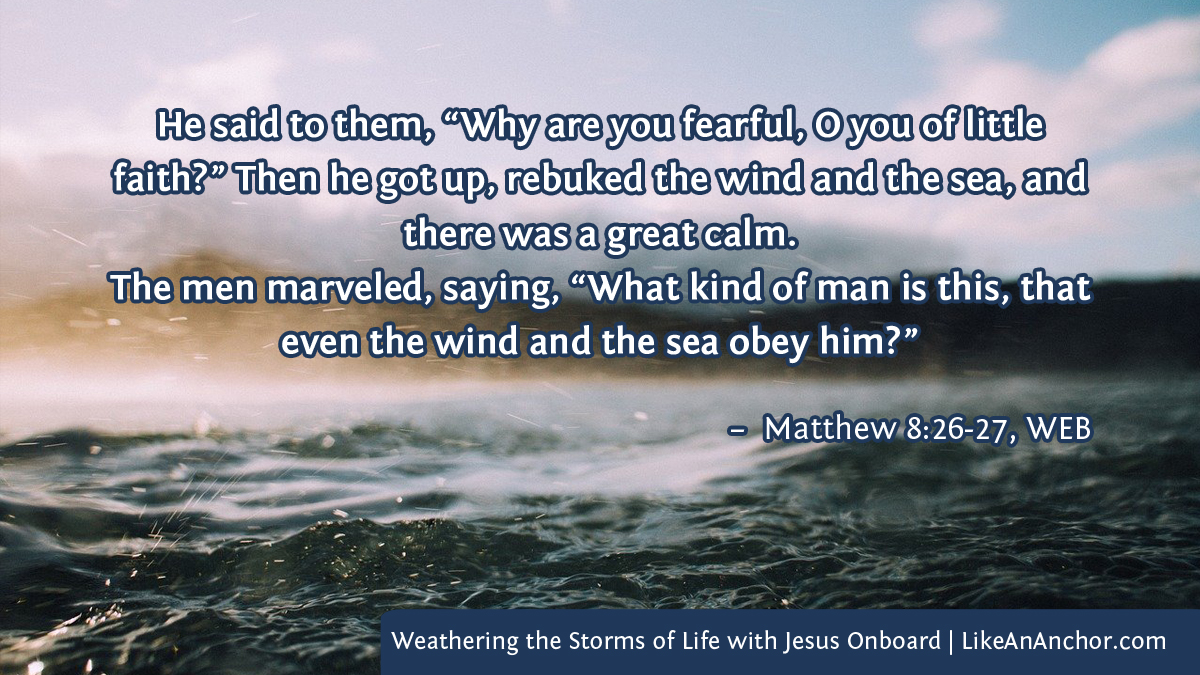
Now a great windstorm developed and the waves were breaking into the boat, so that the boat was nearly swamped. But he was in the stern, sleeping on a cushion. They woke him up and said to him, “Teacher, don’t you care that we are about to die?” So he got up and rebuked the wind, and said to the sea, “Be quiet! Calm down!” Then the wind stopped, and it was dead calm. And he said to them, “Why are you cowardly? Do you still not have faith?” They were overwhelmed by fear and said to one another, “Who then is this? Even the wind and sea obey him!”
Mark 4:35-41, NET
There are a few questions in this story. The disciples ask Jesus, “Don’t you care that we are all about to die?” I’m not sure they even expected Him to do anything other than wake up and reassure them. But then He calmed the storm, and had questions for them. He asked, “Why are you cowardly? Do you still not have faith?” From His perspective, there’d never been anything to worry about. That the disciples were worried showed they didn’t yet fully trust in Him or His power. Then the final question is one the disciples asked among themselves: “Who then is this?” Typical rabbis could not order a storm to stop and have it obey. This teacher they were following was clearly different than the usual prophets or rabbis.
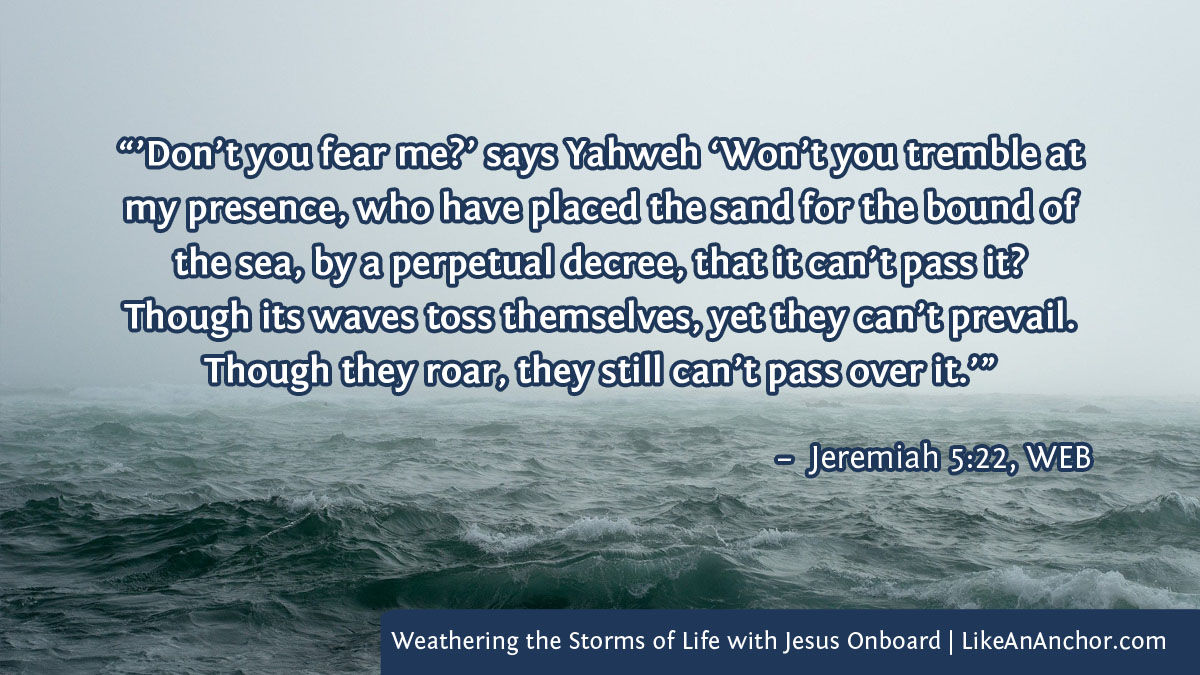
The Jews of Jesus’s day, including His disciples, were typically very familiar with the words of the Old Testament. Some of those words likely came to mind during this storm and miracle. In Job, God describes Himself as the one who “laid the foundations of the earth,” “shut up the sea with doors,” and “made clouds its garment” (Job 38:1-11). Psalms describe Him as the one who “walks on the wings of the wind” and “makes lightnings with the rain” (Psalms 104:3; 135:7). In the prophets, He’s the one who keeps the sea and its waves in check, causes the waves to “stir up and roar,” and “makes storm clouds” (Jer. 5:22; 31:35; Zech, 10:1). Perhaps the scripture most likely to come to the disciples’ minds, though, is in Psalms.
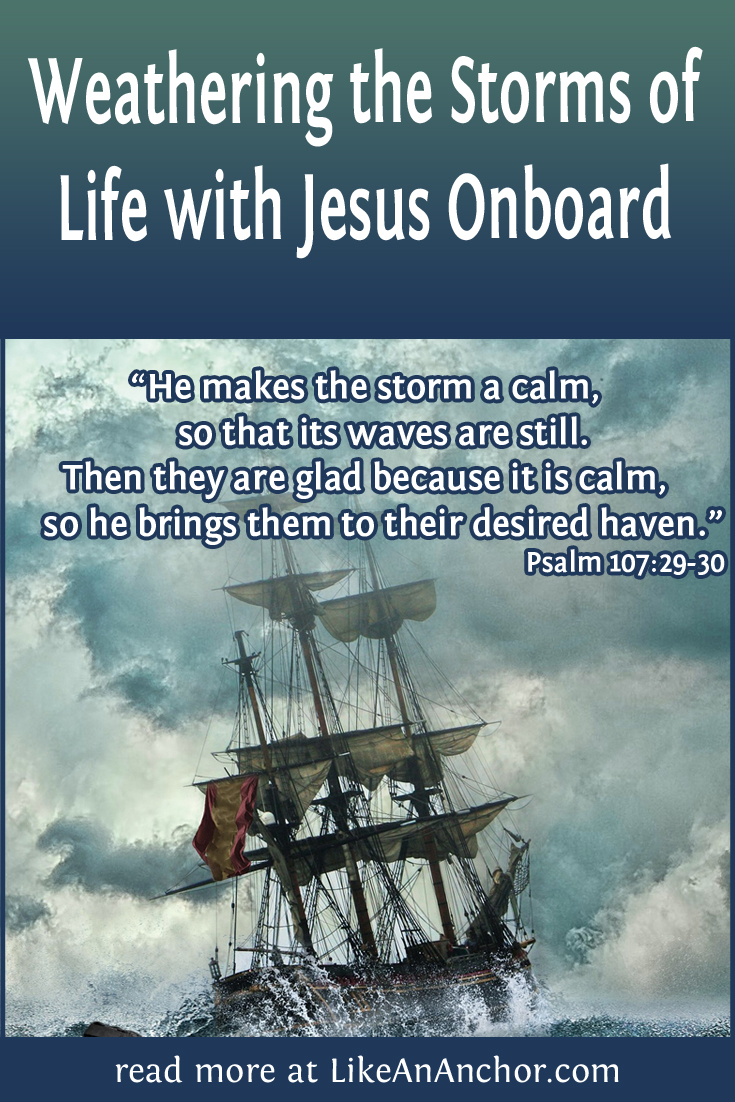
Those who go down to the sea in ships, who do business in great waters; These see Yahweh’s deeds, and his wonders in the deep. For he commands, and raises the stormy wind, which lifts up its waves. They mount up to the sky; they go down again to the depths. Their soul melts away because of trouble. They reel back and forth, and stagger like a drunken man, and are at their wits’ end. Then they cry to Yahweh in their trouble, and he brings them out of their distress. He makes the storm a calm, so that its waves are still.
Psalm 107:23-29, WEB
No wonder Jesus’s disciples were “overwhelmed by fear” even after He proved they weren’t going to die in a storm. He’d just done something only Yahweh could do. By calming the sea, Jesus illustrated He was God here on earth in the flesh.
In scripture, waves and storms are used as metaphors for great trials. God’s anger and judgement on persistently sinful people are linked to storms (Is. 28:2; 29:6; 30:30; Jer. 23:19; 30:23; Ezk. 30:3; Joel 2:2; Nah. 1:3). David speaks of being surrounded by “waves of death” and “floods of ungodliness” (2 Sam. 22:5; Ps. 18:4). Both David (figuratively for despair and possibly depression) and Johan (in a more literal sense) talk about being in the depths of the sea with “waves and billows” passing over them (Ps. 42:7; Jon. 2:3). In all these verses, the storms are representative of great trials or hardships.
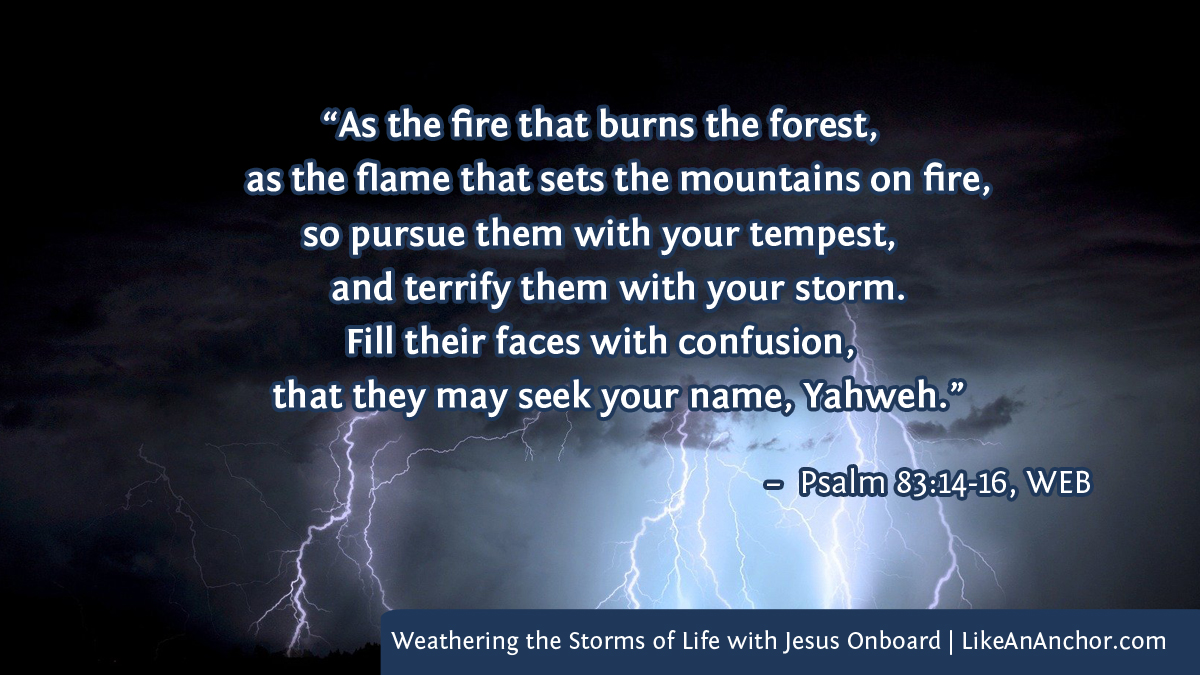
The purpose of such tempest and storms is “that they may seek your name, Yahweh” (Ps. 83:15-16). We’re to learn from the storms of life to listen to Yahweh and turn to Him for shelter and safety. Those who don’t learn that lesson may make “a shipwreck concerning the faith” and eventually find that God does not listen to their cries for help during storms (Prov. 1:24-29; Zech. 7:13-14; 1 Tim. 1:19). As the writer of Hebrews said, though, I am “persuaded of better things for you, and things that accompany salvation, even though we speak like this” (Heb. 6:9, WEB). Bible teachers don’t share warnings in order to condemn; we share them as reminders to keep faithfully seeking God. The righteous stand firm in the whirlwind and storm since they are founded on the Rock, and that is what I want for myself, for you, and for all who follow the Lord (Prov. 10:25; Matt. 7:24-27).
Keep Jesus in your boat, and the storms of life have no power over you. You might get tossed around and nearly swamped, as the disciples were when they cried out asking if Jesus cared that they were dying, but ultimately there’s nothing to worry about. Faith and hope anchor our souls (Heb. 6:19; 10:23).
With Jesus on board our ships, we can weather the storms of life. Working together in unity, He and His Father are the same God who created the seas and storms, and rule over them (Gen. 1:6-8; Job 28:23-27; Ps. 93:3-4; Eph. 3:8-9). They are the ones who’ve seen faithful people through earth-shaking storms and who still the roaring sea (Ps. 46:2-3; 65:7; 89:9; 107:29-30). Today, He still saves and anchors us so that “we are no longer to be children, tossed back and forth by waves and carried about by every wind of teaching by the trickery of people who craftily carry out their deceitful schemes” (Eph. 4:14, NET).
Yahweh, you are my God. I will exalt you! I will praise your name, for you have done wonderful things, things planned long ago, in complete faithfulness and truth. … For you have been a stronghold to the poor, a stronghold to the needy in his distress, a refuge from the storm, a shade from the heat, when the blast of the dreaded ones is like a storm against the wall.
Isaiah 25:1, 4, WEB
If we’re in the middle of a storm and asking God, “Don’t you care that we are about to die?” the answer is two-fold. First, God tells us we don’t need to worry so much; He’s got this. Second, He assures us that He definitely does care; He cares so much that Jesus came to this world and lived and died as a human being to save those who believe in Him and give them everlasting life.
As we face the storm-like trials of our lives, remember that Jesus is there with us in our boats. Even if it seems like He’s fallen asleep and isn’t paying attention, He still has us in His power and under His protection. Hold fast to Him, and He’ll get us through.
He has said, “I will never leave you and I will never abandon you.” So we can say with confidence, “The Lord is my helper, and I will not be afraid. What can people do to me?”
Since last week’s post, inspired by the big questions Leo Tolstoy asked in his book A Confession, I’ve been thinking about the questions that people in the Bible asked. From the sorts of questions recorded in Job, Psalms, Ecclesiastes, and elsewhere in scripture, it seems clear that God is okay with us asking Him things such as “Why am I here?”, “What is the purpose of suffering?”, and “What ought I do with my life?”
Today, we still have a lot of questions for God. Some of them are specific, such as “Why did that bad thing happen to me?” or “How can I decided what the next step for my life is?” Others are more general, the sorts of things that most thinking people wondered at some point in their lives, such as “What is the meaning of life?” and “Where do I fit into the universe?”
It often seems like these types of questions are too big to answer and so we shouldn’t try to ask them. Or it might seem as if we’re the only ones who haven’t figured this out yet, since everyone else seems like they’re functioning just fine. But we’re all asking questions and we all have things we’re uncertain about, just like people in the Bible. Even the “heroes of faith” like Job and David asked big questions, some of which seem audacious to us. We might expect God to get angry or offended at questions like “Why did you make me like this?” or “What do you think you’re doing, letting this terrible thing happen to me?” But throughout scripture, God shows remarkable patience with His people’s questions and also a willingness to answer. One of the most amazing things about Job’s story, for example, isn’t that Job asked questions about his suffering; it’s that God showed up to give an answer and ask questions of His own.
If you search for question marks in the Bible, you come back with 3,256 results in the WEB translation and 2,990 in the NET. The exact number varies depending on how translators choose to interpret phrases and where they put punctuation marks, but however you figure it up that’s a lot of questions. We can’t cover them all in one post, and not all fit in the “big questions” category. I’ve picked out four types of these questions I want to look at today, and there are plenty more that we could examine. If this inspires you to do a study on questions for yourself, I’d love to hear about it in the comments below or in an email.
In his darkest trials, Job asked why he’d even been born if this is what was going to happen (Job 3:11-16; 6:11-13; 10:18). It wasn’t a self-destructive thought for him, but it does seem to be one of frustration and despair. Why even live if suffering is the main result? What’s the point of being born, and living, and dying in a world where such terrible things can happen to good people?
Similarly, Solomon in Ecclesiastes wonders what the point is of living and working here on earth (Ecc. 1:3; 3:9; 4:8). Life seems to just go on and on with no real profit or gain, especially if you’re working alone rather than in a community. If there’s no satisfaction, or wealth, or any sort of meaningful profit then it’s all “vanity. Yes, it is a miserable business” (Ecc. 4:8, WEB). Others ask this type of question more specifically, wondering “What is the point of serving God?” (Job 21:15; Mal. 3:13-14).
God counters this sort of thinking with a question of His own: “Why do you spend money for that which is not bread, and your labor for that which doesn’t satisfy? Listen diligently to me, and eat that which is good, and let your soul delight itself in richness” (Is. 55:2, WEB). In other words, if our lives and efforts seems pointless it’s because we’re devoting them to the wrong sorts of things. This reminds me of one of Tolstoy’s observations in A Confession* that I wrote about last week. He realized that just because it felt as if his life wasn’t meaningful that didn’t mean all life had no meaning.
Another answer that God offers to this question is a clearer picture of Himself. He answered Job’s questions about the meaning of life and the purpose of suffering by revealing Himself to Job more fully (for an interesting take on that aspect of Job, see Philip Yancey’s The Bible Jesus Read*). It might seem an oddly indirect answer to us, but it’s one that appeared to satisfy Job. The clearer we can see and understand God, the more meaningful life seems.
*please note that this is an affiliate link, which means I'll earn a small commission (at no extra cost to you) if you purchase this book.
Faith in God answers a lot of life’s big questions. But it also brings up new questions. Once you believe that God exists and that He’s all powerful, it often follows that we wonder why He lets certain things happen. Why is there suffering? Why are there wars? How could a loving God allow such terrible things? Doesn’t He care?
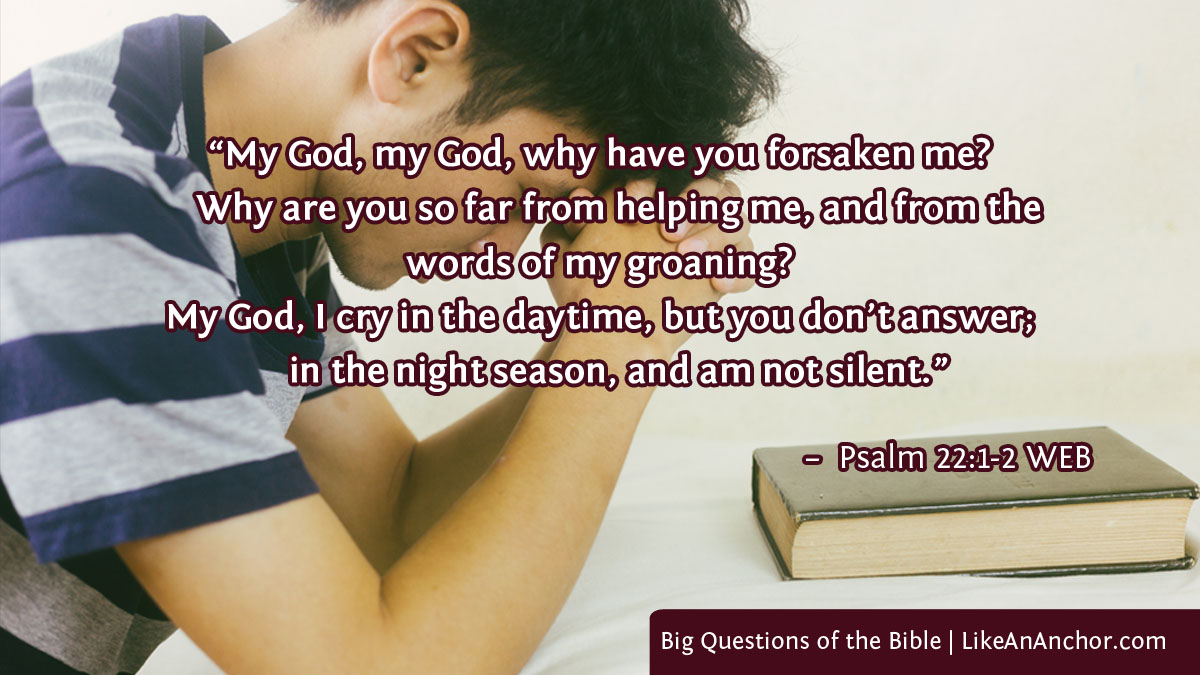
The psalms are full of these sorts of questions. “Why do you stand far off, Yahweh? Why do you hide yourself in times of trouble?” (Ps. 10:1, WEB), “My God, my God, why have you forsaken me?” (Ps. 22:1, WEB), and many more questions like these echo through history in the cries of many hurting people today (Ps. 13:1; 43:2; 44:24; 74:1, 11; 89:46; 108:11). We wonder why it seems that God leaves us alone in our times of trouble, and why it seems like He’s ignoring our cries for help (Lam 5:20; Hab. 1:2). Doesn’t He care about us at all?
There’s a story of a time when Jesus and his disciples were on a boat and a storm blew up. Jesus was sleeping through it, but they woke Him with the question, “Teacher, don’t you care that we are dying?” (Mark 4:38, WEB). Jesus hadn’t been worried at all, but at their question He got up and stopped the storm. I suspect there’s a reason Jesus wasn’t worried. With God on our side, the storms of life don’t present a real danger to us. Even if He seems to not be paying attention, He’s still very present and protective. He has the power to stop the storms instantly, and sometimes He does to show us His power and reliability, but things are still going to work together for good in the end even if He decides to let us go through the storms.
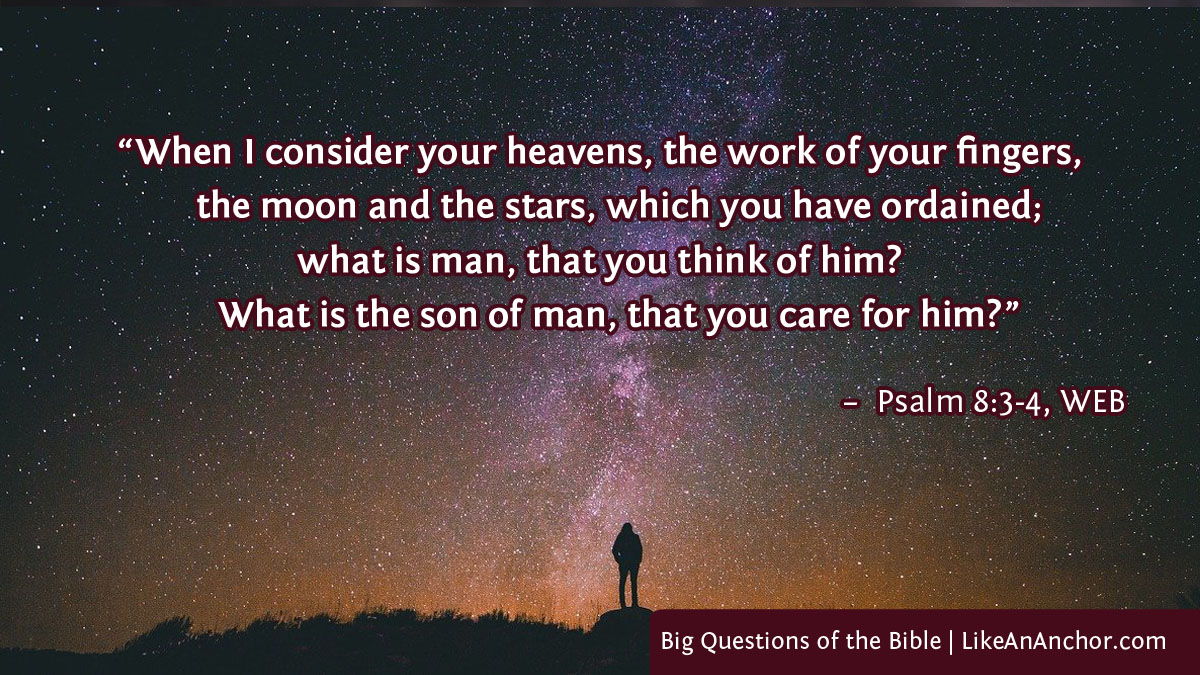
Perhaps a better question would be, “Why does God care so much?” There’s tons of evidence that God cares deeply about humanity. The main proof of that is found in Jesus’s sacrifice–God cares enough about us to die in our place. With that perspective in mind, our question may become “What are we that God should even think of us, much less care so much about us?” (Job 7:17; Ps. 8:4; Heb. 2:6). It’s awe-inspiring to think about the creator of the universe wanting us to be part of His family simply because He loves so much.
This next question is closely related to the last one. We wonder how long our trials will last, sure it would be better if God stepped in now and took care of things for us. We wonder how long it will be until the end comes, since it seems like the sooner the better for Jesus to return and stop pain, suffering, death, and evil. Similarly, we may question God’s planning and timing in other areas, wondering if He is unfair in the things that He commands or the way He interacts with people.
Even though these questions can sound like a lack of faith or an accusation, they’re still questions that it’s okay to ask. Jesus didn’t get upset when His disciples said, “Tell us, when will these things be? What is the sign of your coming, and of the end of the age?”–He just answered their question (Matt. 24:3, WEB). Yahweh didn’t cut-off Moses for asking, “How long must this suffering last?” (Ps. 90:13, NET). We can ask these things. It only becomes problematic when we decided the answer must be that God is wrong and we’re right.
Tolstoy talks about the insanity of this attitude by comparing “learned and liberal” people who reject God to kids who tear apart a watch without understanding how to put it back together, then complain that it doesn’t work. That’s similar to the analogies found in the Bible. When people accuse God of unfairness or of not knowing what He’s doing, God turns some big questions back on them. He says, “You turn things upside down!” It’s not for the creation to question the Creator and decide that He’s the one who lacks understanding. “Yet the house of Israel says, ‘The way of the Lord is not fair.’ House of Israel, aren’t my ways fair? Aren’t your ways unfair?” (Job 8:3; Is. 29:16; Jer. 2:5; Ezk. 18:23-29). God’s not the problem here; our limited understanding and lack of trust are what’s to blame.
A rich young man once asked Jesus, “Good teacher, what good thing shall I do, that I may have eternal life?” When Jesus replied that this man should keep the commandments, he responded, ““All these things I have observed from my youth. What do I still lack?” (Matt. 19:16-20; Mark 10:17-21; Luke 18:18-23). That question is at the top of my list for things I’d like to ask God and get a clear answer on right now. I grew up in the church and didn’t really have a rebellious phase (though that doesn’t mean I haven’t sinned/missed the mark on God’s commandments). But I do sympathize with this young man. I’ve been following God my whole life; what do I still lack?
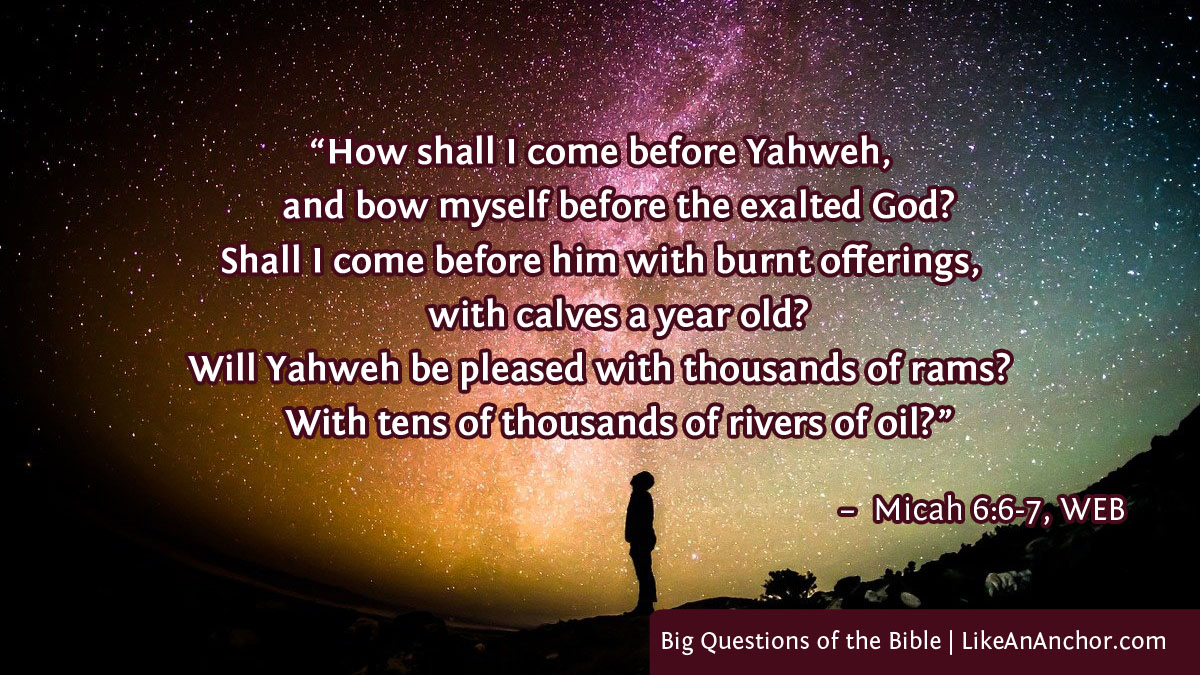
Whether you’re just starting out your journey as a Christian–like those in Acts whose response to hearing the gospel was, “What shall we do?” (Acts 2:37; 16:30)– or you’ve been following God for many years, the question of what to do now is a good one. Throughout scripture, people asked questions like, “How can man be just with God?”, “Where does wisdom come from?”, “Where is the good way?”, and “How shall I come before Yahweh?” (Job 9:2; 28:12, 20; Ps. 119:9; Jer. 6:16; Mic. 6:6-8). We treat these questions like they’re very complicated, but God gives us simple answers.
He has shown you, O man, what is good. What does Yahweh require of you, but to act justly, to love mercy, and to walk humbly with your God?
Micah 6:8, WEB
Jesus reiterates the simplicity of this point in the gospels. His answer to “How can we know the way?” is “I am the way, the truth, and the life” (John 14:5-6, WEB). His answer to “Which is the greatest commandment in the law?” and “What shall I do to inherit eternal life?” is to love God and love your neighbor (Matt. 22:35-40; Luke 10:25-29). It’s not that complicated.
God welcomes His people to engage with Him in real, dynamic relationship. Part of that relationship involves asking questions. If we have concerns, we’re invited to take them to God. If we have questions about Him or for Him, we ought to ask and then seek answers from Him through prayer, Bible study, meditation on the Word, and fasting.
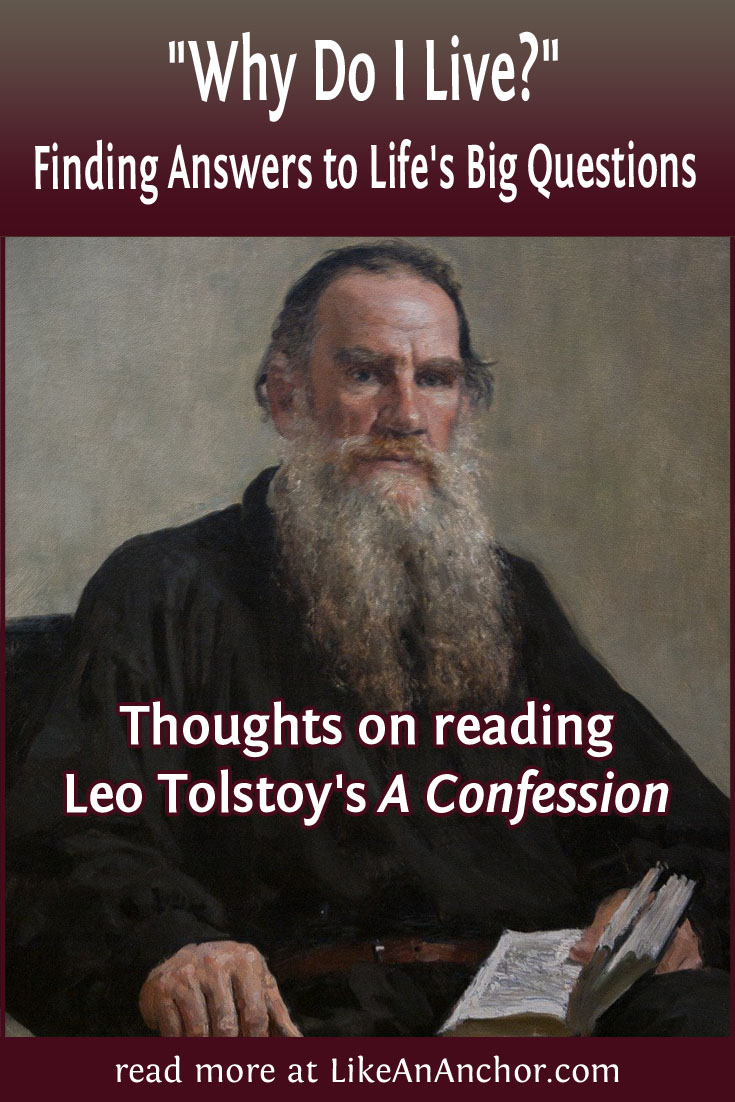
If you’re familiar with Leo Tolstoy, chances are it’s in the context of him being one of the greatest Russian novelists rather than as a Christian writer. He published his two best-known works in the mid-to-late 19th century: War and Peace in 1869 and Anna Karenina in 1878. It was after finishing Anna Karenina early in 1877, and before resuming his literary work in 1885, that he devoted himself to a close study of faith (reference: Aylmer Maude’s introduction to A Confession, The Gospel in Brief, What I Believe, printed by Oxford University Press).
Tolstoy’s essay titled A Confession was mostly written in 1879and was first circulated in Russia (with a short additional note from the author) in 1882 despite efforts to suppress its publication. In this essay, Tolstoy recounts his own loss of faith, the years of his life spent in dissipation among other “learned and liberal” people, and finally his disillusionment with that sort of life. He describes himself as coming to a seemingly inescapable realization that life is meaningless and that he ought to kill himself. This was a time of mental agony for him. Tolstoy was a highly successful and respected author, with a wife and children whom he loved, yet he had to hide ropes and guns lest he use them against himself.
As he recalls his reasoning in those days, Tolstoy talks about asking questions such as, “What am I with my desires?” and “Why do I live?” As a well-educated man, he naturally turned to science and reason for answers. Yet there, he found that people aren’t so much interested in answering these questions as they are in studying and observing the world. What he found from science indicated that everything happened by chance and you must understand “infinite complexity” and “the laws of those mutations of form” before you could hope to understand why you’re alive. Then Tolstoy turned to philosophy, where he found that philosophers had been asking his same questions for thousands of years. Yet they didn’t have an answer which satisfied him either–they just gave back “the same question, only in a complex form” (Section V).
People in the Bible also asked big questions, and we’re still doing that today as well. The questioner from the Bible whom Tolstoy focused on in his writings was Solomon, and he quotes extensively from Ecclesiastes (which I’ve written about in “Crash Course in Ecclesiastes”). Other Bible people who asked big questions include Job and his three friends. And while Solomon and Job are the first people who come to mind as wrestling with big questions, other questions like “If it is like this, why do I live?” (Gen. 25:22), “My God, my God, why have you forsaken me?” (Psalm 22:1), and “Is there unrighteousness with God?” (Rom. 3:5; 9:14) fill the pages of the Bible. We serve a God who invites us to ask big, difficult, and troubling questions and then come to Him for answers.
It’s fitting, then, that Tolstoy found the most satisfying answers for his big questions when he turned to faith. He realizes that just because he’d decided that his life was not meaningful did not mean all life was without meaning. As he looked around him, he realized that people had been acting as if life were meaningful for thousands of years. Perhaps they hadn’t been wrong. Perhaps they–and the people alive now who saw value in living–knew something that he’d missed. And so Tolstoy began seeking answers among those who believe that life is worth living in spite of the hardships, namely, among people of faith. He was not impressed by those Christians among his wealthy, highly educated acquaintances because most professed faith but did not live it out, but Tolstoy did find something to admire in the simple working people. Those people lived with faith that deeply affected their lives and which answered their big questions.
At this point, Tolstoy describes the highly educated and intelligent people who reject God as those who “have decided that the master is stupid or does not exist, and that we are wise, only we feel that we are quite useless and that we must somehow do away with ourselves” (Section XI). These sorts of people are so impressed with themselves that they’ve missed what gives life meaning. He also says, “Were it not so terrible it would be ludicrous with what pride and self-satisfaction we, like children, pull the watch to pieces, take out the spring, make a toy of it, and are then surprised that the watch does not go” (Section IX). It should be no surprise that if we try to take out God and faith–which make life worth living and reveal the meaning of existence– we’ll feel as if life is worthless and meaningless. Tolstoy found this born out in his own experiences: “I need only be aware of God to live; I need only forget Him, or disbelieve Him, and I died” (Section XII).
A Confession is a fascinating read. Tolstoy speaks frankly about terribly difficult subjects, including his struggles with suicidal thoughts and with finding answers to life’s most important questions. He also touches on his conflicts with church dogma (in this case the doctrines of the Russian Orthodox church), which I understand he develops more fully in writings that I haven’t yet read. In a way that reminds me a little of C.S. Lewis, Tolstoy left his childhood Christian faith and then later came back as a more mature and intelligent adult, concluding that God is the only thing which can give life meaning.
So many people in the modern world like to set up “faith” and “reason” as things that are opposed. I love reading about highly intelligent people like Lewis and Tolstoy who come to the conclusion that faith in God is the only reasonable answer to life’s big questions. It helps encourage me that a life of faith is not a life that’s opposed to reason, logic, and intelligence–that, in fact, the most reasonable use of our intelligence leads to the conclusion that faith in God is right and good.
We don’t often give the minor prophets much attention, beyond telling the story of Jonah or studying some sections if you’re curious about future and fulfilled prophecies. I find, though, that when I do study them or run across a verse from one in word searches that their messages are often surprisingly relevant for today. The section of a minor prophet’s book to most recently catch my eye is a verse at the end of Habakkuk.
The short book of Habakkuk records an exchange between the prophet and God, then ends with a psalm/prayer. At the beginning, Habakkuk looked at the nation around him and cried out to the Lord about how “the law lacks power, and justice is never carried out” (Hab. 1:4, NET). He wants God to intervene and make things right, as so many of us want today. However, when God answers it is not the way Habakkuk hoped or expected. God says He’s going to “empower the Babylonians” (Hab. 1:6) to take over Israel.
Habakkuk is so horrified that he argues with God (Hab. 1:12-2:1). God is not obligated to explain Himself to people, yet in this case he does. He talks about how people of integrity ought to live (“the righteous will live by his faith,” see Hab 2:4; Rom. 1:17; Gal. 3:11; Heb. 10:38), and contrasts how He relates to those people with what awaits the wicked. He proclaims, “Woe!” to those who’ve rejected Him and promises that “recognition of the Lord’s sovereign majesty will fill the earth” (Hab. 2:14, NET). It’s quite a lengthy response (Hab. 2:2-20), and Habakkuk seems satisfied with it since the next part of the book is a prayer, likely set to music, praising God. That’s where we’ll focus today.
Receiving Good and Evil from the Lord
Earlier, Habakkuk protested the Lord’s plan to punish His people, but now after talking with God the prophet’s perspective changed. In the prayer recorded at the end of this short book, there’s an odd mix of talking about destruction and salvation. People today often struggle to reconcile the idea of a God that would allow suffering with a God that is salvation, deliverance, and love. Habakkuk doesn’t seem to have that trouble.
Yahweh, I have heard of your fame. I stand in awe of your deeds, Yahweh. Renew your work in the middle of the years. In the middle of the years make it known. In wrath, you remember mercy. …
Plague went before him, and pestilence followed his feet. He stood, and shook the earth. He looked, and made the nations tremble. …
You went out for the salvation of your people, for the salvation of your anointed. You crushed the head of the land of wickedness. You stripped them head to foot. Selah.
Habakkuk 3:2, 5-6, 13, WEB
This reminds me of a question Job asked his wife: “Should we not receive what is good from God and not also receive what is evil?” (Job 2:10, NET). If we believe God is sovereign and that He is responsible for all the good things that happen in our lives, then we ought to trust Him through the bad things as well. There could be something going on that we don’t know about, such as Job suffering as part of God showing that one man’s faith, tested by fire, could make a cosmic difference. Or maybe God is punishing an unfaithful nation and we get caught up in that even though we’re faithful, as happened here with Habakkuk. Or maybe He’s allowing suffering in order to test, refine, and strengthen us (which is the context that the New Testament writers usually mean when they talk about God testing or trying us. See, for example, 1 Pet. 1:6-8; 4:12-13). Whatever the reason for the suffering, the message Habakkuk holds onto is that God is still worthy of trust. He has a plan. He will take salvation action. The timing for that might not make sense to us (yet), but that does not cancel-out the fact that we can have faith in the Lord’s plan and His goodness.
Holding on to Joy
At the end of the prayer, Habakkuk voices some very understandable nervousness. He talks of trembling, knowing that he “must wait quietly for the day of trouble, for the coming of the people who will invade us” (Hab. 3:17, WEB). He has talked with God about what will happen in the future, accepted the Lord’s response, and decided to trust. He is still nervous, but then he makes a very powerful statement of radical faith.
For though the fig tree doesn’t flourish, nor fruit be in the vines; the labor of the olive fails, the fields yield no food; the flocks are cut off from the fold, and there is no herd in the stalls: yet I will rejoice in Yahweh. I will be joyful in the God of my salvation! Yahweh, the Lord, is my strength. He makes my feet like deer’s feet, and enables me to go in high places.
Habakkuk 3:17-19, WEB
Even if the food supply collapses and the country is overrun by invaders, Habakkuk intends to rejoice. He is not rejoicing because those bad things happen, but because they have no power to take away the true cause of Habakkuk’s joy. God is sovereign! He is salvation and strength! That’s not going to change, and holding on to that truth lets us rejoice in Him and claim Him as our savior. No matter what comes, we can imitate Habakkuk’s faith and boldly say, “I will be joyful in the God of my salvation!
The word began with darkness overcome by light. Millenia after that, Light once again entered a world that had become dark and chaotic to start another great transformation–a recreation that will ultimately result in God’s kingdom being fully present here on earth. The opening sections of Genesis and John’s gospel both describe God as an active creator bringing light into darkness, and they talk about that action as profoundly meaningful. The contrast between light and darkness, and God’s role as Light, is mentioned again and again in scripture from psalmists and prophets to New Testament letter writers.
If you’ve ever had the power go out at night and couldn’t find a candle or flashlight, or been in a cave and turned out the lights to experience the profound blackness of being underground, then you know what a relief it can be to have light suddenly available when you’d been in darkness. But you might also know that light can hurt, such as when you step outside into blindingly bright sunlight or you’ve been half-dozing in a dark room and someone walks in and flips the light switch. In many ways, this is also how Light works on a spiritual level. We’ve all been in spiritual darkness, some longer or darker than others but all characterized by a separation from God. He’s in the business of bringing light to darkness, though, and when He enters our lives with Light it can be a relief, a shock, or both.
“Let There Be Light”
In the beginning there was formless emptiness, darkness, and chaos. Then God said, “Let there be light.” There’s depth to that phrase even in English, and it gets a whole lot deeper when we look at the Hebrew. First, right before God calls light into existence, the Hebrew word used in the creation story for water changes from “watery deep” (tehom, chaotic abyss, salty ocean) to “water” (mayim, general word for life-giving water). Then, “the first thing God does is correct the darkness; without light there is only chaos” (NET footnotes on Gen. 1:1-3). There’s also wordplay in the Hebrew so that “let there be” expresses “both the calling into existence and the complete fulfilling of the divine word” (NET). It’s a profound transformation accomplished by God speaking Light.
In the beginning was the Word, and the Word was with God, and the Word was fully God. The Word was with God in the beginning. All things were created by him, and apart from him not one thing was created that has been created. In him was life, and the life was the light of mankind. And the light shines on in the darkness, but the darkness has not mastered it.
A man came, sent from God, whose name was John. He came as a witness to testify about the light, so that everyone might believe through him. He himself was not the light, but he came to testify about the light. The true light, who gives light to everyone, was coming into the world.
John 1:1-9, NET
Light and dark, order and chaos, life and death. The contrasts are sharp between what God offers and any other option available in this world. And just like God spoke light into existence at the beginning, so He’s offering to speak light into our lives today. The Word–the Light–“took up residence among us,” and those who come to Him will be God’s children (John 1:10-14). That’s just as true now as it was for all of Bible history.
One of the most well-known passages in the Bible is John 3:16. Keep reading after that verse, and Jesus talks about how He was sent to save the world and that people are condemned (or not) based on whether they believe in Him (John 3:16-18). Then, He talks about light.
Now this is the basis for judging: that the light has come into the world and people loved the darkness rather than the light, because their deeds were evil. For everyone who does evil deeds hates the light and does not come to the light, so that their deeds will not be exposed. But the one who practices the truth comes to the light, so that it may be plainly evident that his deeds have been done in God.
John 3:19-21, NET
When I read this, I think of that fantasy/sci-fi trope of having nasty, skulking, dangerous creatures that want to eat you being unable to walk in sunlight (think vampires, fyrnocks from Star Wars Rebels, and Tolkein’s goblins). Light can be scary and even painful for the sort of people we are apart from God. Even after we’ve started following God, I dare say most of us have felt that urge to shy away from His light and try to hide the more shameful parts of ourselves. But even if we’re scared, deep down the truest version of ourselves is not the sort of thing that light kills. God’s light only burns away the things that don’t fit with who we’re truly meant to be–people made in the image of God with glorious potential to be just like Him one day.
for you were at one time darkness, but now you are light in the Lord. Live like children of light—for the fruit of the light consists in all goodness, righteousness, and truth—trying to learn what is pleasing to the Lord.
If we want to live as children of light, we need to be the sort of people who come to the Light. That’s just another way of saying we need to believe in and follow Jesus, who said “I am the light of the world! The one who follows me will never walk in darkness, but will have the light of life” (John 8:12, NET). It’s impossible to understate the importance of this idea; it’s at the center of the gospel.
Now this is the gospel message we have heard from him and announce to you: God is light, and in him there is no darkness at all. If we say we have fellowship with him and yet keep on walking in the darkness, we are lying and not practicing the truth. But if we walk in the light as he himself is in the light, we have fellowship with one another and the blood of Jesus his Son cleanses us from all sin.
1 John 1:5-7, NET
As I write this , we’re about a week away from Passover–the day commemorating Jesus’s sacrifice and the renewing of our commitment to follow Him. Before that day, Paul tells us in 1 Corinthians 11 to examine ourselves. Here, in these verses about light, we have a question we can ask as part of that: “I say that I’m walking with Christ, but is my life more reflective of His light or the world’s darkness?” If we can’t honestly answer that we’re walking in the light, then we need to change some things.
Arise! Shine! For your light arrives! The splendor of the Lord shines on you! For, look, darkness covers the earth and deep darkness covers the nations, but the Lord shines on you; his splendor appears over you.
Isaiah 60:1-2, NET
I don’t know about you, but it often feels like there’s chaos and darkness pressing in on me, and I certainly see it filling up the world. But there’s good news! Our God is light. We can choose to walk in His light, and as we do the blood of Jesus covers our sins. We are not helpless victims of the darkness. We’ve been rescued and empowered. We get to shine, like Jesus does, because we’re sharing His light.






 Like An Anchor