Priests and Kings — Attached to Praise

In Genesis 29, we’re briefly introduced to a woman who plays a key role in Biblical history. Though she is largely overlooked, her legacy shaped the religion we now call Christianity in fascinating ways.

Now Laban had two daughters: the name of the elder was Leah, and the name of the younger was Rachel. Leah’s eyes were delicate, but Rachel was beautiful of form and appearance. (Gen 29:16-17)

The matriarchs of Genesis see themselves as filling their godly role when they have children who grow up to play key roles in Biblical history. These women are heroes of motherhood as well as of faith. They have their own speaking lines, personalities, and relationships with God, but they’re typically remembered in terms of the children they raised.

Priests and Kings -- Attached to Praise | marissabaker.wordpress.com
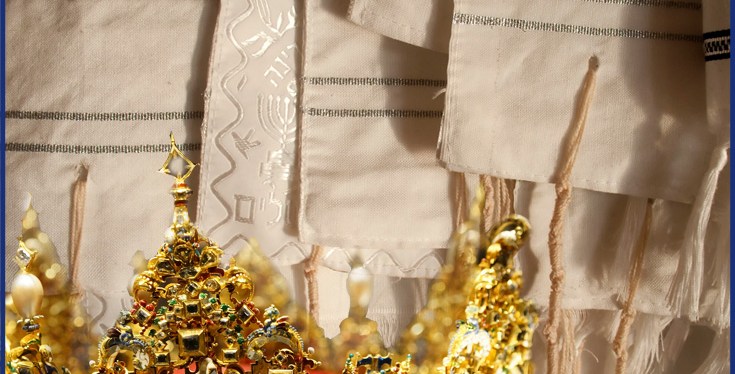
photo credits: “Tallitot” by Robert Couse-Baker (CC BY); “Danish royal crown” by Dion Hinchcliffe (CC BY-SA); “Shofar and Candlesticks” by slgckgc (CC BY)

Leah mothered 6 of Jacob’s 12 sons, as well as the only daughter recorded for any patriarch. Her sons Levi and Judah were the ones God used to found lines of priests and kings. Though the story of Rachel and her son Joseph overshadow the other sons in Genesis, kingship and priesthood play a huge role in God’s plan and there’s much we can learn from Leah’s take on the birth of her sons. Read more

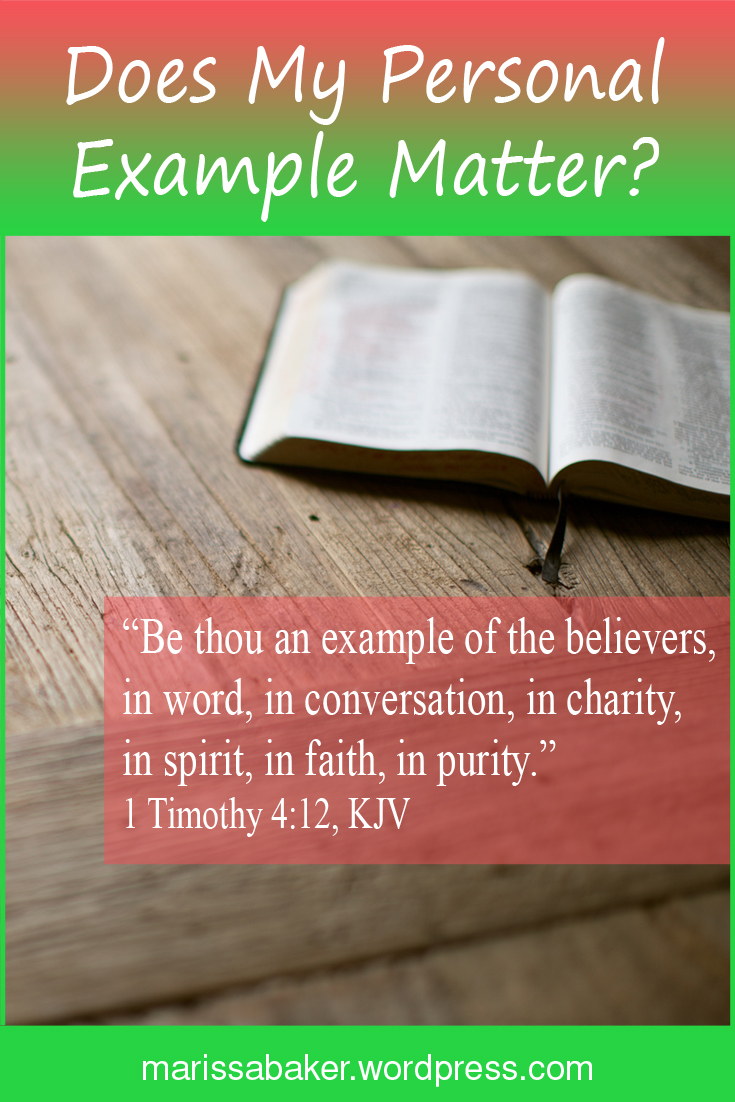
Does My Personal Example Matter?

I’m borrowing the title for this post from a sermon I heard last month. The speaker said “Does my personal example matter?” was a question Google didn’t have an answer for, and he was right — searching this phrase only turns up results on “personal matters” and “personal opinions.” Searching for “Why is it important to set a good example?”, though, turns up some interesting results. On the first page, you’ll see articles on parents setting a good example for children, leading by example in the workplace, and the importance of role models. Clearly, there are those who believe your personal example does matter.
Does My Personal Example Matter?  | marissabaker.wordpress.com

Most of the articles I saw connected setting an example with leadership. Indeed, this is inherent to the English definition of the word “example” (as found on Merriam-Webster.com):

: a person or way of behaving that is seen as a model that should be followed

: one that serves as a pattern to be imitated or not to be imitated

: one that is representative of all of a group or type

In the Greek, we have several words translated “example,” but they build a similar picture to our English idea. Tupos (G5179) means a print, prototype, pattern or model. Hupogrammos (G5261) is something that’s written down so it can be copied. Hupodeigma (G5262) refers to an example, pattern, or representative of a type. Deigma (G1164) means an example, specimen, or sample.

A Model To Follow

As Christians, we’re called both to follow an example and to be an example.

For to this you were called, because Christ also suffered for us, leaving us an example, that you should follow His steps (1 Pet. 2:21)

This verse is the only time hupogrammos is used in scripture. The word comes from hupo (before/under) and grapho (to write). It paints a picture of a teacher writing out letters and phrases for a student to copy. In effect, Peter is telling us to study and “trace over” the lines of Christ’s life exactly.

We can also learn from the examples of our fellow believers. James tells us to “take the prophets, who spoke in the name of the Lord, as an example of suffering and patience,” and mentions Job as a specific example (James 5:10-11). These and others, like the people in the faith chapter, are positive examples modeling Godly life.

Other examples show us what not to do. Israel’s history was “written for our admonition” and “these things became our examples, to the intent that we should not lust after evil things as they also lusted” (1 Cor. 10:11, 6). Ananias and  Sapphira are another example of how we ought not to act. Such examples serve as a model of what happens when we stray from God.

Jesus Christ is the key to knowing which examples to follow. Paul writes, “Imitate me, just as I also imitate Christ” (1 Cor. 11:1). We need to know the example of Christ, follow Him, and check our role models against the pattern He set. Only then will be be able to tell which examples are worth imitating.

Being An Example

I mentioned earlier that setting a good example is connected with being a leader. Everyone in the church has leadership and ministerial responsibilities, though to different extents and in different roles. We’re all part of “a royal priesthood, a holy nation, His own special people, that you may proclaim the praises of Him who called you” (1 Pet. 2:9). Part of this calling involves Jesus Christ making “us kings and priests to His God and Father” (Rev. 1:6). Those are roles of responsibility, roles that people look to for an example.

As we follow the Lord, we can inspire and reach others by our examples, as the Thessalonians did. Paul wrote to them, saying, “you became examples to all in Macedonia and Achaia who believe. For from you the word of the Lord has sounded forth,” and not just locally. Their faith in God “has gone out, so that we do not need to say anything” (1 Thes. 1:7-8). Their example was more effective at preaching than words.
Does My Personal Example Matter?  | marissabaker.wordpress.com

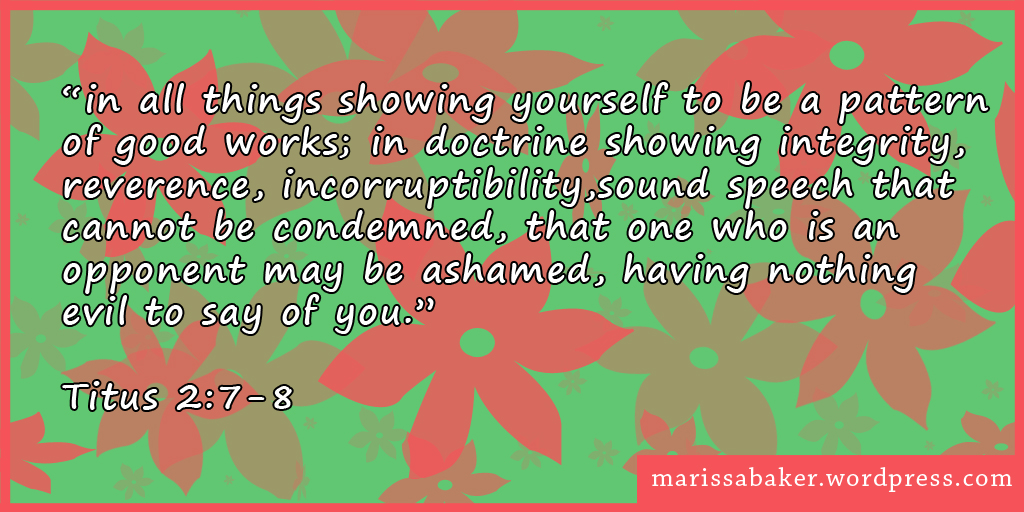
Indeed, we teach by what we do equally (if no more) effectively than by what we say. Writing to a young minister, Paul told him to teach “sound doctrine,” yes, but also to lead by example — “showing yourself to be a pattern of good works; in doctrine showing integrity, reverence, incorruptibility” (Tit. 2:1, 7).

Shepherd the flock of God which is among you, serving as overseers, not by compulsion but willingly, not for dishonest gain but eagerly; nor as being lords over those entrusted to you, but being examples to the flock (1 Pet. 5:2-3)

Representatives

In addition to patterning an example for other believers, we’re also supposed to be examples of what a Christ-follower looks like.

Let no man despise thy youth; but be thou an example of the believers, in word, in conversation, in charity, in spirit, in faith, in purity. (1 Tim. 4:12, KJV)

No matter our age, ability, gift, or role in the church, we can serve as a representative of the Christian type. We are “the epistle of Christ … written not with ink, but with the Spirit of the living God; not in tables of stone, but in fleshy tables of the heart.” (2 Cor. 3:3). We can be seen, “known and read of all men” (2 Cor. 3:2). Indeed, as some have said, you may be the only Bible some people ever read.

Our example doesn’t just “matter.” It’s powerful. We have the amazing opportunity, and responsibility, to show the world how God’s people are supposed to live — to be Christ’s body as we model His love for our brethren and for everyone on the planet.

Download God's Love Story at https://www.smashwords.com/books/view/577523


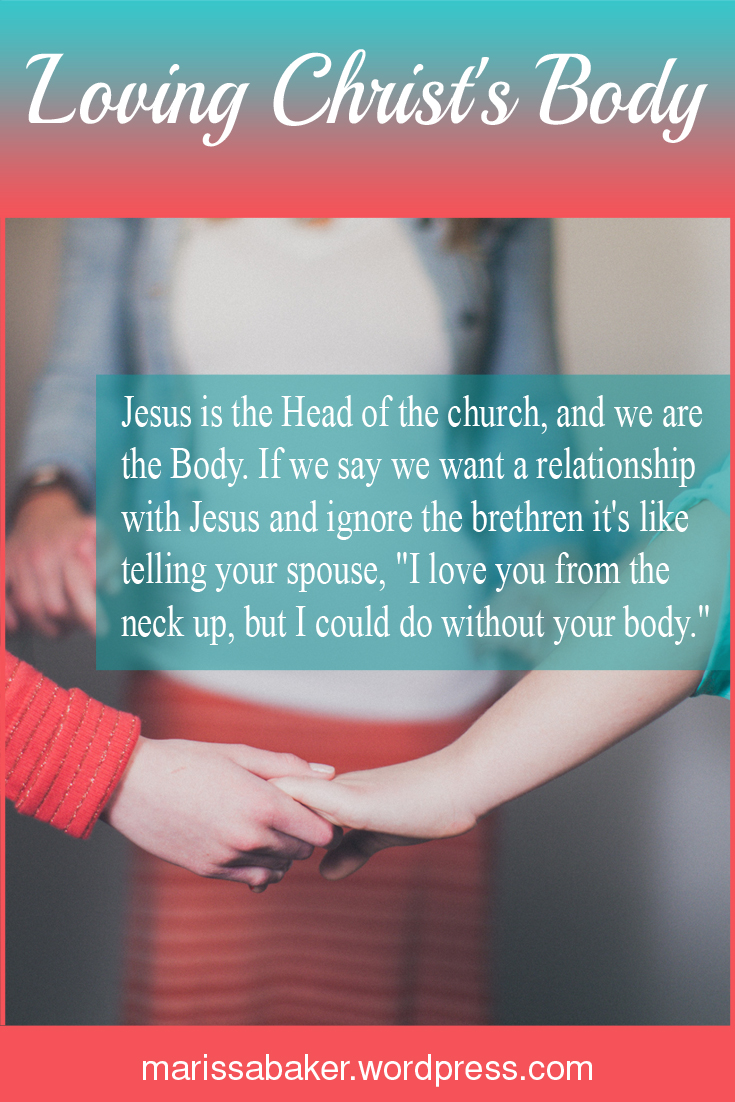
Loving Christ’s Body

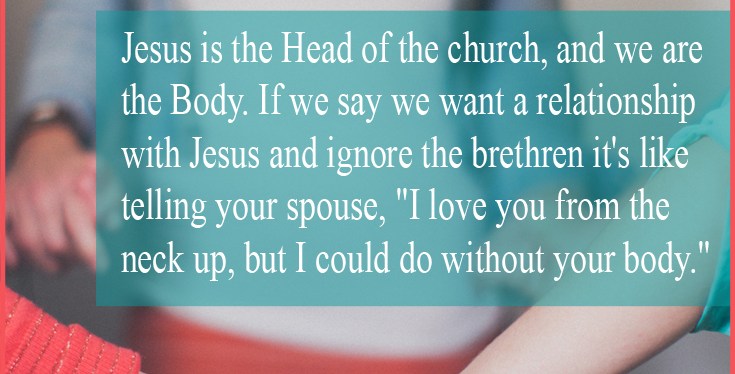
Not too long ago, I heard an analogy on a Christian radio station that stuck with me. It was a pastor trying to convince listeners they need a church to fellowship with. He said that since the church is Jesus Christ’s body and He is the Head, if we say we want a relationship with Jesus and ignore the brethren it’s like telling your spouse, “I love you from the neck up, but I could do without your body.”

Loving Christ's Body | marissabaker.wordpress.com

Vital Commandments

This analogy is not an exaggeration. John’s writings make very clear the high value Jesus puts on love among believers. If we can’t love our brethren, we’re actually incapable of loving God. Read more

What (if anything) must you do to be a Christian?

Is there anything we have to do in order to be a Christian? Some will tell you the answer is “no” — that salvation is a free gift and once you accept it you’re a Christian and there’s nothing else you need to do. Others will say “yes” — that you’re not a Christian unless you keep God’s commandments and follow Jesus Christ.

The truth is that God offers salvation freely, but you have to accept the gift on God’s terms. Those terms are called covenants — agreements that involve two parties binding themselves together with oaths. On the spiritual level, God initiates covenants, establishes the terms and promises, and binds Himself to the covenant oaths. These covenants are unfailing and sure, regardless of human action. We can choose whether or not to walk in covenant with God, but the covenant, and associated consequences for sin, stand whichever you decide.

What (if anything) must you do to be a Christian? | marissabaker.wordpress.com

Choose Covenant

“I make this covenant and this oath, not with you alone, but with him who stands here with us today before the Lord our God, as well as with him who is not here with us today,” Moses recorded in Deuteronomy 29:14-15. Not entering into covenant with God does not mean you’re getting out of consequences for sin — it means you’re choosing a path of death (Deut. 29:18-28).
Read more

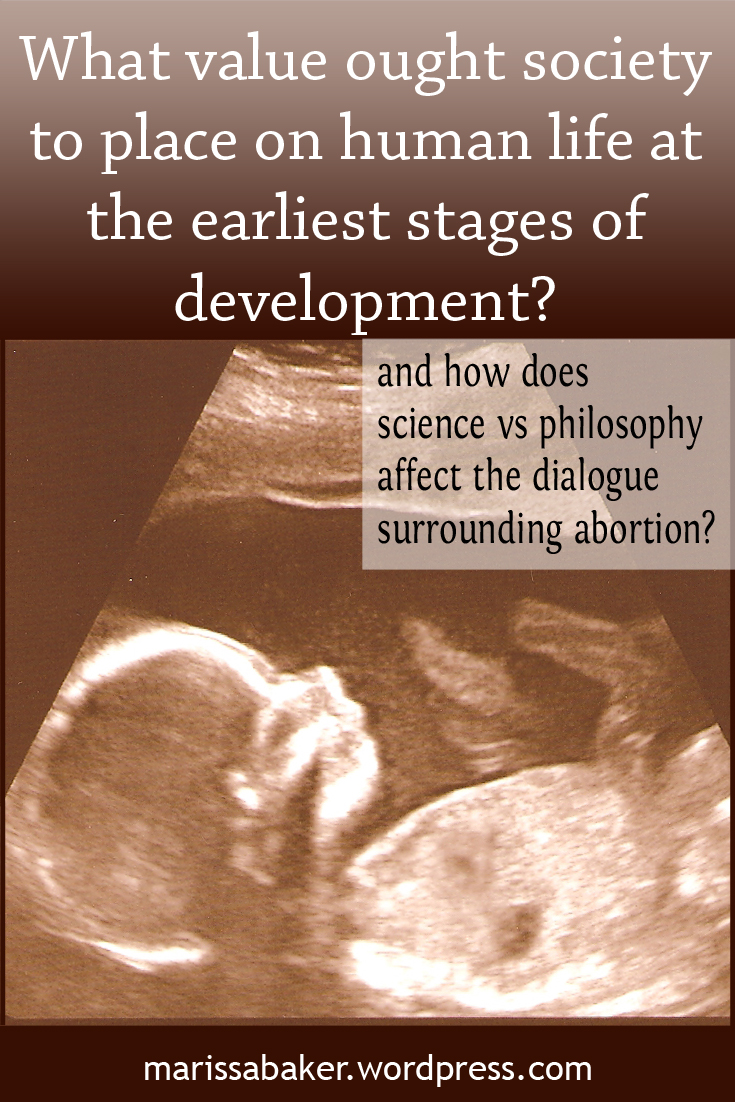
When Should We Value Human Life?

In the abortion debate, one of the things people like to argue is at what point the fetus qualifies as a living human being. Is it when the heart starts beating around 3 weeks? Is it when we can detect higher brain functions at at 22–24 weeks? Is it when the fetus is “viable” without the mother? Or after the baby has been born?

There’s plenty of science to indicate that a unique human entity is created either at the moment of conception or at cellar division about 24 hours later. The zygot, and then the fetus, is alive when a genetically unique cell forms that can grow, metabolize, and respond to stimuli. You can click here to read an excellent white paper on the subject written by Maureen L. Condic, Ph.D, Associate Professor of Neurobiology and Anatomy at the University of Utah School of Medicine. She concludes,

This view of the embryo is objective, based on the universally accepted scientific method of distinguishing different cell types from each other, and it is consistent with the factual evidence. It is entirely independent of any specific ethical, moral, political, or religious view of human life or of human embryos. Indeed, this definition does not directly address the central ethical questions surrounding the embryo: What value ought society to place on human life at the earliest stages of development?

I was on a pro-choice action network website, and they’re perfectly willing to admit that the fetus is alive and that it’s human (click here for the article I was reading). What they contend is that the fetus isn’t a human being yet (they distinguish “human being” from “human”). They also contend that a fetus does not have the right to live parasitically at the expense of its mother if she doesn’t want to carry to term because her person-hood and right to choose is not in dispute. They’ll then turn the argument to the “rights of the woman,” asking why we’re so ready to sacrifice her right to decide whether or not to have a baby on the altar of a fetus’s “hypothetical” right to be born.

Even at this point in the argument, you can see it really isn’t about science or objective fact. The facts are that the fetus is genetically unique, human, and alive from the moment of conception. That’s not in dispute. In reality, the question we should be asking is not, “When does the fetus become human?” but rather, “At what point do we value human life?”

When Should We Value Human Life? | marissabaker.wordpress.com
Photo Credit: “hello in there!” by Adrienne Bassett, CC BY via Flickr

The main leg the pro-life movement has to stand on is convincing society that we should value the life of unborn people so much that killing them is legally considered murder. We can use the science, but ultimately that’s not going to convince people to fight against abortion. People who support the legal right to terminate pregnancies know fetuses are alive — they just don’t think it matters. Our battle needs to be fought on philosophical and moral grounds.

Recent polls show that while more American’s describe themselves as pro-choice than pro-life right now, 51% think abortion should only be legal “under certain circumstances” verses 19% saying legal “under any circumstances (Gallup Polls). Getting into more detail about exactly what this means, we see 84% of Americans want tight restrictions on abortion: 25% say it should be legal in the first 3 months, and the others are divided between only in cases of rape or incest, to save the life of the mother, and not legal at all. (Marist Poll).

The Marist Poll also reports that even though only 13% of respondents favored banning abortion under every circumstance, 60% believe abortion is morally wrong. In today’s America we hate the idea of imposing our morality on other people, but we still do that every day we continue to (rightly!) maintain that murder, rape and pedophilia are wrong. Why is it so hard for us to extend that moral stand to protecting unborn life? And how far are we going to let this go? When we as a society set arbitrary limits on what makes a human life qualify as a human being, we’re on a very slippery slope. In 2011, two researchers in Australia published a paper titled “After-birth abortion: why should the baby live?” I’ve not read the whole paper, but this is the researcher’s own succulent abstract statement of what their work is about:

Abortion is largely accepted even for reasons that do not have anything to do with the fetus’ health. By showing that (1) both fetuses and newborns do not have the same moral status as actual persons, (2) the fact that both are potential persons is morally irrelevant and (3) adoption is not always in the best interest of actual people, the authors argue that what we call ‘after-birth abortion’ (killing a newborn) should be permissible in all the cases where abortion is, including cases where the newborn is not disabled.

While these researchers were not widely supported and later claimed their argument was taken out of context, it was a step in a disturbing trend. Informal evidence suggests college students are increasingly in favor of “after-birth abortions” up to 4 or 5 years old because they believe children that age aren’t “self-aware” yet (never mind that psychologists say children become “self-aware” between 1 to 3 years, usually 18 months).

It’s ridiculous to suggest that a fetus suddenly becomes a human being at 3 months, or at birth, or whatever age you decide to go with, but that he or she isn’t a human being a few minutes, hours, or days earlier. When you take such an argument to it’s farthest extent, you either have to believe human life is precious from conception or arbitrarily define a point at which humans are protected and before which they are not.

While we’re on the subject of valuing human life, I want to point out that a pro-life argument should never be anti-women. As one blogger who works with at-risk women points out, “Abortion isn’t so much about a woman having a choice — but a woman feeling like she has no choice at all.” While I want abortion to be illegal because I firmly believe no human being has the right to decide they can kill another, I also want to create a world where women don’t feel they have to or should have abortions. Where violence against pregnant women who want to keep their child stops. Where people are honest about what actually happens to both the mother and unborn child during an abortion. Where we consider the physical, emotional and psychological risks to the mother and stop pretending abortion is pro-woman.

It is our right and it is our duty to stand up to injustice, to speak out against moral wrongs and fight to correct them. And if we’re Christians, this is doubly the case. We’re called to “choose life, that both you and your descendants may live” (Deut. 30:19). God talks about knowing His people pre-birth and calling prophets and judges “from the womb”  (Judg. 13:5; Is. 49:1, 5; Jer. 1:5; Gal 1:15). Other verses talk about Him forming children inside the womb and being involved in birth (Job 31:15; Ps. 22:9; 139:13; Is 44:2), and about in-womb children reacting like and being treated as people (Gen 25:23; Luke 1:41). For Christians to say that murder is wrong but killing an unborn child is not just doesn’t add-up. There are certain areas in which we cannot be like our culture, and this is one of them.

Firstfruits From the Rejects

All the holy days point to Jesus Christ, often in multiple ways. For the soon-approaching Pentecost — the Feast of Firstfruits — Jesus is Himself “the firstfruits of those who have fallen asleep” because He was the first of God’s people to raise from the dead to eternal life (1 Cor. 15:20-23). He’s also the one who redeemed us, making it possible for us to be firstfruits, and He’s the reason we receive the Holy Spirit, which was first given to the New Testament church on Pentecost (John 14:26; 16:7).

On the surface, the term “firstfruits” simply refers to the first agricultural produce of the harvest season. In the Hebrew scriptures, firstfruits were offered to God before you harvested anything for yourself. This offering occurred after Passover on a Sunday morning and kicked-off the 50-day count to Pentecost (Lev. 23:1-21).

Firstfruits From the Rejects | marissabaker.wordpress.com
photo credit: “Barley” by Susanne Nilsson , CC BY-SA

Pentecost, also called the Feast of Weeks or Feast of Harvest, pays a key role in God’s plan. Even churches that no longer keep the other holy days often mark Pentecost because that’s when the Holy Spirit was given to the New Testament church (Acts 2:1-4). In Leviticus 23, instructions about the wave-sheaf, 50-day count, and Pentecost occupy more than 1/3 of the entire chapter. Clearly, there’s something here we’re supposed to take careful note of.

Gleanings and Ruth

Embedded in the holy days discussion of Leviticus 23 is a peculiar verse. It doesn’t seem related to the chapter’s subject, yet it follows immediately after the instructions about Pentecost.

When you reap the harvest of your land, you shall not wholly reap the corners of your field when you reap, nor shall you gather any gleaning from your harvest. You shall leave them for the poor and for the stranger: I am the Lord your God. (Lev. 23:22)

Why would God put this law in place while discussing the holy days? It doesn’t seem to make sense. It does, however, connect Pentecost with the story of Ruth. In Jewish tradition, Ruth is read every Pentecost, and perhaps that’s a clue as to why the law of gleanings is discussed here.

When Ruth and Naomi arrived in Bethlehem they’re both poor and Ruth was a “stranger,” a Moabitess instead of an Israelite. She more than qualified for gleaning under the law given in Leviticus, as well as the repetition in Deuteronomy 24:19 which added the “fatherless” and the “widow” to the list of those who could glean.

Instead of just letting Ruth glean, Boaz offered her protection (Ruth 2:9), provided food for her (2:14), and told his reapers to drop grain on purpose so she could glean as much as she wanted (2:15-16). When she first meets Boaz, Ruth’s relation to him is strikingly similar to us when first encountering Christ. He is good, and wealthy, and powerful while we have nothing. We don’t deserve anything from Him, and yet He offers us blessings beyond expectation.

Firstfruits From the Rejects | marissabaker.wordpress.com
photo credit: “Wheat” by Susanne Nilsson , CC BY-SA

Opening Salvation

When Jesus died, He opened up the covenants to non-Israelites. Prior to accepting His sacrifice, we were all “strangers from the covenants of promise, having no hope and without God in the world” (Eph. 2:12). We were the sort of people who couldn’t expect more than the gleanings.

But He answered [the Gentile woman] and said, “It is not good to take the children’s bread and throw it to the little dogs.” And she said, “Yes, Lord, yet even the little dogs eat the crumbs which fall from their masters’ table.” (Matt. 15:26-27)

Jesus did honor this woman’s faith and heal her daughter (Matt. 15:21-28), but by-and-large people outside Israel didn’t have access to God before the cross. Strangers who converted, like Ruth (Ruth 1:16; 2:12), were the exception rather than the rule. That didn’t really happen until after Christ’s Passover sacrifice, His ascension to the Father on wave-sheaf Sunday (click here for a timeline), and the Pentecost recorded in Acts 2.

Then Peter said to them, “Repent, and let every one of you be baptized in the name of Jesus Christ for the remission of sins; and you shall receive the gift of the Holy Spirit. For the promise is to you and to your children, and to all who are afar off, as many as the Lord our God will call.” (Acts 2:38-39)

Peter didn’t realize this included Gentiles until latter (Acts 10:34-35, 44-48; 11:18), but speaking by inspiration of the Spirit He still proclaimed salvation for all whom God calls. This was a huge step in God’s plan to save the world through Jesus Christ (John 3:16; 12:47), and it’s connected with Pentecost.

Redeemed Firstfruits

In the epistle of James, we’re told the Father “brought us forth by the word of truth, that we might be a kind of firstfruits of His creatures” (James 1:18). The church is composed of the first people God will “harvest” from the world. We’re a rather unusual sort of firstfruits, though.

For you see your calling, brethren, that not many wise according to the flesh, not many mighty, not many noble, are called. But God has chosen the foolish things of the world to put to shame the wise, and God has chosen the weak things of the world to put to shame the things which are mighty; and the base things of the world and the things which are despised God has chosen, and the things which are not, to bring to nothing the things that are, that no flesh should glory in His presence. (1 Cor. 1:26-29)

God picks us up from the things devalued and discarded by the world. In other words, He finds His firstfruits among the gleanings. He’s taking people who are underwhelming and overlooked and transforming us into something glorious. Like Ruth, we were strangers who are brought into fellowship with God’s people by a Redeemer (Ruth 2:20; Tit. 2:13-14).

Firstfruits From the Rejects | marissabaker.wordpress.com
photo credit: “Wheat” by Susanne Nilsson , CC BY-SA