What Will God’s People Do In The Future?

I just got home from celebrating the Feast of Tabernacles (Sukkot) with my family and many other believers around the world. My family was in Tennessee this year for the Feast, and the fall colors on the trees made for a beautiful backdrop to this joyful festival season. If you’re not familiar with this Feast as one of God’s holy days, check out my post “Understanding the Days that God Calls Holy To Him.” If you are familiar with this day, then you probably know that we believe it pictures the Millennial reign of Jesus Christ after His second coming.

In the future, Jesus will return to earth again. Faithful believers who died will be resurrected and those still alive will rise up along with them to meet Jesus. We’ll be changed, then, to spirit beings like God (1 Cor. 15:52; 1 John 3:2) as the Father completes the process of birthing/adopting us into His family as children and then marrying us to His Son Jesus. The adversary, Satan, will be locked away, and a 1,000-year time period we call the Millennium will begin where Jesus reigns over the earth (Rev. 20).

Then what happens? What are we going to be doing during the Millennium in God’s kingdom, and even into the future after that?

Reign With Him

The main thing we know about our role in the Millennium is that we’ll be working alongside Jesus Christ. We’re told in Revelation that the faithful believers who died (i.e. “fell asleep” in Jesus) and rise again in the first resurrection “will be priests of God and of Christ, and they will reign with him for a thousand years” (Rev. 20:6, NET). We know from other passages this will be a resurrection to spiritual life (1 Cor. 15). If we’re in this group, we’ll be like God and death will no longer have power over us (1 John 3:2; Rev. 20:6).

 So I endure all things for the sake of those chosen by God, that they too may obtain salvation in Christ Jesus and its eternal glory. This saying is trustworthy:

If we died with him, we will also live with him.
If we endure, we will also reign with him.

2 Timothy 2:10-12, NET

Salvation is a process that culminates in our change to spirit beings as part of God’s family. As God-family members, we’ll reign alongside Jesus Christ, seated with Him on His throne (Rev. 3:21-22). Most of the other things that we know we’ll be doing are part of this role.

Image of a man sitting on a beach at sunset overlaid with text from Rev. 20:6, NET version: "Blessed and holy is the one who takes part in the first resurrection. The second death has no power over them, but they will be priests of God and of Christ, and they will reign with him for a thousand years.
Image by Aaron Kitzo from Lightstock

Serve as Priests

We already read the verse that says, “they will be priests of God and of Christ, and they will reign with him for a thousand years” (Rev. 20:6, NET). This is actually a role that God’s people were supposed to start filling all the way back in the time of Exodus. When ancient Israel arrived at Mount Sinai, Yahweh told Moses to tell the people, “Now therefore, if you will indeed obey my voice and keep my covenant, then you shall be my own possession from among all peoples; for all the earth is mine; and you shall be to me a kingdom of priests and a holy nation” (Ex. 19:5-6, WEB). Israel never lived up to that goal, but that’s still something God wants from His people.

 you yourselves, as living stones, are built up as a spiritual house to be a holy priesthood and to offer spiritual sacrifices that are acceptable to God through Jesus Christ. … you are a chosen racea royal priesthooda holy nationa people of his own, so that you may proclaim the virtues of the one who called you out of darkness into his marvelous light. 

1 Peter 2:5, 9, NET (italics mark allusions to and quotations from Ex. 19:5-6; Is. 43:20-21; Mal. 3:17)

In the introduction to Revelation, John says Jesus Christ “loves us and has set us free from our sins at the cost of his own blood and has appointed us as a kingdom, as priests serving his God and Father” (Rev. 1:5-6, NET). Note that there is a slight discrepancy in the Greek here: some manuscripts use the word basileia (kingdom) and some use basileus (king). That’s why you’ll see “kings and priests” or “kingdom of priests” or “priestly kingdom” depending on the translation. Either way, we’ll have a duty to serve within God’s kingdom as priests.

Rule as Judges

Though it’s unclear whether anyone in the resurrection will be called a “king” other than David (Ezk. 37:24), we will be filling a ruling role as we reign alongside Jesus. It seems that this role is closely linked with that of having authority to judge.

Then Peter said to him, “Look, we have left everything to follow you! What then will there be for us?” Jesus said to them, “I tell you the truth: In the age when all things are renewed, when the Son of Man sits on his glorious throne, you who have followed me will also sit on twelve thrones, judging the twelve tribes of Israel.”

Matthew 19:27-28, NET

This verse is specifically about the 12 Apostles, but Paul tells us “that the saints will judge the world” and even that “we will judge angels” (1 Cor. 6:2-3, NET). How to judge righteously is one of the things we should be learning now, in this life (1 Cor. 6:1-11), partly because it’s an aspect of God’s character that we need to develop to be more like Him and partly because it’s a skill we’ll need in the future.

“And to the one who conquers and who continues in my deeds until the end, I will give him authority over the nations—

he will rule them with an iron rod
and like clay jars he will break them to pieces,

just as I have received the right to rule from my Father—and I will give him the morning star. The one who has an ear had better hear what the Spirit says to the churches.”

Revelation 2:26-29, NET (bold italics mark a quotation from Ps. 2:9)

God places a high value on righteousness and justice. He prioritizes those things when He uses His authority as judge, and we will be following that pattern of judging righteous judgement (John 7:24) with the authority He’ll give us in the Millennium. Sometimes, righteousness and justice demand punishment as consequences for wrongdoing, but we’ll also get the chance to exercise godly mercy.

Image of a Bible lying open on a wood platform with sunlight shining on the pages overlaid with text from Isaiah 32:1, WEB version: "Behold, a king shall reign in righteousness, and princes shall rule in justice."
Image by Lamppost Collective from Lightstock

Serve As Jesus Does

It’s vital that we remember God’s idea of a reigning, ruling, authority figure is very different than what the world typically thinks of. When humans have a lot of power, they almost universally abuse it. God will not tolerate such a thing from His people, now or in the Millennium.

But Jesus called them and said, “You know that the rulers of the Gentiles lord it over them, and those in high positions use their authority over them. It must not be this way among you! Instead whoever wants to be great among you must be your servant, and whoever wants to be first among you must be your slave—just as the Son of Man did not come to be served but to serve, and to give his life as a ransom for many.”

Matthew 20:25-28, NET

We’ll rule the same way that Jesus does–by serving the people under our authority. Pride, arrogance, and lording it over others has no place in a godly ruler. In fact, treating other people like that now can disqualify us from being in God’s kingdom (Matt. 24:45-51). This brings us to an important point. God is watching us today and making a judgement as to whether we can be trusted with the roles He plans to give His people in the future (1 Peter 4:17). If we can’t show Him now that we can become humble, service-oriented, teachable people who will faithfully follow His will, then He’s not going to entrust us with the true riches (Luke 16:10-11).

Teach People

We’ve been talking about how we’ll be ruling, but who will we be ruling? When you read through Revelation, you’ll notice that there are people who aren’t included in the first resurrection and who aren’t killed during the tribulation. There will be human beings alive in the Millennium who survive the end times leading up to Jesus’s return and live on into the Millennium. By the time Satan is released at the end of the 1,000 years, there are whole nations on earth for him to attempt to deceive (Rev. 20:7-8). Coupling that information with Old Testament prophecies (for example, Is. 11:1-9; 65:17-25), we can piece together that when the saints are ruling with Jesus as spirit beings who are part of God’s family, there will also be physical human beings on the earth.

For the people will dwell in Zion at Jerusalem. You will weep no more. He will surely be gracious to you at the voice of your cry. When he hears you, he will answer you. Though the Lord may give you the bread of adversity and the water of affliction, yet your teachers won’t be hidden any more, but your eyes will see your teachers; and when you turn to the right hand, and when you turn to the left, your ears will hear a voice behind you, saying, “This is the way. Walk in it.”

Isaiah30:19-21, WEB

If we’re worthy to be in the first resurrection and rule with Jesus as kingly priests, it’s very likely that we’ll be the teachers saying, “This is the way” and showing people how to walk with God. God wants His people to “obey my statutes and carefully observe my regulations” now and there’s no indication that will change in the future (Ezk. 36:27, NET). We will continue to serve Him and keep His commands and we’ll teach others to do so, including the command to keep His Sabbaths and holy days like the Feast of Tabernacles (Zech. 14:16-19).

Live Forever With God

Image of a woman with her arms raised in worship silhouetted by a sunset, overlaid with blog's title text and the words, "God has a glorious future planned for His people, which includes ruling alongside Jesus and doing the things that godly rulers do."
Image by Brittney BorowskiL from Lightstock

Once God transforms us into spirit beings, death has no more power over us . We’ll be immortal (1 Cor. 15:50-54; 1 Thes. 4:16-17). For those in the first resurrection and those who are written in the Book of Life following the end of the Millennium and the second resurrection, life continues on after the Millennium. We don’t know much about what we’ll be doing as we live forever with God, but we know that there will be a profound change in the earth and that humanity will live more closely with God than ever before.

 Then I saw a new heaven and a new earth, for the first heaven and earth had ceased to exist, and the sea existed no more. And I saw the holy city—the new Jerusalem—descending out of heaven from God, made ready like a bride adorned for her husband. And I heard a loud voice from the throne saying: “Look! The residence of God is among human beings. He will live among them, and they will be his people, and God himself will be with them. He will wipe away every tear from their eyes, and death will not exist any more—or mourning, or crying, or pain, for the former things have ceased to exist.”

Revelation 21:1-4, NET

It can be fun to speculate about the details of what we might be doing in this incredible future, but God evidently didn’t want to tell us too much. I suspect the long-term future He has planned is so wonderful we couldn’t wrap our minds around it. We just need enough of a glimpse to know that we want to be there, and to motivate us to keep growing toward the goal of spending forever with God.

God’s plan is so beautiful, and at the end of the story told in the Bible He promises a “happily ever after” greater than we could possibly imagine. Satan and his influence will be done away with. Peace will fill the whole earth. And, assuming we are among the faithful holy people of God during our human lives, we’ll be transformed into spirit beings who are part of God’s family. As God-family members, we’ll be ruling with Jesus Christ and doing the things that Godly rulers do: serving humbly, judging righteously, and teaching truthfully.


Featured image by Lamppost Collective from Lightstock

The Action Words of Faith

The other day as I was reading through Hebrews 11, I noticed the faith chapter follows a pattern: “By faith [name] [action].” Each time the writer mentions a hero of faith, they following it by saying what it was this person did by faith.

As we’ve been studying here on this blog for the past three weeks, faith is linked with the actions we take (see “The Obedience of Faith,” “Be Careful How You Listen,” and “Increase Our Faith“). I thought it might be fitting to follow these posts up with one that’s more concrete; one that moves past discussing faith in action as a concept to looking at the actions that people of faith really did. Hebrews 11 isn’t an exhaustive list, but it is a great place to start.

We Understand

 By faith we understand that the worlds were set in order at God’s command, so that the visible has its origin in the invisible.

Hebrews 11:3, NET

I’ve never before stopped to think about the fact that the faith chapter starts with us. We think of this as a list of heroes of the faith, but the very first people mentioned is “we”–the author and all the readers. None of us were there at the creation of the world. The understanding we have to worship God as Creator is something we do by faith.

Abel Offered

  By faith Abel offered God a greater sacrifice than Cain, and through his faith he was commended as righteous, because God commended him for his offerings. And through his faith he still speaks, though he is dead.

Hebrews 11:4, NET

Abel’s faith prompted him to give an offering to God. If we do this today it’s usually money, but in the Old Testament God’s followers gave physical offerings. In Genesis, we read, “Abel brought some of the firstborn of his flock and of its fat. Yahweh respected Abel and his offering” (Gen. 4:4, WEB). Something about Abel’s offering and the way he presented it pleased God and led to Him commending Abel’s righteousness. We’ll see this connection between action, faith, and righteousness repeated with Abraham as well.

Enoch Pleased God

 By faith Enoch was taken up so that he did not see death, and he was not to be found because God took him up. For before his removal he had been commended as having pleased God. Now without faith it is impossible to please him, for the one who approaches God must believe that he exists and that he rewards those who seek him. 

Hebrews 11:5-6, NET

Enoch is the one break in our “By faith [name] [action]” pattern. Here, “Enoch was taken” by God–it’s God doing the action, not Enoch. The lines that follow, though show that Enoch was doing something to please God. We’re not sure exactly what all was involved in that, but it is linked with “believe” (translated from pisteuo, the verb/action word form of pistis, which is faith as a noun/thing/concept).

Noah Constructed, Condemned, and Inherited

 By faith Noah, when he was warned about things not yet seen, with reverent regard constructed an ark for the deliverance of his family. Through faith he condemned the world and became an heir of the righteousness that comes by faith.

Hebrews 11:7, NET

I still think about a study I published in 2016 “Grace To Build An Ark.” The first time we see “grace” in the Bible, it’s when God decided to spare Noah and his family from the flood. Like the grace we receive, Noah couldn’t have enacted this salvation on his own, but once he received grace he took action. He built an ark, and here we learn that he did that “by faith.”

We’re also told that through faith Noah “condemned the world.” The word translated “condemned” is katakrino, “to give judgement against” (G2632, Thayer’s Dictionary). Noah wasn’t the one who decided the world was “worthy of punishment” (Thayer), but the actions he took by faith highlighted that he was the only one alive who would be obedient to God and drew a sharp contrast between him and the sinful world.

Noah also “became an heir of the righteousness that comes by faith.” In Romans, Paul talked extensively about how “faith was credited to Abraham as righteousness” (Rom. 4), but this points out that it happened for Noah as well. It’s really an amazing thing to say about someone in the Old Testament, when many people who knew about God were “pursuing a law of righteousness” yet fell short of “righteousness that is by faith” (Rom. 9:30-31, NET, see Rom 9:30-10:13). Noah’s example provides further support for one of Paul’s main arguments in Romans: that God has always worked with people who pursued righteousness through faith and obeyed God from the heart rather than simply by rote obedience to the letter of the law.

Abraham Obeyed, Went Out, Lived, Looked Forward, Procreated, and Offered

 By faith Abraham obeyed when he was called to go out to a place he would later receive as an inheritance, and he went out without understanding where he was going. By faith he lived as a foreigner in the promised land as though it were a foreign country, living in tents with Isaac and Jacob, who were fellow heirs of the same promise.  For he was looking forward to the city with firm foundations, whose architect and builder is God. By faith, even though Sarah herself was barren and he was too old, he received the ability to procreate, because he regarded the one who had given the promise to be trustworthy. So in fact children were fathered by one man—and this one as good as dead—like the number of stars in the sky and like the innumerable grains of sand on the seashore. …

By faith Abraham, when he was tested, offered up Isaac. He had received the promises, yet he was ready to offer up his only son. God had told him, “Through Isaac descendants will carry on your name,” and he reasoned that God could even raise him from the dead, and in a sense he received him back from there.

Hebrews 11:8-12, 17-18 NET (bold italics mark a quotation from Gen 21:12)

Abraham is known as the father of the faithful, and for good reason (Rom. 4:12, 16). His whole life is characterized by faithful action in obedience to God and based on trust in God. Most of the other action words used in this section of Hebrews 11 hinge on that first word: “obeyed.” It was in obedience to God that he left his homeland and “lived as a foreigner” in the land God promised to his descendants. He was obeying when he “offered up Isaac.” We also see a lot of trust in Abraham’s life–trust that God would raise up Isaac if he died, trust when looking forward to a heavenly city, and trust that God would give him a child. For Abraham, as for all of us, faith is an action that involves trusting God, staying loyal to Him, and obeying Him.

Image of a smiling woman with her arm raised in praise overlaid with text from Heb. 11:6, NET version: “Now without faith it is impossible to please him, for the one who approaches God must believe that he exists and that he rewards those who seek him.”
Image by Pearl from Lightstock

Isaac and Jacob Blessed

By faith also Isaac blessed Jacob and Esau concerning the future. By faith Jacob, as he was dying, blessed each of the sons of Joseph and worshiped as he leaned on his staff.

Hebrews 11:20-21, NET (bold italics mark a quotation from Gen 47:31)

When we think of blessing today, we usually think of it as something God does for us (e.g. “God blessed us with protection during the storm”) or that we do for God (e.g. “Bless the Lord, O my soul”). In the Bible, though, there’s a third type of blessing as well. People can bless other people. It’s part prophecy, part asking God to bless them. To bless someone like this, you have to have faith in God–faith that He’s guiding the words of your blessing and faith that He’ll carry it out.

Joseph Mentioned and Instructed

 By faith Joseph, at the end of his life, mentioned the exodus of the sons of Israel and gave instructions about his burial.

Hebrews 11:22, NET

This is another example of faith that includes trusting God about the future. Joseph’s only guarantee that Israel would leave Egypt is that God told Him about it (Gen. 50:24-26). He trusted God’s word so much that he made plans for the Exodus that would happen long after his death, instructing his brothers to pass down this command all the way to Moses (Ex. 13:19).

Moses’s Parents Hid

By faith, when Moses was born, his parents hid him for three months, because they saw the child was beautiful and they were not afraid of the king’s edict. 

Hebrews 11:23, NET

We often think of hiding as something we do because of fear, but that’s the opposite of what’s happening here. Moses’s parents hid him to keep him safe from the murderous pharaoh. My baby is almost 3 months old now, and I can’t imagine how much faith it took for his mother to overcome her fears, put her little baby into a basket in the river, and hope that he’d be safe (Ex. 1:22-2:3).

Moses Refused, Chose, Suffered, Left, Persevered, and Kept

By faith, when he grew up, Moses refused to be called the son of Pharaoh’s daughter, choosing rather to be ill-treated with the people of God than to enjoy sin’s fleeting pleasure. He regarded abuse suffered for Christ to be greater wealth than the treasures of Egypt, for his eyes were fixed on the reward. By faith he left Egypt without fearing the king’s anger, for he persevered as though he could see the one who is invisible. By faith he kept the Passover and the sprinkling of the blood, so that the one who destroyed the firstborn would not touch them.

Hebrews 11:24-28, NET

Movies like The Ten Commandments and Prince of Egypt make it seem like Moses didn’t know about his Israelite heritage until shocked by the revelation as an adult, but this passage in Hebrews indicates he knew for a while. He didn’t stumble into the knowledge or run away because he was scarred. He chose, by faith, to align himself with the people of God even though that meant suffering.

All of the faithful actions recorded here for Moses hinge on looking to the future and relying on God. He chose God over Egypt–long-term good over “fleeting pleasure” and treasures in heaven over earthly wealth. He trusted in God to pass the last plague over Israel if they obeyed His instructions, and though it isn’t mentioned here, we know Moses and generations of Israelites to follow continued keeping the Passover as they looked forward to the Messiah.

People of Israel Crossed Red Sea and Watched Jericho Fall

By faith they crossed the Red Sea as if on dry ground, but when the Egyptians tried it, they were swallowed up. By faith the walls of Jericho fell after the people marched around them for seven days. 

Hebrews 11:29-30, NET

The people of ancient Israel are often seen as a cautionary tale–an example of disobedience that we’re to learn from and not imitate (1 Cor. 10:1-12). But there were times that they acted in faith, and we can look to those times as positive examples. They were scared at the Red Sea, but when God parted the waters they fled through this supernatural way of escape by faith. They weren’t the most formidable army in the world, but Joshua didn’t hesitate to lead them into the promised land and trust God to provide the victory. Once again, we see that actions of faith are linked with trusting God.

Rahab Escaped

 By faith Rahab the prostitute escaped the destruction of the disobedient, because she welcomed the spies in peace.

Hebrews 11:31, NET

Rahab didn’t know anything about the God of Israel except what she’d heard about the things He’d done through and for His people (Josh. 2:8-13). That was enough, though, for her to say, “Yahweh your God, he is God in heaven above, and on earth beneath” (Josh. 2:11, WEB), and to act based on faith in Him. You don’t need to know everything about who God is and what He expects from you to begin a life of faith.

Summary of Other Faithful Actions

Image of a man sitting at a table with a Bible in front of him and his head bowed in prayer, overlaid with blog's title text and the words, "Hebrews 11 records actions that people did “by faith” and teaches us about things we can do if we have faith."
Image by WhoisliketheLord Studio from Lightstock

And what more shall I say? For time will fail me if I tell of Gideon, Barak, Samson, Jephthah, of David and Samuel and the prophets.  Through faith they conquered kingdoms, administered justice, gained what was promised, shut the mouths of lions, quenched raging fire, escaped the edge of the sword, gained strength in weakness, became mighty in battle, put foreign armies to flight, and women received back their dead raised to life. But others were tortured, not accepting release, to obtain resurrection to a better life. And others experienced mocking and flogging, and even chains and imprisonment. They were stoned, sawed apart, murdered with the sword; they went about in sheepskins and goatskins; they were destitute, afflicted, ill-treated (the world was not worthy of them); they wandered in deserts and mountains and caves and openings in the earth. And these all were commended for their faith, yet they did not receive what was promised. For God had provided something better for us, so that they would be made perfect together with us.

Hebrews 11:21-40, NET

The actions of faith often seem exciting and heroic when we look back on them. At the time, though, I imagine they were often harrowing for people. The verses in Hebrews tell us people like Moses and his parents acted without fear, but there was still uncertainty. They trusted God, but they didn’t know the outcome when they started out.

Sometimes, the actions we take by faith lead to things like conquering kingdoms, attaining the promises, escaping from lions, and raising the dead. Other times, these actions lead to God’s people being tortured, mocked, imprisoned, and homeless. No matter what the outcome, the point of this chapter is that we can trust God when we act in faith. In the grand scheme of things, He always works things out for good. Sometimes that’s obvious in this life, but whether we see a good outcome here or not, the ultimate fulfillment of God’s promises will happen in His kingdom.

These all died in faith without receiving the things promised, but they saw them in the distance and welcomed them and acknowledged that they were strangers and foreigners on the earth. For those who speak in such a way make it clear that they are seeking a homeland. In fact, if they had been thinking of the land that they had left, they would have had opportunity to return. But as it is, they aspire to a better land, that is, a heavenly one. Therefore, God is not ashamed to be called their God, for he has prepared a city for them. 

Hebrews 11:13-16, NET

Every single person mentioned here in the faith chapter is still waiting to receive all that God promised them. They’ll be resurrected at the same time as the New Covenant believers are at Jesus’s return (see “Rethinking Heaven: Capturing A Vision of the Resurrection“). The faith chapter begins by including us (“by faith we understand”) and it ends with us as well (“they would be made perfect together with us”). When we remain faithful to God–demonstrated by the actions of faith that we take in obedience to Him–we’ll inherit the promises right alongside all the faithful people who’ve followed God over thousands of years.


Featured image by Pearl from Lightstock

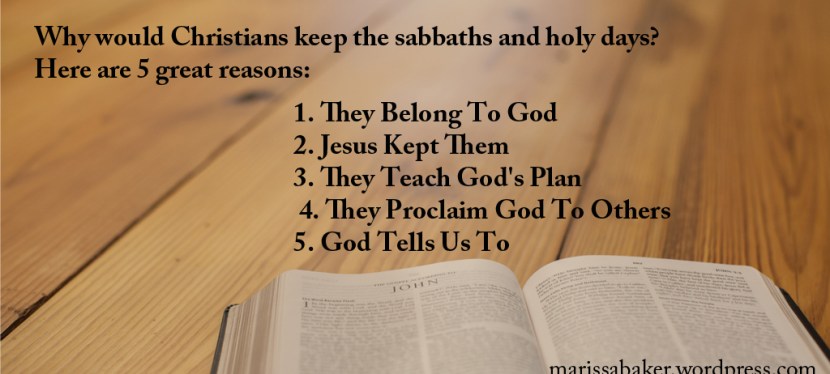
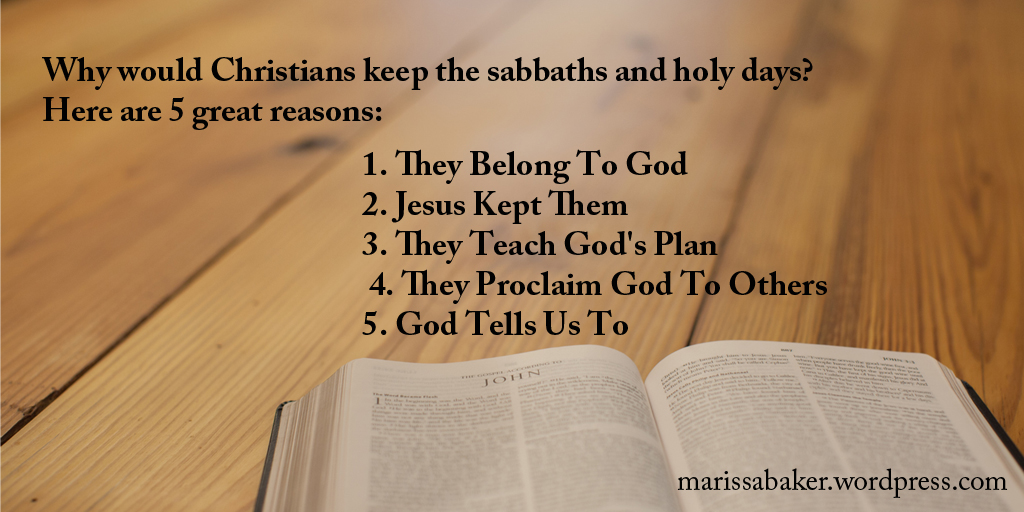
Top 5 Reasons for Christians to Keep God’s Holy Days

Today we celebrate Yom Teruah, also called Feast of Trumpets and Rosh Hashanah. But why? After all, I’m Christian and most people think of this as a Jewish holiday. Same goes for Yom Kippur/Day of Atonement, which we’ll observe 10 days from now, and Sukkot/Feast of Tabernacles that starts in two weeks.

I believe these festival observances, along with others already completed this year, are for Christians today. When Jesus came to this world, it wasn’t to set up a new religion. He was the next step in God’s plan for the world and these days are part of the covenant He makes with His family. He’s still inviting us to gather for “reunions” at certain times of the year.Top 5 Reasons for Christians to Keep God's Holy Days | marissabaker.wordpress.com

1. They Belong To God

And the Lord spoke to Moses, saying, “Speak to the children of Israel, and say to them: ‘The feasts of the Lord, which you shall proclaim to be holy convocations, these are My feasts.” (Lev. 23:1-2)

The holy days aren’t Jewish or exclusively Old Testament. They belong to God Himself. We talk about Leviticus 23 as the chapter where God gives Israel the Feasts, but that’s not quite accurate. God doesn’t say, “Here are your holy days, Israel.” He says, “These are the feasts of the Lord, holy convocations which you shall proclaim at their appointed times” (Lev. 23:4). Read more

Rethinking Hell: A Clearer View of God’s Judgement

One of the most uncomfortable aspects of modern Christianity is the idea of hell. The common notion is that those who aren’t following God (including those who reject Him and those who never knew Him) miss-out on their chance at salvation and are tormented forever in a burning place. Few want to talk about it, many have rejected it, but most don’t agree on an alternative. It’s something Christianity must address, though.

What happens after death for the people who are not followers of Jesus?

For believers, the question “What happens when we die?” has clear answers in scripture. We’re not sure exactly what life in God’s family will be like, but we know that we’ll either be resurrected from the dead (if we died before Jesus’s return) or transformed into spirit beings (if we’re still alive at His return). At that point, “we will be like him, because we will see him just as he is” (1 John 3:2, NET). For other people, things are a bit more ambiguous.

My purpose today isn’t to give a definitive answer, but rather to look at some different readings of scriptures talking about eternal judgement. There are some things we can say with a fairly high degree of certainty, but there are others that I just don’t know the answers to (and I’d rather acknowledge that than take a stance that I’m not reasonably confident lines up with God’s revealed word).

What is “hell”?

The word “hell” is used in the Bible, but not with the same connotation we have for it in English. Western ideas of hell come from Medieval imagery (think Dante’s Inferno). Most uses in the New Testament, though, are translated from the Greek word ghenna. When people of Jesus’s time heard this word they didn’t think of a burning place with a pitchfork-toting devil where eternal souls writhed in torment. They thought of Ghenna–a rubbish heap outside Jerusalem “where the filth and dead animals … were cast out and burned,” which is “a fit symbol of the wicked and their future destruction” (Thayer’s dictionary G1087).

Strong’s dictionary does describe ghenna as a place of “everlasting punishment,” but that imagery wasn’t originally in the Greek language. As we talked about last week, the Bible doesn’t teach humans have immortal souls. Immortality can only come to us as a gift of God, and unless He grants the gift of eternal life we won’t be around for everlasting anything, including torment.

Another word translated “hell” in English Bibles is hades (G86), which originally referred to the Greek god of the underworld but came to mean the grave in general. There’s also one other mention of “hell” in in the New Testament that’s translated from tartaroo (G5020), which was considered a place of eternal torment. The only time it’s used is in 2 Peter 2:4,where it talks about God casting “the angels who sinned … into hell” (NET). Other than that, when we look at what the Bible says about hell, we have to check each verse to see whether it’s talking about hades (the grave) or ghenna (a burning place of destruction).

While the Bible does speak of a burning lake of fire, it doesn’t talk about humans staying there nor going there instantly when they die. After people die, the prevailing Biblical description is that they’ve fallen asleep and are awaiting the resurrection (John 11:11-13; 1 Cor. 15:6, 18, 31; 1 Thes. 4:13-15; 5:10; 2 Pet. 3:4; Dan. 12:2and many others). Some people — the “firstfruits” that we discussed in last week’s post– will be raised from the dead to eternal life at Jesus Christ’s second coming. The rest of the dead stay asleep until a second resurrection.

Image of a woman reading the Bible overlaid with text from Rev. 1:17-18, NET version: “Do not be afraid! I am the first and the last, and the one who lives! I was dead, but look, now I am alive—forever and ever—and I hold the keys of death and of Hades!”
Image by MarrCreative from Lightstock

A Second Resurrection

We don’t actually get a whole lot of information about what happens after the first resurrection and the Millennial reign described in Revelation 20:1-6. We are told in the description of the first resurrection that “The rest of the dead did not come to life until the thousand years were finished” (Rev. 20:5, NET). Skipping to the end, we read this:

Then I saw a large white throne and the one who was seated on it; the earth and the heaven fled from his presence, and no place was found for them. And I saw the dead, the great and the small, standing before the throne. Then books were opened, and another book was opened—the book of life. So the dead were judged by what was written in the books, according to their deeds. The sea gave up the dead that were in it, and Death and Hades gave up the dead that were in them, and each one was judged according to his deeds. Then Death and Hades were thrown into the lake of fire. This is the second death—the lake of fire.  If anyone’s name was not found written in the book of life, that person was thrown into the lake of fire.

Revelation 20:11-15, NET

At this point in the future, “the devil who deceived them” has already been “thrown into the lake of fire and sulfur, where the beast and the false prophet are too, and they will be tormented there day and night forever and ever” (Rev. 20:10, NET). That’s the only mention of eternal torment, though. The people who follow the devil die in the “second death.” They’ll be consumed, burned-up like the rubbish thrown in ghenna.

Death as the punishment for sin fits with God’s warnings to humanity from the very beginning (Gen. 2:15-17; 3:2-3). God’s message is consistent throughout scripture. If you follow His way, then you will live. If you do not, then you are choosing death.

I call heaven and earth to witness against you today that I have set before you life and death, the blessing and the curse. Therefore choose life, that you may live, you and your descendants, to love Yahweh your God, to obey his voice, and to cling to him; for he is your life, and the length of your days.

Deuteronomy 30:19-20, WEB

This message continues through the old and new testaments. Sin leads to death, but following God results in life (Rom. 6:22-23; 8:5-7; 2 Cor. 2:15-16; 1 John 3:14). God doesn’t control or manipulate us with the threat of everlasting punishment. He sets two very simple choices before us: life forever with Him, or permanent death.

  • Note: you could argue my reading of everlasting punishment using verses like Matthew 25:41-46 and Mark 9:42-48. For Matthew 25, I would say that just because the fire is everlasting doesn’t mean the people cast in it stay alive, and that the phrase “everlasting punishment” can just as easily be read “punishment that is irreversible” (because they die in the second death, which fits with Rev. 20:15). For Mark 9, where “hell” is translated from ghenna, I really don’t know what the phrase “worm does not die” means. The Hebrew and Greek both refer to maggots/grubs such as would eat dead flesh, which doesn’t make much sense to me with either interpretation–if the people die, why don’t the worms? and if the people don’t die, why does it say “worm does not die” instead of something like “soul does not die”?
Image of a man praying overlaid with text from Matthew 10:28, WEB version: “Don’t be afraid of those who kill the body, but are not able to kill the soul. Rather, fear him who is able to destroy both soul and body in Gehenna.”
Image by Shaun Menary from Lightstock

Readings on Judgement

Last week I spent quite a bit of time talking about N.T. Wright’s teachings on the resurrection. He has comparatively little to say about hell, though. He goes through the Medieval hell symbolism and meaning of Gehenna (p. 177-178), mentions that while final judgement was accepted as part of God’s plan it wasn’t widely discussed in the epistles (p. 177), and covers different modern views on hell (p. 178). What he does state is that “God is utterly committed to set the world right in the end,” and that means there will be no people in His future world who worship “that which is not God as if it were” and who fail “fully to reflect the image of God” (p. 179).

God will condemn evil, and Wright thinks that those who reject God will “cease to bear the divine image at all” and continue to “exist in an ex-human state” (p. 182-183). That, however, ignores his own teaching that people do not inherently have immortal souls and doesn’t address what the Bible says about the lake of fire. I do, however, like the way Wright speaks of a “final condemnation for those who, by their idolatry, dehumanize themselves and drag others down with them” (p. 180). We know God doesn’t desire that any perish (1 Tim. 2:4; 2 Peter 3:9), but there will be people who end up in the lake of fire and this seems a good way of summing up their condition.

what-happens-after-death

The Churches of God that I’ve attended with most of my life venture into more specifics about the final judgement. Their main teachings are well represented in United Church of God’s booklet “What Happens After Death?” In brief, it goes like this: Those who are not the firstfruits will be resurrected to physical life after the Millennium and given a chance to understand God’s word. After a period of time (some say 100 years) they’ll be judged and the ones who’ve refused to repent will die in the lake of fire. The others will live on in God’s kingdom.

This teaching holds great hope, as well as relief for our worries about people who have not yet committed their lives to Jesus. It also relieves us of a sense of urgency to convert people before they die because we believe there’s a time in the future when they’ll be given the chance to know Him. If they aren’t saved in this life, they’ll have an opportunity to escape eternal death in the second resurrection.

There are a few things that this interpretation doesn’t explain, though. One thing that has to do more with implications than accuracy is that lack of urgency to convert people. We know that God is the one who chooses whether to call someone and open their eyes, and that those who do not choose Him now will have an opportunity in the second resurrection. But we should still care about sharing His word with people today. We’re supposed to be like God, and since He “wants all people to be saved and to come to a knowledge of the truth” that should be our desire as well (1 Tim. 2:4, NET).

The time frame of this judgment is also in question. Romans 2:1-16 indicates that all will be judged based on their actions in this life. It talks of God exercising abundant mercy towards those who didn’t know Him and yet lived good lives, but there’s also the promise of “wrath and anger to those who live in selfish ambition and do not obey the truth but follow unrighteousness” (Rom. 2:8, NET). Yet if people are judged as soon as the books are opened in Rev. 20:12, what about the babies, children, and others who never had a chance to do works by which they could be judged? God’s mercy, justice, and love seems to demand they be given a chance to know Him, which implies a time-gap between resurrection and judgement but that is not explicit in the scripture.

Consistent, Trustworthy God

I don’t have all the answers. What I do know is that, in the years after Jesus’s original apostle’s death, Christian religion generally adopted a terrifying version of God who tortures unbelievers in hell for all eternity. Even if we don’t understand everything about God’s final plan for those who don’t know Him now, it is time to recapture a vision of God that is more consistent with how He reveals Himself as One who is love, justice, and mercy.

His justice demands recompense for sin, but He also has no desire that anyone perish (or suffer forever) and He will be merciful to everyone. For some, this mercy involves granting salvation because they come to repentance and follow Him with a pure heart. For others, that mercy involves letting them die the final, second death because they can’t be allowed to continue in rebellion against Him. That’s a God we can trust, One Who will keep His promises to reward those who follow Him with life and those who persist in disobedient rebellion with death.

Another thing I think we can say for certain is that it’s best to follow God now if we have that option, not to wait for what seems like a second-chance in the future. The firstfruits do receive a greater reward. If you are faithful to God, He will be faithful to reward you according to His promises. That’s what the church should be teaching–not threatening people with “you’ll burn in hell” but rather encouraging them to pursue God and take hold of the “better promises” and the “better resurrection” that comes with following Him now (Heb. 8:6; 11:35, WEB).


Featured image by Anggie from Lightstock

Rethinking Heaven: Capturing A Vision Of The Resurrection

Christians and non-Christians alike typically assume that our religion teaches good Christians go to heaven when they die and bad people, or those who’ve never given their lives to Jesus, go to hell. As more and more Biblical scholars, Christian churches, and individual believers are realizing, though, this isn’t the most accurate picture of what the Bible teaches regarding life after death.

I grew up in churches that taught the resurrection. It’s straight out of the scriptures, but I hadn’t come across other churches teaching something similar until reading a book called Desiring the Kingdom by Catholic theologian James K.A. Smith. In this book, Smith made a comment about Christians not really going to heaven when they die and footnoted it with three book suggestions for further reading. I could only locate one book from that list in the library: Surprised by Hope by New Testament scholar and Anglican bishop N.T. Wright.

Wright’s powerful exegesis on the meaning of the resurrection is inspiring and some of the thoughtful, well-researched ways he diverged from my church’s traditional teachings made me realize there are alternative explanations for a few difficult scriptures that deserve a second look. I also admire his style. Instead of telling people “You’re wrong,” he says, “We’ve been misinformed, and here’s the more wonderful plan God has for us.” That’s what I want to focus on today. The deeper our understanding of what God is actually planning for us, the firmer our hope and faith becomes.

What Happens When We Die?

The idea that human beings have immortal souls does not come from the Bible, It traveled into Christian theology from Greek philosophy, specifically Plato (see “Plato’s Shadow” by Gary Petty for more details). The Bible teaches that God “alone possesses immortality” (1 Tim. 6:16, NET). Immortality is not something inherent to humans. We didn’t even have a chance at eternal life until Jesus Christ broke “the power of death and brought life and immortality to light through the gospel!” (2 Tim. 1:10, NET).

In Hebrew thought and New Testament theology, the soul refers “not to a disembodied entity hidden within the outer shell of a disposable body, but rather to what we would call the whole person or personality” (Wright, p. 28). In Hebrew, the word translated “soul” is nephesh (H5315). It refers to a living thing with breath (Thayer’s Dictionary).

 Yahweh God formed man from the dust of the ground, and breathed (naphach) into his nostrils the breath (neshamah) of life; and man became a living soul (nephesh).

Genesis 2:7, WEB

The New Testament does talk about different parts of a human. We have a body  — the soma , which is fleshy, physical, and “that which casts a shadow” (Thayer G4983). We have a soul — psuche , the vital force of life and personality (G5590). And we have a spirit — pneuma , the “rational spirit, the power by which the human being feels, thinks, decides” (Thayer G4151). The three can’t really be separated in any useful way, though; they all go together to make us human beings in the image of God.

Now may the God of peace himself make you completely holy and may your spirit (pneuma) and soul (psuche) and body (soma) be kept entirely blameless at the coming of our Lord Jesus Christ.

1 Thessalonians 5:23, NET

So, we are human bodies that God created from dust and breathed into, making us living beings with spirits that can communicate with His Spirit. Ecclesiastes says that, at death, “the dust returns to the earth as it was, and the spirit returns to God who gave it” (Ecc. 12:7, WEB). Wright believes that this spirit is conscious while awaiting the bodily resurrection, but I lean more toward my church’s traditional teaching that this isn’t the case.

While there are a couple verses hinting at the possibility of consciousness after death (Luke 16:19-31; Rev. 6:9-10), the bulk of scripture compares death to sleep (John 11:11-13; 1 Cor. 15:6, 18, 31; 1 Thes. 4:13-15; 5:10; 2 Pet. 3:4; Dan. 12:2; and many others). Furthermore, “in death there is no memory of you” (Ps. 6:5, WEB), “the dead don’t praise Yah” (Ps. 115:17, WEB), and ” the dead don’t know anything” (Ecc. 9:5, WEB). Two scriptures–one in a parable and one in Revelation– that aren’t necessarily clear/straightforward do not seem to be enough evidence to counter the many, many other scriptures describing the dead as unconscious and sleeping.

Image of a man reading the Bible overlaid with text from 1 Thes. 4:13-16, WEB version:  “But we don’t want you to be ignorant, brothers, concerning those who have fallen asleep, so that you don’t grieve like the rest, who have no hope. For if we believe that Jesus died and rose again, even so God will bring with him those who have fallen asleep in Jesus. ... The dead in Christ will rise first.”
Image by Matt Vasquez from Lightstock

For The Firstfruits

Eternal life is a gift God promises to those who follow Him now, in this life (we’ll save those who don’t for a follow-up post next week). The promises to believers are spelled out clearly in scripture, and nowhere more clearly than in 1 Corinthians 15. Here in the resurrection chapter, Paul reminded the Corinthians that he declared to them the gospel: “that Christ died for our sins according to the scriptures, and that he was buried, and that he was raised on the third day according to the scriptures, and that he appeared to” the apostles and hundreds of other believers (1 Cor. 15:3-5, NET). Jesus’s resurrection is central to the gospel message.

Paul then addressed a group of people who didn’t believe in the resurrection of the dead. He stated in no uncertain terms that if there is no resurrection the gospel is empty, and “if Christ has not been raised, your faith is useless; you are still in your sins. Furthermore, those who have fallen asleep in Christ have also perished” (1 Cor. 15:17-19, NET). There is no alternative. Either there’s a resurrection of the dead or we have no hope at all; physical death would be permanent.

Paul spent the next few verses talking about how and when we’ll be raised. N.T. Wright summed up the “how” by saying, “the risen Jesus is both the model for the Christian’ future body and the means by which it comes about” (p. 149). The “when” for the resurrection of faithful believers is Jesus Christ’s second coming (1 Thes. 4:13-18; 1 Cor. 15:23). This resurrection is for “the firstfruits”–a select group of people who actively, faithfully followed God during their physical lives. It’s not enough to verbally accept Jesus as your savior; we also have to live like Christians. And so the resurrection chapter also includes the injunction not to be deceived or corrupted, but rather “Sober up as you should, and stop sinning!” (1 Cor. 15:34. NET).

Image of a woman reading the Bible overlaid with text from 1 John 3:2-3, NET version:  “Dear friends, we are God’s children now, and what we will be has not yet been revealed. We know that whenever it is 
revealed we will be like him, because we will see him just as he is. And everyone who has this hope focused on him purifies himself, just as Jesus is pure.”
Image by Pearl from Lightstock

A Bodily Resurrection

Paul anticipated one question that many will have about the resurrection when he said, “But someone will say, ‘How are the dead raised? With what kind of body will they come?'” (1 Cor. 15:35, NET). It’s an understandable question, especially today given the confusion about what “soul” actually means. The short answer is given by John: “we will be like him, because we will see him just as he is.” (1 John 3:2, NET). When we’re resurrected, it will be to an existence like God’s.

Paul addresses this question in more depth. He likens our bodies now to “a bare seed” sown in a field with the expectation that it will grow into a mature, flourishing plant (1 Cor. 15:37, NET).We currently have a “natural body” that bears the image of the first human being that God breathed into and made a living being. Those who rise from the dead in the first resurrection will have a “spiritual body” that bears the image of Jesus Christ (1 Cor. 15:42-49).

 It is the same with the resurrection of the dead. What is sown is perishable, what is raised is imperishable. It is sown in dishonor, it is raised in glory; it is sown in weakness, it is raised in power; it is sown a natural body, it is raised a spiritual body. If there is a natural body, there is also a spiritual body.

1 Corinthians 15:42-44, NET

In Greek, the words “natural” and “spiritual” are psychikos and pneumatikos. Wright points out that “Greek adjectives ending in -ikos describe not the material out of which things are made but the power or energy that animates them” (p. 155, emphasis in original). We currently have a body animated by the human soul. We will have a body “animated by God’s pneuma, God’s breath of new life, the energizing power of God’s new creation” (p. 156).

When Jesus rose from the dead, people could touch Him (John 20:27) and eat with Him (John 21:9-13). He told them, “Look at my hands and my feet; it’s me! Touch me and see; a ghost does not have flesh and bones like you see I have” (Luke 24:39, NET). Though He could appear in the middle of a locked room or vanish from sight (Luke 24:30-31, 36), Jesus wasn’t a ghost or a disembodied spirit. His spiritual body was something more than His physical one.

We’re not waiting for an escape from the body, but rather “the redemption of our bodies” (Rom. 8:23, NET). We long “to put on our heavenly dwelling … because we do not want to be unclothed, but clothed, so that what is mortal may be swallowed up by life” (2 Cor. 5:1-5, NET). We’re not waiting to go to heaven when we die — we’re waiting for Christ to come down from heaven to raise His people from their sleep of death and transform us all to have a spiritual life and body like His (1 Cor. 15:51-58). And it doesn’t end there!

Blessed and holy is the one who takes part in the first resurrection. The second death has no power over them, but they will be priests of God and of Christ, and they will reign with him for a thousand years.

Revelation 20:6, NET

We don’t have a ton of information about what happens after the first resurrection, but God does sketch out the final stages of His plan for us. We know that for 1,000 years, those firstfruits who were resurrected from the dead or who were alive and transformed at Jesus’s second coming reign alongside Him in what we call the Millennium (most details about this come from the prophets and Revelation). After that, there will be a resurrection of the remaining dead, a final judgment, Satan’s total defeat, a new heaven and new earth, and God will come to dwell with humanity on earth (Rev. 20-22). It’s an incredible future that God has planned for His creation! Let’s not settle for any teaching that offers less than His glorious plan that He has revealed to us in scripture.


Featured image by Ruby-Rose from Lightstock

Song Recommendation: “With The Sound of Trumpets

Walking Through Philippians 3: Paul’s Thoughts on Following Jesus

In 1 Corinthians 11:1, Paul said, “Be ye followers of me, even as I also am of Christ” (KJV). If we want a how-to guide for the way Paul follows Jesus, we can find a succinct version in the 3rd chapter of Philippians. This chapter is a bit unusual. Rather than speaking generally to his fellow believers or addressing a specific issue in the church, Paul gets real about his own walk of faith.

click to read article, Walking Through Philippians 3: Paul's Thoughts on Following Jesus | marissabaker.wordpress.com
photo credit: Samuel Zeller via StockSnap.io

Paul’s Zeal

We break into the middle of the letter to the church in Philippi. Paul has been warning against “dogs, “evil workers,” and “the mutilation.” He gives a general principle that physical things like circumcision aren’t what determines whether or not you’re part of God’s chosen people. “We are the circumcision,” he writes, “who worship God in the Spirit, rejoice in Christ Jesus, and have no confidence in the flesh” (Phil. 3:2-3). He then shifts to using himself as an example.

Though I also might have confidence in the flesh. If anyone else thinks he may have confidence in the flesh, I more so: circumcised the eighth day, of the stock of Israel, of the tribe of Benjamin, a Hebrew of the Hebrews; concerning the law, a Pharisee; concerning zeal, persecuting the church; concerning the righteousness which is in the law, blameless. (Phil 3:4-6)

What a pedigree! Under the Old Covenant, Paul was as perfect as you could get. There was no stain on his Israelitish lineage. His parents kept the Law and had him circumcised. He became an elite leader in the Jewish community and an expert in the Law, which he kept to the letter. He even actively persecuted heretics.

Then, suddenly, Jesus Himself showed up and told Paul those weren’t heretics. The Messiah had come and Paul was fighting the next step in God’s plan. In response, Paul gave up power, prestige, and (parts of) the belief system he’d poured his entire life into to follow Jesus. And that’s an aspect of Paul’s life that we’re supposed to imitate. Read more