Confidence in Salvation

Are you saved?

It’s a question associated with overly enthusiastic or exceptionally earnest evangelists, knocking on doors and chatting you up in coffee shops. But it’s also a question that haunts many Christians. Like many things, we often fall into two extremes related to this question. On the one hand, we have people who say, “Once saved, always saved, so it doesn’t matter what I do now.” On the other hand, we have people who are terrified that they’re not actually saved and spend their lives struggling to measure up to God’s perfect standard with no assurance that they’ll make it in the end.

A few weeks ago, our pastor gave a message about the three ways that the Bible talks about salvation: we are saved, we are being saved, and we will be saved. He also mentioned an analogy that I’ve been mulling over for a couple weeks now. Like all analogies, it breaks down if you carry it too far, but I think it gives us a good starting point.

People who say they are already saved by Jesus are correct. But so are people who say that you can “lose” that salvation (though “reject” would be a much more accurate term). It’s like if a firefighter pulls you out of a burning building. Once you’re out of the fire, you’ve been saved. The salvation has already happened and it’s not going to be undone by the person who rescued you. But you can still run back into the burning building. It would be phenomenally stupid, but you have the free will to reject salvation. Knowing that can lead to anxiety for many people, but how worried should you actually be about this knowledge?
Image of a man walking in the woods while reading a Bible overlaid with text from 1 Thes. 5:8-9, NET version: "But since we are of the day, we must stay sober by putting on the breastplate of faith and love and as a helmet our hope for salvation. For God did not destine us for wrath but for gaining salvation through our Lord Jesus Christ.”
Image by HarveyMade from Lightstock

Be Confident

In my church, we spend quite a bit of time refuting the “once saved, always saved” heresy. No, you didn’t do anything to earn salvation–it’s a gift of God–but once you’re saved by grace, you owe God loyalty, faithfulness, and obedience. You can even choose to reject salvation, either verbally or by actions that deny your relationship with God (see, for example, 1 Cor. 6:9-10; Gal. 5:19-21; Heb. 10:26-31). We are currently saved, but it is also an ongoing process of walking with God that He will finally accomplish at Jesus’s return.

It’s an important point to understand, but I think perhaps we should spend just as much time countering the mistake that is more pervasive in our church, namely, the fear that we’re not good enough for God and might not really be saved. I’ve known people paralyzed by anxiety and fear that they don’t measure up to God, that He won’t give them salvation, and that they won’t be good enough to be in the kingdom. While we should have a great deal of respect for God, He does not want the people He welcomed into a relationship with Him to cower in fear!

You’re not supposed to feel guilty that you needed God’s grace. You should realize that you’re guilty of sin and can only be saved by His grace, but you shouldn’t beat yourself up because you couldn’t earn salvation. You were never meant to earn it! Reading through all of Paul’s letter to the Romans (preferably in one setting) is a beautiful exploration of these facts. None of us can earn salvation, but God knows that and in His great mercy, He worked things out so we don’t need to; we just need to believe in Jesus and commit to following Him. None of our works earn God’s favor or pay Him back for His grace, but good works (and refusing to go back to living in sin) are the correct response to His work in us. Confidence that we’ve received salvation is a topic Paul kept coming back to again and again in his letters.

And so, since we have been justified by his grace, we become heirs with the confident expectation of eternal life.

Titus 3:7-8, NET

This was according to the eternal purpose that he accomplished in Christ Jesus our Lord, in whom we have boldness and confident access to God by way of Christ’s faithfulness.

Ephesians 3:11-12, NET

God wants us to be bold and confident in relation to our salvation. He accomplished it, and He wants us to realize that it’s something He will not revoke and no one else can revoke. Jesus pulled us out of the fire when we accepted His sacrifice on our behalf. He’s not going to throw us back in. At the same time, that moment of salvation starts a participatory process. We’re meant to be fully involved in the transformation that salvation starts in our lives.

Balancing Humility and Certainty

We can have great confidence and boldness in the fact that “God did not destine us for wrath but for gaining salvation through our Lord Jesus Christ” (1 Thes. 5:9, NET). He doesn’t set us up for failure. In fact, He wants us to succeed! He’s already proved how invested He is in saving us by Jesus literally dying in our place. We don’t need to worry that God thinks we’re not good enough (Jesus cared enough to die for us while we were yet sinners [Rom. 5:8]) or that He’ll give up on us partway through the salvation process (Phil. 1:6).

Therefore, since we have been declared righteous by faith, we have peace with God through our Lord Jesus Christ, through whom we have also obtained access into this grace in which we stand, and we rejoice in the hope of God’s glory. …

Much more then, because we have now been declared righteous by his blood, we will be saved through him from God’s wrath. For if while we were enemies we were reconciled to God through the death of his Son, how much more, since we have been reconciled, will we be saved by his life?

Romans 5:1-2, 9-10, NET

Image of three women holding hands, overlaid with blog's title text and the words, "When we are confidently devoted to God, we have no reason to fear that He won't accomplish our salvation."
Image by Anggie from Lightstock

Here, Paul uses the term “reconciliation” for the salvation already accomplished–the restoration of relationship between us and God when Jesus’s sacrifice covered our sins–and “we will be saved” for the final salvation that we look forward to when Jesus returns and we become fully part of God’s family. We are assured without a doubt that Jesus accomplished salvation in our lives when we entered a covenant relationship with Him, and that God will finish the work that He started in us unless we choose to stop working with Him (Phil. 2:12-13; Heb. 2:1-3).

There is a delicate balance we must maintain between humility and confidence. We must confidently expect that God will deliver on His promises of eternal life while at the same time recognize that we could be disqualified from receiving those promises if we reject and abandon God. Even the apostle Paul didn’t dare say he’d already attained the resurrection during most of his life (1 Cor. 9:27; Phil 3:10-14); it was only right at the end of his life that he could say, “I have kept the faith” and will inherit the crown (2 Tim. 4:6-8). Self-righteous confidence is a danger we must be careful to avoid; our confidence should rest in God, not ourselves (Luke 18:9-14; Rom. 2:17-29). And when our confidence is placed firmly in God, then we have nothing to fear.

Yahweh is my light and my salvation.
Whom shall I fear?
Yahweh is the strength of my life.
Of whom shall I be afraid? …
Though war should rise against me,
even then I will be confident. …

I am still confident of this:
I will see the goodness of Yahweh in the land of the living.
Wait for Yahweh.
Be strong, and let your heart take courage.
Yes, wait for Yahweh.

Psalm 27:1, 3, 13-14, WEB

Featured image by PhotoGranary from Lightstock

Pauline Introductions, Part 2: How Does Paul Talk About God?

Today’s post is the second in a three-part series. In these posts, we’re looking at the introductions of Paul’s epistles and examining how Paul talks about himself, how Paul talks about God, and how Paul talks about us in the introductions to his letters. We’ll be focusing on the epistles he wrote to church communities rather than the pastoral epistles (Timothy, Titus) or the letter to an individual (Philemon). This series will also exclude Hebrews since there’s a good chance Paul wasn’t the author. That leaves us with nine letters: Romans, 1 Corinthians, 2 Corinthians, Galatians, Ephesians, Philippians, Colossians, 1 Thessalonians, and 2 Thessalonians.

If you’re wondering why I didn’t post this two weeks ago like I typically would, I broke my foot and I’ve been struggling to keep up with everything that needs doing. Subscribe to my newsletter if you want to stay up-to-date on news like that and changes in post schedules.

Grace and Peace from God the Father and the Lord Jesus Christ

All of these introductions except two have Paul using the phrase, “Grace and peace to you from God our Father and the Lord Jesus Christ” (Rom. 1:7; 1 Cor. 1:3; 2 Cor. 1:2; Gal. 1:3; Eph. 1:2, Phil. 1:2; 2 Thes. 1:2, NET) There’s a similar phrase in 1 Thessalonians 1:1, and Colossians 1:2 just says, “Grace and peace to you from God our Father!” (Paul mentions Jesus elsewhere in the introduction, just not as part of this phrase). We could call this Paul’s standard greeting, and it tells us several things about how he views God.

For Paul, God the Father and the Lord Jesus Christ are a source of grace and peace. There are a lot of other things that God supplies us with (love, mercy, and justice, just to name a few), but grace and peace are the ones Paul uses in his salutations. According to “Grace to You and Peace: An Analysis of the Pauline Letter Openings” by JPT Aquino, “Paul used the epistolary conventions of his time” in the way that he structured his letters (p. 2) but he chose his own signature opening phrase to communicate “the theology that underlies his letters, as well [as] his life and ministry” (p. 109). As we think of Paul’s focus in his letters, “grace and peace from God the Father and the Lord Jesus Christ” does seem like a good introduction to what he typically emphasizes. He focuses a lot on God’s grace toward us, the internal peace He gives us, and the peace that He wants to see between those in His church.

This phrase also gives us hints about how Paul understands the nature of God. As in the rest of the Bible, Paul sees God the Father and God the Son as the central figures in the God-family, which They invite us to join in a process we understand through analogies of birth, adoption, and marriage. Both the Father and Jesus have always existed as God, but now that Jesus came as the Messiah, we know these two God-beings as God the Father (Matt. 11:27; John 14:6-11) and the Lord Jesus Christ (Matt. 16:16; Phil. 2:9-11; 1 John 3:5). You might remember from the first post in this series that Paul introduces himself as an apostle commissioned by the Father and Jesus; they’re the reason for his ministry and the Ones that he’s representing as he writes these letters.

Image of a man reading the Bible overlaid with text from Gal. 1:3-5, NET version: “Grace and peace to you from God the Father and our Lord Jesus Christ, who gave himself for our sins to rescue us from this present evil age according to the will of our God and Father, to whom be glory forever and ever! Amen.”
Image by Matt Vasquez from Lightstock

Source of the Gospel

From Paul, a slave of Christ Jesus, called to be an apostle, set apart for the gospel of God.  This gospel he promised beforehand through his prophets in the holy scriptures, concerning his Son who was a descendant of David with reference to the flesh, who was appointed the Son-of-God-in-power according to the Holy Spirit by the resurrection from the dead, Jesus Christ our Lord.

Romans 1:1-5, NET

Paul only mentions the gospel in the salutation to one letter. He also brings it up in the prayers for churches that make up what I think of as the second half of his introductions in several other letters, but those have to do with our response to the gospel so we’ll save that for the Part 3 post in a couple weeks (Eph. 1:13; Phil. 1:5-7; Col. 1:5-6; 1 Thes. 1:4-5).

In Romans, though, Paul lays a foundation for talking about what God’s good news is doing in us by describing it as “the gospel of God” that “he promised beforehand through his prophets in the holy scriptures, concerning his Son.” There is to be no confusion: the gospel is about Jesus, who is the Son of God, and what He and the Father are doing and have done for us. It’s also not a new thing; the gospel that Paul preaches is something that God promised in the scriptures we now call the Old Testament. Christianity wasn’t a new religion, it’s just what people started calling those who understood that Jesus is the Messiah/Christ and followed Him as He showed the way to continue following God faithfully.

The One Who Calls and Chooses

God is the one who called Paul to be an apostle (Rom. 1:1; 1 Cor. 1:1), called us to belong to and fellowship with Jesus (Rom. 1:6; 1 Cor. 1:9), and called us to be saints (Rom. 1:7; 1 Cor 1:2). He also chose us (Eph. 1:4; 1 Thes. 1:4) and is the one who “began a good work” in us (Phil. 1:6). All the things that Paul is (which we talked about in the previous post) and all the things that we are (which we’ll talk about in the next post) happened because God made choices. He chose to call us into His family, offer us eternal life, and make us holy (that’s what the word “saint” means).

 Blessed is the God and Father of our Lord Jesus Christ, who has blessed us with every spiritual blessing in the heavenly realms in Christ. For he chose us in Christ before the foundation of the world that we should be holy and blameless before him in love. He did this by predestining us to adoption as his legal heirs through Jesus Christ, according to the pleasure of his will

Ephesians 1:3-5, NET

This focus in the intro to Paul’s letters on God the Father’s and Jesus Christ’s action in our lives carries through the rest of Paul’s writings. He’s constantly pointing to Them and what They are doing. Take Philippians, for example. Right at the start of the letter, Paul focuses on “the one who began a good work in you” and who “will perfect it until the day of Christ Jesus” (Phil. 1:6, NET). We’re here, reading Paul’s letters to learn more about God, because He started working in us and He won’t give up until He’s brought us to perfection. A little later in this same letter, Paul wrote, “continue working out your salvation with awe and reverence, for the one bringing forth in you both the desire and the effort—for the sake of his good pleasure—is God” (Phil. 2:12-13, NET). We’re participating in our salvation, but God’s doing the work and as long as we don’t reject Him, He’ll make sure we succeed.

Continuing in Philippians, Paul also talked about rejecting human credentials, power, or prestige and focusing only on the calling of God. Paul encouraged all his readers to join him: “with this goal in mind, I strive toward the prize of the upward call of God in Christ Jesus. Therefore let those of us who are ‘perfect’ embrace this point of view” (Phil. 3:14-15, NET). Just as Paul put the calling of God at the forefront of many letters, so we should put God’s calling at the forefront of our lives.

Rescuer and Helper

In several of his introductions, Paul emphasizes the redemptive work that God accomplishes in saving and sanctifying His people. We are “sanctified in Christ Jesus” (1 Cor. 1:2). He “gave himself for our sins to rescue us from this present evil age according to the will of our God and Father” (Gal. 1:3, NET).  It is “In him” that “we have redemption through his blood, the forgiveness of our offenses, according to the riches of his grace” (Eph. 1:7, NET).

God’s aid didn’t stop with accomplishing our redemption, though. He is all-in when it comes to the work of bringing children into His family. Jesus’s work of sanctifying, rescuing, and redeeming His people is ongoing, and it includes love (Rom. 1:7; 1 Thes. 1:4), grace (1 Cor. 1:4; Eph. 1:6-7; Phil. 1:7), and comfort.

Blessed is the God and Father of our Lord Jesus Christ, the Father of mercies and God of all comfort, who comforts us in all our troubles so that we may be able to comfort those experiencing any trouble with the comfort with which we ourselves are comforted by God. 

2 Corinthians 1:3-4, NET

Even just looking at the openings of Paul’s letters, we see the depth of his devotion to God, the awe he feels for the Father and Son, and the wonder of God’s incredible work in our lives. God’s grace, peace, calling, and salvation are at the forefront of Paul’s mind and his letters. In one of these letters, Paul wrote, “Be imitators of me, just as I also am of Christ” (1 Cor. 11:1, NET). One of the ways that we can imitate him is by similarly prioritizing God and cultivating a relationship with Him that’s at the center of our lives and our focus.


Featured image by StartupStockPhotos from Pixabay

Faithfully Continuing Toward Salvation in the End Times

I’d been trying to decide what topic to write about this week, and then one morning I woke up with this phrase running through my head: “our salvation is now nearer than when we became believers.” I think I might have been dreaming about editing a blog post, since I woke up feeling like I needed to add it to an article. I couldn’t think of an existing post that needed editing, so I decided to look up where the quote came from, check out the context, and see where that took me.

Owe no one anything, except to love one another, for the one who loves his neighbor has fulfilled the law. For the commandments, “Do not commit adultery, do not murder, do not steal, do not covet,” (and if there is any other commandment) are summed up in this, “Love your neighbor as yourself.” Love does no wrong to a neighbor. Therefore love is the fulfillment of the law.

And do this because we know the time, that it is already the hour for us to awake from sleep, for our salvation is now nearer than when we became believers. The night has advanced toward dawn; the day is near. So then we must lay aside the works of darkness, and put on the weapons of light. Let us live decently as in the daytime, not in carousing and drunkenness, not in sexual immorality and sensuality, not in discord and jealousy. Instead, put on the Lord Jesus Christ, and make no provision for the flesh to arouse its desires.

Romans 13:8-14, NET (bold italics mark quotations from  Ex. 20:13-15, 17; Deut. 5:17-19, 21; Lev. 19:18

I quote the first part of this passage a lot, but I always stop after the part about love fulfilling the law. If you keep reading, Paul adds a sense of urgency to his instruction to fulfill the law by loving each other. We should “do this because we know the time.” What does that mean? And if Paul could say, “the day is near” to readers almost 2,000 years ago, what would he say to us today?

Image of a man studying the Bible overlaid with text from James 5:7-8, NET version: "So be patient, brothers and sisters, until the Lord’s return. Think of how the farmer waits for the precious fruit of the ground and is patient for it until it receives the early and late rains. You also be patient and strengthen your hearts, for the Lord’s return is near."
Image by Chris Mainland from Lightstock

Getting Ready For the End

As you read the New Testament, it seems clear that the apostles originally thought Jesus’s second coming would happen in their lifetimes, but that they eventually realized it was farther off in the future. That didn’t soften their sense of urgency, though. Paul probably wrote Romans around 57 A.D. and John wrote his letters around 100 A.D., and yet they both have the same sense of urgency (dates from Britannica.com).

Do this, knowing the time, that it is already time for you to awaken out of sleep, for salvation is now nearer to us than when we first believed. The night is far gone, and the day is near. Let’s therefore throw off the deeds of darkness, and let’s put on the armor of light.

Romans 13:10-11, WEB

 Little children, these are the end times, and as you heard that the Antichrist is coming, even now many antichrists have arisen. By this we know that it is the final hour. 

1 John 2:18, WEB

One of the things that we can learn from this sense or urgency is that even if Jesus doesn’t return in our lifetimes, it’s useful to live as if He will. This is the final hour. The Day of the Lord is near. We do live in the end times. Whether Jesus returns in our lifetimes or not, we have a finite amount of time for our human lives here on this earth. And if God has opened our eyes to the truth, we’ve entered a relationship with Him and committed to following Him in this life, then we’re part of His house and His judgement starts with us.

For the culmination of all things is near. So be self-controlled and sober-minded for the sake of prayer. Above all keep your love for one another fervent, because love covers a multitude of sins.

1 Peter 4:7-8, NET (bold italics mark a quotation from Prov. 10:12)

But let none of you suffer as a murderer or thief or criminal or as a troublemaker. But if you suffer as a Christian, do not be ashamed, but glorify God that you bear such a name. For it is time for judgment to begin, starting with the house of God. And if it starts with us, what will be the fate of those who are disobedient to the gospel of God? And if the righteous are barely saved, what will become of the ungodly and sinners? So then let those who suffer according to the will of God entrust their souls to a faithful Creator as they do good.

1 Peter 4:15-19, NET (bold italics mark a quotation from Prov. 11:31)

As the church of God (the faithful, believing body of Jesus Christ), we’re judged based on how we live our lives here on this earth. What happens to unbelievers is a little more vague, but their resurrection happens at a different time and their judgement is handled a little differently (see “Rethinking Hell: A Clearer View of God’s Judgement“). For us, though, this is our time to learn about God and live His way of life, with the hopeful expectation that in the final judgement after the resurrection we’ll hear “well done, good and faithful servant” (“Rethinking Heaven: Capturing A Vision Of The Resurrection“).

Heading Toward Salvation

Image of a woman walking along railroad tracks, overlaid with the blog post's title text and the words, "Whether Jesus returns in our lifetimes or not, we should live with a sense of urgency and awareness in our walk as believers."
Image by Anggie from Lightstock

One of the interesting things about the verse we started with in Romans 13 is that Paul says, “our salvation is now nearer than when we became believers.” Modern Christianity tends to treat salvation as a thing that happens when you commit to Jesus Christ, but the New Testament writers treat salvation as a process that begins with our commitment to follow God for the rest of our lives (Phil 3:8-16, for example). This topic comes up in some of the most sobering warnings that Biblical writers deliver to New Covenant Christians.

Therefore leaving the teaching of the first principles of Christ, let’s press on to perfection—not laying again a foundation of repentance from dead works, of faith toward God, of the teaching of baptisms, of laying on of hands, of resurrection of the dead, and of eternal judgment. This will we do, if God permits. For concerning those who were once enlightened and tasted of the heavenly gift, and were made partakers of the Holy Spirit, and tasted the good word of God and the powers of the age to come, and then fell away, it is impossible to renew them again to repentance; seeing they crucify the Son of God for themselves again, and put him to open shame. For the land which has drunk the rain that comes often on it and produces a crop suitable for them for whose sake it is also tilled, receives blessing from God; but if it bears thorns and thistles, it is rejected and near being cursed, whose end is to be burned.

Hebrews 6:1-8, WEB

It is vital that we press on once the salvation process begins, building on the elementary principles we first learned. We’re supposed to grow as believers and become more and more like God the Father and Jesus Christ. If we’re not growing, then we’re falling away and that’s a dangerous thing. Notice, though, what the author of Hebrews says right after issuing this sobering warning.

But, beloved, we are persuaded of better things for you, and things that accompany salvation, even though we speak like this. For God is not unrighteous, so as to forget your work and the labor of love which you showed toward his name, in that you served the saints, and still do serve them. We desire that each one of you may show the same diligence to the fullness of hope even to the end, that you won’t be sluggish, but imitators of those who through faith and perseverance inherited the promises.

Hebrews 6:9-12, WEB

Though the author penned these warnings, he’s sure that the people he’s writing to are doing “better things … that accompany salvation.” The warning isn’t because he thinks they’re all about to miss out on eternal life, but because he wants them to be awake, diligent, and press on faithfully “even to the end.”

As we look at the world around us, many Christians feel that things are getting so bad it must be close to Jesus’s return. We’re not the first generation to feel this way, but whether we’re right or not we should live with a sense of urgency in our walk as believers. We’re not supposed to be afraid, but we are supposed to be aware of the dangers in complacency. It’s our duty to keep following God faithfully, holding onto the hope He has given us firmly, and keep learning and growing as part of our living, dynamic relationship with the Father and Jesus.


Featured image by Pearl from Lightstock

Jesus as the Originator and Trailblazer: A Study of Archegos

I’ve heard countless sermons, Bible studies, and seminars. While many were good and beneficial, only a few still stand out in my mind years later. One of those was a message on the Greek word archegos (G747 ἀρχηγός). This word only shows up four times in the New Testament, but because it describes Jesus Christ it’s a word with great significance. Its root words are used more often–58 times for arche (G746 ἀρχή) and 71 times for ago (G71 ἄγω)–and they can provide additional clues as to the meaning and depth of archegos.

According to Spiros Zodhiates’ The Complete WordStudy Dictionary: New Testament, archegos is a noun derived from arche, beginning or rule, and ago, to lead. It means “originator, founder, leader, chief, first, prince, as distinguished from simply being the cause. One may be the cause of something but not the beginning” (entry 747). In other words, the archegos is the reason something begins and the one who begins it. Thayer’s Greek dictionary adds that archegos also means “one that takes the lead in any thing and thus affords an example, a predecessor in a matter, pioneer.” Once the thing is begun, the archegos models how to continue forward.

Image of sunrise over a green wheat field overlaid with text from Acts 3:14-15, TLV version:  “But you rejected the Holy and Righteous One and asked for a murderer to be granted to you. You killed the Author of life—the One God raised from the dead! We are witnesses of it.”
Image by KBCH from Pixabay

Archegos of Life

The first time archegos appears in the New Testament is in Acts. Peter and John were going into the temple and a lame man asked them for help. Peter locked eyes with him and said, “I have no silver or gold, but what I do have I give you. In the name of Jesus Christ the Nazarene, stand up and walk!” (Acts 3:6, NET). The man was miraculously healed, and naturally this attracted a throng of people marveling at what just happened. Peter takes this moment to share the gospel (Acts 3:1-11).

When Peter saw this, he declared to the people, “Men of Israel, why are you amazed at this? Why do you stare at us as if we had made this man walk by our own power or piety? The God of Abraham, Isaac, and Jacob, the God of our forefathers, has glorified his servant Jesus, whom you handed over and rejected in the presence of Pilate after he had decided to release him. But you rejected the Holy and Righteous One and asked that a man who was a murderer be released to you. You killed the Originator (archegos) of life, whom God raised from the dead. To this fact we are witnesses!”

Acts 3:12-15, NET

Here, the NET translates archegos as “Originator.” Some of the other common translation choices include Prince and Author, with other words like Source, Lord, and “one who made” also showing up in a few versions. Whichever translation you go with, this is a stunning statement. People killed the great Ruler who made life possible and enacted its beginning. To get more depth on this title for Jesus, and what it means for us and Peter’s listeners, we can turn to the letter to Laodicea in Revelation. Here’s a quote from Zodihiates explaining how the two verses relate:

“Jesus Christ is called the archegos of life (Acts 3:15) because He is he arche, the beginning or originator of God’s creation. This excludes Him from Himself being a product of that beginning.”

Zodhiates, The Complete WordStudy Dictionary: New Testament, entry G747

Other verses in the New Testament identify Jesus (or The Word, as He was known back then) as the God through whom all things were made (John 1:1-4; Eph. 3:9; Col. 1:15-16). In other words, He is the originator or cause of creation. That includes the creation of human life. It is therefore all the more hard-hitting when Peter confronts his listeners in Acts with killing Jesus when He says they killed the One who was the very source of all life. And it makes us appreciate Jesus’s sacrifice more when we gain a deeper realization of how powerful and wonderful He is, and what He sacrificed to save the people He and His Father worked together to create.

Image of a mountaintop overlaid with text from Acts 5:31, WEB version:  “God exalted him with his right hand to be a Prince and a Savior, to give repentance to Israel, and remission of sins.” version:
Image by Dan Fador from Pixabay

Archegos and Savior

The second time archegos shows up in Acts is when Peter and the other apostles are called before the council and high priest to answer charges for spreading the gospel. In this verse, most translations choose Prince or Leader for archegos, though a few use Ruler.

But Peter and the apostles replied, “We must obey God rather than people. The God of our forefathers raised up Jesus, whom you seized and killed by hanging him on a tree. God exalted him to his right hand as Leader (archegos) and Savior, to give repentance to Israel and forgiveness of sins. And we are witnesses of these events, and so is the Holy Spirit whom God has given to those who obey him.”

Acts 5:29-32, NET

The clue here for how to translate archegos seems to be God’s action of exalting Jesus. In this case, translators lean toward the aspect of meaning having to do with authority and ruling. But like other English words, “leader” or “prince” don’t fully capture the nuances of this Greek word. We can also keep the originator and trailblazer aspects of the word in mind, though the primary meaning here has to do with God exalting him to a position of power.

Notice the exaltation is linked to Jesus’s role as savior. This holds true in Philippians as well, where Paul writes, “He humbled himself, by becoming obedient to the point of death—even death on a cross! As a result God highly exalted him and gave him the name that is above every name (Phil. 2:8-9, NET). Paul continues on to say that as a natural consequence of what Jesus did and His exaltation as Lord, you should “continue working out your salvation with awe and reverence, for the one bringing forth in you both the desire and the effort—for the sake of his good pleasure—is God (Phil. 2:12-13, NET). Archegos is not used in this letter, but I think it helps us see how Jesus’s role as Ruler and Savior also relate to Him as the Originator of life and the one blazing a trail for us to follow. 

Image of a tree sprouting in the forest overlaid with text from Heb. 2:10, TLV version:  “For it was fitting for God—for whom and through whom all things exist—in leading many sons to glory, to perfect through sufferings the initiator of their salvation.”
Image by Holger Schué from Pixabay

Archegos of Their Salvation

Hebrews is the only other New Testament book that uses the word archegos. Here, translators’ word choices include Captain, Author, Creator, Pioneer, Founder, Source, Originator, Leader, and Champion. This verse once again links Jesus’s role as archegos with salvation.

but we see Jesus, who was made lower than the angels for a little while, now crowned with glory and honor because he suffered death, so that by God’s grace he would experience death on behalf of everyone. For it was fitting for him, for whom and through whom all things exist, in bringing many sons to glory, to make the pioneer (archegos) of their salvation perfect through sufferings. For indeed he who makes holy and those being made holy all have the same origin, and so he is not ashamed to call them brothers and sisters

Hebrews 2:9-11, NET (bold italics mark a quotation from Ps. 8:5)

Once again, we’re reminded that Jesus is the originator of life, since He is the one “for whom and through whom all things exist.” He’s also the Author of eternal life, pioneering the way for people to go from physical, temporary human life to eternal, spiritual life after salvation. This is a process. He is bringing many sons to glory and making His brothers and sisters holy.

Also, notice that God the Father made Jesus “perfect through suffering.” The Greek word translated “perfect” is teleioo (G5048
τελειόω). It means that something or someone has been perfected, completed, or accomplished. For Jesus, this process is complete. He “has been raised from the dead, the firstfruits (aparchē) of those who have fallen asleep” ( 1 Cor. 15:20, NET). Now, just as His Father brought Him to perfection, He’s continuing to bring to completion the process of salvation that He began in us.

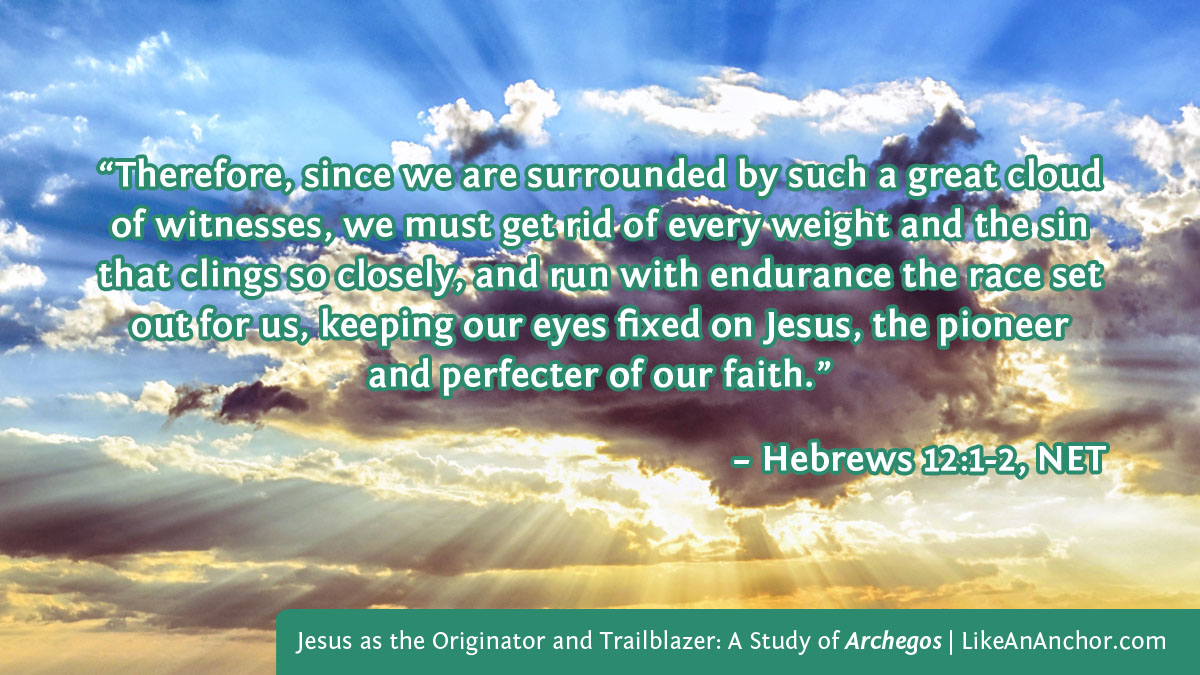
Image of clouds with sunlight behind them overlaid with text from Heb. 12:1-2, NET version:  “Therefore, since we are surrounded by such a great cloud
of witnesses, we must get rid of every weight and the sin that clings so closely, and run with endurance the race set out for us, keeping our eyes fixed on Jesus, the pioneer and perfecter of our faith.”
Image by RÜŞTÜ BOZKUŞ from Pixabay

Archegos of Faith

As the letter of Hebrews continues, the author dives deep into Jesus’s roles and the meaning of the New Covenant. As the letter draws to a close, we find the famous faith chapter (Heb. 11) followed by this statement:

Therefore, since we are surrounded by such a great cloud of witnesses, we must get rid of every weight and the sin that clings so closely, and run with endurance the race set out for us,  keeping our eyes fixed on Jesus, the pioneer (archegos) and perfecter of our faith. For the joy set out for him he endured the cross, disregarding its shame, and has taken his seat at the right hand of the throne of God.

Hebrews 12:1-3, NET (italics mark an allusion to Ps. 110:1)
Image of a woman reading the Bible outdoors with the blog's title text and the words "Knowing Jesus as the Originator and Trailblazer of life, salvation, and faith provides incredible encouragement."
Image by StockSnap from Pixabay

Here, translations for archegos include Author, Leader, Pioneer, Initiator, Source, Originator, “one who began,” and “the champion who initiates.” I don’t know of any translation using “trailblazer” (though “pioneer” carries a very similar idea), but that’s what I think of when I read this verse. He went first to blaze the trail and leave a clearly marked path behind Him so we could follow. I’d like to quote Zodhiates’s dictionary again to help us understand what’s going on in this verse grammatically.

“This may mean that Jesus is the one who initiates (and completes) faith in the souls of men. However, because faith is actually articular (tes pisteos) it may be best to understand it objectively referring to what is believed. In the context faith is treated as a way of life. The author summons a ‘cloud of witnesses’ whose lives testify to the reward of faith. Jesus stands as the chief witness for it was He who blazed the trail and gave us the ideal model of ‘the faith.'”

Zodhiates, The Complete WordStudy Dictionary: New Testament, entry G747

We can think of Jesus not only as the starting place for our faith, but as the one who provides a model of faithful life for us to imitate. As we examine the phrase “archegos … of our faith,” it adds another layer of meaning to our ongoing study of faith this year (see “Relational Faith: A Book Review and Theological Reflection“). You might recall we’ve been defining faith as “active loyalty, trust, hope, knowledge, and persuasion … within the new covenant brought about through Christ’s Atonement” (Schmidt, Relational Faith, p. 11). As we follow the Archegos of faith, we’re to do the same type of faithful actions and demonstrate the same loyalty to Jesus as He showed to His Father.

Also notice that Jesus is described as the “perfecter.” This is the Greek word teleiotes (G5051 τελειωτής). It’s the word for the one who brings something or someone to the state of perfect completion described by teleioo. Just like the Father perfected Jesus, bringing His trailblazing walk of faith to full completion and resurrected life, Jesus is doing the same as He (and the Father) work in us today.

I am sure of this very thing, that the one who began (enarchomai) a good work in you will perfect (epiteleō) it until the day of Christ Jesus.

Philippians 1:6, NET

Here in Philippians, “began” and “perfect” are translated from words derived from arche and teleo. Knowing Jesus as the Originator and Trailblazer of life, salvation, and faith provides incredible encouragement. He does not leave things unfinished. Together with His Father, He began a good work starting with the origin of life, He pioneered the path of faith for us to follow, and He has the ruling power to bring salvation to full completion. All of that is encompassed in this title, Archegos. And I hope that learning more about Jesus as the Archegos will awe and encourage you, as it has for me over many years.


Featured image by Peter H from Pixabay

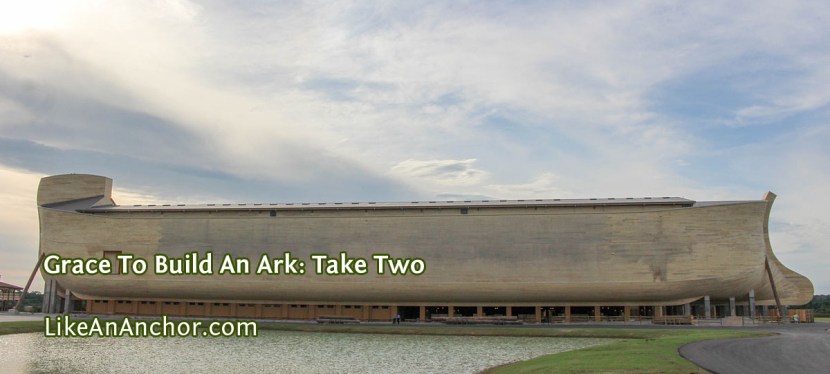
Grace To Build An Ark: Take Two

About six years ago (at the end of 2016), I wrote a blog post called “Grace to Build An Ark.” As I’ve studied grace more over the years, I keep coming back to this idea. When Noah found grace in the Lord’s eyes, God didn’t drop a ready-made ark from the sky. He gave Noah the plans to build an ark for himself.

We rightly think of grace as an “unmerited favor” or a “free gift” from God. But we often wrongly think that because the gift is given freely there are no accompanying expectations. I write about this error in posts like “Learning More About Covenant Grace” and you can learn even more about it by reading the book that inspired that post, Relational Grace: The Reciprocal and Binding Covenant of Charis (2015). Here’s one quote from the author, Brent Schmidt:

Jews knew about covenantal relationships from the Bible. Every commandment was a covenant with God. Several stories, including Joseph, Moses, and David, associate the concepts of grace and mercy with covenants. Greek-speaking Jews lived in a culture that depended heavily on reciprocal relationships and understood what charis meant. When Paul taught them using the word charis, they would have understood that by accepting God’s grace they were making covenantal obligations.

BRENT SCHMIDT, RELATIONAL GRACE, P. 64

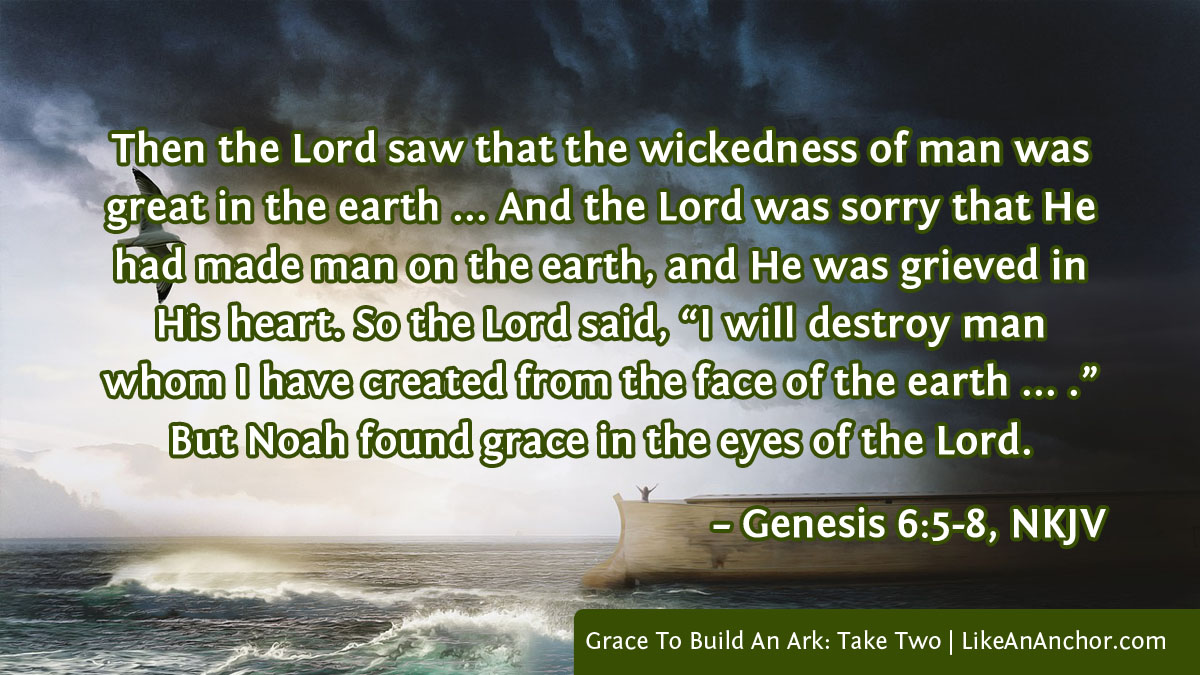
Noah’s story is the very first time we see the word “grace” in the Bible (Hebrew chen, also “kindness” or “favor”). God looked down on earth and “saw that the wickedness of man was great in the earth.” Grieving, God decided to destroy His creation, except “Noah found favor in Yahweh’s eyes” (Gen. 6:5-8, WEB). Once God chose to extend grace to Noah, He warned Him about the world-destroying flood, saying, “Make a ship of gopher wood,” gave him building instructions, and promised, “I will establish my covenant with you” (Gen. 6:13-21, WEB).

Noah and his family didn’t earn the right to be in the ark or to have a covenant-relationship with God. Their salvation was a gracious choice God made. But Noah still had to obey the command to build. Likewise, salvation is offered freely to us by God’s grace as He welcomes us into a covenant with Him. And we also have an obligation to obey God and to build something.

Building By Grace

Giving Noah the time and ability to build an ark so he and his family would live and the world would continue was a free gift of God’s grace. But Noah wouldn’t have been saved if he’d refused to build the ark. Peter and the author of Hebrews both talk about how important this building step was, and what it means for us today.

By faith Noah, when he was warned about things not yet seen, with reverent regard constructed an ark for the deliverance of his family. Through faith he condemned the world and became an heir of the righteousness that comes by faith.

Hebrews 11:7, NET

God patiently waited in the days of Noah as an ark was being constructed. In the ark a few, that is eight souls, were delivered through water. And this prefigured baptism, which now saves you—not the washing off of physical dirt but the pledge of a good conscience to God—through the resurrection of Jesus Christ, who went into heaven and is at the right hand of God with angels and authorities and powers subject to him.

1 Pet. 3:20-22, NET

Hebrews talks about the righteousness by faith that Noah inherited. Peter says Noah’s salvation prefigured baptism and our salvation. We live in times very similar to those Noah faced, and we’re also fast approaching the end of this world (1 John 2:18; Matt. 24:37-39; 2 Pet. 3:1-10). Like Noah, God has extended a lifeline to us–salvation by His grace. Also like Noah, we need to respond by taking action based on faith. Twice in Genesis, we’re told “Noah did everything that Yahweh commanded him” (Gen. 6:22; 7:5). If someone wrote the stories of our lives, could they say that about you and me?

Faith is an active thing. As we studied earlier this month, God seems to like building things, particularly when it involves building people up. He talks about building us into His temple, a dwelling place for Him here on earth as He lives inside the people of His church. He also talks about us participating in the building process.

We are coworkers belonging to God. You are God’s field, God’s building. According to the grace of God given to me, like a skilled master-builder I laid a foundation, but someone else builds on it. And each one must be careful how he builds. For no one can lay any foundation other than what is being laid, which is Jesus Christ. If anyone builds on the foundation with gold, silver, precious stones, wood, hay, or straw, each builder’s work will be plainly seen, for the Day will make it clear, because it will be revealed by fire. And the fire will test what kind of work each has done. If what someone has built survives, he will receive a reward. If someone’s work is burned up, he will suffer loss. He himself will be saved, but only as through fire.

Do you not know that you are God’s temple and that God’s Spirit lives in you? If someone destroys God’s temple, God will destroy him. For God’s temple is holy, which is what you are.

1 Corinthians 3:9-17, NET

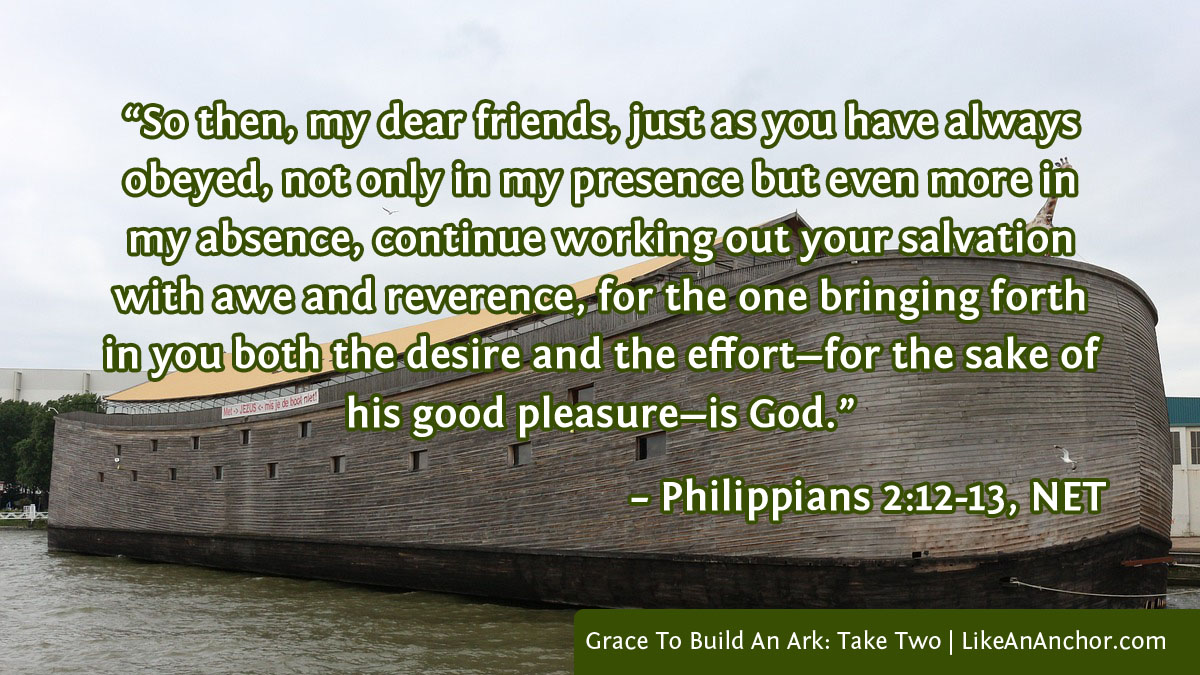
Just like Noah so long ago, God expects us to act on the gift of grace that He gives us. God’s grace brings us into salvation and then we start building and working. We step out in obedience with faith, trusting the guides God gives us for how to build. We “work out our own salvation” while God “works in us both to will and to work, for his good pleasure” (Phil. 2:12-13, WEB).

Continuing to Walk With God

Our walk with God doesn’t end when we receive His grace. That’s when it starts. Once we’ve covenanted with Him–in other words, entered a relationship with Him–we’re expected to “walk worthy of the calling with which you were called” (Eph. 4:1; Col. 1:10). The gift should change us. How could it not? What human being could encounter God in a meaningful, ongoing way and stay the same?

For by grace you are saved through faith, and this is not from yourselves, it is the gift of God; it is not from works, so that no one can boast. For we are his creative work, having been created in Christ Jesus for good works that God prepared beforehand so we can do them.

Ephesians 2:8-10, NET

Before we’re told that Noah found favor in the eyes of Yahweh, we’re given a description of his character. “Noah was a righteous man, blameless among the people of his time. Noah walked with God” (Gen 6:9, WEB). That’s what we’re supposed to do as well. Noah stood out from the wicked world around him because he followed God, and God noticed. When He spoke to Noah, Yahweh said, “Come with all of your household into the ship, for I have seen your righteousness before me in this generation” (Gen 7:1, WEB).

God loves and longs to save the whole world (John 3:16; 2 Pet. 3:9; 1 Tim. 2:3-4). But He won’t force people to follow Him and He won’t bring people into His kingdom who refuse the gift of salvation in word or action. That’s a choice we’re given to make. As He has always done, God sets before us life or death, blessings or cursing. We can either live in His grace or refuse to walk with Him. There’s no third option.

Behold, I have set before you today life and prosperity, and death and evil. For I command you today to love Yahweh your God, to walk in his ways and to keep his commandments, his statutes, and his ordinances, that you may live and multiply, and that Yahweh your God may bless you in the land where you go in to possess it. … I call heaven and earth to witness against you today that I have set before you life and death, the blessing and the curse. Therefore choose life, that you may live, you and your descendants, to love Yahweh your God, to obey his voice, and to cling to him; for he is your life, and the length of your days.

Deuteronomy 30:15-6, 19-20, WEB

Salvation isn’t about going on with your old life after you’ve received grace. It’s about a life-changing relationship with the One who continually gives grace (John 1:17; 1 Cor. 1:4; Eph. 4:7; 2 Thes. 2:16-17; 2 Tim. 1:9). And we have help in our quest to keep living by obedience as we build up ourselves and others in the church. God’s not going to call us into something without equipping us to finish it.

Building our arks has nothing to do with what we can accomplish on our own. Rather, it’s about believing Jesus when He said, “My grace is enough for you, for my power is made perfect in weakness.” (2 Cor. 12:9, NET). By God’s grace we are saved, we’re equipped to walk by faith, and we’re told to build, just like Noah. Our building project isn’t a giant boat, but the very church of God. Jesus said, “I will build my church” (Matt. 16:18, NET), but He graciously invites us to have a role in that. We get to build each other up and we get to build up our own faith.

But you, dear friends, by building yourselves up in your most holy faith, by praying in the Holy Spirit, maintain yourselves in the love of God, while anticipating the mercy of our Lord Jesus Christ that brings eternal life. 

Jude 1:20-21, NET

Featured image by Greg Reese from Pixabay

Song Recommendation: “Build a Boat” by Colton Dixon

Save

Save

Save

Isaiah Study: Replacing Fear With Joy

As we continue our now two-month study of Isaiah 40-66, I want to connect two of the themes I noted in my very first post at the start of this study. That list of themes included (among other things) “Reminders to ‘fear not!'” and “Joy in our relationships with God.” We already talked about joy in connection to the Sabbath covenant, but there’s a lot more joy here as well. These last 27 chapters of Isaiah record an extended dialog where God shares His feelings, desires, and plans for the future. A large part of those plans and desires have to do with working out wonderful things for His people. We have nothing to fear, and great cause for joy, when we’re in a relationship with God.

Fearless Joy for the Future

Isaiah wrote during a time of upheaval in his country. Israel fell to invading Assyrian armies and, while God delivered Judah for a time in response to righteous King Hezekiah’s prayer, Isaiah warned Jerusalem’s fall would come as well. We can understand why the people already in exile and those who knew captivity was coming might feel abandoned by God. At the same time, we can also see God’s perspective on that crisis–His rebuke for those who abandoned Him, His disgust for idolatry, His reminders of His power and justice, and His desire to dwell with and bless a people who follow Him faithfully. As part of His commitment to justice and salvation, He promises a New Covenant and a new type of relationship; one where He and His people won’t drift apart.

It’s really amazing. After all of the grief we put God through when we sin (Gen 6:5-6); after all the heartbreak of watching the people who covenanted with Him as His bride run off after other gods (Jer. 3:20; 5:7; Is. 54:4-8), He still loves us and wants a relationship with us. He wants that relationship so much Jesus died to replace the Old Covenant marriage with a better covenant and better promises (Rom. 7:1-6; Heb. 8:6-10).

The Lord Yahweh’s Spirit is on me,
    because Yahweh has anointed me to preach good news to the humble. …
    to comfort all who mourn,
to provide for those who mourn in Zion,
    to give to them a garland for ashes,
    the oil of joy for mourning,
    the garment of praise for the spirit of heaviness …

Everlasting joy will be to them.
“For I, Yahweh, love justice.
    I hate robbery and iniquity.
I will give them their reward in truth
    and I will make an everlasting covenant with them.”

Isaiah 61:1, 3,8, WEB

This section of Isaiah has a very hopeful, Messianic message. There are so many prophecies in here looking forward to Jesus’s first coming as well as His second coming. There’s a new covenant, a new marriage relationship, and a new earth that (from our perspective today) have already started happening and will reach fulfillment soon. By “soon” I mean in the same sense that the apostle John did when he said “these are the end times.” We don’t know exactly when Jesus will be back, but His coming is now “nearer to us than when we first believed” and we ought to be making ourselves ready. The promise of His coming should feel real to us, and we should react with fearlessness and joy, just as God’s people are told to do in Isaiah.

Image of a smiling woman worshiping overlaid with text from Isaiah 61:10, WEB: "I will greatly rejoice in Yahweh! My soul will be joyful in my God, for he has clothed me with the garments of salvation.   He has covered me with the robe of righteousness, as a bridegroom decks himself with a garland and as a bride adorns herself with her jewels.”
Image by Pearl from Lightstock

No Fear of Anyone Who’s Not God

Isaiah chapters 40-66 open with messages of comfort and punishment, a call to prepare the way for the Lord (a prophetic passage pointing to John the Baptist declaring the Messiah), and reminders of God’s sovereignty. He’s incomparable, irreplaceable, and all powerful. Knowing this about God should make us treat Him with the sort of respect, awe, and reverence that’s often called “fearing the Lord.” Knowing that this powerful One calls us His people and promises to help us also gives us joy and confidence. When we fear God, we don’t need to fear anything or anyone else.

“‘You are my servant, I have chosen you and have not cast you away.’
Don’t you be afraid, for I am with you.
    Don’t be dismayed, for I am your God.
    I will strengthen you.
    Yes, I will help you.
    Yes, I will uphold you with the right hand of my righteousness. …
For I, Yahweh your God, will hold your right hand,
    saying to you, ‘Don’t be afraid.
    I will help you.’
Don’t be afraid, you worm Jacob,
    and you men of Israel.
    I will help you,” says Yahweh.
    “Your Redeemer is the Holy One of Israel”

Isaiah 41:9-10, 13-14, WEB

Similar wording shows up again and again in this section of Isaiah. The words, “Don’t be afraid, for I have redeemed you. … Don’t be afraid, for I am with you,” also come with a reminder that Yahweh created us and He is our God (Is. 43:1, 5, WEB). Similarly, God reminds us that He is the only true God and Creator while saying, “Don’t fear, neither be afraid” to the people who say, “I am Yahweh’s … and honor the name of Israel” (Is. 44:8, 5, WEB). Again, God says, “Don’t be afraid, for you will not be ashamed. Don’t be confounded, for you will not be disappointed” as He promises, “my loving kindness will not depart from you, and my covenant of peace will not be removed” (Is. 54:4, 10 WEB).

God doesn’t ask us to pretend the bad things never happened, just like He didn’t pretend Israel wasn’t going through terrible times. Instead, He says in Isaiah 51, “Yahweh has comforted Zion … and I will establish my justice for a light to the peoples.” He promises, “my salvation will be forever, and my righteousness will not be abolished” (Is. 51:3, 4, 6, WEB). He also asks why we would fear any oppressor when the God of the universe is on our side? He could stretch out the heavens and break the seas; why wouldn’t He be able to deliver? Why would we doubt His promise that “Those ransomed by Yahweh will return, and come with singing to Zion. Everlasting joy shall be on their heads. They will obtain gladness and joy. Sorrow and sighing shall flee away”? (Is. 51:11, WEB).

Image of a smiling woman worshiping overlaid with text from Isaiah 49:13, WEB: “Sing, heavens, and be joyful, earth! Break out into singing, mountains,
for Yahweh has comforted his people, and will have compassion on his afflicted.”
Image by Ruby-Rose from Lightstock

The Joy of Salvation

As we look more closely at the declarations of joy in this part of Isaiah, we see that it’s connected with God’s power and deliverance over and over again. We “shout joyfully” to “give the Lord the honor he deserves” (Is. 42:11-12, WEB). Messengers are told to shout with joy as they proclaim that God is on His way with deliverance and salvation (Is. 48:20-21; 52:7-9). God assures His people that there’s no way He’ll get them to the point of deliverance and then fail to follow-through. Rather, His “servants will rejoice” and “sing for joy of heart” (Is. 65:13-19; 66:9-11).

Image of a man sitting on a beach next to a Bible with the blog's title text and the words "We have nothing to fear, and great cause for joy, when we're in a relationship with God."
Image by Aaron Kitzo from Pixabay

For as the rain comes down and the snow from the sky,
    and doesn’t return there, but waters the earth,
    and makes it grow and bud,
    and gives seed to the sower and bread to the eater;
so is my word that goes out of my mouth:
    it will not return to me void,
    but it will accomplish that which I please,
    and it will prosper in the thing I sent it to do.
For you shall go out with joy,
    and be led out with peace.
The mountains and the hills will break out before you into singing;
    and all the trees of the fields will clap their hands.

Isaiah 55:10-12, WEB

Joy and salvation are connected several times in the Old Testament’s more poetic writings. David wrote, “My soul shall be joyful in Yahweh. It shall rejoice in his salvation” (Ps. 35:9, WEB). After David sinned, his repentant prayer included the request, “Restore to me the joy of your salvation” (Ps. 51:12, WEB). Earlier in Isaiah, he writes about joyfully drawing water “out of the wells of salvation” (Is. 12:3, WEB). Similarly, Habakkuk declares, “I will be joyful in the God of my salvation!” (Hab. 3:18, WEB). This link between joy and salvation is essential for understanding God’s commands to rejoice. Even if there are things in our lives that might make joy seem impossible, they can never negate the deep, lasting joy that comes from knowing God saves us.

The promise of joy and salvation includes everyone who responds to God’s invitation to join His family. In Isaiah, God speaks to “the foreigners who join themselves to Yahweh” and “everyone who keeps the Sabbath from profaning it, and holds fast my covenant.” The promise isn’t exclusive; God welcomes everyone who wants “to serve him, and to love Yahweh’s name, to be his servants.” For these people, God promises, “I will bring these to my holy mountain, and make them joyful in my house of prayer.
Their burnt offerings and their sacrifices will be accepted on my altar; for my house will be called a house of prayer for all peoples” (Is. 56:6-8, WEB). That’s an amazing promise, and it’s one that we get to be part of today.

Featured image by Inbetween from Lightstock