What Are Ordained Roles in the Church?

A couple weeks ago, some of my family was talking about deacons and deaconesses in the church today. Who gets to be ordained deacons, what do they do, why we don’t see as many today, and things like that. That got me thinking about different service/authority roles that the New Testament talks about. I wanted to study the Greek words used, since English translations often use different words to represent the same Greek word and that can confuse things for modern readers.

As ground work, I started looking at the topic of ordination, assuming it would be relatively simple (spoiler warning: it is not). Different Christian denominations handle this topic differently, and also recognize different roles that men (and occasionally women) can be ordained into. Figuring out the Bible’s stance on all of this is not entirely straight-forward, which is probably why there are so many different takes on it in different groups. It also seems that things were a little less formal in early New Testament times.

The Surprisingly Complicated Topic of Ordination

According to GotQuestions.org, which is a good source for non-denominational overviews of Christian topics, “The modern definition of ordination is ‘the investiture of clergy’ or ‘the act of granting pastoral authority or sacerdotal power,'” and in most cases “the ceremony involves the laying on of hands.” There is Biblical precedent for this practice, but there are also differences between the modern tradition of ordination and the Biblical examples we see for selecting New Covenant church leaders.

In the King James Version of the New Testament, the word “ordain” is found in 21 verses and it’s translated from 14 different Greek words. I don’t use the KJV much, but it’s the easiest translation to find versions linked with Strong’s numbers for studying the Greek text, and it’s a hugely influential translation. One of the big limitations of the KJV, though, is that the English language has changed dramatically since 1611. Some of the translation choices that were accurate 400+ years ago no longer work today. For example, “ordain” came into English by way of Late Latin, to Anglo-French, to Middle English with the meaning “to put in order, appoint” (Merriam Webster). Some of the times when it appears in the KJV, it’s in the sense of ordaining someone into a role. Other times, it’s about a fact that God appointed or decrees someone put in order.

My favorite modern translation for the New Testament, the New English Translation, only uses “ordain” once. For the 21 verses where that word is used in the King James version, they use the English word “appointed” most often, but also “become,” “decided,” “designated,” “intended,” “instituted,” “determined,” “give direction,” “commanded,” “administered,” and “prepared.” Those words give a better idea of the range of Greek words behind “ordain.” For today’s post, we’re looking at the Greek words that include the sense of appointing people for certain tasks.

  • poieo (G4160). Primary meanings are “to make” or “to do” (Thayer). This word appears 586 times in the New Tesatament, with a broad range of meanings.
    • “He appointed twelve so that they would be with him and he could send them to preach” (Mark 3:14, NET).
  • tithemi (G5087). Primary meanings “to set, put, place,” “to make,” and “to set, fix, establish” (Thayer). This word appears 94 times, with meanings ranging from putting a candle under a bushel (Matt. 5:15) to preparing a corpse for burial (Mark 6:29; Acts 9:37) to laying down your life as a sacrifice (John 10:17-18; 15:13) to making Abraham a father of nations (Rom. 4:17).
    • “For this I was appointed a preacher and apostle—I am telling the truth; I am not lying—and a teacher of the Gentiles in faith and truth” (1 Tim. 2:7, NET).
  • kathistemi (G2525) means “to set, place, put,” including “to set one over a thing” or “to appoint one to administer an office” (Thayer). Used 21 times in the New Testament, often in the sense of putting someone in authority over something (see Matt. 24:45; 25:21; Acts 6:3; 7:10).
    • “The reason I left you in Crete was to set in order the remaining matters and to appoint elders in every town, as I directed you” (Tit. 1:5, NET). Also used of high priests in Heb. 5:1 and 8:3.
  • tasso (G5021). “To put in order, to station” (Thayer). Used 8 times in the New Testament, always with the connotation of a person appointed for something, whether it’s an office of authority or a location they’re supposed to go (Matt. 28:16; Luke 7:8; Acts 15:2; 22:10; 28:23; Rom. 13:1; 1 Cor. 16:15).
    • “When the Gentiles heard this, they began to rejoice and praise the word of the Lord, and all who had been appointed for eternal life believed” (Acts 13:48, NET).
  • cheirotoneo (G5500). “To vote by stretching out the hand,” such as appointing “one to have charge of an office or duty” (Thayer). Only used twice (2 Cor. 8:19).
    • “When they had appointed elders for them in the various churches, with prayer and fasting they entrusted them to the protection of the Lord in whom they had believed” (Acts 14:23, NET).

These words all have to do with appointing someone to a task, sometimes with the idea of setting them in place, sometimes in the sense of making them hold an office, and sometimes by voting. There wasn’t just one word that meant “ordain” the same way we have in English. It does appear there was some type of ceremony involved (see Acts 6:6; 13:2-4 for laying on of hands as part of setting people apart for service) and that there was a selection process of some kind (e.g. choosing, voting, listening for God’s direction). Roles appointed in this way included preacher, apostle, elder, and high priest (under the Old Covenant). Some also include all believers in the sense of being appointed to eternal life (Acts 13:48) or appointed to bear good fruit (John 15:16).

Looking at Roles In The Church

When I wrote earlier this year about women serving in the church, I argued that focusing on who gets to be in charge (i.e. who holds authority roles in the church) misses the point. Positions we think of as having “authority” are described as responsibilities for service. That’s not to say having authority is necessarily bad; Jesus has all authority in heaven and on earth and gave certain kinds of authority to people in His church. But if we think about ordained positions like pastor or elder primarily as positions of authority, then we’re missing focus on humility and service (Matt. 20:24-28; Luke 22:24-27).

That’s important background understanding to keep in mind as we study roles in the church. We all have a vital part to play but we don’t all hold the same roles (1 Cor. 12). There are two main lists of what we might call authority or leading roles in the church, one in 1 Corinthians and one in Ephesians. Putting them together, we have “some as apostles, some as prophets, some as evangelists, and some as pastors and teachers” (Eph. 4:11), as well as those gifted with “miracles, gifts of healing, helps, gifts of leadership, different kinds of tongues” (1 Cor. 12:28, NET). Paul also talks about overseers (bishops) and deacons or deaconesses (servants) in other letters (Phil. 1:1; 1 Tim. 3:1-4, 8-13; Titus 1:7-9). Elders also come up frequently (Acts 11:30; 14:23; 15:2-6, 22-23; 16:4; 1 Tim. 5:17; Tit. 1:5; Jams 5:14; 1 Pet. 5:1), and it appears their roles overlap with overseers (Acts 20:17, 28).

  • Apostles. Greek apostolos (G652), “a delegate, messenger, one sent forth with orders” (Thayers). This category definitely included the 12 apostles hand-picked by Jesus, Matthias (who replaced Judas), and Paul. However, it is uncertain if it applied to any others (like Barnabus, Timothy, Silvanus, and Junia). Scripture is also unclear on if any humans should be designated as apostles today, but Zodhiates notes in his dictionary that it is probable “there is no continuity of the office of an apostle since in no place were the churches instructed to ordain apostles.”
  • Prophets. Greek prophetes (G4396). Broadly speaking, it means one who speaks as they are inspired by God, often “concerning future events” (Thayers). This word “corresponds to the person who in the OT spoke under divine influence and inspiration” to foretell “future events,” deliver messages from God to people, and act as “the interpreter of His will” (Zodhiates). This is one of the roles that we definitely know can apply to both men and women.
  • Evangelists. Greek euaggelistes (G2099), “a bringer of good tidings” (Thayers). Could be a formal title, but may also simply apply to those who share the gospel of salvation. “Evangelist” is only used three times in the New Testament (Acts 21:8; Eph. 4:11; 2 Tim. 4:5), but the verb “to bring good news” (euaggelizo, G2097) is used 60 times. Though we don’t have a lot of information on this role, some scholars infer that evangelists (along with apostles and prophets) were “itinerant ministers … preaching wherever they found an opportunity, while pastors and teachers were attached to some congregation or location” (Zodhiates).
  • Teachers. Greek didaskalos (G1320), “one who teaches” (Thayer). The word is often used of Jesus as The Teacher, as well as His followers who teach whether they “hold the office of teacher” or are “endowed with the teaching gift” and minister “in an unofficial capacity” (Zodhiates).
    • Pastors. Greek poimen (G4166), literally “a herdsman, especially a shepherd” and metaphorically, “the presiding office, manager, director of any assembly” (Thayer). I have “pastors” nested under “teachers” because of how Ephesians 4:11 is phrased in Greek. Some interpret “pastors and teachers” as one group (i.e. all pastors are teachers and all teachers are pastors) because there’s only one definite article in Greek. The NET translation, however, points out this is “extremely unlikely” given that both “nouns are plural …. It is better to regard the pastors as a subset of teachers. In other words, all pastors are teachers, but not all teachers are pastors” (study note on Eph. 4:11). Zodhiates concurs, noting that “there is a growing consensus that pastors are a sub-group within the larger body of teachers.”
  • Elders. Greek presbuteros (G4245) can refer to someone who is “the elder of two people” or someone “advanced in life … a senior” (Thayer). It is also used as “a term of rank or office” in both Christian and Jewish communities of the New Testament. You’ll often see “elders” used in the gospels to talk about judges and Sanhedrin members in the Jewish community. In Christian communities, Thayer’s dictionary notes that “the NT uses the term term bishop, elders, and presbyters interchangeably” and Zodhiates agrees elder is equivalent to overseer/bishop. It also is worth noting that this word typically seems to refer to men, but is used once for women (1 Tim. 5:2 is typically translated “elder women” or “older women,” and it’s the feminine version of presbuteros).
    • Overseers. Greek episkopos (G1985), someone “charged with the duty of seeing that things to be done by others are done rightly” (Thayer). Also translated “bishops.” I have this role nested under “elder” because in Actus 20, Paul tell the elders he gathered (v. 17) that the holy spirit made them overseers of God’s flock (v. 28). This supports our assumption that the words are used interchangeably. We find qualifications for overseers in 1 Timothy 3:1-7 and Titus 1:5-9.
  • Deacons. Greek diakonos (G1249), “one who executes the commands of another, especially of a master” (Thayer). Typically translated “servant,” “minister,” or “deacon.” The word is applied to some specific people: Jesus (Rom. 15:8), Phoebe (Rom. 16:1), Apollos (1 Cor. 3:5), Paul (Col. 1:23), Tychicus (Eph. 6:21; Col. 4:7), Epaphras (Col. 1:7), and Timothy (1 Thes. 3:2). We find qualifications for deacons in 1 Timothy 3:8-13. I’ve seen arguments that all the people named as diakonos are just “servants” rather than ordained “deacons” because they argue the role of deacon should be attached to a single church congregation, not overlap with pastor or apostle, and only apply to men, but it seems strange to me to insist on that distinction given that it’s all the same Greek word.

Why Does This Matter?
Image of people sitting in church pews, overlaid with blog's title text and the words, "What leadership roles did God set up in the church, and why should we care?"
Image by Brown Bag Photography from Lightstock

I found this a very interesting study, but as I continued working on it I started to wonder what the point is. There’s scholarly and doctrinal interest in this topic, but what does it have to do with the lives of Christians as a whole?

I think there is value, even for the majority of Christians who are not formally ordained, in understanding what the Bible has to say about authority or leadership roles in the church. It helps us understand that God did put structure in place and we should accord respect and honor to the men He charged with serving the church (1 Tim. 5:17). We are not meant to see elders, pastors, and others like them as adversaries, but as helpers and fellow workers (2 Cor. 1:24). It may be hard to trust people in leadership positions if you have experience with those who have abused those positions, but we must keep in mind that the roles themselves are not the issue.

That said, we’re also not called to blindly follow human beings no matter what they do. Understanding what the Bible says about people God entrusted with leadership roles in His church also helps us recognize when not to follow someone who claims authority. For example, if someone today claims that God appointed him an apostle and we should follow whatever he says, we should not believe that person. If a minister, elder, deacon, etc. starts teaching things contrary to God’s law or living a completely dissolute life, we should recognize that we have an obligation not to follow them.

Jesus Christ is the Head of all things to the church. As the Head of the Body, He sets people in different positions to fill different roles so the body is complete, diverse, unified, and accomplishing the variety of tasks the church needs to be doing (1 Cor. 12). The whole church–consisting of every person He has called to follow Him and who responded to His call by committing to Him–is under His authority. We can follow and imitate other respectable Christians, but only in so far as they are imitating and following Jesus (1 Cor. 4:16-17; 11:1; Phil. 3:17; 1 Thes. 1:6; Heb. 6:12).


Featured image by Matt Vasquez from Lightstock

Pauline Introductions, Part 1: How Does Paul Introduce Himself?

As I was reading Galatians a couple weeks ago, I was struck by how much Paul packs into those first couple sentences of the letter. He introduces himself, explains his qualifications for writing to them, wishes his readers well, glorifies God, and highlights one of the amazing things God has done for His people.

This introduction is part of a pattern that Paul follows in his other letters to churches. The first few lines of the letter might also include a brief summary of the gospel, some further description of his audience, and/or expressions of thanksgiving. As I looked at the openings of these letters, I wondered what we might learn by comparing the very first things that Paul wanted his readers to see and hear when they read his letters.

I expect this will be the first of a three-part post series: how Paul talks about himself, how Paul talks about God, and how Paul talks about us in the introductions to his letters. We’ll be focusing on the epistles he wrote to church communities rather than the pastoral epistles (Timothy, Titus) or the letter to an individual (Philemon). This series will also exclude Hebrews since there’s a good chance Paul wasn’t the author. That leaves us with nine letters: Romans, 1 Corinthians, 2 Corinthians, Galatians, Ephesians, Philippians, Colossians, 1 Thessalonians, and 2 Thessalonians.

Apostle

Paul introduces himself as an apostle in six of the nine letters: Romans, 1 Corinthians, 2 Corinthians, Galatians, Ephesians, Colossians. He also talks about how he became an apostle, probably because it wasn’t the usual way. The other apostles named directly in the New Testament were among Jesus’s original 12 disciples, while Paul was personally selected by Jesus later. (Note that there may have been other apostles, but it’s not clear if that’s the case. For example, some consider Barnabas an apostle but he’s not explicitly called one in scripture [Acts 4:36; 14:14; 15:2, 22], and it’s unclear if Andronicus and Junia were apostles or not [Rom. 16:7]).

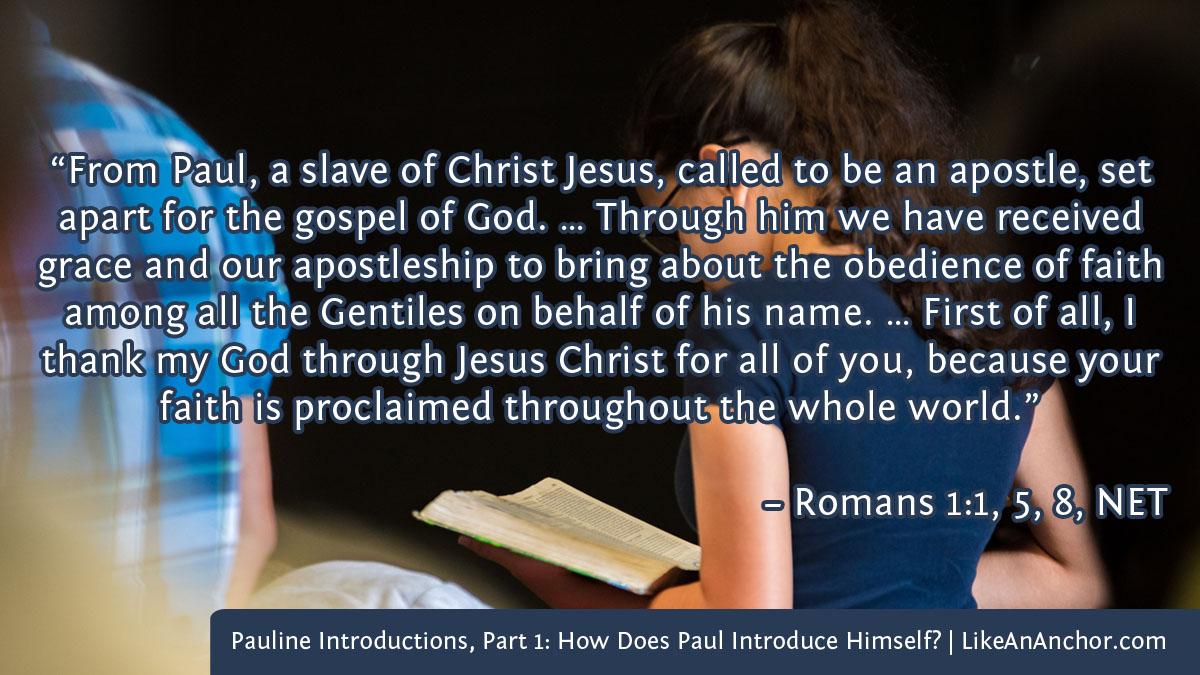
In the book of Romans, Paul introduces himself as “a slave of Christ Jesus, called to be an apostle, set apart for the gospel of God” (Rom. 1:1, NET). Just a few lines later he adds, “Through him we have received grace and our apostleship to bring about the obedience of faith among all the Gentiles on behalf of his name” (Rom. 1:5, NET). It matches something he says later in Romans, calling himself “an apostle to the Gentiles” (Rom. 11:13, NET). Most of the time, he’s not that specific, though. He simply states that he’s “an apostle of Christ Jesus by the will of God” (2 Cor. 2:2; Eph. 1:1; Col. 1:1, NET) or that he’s “called to be an apostle of Christ Jesus by the will of God” (1 Cor. 1:1, NET).

Galatians is the letter where Paul spends the most time discussing his apostleship. He opens the letter by saying, “From Paul, an apostle (not from men, nor by human agency, but by Jesus Christ and God the Father who raised him from the dead)” (Gal. 1:1, NET), then follows that with a vindication of his apostleship and more details about it (Gal. 1:11-2:10). In the letter to the Galatian brethren, Paul focuses on correcting their theological errors and countering false teachers. That gives us context for his focus on his credentials in this letter: he wants to assure the Galatian believers that the gospel they originally received came straight from Jesus and was verified by the apostles. Throughout all of this, Paul’s reason for calling himself an apostle is to point his readers to Jesus and the Father as the higher authority. They are the ones who “empowered me for my apostleship to the Gentiles” (Gal 2:8, NET) and that’s the reason we can trust what Paul says in his role as an apostle.

Image of a young woman reading the Bible overlaid with text from Romans 1:1, 5, 8, NET version: "From Paul, a slave of Christ Jesus, called to be an apostle, set apart for the gospel of God. … Through him we have received grace and our apostleship to bring about the obedience of faith among all the Gentiles on behalf of his name. … First of all, I thank my God through Jesus Christ for all of you, because your faith is proclaimed throughout the whole world."
Image by José Roberto Roquel from Lightstock

Slave

In both Romans and Philippians, Paul calls himself a “slave of Jesus Christ” (Rom. 1:1; Phil. 1:1). He also uses this phrase to describe himself in other letters we’re studying today, just not in the introduction (2 Cor. 4:5; Gal. 1:10; Col. 1:7; 4:7). Slavery in the Bible is a super tricky subject, but in this particular context at least we have a pretty good idea of what Paul is talking about. Here’s part of what the New English Translation (NET) translators have to say in their footnote that accompanies most verses using the word:

tn Traditionally, “servant” or “bondservant.” Though δοῦλος (doulos) is normally translated “servant,” the word does not bear the connotation of a free individual serving another. BDAG [Bauer’s Lexicon of Biblical Greek] notes that “‘servant’ for ‘slave’ is largely confined to Biblical transl. and early American times…in normal usage at the present time the two words are carefully distinguished” (BDAG 260 s.v.). One good translation is “bondservant” (sometimes found in the ASV for δοῦλος) in that it often indicates one who sells himself into slavery to another. But as this is archaic, few today understand its force. …

sn Undoubtedly the background for the concept of being the Lord’s slave or servant is to be found in the Old Testament scriptures. For a Jew this concept did not connote drudgery, but honor and privilege. It was used of national Israel at times (Isa 43:10), but was especially associated with famous OT personalities, including such great men as Moses (Josh 14:7), David (Ps 89:3; cf. 2 Sam 7:58) and Elijah (2 Kgs 10:10); all these men were “servants (or slaves) of the Lord.”

NET translation note (tn) and study note (sn) on Galatians 1:10

In Romans, Paul further developed this idea by explaining that all human beings serve as slaves, either to sin or to righteousness (Rom. 6:15-20). We don’t get the choice to not serve anything, but we do get to choose who we submit to as our master. Will we be controlled by sin, or will we accept and strive for the privilege of serving God and living righteous lives that glorify Him? Paul made that choice when he rejected human privilege and credentials, responded to God’s call, and stopped persecuting the church and became someone persecuted for preaching the truth (Phil. 3). When he describes his service to God, he doesn’t use a word that would indicate a servant who can just walk away if they want, but someone who (in this case voluntarily) bound himself in lifelong service. He’s fully committed to serving God.

Thankful and Praying

Several times when writing to a church, one of the very first things Paul tells them is that he is thankful and praying for them. He has prayers in other letters as well, but in 1 Corinthians, Philippians, Colossians, 1 Thessalonians, and 2 Thessalonians it’s right at the start of the letter.

A lot of what Paul shares in these assurances that he’s praying for his readers is about how he views them, but it also tells us something about him. He says, “I always thank my God for you” (1 Cor. 1:4, NET), “ I thank my God every time I remember you. I always pray with joy in my every prayer for all of you” (Phil. 1:3-4, NET), “We always give thanks to God, the Father of our Lord Jesus Christ, when we pray for you” (Col. 1:3, NET), “We thank God always for all of you as we mention you constantly in our prayers” (1 Thes. 1:2, NET), and “We are bound to always give thanks to God for you” (2 Thes. 1:3, WEB). Paul wants his readers to know that he–and for some letters his co-authors as well (Timothy for Colossians, Silvanus and Timothy for Thessalonians)–are thankful for them and that they remember them when they’re praying.

I think it tells us a lot about Paul’s character and his focus that he doesn’t start these letters by talking about his credentials (other than apostle chosen by God and slave in Jesus’s service, both emphasizing his humility) or by telling the churches what they’re doing wrong. There is correction in many of these letters, some very serious (especially 1 Corinthians), but that’s not where he starts. He starts with thankfulness. He wants his readers to immediately know that he’s thankful for them and he’s praying for them.

Blessed

Paul also used a few other phrases to describe himself, which I’ve collected in this final section. All of these descriptions (“set apart for the gospel” and recipient of grace in Romans, “comforted by God” in 2 Corinthians, rescued by Jesus in Galatians, and “blessed” in Ephesians) relate to ways that God has blessed Paul. One of these letters was written from Prison (Eph. 3:1) and another Paul recounts a huge list of sufferings he’d gone through (2 Cor. 11:23-33), yet he focuses on his blessings. And not just his blessings, either: in 2 Corinthians, Galatians, and Ephesians, he talks about “us” being blessed.

In 1 Corinthians, Paul encouraged us to imitate him as he imitated Christ (1 Cor. 11:1). Just from the way he talks about himself in the introduction to these epistles, we see a humble man who focused on the work that God was doing in him and the churches he served. We think of Paul as one of the most important men in the whole Bible, but he kept pointing back to Jesus and the Father. Even when acknowledging that he had been commissioned by God as an apostle, he also called himself God’s slave.

In addition, we see that Paul was an encouraging person. Over and over in these letters, he told Christians to build others up rather than fight with them and tear them down, and he models that approach in his letter writing. He also tells his readers he’s thankful for them and that he’s praying for them. He also talked about his blessings, something that is encouraging to hear from other people, and included his readers in the “us” who are blessed.


Featured image by StartupStockPhotos from Pixabay

Being A Faithful Servant

Our salvation requires action. Even the most liberal versions of Christianity expect people to believe in and confess Christ even if they say you don’t have to do anything after that. And scripture takes it several steps further, saying that believers are also to repent of their past sins and then commit to following Jesus.

God wants relationship with us. Like all relationships, this is a two-way street. We’ll never be able to out-give or out-love God, or even come close to matching what He offers us. But He still wants us to give Him what we do have to offer: our hearts, minds, and souls. He wants commitment and faithfulness from those who’ve asked to be in relationship with Him.Being A Faithful Servant | marissabaker.wordpress.com

Parables and Responsibilities

Near the end of His life, Jesus’ disciples asked Him about signs signalling the end of the world and His second coming. After answering this question in Matt 24:3-44. He moved on to what’s expected of His followers while they wait. He tells them to watch and be ready, then He beings a series of parables.

Who then is the faithful and wise servant, whom his lord has set over his household, to give them their food in due season? Blessed is that servant whom his lord finds doing so when he comes. (Matt. 24:45-46, WEB)

The people waiting for Christ’s return are supposed to be doing something. In this particular parable, it has to do with how they treat their fellow servants. God cares about how you interact with the people around you. Having a relationship with Him is meant to transform that area of your life. Read more

Servants of God Forever

Servants of God Forever | marissabaker.wordpress.comLast week we talked about the future, and what the people of God might be doing in the tribulation leading up to Christ’s return. Today, let’s go a bit father into the future. In Revelation 20, we’re told that the devil will be locked away for 1,000 years while the faithful live and reign with Christ (20:4). At the end of the Millennium, he is released and those who join his rebellion against God are destroyed, and Satan is locked away (20:7-10). This is followed by the second resurrection and final judgement of the dead who were not counted among the firstfruits.

From this point on, we have very little detail. Revelation 21 and 22 gives descriptions of the New Jerusalem and the new heaven and new earth, and we’re told there will be “nations of those who are saved” (21:24). We know “the Lord God Almighty and the Lamb are its temple” giving light to the entire world (21:22; 22:5). One thing we don’t know is exactly what we’ll be doing there. Most speculation I’ve heard assumes we’ll be helping Christ re-build the world and counsel survivors of the tribulation through the Millennium. Some have suggested we might spread out and colonize other planets after that. But we really don’t know. I’ve always thought that if it was really important for us to know, God would have told us. A message I heard a couple weeks ago, though, has me wondering if He did give us some clues after all.

Servants

The Rabbi at my Messianic group was talking a couple weeks ago about patterns that God sets up in how He runs things. In ancient Israel, the Levites were a tribe set apart for God, which this speaker connected to our role today as God’s called-out people. The Rabbi’s focus was on how that affects us today, but I wondered if it might carry over into the future as well, with God re-using this pattern.

Thus you shall separate the Levites from among the children of Israel, and the Levites shall be Mine. After that the Levites shall go in to service the tabernacle of meeting. So you shall cleanse them and offer them like a wave offering. (Num. 8:14-15)

The Levites — 1 tribe out of 12 — were specifically set aside for God to serve in His tabernacle. Verse 11, here in Numbers 8, calls them “a wave offering from the children of Israel, that they may perform the work of the Lord.” Similar wording is used today, as we’re called to present ourselves to God as an offering.

I beseech you therefore, brethren, by the mercies of God, that you present your bodies a living sacrifice, holy, acceptable to God, which is your reasonable service. (Rom. 12:1)

Our lives aren’t our own. When we commit to following God, we pledge everything we are to His service. We are His, and just as He said the Levites “shall be Mine,” so He can call each of us His because He redeemed us.

For they are wholly given to Me from among the children of Israel; I have taken them for Myself instead of all who open the womb, the firstborn of all the children of Israel. For all the firstborn among the children of Israel are Mine, both man and beast; on the day that I struck all the firstborn in the land of Egypt I sanctified them to Myself. I have taken the Levites instead of all the firstborn of the children of Israel. (Num. 8:16-18)

Servants of God Forever | marissabaker.wordpress.comBecause of the events that happened on Passover, when the Lord rescued Israel from Egypt, all the firstborn were holy to Him. Instead of having all the firstborn sent to serve in the tabernacle, though, He set aside one tribe for that role. In much the same way, Jesus Christ’s sacrifice made redemption possible for all people, but right now He’s only working with the firstfruits.

Or do you not know that your body is the temple of the Holy Spirit which is in you, which you have from God, and you are not your own? For you were bought at a price; therefore glorify God in your body and in your spirit, which are God’s. (1 Cor. 6:19-20)

We are purchased with Christ’s blood, bought-back from our enslavement to sin so we can serve God (Rom. 6:15-23). That’s not a role that’s going away any time soon.

And there shall be no more curse, but the throne of God and of the Lamb shall be in it, and His servants shall serve Him. They shall see His face, and His name shall be on their foreheads. There shall be no night there: They need no lamp nor light of the sun, for the Lord God gives them light. And they shall reign forever and ever. (Rev. 22:3-5)

This is in the description of the New Jerusalem. Right before this, it talks about “the nations” who walk in God’s light and are healed by the tree of life (Rev. 21:24-22:2). Then, we see God’s servants mentioned as a separate group. Could that be those who were firstfruits, continuing in their role as servants especially chosen for God’s holy use?

Priests

Not all the Levites served as priests. Even within the tabernacle service there were different roles and responsibilities. Most notable was the fact that there was only one high priest at any given time. Today, the role of High Priest is held by Jesus Christ (Heb. 8:1-6), whose perfect sacrifice fulfilled the sacrifices offered by the Old Covenant high priests. So, where did the rest of the Levites fit in?

And I have given the Levites as a gift to Aaron and his sons from among the children of Israel, to do the work for the children of Israel in the tabernacle of meeting, and to make atonement for the children of Israel, that there be no plague among the children of Israel when the children of Israel come near the sanctuary. (Num. 8:19)

Here, the Levites are described as a gift given to the high priest for service in the tabernacle. This is repeated several chapters later.

 Behold, I Myself have taken your brethren the Levites from among the children of Israel; they are a gift to you, given by the Lord, to do the work of the tabernacle of meeting. (Num. 18:6)

This sounds a lot like Jesus’ prayer on the night in which He was betrayed.

I pray for them. I do not pray for the world but for those whom You have given Me, for they are Yours. And all Mine are Yours, and Yours are Mine, and I am glorified in them. (John 17:9-10)

Servants of God Forever | marissabaker.wordpress.comGod has given us to His Son, our High Priest, to serve and glorify Him. As quoted earlier, we are God’s temple today. That’s where priests serve — in the temple (or the tabernacle, at the time when Numbers was written). Jesus is in His church as the High Priest in His temple, and we’re right there serving with Him.

But you are a chosen generation, a royal priesthood, a holy nation, His own special people, that you may proclaim the praises of Him who called you out of darkness into His marvelous light (1 Pet. 2:9)

Even today, God’s people are described as a priesthood. That role continues into the future — definitely into the Millennium, and quite probably beyond.

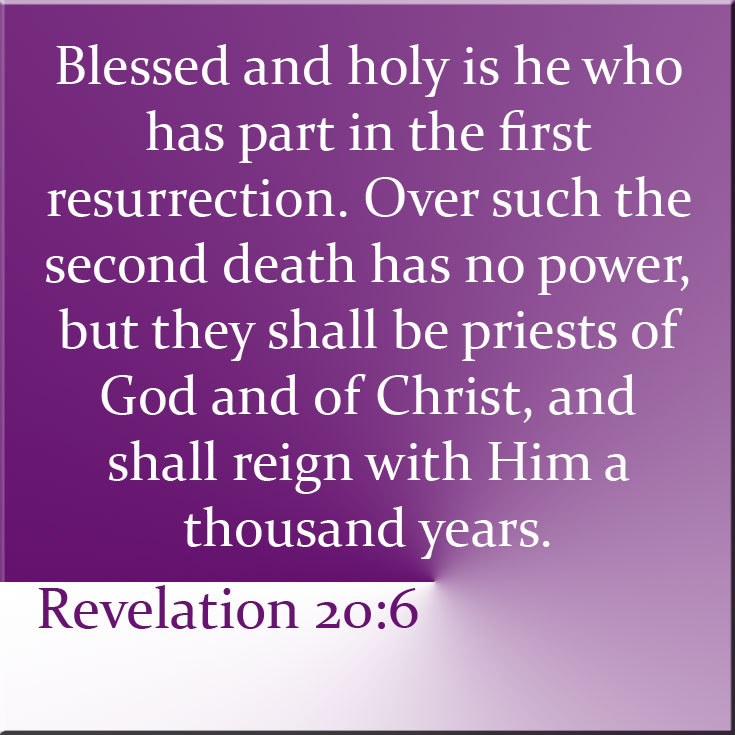
Blessed and holy is he who has part in the first resurrection. Over such the second death has no power, but they shall be priests of God and of Christ, and shall reign with Him a thousand years. (Rev. 20:6)

When you look back at the book of Numbers, both passages we quoted about the Levites’ role as helpers to the high priest emphasized service. That’s also the common thread uniting the two descriptions of God’s people in the future as servants and priests. If we want to work on something that will carry over into the future, serving God by serving His people seems a good place to start. There is an aspect of our future that involves ruling, but to learn to rule with Christ, we must first learn to serve. That’s what Christ did and does (Phil. 2:5-9), it’s what Paul did (Phil. 2:17-18), and that’s what we should be doing.


What Is A Minister?

So many people, across every Christian denomination, are becoming fed-up with church. Last week, we talked about how part of the reason people say they leave the church is how badly they were treated by fellow believers. Another reason people give for leaving, or at least rejecting “organized religion,” is how they’ve been treated by the ministry.

What is a Minister? | marissabaker.wordpress.comI’ve been blessed in that I’ve had both good and bad experiences with people in ministry roles. I know others who have only seen exploitative, authoritarian, or otherwise bad examples of the ministry. To keep hold of our faith, sometimes we have to be able to look past men like this and cling fast to God. We can’t fall into the trap of blaming Him for what people do. In fact, He’s probably upset even more upset than we are. How would you feel if someone started mis-treating your children while saying that they served you?

Seeing so many examples of what the ministry shouldn’t be leads some to think perhaps there shouldn’t be a ministry or human leadership roles in the church at all. There are too many scriptures that talk about the proper role of ministers, though, for me to agree. Rather, it make me ask, “Ideally, what does God want the ministry to do?” and “How can we recognize a true minister?” If we can answer those questions, perhaps we can encourage the people who do have leadership and teaching abilities towards being the kind of ministers God wants so see. Perhaps some of us can even fill those roles.

Puts Christ First

Jesus Christ is the Head over all things to the church (Eph. 1:22) and the Head of each individual (1 Cor. 11:3). A true minister will acknowledge Christ as his Head, and also respect Christ’s role as your Head.

Not that we have dominion over your faith, but are fellow workers for your joy; for by faith you stand. (2 Cor. 1:24)

Good ministers also recognize that any authority they do have comes from Jesus. He is the One who appoints ministry roles in order that His people might grow towards perfection and be edified in unity (Eph. 4:11-16).

And I thank Christ Jesus our Lord who has enabled me, because He counted me faithful, putting me into the ministry (1 Tim. 1:12)

I dare say no one has had an experience quite like Paul’s conversion and calling, but everyone in a ministry role owes their appointment to Jesus Christ. If their allegiance lies anywhere else, then they are not a true minister. As believers we cannot build on any foundation other than Jesus Christ, and as teachers we cannot lay any other foundation and expect to prosper (1 Cor. 3:11-13).

Not A “Hireling”

I’m of two minds regarding the paid ministry. One the one hand, it is clear in scripture that the people who serve God’s people are supposed to be supported by the brethren. On the other hand, it seems that (in the church as well as in the world) the more money involved the more likely people are to become corrupt.

If we have sown spiritual things for you, is it a great thing if we reap your material things? If others are partakers of this right over you, are we not even more? Nevertheless we have not used this right, but endure all things lest we hinder the gospel of Christ. Do you not know that those who minister the holy things eat of the things of the temple, and those who serve at the altar partake of the offerings of the altar? Even so the Lord has commanded that those who preach the gospel should live from the gospel. (1 Cor. 9:11-14)

Paul did not choose to live off the churches’ money and generosity, but he would have had every right to do so. Similarly, when Jesus sent the 70 out to preach He told them to dwell as guests in one house “eating and drinking such things as they give, for the laborer is worthy of his wages” (Luke 10:7). Paul uses the same phrase in 1 Timothy when explaining why elders deserve respect (1 Tim. 5:17-18).

What is a Minister? | marissabaker.wordpress.com
( Paul Woods, via Flickr, CC BY-NC-SA)

The problems are more likely to arise, I think, when ministers are hired and paid by a corporation rather than supported by their local churches. To be fair, I have seen good and bad ministers in both independent and corporate churches, but I do think the corporate ministry is more likely to attract more of the sort of people who are in it for the prestige, politics, and paycheck.

But a hireling, he who is not the shepherd, one who does not own the sheep, sees the wolf coming and leaves the sheep and flees; and the wolf catches the sheep and scatters them. The hireling flees because he is a hireling and does not care about the sheep. (John 10:12-13)

Again, I want to stress that not all paid ministers have this attitude. I do think, however, that a system in which ministers are dependent on a corporate group for money and assignments rather than being connected to a local congregation is more likely to produce “hirelings” who are not invested in truly caring for Christ’s sheep.

Helpers of Your Joy

We already quoted 1 Corinthians 1:24, which describes the ministry’s role as “fellow workers for your joy.” The King James Version renders this “helpers of your joy.” There are times for correcting those who teach other doctrines and rejecting heretics “after the first and second admonition,” as Paul told Timothy and Titus (1 Tim. 1:3-8; Tit. 3:10-11). Discipline and rule is not a minister’s main role, though. A minister’s influence in a congregation should bring joy and peace. If someone needs corrected, it should be done with the respect due a family member (1 Tim. 5:1-2).

When Paul gives instructions to Timothy and Titus, he tells them to remind the brethren of our foundation in Christ, to teach and encourage, to exercise godliness, to shun profanity and nonsense, and to live peaceably (1 Tim. 4:6-7; 2 Tim. 2:14-16; Tit. 2:1-15). Basically, they were to do what Paul himself did — teach the brethren and equip them with the tools needed so they could draw closer to God and not “be corrupted from the simplicity that is in Christ” (2 Cor. 11:3).

Therefore, my beloved, as you have always obeyed, not as in my presence only, but now much more in my absence, work out your own salvation with fear and trembling; for it is God who works in you both to will and to do for His good pleasure. (Phil. 2:12-13)

Notice that Paul wanted this church group to be able to work toward salvation without his help or presence, recognizing that it was God who worked in them. This didn’t eliminate the need for Paul’s role, but it meant they weren’t supposed to be dependent on any human minister. Other believers, including the ministry, can help us on the road to salvation, but they are not the One “who works in you” (1 Cor. 3:4-11).

That is the key to what make a true minister — they seek God first, and do everything they can to make sure the people they serve also seek God first and develop a relationship with Him. Really, it just means they are doing the same thing that every believer should be doing. They are showing love and helping their brethren in the best way they can using their specific gifts. There is much more to a minister’s role than this, but this is where everything has to start.

Praise and Worship: What is Worship?

Praise and Worship blog series, "What is Worship?" | marissabaker.wordpress.comI’ve titled this blog series “Praise and Worship,” but so far we’ve only talked about praise and prayer. I think it’s typical to think of praise and worship going together, and perhaps you’re like me and the first thing you think of is praise and worship music. While praise is typically done aloud and often includes music and singing, worship in the Bible is actually quite different.

Defining Worship

In the Old Testament, most mentions of “worship” are translated from the Hebrew word shachah (H7812). It is a “verb meaning to bow down, to prostrate one self, to crouch, to fall down, to humbly beseech, to do reverence, to worship” (Baker and Carpenter). It was the accepted way of showing respect to powerful people, such as Boaz (Ruth 2:10) or David (1 Sam. 25:41).

While it was acceptable to bow before other people sometimes, when their position and character called for such a gesture of respect, it was never acceptable to do this before any deity other than the one True God (Josh. 23:7). When using shacha in the sense of worship, it may only be used toward God if you intend to worship properly.

Give to the Lord the glory due His name; bring an offering, and come before Him. Oh, worship the Lord in the beauty of holiness! (1 Chr. 16:29)

In the New Testament, there are several words translated “worship,” but we’ll only look at two of them right now. One, latreuo (G3000) is associated with the act of serving God, and involves the voluntary service of a hired servant rather than the compulsory service of a slave. We’ll get back to this word near the end of the post.

The Greek word most often translated “worship” has a meaning very similar to the Hebrew shachah. Proskuneo (G4352) means “to worship, do obeisance, show respect, fall or prostrate before. Literally, to kiss toward someone, to throw a kiss in token of respect of homage” (Zodhiates). I’ve written about this word before, in a post called “Blowing Kisses to God.” In the New Testament, the usual meaning is to bow or kneel before someone in reverence.

But if all prophesy, and an unbeliever or an uninformed person comes in, he is convinced by all, he is convicted by all. And thus the secrets of his heart are revealed; and so, falling down on his face, he will worship God and report that God is truly among you. (1 Cor. 14:24-25)

In Spirit

Praise and Worship blog series, "What is Worship?" | marissabaker.wordpress.comWe no longer use this form of salutation to show respect, at least in Western cultures. Bowing to someone seems very foreign, unless we are kneeling in prayer, and even then most of us aren’t crouching on the ground.

While the physical act of bowing before God does endure — for “at the name of Jesus every knee should bow” (Phil 2:10) — that is no longer the main definition of worship. Jesus pointed this out when talking with a Samaritan woman about whether God should be worshiped in a specific location.

Jesus said to her, “Woman, believe Me, the hour is coming when you will neither on this mountain, nor in Jerusalem, worship the Father. … But the hour is coming, and now is, when the true worshipers will worship the Father in spirit and truth; for the Father is seeking such to worship Him. God is Spirit, and those who worship Him must worship in spirit and truth.” (John 4:21, 23-24)

So, it is not enough to model the physical act of bowing down in worship. We have to find the “spirit and truth” at the heart of worship that pleases God, and then model that.

People in the Bible who rightly worship God do so when they are asking Him for something (Ex. 34:8-9), as part of their praise (Ps. 138:2), and with godly fear (Ps. 5:7). Reverence for God is at the core of true worship. We worship Him because we believe He is worthy of worship.

All nations whom You have made shall come and worship before You, O Lord, and shall glorify Your name. For You are great, and do wondrous things; You alone are God. (Ps. 86:9-10)

Worship seems to be the natural response to an encounter with God or one of His messengers. Abraham “bowed himself toward the ground” when the “Lord appeared to Him” (Gen. 18:1-2). Manoah and his wife “fell on their faces to the ground” after the angel of the Lord prophesied Samson’s birth (Judg. 13:20). Exekiel says, “I fell upon my face” when he saw his first vision (Ezk. 1:28), and Daniel describes the same reaction (Dan 8:17). John fell at the feet of two angels intending to worship them when he received the Revelation of Jesus Christ, though they corrected him since they were servants of God and not God Himself (Rev. 19:10; 22:8).

When we see a glimpse of who and what God the Father and Jesus the Son are and understand it at all, it’s impossible not to worship. The disciples worshiped Jesus when He demonstrated power over a storm (Matt 14:32-33), and when He ascended to heaven (Luke 24:51-52). Peter, James, and John fell on their faces when they heard a Voice from heaven while witnessing Jesus’ transfiguration (Matt. 17:5-6), and a blind man who was healed worshiped Jesus when he understood who He was (John 9:38). We were created to recognize our Creator and pay Him the honor He is due.

Sacrifice and Service

I mentioned earlier that one of the Greek words translated “worship” is connected with serving God. This is also the case in the Old Testament, where we often see worship and sacrifice paired (2 Chr. 29:27-30). Jesus also connected worship and service when rejecting Satan’s temptation, saying, “You shall worship the Lord your God, and Him only you shall serve” (Matt. 4:10).

Praise and Worship blog series, "What is Worship?" | marissabaker.wordpress.comIn the Old Testament, service to God involved animal sacrifices and a physical priesthood, but that was simply “a shadow of the good things to come,” and now a different sort of service is expected from God’s people (Heb. 10:1-4). Now, personally being “a living sacrifice” is described as our “reasonable service” (Rom. 12:1). This will likely involve a physical aspect, but that’s as a result of our spiritual worship (Phil. 3:3).

God, who made the world and everything in it, since He is Lord of heaven and earth, does not dwell in temples made with hands. Nor is He worshiped with men’s hands, as though He needed anything, since He gives to all life, breath, and all things. (Acts 17:24-25)

To repeat Christ’s words to the woman at the well, “God is Spirit, and those who worship Him must worship in spirit and truth” (John 4;24). In the New Testament church, God wants to be closer to His people than ever before. He’s not putting physical sacrifices and forms of service between us any more — those are done away with and we are brought near Him by the sacrifice of His Son (Eph. 2:13). His Spirit is communicating directly with our spirits, and He wants us to serve Him from the center of our being.

Therefore, since we are receiving a kingdom which cannot be shaken, let us have grace, by which we may serve God acceptably with reverence and godly fear. (Heb. 12:28)