When Paul wrote his epistle to the Galatians, he did so to combat a destructive heresy. From his comments in this letter, it appears that a group of people came through Galatia teaching the Christians there that they had to be circumcised and follow Jewish law in order to receive salvation. Paul refutes this, along with the false teachers’ claim that he wasn’t really an apostle.
I like writing “Crash Course In …” posts because it’s important to look at context when interpreting passages of scripture. Ecclesiastes, for example, doesn’t make much sense unless you follow Solomon’s whole trail of thought from beginning to end. Similarly, Galatians is easy to misinterpret if you don’t look at the whole of Paul’s purpose for the argument he makes in this letter (and put it alongside some of his other writings as well).
Another Gospel? Really?
Paul opens this letter by introducing himself as an apostle who was made so by “Jesus Christ, and God the Father, who raised him from the dead” (Gal. 1:1, all scripture references from WEB). He also reminds his readers of the message he preached to them before — that our Lord Jesus Christ “gave himself for our sins, that he might deliver us out of this present evil age, according to the will of our God and Father” (1:4). With those facts established, Paul immediately jumps into his purpose for writing this letter. Read more →
Choosing to follow God means we’re walking in harmony with Him. And that means we’ll be walking out-of-step with this world and with “the god of this world,” as Yahweh’s adversary is called (2 Cor. 4:4). In many ways, our Christian walk is one of warfare and struggle.
One of my ongoing struggles is with anxiety. My mind wants to loop through worst-case scenarios and imagine all the “what if?”s in a given situation. I’m often nervous, jumpy, and preoccupied with what’s going on in my head. My anxieties are something I can’t see, and unless I tell people about them or have a panic attack in public most wouldn’t have a clue how much it impacts my life (they call this “high functioning anxiety”).
Scriptures tell us that as Christians, the battles we face have spiritual components. These sorts of battles are difficult whether they’re visible to other people or not; whether they’re internal or external. But even when we feel like we’re battling something we can see — a nasty coworker, a disease, a failing relationship — Paul reminds us that we “do not wrestle with flesh and blood.” There are spiritual forces behind all the battles we face (Eph. 6:12). And we can’t see the full extent of our battles, or fight them effectively, without God’s help.
The Usual Type of Battle
It’s often a struggle for me to answer the question, “How’ve you been?” or “How was your week?” Unless something electronic breaks or someone I care about is going through something, my weeks would usually look pretty good from the outside. And I don’t want to tell most people that I’ve been struggling all week with something that’s only a problem inside my own head.
There’s a stigma against admitting you’re struggling. You might be seen as a saintly example of endurance if you’re facing a physical trial. But in many churches it’s a different story when you’re battling something mental or emotional. So many people see interior struggles as either a lack of faith or something that you could just “get over” if you prayed about it enough. However, there’s a passage in 2 Corinthians where Paul makes it sound like struggles within ourselves are the kinds of battles Christians usually face.
For though we walk in the flesh, we don’t wage war according to the flesh; for the weapons of our warfare are not of the flesh, but mighty before God to the throwing down of strongholds, throwing down imaginations and every high thing that is exalted against the knowledge of God, and bringing every thought into captivity to the obedience of Christ (2 Cor. 10:3-5, WEB)
Our warfare isn’t primarily a physical battle. It’s a spiritual and internal one that can also spill over into our outer lives. Even when the Adversary uses outside attacks it’s still part of a battle for our minds, hearts and spirits. It’s well past time for Christians to recognize this and start supporting each other through the invisible battles we all face. Read more →
Once upon a time, a great King and Prince decided to they didn’t want to be alone anymore. There were other beings in their realm, but none like them. No one else to share their love and unity with, at least not in the way they longed for. So they came up with a plan. They created a beautiful garden and from the earth they molded living, breathing people patterned after their own image. They wanted these people to be their companions, but not as servants or slaves, and that meant the people had to be given free will. They would need the opportunity to choose the King and Prince just as the King and Prince chose to want them.
But there was an evil force at work. One of the other beings, prideful and jealous of the King, led a revolt and became the Adversary. And as Adversary, he made it his goal to thwart the King’s plan, including the great plan to grow his family. The Adversary was not powerful enough to destroy the King. But he knew if he could kill these new people who the King wanted to become his children he would have his revenge.
When tempted by the Adversary, the King’s new creation fell into his lie. They chose a path that led away from the king their Father and the Prince their brother. And that choice changed the battle field between the King and Prince and the Adversary. Now they fought over the fate of the King’s children.
The King and Prince weren’t caught off-guard by the Adversary, though. They already had a plan, but it seemed a strange sort of plan for going into battle. Rather than using force to get the King’s children back they used love. The Prince came as a suitor asking for his adopted sister’s hand in marriage. And some of the people made a covenant with him, but there was still a death penalty hanging over their heads. The Adversary had talked them all into breaking the King’s law and someone had to pay the price justice demanded. So that’s what the Prince did, leaving his kingdom and making himself vulnerable on the battlefield.
But even though the Adversary is still doing damage in the world, the King is holding off on the final battle. He wants to get as many people as possible on his side because he knows if they don’t accept the victory he and the Prince already won that they’ll take part in the Adversary’s defeat. And his goal all along was to make every single person part of His family. He’s not giving up on reaching as many of them as he can. So he keeps calling people to join in following the Prince as the Adversary keeps trying to yank them away.
That is the situation we’re called into today when we begin a walk as Christians. Our Prince, brother, and rescuing lover Jesus has achieved victory. But His people here on earth are still fighting the Adversary Satan, waiting for the final battle to end all this. Read more →
with all prayer and supplication praying at all times in the Spirit, and to this end being alert with all perseverance and supplication for all the saints (Eph. 6:18, LEB)
All the armor must be put on and used with prayer. In this context, we can see prayer either as the connective tissue buckling the other armor on us or as a necessity before and when using the armor (or both). Whether you count prayer as a piece of armor or not, it’s clear that praying is essential when going into a battle we want God to fight for and with us.
As with the six pieces of armor listed earlier, we have examples of prayer being used in physical battles as well as spiritual ones. People of God have always recognized that even when facing physical enemies there’s a more important spiritual side to the battle. And it’s the Lord of Hosts who determines the outcome.
Three righteous kings left us records of their prayers before battle. Asa prayed when facing “an army of a thousand thousands” (2 Chr. 14:9-12), Jehoshaphat when facing “a great multitude” of Moabites and Ammonites (2 Chr. 20:1-29), and Hezekiah when threatened by a powerful Assyrian army (Is. 37:8-38).
In all three cases, God answered with a powerful victory. “Yahweh defeated the Cushites before Asa” and his army (2 Chr. 14:12, LEB). The Lord sent Jehoshaphat and his men armored into battle, but did all the fighting Himself (2 Chr. 20:16-29). And Hezekiah woke up one morning to find his enemy struck dead outside (Is. 37:36-37). Clearly, prayer is an effective battle strategy for those following God and fighting against His enemies. Read more →
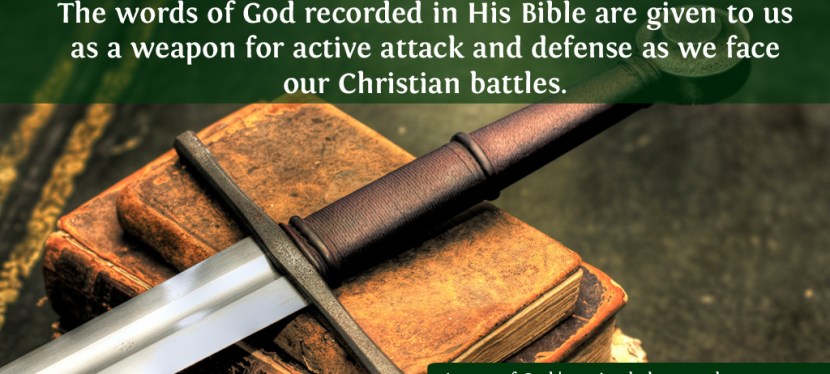
Thus far, the armor of God we’ve been studying has all been defensive. The girdle, breastplate, footwear, shield, and helmet all protect us. They’re essential in battle, but they’re not something we can use to attack and (with the exception of the shield) they’re not actively defensive either. This next piece of armor, though, is a weapon.
receive … the sword of the Spirit, which is the word of God (Eph. 6:17, LEB)
Paul tells us exactly what we’re given as the only weapon included in this Armor of God. It’s called the Sword of the Spirit and it is the Word of God. Now it’s up to us to learn how to use the word as a sword.
There are two words in Greek for “word,” and we have to start by defining them if we want to avoid confusion. Just looking at the English, we would connect Eph. 6:17 with Heb. 4:12, which says, “the word of God is living and active, and sharper than any two-edged sword, piercing even to the dividing of soul and spirit” (WEB). But these versus aren’t talking about the same thing.
In Hebrews, it’s talking about the logos (G3056). This word refers to a spoken word of intelligence, and it’s what’s used as a name for Jesus in John 1:1, 14. Reading on in Hebrews makes it clear that He’s being talked about in this passage as well (Heb. 4:13-16).
In Ephesians, on the other hand, the word is rhema (G4487). It refers to the spoken or written sayings of God, but isn’t used as a title for the speaker. So in Hebrews, the Word as a sword refers to Jesus cutting into people’s spirits and knowing them deeply. Ephesians is talking about wielding the word, or scriptures, of God as a weapon. Read more →
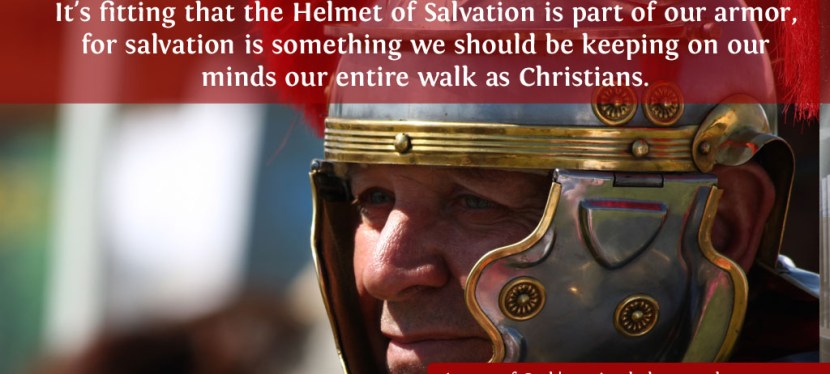
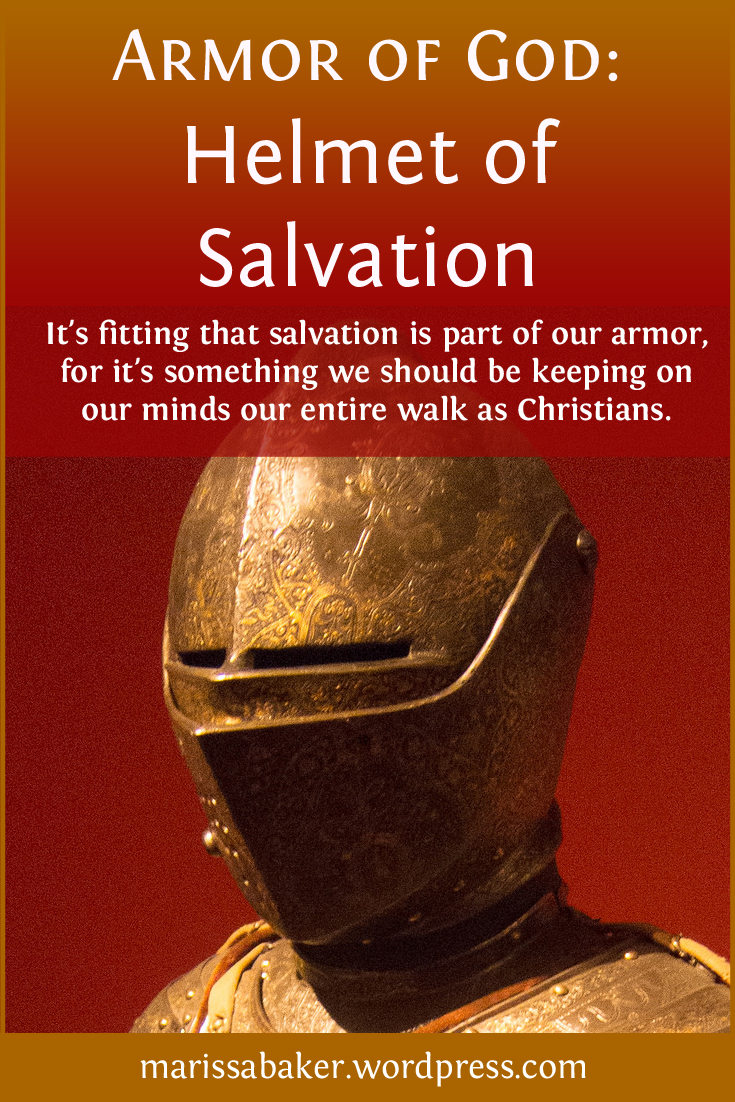
and receive the helmet of salvation (Eph. 6:17, LEB)
Just a short phrase in this list, but it’s an incredibly powerful piece of armor. As every Christian knows, salvation is one of the core tenants of our faith. We wouldn’t be here without Jesus dying to save us and continuing to work on bringing His followers into the family of God. But usually we think of salvation as something we’re given, like grace, rather than something that we keep carrying around as part of our armor. So let’s take a look at the idea of salvation in that context.
One of the most interesting things about the Helmet of Salvation is that it’s one of the armor pieces that God Himself wears. We referenced the verse about God’s helmet a few weeks ago when talking about the Breastplate of Righteousness. It reads,
He put on righteousness as a breastplate,and a helmet of salvation on his head. He put on garments of vengeance for clothing, and was clad with zeal as a mantle. (Is. 59:17, WEB)
When we’re told, “receive the helmet of salvation,” we’re being given a piece of armor identical to one that God has worn on His own head. “Salvation belongs to Yahweh,” which gives Him the absolute right to wear it as a helmet and to share it with whomever He wills (Ps. 5:8, WEB). Read more →



 Like An Anchor