As the Passover approaches, those of us who believe Jesus intended modern-day Christians to observe it are given a task. Before following Jesus’ instruction to take the Passover symbols “in remembrance of Me,” we’re told to examine ourselves.
For as often as you eat this bread and drink this cup, you proclaim the Lord’s death until he comes. Therefore whoever eats this bread or drinks the Lord’s cup in a way unworthy of the Lord will be guilty of the body and the blood of the Lord. But let a man examine himself, and so let him eat of the bread, and drink of the cup. (1 Cor. 11:26-19, WEB)
Every year I hear these scriptures read, and every year since my baptism in 2008 I ask myself, “How?” What can I do to examine myself and determine if I’m keeping the Passover in a worthy manner?”
Perhaps the reason why I’ve always felt like I was hitting a wall when trying to examine myself is found in a very familiar scripture:
The heart is deceitful above all things, and it is exceedingly corrupt: who can know it? I, Yahweh, search the mind, I try the heart, even to give every man according to his ways, according to the fruit of his doings. (Jer. 17:9-10, WEB)
There’s no way we can successfully examine ourselves without God’s help. Maybe that should have been obvious, but I only connected it with Passover after hearing Len Martin’s sermon on self-examination (which you can listen so by clicking here; I highly recommend it). We need to ask God to examine us, or our self-examination isn’t going to bear much fruit. Read more →
Without going into too much detail, I’ve recently heard from more than one person who is a Christian and has sexual abuse in their pasts. They’ve reached out in response to my request for different Myers-Briggs types to talk about their faith. As heartbreaking as it is to hear about the terrible things their abusers did, it’s equally heartbreaking to hear how the church has responded.
The people who contacted me didn’t say they were hesitant to open-up to me because I was a stranger on the internet. Rather, they were worried because I’m Christian and they’ve had so many Christians react badly in the past. One, abused by “upstanding members in the church” encountered people who wouldn’t believe her or were angry she actually filed a police report. Another faced judgment so harsh she compared it to “being victimized twice.”
That sort of things should never happen in the household of God. We can’t always prevent terrible things being done by and to other people. But we are 100% responsible for how we respond when someone shares their pasts with us.
In his epistle, James tells the church not to judge others for the way they look. You should be just as welcoming and loving to the “poor man in filthy clothing” as to the “man with a gold ring, in fine clothing” (James 2:2, WEB). But do you really think this only applies to peoples’ outer appearance?
If you fulfill the royal law, according to the Scripture, “You shall love your neighbor as yourself,” you do well. But if you show partiality, you commit sin, being convicted by the law as transgressors. (James 2:8-9, WEB)
It is a sin to make snap judgments of people based on their appearance, their pasts, or aspects of their personality you just don’t like. Remember, you’ll be judged with the same type of judgment you turn on other people (Matt. 7:1-2). So “use mercy to them all” (Shakespeare, not the Bible, but still a good policy to follow). Read more →
Our walks with God don’t all look the same. We’re influenced by our backgrounds, variations in beliefs, and individual personalities. And even though the goal is for us all to become “like God,” that doesn’t mean we become indistinguishable from each other. God created great variety in people and I believe He did that for a reason.
This is the first post in a series looking at Christians with different personality types. Today, we’re focusing on my personality type — INFJ. When you start talking with people of faith who fall into different personality type groups, you notice not all the personalities feel equally valued and understood by Christian churches. And churches on the whole seem skewed toward attracting Sensing and/or Feeling types. If Christianity is a faith meant for all people then why aren’t we doing a better job of connecting with all personality types?
Empathy For All
I asked INFJs which Bible characters they identified most with and received a flood of responses. It seems we can’t pick just one favorite character. Several INFJs mentioned that our empathy makes it easy to identify with Bible characters. Rachel writes, “My personality pushes me to strive to understand everyone, so I can identify with all the characters in the Bible in some way.” We do have favorites, though, (mine is the apostle John) and the INFJs who did get into details about their favorite characters were very specific.
I identify with David the most. His emotion portrayed through the Psalms and some OT stories resonate in my heart, especially that of love for God, the Scriptures, and pains of stress under sin and oppression. The way in which he responds to certain situations are very similar to how I’ve responded to mine relate as well. – Sarah H
I identify most with Rahab because she was an idolater who was saved when she trusted God. Not only that, but because of that decision, she was given a place in the line of Christ. I, too, was an idolater, but when I trusted Christ, God adopted me into His household. Now I’m a princess in the royal house of God. – Lillith
There wasn’t a whole lot of overlap, but multiple INFJs specifically mentioned King David, the Apostle Paul, and Jesus Christ. In our favorite characters, as in many other things, INFJs seek connection. They’re identifying with Bible characters who share aspects of their own personality traits and who inspire them to connect with God. And we do that with multiple characters. Take a look at some of what an INFJ named Alexandria wrote me:
I am Mary and Martha. I love Mary for the way she valued Yahweh and sat attentively, listening to all His wisdom. I identify with Martha and always love to think that I am treating my guests like royalty by having everything organized and prepared.
I love David…oh how I love him. I love that he was so gracious to Saul, even though Saul treated him so badly, trying to kill him! I love that David was a flagrant sinner and yet God called him a man after His own heart. I am so moved at how gracious the Lord was with David every time, and I remember that when I feel like my failings are stacking up!! I like his passion for life and the depth of his soul and all that he felt so poignantly. …
And last of all, my heart beats with Paul. I love his drive to get others to really live by the teachings of the scriptures. His quest for spiritual excellence is so awesome and it is so moving how dedicated he is to those he serves and he loves them so authentically and I feel like I really “get” him. He is a person who is passionate in living the Christian life the right way with integrity and love.
Using Our Gifts
INFJs who talked about serving in their church felt their contributions were appreciated. These INFJs are leading Bible studies, cooking dinners for small groups, participating in youth/teen ministry, using their artistic skills, teaching, and contributing musically. Many INFJs also expressed the desire to help more, but said they either haven’t had the opportunity or were actively discouraged. Read more →
Why did the prophet Elijah flee from Queen Jezebel in the story recorded in 1 Kings18-19? It’s a question I’ve heard asked quite often in sermons, typically with some laughter. Elijah had just faced down all the prophets of Baal, saw God work a mighty miracle, and finally got the people of Israel’s attention. Then he runs for the hills when a woman threatens him. Really? What an appalling lack of faith!
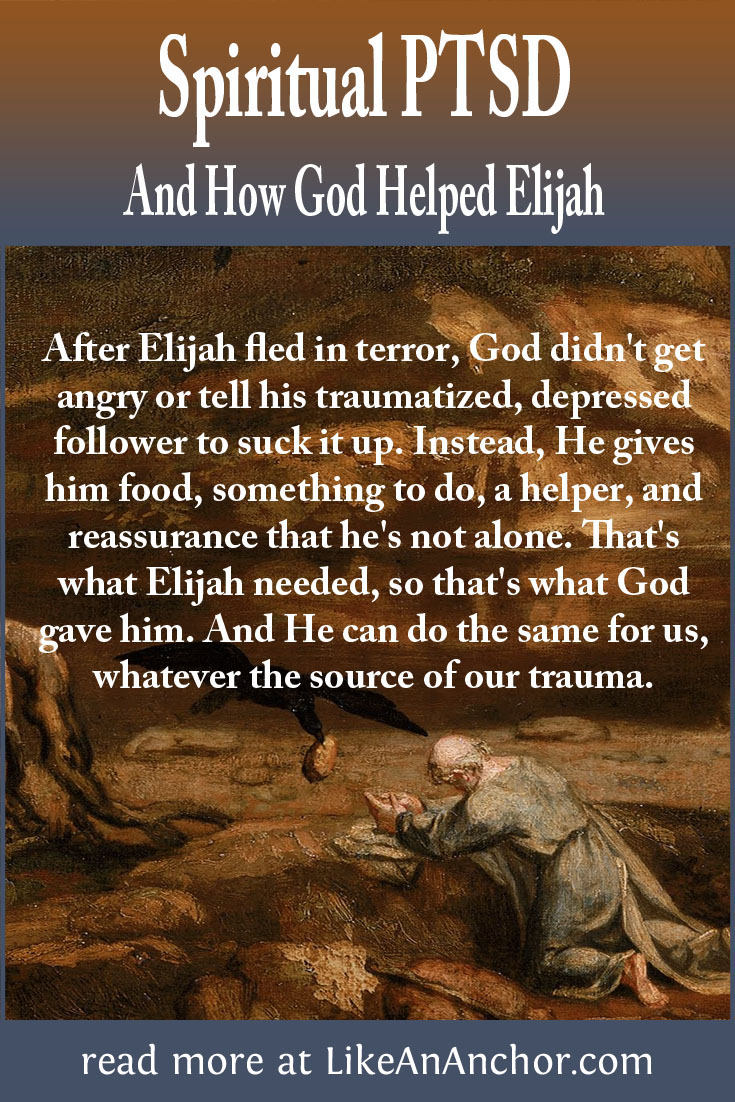
A few weeks ago, my sister asked, “Do you think people can have spiritual PTSD?” For context, the Anxiety and Depression Association of America says that Post Traumatic Stress Disorder (PTSD) “is a serious potentially debilitating condition that can occur in people who have experienced or witnessed” a traumatic event such as “exposure to actual or threatened death, serious injury, or sexual violation.” That could very well be something Elijah was dealing with in this story. And I suspect that since you chose to click on a post with the title “Spiritual PTSD,” you or someone you know might have experienced some kind of trauma as well. Perhaps God’s response to Elijah’s trauma holds hope for us today as well.
Elijah’s Traumatic Day
The first time Elijah steps on the Biblical scene, he tells one of the scariest kings to ever rule Israel, “As Yahweh, the God of Israel, lives, before whom I stand, there shall not be dew nor rain these years, but according to my word” (1 Kings 17:1, WEB). We know nothing of Elijah’s background save that he was a Tishbite from Gilead. What we do know is that God promptly sent him into hiding first by himself and then with a widow’s family (1 Kings 17:2-24).
I don’t know why God hid Elijah. Perhaps God wanted him to learn patience and trust. Or maybe He wanted to keep Elijah safe. Whatever the reason, there’s no indication Elijah was hesitant to come out of hiding when the Lord said, “Go” several years later. First Elijah presents himself to King Ahab, then he calls hundreds of pagan priests to the now famous meeting at Mount Carmel (1 Kings 18:1-20).
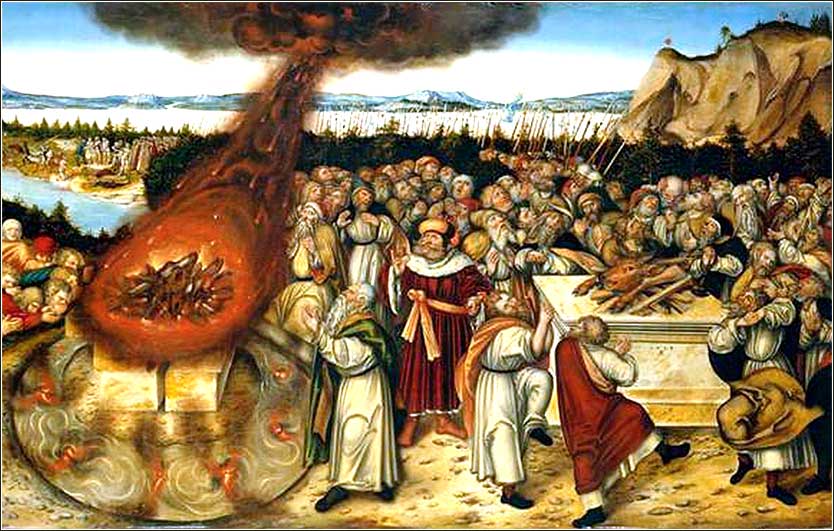
We often read this story and focus on God’s awesome work in demonstrating that He alone is God. Today, let’s try to see it from Elijah’s perspective. He came out of hiding to talk with a king who wants him dead. He called 850 priests and prophets of a hostile religion to a meeting and spent a full day taunting them in public. The scripture records “they cried aloud, and cut themselves in their way with knives and lances, until the blood gushed out on them” (1 Kings 18:28, WEB). That couldn’t have been much fun be around. And with so many there, I doubt every evil priest stayed right by the alter. I imagine they also tried to stir up the people and spent time threatening and taunting Elijah as well.
Image credit: “Elijah and the Priests of Baal” (cs. 1545) by Lucas Cranach the Younger
That went on all morning. In the afternoon, Elijah single handedly prepared a stone altar, butchered a bull, and set it up for an offering to God. I imagine he was physically exhausted by the time he stepped back and ordered the people to pour water over the altar three times (1 Kings 18:21-38). Then he prayed. God responded in spectacular fashion, burning up the water, stones, and dust as well as the sacrifice and wood. The people “fell on their faces” and said “Yahweh, he is God!” But Elijah’s job wasn’t done yet. He said, “Seize the prophets of Baal! Don’t let one of them escape!” They seized them; and Elijah brought them down to the brook Kishon, and killed them there” (1 Kings 18:39-40, WEB).
Elijah killed (probably with some help) at least 450 people that evening, perhaps 850 if “the prophets of the groves” from verse 19 were included with the prophets of Baal. And that still wasn’t the end of his day. He went up to the top of Carmel and prayed earnestly for rain. Once he saw a little cloud forming “he tucked his cloak into his belt and ran before Ahab to the entrance of Jezreel” (1 Kings 18:46, WEB). That’s at least 15 miles and he was running faster than a chariot.
There’s little indication what Elijah’s mental state was at this point. Was he exhausted but still patiently trusting God would work things out? Was he excitedly hopeful Ahab would turn back to God? We don’t know. We just know that when Jezebel promised to kill him within 24 hours “he ran for his life” (1 Kings 19:1-3, WEB). He ran about 100 miles from Jezreel to Bersheba, then goes another day’s journey in the wilderness and prays for death. In his series “Profiting From The Prophets,” Pastor Bob Deffinbaugh suspects Elijah could be “diagnosed as suicidal” and depressed at this point. I’m not a psychologist any more than Pastor Deffinbaugh is, but I’d say PTSD would be an equally valid diagnosis.
God’s Course of Treatment
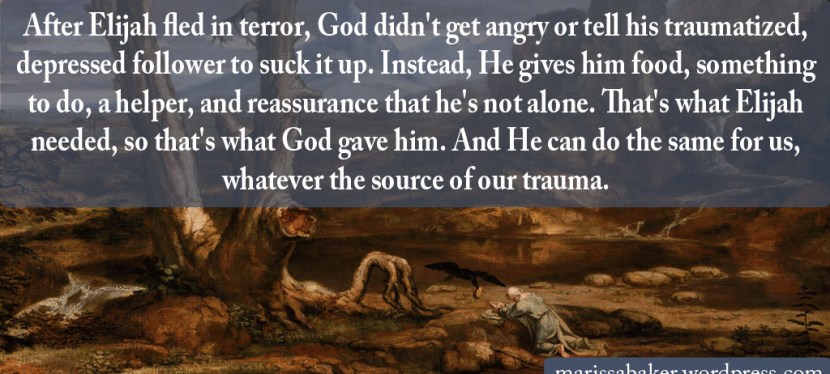
Perhaps the most remarkable thing about this story is how God responds to Elijah’s fear. He doesn’t get angry or tell his traumatized, depressed follower to suck it up. He sends an angel to offer encouragement, food, and strength so Elijah could get to Mount Horeb. There, God asks, “What are you doing here, Elijah?” (1 Kings 19:19:9, WEB). Elijah responds,
“I have been very jealous for Yahweh, the God of Armies; for the children of Israel have forsaken your covenant, thrown down your altars, and killed your prophets with the sword. I, even I only, am left; and they seek my life, to take it away.”
1 Kings 19:10, WEB
I’m not sure why God answered with “a great and strong wind [that] rent the mountains,” then an earthquake, then a fire. The scriptures say “the Lord was not in” these things. Perhaps Elijah refused to come out of his cave when God called the first time. Maybe he needed to see a display of God’s power as an encouragement or reminder. Whatever the case, he responds this time when the Lord calls in “a still small voice” (1 Kings 19:11-13, KJV). The LEB translates this as “the sound of a gentle whisper.”
The Lord asks again, “What are you doing here, Elijah?” Elijah gives the same answer, probably the only one he could come up with after all that. The Lord responds in three parts: He gives Elijah a mission to anoint two kings, he tells him to anoint Elisha as his replacement, and He reveals there are 7,000 faithful people still in Israel (1 Kings 19:14-18). Food, something to do, a helper, and reassurance that he’s not alone. That’s what Elijah needed and that’s what God gave him.
What About Us?
Image credit: “Elijah In The Desert” (1818) by Washington Allston
When my sister brought up the idea of spiritual PTSD she wasn’t just talking about people in the Bible who God brought through traumatic situations. She was also asking about a kind of spiritual parallel. Can someone experience a traumatic event in their spiritual walk that gives them a sort of spiritual “PTSD” that affects how they interact with God, churches, and fellow Christians?
I think it can. One of the perks of writing a blog is that I get to hear from many of my fellow Christians who reach out to share their stories. But the heartbreaking thing is that many of those stories are ones that involve deep hurt, much of it caused by fellow church members. We probably all know stories (or have personal stories) of being abused, dismissed, slandered, and much more all by people who claim to be following God. Even worse, the party at fault is often in a leadership position. Far too often, a Christian’s deepest hurts come from the people who should be the first ones to reach out in love and compassion.
But that’s the great thing about God. Nothing limits Him. He can help us just as effectively as He helped Elijah, whatever the source of our trauma. Because we can look at examples like Elijah’s, we know God follows through on promises like, “‘I will in no way leave you, neither will I in any way forsake you.’ So that with good courage we say, ‘The Lord is my helper. I will not fear. What can man do to me?'” (Heb. 13:5-6, WEB).
I have a blog post (or more likely series) that I’d really like to write and I need your help.
When I started this blog, I worried it would seem like an awkwardly smooshed together amalgam of INFJ blog and Christian blog. You’re supposed to find a niche or theme of some kind and focus your blogging there. Not start two blogs on the same site and post one on Mondays and one on Saturdays. But I felt this what what I should do and so I did. And it’s been wonderful.
I’ve heard from so many INFJs who find my blog through the Myers-Briggs posts and then comment because they discovered I’m Christian. I’ve also heard from other types. Most surprisingly, quite a large number of NTs want to talk about their faith. It’s been fascinating to hear from the types stereotyped as the least religious. Many talk about the challenges they face, especially in connecting with other Christians or in feeling like their faith walk doesn’t follow the “normal” pattern.
That has me wondering: if Christianity is a faith meant for all people then why aren’t we doing a better job of connecting with all personality types? It’s a very broad generalization, but most Christians in the United States seem to be Sensing types and/or Feeling types. And that’s who many churches cater toward. They’re focusing on the sort of traditions that make SJ types comfortable, or trying to engage SP types in sensory worship experiences, or appealing to the spiritual interests of a few NF types.
I firmly believe God created personality variations for a reason and that He longs for a relationship with all people. There are already Christians of every personality type who have strong walks with God. But they’re not all equally valued and understood in the churches. And I’d very much like to start changing that.
List of Finished Posts:
As this project continues, I’ll post links to the finished posts here. If you see your type on the list, you’re welcome to head over to that post to read what your fellow believers wrote about their faith and leave your perspective in the comments section. I’m hoping to turn this project into a book eventually, and I greatly value your perspective even if I’ve already published a post on your type.
Here’s where you guys come in. I want to hear from Christians of as many different personality types as possible. If you want to contribute and don’t know your personality type yet, please check out my post Finding Your Real Myers-Briggs Type (if you can’t narrow it down to a single type or just want to take one online test instead of researching typeology in-depth, that’s okay. I’d still love to hear from you).
I’m asking you to please share your personality type and answer some (or all, if you like) of these questions:
Which Bible characters and/or stories do you most identify with?
Do you have gifts or talents that you feel are not appreciated or that you don’t have an opportunity to use in the church?
Do you have gifts or talents that are particularly encouraged and supported in the church?
Are there expectations from other Christians that you have a hard time meeting because of how your mind naturally works?
Which teaching/preaching styles connect with you best? How do you like to hear and learn about God and His word?
In what ways could the church better connect with someone like you when preaching the gospel?
What’s one of the biggest challenges you face as a Christian?
Why are you a Christian? In other words, what makes you believe this faith is the right one?
You can either leave a comment here or send me a private message through my Contact Me form. Unless you tell me otherwise, I’ll assume that by getting in touch you agree I can quote you directly and credit you by first name (or screen name) and Myers-Briggs type.
Please spread this around! The more people sending in their ideas and perspectives the better. Hopefully we’ll get enough feedback for several posts. Maybe it will even grow into an ebook. I can’t wait to read what you all have to say!
Jesus told us “The first of all the commandments is: ‘Hear, O Israel, the Lord our God, the Lord is one. And you shall love the Lord your God with all your heart, with all your soul, with all your mind, and with all your strength.’ This is the first commandment” (Mark. 12:29-30).
Even though this commandment forms the basis of all other commands and is most important for us to remember and obey, it can also be easy to overlook. It sounds so simple: “Love God, check. Yup. I’m good.” But Jesus went into more detail than just “love God.” He started out by reminding us Yahweh is echad. He is united, preeminent, and the only one worthy of the title Lord.
With that reminder in place, Jesus goes on to quote an Old Testament passage telling us how to love God. The way we should love our Lord isn’t left up to our imagination or emotions. We’re told what we’re supposed to do.
With All Your Heart
As today, most people in Jesus’s day didn’t just think of the heart as a muscle pumping blood. It was seen as the “seat of emotions” and the core of your “inner man” (labab, H3824). In Greek, kardia metaphorically referred to the “center of all physical and spiritual life” and the “fountain and seat of thoughts, passions, desires, appetites, affections, purposes, endeavors (G2588, Thayer). That’s the first way we’re supposed to love God — with all our emotions, thoughts, and yearnings that come from the very core parts of who you are inside. Read more →






 Like An Anchor